
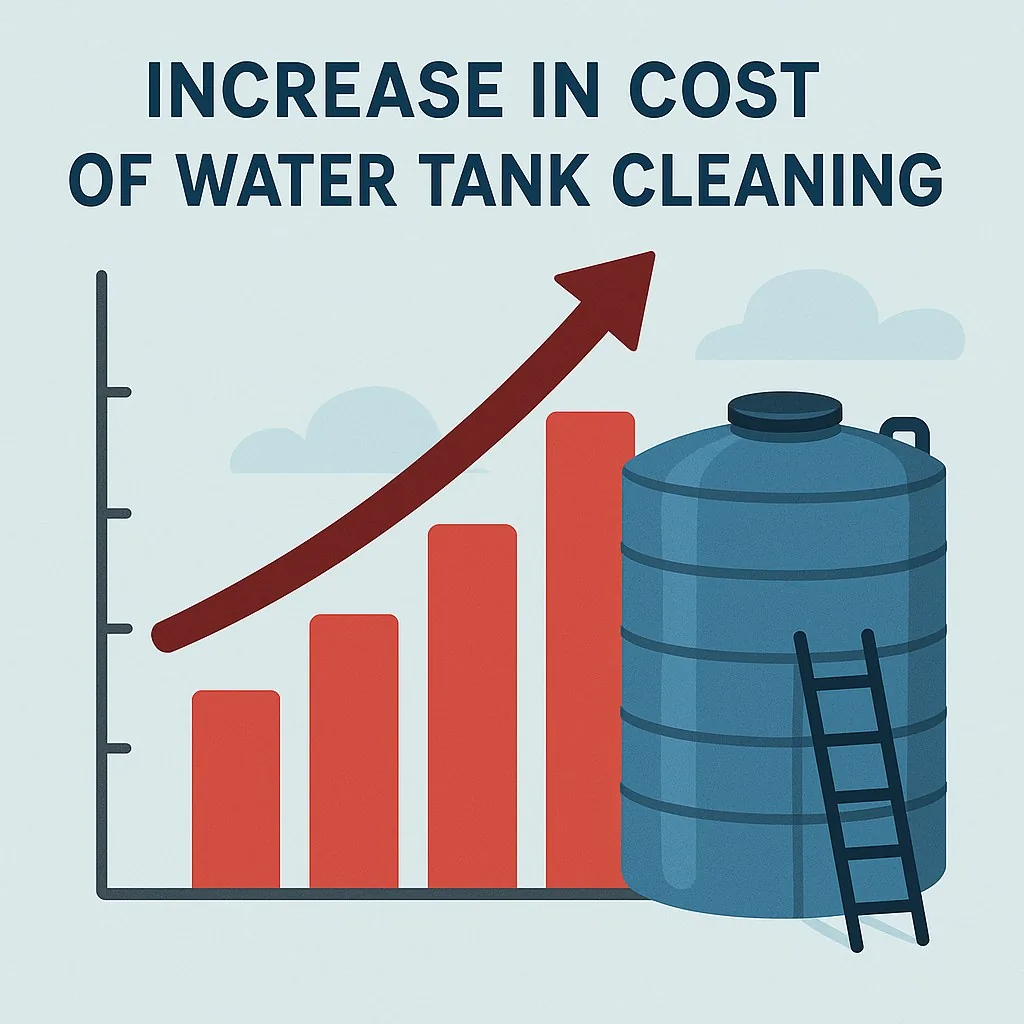
Honest price ranges in Delhi (2026)
- Residential overhead tank (up to 750L): ₹500-700
- Residential overhead (up to 1000L, Premium): ₹700-900
- Underground sump (kothi): ₹1,500-2,500
- Society shared tank (4-8 flats): ₹1,200-2,000
- Society reservoir (large): ₹2,500-5,000
- Restaurant / commercial with FSSAI cert: ₹1,500-2,500
- Industrial reservoir (Okhla): ₹3,000+ (size-based)
- Annual AMC (4 visits): typically 15-25% off per-visit pricing
If you’re quoted ₹200 or ₹2,500 for a standard home tank, something is off. Read on.
Prices scale with tank size, so it helps to know your litres first. Our free water tank capacity calculator gives your tank size in litres from its dimensions.
What you actually pay in Delhi
Water tank cleaning prices in Delhi haven’t changed dramatically in the last few years — what’s changed is the spread. The cheapest end of the market has gone scarier (people offering “cleaning” for ₹200 that’s really just a 10-minute rinse), and the premium end has stretched up (some aggregator apps charge ₹1,500+ for the same job we do for ₹699).
Here’s what fair pricing looks like as of mid-2026:
1. Residential overhead tank (most Delhi homes)
Fair price: ₹699-899 depending on size.
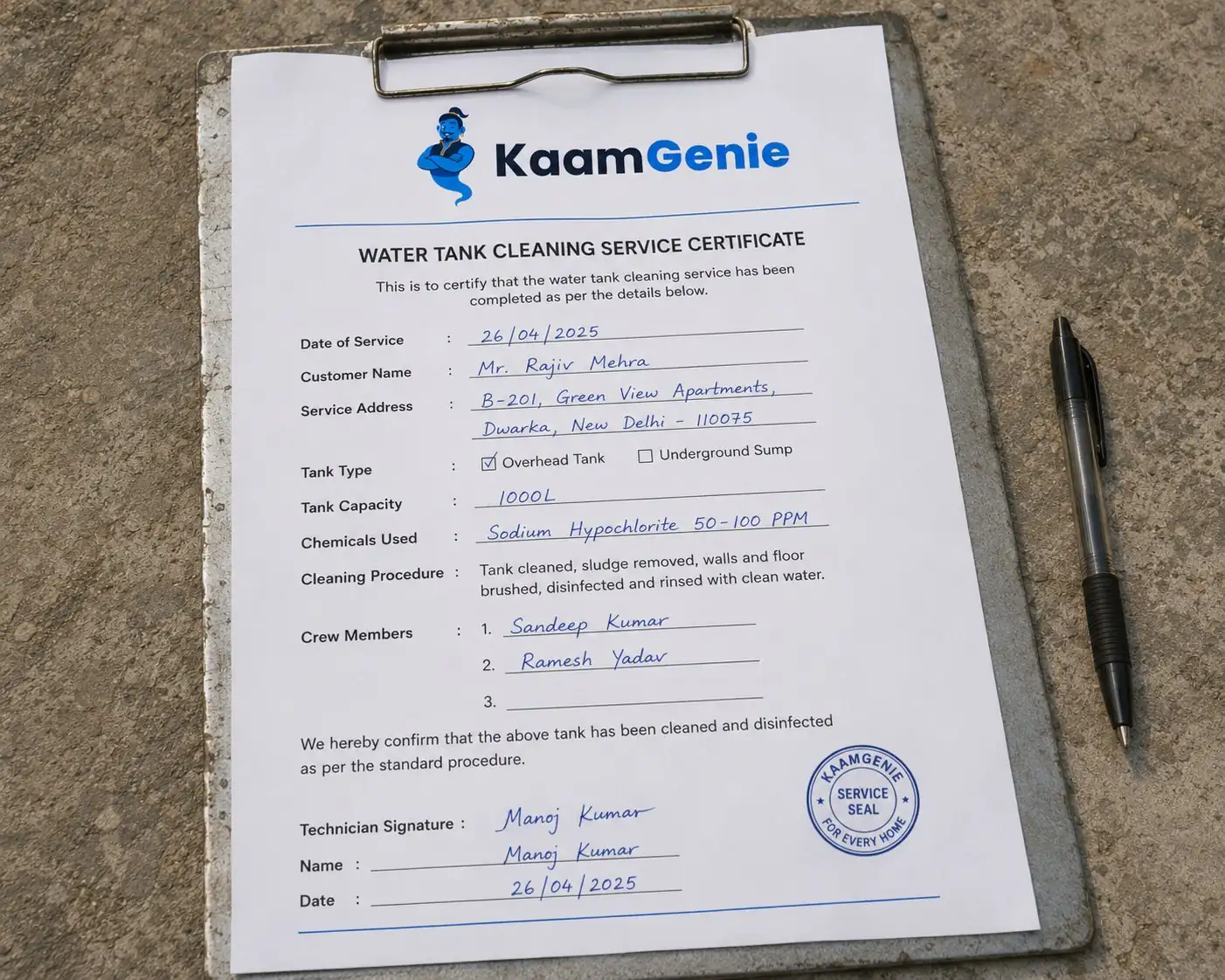
This is your standard rooftop plastic tank serving one home or flat. Up to 500 litres, ₹699 is the standard price. 501-1,000 litres with the Standard add-ons, ₹899. The job takes about 90 minutes, uses food-grade disinfectant, and includes before/after photos plus a dated cleaning record.
2. Underground sump (kothis)
Fair price: ₹1,500-2,500.
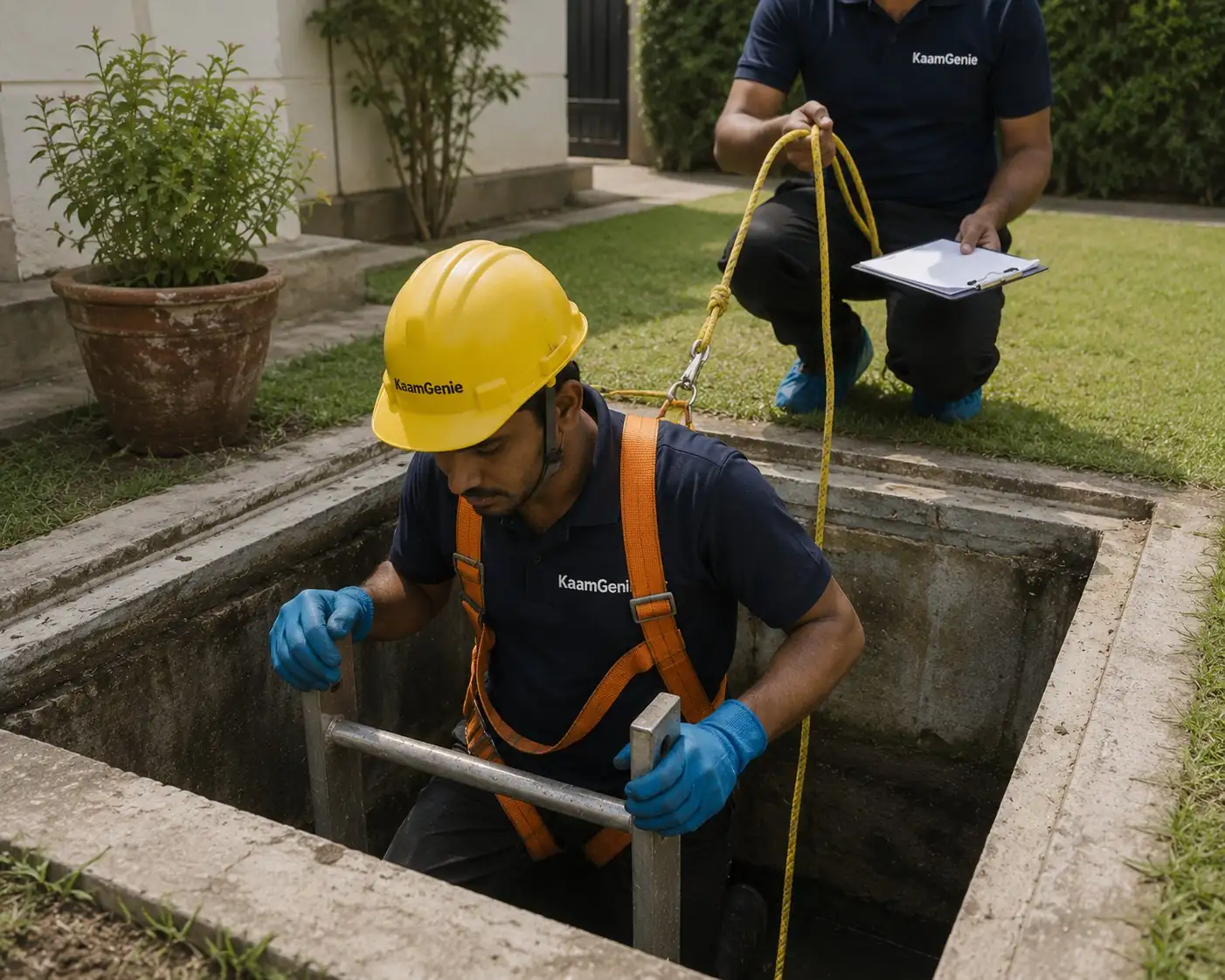
Sumps cost more than overheads because they require confined-space entry, more equipment, more time (2-2.5 hours), and additional safety gear. The price varies by sump capacity — a 3,000-litre sump in a Saket kothi sits around ₹1,800; a 5,000-litre one in Defence Colony might hit ₹2,500.
3. Society and apartment tanks
Fair price: ₹1,200-2,000 for shared rooftop tanks (4-8 flats), ₹2,500-5,000 for large society reservoirs.
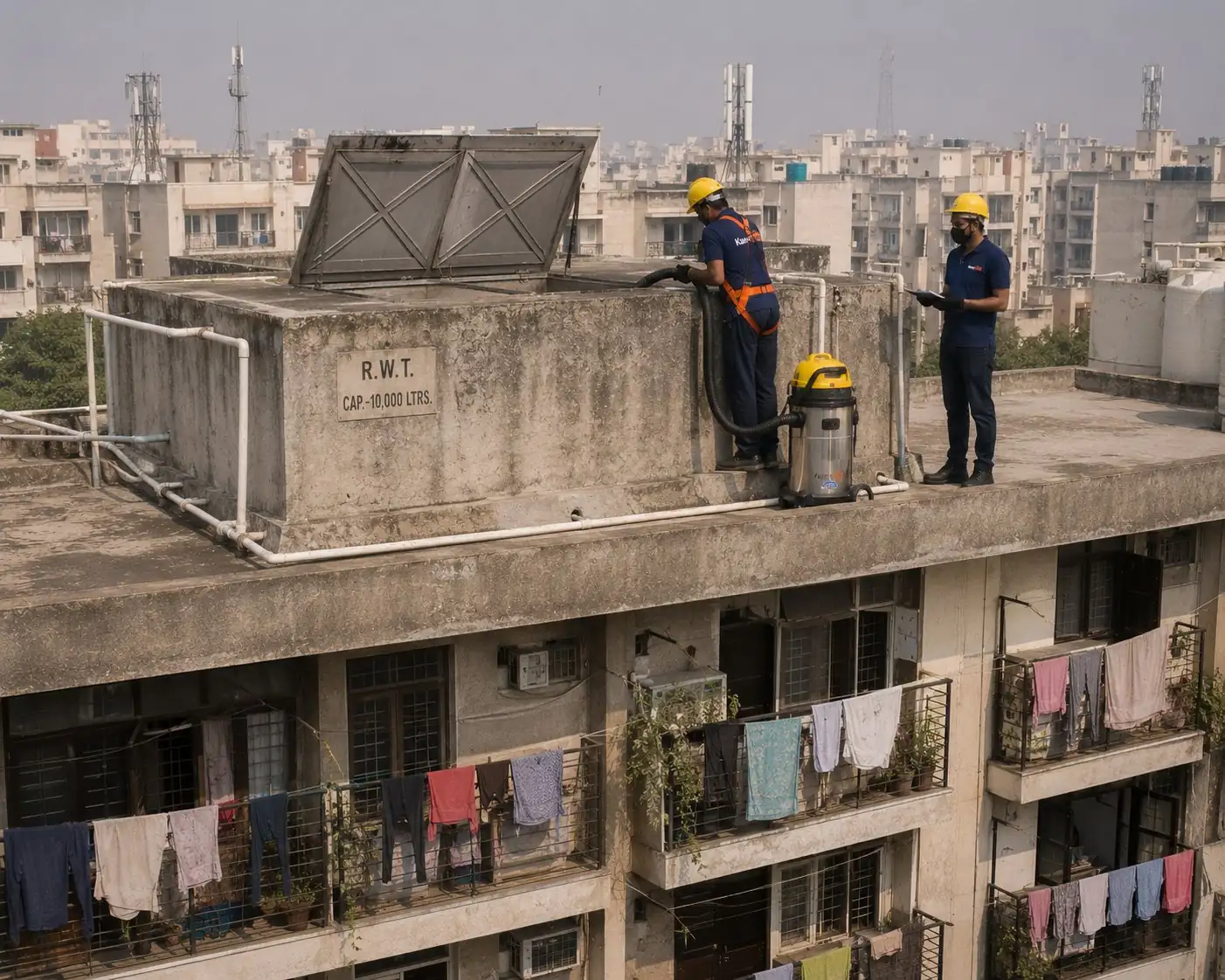
Society pricing depends on capacity and access. A typical DDA flat building with one rooftop tank serving 6 flats — ₹1,500. A large society in Vasant Kunj with a 10,000-litre reservoir on a separate water tower — ₹3,500-4,500. RWAs that book us on AMC typically pay 20% less per visit.
4. Restaurants, cafés and food businesses
Fair price: ₹1,500-2,500 with FSSAI-acceptable cleaning documentation.
The price is higher than residential because food businesses need stricter disinfection protocols, documented water testing, and dated cleaning documentation that meets FSSAI inspection standards. We do this for several restaurants in Hauz Khas Village and the Lajpat Nagar Central Market.
5. Industrial reservoirs (Okhla)
Fair price: ₹3,000+ depending on capacity.
Industrial pricing is custom because tank sizes range wildly — 5,000 litres to 50,000+ litres, and access conditions vary. We quote on visit. Annual contracts include quarterly cleaning + water testing + audit-ready paperwork.
| Tank type | Typical capacity | Ad-hoc price | Annual contract (per visit) |
|---|---|---|---|
| Residential overhead (Basic) | Up to 500L | ₹699 | ₹560 |
| Residential overhead (Standard) | 500-1,000L | ₹899 | ₹720 |
| Underground sump | 3,000-5,000L | ₹1,500-2,500 | ₹1,200-2,000 |
| Society shared tank | 4-8 flats | ₹1,200-2,000 | ₹960-1,600 |
| Society large reservoir | 10,000-20,000L | ₹2,500-5,000 | ₹2,000-4,000 |
| Restaurant / FSSAI | Any size | ₹1,500-2,500 | ₹1,200-2,000 |
| Industrial reservoir (Okhla) | 5,000-50,000L+ | ₹3,000+ | Custom quote |
Get a fixed price on the call
Three questions — tank size, tank type, water source — and you have a firm quote. No on-site renegotiation, no hidden charges, GST inclusive.
What changes the final quote (up or down)
Same tank size doesn’t always mean same price. These factors push quotes up or down by 10-30%:
- Tank condition — if it hasn’t been cleaned in 3+ years, expect to pay 20-30% more because the cleaning takes longer
- Access difficulty — rooftops with no proper ladder, sumps under heavy lids, tanks behind narrow staircases all add time
- Water disposal — if there’s no proper drainage on the rooftop, we have to carry water down, which costs more time
- Crew size needed — large sumps and industrial tanks need 2-3 crew members, not 1
- Day / time — same-day rush jobs and after-7-PM bookings sometimes carry a small surcharge
- Distance from base — areas significantly outside our standard zones (most South Delhi is fine; East Delhi adds a small fee)
Why some quotes are suspiciously cheap (red flags)
If someone offers to clean your home tank for ₹200-300, they’re doing one of these:
- Just rinsing, not cleaning — opening the tank, splashing some water around, closing it. Total time: 10 minutes. Bio-film, sediment, scale: all still there.
- Not using disinfectant — or using a cheap chlorine solution that’s not food-grade. Leaves chemical residue or doesn’t kill bacteria.
- Skipping the photos and certificate — so you have no record of what was done, no recourse if water issues come up later
- Untrained casual labour — person showed up off the street with a bucket, no police verification, no uniform, no ID
The math doesn’t work otherwise. A real cleaning crew costs ₹500-700 just in labour, equipment depreciation, transport, and disinfectants for a single job. Anyone doing it for less is cutting something important.
Why some quotes are inflated (and when premium is worth it)
On the other end, you’ll see quotes from aggregator apps and "premium" services charging ₹1,500-2,500 for the same standard residential cleaning. What you’re paying for:
- Brand markup — the platform takes a 20-40% cut, so the actual cleaner only gets ₹699-899 of your ₹1,500
- Customer service overhead — their call centre, app development, marketing
- Sometimes genuinely better quality — if the platform actually screens and trains crew well
Premium pricing is worth it ONLY if the actual service quality matches the price. If a ₹1,800 aggregator booking gets you the same crew, same chemicals, same time as a ₹700 local provider, you’re paying ₹1,100 for branding. If it gets you better-trained crew, better equipment, and accountability you can actually invoke, that’s different.
AMC pricing math (for societies and commercial)
Annual maintenance contracts (AMC) typically save 15-25% per visit compared to ad-hoc bookings. Here’s why:
- The provider locks in your business for the year — predictable revenue, so they discount
- Scheduled visits are more efficient than emergency calls
- Same crew comes each time — no relearning your tank’s quirks
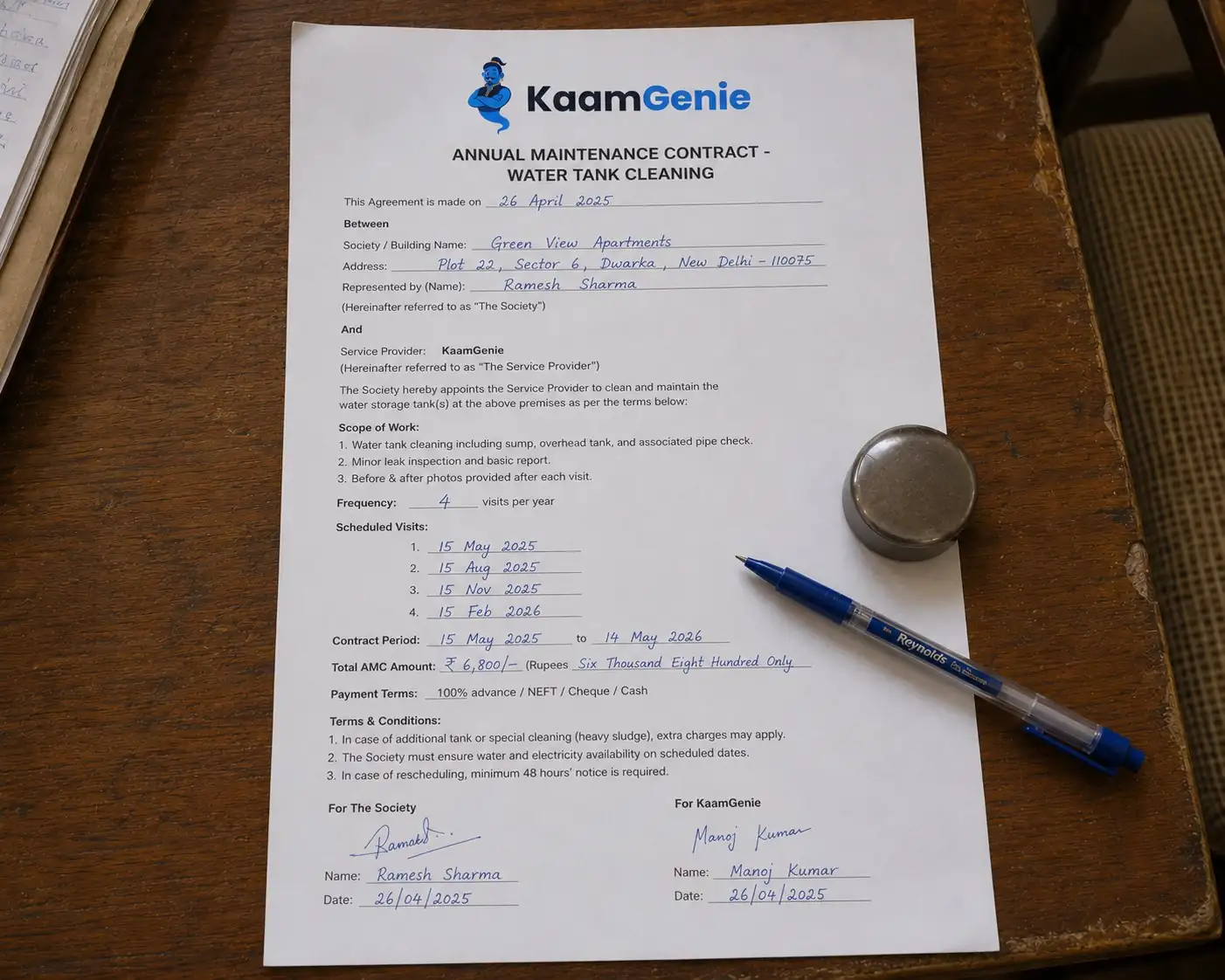
Sample AMC math for a 6-flat building in CR Park:
- Per-visit: ₹1,500 × 2 cleanings/year = ₹3,000
- AMC (4 visits/year): ₹1,200 × 4 = ₹4,800
You pay more total (because you get more visits), but the per-visit cost drops 20% and your tank stays consistently clean. For societies and food businesses, AMC is almost always the better economics.
Ad-hoc vs AMC — total annual spend for a 12-flat building (4,000L shared tank)
Per-flat economics: AMC = ₹58/month per flat (less than one bottle of branded water)
AMC costs more total because you get 2× the visits. But per-visit drops 29% and tank stays consistently cleaner — fewer mid-year resident complaints.
Hidden costs to watch for
A few things that may not appear in the quote but show up later:
- Repairs or patching — if your tank has a crack or fitting issue, the cleaner may quote separately for fixing it (₹300-1,000 typical)
- Multiple tanks — if you have an overhead AND a sump, that’s usually two separate prices, not one
- Specialty disinfection — if your tank had a contamination event (animal carcass, sewage backup), the cleaning needs extra steps and costs ₹500-1,000 more
- Travel charges — for areas significantly outside the cleaner’s normal zones
- Disposal fees — for very dirty tanks where the wastewater can’t go down a regular drain
A reputable cleaner will tell you about any of these on the booking call, not surprise you on the day.
How to compare quotes properly
When you’re calling 2-3 cleaners for quotes, ask each one the same set of questions:
- What does your standard cleaning include? (drainage, vacuum, jet wash, disinfectant, UV?)
- Is the disinfectant food-grade?
- How long will the job take?
- Do you provide before/after photos and a dated cleaning record?
- Is your crew police-verified?
- Is there a service guarantee if I’m not satisfied?
- Are there any additional charges I should expect?
The honest cleaner will answer all of these clearly. The one who hesitates or gives vague answers is the one whose ₹400 quote will end up costing you more in the long run.
Fixed price · No surprises · GST inclusive
Our pricing is published on this page. The number we tell you on the call is the number you pay on the day. Annual contracts available with 20% off per visit.
The honest middle ground
For most Delhi homes, you should be paying ₹699-1,499 for a standard residential overhead tank cleaning. If you’re paying significantly less, you’re probably not getting a real cleaning. If you’re paying significantly more, you’re paying for a brand or platform layer that doesn’t add proportional value.
For societies and commercial, the honest range is wider because tank sizes and access vary. Get 2-3 quotes, ask the questions above, and pick the provider whose answers feel real — not the cheapest, not the most expensive.
What KaamGenie charges
For full transparency, our pricing across Delhi NCR:
- Residential overhead (up to 500L) — ₹699
- Standard (501-1000L) — ₹899
- Underground sump — ₹1,500-2,500 based on size
- Society/commercial — quoted on visit, AMC discount available
- Industrial Okhla — ₹3,000+ based on capacity
Detailed pricing on our water tank cleaning service page. To book, call +91 95603 66362 or use the booking form on this site — we'll confirm shortly.
Frequently asked questions
Why does residential cleaning start at ₹699 — what’s actually included?
Inspection with photos, full drainage, manual sludge removal, scrubbing with food-grade brushes, high-pressure jet wash, food-grade chemical disinfection with 20-minute contact time, refill, and a dated cleaning record. About 90 minutes of work for a 1000L tank.
Why are sump cleanings so much more expensive than overhead tank cleanings?
Three reasons: confined-space entry safety gear, two-person crew (one inside, one as standby outside), and longer time on site (2-2.5 hours vs 90 minutes). Sumps also tend to have more sediment because they hold more water and turnover is slower.
Do you charge differently for different areas of Delhi?
Same base prices everywhere we serve in Delhi. Some areas significantly outside our standard zones add a small visit fee. Most of South Delhi and Okhla is at standard pricing, no zone surcharge.
What’s the actual difference between Basic and Premium plans?
Basic ₹699 covers tanks up to 500L. Standard ₹899 covers tanks up to 1000L (slightly larger tank, slightly longer job). Both include the same 6-step process, food-grade chemicals, and cleaning record. The premium plan isn’t a quality upgrade — it’s a tank-size upgrade.
How do AMC contracts actually save money — what’s the math?
For a 6-flat building example: per-visit booking is ₹1,500 × 2 cleanings/year = ₹3,000. AMC at ₹1,200 × 4 visits/year = ₹4,800. You pay more total but get more visits — and the per-visit cost drops 20%, the same crew comes each time, and your tank stays consistently clean.
Are there hidden charges I should ask about before booking?
Possible add-ons that should be disclosed upfront: travel surcharge for areas outside the standard zone, multi-tank discount for overhead + sump combo, GST (18% on services), chemical surcharge for severely scaled borewell tanks, after-hours premium for jobs starting after 6 PM. Ask the service to confirm “is this the final price including everything?” on the call. If they say yes, hold them to it on the day.
Is GST included in the quoted price for water tank cleaning in Delhi?
Depends on the service. Registered services charge 18% GST on top of the base price — so a ₹699 cleaning becomes ₹824 after GST. Smaller unregistered providers often don’t charge GST but also don’t give you a proper invoice. For RWAs, restaurants, and offices that need the invoice for accounting, an 18% GST-inclusive booking is non-negotiable.
Can I negotiate the price for water tank cleaning?
Residential bookings — usually not, the prices are already tight. Society/RWA contracts — yes, 10-15% off list price is normal for an annual commitment. Multi-tank households (overhead + sump together) — yes, 10-15% combined discount is common. Off-season months (January, February, September) — yes, sometimes 10-15% off list. If a service refuses ANY discount even for annual contracts or multi-tank bookings, they’re either too small to flex or running on minimum margins.
What’s the cheapest reliable water tank cleaning in Delhi?
₹699 for a residential overhead tank up to 500L is roughly the floor for a real cleaning in Delhi (2026). Below that, you’re paying for a rinse. The “cheap and reliable” sweet spot for most Delhi homes is ₹699-899 — proper process, food-grade chemicals, photos, certificate. Anything cheaper is cutting corners; anything more expensive is paying for platform markup.
Does a society water tank cleaning cost more than a single-home cleaning?
Per-tank, no — society contracts are usually cheaper per tank than ad-hoc residential bookings. Total cost, yes — societies have more tanks (overhead + sumps + booster) and need more visits per year. A 12-flat building with one shared overhead tank pays ₹8,400/year on a quarterly contract — about ₹700 per flat per year, or ₹58 per month. See the full math in our RWA contracts guide.
Are there any senior-citizen or first-time customer discounts?
First-time customers occasionally get 10% off the first booking with us — ask on the call if a promotion is active. Senior citizens (60+) typically get a flat 10% off any service. These aren’t advertised on the website because they vary by month based on booking volume. The easiest way to find out is to mention it on the booking call.
What payment methods do Delhi water tank cleaning services accept?
Established services accept cash, UPI (Google Pay, PhonePe, Paytm), bank transfer, and sometimes cards. Pay-after-service is the norm — don’t pay full advance unless it’s a known platform booking. Cash-only services with no digital payment option are a red flag for the kind of accountability problems you’d want to avoid for your drinking-water supply chain.
Sources & references
- Food Safety and Standards Authority of India (FSSAI) — sets water hygiene requirements for food businesses, including cleaning frequency and documented cleaning records that justify the higher pricing for restaurant tanks.
- Bureau of Indian Standards (BIS) — IS 10500:2012 defines drinking water quality parameters that informed cleaning protocols meet.
- Delhi Jal Board (DJB) — municipal water supply authority for Delhi; their water quality reports inform regional cleaning frequency recommendations.
- WHO Fact Sheet on Drinking Water — global framework on safe drinking water that supports the case for proper rather than rushed cleaning.
Last verified: 9 May 2026. If you find any of these links broken, please let us know.