
The short version
- Borewell water — high mineral content, scales your tank walls, needs cleaning every 4 months
- DJB water — treated municipal water, carries sediment from old pipes, needs cleaning every 6 months
- Most South Delhi homes have both — DJB primary, borewell as summer backup. Default to the 4-month schedule.
- Restaurants & food businesses — quarterly regardless of source, per FSSAI norms
If you don’t know which source you have, the kettle test usually answers it: chalky white coating in 2-3 months means you’re mostly on borewell.
Two completely different liquids
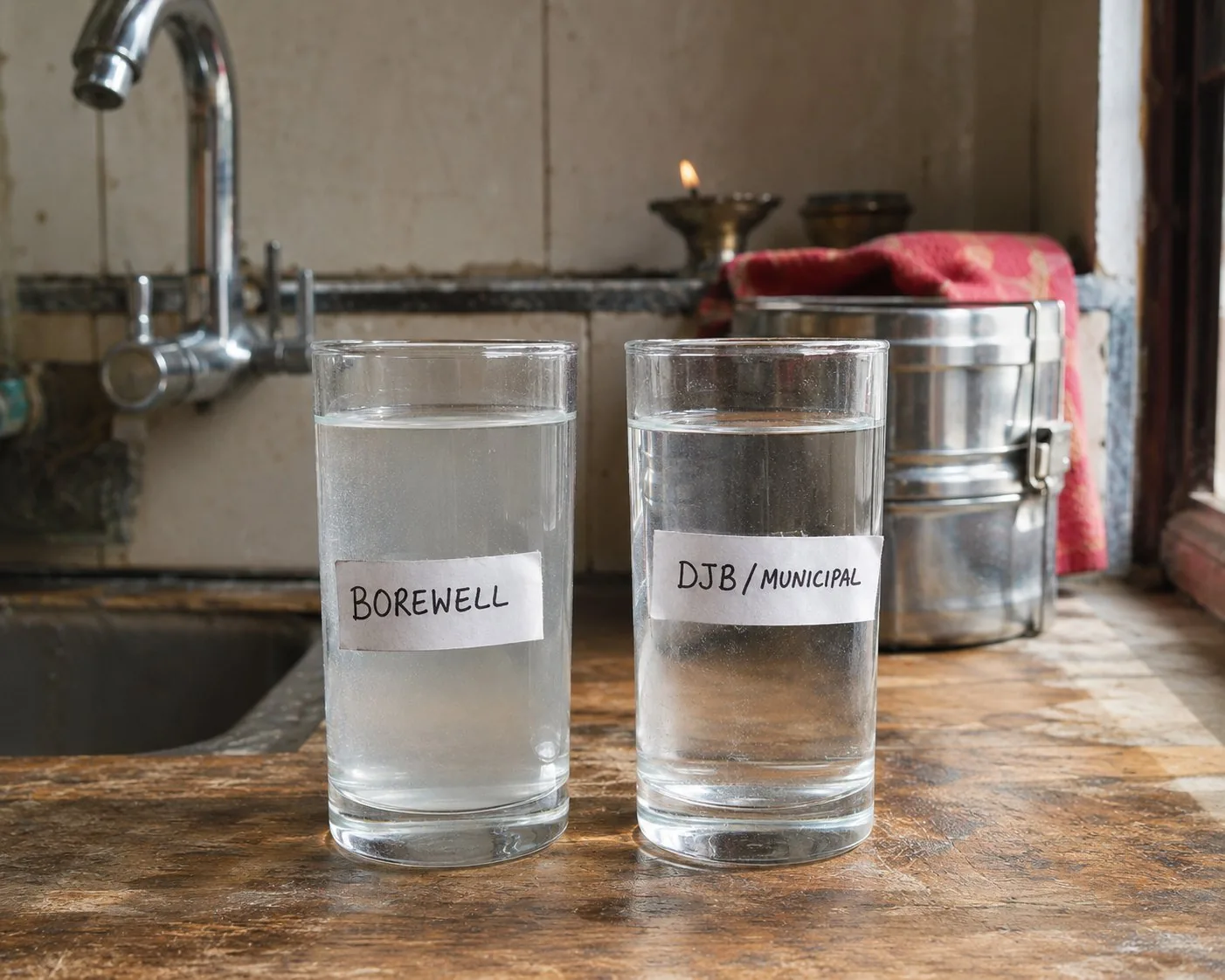
Most people don’t think about it, but the water flowing from your DJB municipal connection and the water coming up from your borewell pump are fundamentally different liquids. They taste different, scale differently inside your kettle, and behave differently inside your water tank.
DJB water is treated water from the Yamuna and the Munak Canal system, run through DJB’s water treatment plants at Wazirabad, Sonia Vihar, Bhagirathi and Chandrawal. It’s chlorinated, lower TDS (typically 200-400 ppm), filtered for major sediment. By the time it reaches your tank, it’s safe potable water — but the journey through old DJB feeder pipes can pick up rust, sand, or silt depending on the age and condition of the line.
Borewell water in Delhi is groundwater pulled directly from underground aquifers. No treatment, no filtration. TDS varies from around 300 ppm in clean pockets to 1500+ ppm in heavily salty areas. The minerals — calcium, magnesium, sometimes iron, occasionally fluoride — are what make it “hard.” Some Delhi pockets (West Delhi, parts of South-West, outer Najafgarh side) have borewell water that fails BIS drinking standards on TDS alone.
The difference matters because each one affects your tank in different ways — and the cleaning schedule should account for it.
What borewell water does inside your tank
Borewell water leaves a visible signature on every surface it touches. The minerals dissolved in it (mainly calcium carbonate and magnesium carbonate) precipitate out as the water sits or evaporates. You see this every day if you’re on borewell: white chalky deposits on bathroom tiles, limescale buildup on taps and showerheads, faster geyser element corrosion, hard kettle deposits, soap that doesn’t lather properly.
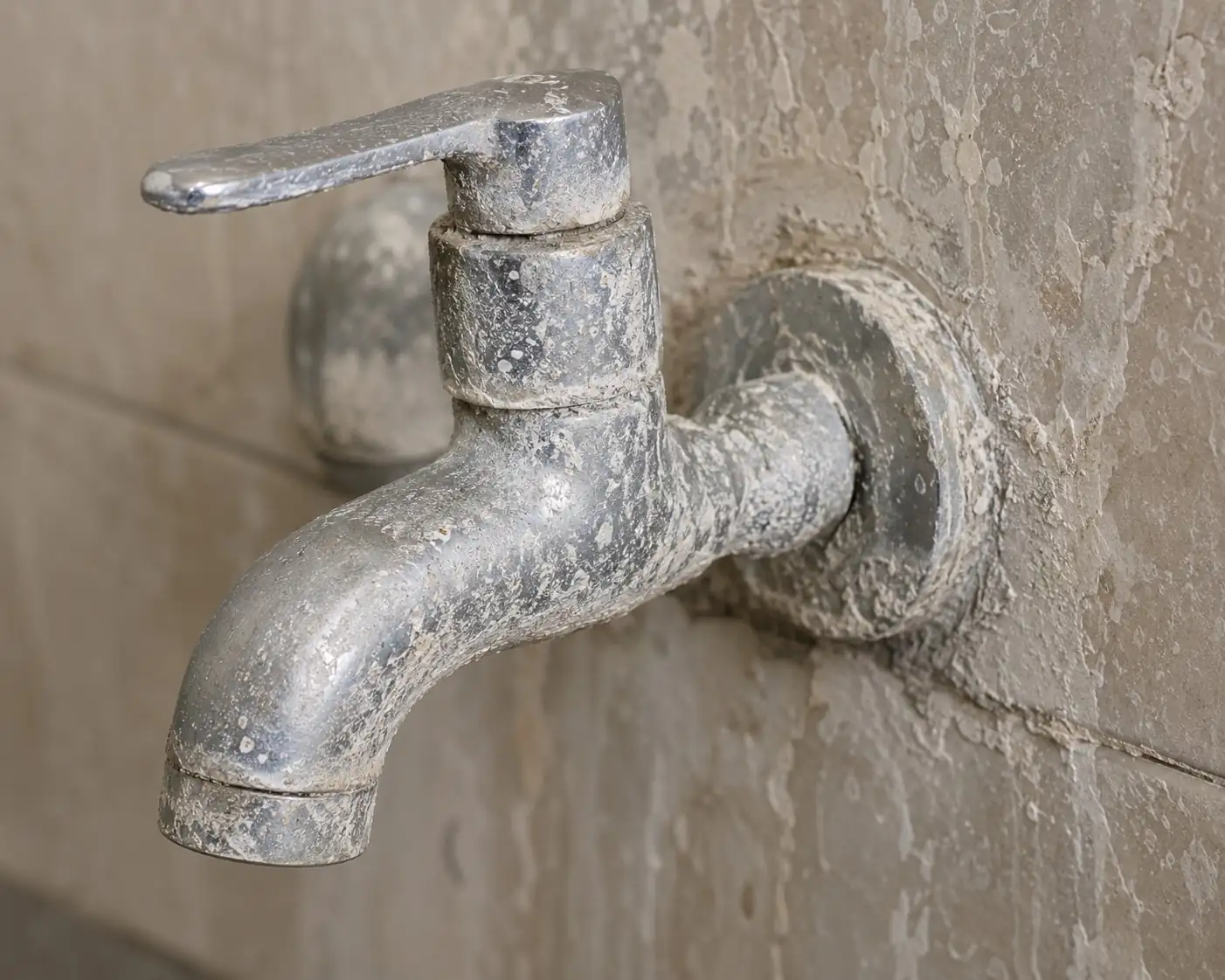
Inside your tank, the same minerals deposit on the walls. Within a year of borewell use, expect 1-2mm of scaling on the inside walls. Within 3 years, the scaling can be 5-7mm thick — we’ve cleaned tanks in heavy-borewell pockets where the scale layer was visibly chalky.
Why this matters:
- Scaling is bacterial habitat — the rough mineral surface is a perfect place for bio-film and bacteria to grow, hidden in the gaps between mineral crystals
- Reduces tank capacity — a 1000L tank with thick scaling effectively holds only 950-970L over a few years
- Bypasses normal cleaning — soft cleaning (rinse-and-go) doesn’t break the mineral layer; needs proper food-grade descaler at the cleaning step
- Damages downstream appliances — the same minerals that scale your tank scale your geyser, washing machine, RO membrane, and dishwasher
Recommended cleaning frequency for borewell: every 4 months. In heavy-borewell pockets where TDS is consistently above 1000 ppm, every 3 months.
What DJB water does inside your tank
DJB water is treated, but the journey to your tap isn’t pristine. The DJB feeder pipes in many Delhi areas are 30-50 years old. They corrode, they rust internally, they accumulate sediment over decades. When pressure changes (during DJB pumping cycles), this sediment gets stirred up and travels into your tank.
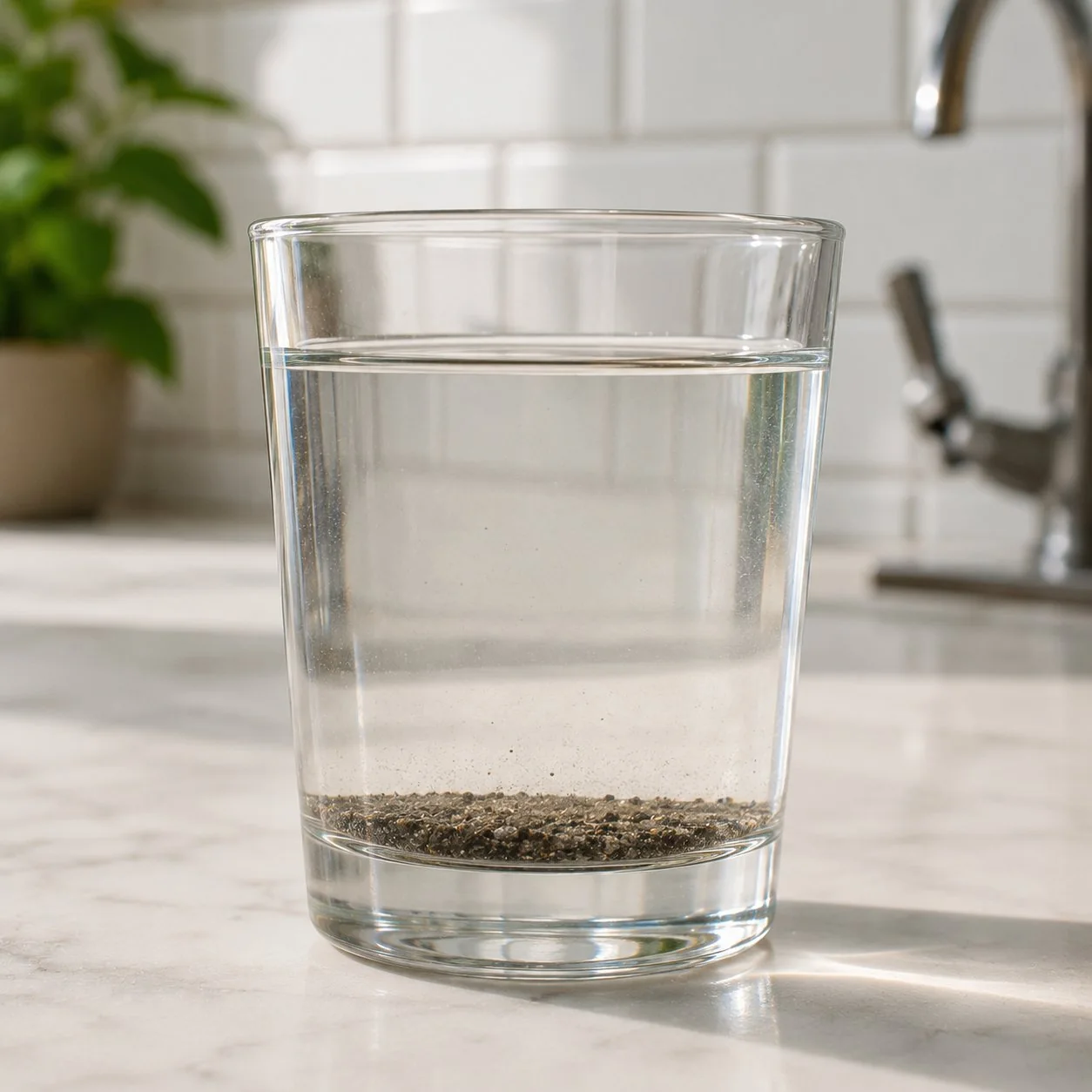
What you see in DJB-fed tanks:
- Brown/yellow-tinted sediment at the bottom (rust + silt from older pipes)
- Less mineral scaling on walls (lower TDS than borewell)
- Occasional chlorine taste right after a DJB supply event — this dissipates within hours
- During low-pressure summer cycles, you can get murky water for a day or two as the pipes flush sediment
Why this matters:
- Sediment accumulates faster — the bottom layer of a DJB-only tank can have 2-3 inches of sludge within a year
- Cycles through your taps — when the tank refills, sediment kicks up and travels to your kitchen and bathroom
- Damages booster pumps — sand particles wear out pump impellers
- Quality varies day-to-day — DJB water from 6 AM and 4 PM can be measurably different even on the same day
Recommended cleaning frequency for DJB: every 6 months. If your area has known infrastructure issues (pipe replacement work happening, frequent supply disruptions), bump to every 4 months.
Most South Delhi has both — and that changes things
Outside of high-rise apartment complexes that are 100% on DJB, most South Delhi homes have BOTH connections:
- DJB as primary supply — feeds the tank during normal hours when supply is available
- Borewell as summer backup — pump kicks on when DJB pressure drops or supply fails (which happens routinely from April-July)
This dual-source setup means that during DJB-strong months (Sept-March), your tank is mostly DJB water. During DJB-weak months (April-July), your tank shifts to mostly borewell. Year-round, the water in your tank is a varying blend.
What changes for cleaning frequency:
- You can’t time cleaning to one source — you’ll always be behind on the other
- Default to the borewell schedule (every 4 months) — borewell is the harder source, so if you’re cleaning often enough for borewell, you’re more than fine for DJB
If you only ever use DJB and have NO borewell connection, every 6 months is fine. We’ve covered the broader frequency question in our guide on how often to clean your water tank.
How to tell which one you have
Most homeowners actually don’t know the answer to this. Here’s how to figure it out in two minutes:
Check your tank inlet area
Look at where water enters your tank, usually on the rooftop:
- DJB-only: a single steel or PVC pipe coming up from below, no electric pump
- Borewell-only: an electric pump (visible motor casing, blue or red) feeding into the tank
- Both: both fixtures present, sometimes with hand-valves to switch between them
Look at your bathroom
- Lots of white chalky scaling on tiles, taps, and showerheads → borewell-heavy
- Less scaling, occasional rust spots near taps → DJB-heavy
- Both signs visible → you’re on a mix
The drop test
Fill a clean glass tumbler from your kitchen tap. Let a single drop dry on a clean dark surface (a steel plate or dark countertop):
- Borewell water leaves a visible white ring (mineral residue)
- DJB water dries clean or leaves a barely-visible faint mark
Pressure check
Borewell pumps deliver consistent pressure 24/7 because the pump is always on demand. DJB pressure varies (strong morning, weak afternoon, weakest in summer). If your shower pressure is the same all day, you’re likely on a borewell pump. If pressure changes through the day, you’re on DJB or DJB-with-occasional-borewell.
What to do if you have both
If you’ve checked and confirmed you have both DJB and borewell connections (very common in South Delhi):
- Default to a 4-month cleaning cycle — assume borewell is the dominant source for tank-cleaning purposes
- During peak summer (May-July), consider an extra cleaning halfway through if you’re using borewell heavily
- Mineral pre-filter at the inlet can extend the interval slightly — these are not water purifiers (don’t drink the output), but they catch the worst sediment before it enters the tank. ₹2,000-4,000 installed
- Tell your cleaner about both sources — they’ll factor this into the cleaning approach. Borewell-heavy tanks need food-grade descaler in addition to standard cleaning
Cleaning recommendations summary
| Attribute | DJB (municipal) | Borewell (groundwater) |
|---|---|---|
| Typical TDS | 200-400 mg/L | 600-1,400 mg/L |
| Hardness | Soft to moderate | Hard to very hard |
| Scale buildup speed | Slow (6+ months to visible) | Fast (2-3 months to visible) |
| Sediment type | Iron oxide from old feeder pipes | Mineral particles + sand |
| Recommended cleaning | Every 6 months | Every 3-4 months |
| Cleaning chemistry needed | Standard 8-step | 8-step + food-safe descaling |
| Cleaning duration (1,000L tank) | ~90 minutes | ~120-150 minutes |
| Cleaning cost (residential) | ₹699-899 | ₹999-1,299 |
| RO purifier waste | ~1L:1L (efficient) | ~2-3L:1L (high) |
Borewell-fed tank? We add the descale step automatically
Our borewell cleaning includes food-safe descaling before disinfection — the only way to actually remove mineral scale. Annual contracts available for outer Delhi (Narela, Bawana, Najafgarh).
Cleaning frequency by source — visual
Months between cleanings — by water source
Shorter = more frequent cleaning needed
Most Delhi homes sit in the 4-5 month range. Outer Delhi pockets reliant on borewell as primary supply genuinely need 2-month cycles — see our borewell outer Delhi guide.
Special concerns by Delhi area
Borewell quality and source mix vary a lot across Delhi:
- South Delhi (Saket, GK, Vasant Kunj, Defence Colony) — mostly mixed (DJB + borewell). Borewell quality moderate-to-hard. Saket area details · Vasant Kunj details
- Central Delhi (CP, Karol Bagh, Daryaganj) — mostly DJB-fed. Borewell less common in city centre.
- East Delhi (Mayur Vihar, Preet Vihar) — DJB-dominant in newer apartment complexes; mixed in old colonies.
- West Delhi (Janakpuri, Rajouri Garden, Tilak Nagar) — heavy borewell use, often hard water, sometimes salinity issues.
- North Delhi (Pitampura, Rohini, Model Town) — mostly DJB; borewell less heavy.
- Outer South Delhi pockets (Vasant Kunj C-blocks, parts of Greater Kailash, Khanpur) — often borewell-dominant.
If you’re not sure about your specific area, the kettle test is reliable: if your kettle gets a chalky white coating within 2-3 months, you’re on borewell-dominant supply.
Not sure what your source actually is?
Call us — we’ll bring a TDS meter and check at booking. Quote adjusts based on real source data, not guesswork.
Want a tank cleaning that handles both source types?
Our standard 8-step cleaning process works for both DJB-fed and borewell-fed tanks. For borewell-heavy tanks (or mixed tanks with visible scaling), we add a food-grade descaler step to clear the mineral buildup. Tell us about your water source on the booking call — we’ll adjust the approach and the price reflects what’s actually needed (not a flat upcharge).
Pricing across Delhi: our full cost breakdown covers what’s included. Most South Delhi homes pay ₹699-1,499 for a standard residential cleaning, including the descaler step where needed.
Frequently asked questions
How can I find out the TDS level of my water at home?
Buy a basic TDS meter from any hardware shop or online — ₹200-500. Dip it in a glass of tap water, get the reading in seconds. Below 500 ppm is acceptable; 500-1000 ppm is hard water territory; above 1000 ppm and you have serious mineral content. BIS drinking water standard caps acceptable TDS at 500 ppm desirable, 2000 ppm upper limit. If you’re getting above 2000 ppm, you should be using a RO purifier for drinking water and our cleaning crew will add a descaler treatment to your tank cleaning.
Is borewell water safe to drink even after tank cleaning?
Tank cleaning addresses what’s in your tank — sediment, scaling, bio-film. It doesn’t change the inherent water quality of borewell water itself. If your borewell water has high TDS, fluoride, arsenic, or other dissolved contaminants, even a perfectly clean tank delivers unsafe drinking water. For drinking, use a RO+UV purifier. Tank cleaning plus RO purifier together gives you safe water for both bathing and drinking.
Should I install a water softener if I’m on borewell?
Depends on your TDS. Below 500 ppm — no, regular tank cleaning is enough. 500-1000 ppm — consider it specifically for the geyser and washing machine line. Above 1000 ppm — a softener is worth it for protecting appliances. Salt-based softeners cost ₹15,000-30,000 installed. Don’t put softened water through a RO purifier — the RO rejects too much, reducing membrane lifespan. Keep RO on the unsoftened drinking line.
Does mixing DJB and borewell water make it dirtier?
No, mixing two clean water sources doesn’t make either dirtier. The mix is just a blend. What it does affect: cleaning frequency. The mix has the mineral content of borewell plus the sediment characteristics of DJB, so both issues compound — which is why we recommend the borewell schedule (4 months) for mixed homes.
What if my building uses tanker water sometimes — does that change cleaning frequency?
Yes, significantly. Tanker water quality is wildly variable depending on the source. Some tankers are reputable (DJB-licensed), others are less so. Heavy sediment, biological contamination, and unknown TDS are all common. If your building uses tanker water more than 2-3 times a year, treat your tank cleaning as if you’re on borewell (4-month schedule). After any single tanker fill from an unknown source, schedule a cleaning within 2-3 weeks if possible.
Does borewell water taste different from DJB water?
Yes. Borewell water typically has a slightly mineral or “earthy” taste due to dissolved calcium, magnesium, and sometimes iron. DJB water has a faint chlorine taste from municipal treatment. Once both pass through your RO purifier, the taste evens out. Many Delhi families can tell the difference from a glass — particularly when switching between sources in summer.
Will boiling borewell water remove the minerals?
No. Boiling kills bacteria but concentrates dissolved minerals (the opposite of removing them — some water evaporates, mineral content stays). Boiled borewell water has the same TDS as the original or slightly higher. For drinking borewell water, you need either RO/UV filtration or a separate softening + filtration setup.
Why does scale build up faster on borewell-fed tanks even with regular cleaning?
Three reasons: (1) higher dissolved minerals mean more deposit volume per litre passing through; (2) tank water evaporates from the open lid gap, concentrating remaining minerals; (3) sun-heated tank walls accelerate scale crystallization on the inside surface. Even quarterly cleaning won’t eliminate scale entirely on heavy borewell — you’ll see thin recurrence by month 3.
Do plastic and concrete tanks scale differently with borewell water?
Yes. Plastic tanks show scale as a white or yellowish crust that can be brushed off; concrete tanks absorb minerals into the surface and develop hardened ridges that need a stronger acid descaling step. For concrete sumps on borewell, expect cleaning to take 30-45 minutes longer than the equivalent plastic tank.
Can I switch entirely from borewell to DJB or vice versa to simplify cleaning?
DJB connection is fixed by your DDA/colony — you either have it or you don’t, and switching isn’t typically possible. Most Delhi families on dual supply use DJB as primary and borewell only as summer backup. The simplification path is reducing borewell use, not eliminating it. If you do this, your cleaning frequency can stretch back to the 6-month DJB schedule.
Is RO purifier waste water enough of a problem to skip the borewell?
RO purifiers reject 2-3 litres of waste water for every 1 litre of clean water on high-TDS borewell input. That’s a real water cost concern in summer-supply-limited Delhi. Some Delhi households connect the RO waste line to the toilet flush tank to reuse the water. Doesn’t reduce your tank cleaning frequency but does reduce the resource cost of being on borewell.
What’s the cheapest reliable way to know my water source TDS?
Cheapest = a ₹200-500 handheld TDS meter from Amazon or any electronics shop. 5-second reading per glass. Test at three points: tank outlet, kitchen tap, RO purifier output. The difference between tank-outlet and kitchen-tap reveals plumbing contamination; tap vs RO reveals purifier effectiveness. Free option: schedule a cleaning visit and ask the crew to bring a TDS meter — we test as part of the visit.
Sources & references
- Bureau of Indian Standards (BIS) — IS 10500:2012 defines acceptable TDS limits (500 ppm desirable, 2000 ppm upper) and other water quality parameters used throughout this article.
- WHO Guidelines for Drinking-water Quality, 4th edition — global standard for hardness, mineral content, and disinfection of stored water.
- Delhi Jal Board (DJB) — Delhi’s municipal water supply authority; their water quality reports inform the regional context for DJB supply characteristics.
- CPHEEO — Manual on Water Supply and Treatment — the Government of India’s engineering manual covering tank design, cleaning protocols, and water source guidance.
- Indian Council of Medical Research (ICMR) — conducts and publishes water quality and groundwater contamination research relevant to Indian urban contexts.
- WHO Fact Sheet on Drinking Water — overview of safe drinking water requirements and contamination risks.
Last verified: 10 May 2026. If you find any of these links broken, please let us know.