
Quick answer
- Dry winters, AC, heat, direct sun, body oils and sanitiser are the main causes of cracking.
- Real leather responds to conditioning; PU and bonded leather peeling cannot be reversed.
- Condition every 3 to 4 months, or every 2 to 3 months near AC, heaters or sunny windows.
- Keep the sofa out of AC airflow and afternoon sun, and avoid household oils and soaps.
- Professional leather clean and condition costs Rs 599 per seat plus GST.
Why leather sofas crack so quickly in Delhi NCR
A good leather sofa should last well over a decade, yet in Delhi NCR homes we regularly see three or four year old sofas with fine lines on the seat, stiff grey patches on the armrests and tiny splits along the headrest. The climate is a big reason. Leather is a natural hide that holds a certain amount of moisture and oil inside its fibres. When that moisture and oil are drawn out faster than they are replaced, the surface stiffens, the finish loses flexibility and the leather starts to crack every time someone sits down.
The main causes we see in the field
- Dry winter air: from November to February the air in Delhi, Gurgaon and Noida is very dry, and room heaters and blowers make it drier still. Leather gives up moisture to the air week after week.
- Air conditioning all summer: an AC running for ten or twelve hours a day dehumidifies the room constantly, and a sofa placed right under or in front of the indoor unit dries out fastest.
- Summer heat: in May and June, a closed flat can get very hot during the day, and heat accelerates the drying of both leather and its protective finish.
- Direct sun through windows: a sofa that sits in a patch of afternoon sun through a west or south-facing window fades, dries and cracks along exactly the area the sun falls on. You can often see the line where the shadow of the window frame ends.
- Body oils, sweat and hair oil: these sound like they would "moisturise" leather, but they actually break down the finish over time and leave darkened, sticky patches on headrests and armrests that crack first.
- Harsh cleaning: dish soap, detergent, baby wipes, glass cleaner and especially alcohol-based hand sanitiser strip the natural oils and the top coat. Since 2020 we have seen a lot of sanitiser damage on leather sofas, usually as dull, dry patches where people wiped frequently.
Real leather vs PU and rexine: two very different problems
Before you try to prevent or treat cracking, it helps to know which material you actually have, because what looks like "cracked leather" can be two completely different things.
| Material | What happens | Can care help? |
|---|---|---|
| Genuine leather (full-grain, top-grain) | Dries out, stiffens, develops fine surface cracks and creases | Yes: regular conditioning slows drying and keeps it supple; early cracks can be softened |
| PU / faux leather / leatherette | Plastic coating breaks down and peels or flakes off the fabric backing | Only partly: gentle cleaning slows wear, but peeling cannot be reversed |
| Rexine (PVC-coated fabric) | Hardens, becomes brittle and splits, especially in heat and sun | Partly: mild cleaning and shade help, but splits are permanent |
| Bonded leather | Leather fibres glued to a backing; surface layer flakes like PU | Only partly: peeling cannot be reversed |
The honest point here is that PU peeling cannot be reversed. If your sofa is shedding small black or brown flakes and the fabric backing is showing through, no conditioner, cream or cleaning process will reattach that coating. Gentle cleaning can slow the spread and remove oils that speed it up, but once peeling covers large areas, the realistic options are reupholstery or a fitted cover. Genuine leather, on the other hand, responds well to care, and that is where prevention really pays.
A simple check: look at the underside or a cut edge. Real leather shows a fibrous, suede-like back, while PU and rexine show a woven or knitted fabric backing. The price tag and label are also good clues. If you are still not sure, our comparison of fabric vs leather sofa care covers the basic differences between materials.
A conditioning routine that actually works
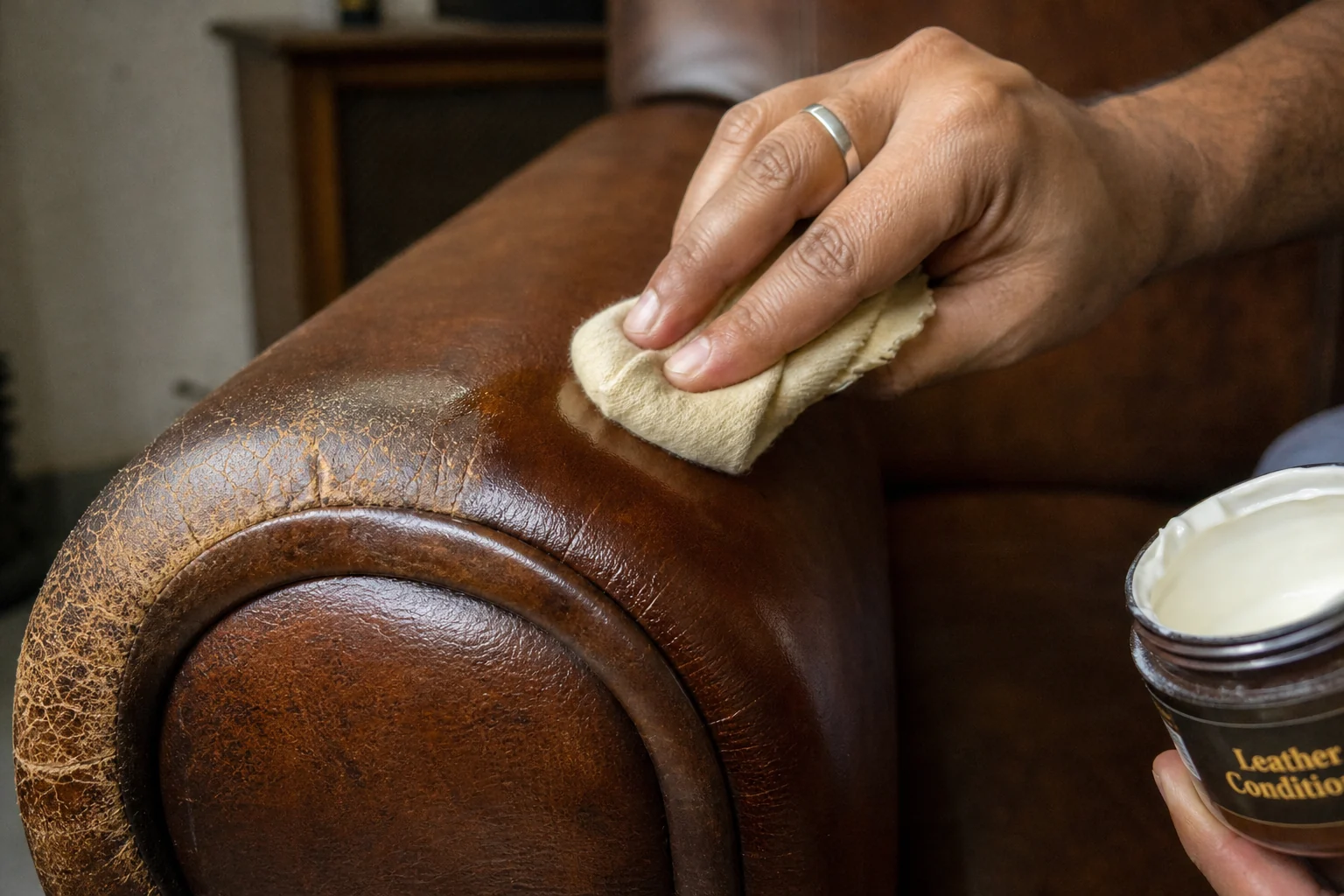
Conditioning puts back the moisture and oils that the climate takes out. The key is regularity, not quantity: a little conditioner applied often works far better than a heavy coat once in three years.
How often to condition in Delhi NCR
- Normal homes: every 3 to 4 months, which lines up roughly with the start of winter, the end of winter, the start of the AC season and the monsoon.
- Sofas near an AC, a heater or a sunny window: every 2 to 3 months, because they dry out much faster.
- Heavy use homes where the sofa is the main seat every day: check the armrests and headrests monthly and condition them more often than the rest.
How to do it
- Dust the sofa with a dry microfibre cloth and vacuum the seams with a soft brush.
- Wipe away surface grime with a cloth just damp with water or a pH-neutral leather cleaner. Never pour water on leather or let it soak in.
- Let it dry for a few minutes, then apply a small amount of a good water-based leather conditioner on a soft cloth, working it in gently in circles, one panel at a time.
- Pay extra attention to headrests, armrests and seat fronts, which dry and crack first.
- Buff off the excess after 15 to 20 minutes so the surface is not greasy or sticky.
Always test a new conditioner on a hidden spot first, because some products darken certain leathers. Avoid coconut oil, mustard oil, olive oil and petroleum jelly; they may look good for a day but they go rancid, attract dust and can stain. For PU and rexine, skip leather conditioner entirely, as it does not penetrate a plastic coating; just wipe gently with a mild cleaner and dry it.
Rather leave it to a pro? Book a home sofa clean across Delhi NCR.
Fabric shampoo, leather conditioning, or a full deep clean with stain and odour treatment. Per-seat pricing from ₹349.
Placement: the cheapest crack prevention there is
Where the sofa sits in the room has as much effect as any product you buy. A few changes can add years of life to the leather:
- Keep the sofa at least a metre or so away from the AC indoor unit, and angle the louvres so cold, dry air does not blow straight onto it.
- Do not park a room heater or blower near the sofa in winter.
- Use sheer curtains, blinds or UV film on windows that throw afternoon sun onto the seating area.
- Avoid placing leather against a wall that heats up in summer, such as a top-floor west wall.
- If someone uses hair oil, drape a washable cotton cloth over the headrest; it saves the most vulnerable area from both oil and drying.
What to do when you spot early cracks
Fine, shallow surface lines on genuine leather are an early warning, and this is the stage where action makes the most difference.
- Clean and condition straight away, and repeat the conditioning on the affected panel after a week or two. Early creases often soften and become much less visible.
- Do not sand, scrub or use "magic" erasers on cracked areas; they remove more of the finish and make it worse.
- Stop using sanitiser or wipes on the sofa. If hygiene is a concern, a pH-safe leather cleaner is the safer option.
- Fix the cause: move the sofa out of the sun or the AC airflow, otherwise the cracks will return.
Deep cracks where the colour coat has split open, or where the leather is torn, cannot be cleaned or conditioned away. Those need a leather repair or recolouring specialist. Conditioning still helps the rest of the sofa, but the cracked area will remain visible. We will always tell you which stage your sofa is at before starting.
When to call a professional
Home conditioning is enough for routine care, but a professional clean and condition once or twice a year is worth it, especially in Delhi's dusty climate. Fine dust and grime sitting on leather act like sandpaper every time someone sits down, and body oils in the grain cannot be fully lifted with a cloth. A professional clean removes that buildup from the grain and seams first, so the conditioner can actually reach the leather instead of sitting on top of dirt.
KaamGenie's leather and rexine clean with conditioning is priced at ₹599 per seat, and a leather 3+2 set starts from ₹2,499 (GST extra). The crew comes to your home, patch-tests on a hidden spot, cleans with a pH-safe leather cleaner, and conditions every panel. Leather is never soaked, so there is almost no drying time and you can use the sofa right away. You can book through our leather sofa cleaning service, or check what a full set will cost with the sofa cleaning cost calculator. For leather recliners, which crack fastest on the headrest and footrest, see our guide to recliner sofa cleaning.
Frequently asked questions
Why is my leather sofa cracking after only a few years?
In Delhi NCR the usual causes are dry winter air, long hours of AC, summer heat, direct sun through a window, body oils on headrests and armrests, and cleaning with harsh soaps or sanitiser. All of these pull moisture and oils out of the leather faster than they are replaced, so it stiffens and cracks.
Can cracked leather on a sofa be repaired?
Fine surface lines on genuine leather often soften and become much less visible with cleaning and repeated conditioning. Deep cracks where the colour coat has split, or torn leather, cannot be fixed by cleaning and need a leather repair or recolouring specialist. Peeling PU or bonded leather cannot be reversed at all.
How often should I condition a leather sofa in Delhi?
Every 3 to 4 months suits most homes in Delhi NCR, roughly at each change of season. Sofas close to an AC, heater or sunny window dry out faster and benefit from conditioning every 2 to 3 months. Armrests and headrests may need extra attention in between.
Is coconut oil good for a leather sofa?
No. Coconut, mustard and olive oil, and petroleum jelly, may make leather look glossy for a day, but they can go rancid, attract dust, darken the colour unevenly and leave a sticky surface. Use a proper water-based leather conditioner and test it on a hidden spot first.
Why is my faux leather sofa peeling?
Faux leather or PU is a thin plastic coating on fabric. Heat, sun, sweat, hair oil and dry air break that coating down until it lifts and flakes off. Cleaning gently can slow the spread, but peeling cannot be reversed. Once it covers large areas, reupholstery or a fitted cover is the realistic fix.
Does hand sanitiser damage a leather sofa?
Yes. Alcohol-based sanitiser strips natural oils and the protective top coat from leather and leatherette, leaving dull, dry patches that crack or peel sooner. Avoid wiping the sofa with sanitiser or disinfectant wipes, and use a pH-safe leather cleaner instead if you want to clean it hygienically.
How can I tell if my sofa is real leather or rexine?
Look at the underside or a hidden cut edge. Real leather has a fibrous, suede-like back, while PU and rexine show a woven or knitted fabric backing. Real leather also has slightly irregular grain and a natural smell. If you are unsure, the technician can identify it before cleaning.
Should I keep my leather sofa away from the AC?
Yes, ideally at least a metre or so away, with the louvres angled so cold, dry air does not blow directly onto it. Constant AC airflow dehumidifies the leather and is one of the most common reasons we see cracked armrests and headrests in NCR flats.
How much does leather sofa conditioning cost in Delhi NCR?
KaamGenie charges Rs 599 per seat for leather or rexine cleaning with conditioning, and a leather 3+2 set starts from Rs 2,499, with GST extra. The crew cleans at your home with a pH-safe cleaner, never soaks the leather, and conditions every panel.
Can I use the sofa straight after a professional leather clean?
Yes, in almost all cases. Leather and rexine are wiped with controlled moisture rather than soaked, so there is almost no drying time. The conditioner is buffed in and any excess removed before the crew leaves, so the surface is not sticky or greasy.
Sources & references
- India Meteorological Department (IMD): Delhi NCR seasonal temperature and humidity patterns, including dry winters and hot summers.
- U.S. EPA: Indoor Air Quality: Indoor humidity and air conditions that affect furnishings.
Last verified: 4 November 2026.