
Quick answer — bees & wasps in Delhi (2026)
- Bee or wasp matters (2026): fuzzy honey bees make a hanging comb and should be relocated, not killed; smooth wasps and hornets build paper or mud nests and sting again and again.
- Don’t DIY: a disturbed colony swarms and can deliver dozens of stings — serious for anyone with an allergy, and deadly in rare cases.
- Honey bees: a trained remover or beekeeper relocates the comb; killing a hive indoors leaves rotting honey that draws ants and rodents.
- Real cost (2026): a small reachable wasp nest starts at about ₹1,200; a large or high honey bee hive needing height access runs ₹4,000–₹9,000+. GST 18% extra.
- Safety, honestly: trained removal lowers the risk a lot — nobody can promise zero risk with stinging insects.
- Same-day response available across most of Delhi.
Bee or wasp? How to tell, and why it changes everything
Before anyone touches anything, work out what you’re actually looking at. People in Delhi call every flying striped insect a “bee,” but bees and wasps are different animals and you treat them in completely opposite ways. Get this wrong and you either kill a colony you should have saved, or you tiptoe around something that’s going to keep stinging you.
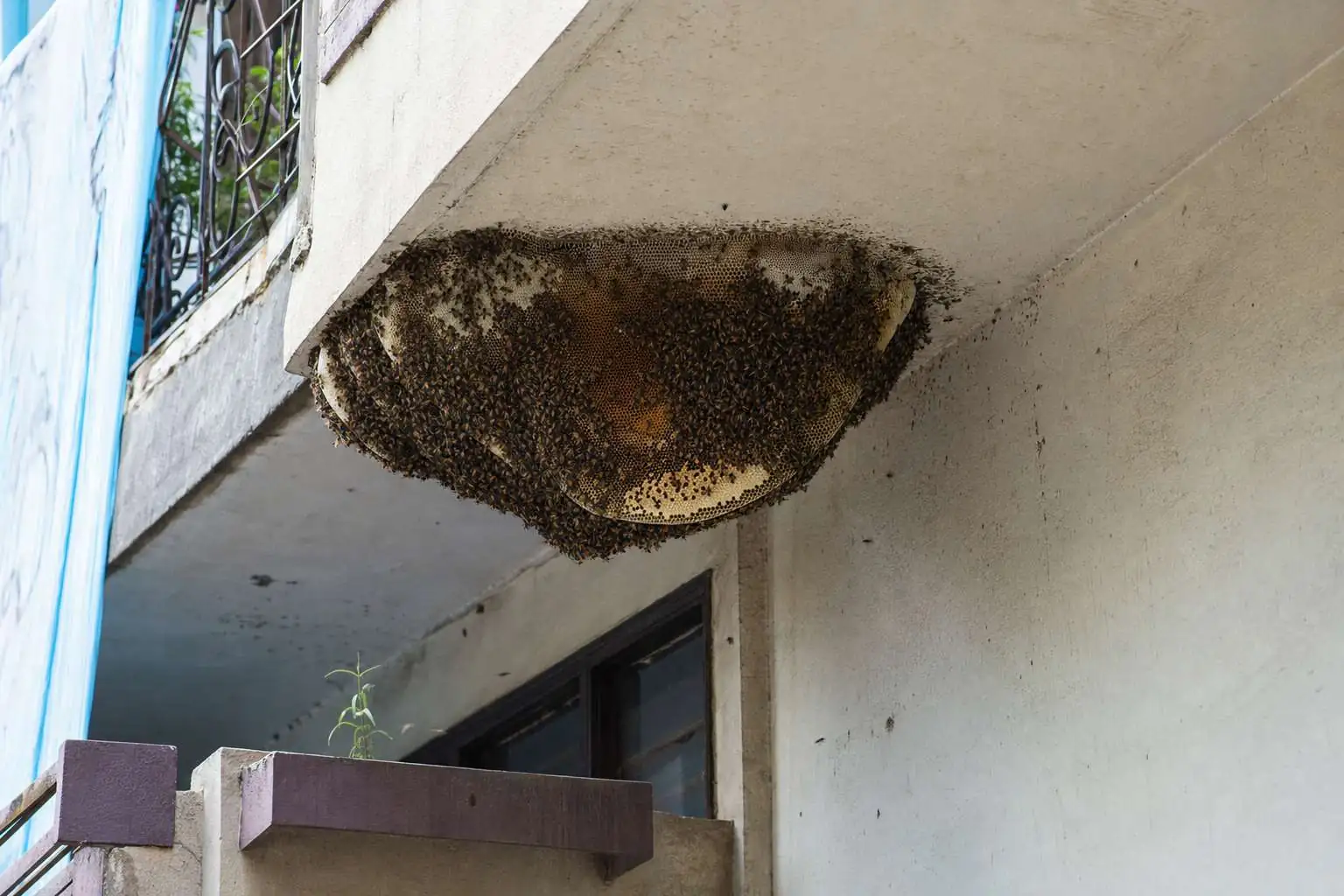
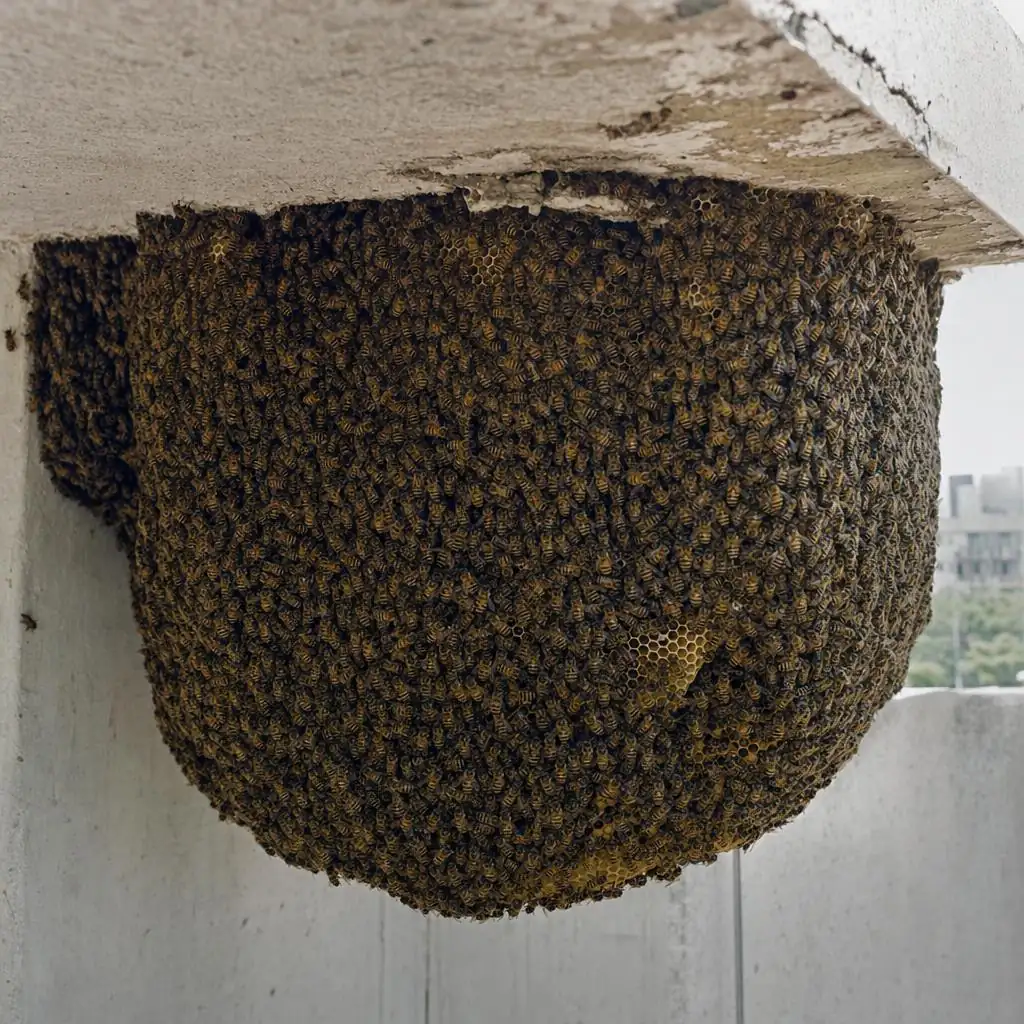
Honey bees are the fuzzy ones. They look soft, almost golden-brown, and they move in a big slow cloud when they swarm. In Delhi the common rock bee (we call it the bhirh) builds a single open comb that hangs down — under a balcony slab, off a window AC unit, from a tree branch, sometimes flat against a wall. It looks like a grey-brown sheet covered in thousands of bees. Honey bees are pollinators. They are genuinely useful, they are under pressure everywhere, and the right answer is almost always to relocate them, not poison them. They’ll defend the comb if you mess with it, but a colony left alone usually just gets on with its day.
Wasps and hornets are the smooth, shiny, hard-bodied ones with a thin waist. Their nests look engineered — a paper wasp nest is like a small grey umbrella made of what looks like cardboard, and you’ll find them tucked in window frames, under chajjas, inside meter boxes and behind AC outdoor units. Mud daubers leave little clay tubes on walls. Hornets are the big aggressive cousins and their nests can get to the size of a football. The important difference: a wasp can sting you over and over, it doesn’t die after one sting the way a honey bee does, and they get nasty when you’re anywhere near the nest. There’s nothing to relocate here — wasps aren’t hive pollinators you want to save, so the job is proper removal.
| What you see | Honey bees | Wasps / hornets |
|---|---|---|
| Body | Fuzzy, soft-looking, golden-brown | Smooth, shiny, hard, thin “waist” |
| The nest | One open comb hanging down (grey-brown sheet) | Paper umbrella, mud tubes, or a ball in a cavity |
| Where in Delhi | Balcony slabs, AC units, tree branches, walls | Window frames, chajjas, meter boxes, AC outdoor units |
| Stinging | Stings once, then dies; defends the comb | Stings repeatedly; aggressive near the nest |
| Useful? | Yes — pollinators worth saving | No reason to keep them indoors |
| Right approach | Relocate the comb | Treat, then remove the nest, then seal |
Why DIY removal is genuinely dangerous
This is the part I want you to actually read, because it’s where people get hurt. A bee or wasp colony is not a single insect — it’s thousands of them with one job, which is to defend the nest. The moment you spray it, smoke it, hit it or block it, you trigger that defence all at once. A few angry insects you can run from. A whole colony coming at you is a different thing entirely.
Multiple stings are the real risk. One sting hurts. Twenty or fifty stings in a few seconds — which is completely normal when a disturbed rock bee colony comes off the comb — puts a load of venom into your body fast. And then there’s allergy. Some people have no idea they’re allergic until the day a sting closes their throat. That severe reaction, anaphylaxis, can kill, and it can happen within minutes. If anyone in the house has ever reacted badly to a sting, DIY isn’t a debate — the answer is no.
Then there’s the boring way people get hurt, which is the fall. Half these nests in Delhi are up high — second-floor balcony slab, the top of a stilt pillar, the outdoor AC bracket hanging over the gali. So you’ve got someone on a wobbly ladder, one hand holding a can of spray, the other swatting at insects, and that’s how a sting turns into a broken arm or worse. I’ve seen it.
The last thing is the one people never think about: a half-done job is worse than no job. If you knock down part of a nest, or spray it and don’t clear it, you get a colony that’s now angry, defensive, and stinging anyone who walks past — and they rebuild within days, often in the exact same spot. So you took all the risk and ended up with a more aggressive problem. In 2026 there is no clever home hack for this. The whole reason trained removal exists is that the colony has to be dealt with in one controlled go.
Hive or nest near a doorway in Delhi?
Don’t poke it. We send a suited remover — a small reachable wasp nest starts at ₹1,200, GST 18% extra.
Honey bees: relocation, not killing
If it’s honey bees, the goal isn’t to win — it’s to move them. Bees pollinate a huge share of what we eat, they’re struggling everywhere, and a healthy colony is worth saving. The right job is a trained remover or a beekeeper who comes suited up, calms the colony (usually with cool smoke, which makes them gorge on honey and turn docile), and carefully cuts and lifts the whole comb — brood, queen and all — into a box. The queen is the key. Get her in the box and the rest follow. They then take the colony somewhere it can live, often to a beekeeper who actually wants it.
Now here’s why killing a hive in place — especially indoors, in a wall cavity or a false ceiling — is a mistake people regret. Say you spray the comb dead. You’ve still got kilos of comb and honey sitting inside your wall. Nobody removed it. That honey ferments, leaks through the plaster as a sticky brown stain, and the smell pulls in ants, then cockroaches, then sometimes rats. I’ve been to flats in Delhi where the bee “problem” was solved with a can of spray six months earlier, and now there’s a stain spreading across the bedroom wall and a parade of ants nobody can explain. The fix at that point means opening the wall. So even when you don’t care about saving bees — and you should — killing them in place and walking away just trades one problem for three.
Proper relocation also means closing the door behind them. A good remover seals the gap, slab edge or cavity the bees were using, because honey bees leave a scent that tells the next swarm “good spot, move in here.” If you don’t seal it, you’ll be doing this again next season.
Wasps & hornets: proper removal
Wasps are a different job and there’s no soft option. You’re not relocating them, you’re removing them, and it has to be done so the whole nest goes down together. Here’s what a trained person actually does, and why each step matters.
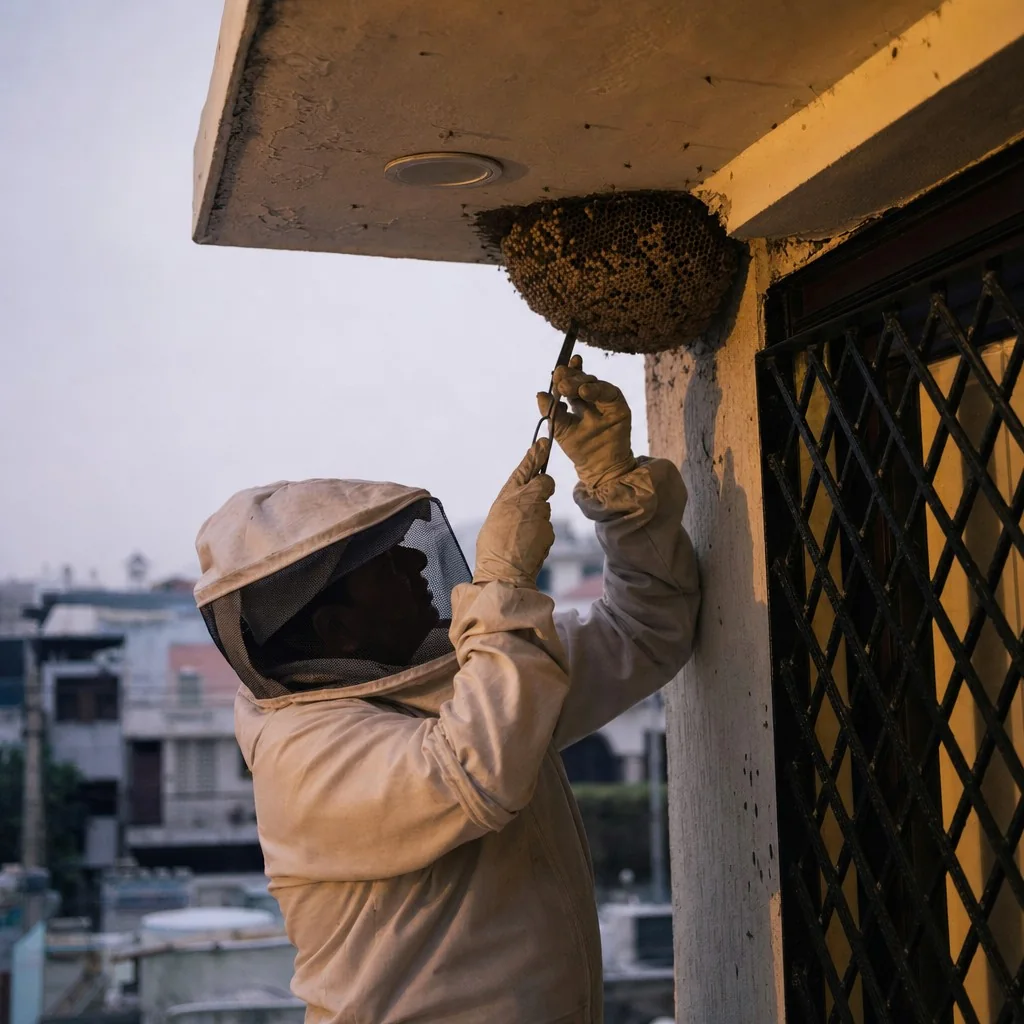
First, timing. Good removal happens at dusk or after dark, because that’s when nearly the whole colony is home and slow. Hit a wasp nest at 3pm and half the foragers are out flying — they come back to a wrecked nest and a person standing there, and they’re furious. Second, protection: a proper sting-proof suit, gloves and a veil. This isn’t a helmet and a dupatta over the face; one gap and a hornet finds it. Third, treat then remove: the nest is treated with an approved insecticide so the colony is knocked down, and only then is the nest physically taken away — because a treated-but-left nest still has stragglers and still smells like “home.” Fourth, seal the void. Wasps love a cavity — a hollow window frame, the gap behind an AC bracket, a meter box. If you don’t close it after, a new queen moves into the same hole come spring. The chemicals used here are meant to be CIB&RC-approved products applied at label rates — that’s the difference between a controlled treatment and someone emptying a random aerosol into your wall.
| Job | Typical Delhi price (2026) | What drives it |
|---|---|---|
| Small, reachable wasp / paper-wasp nest | Starting at ₹1,200 | Ground or low height, single small nest |
| Hornet nest | ₹2,500–₹5,000 | Larger nest, more venom, often in a cavity |
| Honey bee comb relocation | ₹3,000–₹7,000 | Live relocation, comb size, beekeeper handling |
| Large / high hive needing height access | ₹4,000–₹9,000+ | Ladder or harness work, 2nd floor and above |
Two things move these numbers more than anything: height and size. A paper-wasp nest you could touch from the floor is a quick job. A football-sized rock-bee comb hanging off a third-floor slab over a busy lane means harness work, traffic control below, and more risk — so it costs more, and honestly it should. Add GST 18% on top of all of these. Be very suspicious of anyone quoting ₹300 for a hive on the phone before they’ve seen a photo — that’s the price of a spray-and-run that leaves you worse off.
Real cost in Delhi (2026) and what you’re paying for
People always ask why removal costs more than a ₹100 can of insect spray, and it’s a fair question. You’re paying for three things the can doesn’t give you: a person who’s willing to stand next to an angry colony, the gear that lets them do it without getting put in hospital, and the full clear-out so it doesn’t come back. The chart below is the honest trade-off — not in rupees, but in how likely you are to get badly stung.
Sting risk by approach (2026)
Lower is better. Trained removal cuts the risk a lot — but with stinging insects nobody can honestly call it zero.
Notice that leaving a nest completely alone isn’t risk-free either — a colony by your front door grows, and the chance of an accidental knock goes up over time. The point of the chart isn’t “trained removal is magic.” It’s that DIY is the one bar that’s genuinely off the scale, and it’s the one fully in your control.
Honey bees you’d rather relocate than kill?
Tell us where the comb is and send a photo on WhatsApp — we’ll quote relocation, not a kill job.
What NOT to do
If you take nothing else from this page, take this list. Every one of these is something a Delhi household has tried, and every one of them goes wrong.
- Don’t burn it. Setting fire to a comb or nest — with a torch, a burning rag, anything — is how people set fire to a balcony, a curtain, or themselves. It also sends a whole colony off the nest at once. Just no.
- Don’t spray it with water. A hose or a bucket doesn’t kill them, it makes them angry and wet, and now you’re standing in the splash zone of a furious colony.
- Don’t hit it with a stick or knock it with a broom. This is the classic Delhi mistake and it’s exactly what my neighbour did. You will not win a fight with a stick against ten thousand bees.
- Don’t block the entry while they’re inside. Sealing a wall cavity or hole with the colony alive inside doesn’t trap the problem — they chew out somewhere new, often into the room, and you’ve still got rotting comb behind the wall.
- Don’t empty a random aerosol into a cavity and walk away. Half-treated, not removed, not sealed — that’s the recipe for an aggressive colony that rebuilds.
- Don’t send a kid, a maid or the building guard up a ladder to “just have a look.” If it needs height and it’s a live colony, it needs gear and training.
When it’s an emergency — and who to call
Most bee and wasp situations can wait a day or two for a proper appointment. Some can’t. Treat it as urgent if any of these are true:
- Someone in the house has a sting allergy or has ever had a serious reaction. The colony has to go, and until it does, keep everyone well clear and have antihistamines and a plan to reach a hospital fast.
- There are small children or elderly people who can’t move quickly away from a swarm, or who can’t tell you early that they’ve been stung.
- The nest is right by a doorway, a staircase, a play area or your AC unit — anywhere people pass close every day. That’s a knock waiting to happen.
- The colony has turned aggressive — bees or wasps coming at people who are just walking past, not touching anything. That’s a colony already on the defensive.
In any of those cases, don’t experiment. Get everyone inside, close the windows on that side, and call a trained remover — us on 95603 66362, or message a photo on WhatsApp so we can tell you bee or wasp and quote before we come. If someone’s been stung a lot or is struggling to breathe, that’s a doctor first, removal second.
Areas we serve across Delhi
We do bee and wasp removal across most of Delhi — South Delhi (Saket, Malviya Nagar, Khanpur, Lajpat Nagar), East Delhi (Mayur Vihar, Preet Vihar, Laxmi Nagar), West and North-West Delhi (Janakpuri, Rajouri Garden, Pitampura, Rohini) and Central and North Delhi. If you’re inside Delhi, send a photo and we’ll come. Coming soon: Gurgaon, Noida, Faridabad and Ghaziabad — we’d rather tell you straight that we’re not there yet than send someone who can’t do the job properly.
Frequently asked questions
How do I know if it’s bees or wasps in Delhi?
Look at the body and the nest. Honey bees are fuzzy and golden-brown and build one open comb that hangs down like a grey-brown sheet. Wasps and hornets are smooth and shiny with a thin waist, and their nests look made — a paper umbrella, mud tubes, or a ball tucked in a cavity. If you’re not sure, send us a photo on WhatsApp and we’ll tell you, because the two are handled completely differently.
Can I just spray a bee hive myself with insect spray?
Please don’t. Spraying a colony triggers the whole nest to defend at once, and a disturbed rock-bee colony can put dozens of stings on you in seconds. On top of that, a sprayed-but-not-removed hive leaves rotting comb and honey behind that draws ants and rats. In 2026 there is no safe DIY shortcut for a live colony.
Why should honey bees be relocated instead of killed?
Honey bees are pollinators — they matter, and they’re under pressure everywhere. A trained remover or beekeeper can calm the colony, lift the whole comb with the queen, and move it somewhere it can live. Killing a hive in place, especially inside a wall, also leaves you with fermenting honey, stains and a fresh ant and rodent problem.
How much does bee or wasp removal cost in Delhi in 2026?
A small reachable wasp nest starts at about ₹1,200. A hornet nest is usually ₹2,500–₹5,000. Live honey bee comb relocation runs ₹3,000–₹7,000, and a large or high hive needing ladder or harness work can be ₹4,000–₹9,000 or more. GST 18% is extra. Height and nest size move the price more than anything else.
Is professional bee and wasp removal 100% safe?
No honest remover will tell you it’s 100% safe — you’re dealing with stinging insects. What trained removal does is cut the risk a lot: the right suit, the right timing at dusk, approved chemicals and a full clear-out. That’s a world away from someone on a ladder with a can of spray, but nobody can promise zero risk.
What if someone in my house is allergic to stings?
Then treat it as urgent and keep everyone well clear of the nest until it’s removed. A severe allergic reaction (anaphylaxis) can be life-threatening and can happen within minutes of a sting. Have antihistamines on hand, know your nearest hospital, and get a trained remover out — this is not a situation for DIY.
Do you remove nests that are high up, like on a balcony or AC unit?
Yes — a lot of Delhi hives are on second-floor slabs, stilt pillars and outdoor AC brackets. That work needs a ladder or harness and proper fall safety, which is exactly why it costs more than a nest you could reach from the floor. Send a photo and we’ll quote based on the height and size.
Will the bees or wasps come back after removal?
They can, if the spot isn’t sealed. Honey bees leave a scent that tells the next swarm it’s a good site, and wasps love re-using the same cavity. A proper job includes sealing the slab edge, frame or hole after removal so a new colony doesn’t simply move into the same place next season.
Is it true that killing bees in a wall causes other pests?
Yes, and we see it often. If you kill a colony inside a wall or false ceiling and leave the comb, the honey ferments, leaks through as a brown stain, and the smell pulls in ants, cockroaches and sometimes rodents. Fixing that later usually means opening the wall — far more hassle than removing the bees properly the first time.
How fast can you come if there’s a hive near my door?
We offer same-day response across most of Delhi for nests in a risky spot like a doorway, staircase or play area. Call 95603 66362 or WhatsApp a photo. If anyone has already been stung badly or is having trouble breathing, see a doctor first — removal can wait until the person is safe.
What time of day is best for wasp removal?
Dusk or after dark, when nearly the whole colony is home and slow. Treating a wasp nest in the middle of the day means half the foragers are out, and they return to a wrecked nest and an angry mood. Good removers plan around this; it’s one of the things that separates a clean job from a chaotic one.
Do you use safe, approved chemicals for wasp nests?
For wasps and hornets we use CIB&RC-approved insecticides applied at label rates, then physically remove and seal the nest. Honey bees are different — those are relocated alive wherever possible rather than chemically treated. Either way, the aim is to deal with the colony in one controlled visit, not to soak your home in random aerosol.
Bees or wasps at your place in Delhi?
Don’t risk a ladder and a can of spray. Send a photo and we’ll tell you bee or wasp, then quote — same-day across most of Delhi.
Sources & references
- Central Insecticides Board & Registration Committee (CIB&RC) — regulates the insecticides used in licensed wasp and hornet nest removal.
- Indian Council of Medical Research (ICMR) — publishes research on insect stings and severe allergic (anaphylactic) reactions.
- National Centre for Disease Control (NCDC) — public-health reference on stinging-insect risk and first response.
Last verified: 9 June 2026. If you find any of these links broken, please let us know.