Home › Services › Pest Control › Cockroach Treatment
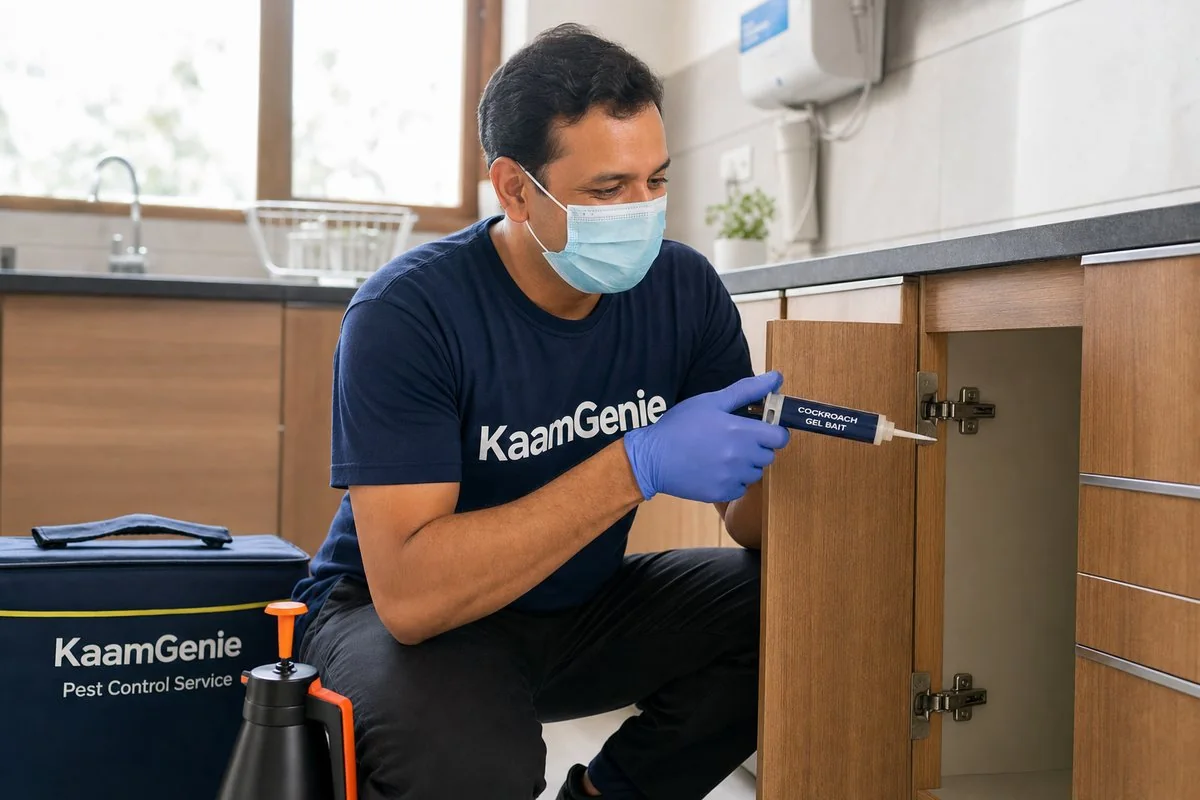
Service · Pest Control CategoryCockroaches in Delhi kitchens are unavoidable without targeted treatment. Delhi’s food culture, monsoon humidity, older building stock, and shared drain lines mean even the cleanest homes get hit. The trouble is, DIY sprays don’t actually fix the problem — Delhi cockroaches are now widely resistant to over-the-counter chemicals, and spray only kills what it touches. We use the right method instead: CIB&RC-approved gel bait placed inside cabinet hinges, sink drains, and behind appliances, where cockroaches hide. They feed, carry the bait back to the nest, and the whole colony collapses in 7-14 days. Pet-safe, child-safe, no smell, no evacuation, starting at ₹599 with a 15-day re-treatment warranty.
Pick the option that matches your home or premises. Fixed prices · GST 18% extra · Same-day available.
All prices: GST 18% extra · Cash / UPI / Card / Bank transfer · Same-day available · Free phone consultation before booking.
Every quote is confirmed on the phone after a 5-minute description of your home. We never quote without understanding the job, and we never change the price on arrival.
If you live in Delhi and you’ve never seen a cockroach in your kitchen, you are the exception. The combination of Delhi’s climate, food culture, building stock, and shared infrastructure makes cockroach pressure almost universal — from Lutyens kothis to DDA flats in Rohini, from Defence Colony first floors to ground-floor builder units in Mayur Vihar. Four factors make this true:
1. Food culture and kitchen design. Delhi households cook at least twice a day, often with tadka, deep-frying, and high-grease dishes. Greasy splatter coats the inside of kitchen cabinets, behind the chimney, under the gas stove, and in the chimney duct. Grease residue is cockroach food — even when the visible kitchen looks spotless, the cavities behind appliances are a buffet.
2. Monsoon humidity. From late June through September, Delhi humidity climbs above 70%. Cockroach egg cases hatch faster, nymphs mature quicker, and colonies double in size every 60-90 days during monsoon. This is why most Delhi homeowners notice an “explosion” of cockroaches in July-August even if they only saw one or two in May.
3. Older building age and shared drains. Most South Delhi colonies (Lajpat Nagar, GK, Defence Colony), East Delhi DDA pockets (Mayur Vihar, Patparganj), and Central Delhi government quarters were built in the 1960s-90s. They share a common building drain stack. One infested flat means cockroaches travel through the stack to every other flat — you can clean your own kitchen perfectly and still get re-infested from the neighbour’s sink upstairs.
4. Kitchen exhaust gaps. Most Delhi kitchens have an exhaust chimney duct that vents outside, a window with a partially broken mesh, or a sink overflow pipe with no trap. Each gap is a cockroach motorway. Modular kitchens make this worse, not better — the gaps between the cabinet carcass and the wall are perfect harbourage with constant warmth from appliances.
Add these factors together and the conclusion is uncomfortable but honest: even a clean Delhi home gets cockroaches. The question is not how to avoid them, it’s how to treat them properly when they arrive.
Most Delhi homes deal with one of two species — sometimes both at the same time. The protocol differs slightly for each, which is why the crew identifies the species during inspection.
German cockroach (Blattella germanica). The small one. Light brown, about 12-15 mm long, with two dark parallel stripes behind the head. This is the species you see scurrying out from behind the toaster, inside cabinet hinges, behind the fridge, and under the gas stove. They prefer warm, humid, food-rich spots — 95% of German cockroach infestations are in the kitchen. They reproduce extremely fast: one female plus her offspring can produce 30,000 cockroaches in a year. This is the species most Delhi households actually have.
American cockroach (Periplaneta americana). The big one. Reddish-brown, 35-45 mm long, capable of short flight. You see these in bathroom drains, sewer outlets, basements, garages, society common drain shafts, and ground-floor utility rooms. They prefer dark, damp spots and travel through plumbing. American cockroaches in your bathroom usually come up through the drain — not from your own kitchen.
Why this matters for treatment. German cockroaches respond best to gel bait — placed deep inside the kitchen cabinet hinges, behind the toaster, under the sink, and around the gas stove. They feed, carry it back to the harbourage, and the whole colony collapses. American cockroaches respond better to drain treatment — gel bait at the U-bend joints, plus targeted spray inside the bathroom drain shaft. Most full-home Delhi jobs include both, because most Delhi homes have both species.
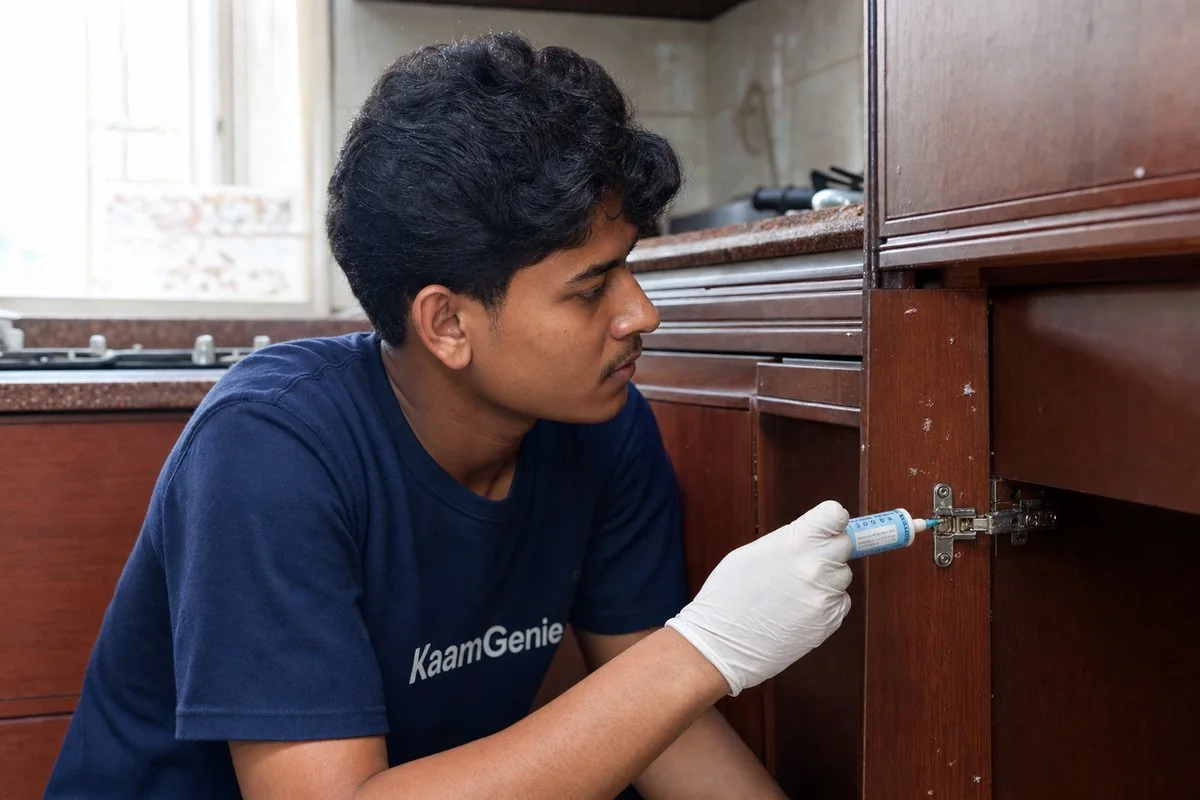
Every Delhi homeowner has tried it — the can of HIT, the bottle of cockroach killer, the “Lakshman Rekha” chalk, the ultrasonic plug-in from Amazon. They don’t work. There are three specific reasons, and once you understand them, the gel-bait approach makes obvious sense.
Resistance. Delhi’s German cockroach population has been exposed to over-the-counter cypermethrin and deltamethrin sprays for two decades. Field studies in Indian metros now show 60-90% resistance to common active ingredients in retail sprays. You can drown a kitchen in spray and watch the cockroaches walk away unaffected. The chemicals you can buy at a kirana shop are 10-15 years behind what professional pest control uses.
Surface-only kill. Spray only kills what it touches. The cockroaches you see and spray are roughly 5% of the colony. The other 95% are hiding inside the wall cavity, behind the chimney, inside the gap between cabinet and wall, under the gas stove insulation, inside the toaster. None of them get touched by your spray. Worse: heavy spray actually disperses survivors deeper into hidden spots, making them harder to reach later.
No effect on egg cases. Female cockroaches carry egg cases (oothecae) that contain 30-40 eggs each. The casing is wax-coated and largely impermeable to spray chemicals. So even if you kill every adult you see, the egg cases hatch 2-3 weeks later and you’re back to square one. This is why spraying gives you 4-7 good days, then the problem returns worse.
Gel bait beats all three: cockroaches walk to the bait voluntarily, eat it, carry it back to the colony, the entire colony — including the females with egg cases — feeds on it through trophallaxis (mutual feeding), and over 7-14 days the colony collapses. There is no resistance problem (Delhi cockroaches haven’t built tolerance to fipronil bait), no surface-only limitation (they bring the chemical to the colony), and egg-bearing females die before laying. That is the entire scientific case for switching from spray to bait.
Cockroach treatment looks deceptively simple from the outside — the crew is in and out in 60-90 minutes. But there’s a structured protocol behind it, and getting any step wrong means the treatment fails. Same six steps every job:
Total time on site: 60-90 minutes for a 2-3 BHK Delhi flat. Restaurants and commercial kitchens take 2-3 hours because there are more cabinets, more equipment, and stricter documentation.
The Central Insecticides Board & Registration Committee (CIB&RC), under the Ministry of Agriculture, is the Indian regulator that approves which pest-control chemicals can be sold and used in India, at what concentration, and for which use case. For cockroach gel bait specifically, CIB&RC has cleared a short list of active ingredients for residential use. We use only chemicals from that list.
What gel bait actually is. A water-based or hydrocarbon-based gel paste containing a low-concentration insecticide (typically 0.05% to 0.6%) plus food attractants (sugars, proteins, fats). The active ingredient in our standard residential bait is fipronil 0.05% — the same active used by global brands like Goliath and Maxforce in commercial pest control. For heavy infestations and resistance-suspected populations, we switch to imidacloprid 2.15% bait, which uses a different chemical pathway and bypasses any fipronil resistance.
Why it’s safer than spray. Three reasons. First, the chemical is contained in a sticky paste — it doesn’t evaporate, doesn’t become airborne, and doesn’t coat food-prep surfaces. Second, the total quantity is tiny — 3-5 grams for a whole flat versus a half-litre of spray. Third, the placement is concealed — gel dots go inside hinge cavities, behind appliances, under the sink U-bend, none of which are reachable by toddlers or pets in normal use. Compare this to spray, which coats every surface in the kitchen.
What NOT to do after treatment. Do not spray any other insecticide (HIT, Mortein, anything you might buy at a shop) over our gel dots — the spray contains repellents that drive cockroaches away from the bait, ruining the treatment. Do not wipe or scrub the gel dots — they are placed exactly where they need to be. Do not move appliances or deep-clean cabinet interiors for 15 days — disturbance scatters the colony and the bait stops working. Do not call us back and say “it’s not working” on day 3 — the colony collapse takes 7-14 days, that’s how the chemistry works.
CIB&RC-approved gel-bait protocol, pet-safe, child-safe, no smell, no evacuation. 15-day re-treatment warranty. Starting at ₹599. We can be at your home today.
This is the single most important section of this page. Most cockroach treatment failures in Delhi are not because the chemical didn’t work — they’re because the customer disturbed the treatment in the first 15 days. Read this list, take it seriously, and follow it:
Do NOT wipe or scrub the gel bait dots. The pinhead-sized dots placed inside cabinet hinges, behind appliances, and along corners must stay undisturbed. Every dot wiped off is one less feeding station for the colony. If you can’t see them (which is the point — they’re concealed), that’s normal. Don’t go hunting for them to clean.
Do NOT spray any insecticide over the treated area. No HIT, no Mortein, no Baygon, no “naturally-derived” sprays from Amazon. All cockroach sprays contain repellents that drive cockroaches AWAY from surfaces — which means they’ll avoid our gel bait dots and the treatment fails. If you see a cockroach in the first 7 days, leave it alone. That’s the gel bait pulling them out of hiding to feed.
Do NOT move appliances or deep-clean cabinet interiors. Don’t pull out the fridge, don’t shift the microwave, don’t empty out the kitchen cabinets to scrub the insides. The colony has settled around our bait placement; physical disturbance scatters them and they may relocate to a spot where the bait hasn’t been placed. Normal day-to-day cooking, opening cabinets, washing dishes, taking out the trash — all fine. Just don’t reorganise the kitchen.
Do NOT use cockroach chalk or boric acid powder. Same reason as spray — these are repellents to live cockroaches. They drive cockroaches away from the bait dots, which means the colony stops feeding on the bait and survives. After 15 days, when treatment is complete, you can use whatever maintenance method you like.
Do expect to see MORE cockroaches in days 3-5. This is the most counter-intuitive part. Gel bait is a food attractant — it pulls cockroaches out of hiding to feed. So you’ll see cockroaches that you didn’t even know existed, walking around the kitchen at night. This is the treatment working. By day 7, the count drops sharply. By day 14, you should see zero. If you still see live ones at day 15, that’s when you call us — not on day 3.
Every cockroach treatment carries a 15-day re-treatment warranty. The window is calibrated to the gel-bait chemistry — fipronil and imidacloprid baits show full colony collapse within 7-14 days, so by day 15 you should see no live cockroach activity in the treated zones.
When to call us back. If on day 15 (or later, up to day 20) you’re still seeing live cockroaches in the treated kitchen or bathroom, call +91 95603 66362 or WhatsApp us. We schedule a free re-treatment visit, the same crew comes back, re-inspects, and applies fresh gel bait at the same and additional points. The re-treatment is completely free under warranty.
What’s included. Full re-inspection of all treated zones plus new zones if cockroaches have migrated. Fresh gel-bait application at all hotspots. Updated photo documentation. The re-treatment carries its own 15-day warranty.
What’s not included. Warranty does not cover new infestations from external sources — if the cockroach activity is coming from a neighbour’s flat through the shared drain stack, from a common society dustbin, or from a newly-renovated unit next door, that’s a fresh job, not a warranty re-treatment. Warranty also doesn’t apply if the customer has used spray, chalk, or repellent over the treated area in the 15-day window. We’re happy to do a fresh-job re-treatment at a discount, but that situation isn’t warranty.
For homes with persistent cockroach pressure — ground-floor flats near common drains, restaurants, society guard rooms, basement kitchens — we strongly recommend our optional quarterly maintenance contract: 4 treatments per year, free re-treatment between visits, and priority booking. It works out cheaper per visit than ad-hoc bookings, and the colony pressure never builds back up.
Cockroach treatment is not abstract — it solves specific real-world problems. Here are three patterns we treat every week across Delhi:
Scenario 1: Lajpat Nagar restaurant kitchen pre-FSSAI audit. Mid-range North Indian restaurant in Lajpat Nagar Central Market, kitchen footprint about 350 sq ft, scheduled FSSAI inspection in 10 days. Owner had been spraying HIT every night for two weeks and the cockroach traffic was getting worse, not better. Our crew did a 9 PM-to-midnight visit (kitchen closed), full gel-bait protocol at 32 placement points including the deep-fry station, tandoor area, dishwashing sink, and dry-storage shelves. Issued a treatment certificate in FSSAI-acceptable format. By the day-of audit, zero visible cockroach activity, restaurant passed cleanly. Now on quarterly maintenance contract.
Scenario 2: Defence Colony kothi family with a baby. Family of four in a Defence Colony first-floor kothi unit, six-month-old baby, two cats, kitchen cockroach problem that the family was scared to spray because of the baby. They called us specifically because we use gel bait, not spray. Crew did a careful inspection with the parents walking through, identified that the source was the chimney duct gap and a broken kitchen window mesh. Placed gel bait at 16 points, all concealed inside cabinet hinges and behind appliances where the baby couldn’t crawl to and the cats couldn’t lick. Family carried on cooking the same day. Day 14 follow-up: zero cockroach activity. Mesh repair recommended for long-term protection (separate carpentry referral).
Scenario 3: Mayur Vihar Phase 1 society ground-floor block. Five neighbouring flats on the ground floor of a DDA society in Mayur Vihar Phase 1 had ongoing cockroach migration from the common drain stack. Treating one flat at a time wasn’t working — cockroaches just relocated to the next flat. We negotiated a coordinated block treatment with the RWA: all five kitchens treated the same day, plus a treatment of the common drain shaft on the ground floor. Cost split across the five households via the RWA. Issue cleared in 12 days and hasn’t returned in 8 months. This is now our standard recommendation for ground-floor blocks in DDA societies.
Call us and describe what you’ve been seeing. We’ll tell you honestly whether you need full gel-bait treatment, a one-time spray, or just kitchen-hygiene fixes. No pressure to upsell — if a ₹599 fix is the right answer, that’s what we’ll quote.
Cockroach treatment is currently live across all of Delhi:
Coming soon: Gurgaon, Noida, Faridabad, Ghaziabad. We’re onboarding pest control crews in these NCR zones over the next few months. If your cockroach problem in NCR outside Delhi is urgent, call us anyway — we may be able to arrange a one-off visit while permanent coverage is being set up.
For a typical 2-3 BHK Delhi flat, the on-site work takes 60-90 minutes. The crew inspects the kitchen, bathrooms, and utility areas, identifies hotspots (sink drains, cabinet hinges, under appliances), places gel-bait dots at 12-15 strategic points, and does a quick adult spray where you’ve seen heavy activity. Restaurants and commercial kitchens take 2-3 hours because there are more hiding zones. The actual kill takes 7-14 days after we leave — that’s how gel bait works.
Yes — this is the biggest single reason we use gel bait instead of open spray. The bait is placed in pinhead-sized dots inside cabinet hinges, behind appliances, and along corners where pets and kids cannot reach. We use only CIB&RC-approved chemicals (fipronil or imidacloprid bait gels) at the exact concentrations the Central Insecticides Board permits for residential use. Unlike spray, there is no airborne exposure, no smell, and no need to evacuate. Cooking can resume the same day.
Three reasons. First, Delhi cockroaches (especially the German cockroach) have built up resistance to common over-the-counter chemicals like cypermethrin — you kill the ones you see but the colony shrugs it off. Second, sprays only kill what they directly touch — the 95% of the colony hiding inside walls, behind appliances, and inside drains stays untouched. Third, sprays don’t reach the egg cases (oothecae), so a new wave hatches in 2-3 weeks. Gel bait solves all three.
You’ll actually see more cockroaches in the first 3-5 days — that’s gel bait working. The bait pulls them out of hiding to feed, so they appear in the open more than usual. By day 7, activity drops sharply. By day 14, you should see no live cockroaches at all. If you still do at day 15, that triggers the free re-treatment under warranty. For very heavy infestations (restaurants, basement kitchens), full clearance takes 21-30 days because the colony is larger.
A normal day-to-day kitchen clean is enough. We don’t need you to empty cabinets or scrub everything. Crucially, do NOT spray pesticide or use cockroach chalk in the 48 hours before our visit — spray repellent on surfaces will make cockroaches avoid our gel bait dots, which defeats the whole protocol. Keep food covered, take out the trash, and let our crew place the bait. Deep-cleaning the kitchen happens after treatment is complete, not before.
Every cockroach treatment carries a 15-day re-treatment warranty. If you continue to see live cockroach activity 15 days after our visit, we come back and re-apply the gel bait at no extra cost. The warranty assumes you’ve followed the post-treatment do-not-disturb instructions — don’t wipe the gel dots, don’t spray over them, don’t move appliances. Warranty does not cover new infestations from external sources (society common drain pipes, neighbour spillover) — those are treated as fresh jobs.
For a standard Delhi household, once every 6-12 months keeps things clean. For ground-floor flats near common drain lines, restaurants, society guard rooms, and commercial kitchens, quarterly treatment is the right cadence because external re-introduction is constant. We offer an optional annual service contract with 3-4 visits and free re-treatment if the count rises between visits — this works out cheaper than ad-hoc re-bookings for high-risk properties.
Yes. Gel bait is placed in concealed spots — inside hinge cavities, behind appliances, under sink U-bends — not on counters or food-prep surfaces. There is no spray residue on cooking surfaces, no smell, and no airborne chemical. You can cook the same day, wash dishes normally, and use the kitchen as usual. The only rule is do not wipe or scrub the gel dots themselves, which are out of sight in any case. This is the single biggest practical advantage of gel bait over old-school spray.
Yes — commercial cockroach treatment is a major part of our work. Restaurants preparing for FSSAI audits, hotels, banquet kitchens, society guard rooms, office pantries, and cloud-kitchen units all use our quarterly protocol. Commercial jobs include treatment certificates suitable for FSSAI documentation, scheduled night-time visits so the kitchen doesn’t shut for the day, and a stricter 7-day callback window. Price quoted per kitchen footprint after a site visit — not flat per-BHK like residential.
Cockroach treatment starts at ₹599 for a 1 BHK flat with one kitchen and one bathroom. 2-3 BHK flats range upward depending on number of bathrooms and kitchen size. Kothis with multiple kitchens and basement utility rooms are quoted after a phone description. Restaurants and commercial kitchens need an on-site visit before quote. We never quote without understanding the job, and we never change the price on arrival. Pricing format is “Starting at ₹X” — the final number comes from your home’s actual size and severity.
You don’t need to live with cockroaches in your kitchen. The treatment is pet-safe, child-safe, no smell, no evacuation, takes 60-90 minutes, and starts at ₹599. Call +91 95603 66362, WhatsApp here, or click the button below. Same-day visits available across Delhi.
Published by KaamGenie Private Limited — Delhi NCR’s trusted home services provider for water tank cleaning, pest control, and household maintenance. CIN: U74909DL2026PTC466750. Last updated 5 June 2026.
Every pest control service we offer across Delhi NCR — CIB&RC chemicals, photo documentation, GST invoice, transparent pricing.
Full overview of every pest control sub-service. Starting prices, process, CIB&RC chemicals, what each treatment covers.
Anti-termite chemical injection for Delhi wooden door frames, almirahs, plywood furniture and structural wood.
Combo cockroach, ant, spider, lizard, mosquito treatment for Delhi homes. Pet-safe and child-safe protocols.
Two-visit protocol covering mattress seams, skirting, frame joints. Accounts for 10-14 day egg-hatching cycle.
Thermal fogging + larvae treatment + breeding-site elimination. Critical for dengue prevention pre/post monsoon.
Tamper-resistant bait stations + entry-point sealing + 30-day follow-up audit. Safe for kids and pets.
Gel baiting and targeted spray for sugar ants, black ants and red ant trails in kitchens and homes.
FSSAI-compliant pest control for restaurants, hotels, offices. Monthly visits, audit-ready documentation.
4 quarterly visits + free re-treatments + scheduled reminders. 20-25% off per-visit pricing.