Home › Services › Pest Control › Termite Treatment
Service · Pest Control CategoryTermites are the single most-feared pest in Delhi homes — they silently eat through wooden door frames, almirahs, skirting, and plywood furniture for months before you notice. Delhi’s climate makes it worse: humid post-monsoon air, hot dry summers, older buildings full of wood, and ground-floor flats with direct soil contact. We treat termites the right way: CIB&RC-approved chemicals (chlorpyrifos, imidacloprid, fipronil) injected directly into wood and soil entry points, not sprayed surface-level. Starting at ₹2,499. Same-day inspection available across Delhi.
Pick the option that matches your home or premises. Fixed prices · GST 18% extra · Same-day available.
All prices: GST 18% extra · Cash / UPI / Card / Bank transfer · Same-day available · Free phone consultation before booking.
Every termite quote is confirmed on the phone after a 5-minute description of your home. We never quote without understanding the job, and we never change the price on arrival.
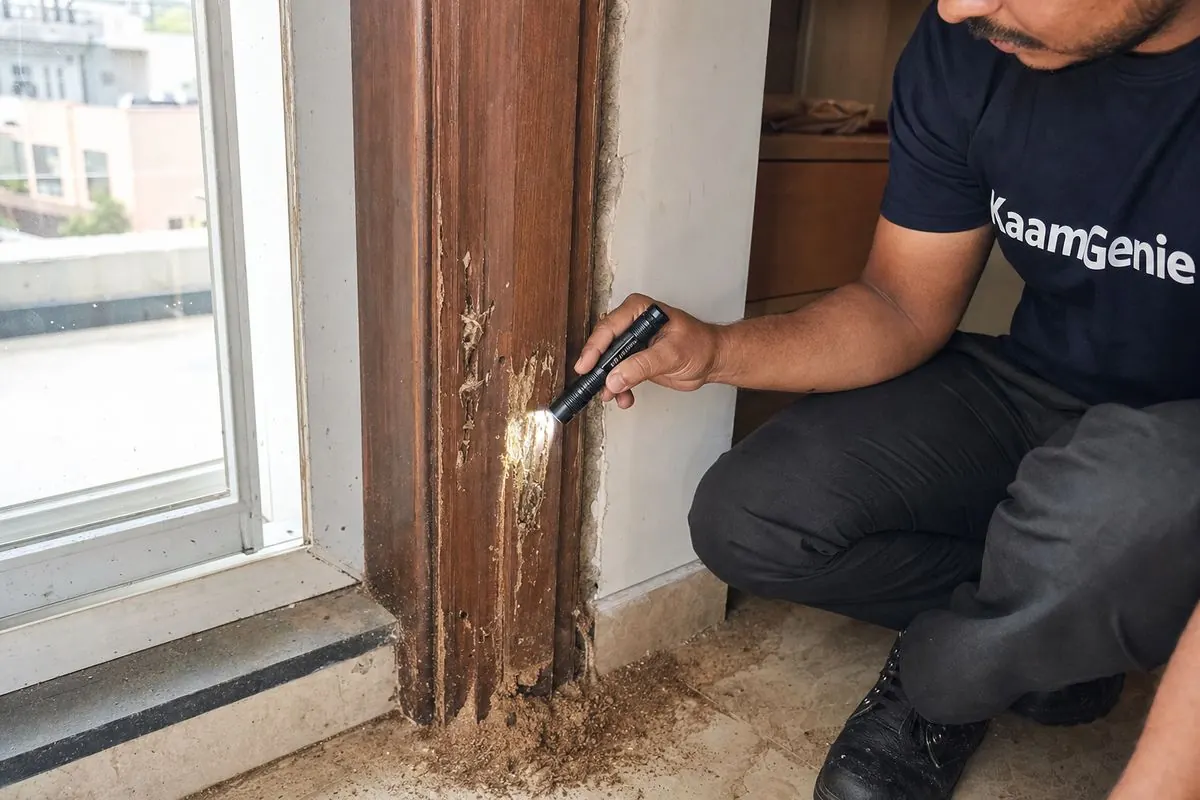
Termites are quiet, slow, and invisible. By the time most Delhi homeowners realise they have an infestation, the damage is months old. Here’s what to look for — one sign is enough to warrant an inspection.
If you spot any of these signs in your Delhi home, don’t wait. Termites double their colony size roughly every 6 months. A small problem becomes a structural one fast.
Delhi is one of India’s most termite-prone metros — and it’s not random. Four factors converge here:
1. Climate. Delhi summers are hot and dry, but post-monsoon (July-October) brings the exact warm-and-humid conditions termite colonies thrive in. Subterranean termites multiply fastest at 25-30°C with high soil moisture — which is Delhi from August through October. By November, colonies are large and actively foraging into homes.
2. Older buildings with wooden structural elements. Much of Delhi’s housing stock — DDA flats, kothis in South Delhi, builder floors in Lajpat Nagar / Defence Colony / Greater Kailash — was built with wooden door frames, wooden window panels, and wooden roof beams. Every one of these is a termite buffet.
3. Plywood and engineered-wood furniture. Modern Delhi flats are full of plywood almirahs, MDF kitchen cabinets, particle-board beds, and laminate skirting. Cheap plywood is actually more attractive to termites than solid wood because it’s softer and contains glue they can digest.
4. Ground-floor flats with garden contact. Anywhere the building touches soil — basement flats, ground floors, kothis with backyards, builder floors with garden access — gives subterranean termite colonies a direct route into the building. South Delhi areas with mature trees and gardens (Vasant Kunj, Chattarpur, Saket farmhouses) are especially affected.
Add it together and you understand why we get termite calls year-round but volumes spike in September-November every year.
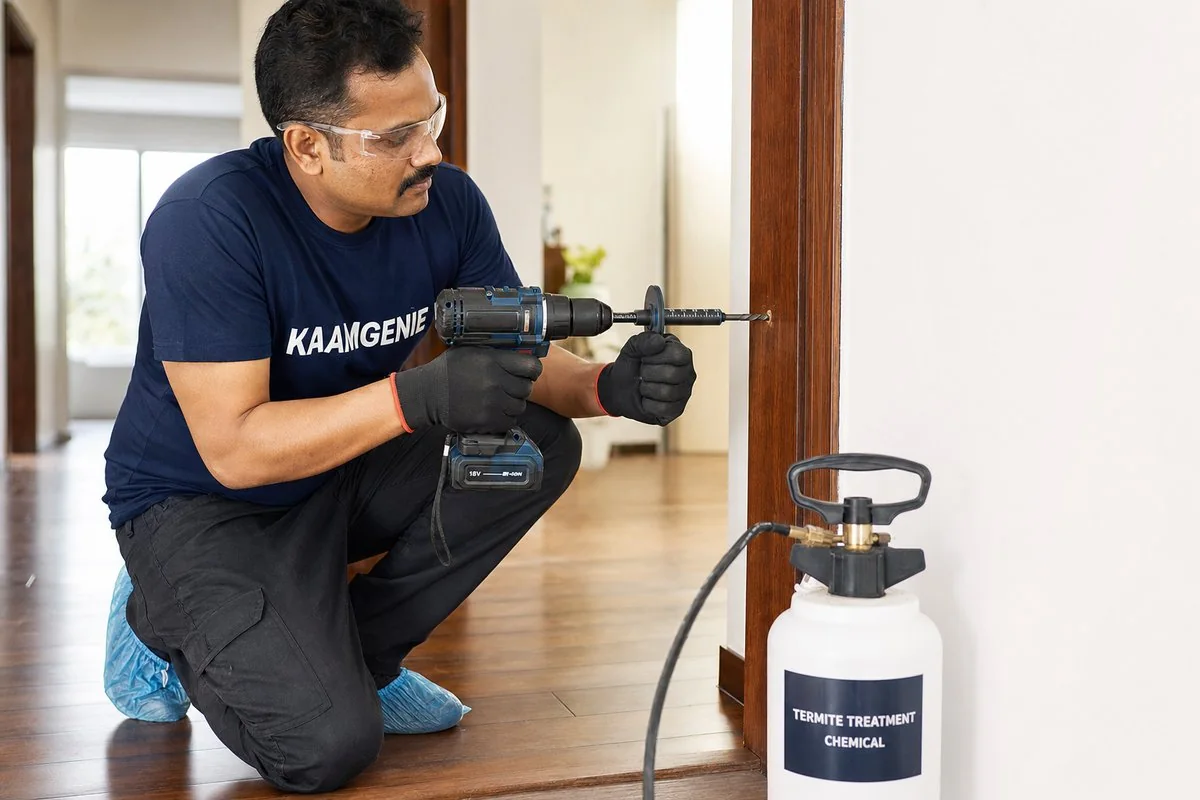
Real termite treatment is not a single spray. It’s a 6-step structured process that targets termite entry points, kills the active colony, and creates a chemical barrier to stop re-entry. Same process every job.
For a typical 2-3 BHK Delhi flat, the full process takes 3-5 hours. Kothis and bungalows take 6-8 hours. Pre-construction barrier treatments on new builds are a full-day job.
The Central Insecticides Board & Registration Committee (CIB&RC), under the Ministry of Agriculture, is the Indian regulator that approves which pest-control chemicals can be sold and used here, at what concentration, and for which use. For anti-termite treatment specifically, CIB&RC has cleared a short list. We use only chemicals from that list — never grey-market or unregistered substances.
Chlorpyrifos. The most widely used termiticide in India for decades. Long residual action — treated wood and soil stay protected for 5-7 years. Used at the standard 1% emulsion concentration. Most cost-effective option for full-home treatment.
Imidacloprid. A newer-generation neonicotinoid that termites carry back to the colony before dying — so it wipes out the queen and workers, not just the foragers you see. Used for severe infestations and pre-construction soil barriers. Lower odour than chlorpyrifos.
Fipronil. The premium option for high-value homes and persistent infestations. Works at very low concentrations (0.1%), low odour, and the “transfer effect” means worker termites poison the entire colony through normal contact and grooming. Often used in pre-construction barriers in kothis and farmhouses.
Safety for residents and pets. All three chemicals, at CIB&RC-approved residential concentrations, are safe after the standard 4-6 hour ventilation window post-treatment. We follow strict pet-safe protocols: pets and small children stay out of the actively treated room during the work and for 4-6 hours after, windows stay open, and we never spray in open kitchens or food storage areas. We brief every household on the protocol before starting.
Termite colonies double every 6 months. A small problem today is a structural one in a year. CIB&RC-approved chemicals, 7-15 day warranty, starting at ₹2,499.
If you’re building a new home, builder floor, or commercial space in Delhi NCR — pre-construction anti-termite treatment is the single best investment you can make in long-term pest protection. It’s done before flooring and finishing work, and the chemical barrier lasts 5-10 years if applied correctly.
When it’s done. Three stages during construction: after foundation excavation (treating the soil before backfilling), at plinth level (treating the soil before the floor slab), and around wall-floor junctions (before tile or marble work begins). Skipping any stage leaves an entry route open.
How much it covers. A properly done pre-construction barrier creates a continuous chemical zone that termites cannot cross to reach the wooden parts of the building. It protects door frames, skirting, plywood furniture, and wooden roof beams — for years — without any further treatment.
Where it’s most useful. New construction in Gurgaon (Sector 56-65 plots), Noida (greenfield sectors), and outer Delhi farmhouses (Chattarpur, Mehrauli). Anywhere with garden contact, mature trees, or termite-prone neighbouring plots. We do site visits, quote per square foot of built-up area, and coordinate with your civil contractor on timing.
If you’re mid-build right now and reading this — call us before the flooring starts. After the tiles go down, this becomes 3x more expensive.
Honest disclosure: we are a termite treatment service, not a carpentry or interior repair service. Here’s the clean split:
What we do cover. Inspection. Identification of active vs old (historic) termite damage. Chemical treatment of all infested wood, walls, skirting, and soil. Drilling and injection. Sealing of injection holes with matching putty. Treatment certificate. Re-treatment within warranty if termites return.
What we don’t cover. Replacement of damaged door frames, almirahs, plywood, skirting, or wooden floors. If termites have already hollowed out a door frame structurally, our treatment kills the termites — but the wood itself stays damaged. You’ll need a carpenter for the physical repair. We’ll happily recommend trusted carpenters in your area as a separate referral.
Why we don’t bundle it: termite treatment and carpentry are completely different trades. Doing both badly is worse than doing one well. We focus on the chemistry; carpentry stays specialist.
Termite treatment pricing isn’t a flat menu — it depends on real factors. Here’s how we work out a quote:
Property size. A 1 BHK flat needs fewer drill points, less chemical, and a shorter time on site than a 4 BHK kothi. Kothis and bungalows with multiple floors, gardens, and external boundaries cost more because there’s more soil-contact perimeter to barrier-treat.
Severity of infestation. Early signs caught in one or two rooms cost less than full-home infestations with active termite activity in every wooden surface. Severe cases also need higher-concentration chemicals (fipronil instead of chlorpyrifos) and re-treatment after 30 days.
Pre-construction vs post-construction. Pre-construction barrier treatments are quoted per square foot of built-up area and are typically cheaper per area covered than post-construction because the work happens before tiles, paint, and finishing. Post-construction work in finished homes takes longer per square foot.
Type of building. Standalone houses with garden boundaries need external soil barrier work in addition to interior injection. Apartments on upper floors usually need only interior treatment, no soil barrier.
Re-treatment. Annual or biannual service contracts (one inspection + one free re-treatment if needed) are priced lower per visit than one-off treatments because of the relationship.
Every quote is given on the phone after a 5-minute description of your home and the signs you’ve spotted. Starting at ₹2,499 for a 1-2 BHK flat with localised treatment. We’ll never quote you a price without understanding the job — and we’ll never change the price on arrival.
| Type | What it covers | Typical use case | Starting price |
|---|---|---|---|
| Spot treatment | One or two rooms with active termite signs — localised injection | Early infestation caught in a single door frame or almirah | Starting at ₹2,499 |
| Full-home post-construction | Inspection + injection across all wooden surfaces + skirting barrier | 2-3 BHK Delhi flat with termites in multiple rooms | Starting at ₹4,999 |
| Kothi / bungalow treatment | Interior injection + external soil barrier along boundary walls | Standalone homes with gardens and soil contact | Starting at ₹7,499 |
| Pre-construction barrier | 3-stage soil and plinth treatment during foundation work | New builds, builder floors, fresh kothis — before flooring | Starting at ₹9,999 (quoted per sq ft) |
| Annual service contract | 4 quarterly inspections + free re-treatment if termites return | High-risk homes — ground-floor flats, kothis with gardens, repeat-infested properties | Starting at ₹6,999/year |
Every standard termite treatment we do carries a 7-15 day activity warranty. The window varies based on the chemical used — chlorpyrifos treatments are 7 days, imidacloprid and fipronil treatments stretch to 15 days. If you spot live termite activity, fresh mud tubes, or new powdery wood residue inside the warranty window, call us — we come back and re-treat free of cost.
Beyond the activity warranty, treatment protection lasts much longer: 3-5 years for post-construction chemical injection, 5-10 years for properly done pre-construction soil barriers. But protection ≠ warranty — protection is the realistic lifespan, warranty is the period where we take repeat-activity as our problem to fix.
For high-risk properties — ground-floor flats, kothis with gardens, homes with repeat infestation history — we strongly recommend our optional annual service contract. It bundles four quarterly inspections, one free preventive re-treatment if termite activity is detected, and priority booking. For around ₹6,999/year, it’s cheaper than one full retreatment if termites return after the standard warranty expires.
Termite treatment is currently live across all of Delhi:
Coming soon: Gurgaon, Noida, Faridabad, Ghaziabad. We’re onboarding pest control crews in these zones over the next few months. If your termite problem in NCR outside Delhi is urgent, call us anyway — we may be able to arrange a one-off visit while permanent coverage is being set up.
One of our pest specialists comes to your home, checks every wooden surface, and gives you an honest assessment. No pressure, no obligation. If termites are active, you’ll get a clear quote on the spot.
Five clear warning signs. First, mud tubes — pencil-thick brown lines climbing up walls or skirting boards, this is how termites travel from soil to wood. Second, powdery wood residue or fine sawdust below furniture and door frames. Third, small pinprick holes in wooden door frames, almirahs, and skirting. Fourth, wood that sounds hollow when tapped. Fifth, discarded translucent wings near windows after monsoon. If you spot even one of these, book an inspection — termites work invisibly for months.
For a typical 2-3 BHK Delhi flat, the full treatment takes 3-5 hours on-site. The crew first inspects every wooden surface, identifies entry points, drills small injection holes near door frames and skirting at standard intervals, injects the chemical, and seals the holes. Larger kothis and bungalows take 6-8 hours. Pre-construction barrier treatments on a new build take 1 full day. The injection sites are sealed cleanly with putty, so there’s no visible damage after.
We use only CIB&RC-approved termiticides — chlorpyrifos, imidacloprid, or fipronil — at the exact concentrations the Central Insecticides Board permits for residential use. These chemicals are injected into wood and soil, not sprayed in open air, so airborne exposure is minimal. We recommend pets and small children stay out of treated rooms for 4-6 hours after the job and rooms be ventilated. After that window, the surfaces are safe to touch and use. We brief every household on the exact protocol.
Yes — both. Pre-construction treatment is done before flooring and foundation work, where we lay an anti-termite chemical barrier in the soil and at plinth level. This is the gold-standard protection and lasts 5-10 years. Post-construction treatment is for existing homes where termites are already active — we drill into floors, skirting, and door frames, and inject the chemical directly. Both follow the same CIB&RC protocol but the methods differ. Tell us which one you need on the booking call.
Post-construction chemical injection treatment typically lasts 3-5 years in Delhi conditions, though high-risk homes (ground-floor flats, kothis with garden boundaries, areas with heavy wooden interior work) may need a re-check at year 2-3. Pre-construction barriers last 5-10 years if applied correctly during foundation. Termites can return if soil treatment near boundaries breaks down, or if untreated wooden furniture is brought in from an infested source. We offer optional annual re-checks for high-risk homes.
No. The drill holes are 4-6mm wide, made at standard intervals along skirting and door frames, and sealed cleanly with matching putty after injection. On wooden floors and laminate, we drill only at the joints or skirting line so the visible surface is untouched. The chemical itself is water-based at the injection concentration and doesn’t stain or warp wood. We’ve treated thousands of polished door frames, almirahs, and parquet floors in Delhi without visible damage. We’ll show you a sample seal point before drilling.
Yes — every treatment carries a 7-15 day activity warranty. If you spot live termites or fresh mud tubes within that window, we come back and re-treat at no extra cost. For homes that want longer protection, we offer an optional 1-year service contract that includes quarterly inspections and one free re-treatment if termites are detected. The contract is most useful for ground-floor flats, kothis with old wooden work, and homes that have had repeat infestations.
You can stay home — the work is localised to one or two rooms at a time. We recommend pregnant women, infants, elderly with breathing issues, and pets stay out of the actively treated room for 4-6 hours. Most families just shift to the living room or another floor while the crew works. After 6 hours and good ventilation, the entire home is safe to occupy. For pre-construction treatments on empty new builds, this isn’t a concern at all.
Three reasons. First, chemicals — CIB&RC-approved termiticides like fipronil and imidacloprid cost 4-6x more than general cockroach or rodent chemicals. Second, time — termite treatment is a 3-8 hour job involving inspection, drilling, injection, and sealing, versus 60-90 minutes for general spraying. Third, expertise — drilling at the right depth and interval requires trained crew, not a sprayer. The starting price of ₹2,499 reflects this. Cheap ₹500 “termite sprays” you’ll see advertised are mostly surface-level cockroach chemical — not a real treatment.
Right now we cover all of Delhi — South Delhi, Central Delhi, East Delhi, West Delhi, North Delhi, and North-West Delhi for termite treatment. Gurgaon, Noida, Faridabad, and Ghaziabad are coming soon — we’re onboarding pest control crews in those zones currently. If you’re in NCR outside Delhi and the termite problem is urgent, call us anyway — we may be able to arrange a one-off visit while permanent coverage is set up.
Termites don’t pause. Every week you wait, the colony grows and the damage spreads. Call +91 95603 66362, WhatsApp here, or click the button below. Same-day inspection available across Delhi.
Published by KaamGenie Private Limited — Delhi NCR’s trusted home services provider for water tank cleaning, pest control, and household maintenance. CIN: U74909DL2026PTC466750. Last updated 5 June 2026.
Every pest control service we offer across Delhi NCR — CIB&RC chemicals, photo documentation, GST invoice, transparent pricing.
Full overview of every pest control sub-service. Starting prices, process, CIB&RC chemicals, what each treatment covers.
Combo cockroach, ant, spider, lizard, mosquito treatment for Delhi homes. Pet-safe and child-safe protocols.
Targeted gel-bait protocol for kitchen and bathroom infestations. CIB&RC chemicals, 15-day re-treatment warranty.
Two-visit protocol covering mattress seams, skirting, frame joints. Accounts for 10-14 day egg-hatching cycle.
Thermal fogging + larvae treatment + breeding-site elimination. Critical for dengue prevention pre/post monsoon.
Tamper-resistant bait stations + entry-point sealing + 30-day follow-up audit. Safe for kids and pets.
FSSAI-compliant pest control for restaurants, hotels, offices. Monthly visits, audit-ready documentation.
4 quarterly visits + free re-treatments + scheduled reminders. 20-25% off per-visit pricing.