Home › Services › Pest Control › Bed Bug Treatment
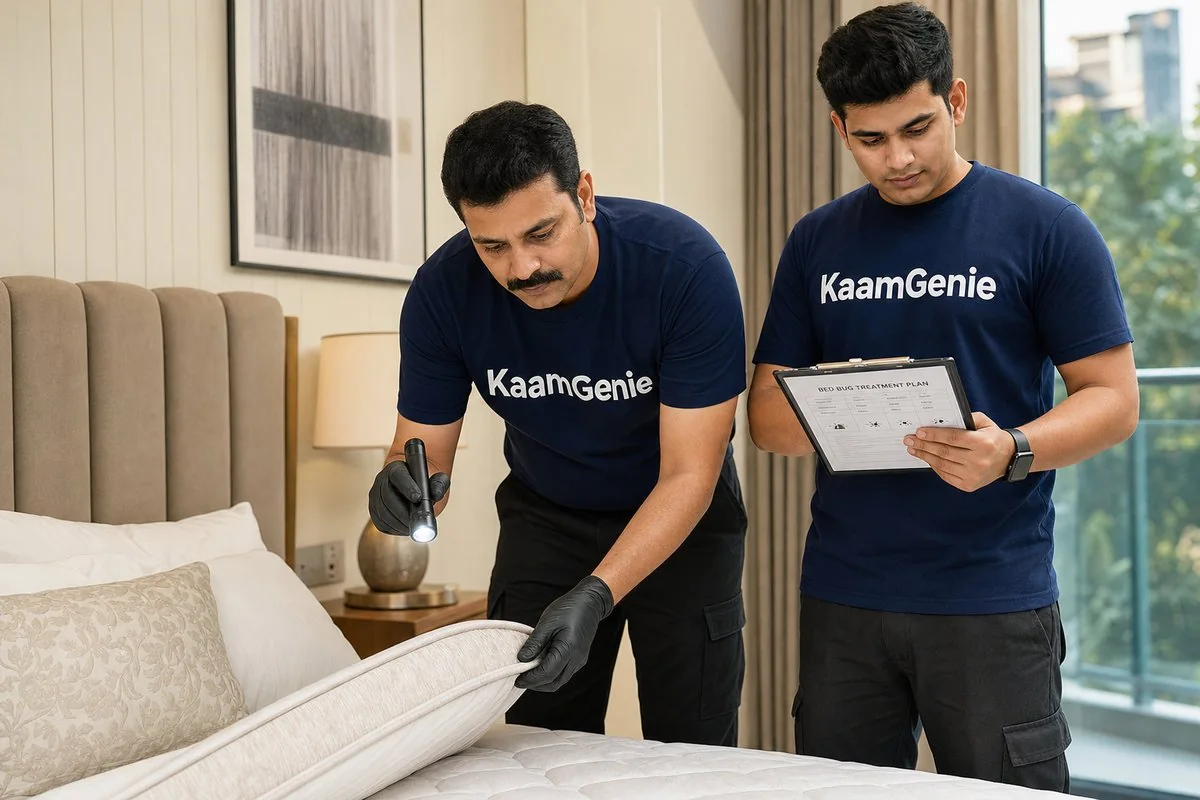
Service · Pest Control CategoryBed bugs are the single most disruptive household pest because they attack you while you sleep. Within a week of a serious infestation you’re running on three hours of broken sleep, your kids are covered in bite welts, and you’ve started inspecting hotel rooms with a torch on every trip. Delhi sees a spike in calls after every wedding season, every summer holiday, and every PG-room turnover — bed bugs hitch a ride in luggage, second-hand furniture, and shared accommodation walls. They cannot be solved with a single visit because of their 10-14 day egg cycle — eggs survive the spray, hatch a week later, and re-start the infestation. Our protocol is built around this biology: two visits, fourteen days apart, CIB&RC-approved chemicals, mattress seams to skirting boards to frame joints. Starting at ₹1,299 for a single bedroom, both visits included.
Pick the option that matches your home or premises. Fixed prices · GST 18% extra · Same-day available.
All prices: GST 18% extra · Cash / UPI / Card / Bank transfer · Same-day available · Free phone consultation before booking.
Every quote is confirmed on the phone after a 5-minute description of your premises. We never quote without understanding the job, and we never change the price on arrival.
One of the reasons bed bug infestations get out of control in Delhi homes is that people misidentify them. Rashes get blamed on heat, bites get blamed on mosquitoes, and the actual bug is hiding in a mattress seam two feet from the sleeper. Here’s how to know it’s bed bugs specifically.
If you spot any two of these signs together, treat it as confirmed and book an inspection. Bed bug infestations double in population every 16 days — what looks like a small problem this week is a serious one next month.
Bed bug infestations in Delhi are not a hygiene problem. Some of the cleanest homes in Vasant Kunj and Defence Colony get bed bugs because of how the pest spreads. Here are the four most common Delhi entry points.
1. Travel and luggage. By far the most common cause. Bed bugs hide in the seams of luggage in hotel rooms, hostels, friends’ spare rooms, and overnight trains. You bring the bag home, set it on the bed for unpacking, and a few bugs walk out and into the mattress. Two weeks later, you have an infestation. Delhi spikes after every Goa season, every summer trip to the hills, and every wedding away from home.
2. Second-hand furniture. Buying a used bed frame, sofa, or mattress — from OLX, a moving neighbour, or a relative who’s downsizing — is high-risk. Bed bugs hide in joints, screw holes, and fabric piping where they’re invisible without a torch. The furniture comes home and the bugs spread from there. Builder-floor flats with handed-down furniture from the previous tenant are particularly vulnerable.
3. Apartment building transmission. In dense Delhi housing — DDA flats, multi-storey builder floors, PG buildings, hostels — bed bugs travel through wall cracks, electrical conduits, common skirting, and shared furniture. A neighbour’s untreated infestation becomes yours within weeks. This is why PG buildings and hostels need building-wide treatment, not single-room.
4. PG and hostel accommodation. Shared PG rooms in Karol Bagh, Mukherjee Nagar, Laxmi Nagar, and Munirka are bed bug hotspots because of constant tenant turnover. A new tenant arriving with infested luggage seeds an entire floor. We handle dozens of PG calls every month for exactly this reason.
None of these point to anyone’s housekeeping being at fault. Bed bugs are an opportunistic insect — if there’s a sleeping human and a hiding spot within 5 metres, they’ll take it.
This is the single most important thing to understand about bed bug treatment, and it’s why we refuse to do single-visit jobs.
A fertilised female bed bug lays 1-5 eggs per day, every day, for the rest of her life. The eggs are pearl-white, about 1mm long, and are glued into the same seams and crevices where adult bugs hide. The eggs are protected by a hard chitin casing that chemicals cannot reliably penetrate. Even the strongest CIB&RC-approved insecticides used at residential concentrations will kill 100% of live bugs and nymphs on contact, but only 30-50% of eggs.
The eggs hatch 10-14 days after they’re laid. So here’s what happens if you treat once and walk away:
This is exactly why so many people who’ve used cheaper single-visit services keep telling us “they treated us three times and the bugs always come back.” Three single visits, 30 days apart, is not the same as one proper two-visit protocol.
The two-visit protocol works because visit 2 lands inside the 10-14 day window — when the surviving eggs have hatched into nymphs but before the nymphs have matured to reproductive age. We kill the entire second generation before it can lay a third generation. Cycle broken.
Both visits are included in the starting price. This is non-negotiable for us — we won’t take a job if a customer wants to skip visit 2 to save money, because the failure rate is too high and we won’t put our name on it.
Visit 1 — Day 0 (60-90 minutes)
Visit 2 — Day 14 (30-45 minutes)
Done correctly, this protocol eliminates over 95% of household bed bug infestations in two visits. The remaining cases are usually buildings with active untreated neighbours, or homes where the customer continued to travel and reintroduced bugs from outside.
Bed bugs are tiny and lazy — they don’t travel far from a feeding source. 95% of an infestation is within 2 metres of where you sleep. These are the exact surfaces we treat in every visit.
We do not treat clothes inside wardrobes, soft toys, or sleeping items with the chemical — you handle those with hot-water washing and tumble-drying as part of pre-treatment prep (covered below).
Every chemical we use is registered with the Central Insecticides Board & Registration Committee (CIB&RC) under the Ministry of Agriculture — the Indian regulator for household pesticide chemicals. We use the residential-grade concentrations CIB&RC permits, never grey-market or industrial-strength substances.
Deltamethrin. A synthetic pyrethroid — the standard first-line bed bug chemical worldwide. Used at 1.25% concentration for surface spraying. Kills on contact and leaves a 7-10 day residual film on treated surfaces. Low odour, low human toxicity at residential concentration.
Cypermethrin. Used for severe infestations where deltamethrin alone may have been compromised by previous over-the-counter treatments. Slightly stronger residual effect, still in the pyrethroid family.
Imidacloprid. A neonicotinoid used in combination treatments for heavy infestations — the bugs carry it back to the harbourage and it kills late-stage nymphs. Lower odour profile.
Steam (no chemical). For direct treatment of mattresses, pillows, and soft furnishings. 70-80°C wet steam kills bed bugs and eggs on contact without leaving any residue on the surface you sleep on. This is the safest part of the protocol for families with infants.
Safety for residents, pets, and children. The protocol requires the treated bedroom to be vacated for 4-6 hours after treatment with windows open for ventilation. Pets, infants, pregnant women, and anyone with respiratory issues should leave for longer — ideally the full day. Once the chemical has dried (2-3 hours) and the room has been aired, surfaces are safe to touch. The room is safe to sleep in by bedtime on treatment day. We’ll walk you through the exact timeline on arrival.
Bed bug populations double every 16 days. The longer you wait, the more rooms get infected and the more it costs to treat. Two-visit protocol, CIB&RC-approved chemicals, both visits included — starting at ₹1,299.
Bed bug treatment only works if the customer does their part. None of these steps are negotiable — if they’re skipped, the infestation survives in untreated fabric and re-establishes within weeks. We’ll re-explain this on the booking call.
The night before treatment.
Morning of treatment. Plan to be out of the home for 4-6 hours after the crew finishes. Take pets, infants, and anyone with respiratory issues out for the full day. We’ll send a reminder message the morning of.
Bed bug pricing scales with the number of bedrooms infested, not the total flat size. A 4 BHK with bed bugs only in the master bedroom is priced as a 1-bedroom job. Every price below includes both visits — we do not charge separately for the visit-2 follow-up.
| Bedrooms infested | Starting price | Two-visit included | Duration (visit 1) |
|---|---|---|---|
| 1 bedroom | Starting at ₹1,299 | Yes — both visits | 60-90 minutes |
| 2 bedrooms | Starting at ₹2,199 | Yes — both visits | 90-120 minutes |
| 3 bedrooms | Starting at ₹2,999 | Yes — both visits | 2-3 hours |
| 4+ bedrooms / whole house | Starting at ₹3,999 | Yes — both visits | 3-4 hours |
| PG / hostel / hotel (per room) | Starting at ₹4,999 (multi-room quote) | Yes — both visits, per room | Phased, building-wide |
Final pricing is confirmed on the inspection call after we understand the room count, infestation severity, and accessibility. We’ll never quote you a price without that conversation — and we’ll never change the price on arrival.
Three patterns we see almost every week in Delhi — if any of these sound familiar, you know what’s happening.
Saket flat post-travel. A working couple in a 2 BHK in Saket returned from a 10-day Goa trip in February. Within a week the wife had clustered bite marks on her arms and shoulders. They blamed mosquitoes for ten days, then spotted rust stains on the bedsheet. Inspection found bed bugs in the master mattress seams only — brought home from the Goa hotel in luggage. Treated as single-bedroom (₹1,299), visit 2 fourteen days later confirmed full clearance. No recurrence on the 30-day follow-up.
Karol Bagh PG building. A PG operator in Karol Bagh called after three tenants on the second floor complained of bites within the same week. Inspection found heavy infestation across 4 rooms with evidence of wall-cavity spread between two adjacent rooms. Treated as a phased commercial job — rooms 1 & 2 on day 0, rooms 3 & 4 on day 1, then full-building re-treat at day 14. Per-room pricing applied. Operator now does our prevention briefing for every new tenant.
Greater Kailash 3 BHK. A family in GK-1 bought a used solid-wood bed frame from OLX for the kids’ room. Three weeks later both kids were waking up with bites. Adults in the master bedroom were unaffected at the time of the call. Inspection confirmed bugs in the second-hand frame joints (visible in the screw holes) and a small spread to the kids’ mattress. Treated as 1-bedroom (the kids’ room), with a preventive light treatment of the master bedroom skirting as a precaution. No spread documented in the 30-day window.
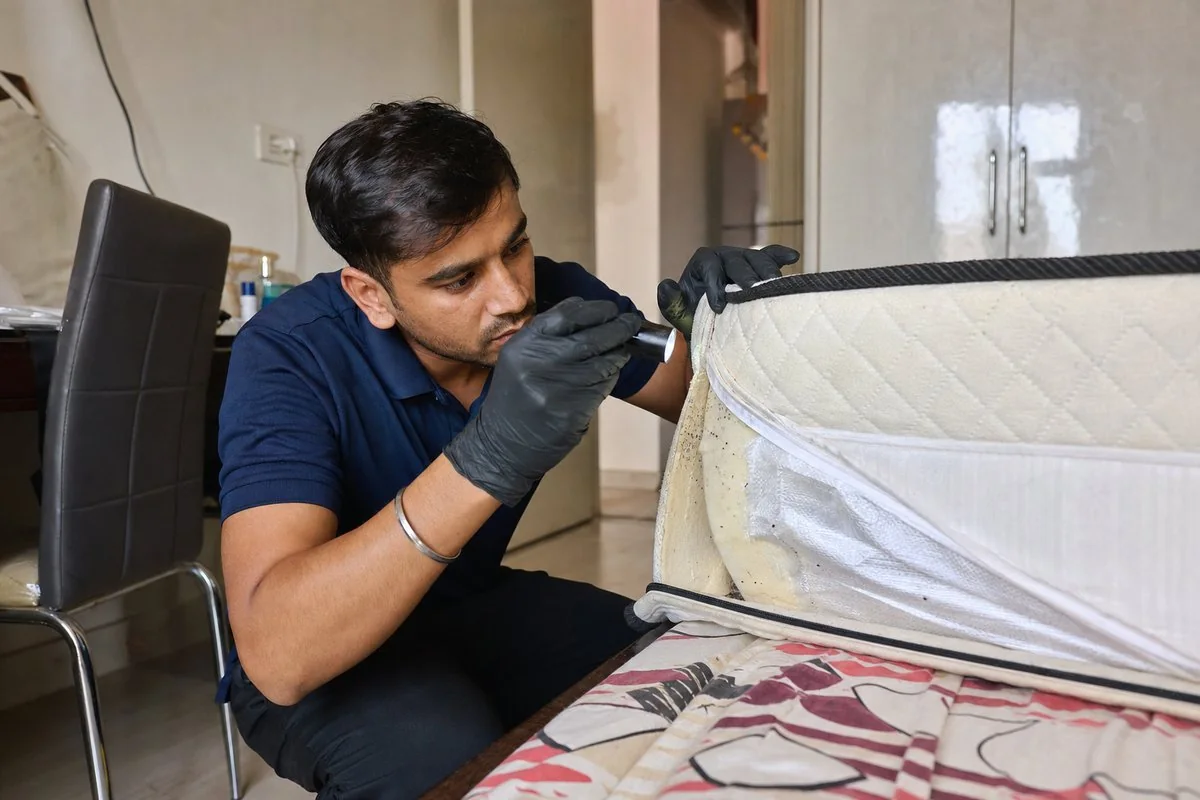
One of our pest specialists comes to your home, checks every mattress seam and skirting joint, and gives you an honest assessment. No pressure, no obligation. If bed bugs are confirmed, you’ll get a clear quote on the spot.
Bed bug treatment is currently live across all of Delhi:
Coming soon: Gurgaon, Noida, Faridabad, Ghaziabad. We’re onboarding pest control crews in these zones over the next few months. If your bed bug problem in NCR outside Delhi is urgent, call us anyway — we may be able to arrange a one-off visit while permanent coverage is set up.
Three differences. Bed bugs are flat, oval, reddish-brown, about the size of an apple seed (4-5mm) and visible to the naked eye. Fleas are smaller, darker, and jump — bed bugs crawl. Dust mites are microscopic and invisible. The giveaway signs for bed bugs specifically are rust-coloured smears on bed sheets (crushed bugs after you roll over them), dark pinprick faecal spots along mattress seams, a sweet musty odour in a heavily infested room, and itchy bites in lines or clusters on exposed skin — not random single bites.
Because of the bed bug egg cycle. A female bed bug lays 1-5 eggs every day, and those eggs hatch 10-14 days later. The chemicals we use kill live bugs and nymphs on contact but cannot reliably penetrate the egg casing. So if we only treat once, the eggs hatch a week later and you have a new generation. Visit 1 kills everything currently alive. Visit 2, scheduled 14 days later, catches the freshly hatched nymphs before they can lay their own eggs and breaks the cycle. Skipping visit 2 is the #1 reason bed bug treatments fail.
Yes — when used correctly. We use only CIB&RC-approved insecticides like deltamethrin, cypermethrin, and imidacloprid, at the residential concentrations the Central Insecticides Board permits. They are sprayed into seams, joints, and crevices — not in open air or on toys. We ask families to leave the treated room for 4-6 hours and ventilate well after. Once dry, surfaces are safe to touch and use. Pets and small children should stay out of the actively treated bedroom for at least 6 hours. We brief every household on the exact protocol before starting.
Three things, ideally the night before. First, strip all bedding — sheets, pillow covers, duvet covers, mattress protectors — and wash them at 60°C or higher, then tumble-dry hot. Heat kills bugs and eggs in fabric. Second, clear the floor around the bed of clothes, shoes, books, toys — we need to reach skirting and bed frame freely. Third, vacuum the room thoroughly and empty the vacuum bag outside immediately. Don’t move furniture or mattresses from the infested room to a clean room before treatment — you’ll just spread the infestation.
Yes, after the standard 4-6 hour leave window and good ventilation. The chemicals we use dry within 2-3 hours and lose their airborne phase. By bedtime on treatment day, the room is safe to sleep in. In fact we want you to sleep in the treated bed — bed bugs are attracted by your body heat and CO2, which draws any surviving bugs out of hiding and onto the treated surfaces where they die. Don’t move to a different bed or sofa after treatment, that just gives the bugs new territory.
No. The chemicals we use are sprayed into mattress seams, piping, tags, and along the box-spring frame — not soaked into the foam or fabric. They are water-based at residential concentration and don’t stain, discolour, or warp mattress materials. After the treatment dries (2-3 hours), the mattress is safe to use and looks identical. We do not recommend throwing out your mattress before treatment — it’s almost always unnecessary, and a new mattress in an untreated room will be re-infested within weeks. Treat first, throw out only if structurally damaged.
For a single bedroom, the visit-1 treatment takes 60-90 minutes on-site — inspection, steam treatment of mattress seams, targeted chemical spraying of all hiding spots, and documentation. Multi-bedroom flats with infestation in more than one room run 2-3 hours. The visit-2 follow-up 14 days later is faster — typically 30-45 minutes — because we’re only re-treating spots where we found fresh activity. Heavy infestations in PGs or hotel rooms with multiple beds may need a full half-day on visit 1.
Every bed bug treatment carries a 30-day activity warranty from visit 2. The two-visit protocol itself is the primary guarantee — if you complete both visits and follow our pre-treatment instructions, bed bugs are eliminated in over 95% of cases. If you spot live bed bug activity, fresh rust stains, or new bites in the 30 days after visit 2, call us and we come back to re-treat free of cost. The warranty does not cover re-infestations from outside sources — visitors, second-hand furniture, or travel after treatment.
Pricing depends on how many bedrooms are infested, not on the size of the whole flat. Single-bedroom treatment starts at ₹1,299 and includes both visits. Two bedrooms typically start at ₹2,199, three bedrooms at ₹2,999, and larger 4+ BHK homes or PG buildings are quoted after a quick phone consultation. The price always includes both visits — we never charge separately for the follow-up. Cheap single-visit treatments advertised for ₹500-800 are almost guaranteed to fail because they skip the egg-cycle problem.
Yes — we handle commercial bed bug work across Delhi NCR including PG accommodations, hostels, hotels, guest houses, and serviced apartments. For commercial properties we do a phased room-by-room treatment so the building can stay operational, coordinate timing with housekeeping, and provide treatment certificates per room for your records. We also brief your staff on prevention — what to look for during turnover, how to handle infested linen, and how to stop guests from carrying bugs in. Pricing is quoted per room after a quick on-site survey.
Bed bug populations double every 16 days. Every week you wait, you’re losing sleep, your kids are getting more bites, and more rooms get infected. Call +91 95603 66362, WhatsApp here, or click the button below. Same-day inspection available across Delhi.
Published by KaamGenie Private Limited — Delhi NCR’s trusted home services provider for water tank cleaning, pest control, and household maintenance. CIN: U74909DL2026PTC466750. Last updated 5 June 2026.
Every pest control service we offer across Delhi NCR — CIB&RC chemicals, photo documentation, GST invoice, transparent pricing.
Full overview of every pest control sub-service. Starting prices, process, CIB&RC chemicals, what each treatment covers.
Anti-termite chemical injection for Delhi wooden door frames, almirahs, plywood furniture and structural wood.
Combo cockroach, ant, spider, lizard, mosquito treatment for Delhi homes. Pet-safe and child-safe protocols.
Targeted gel-bait protocol for kitchen and bathroom infestations. CIB&RC chemicals, 15-day re-treatment warranty.
Thermal fogging + larvae treatment + breeding-site elimination. Critical for dengue prevention pre/post monsoon.
Tamper-resistant bait stations + entry-point sealing + 30-day follow-up audit. Safe for kids and pets.
FSSAI-compliant pest control for restaurants, hotels, offices. Monthly visits, audit-ready documentation.
4 quarterly visits + free re-treatments + scheduled reminders. 20-25% off per-visit pricing.