Home › Services › Pest Control › Rodent Control
Service · Pest Control CategoryDelhi homes near food markets, basements, ground floors, and society garbage zones get rats regularly — it’s not a hygiene failure on your part, it’s geography. Lajpat Nagar near Central Market, Khan Market kitchens, Mayur Vihar garbage shafts, Vasant Kunj kothis with garden contact — all hotspot zones we treat every week. The fix isn’t a few sticky traps. It’s tamper-resistant bait stations in safe locations, entry-point sealing with steel wool and silicone caulk so the next wave can’t follow, and a 30-day follow-up audit to make sure the colony stays cleared. Pet-safe placement away from kids and dogs. Starting at ₹999. Same-day inspection available across Delhi.
Pick the option that matches your home or premises. Fixed prices · GST 18% extra · Same-day available.
All prices: GST 18% extra · Cash / UPI / Card / Bank transfer · Same-day available · Free phone consultation before booking.
Every quote is confirmed on the phone after a 5-minute description of your premises. We never quote without understanding the job, and we never change the price on arrival.
Rats are not magic. They follow physical entry routes, and once you know what they are, the solution becomes obvious: seal them. Here are the six entry points we find in 90% of Delhi homes we inspect.
Until these entry points are physically sealed, killing the current rats just creates space for the next ones to move in along the same routes within 2-3 weeks. That’s why our treatment always starts with mapping the entry points.
Sticky pads, snap traps, and the ₹200 bait packets from kirana stores are the most common DIY approaches in Delhi homes. They all share the same three failures.
1. They kill one or two rats, not the colony. A typical Delhi house rat (Rattus rattus) lives in a colony of 8-25 individuals. A breeding female produces 5-7 litters per year with 6-8 pups each. Killing one or two foragers doesn’t even dent the population — the colony replenishes within weeks. You see a dead rat, feel like the problem is solved, and three weeks later you’re back to scratching sounds at night.
2. They don’t address entry points. Even if a DIY trap killed every rat currently in the home (it won’t), new rats follow the exact same scent trail through the same entry points within days. Rat urine carries pheromone markers that other rats can detect for weeks. Without sealing, you’re running an endless conveyor belt of rats and traps.
3. They’re dangerous in homes with kids and pets. Snap traps catch fingers. Sticky pads are a nightmare to clean up if a dog steps on one. Loose grain bait from kirana shops is unbranded, often the wrong chemical, sometimes acutely toxic to dogs and cats — we’ve seen multiple cases of pet poisoning from grandma’s “rat ki dawa” left in the kitchen corner.
Real rodent control is a 4-step protocol, not a product you buy. The product is the bait; the work is the survey, placement, sealing, and follow-up.
Same protocol on every job, scaled to property size. No shortcuts — if any step is skipped, the treatment fails.
For a typical Delhi 1-2 BHK flat with light-to-moderate activity, the initial visit is 60-90 minutes and the population is cleared in 7-14 days. Heavy infestations — restaurants, basements, society garbage areas — can take 30-45 days and multiple follow-up rounds.
There are three broad approaches to rodent control. Here’s the honest comparison.
Snap traps and sticky pads. Cheap, immediate, satisfying to see a result. But they catch one rat at a time, miss the colony entirely, can injure kids and pets, and are gruesome to clean up. We don’t use them as a primary tool. For one-off captures in food-prep zones where bait can’t go, we’ll deploy a small number of snap traps under supervision — but never as the main treatment.
Loose poison pellets / grain bait. The kirana-shop standard. Effective at killing rats but dangerous beyond measure: dogs and cats find and eat the pellets, kids see grain and put it in their mouth, the bait scatters under appliances where you can’t retrieve it. We never use loose poisons in residential homes. Most pet poisoning cases we hear about trace back to a loose-pellet treatment.
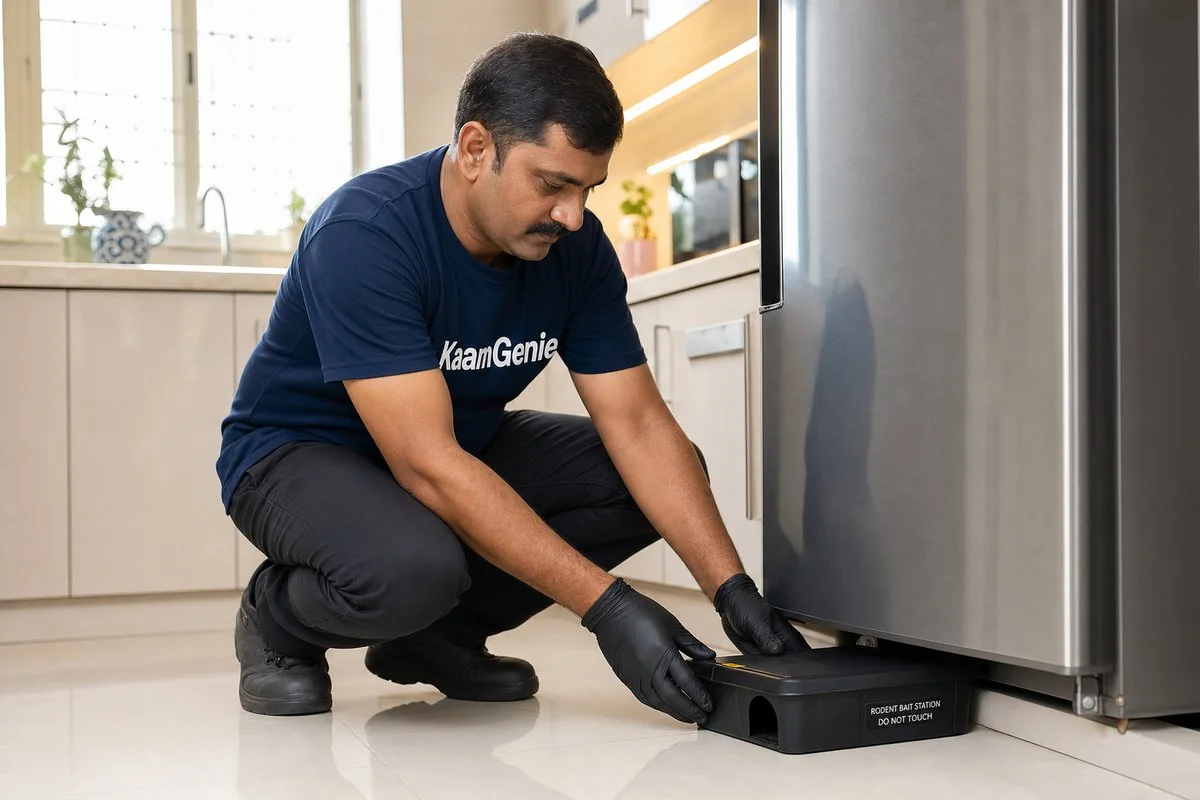
Tamper-resistant bait stations. Our standard tool. Black plastic, lockable, weighted, with the bait sealed inside a chamber only a rodent’s small head can reach. A toddler can pick the box up and shake it without getting near the bait. A dog can paw at it and not access the contents. The bait inside is CIB&RC-approved second-generation anticoagulant — effective at low doses, slow-acting so rats don’t develop bait shyness, and the rodents typically die outside the building looking for water.
The bait stations cost more per unit than loose pellets, but they’re the only ethically defensible option in homes with kids, pets, or near food prep. We don’t take shortcuts here.
The sealing step is where most pest-control companies cut corners. We don’t. Here’s exactly what we use and why.
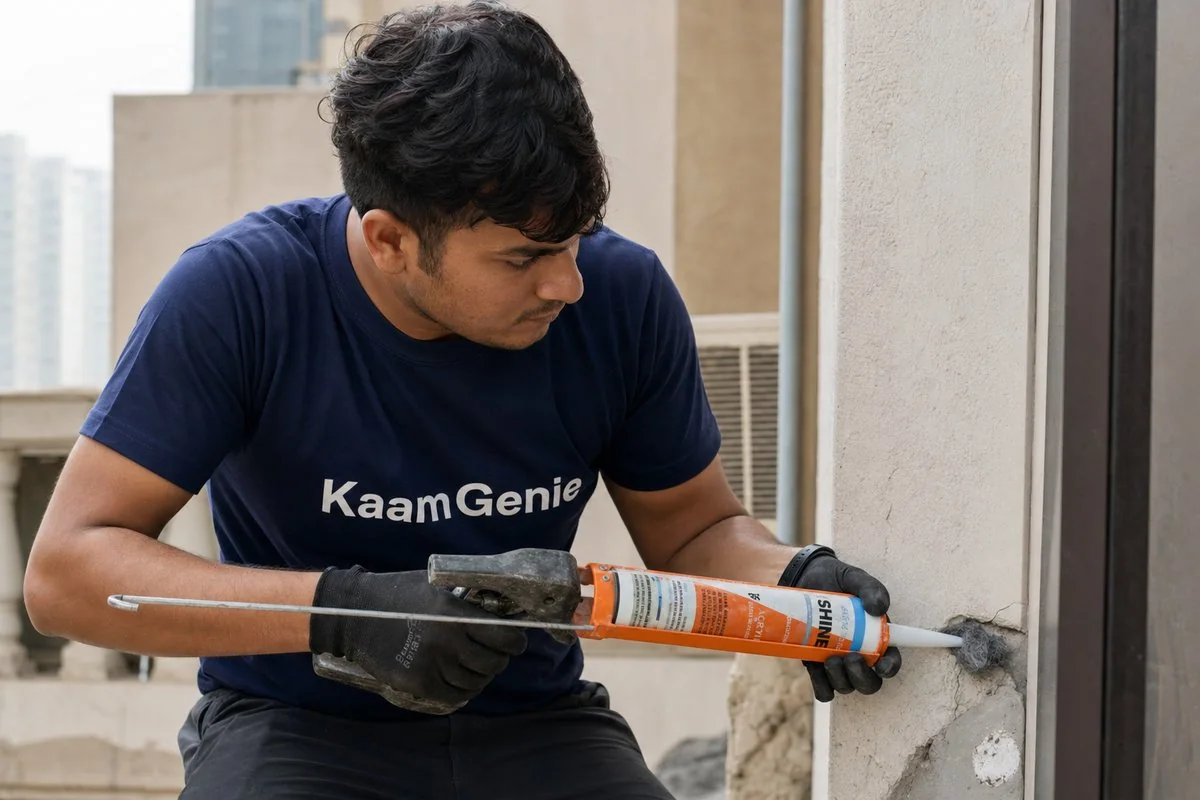
Steel wool stuffing. Rats can chew through wood, drywall, plastic, thin aluminium, and even soft cement — but they cannot chew through steel wool. The strands cut their gums on contact, and they back off. We use coarse-grade industrial steel wool, packed tight into every gap from 6mm to 40mm wide. It’s the primary defence layer.
Silicone caulk. Applied over the steel wool, the caulk holds the stuffing in place permanently and seals the gap against moisture and weather. We use weatherproof neutral-cure silicone in white, brown, or grey to match the wall. For interior application it’s nearly invisible after curing. Caulk alone won’t stop rats — they’ll chew straight through — but as a top layer over steel wool, it’s permanent.
Galvanised steel mesh inserts. For larger penetrations — AC piping wall holes (60-80mm), water-line wall openings, broken brick work — we cut and fit galvanised steel mesh, then bond it in with caulk and finish with cement or putty for a clean look. The mesh is corrosion-resistant and lasts years.
Stainless steel vent covers. Kitchen exhaust outlets, bathroom ventilation grilles, and external vents need airflow but not rodent access. We install heavy-grade stainless mesh covers (rust-proof, won’t flake) over the openings on the outside of the wall. Air flows; rats don’t.
Door brush strips. For door bottoms with persistent gaps, we install heavy-bristle brush strip seals along the bottom edge. They allow normal door opening, seal the gap against rodents, and are inexpensive to replace if worn.
What we don’t use: spray foam alone (rats chew through it in days), newspaper or rags stuffed into gaps (gone in one night), masking tape on door bottoms (useless), and any plastic mesh (rats chew through plastic faster than wood).
A breeding pair of rats becomes 50+ in six months. Tamper-resistant bait stations, entry-point sealing, 30-day audit. Pet-safe placement, starting at ₹999.
Once we’ve done thousands of rodent inspections across Delhi, the hiding spots become predictable. Here’s where to look first — and where our bait stations almost always go.
Behind and underneath the refrigerator. Warm motor compartment, hidden from view, close to kitchen food smells. Probably the single most common nesting spot in Delhi flats. Pull the fridge out — if you see droppings, gnawed cable insulation, or shredded paper, that’s a confirmed nest site.
Under kitchen sinks and inside utility cabinets. Plumbing penetrations come up through the cabinet floor, providing both an entry route and shelter. Damp, dark, and adjacent to food. The under-sink trap is almost always a rat highway in older Delhi homes.
Drop ceilings and false ceilings. Common in living rooms and bedrooms of newer Delhi flats. Once a rat gets above the false ceiling (often via an AC trunking gap), they have a hidden city-wide highway. You’ll hear scratching at night and never see anything during the day. We open inspection panels and bait the cavity.
Basement storage and parking. The single biggest harbourage zone for any building. Boxes, old furniture, unused luggage, society common storage — all perfect rat nesting material. Society basements with poor housekeeping become breeding grounds that supply the entire building above.
Garbage areas and waste storage. If your home has a balcony garbage zone, society shaft, or external dustbin near the wall, this is a feeding ground. Rats live nearby and forage into the home for water and shelter. The garbage area itself needs treatment, not just the kitchen inside.
Society common areas. Lift machine rooms, water tank rooms (we’ve seen rats nesting next to underground sump tanks), terrace ducts, electrical rooms, society gym storage. Individual flat treatment fails if the common areas are infested — which is why we offer RWA-wide contracts.
The follow-up is what separates a real rodent control treatment from a one-shot bait drop. It’s built into every standard job, free of charge.
What we check. Each bait station is opened and inspected. Heavy bait consumption means the population is still active — we refill and may extend with a paid second round. Zero consumption means either the colony is cleared, or rats are ignoring the bait because they’ve found something tastier (in which case we relocate the station). Partial consumption is normal mid-treatment.
Re-check sealed entry points. Settling, monsoon water damage, or maintenance work (a plumber opening up a wall) sometimes creates new gaps. The follow-up crew checks every sealing point against the photo log and fixes anything that’s broken.
Identify new entry points. If activity is still high despite good bait consumption, there’s usually a new entry route we missed first time — or one that opened up. We re-survey the property and add seals where needed.
Audit log and certificate. You get a written follow-up report listing bait consumption per station, sealing status, and recommendation for next steps (close the job, schedule paid extension, or start a maintenance contract). For restaurants and societies, this report is FSSAI / RWA-audit compatible.
For high-risk properties — ground floors near markets, restaurants, society common areas, kothis with garden boundaries — we strongly recommend the optional monthly maintenance contract that includes 12 audits per year, ongoing bait refills, and one free re-treatment if activity spikes. For around ₹3,999/year for a 2-3 BHK Delhi flat, it’s cheaper than two emergency call-outs.
Rodent control pricing depends on property size, severity of infestation, number of bait stations needed, and whether external sealing work is involved. Honest starting prices below — the final quote is given on the phone after a 5-minute description of your home.
| Property type | Starting price | Bait stations included | 30-day follow-up included |
|---|---|---|---|
| 1-2 BHK flat (light activity) | Starting at ₹999 | 3-4 stations | Yes — included |
| 2-3 BHK flat (full home) | Starting at ₹1,799 | 5-7 stations | Yes — included |
| Kothi / bungalow / ground-floor builder floor | Starting at ₹2,499 | 8-12 stations + external sealing | Yes — included |
| Restaurant kitchen / commercial | Starting at ₹3,499 | 10-15 stations + FSSAI placement log | Yes — monthly contract option |
| Society common areas (RWA) | Starting at ₹4,999 | Quoted per society size | Yes — monthly contract option |
Three patterns we see repeatedly — these are anonymised but typical of the work we do every week.
Lajpat Nagar restaurant basement. A small family-run restaurant near Central Market called us after a customer complained about a rat sighting near the dry storage. Survey found heavy rodent activity in the basement storage area, gnaw marks on flour sacks, droppings throughout the back-of-house, and an open drain penetration near the service entrance. We placed 12 bait stations across basement and service zones (none in food-prep), sealed the drain penetration with steel mesh and caulk, brush-stripped the service door, and started them on a monthly maintenance contract. Activity cleared in 18 days; they’ve been on monthly service for 14 months without incident.
Vasant Kunj kothi garden side. An owner-occupied kothi in Vasant Kunj with garden boundary to a neighbouring vacant plot. Family was hearing scratching at night in the ground-floor utility room and finding droppings near the dog food storage. Survey found three entry points: a broken floor drain in the back patio, an AC piping wall hole, and a gap under the garden-side door. We placed 8 bait stations in utility areas (none in the main living spaces where the dog roams), sealed all three entry points, and installed a brush-strip on the door. Population cleared in 11 days; 30-day follow-up showed zero activity and minimal bait consumption.
Mayur Vihar society garbage shaft. A 60-flat society in Mayur Vihar Phase 1 called after multiple residents reported rats coming up the garbage chute into their kitchens. Inspection found the basement chute collection area was the colony nest — piles of accumulated garbage and minimal housekeeping. We worked with the RWA to schedule a deep clean of the basement, then placed 15 bait stations along the chute and basement perimeter, sealed the chute hatches on each floor with steel mesh inserts, and started an ongoing monthly contract for the common areas. Individual flat complaints dropped to zero within 30 days.
One of our pest specialists comes to your home, surveys the property, checks for droppings and entry points, and gives you a clear quote. No pressure, no obligation.
Rodent control is currently live across all of Delhi:
Coming soon: Gurgaon, Noida, Faridabad, Ghaziabad. We’re onboarding pest control crews in these zones over the next few months. If your rodent problem in NCR outside Delhi is urgent, call us anyway — we may be able to arrange a one-off visit while permanent coverage is being set up.
Three quick checks. Size of droppings — rat droppings are 12-18mm long, dark brown, capsule-shaped; mouse droppings are 3-6mm and look like rice grains. Sound — rats make heavy scratching and gnawing at night, usually in ceilings, drop ceilings, or under floors; mice make lighter, faster scurrying behind kitchen cabinets and skirting. Damage — rats chew through wood, plastic pipes, and even thin metal; mice mostly chew paper, cardboard, and food packets. In Delhi, ground floors and basements mostly have rats; upper-floor flats usually have mice. We treat both, but the bait sizing differs.
Yes — that is the entire reason we use tamper-resistant bait boxes instead of loose poison. The black plastic stations are lockable, the bait sits in a sealed inner compartment that only a rodent’s small head can reach, and they’re placed in inaccessible corners — behind refrigerators, under sinks, behind washing machines, in utility ducts. A toddler can pick the box up and shake it without getting near the bait. We never scatter loose pellets, never put bait in open trays, and never use grain-based poisons in homes with cats or dogs. We brief every household on placement before starting.
Honest answer: some rats die outside (most), a few may die in inaccessible spots like wall cavities or ceiling voids. The CIB&RC-approved anticoagulant baits we use cause increasing thirst, so rodents typically leave the building looking for water and die outdoors in 3-7 days. In the small minority where one dies indoors, the smell lasts 7-10 days. We will come out and locate and remove it if it’s accessible. Heavy infestations are more likely to have an indoor death — which is why for severe cases we use a multi-visit approach with smaller bait quantities per round.
For a typical Delhi home with light-to-moderate rat activity, the initial visit takes 60-90 minutes (survey + bait placement + entry-point sealing) and the population is cleared in 7-14 days. We then do the 30-day follow-up audit. For heavy infestations in restaurants, basements, society garbage areas, or food storage zones, full clearance can take 30-45 days with two or three follow-up visits. Bait consumption tells us what’s happening — fresh bait disappearance for 3+ days after the initial drop means the population is still active and we need another round.
Yes — every standard rodent control job includes one free 30-day follow-up audit. The crew comes back, opens each bait station, checks how much bait was consumed, refills if needed, inspects for any new entry points that opened up, and re-checks the sealing material at the original entry points. If bait consumption is still high, we extend with a paid second follow-up. For restaurants, society common areas, and high-risk properties we offer ongoing monthly contracts that bundle the audit, bait refill, and one free re-treatment if activity returns.
Steel wool stuffing plus silicone caulk is the gold standard — rats can’t chew through steel wool, and the caulk holds it in place and seals the gap against weather. For larger holes (wall penetrations around AC piping or water lines), we use galvanised steel mesh inserts. For vents and exhaust openings where airflow must be preserved, we install heavy-grade stainless mesh covers. We don’t use spray foam alone — rats chew through it in days — and we don’t use newspaper or rags. Every sealed point is photographed before-and-after for the audit log.
Starting at ₹999 for a 1-2 BHK Delhi flat with light activity — that covers the survey, 3-4 bait stations, basic entry-point sealing, and the 30-day follow-up. Full-home treatment for a 2-3 BHK with moderate activity starts at ₹1,799. Kothis, bungalows, and ground-floor builder floors with garden contact start at ₹2,499. Restaurant kitchens and society common areas start at ₹3,499. Every quote is given on the phone after a short description of the property and the rodent activity you’ve spotted. We never change the price on arrival.
Yes — restaurant kitchens and food businesses are a major part of our rodent control work. We follow strict food-grade protocols: no bait stations near open food prep zones, all bait boxes in service areas and basement storage only, FSSAI-compatible placement records, and a monthly service contract option that helps you stay audit-ready. We also do entry-point sealing on the kitchen exhaust hood penetrations, drain pipes, and dry storage doors, which is where most restaurant rodent issues actually start. Lajpat Nagar, Khan Market, Connaught Place, and Defence Colony restaurants are regular clients.
Yes — if you don’t seal entry points. This is the single biggest reason DIY traps and one-off bait drops fail. Killing the current rats doesn’t stop the next wave from following the same scent trail and entry route into your home. Our 4-step protocol — survey, bait, seal, audit — is built around this. The sealing step is what actually keeps rats out long-term. Properties most prone to re-entry: ground floors near markets, basements with drain access, restaurants, society garbage shafts, kothis with garden boundaries. For these we recommend ongoing monthly contracts.
Yes — RWA / society common-area rodent control is a regular line of work for us. Typical scope: garbage shaft and chute treatment, basement parking bait stations, society gym storage, water tank room perimeter, lift machine rooms, and external boundary walls. We provide RWAs with a monthly service contract that bundles bait refills, the 30-day audit, and one free re-treatment if activity spikes — priced per society size. We carry GST invoices, KYC-verified crew, and treatment certificates the RWA can share with residents. Same-day site visits available for emergency calls.
Rats don’t pause. Every week you wait, the colony grows and the damage spreads — chewed cables, contaminated food storage, gnawed plywood, sleepless nights. Call +91 95603 66362, WhatsApp here, or click the button below. Same-day inspection available across Delhi.
Published by KaamGenie Private Limited — Delhi NCR’s trusted home services provider for water tank cleaning, pest control, and household maintenance. CIN: U74909DL2026PTC466750. Last updated 5 June 2026.
Every pest control service we offer across Delhi NCR — CIB&RC chemicals, photo documentation, GST invoice, transparent pricing.
Full overview of every pest control sub-service. Starting prices, process, CIB&RC chemicals, what each treatment covers.
Anti-termite chemical injection for Delhi wooden door frames, almirahs, plywood furniture and structural wood.
Combo cockroach, ant, spider, lizard, mosquito treatment for Delhi homes. Pet-safe and child-safe protocols.
Targeted gel-bait protocol for kitchen and bathroom infestations. CIB&RC chemicals, 15-day re-treatment warranty.
Two-visit protocol covering mattress seams, skirting, frame joints. Accounts for 10-14 day egg-hatching cycle.
Thermal fogging + larvae treatment + breeding-site elimination. Critical for dengue prevention pre/post monsoon.
Gel baiting and targeted spray for sugar ants, black ants and red ant trails in kitchens and homes.
FSSAI-compliant pest control for restaurants, hotels, offices. Monthly visits, audit-ready documentation.
4 quarterly visits + free re-treatments + scheduled reminders. 20-25% off per-visit pricing.