
The short version
- Gurgaon runs on three water sources at once — GMDA canal supply (treated at the NCR/Basai and Chandu Budhera plants), hard borewell groundwater, and private tankers.
- Supply is intermittent, so almost every home and society stores water in an underground reservoir (UGR) and pumps it to rooftop tanks.
- Hardness and TDS leave scale; tanker and borewell sediment settles on the floor; standing time lets biofilm grow.
- None of that is fixed by a purifier — it has to be scrubbed and disinfected out of the tank itself, on a schedule.
If your building takes any tanker water at all, your tank is collecting sediment you can’t see. Cleaning is the only thing that removes it.
Ask ten Gurgaon residents where their water comes from and you’ll get ten different answers — “the society borewell,” “we buy tankers,” “canal water, I think.” They’re often all correct, sometimes about the same building. Gurugram is one of the most supply-blended cities in the NCR, and that blend is the single biggest reason stored-tank hygiene matters here more than in a city on one clean piped source.
| Source | How it reaches you | What it tends to deposit |
|---|---|---|
| GMDA canal supply | Yamuna canal water treated at the NCR/Basai and Chandu Budhera plants, pushed through boosting stations to society lines | Fine sediment from old or long pipe runs; chlorine that fades during storage |
| Borewell groundwater | Society or building borewells pumped directly into the UGR | Hardness scale (calcium, magnesium), high TDS, fine sand and silt |
| Private tankers | Tanker fills the UGR at the gate via hose, especially in newer sectors | Whatever the source borewell, barrel and hose carry — sediment, variable hardness |
| Rooftop / tower tanks | Pumped up from the UGR for daily pressure to flats | Re-settled sediment, biofilm on walls, lid debris and insects |
Not sure what’s sitting in your tank?
Book a cleaning and the crew opens it, photographs the inside, and shows you exactly what your supply has left behind. ₹699 onwards.
Source one: GMDA canal supply
The piped water that reaches established colonies and many societies starts a long way from Gurgaon. Raw water is drawn from the Yamuna and carried by canal into the city, where it is cleaned at large water treatment plants — principally the NCR (Basai) plant on the western edge and the newer Chandu Budhera plant beyond it. From there the treated water is lifted through boosting stations and pushed into the distribution network managed by the Gurugram Metropolitan Development Authority (GMDA) and the municipal body.
This water leaves the treatment plant genuinely clean. The trouble is the distance it travels and the time it then spends standing in your tank. By the time canal water has moved through kilometres of pipe, sat in a boosting reservoir, and finally landed in your building’s underground reservoir, the disinfectant residual has largely faded and it has picked up fine sediment along the way. Treated at source is not the same as clean at your tap — storage is where the gap opens up.
Source two: hard borewell groundwater
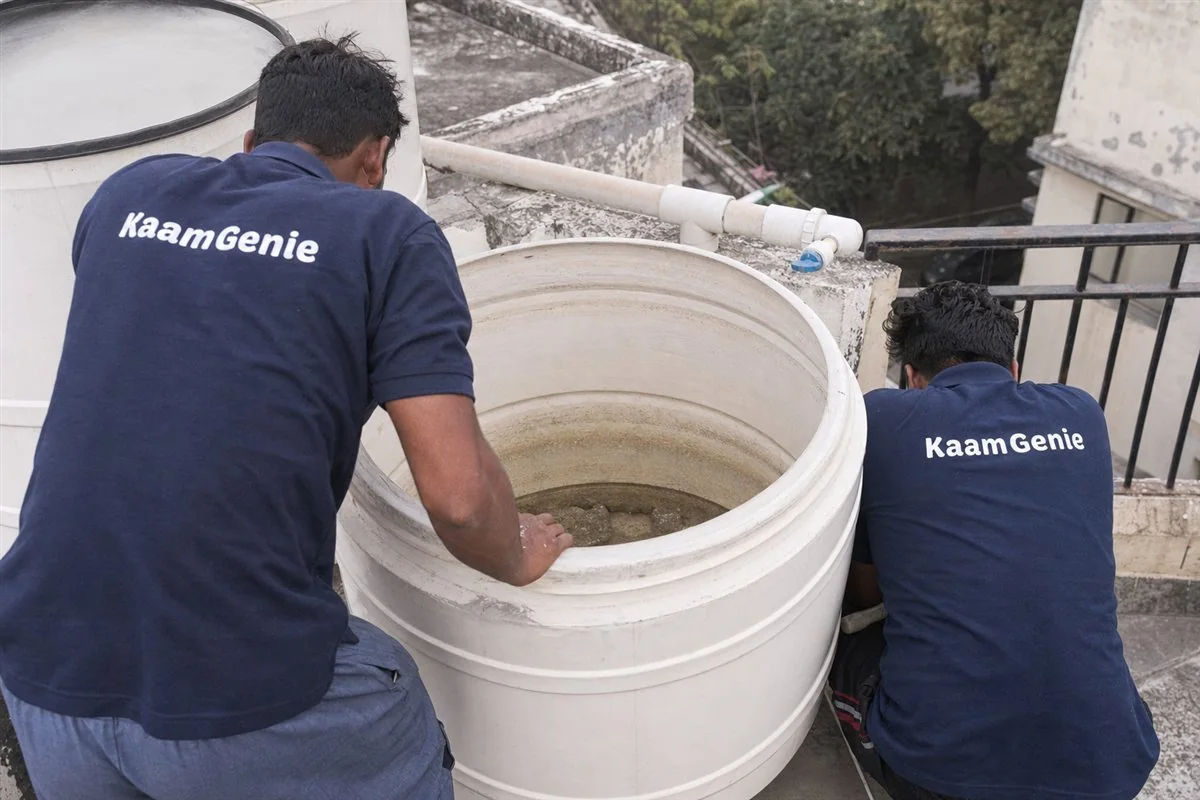
A huge share of Gurgaon — particularly condominium belts and sectors where the piped network is thin — leans on borewell groundwater. And Gurgaon’s groundwater is hard. It carries high dissolved minerals, elevated TDS, and fine sand that the borewell pump lifts along with the water.
When hard water stands in a tank, two things happen. First, calcium and magnesium precipitate out as a chalky white scale on the walls and floor — the same crust you see building on a geyser element or a kettle. Second, that rough scale surface becomes the perfect anchor for biofilm: bacteria grip a textured, mineral-coated wall far more easily than smooth, clean plastic. A hard-water tank that is only ever rinsed from the top keeps thickening its crust year after year. The way to deal with it is exactly what we explain in our guide to hard water tank cleaning in Gurgaon — physical scrubbing, not just a hose-down.
Source three: private tankers
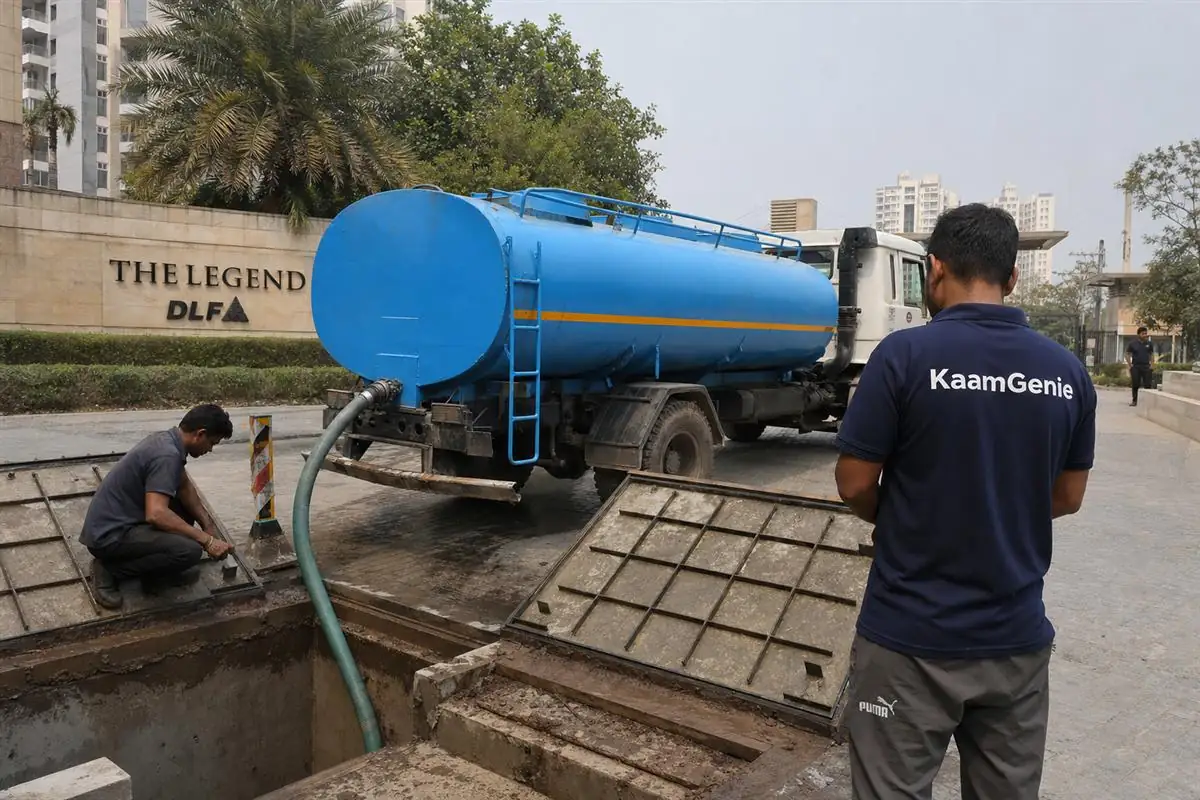
The third source is the one that defines daily life in much of New Gurgaon and the new-tower belts: the private water tanker. When canal supply is short and the borewell can’t keep up, a tanker arrives at the society gate and fills the underground reservoir through a hose. Whole sectors along Dwarka Expressway, Southern Peripheral Road (SPR) and Sohna Road run on this for months at a stretch.
Tanker water is a genuine lifeline, but it carries a hygiene catch: it is only as clean as the borewell it came from, the barrel that carried it, and the hose that filled your tank. You have no visibility into any of those. Even a clean tanker delivers fine sediment and water of variable hardness straight into your UGR, where it sits and settles. That is why we treat tanker-fed buildings as needing more frequent attention — the dynamics are covered in detail in our piece on tanker water and tank cleaning in Gurgaon.
Why the storage chain is where it all collects
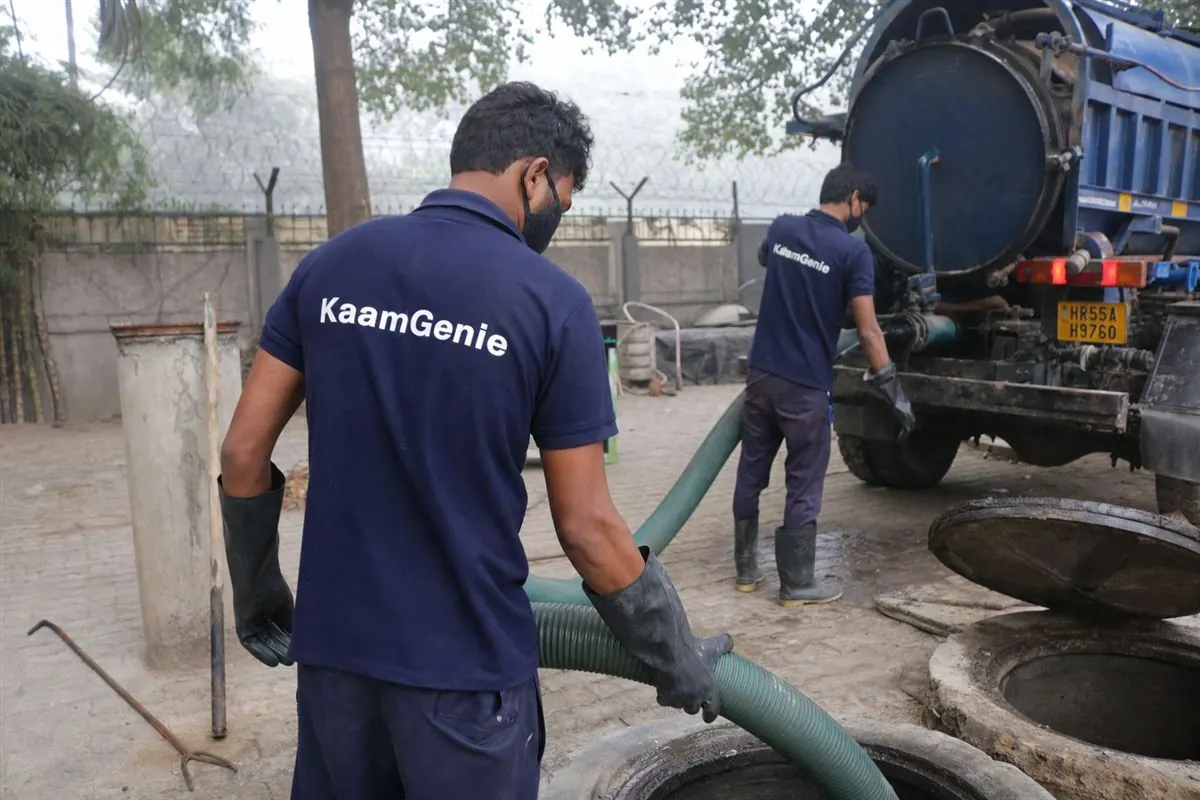
Here is the part that ties the three sources together. Because Gurgaon’s supply is intermittent — a few hours of canal water, a daily tanker, a borewell that runs on a timer — nobody can draw water directly when they need it. So every building stores a buffer. The standard arrangement across the city is a large underground reservoir (UGR) at ground or basement level, with pumps lifting that water up to overhead tower tanks that feed the flats by gravity.
That storage chain is brilliant for keeping taps running. It is also where every contaminant from all three sources accumulates. Canal sediment, borewell sand, tanker grit and hardness scale all settle to the bottom of the UGR. Whatever gets pumped upward then re-settles in the rooftop tanks. And because stored water stands for days, anything organic has time to grow into biofilm. The longer the water sits and the more sources it has come from, the heavier the deposit. This is why overhead and underground tanks behave so differently and need different handling — something we break down in our overview of water tank cleaning services across the NCR.
What this means for different Gurgaon homes
The supply mix isn’t uniform across the city, so the cleaning need isn’t either:
- Established DLF colonies and Golf Course Road condominiums — large basement UGRs feeding multiple tower tanks, often on a blend of canal and borewell water. Shared storage means one neglected reservoir affects every flat above it.
- Independent builder floors in older sectors — smaller individual rooftop tanks, frequently hard borewell water, and often no fixed cleaning schedule because each floor manages its own.
- New towers on Dwarka Expressway, SPR and New Gurgaon — heavily tanker-dependent until piped supply arrives, plus construction debris in brand-new tanks. These need an early first clean and a tight schedule.
- Corporate and commercial buildings in Cyber City and Udyog Vihar — very large reservoirs, high daily turnover, and food and beverage operations that bring FSSAI hygiene obligations into play.
If you live in one of the condo belts around Golf Course Road, the newer mid-city sectors near Sector 65, or the tanker-heavy townships of New Gurgaon, the supply picture — and therefore the cleaning frequency you need — is meaningfully different from a single-source piped city.
How quickly sediment builds — relative deposit by supply type
Indicative, based on what our Gurgaon crews typically find at cleaning
The more your building relies on borewell and tanker water, the faster sediment and scale accumulate — and the shorter your cleaning interval should be.
Tanker-fed or hard-water building?
Those tanks fill the fastest with sediment. Get on a schedule that matches your supply — residential ₹699 onwards, society and UGR quoted on capacity.
The bottom line: cleaning is the missing step in Gurgaon’s supply chain
Gurgaon spends enormous effort getting water to you — treating Yamuna water at Basai and Chandu Budhera, sinking borewells, running a fleet of tankers. But that whole chain ends the moment water enters your storage. From the UGR floor to the rooftop tank wall, what happens next is entirely on the building. Treated, pumped or trucked, all three sources leave a deposit, and the only thing that removes it is a proper scrub-and-disinfect on a schedule that matches how much tanker and borewell water you take.
If you want the full local picture — pricing, what a society contract covers, and how often different building types should book — start at our water tank cleaning in Gurgaon hub, see real numbers in the Gurgaon cost guide, and read how shared storage is handled in society water tank cleaning. Your supply is complicated; keeping the tank at the end of it clean shouldn’t be.
Frequently asked questions
Where does Gurgaon’s tap water actually come from?
Most of Gurgaon’s treated supply is canal water brought from the Yamuna through the Gurugram Water Services (GMDA) network and cleaned at large water treatment plants — the NCR/Basai plant and the Chandu Budhera plant on the city’s western side. That treated water is pushed to boosting stations and into society lines. Alongside it, a very large share of the city runs on borewell groundwater and on private water tankers, especially in newer sectors and condominium belts where the piped canal network has not fully reached.
Why does tanker-supplied water make tank cleaning more important?
Tanker water is only as clean as the source borewell, the tanker’s own barrel, and the hose used to fill your reservoir — none of which you control. Even good tanker water carries fine sediment and varying hardness, and it is pumped straight into your underground reservoir where it sits. Over weeks that sediment settles into a layer on the floor of the tank. Regular cleaning is the only way to remove what the tanker keeps depositing.
Does hard borewell water in Gurgaon make tanks dirtier?
Yes. Gurgaon’s groundwater is typically hard, with high dissolved minerals and TDS. As that water stands in a tank it leaves calcium and magnesium scale on the walls and floor, and that rough scale layer is exactly where biofilm and bacteria take hold. Hard-water tanks build a visible chalky crust far faster than tanks fed only on soft treated water, so they need scrubbing more often, not just rinsing.
How does Gurgaon’s intermittent supply affect my underground reservoir?
Because supply is intermittent — a few hours of canal water, or a tanker every day or two — homes and societies store large volumes in underground reservoirs (UGRs) and pump it up to rooftop tower tanks. Water that sits longer settles more sediment and gives bacteria time to multiply. The bigger your buffer storage, the more important it is that the UGR and the rooftop tanks both get cleaned, because contamination at the bottom of the UGR travels up to every flat.
Will cleaning my tank reduce the white scale and TDS in my water?
Cleaning removes the scale and sediment already deposited inside the tank, so you stop pushing loose flakes and sludge into your taps, and your stored water looks and smells better. It does not change the dissolved hardness of incoming water — that is a treatment question for an RO or softener. Think of tank cleaning and a purifier as two different jobs: the tank handles what has settled in storage, the purifier handles what stays dissolved.
How often should I clean my tank given Gurgaon’s water supply?
For most Gurgaon homes on a mix of borewell and tanker water, every 6 months is sensible, and every 3-4 months if you are entirely tanker-dependent or notice quick scaling. Societies with shared UGRs and rooftop tanks usually run a fixed schedule of two to four cleanings a year. The dirtier and harder your source water, the shorter the interval — tanker-heavy buildings sit at the frequent end.
We get only tanker water in our new sector — is cleaning even worth it?
It is more worth it, not less. New towers along Dwarka Expressway, Southern Peripheral Road and the New Gurgaon sectors often run almost entirely on tankers until the piped network arrives. Brand-new tanks also carry construction debris — cement slurry, sand and grit — from the build. A first cleaning after possession plus a regular schedule keeps that grit and the daily tanker sediment from reaching your kitchen.
Does a water purifier mean I can skip tank cleaning?
No. Your RO or UV unit treats the last litre at the kitchen tap, but every other tap — bathing, brushing, washing vegetables, filling pots — draws straight from the stored tank. A dirty tank also clogs purifier pre-filters faster and shortens membrane life. Cleaning the tank protects the whole house and your purifier; the purifier alone protects only one tap.
How long does a cleaning take and what does it cost in Gurgaon?
A standard residential overhead tank takes about 75-90 minutes and starts at ₹699 onwards. Underground reservoirs, large society UGRs and commercial tanks are quoted on capacity and access because they take longer and need confined-space equipment. You get before and after photos and a cleaning record on WhatsApp either way.
Sources & references
- Bureau of Indian Standards (BIS) — IS 10500:2012 is the canonical Indian Standard for drinking water specification, defining acceptable limits for physical, chemical, and biological parameters including hardness and total dissolved solids.
- WHO Guidelines for Drinking-water Quality, 4th edition — the global reference for water quality standards, including guidance on storage and disinfection.
- Food Safety and Standards Authority of India (FSSAI) — defines water quality requirements for food businesses, including hygiene standards for stored water and acceptable disinfection chemicals.
- WHO Fact Sheet on Drinking Water — overview of safe drinking water requirements and contamination risks.
- CPHEEO — Manual on Water Supply and Treatment — the Government of India’s engineering manual covering tank design, cleaning protocols, and disinfection practices.
Last verified: 29 June 2026. If you find any of these links broken, please let us know.