
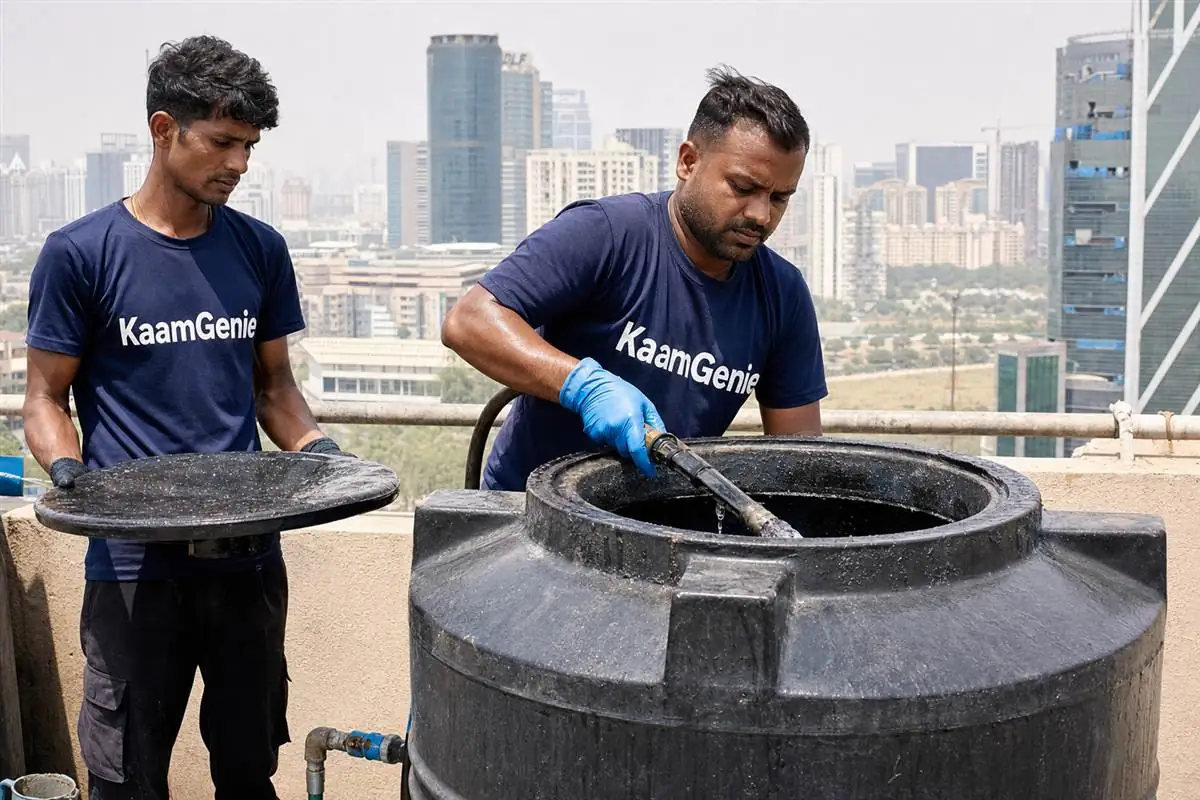
The short version
- Gurgaon largely runs on hard borewell water and tankers — both leave more scale and sludge than treated piped supply.
- The property mix is unusual: DLF condos, AOA societies, independent builder floors, and new Dwarka Expressway / SPR towers — each needs a slightly different approach.
- A real clean is an 8-step job: inspect, drain, de-sludge, scrub, jet wash, vacuum, disinfect with food-grade chemical, refill — for condos the underground reservoir and rooftop tanks both.
- Residential cleaning starts at ₹699 onwards; societies, sumps and commercial tanks are custom-quoted.
- Clean every 6 months — every 3–4 months if you rely heavily on tanker or raw borewell water.
Ready to book? See pricing and slots for water tank cleaning in Gurgaon.
| Property type | What needs cleaning | Who arranges it | Recommended frequency |
|---|---|---|---|
| DLF / luxury condominium | Underground reservoir + rooftop tower tanks | Facility / AOA team (contract) | Every 6 months |
| AOA / RWA society | Shared UGR + per-tower tanks | Society maintenance | Every 6 months |
| Independent builder floor | Overhead tank (+ sump if present) | Owner or tenant | Every 6 months |
| Plotted house / kothi | Overhead tank + underground sump | Owner | Every 6 months |
| New Dwarka Expressway / SPR tower | UGR + rooftop tanks (post-handover debris) | Facility team / new owner | First clean at possession, then 3–6 months |
| Heavy tanker-dependent home | Overhead tank + sump | Owner or tenant | Every 3–4 months |
Book the real 8-step cleaning
All 8 steps documented, before/after photos, fixed price. Anything short of this is a rinse. ₹699 onwards.
Gurgaon’s water reality: hard borewell + heavy tanker dependence
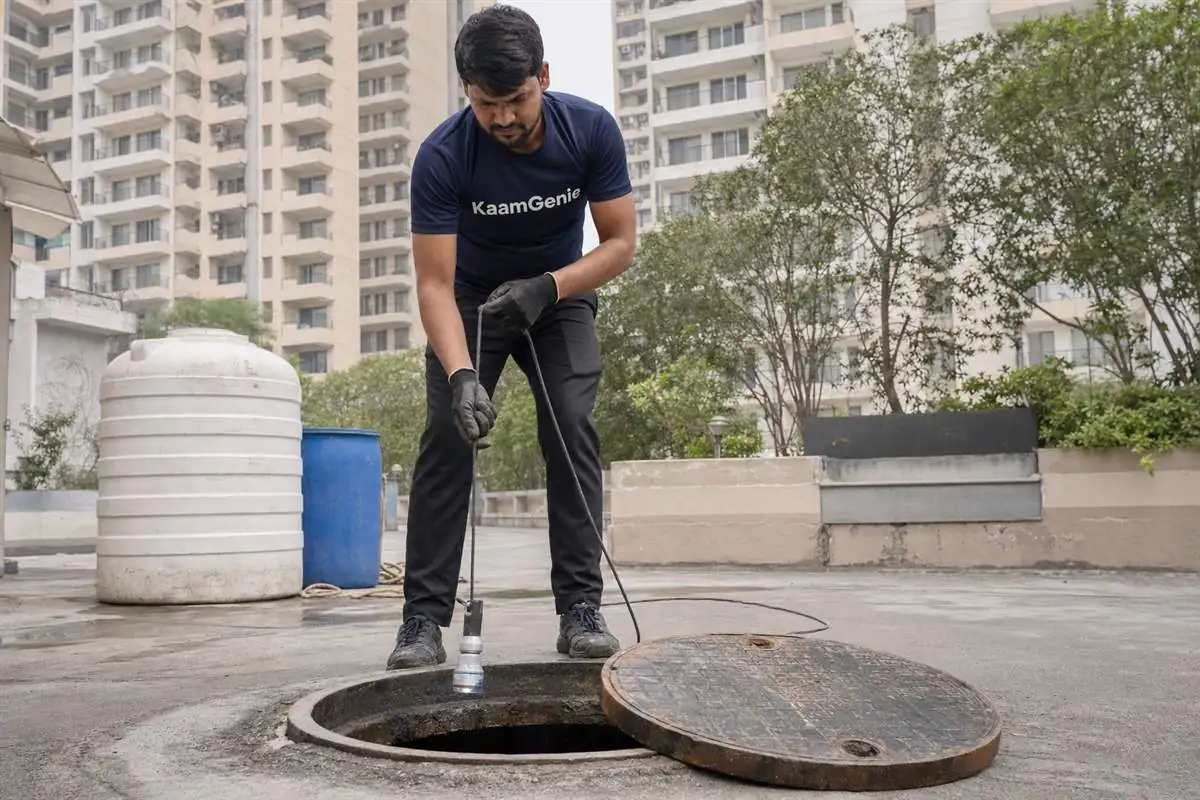
To understand tank cleaning in Gurgaon, you have to understand where the water comes from. Unlike older parts of Delhi that sit on a relatively mature treated-water network, much of Gurgaon — the Millennium City — grew faster than its piped supply. The result is that an enormous number of homes, builder floors and even gleaming condominiums depend on two sources: hard borewell groundwater drawn locally, and private water tankers trucked in daily.
Both are hard on tanks. Borewell water in this belt is high in dissolved calcium and magnesium — classic hard water — which precipitates out as the white-grey scale you see crusting on tank walls and around fittings. Tanker water, meanwhile, varies wildly by source and is frequently loaded with suspended sand and silt that settle into a sludge layer on the tank floor. Put the two together and you get tanks that build up sediment and scale noticeably faster than tanks on fully treated municipal water. That is the single biggest reason Gurgaon homes need cleaning more often than people expect. If your area leans heavily on tankers, our dedicated guide to hard water tank cleaning in Gurgaon goes deeper on the scale problem.
This is true everywhere from the established colonies off Golf Course Road to the dense residential stretches along Sohna Road. The water source changes the maintenance maths, not the method.
The property mix: condos, builder floors, societies and new towers
Gurgaon’s housing stock is genuinely varied, and the right cleaning approach depends on which kind of property you have:
- DLF and luxury condominiums — the high-rises across DLF Phases and the premium pockets of DLF Phase 5 store water in a large common underground reservoir (UGR) that is pumped up to rooftop tower tanks. Both stages need cleaning, and it is almost always handled as a society contract by the facility team. We cover this end-to-end in our guide to DLF condominium tank cleaning.
- AOA / RWA societies — resident-managed societies work the same way: a shared sump plus per-tower tanks, cleaned on a schedule with certificates kept for records. See society water tank cleaning in Gurgaon for how contracts and tower-by-tower staging work.
- Independent builder floors — the ubiquitous G+3 and G+4 builder floors across the sectors usually have their own overhead tank per floor (sometimes a shared sump). Here the owner or tenant books directly.
- Plotted houses and kothis — older independent homes in DLF colonies and the original sectors typically have both an overhead tank and an underground sump.
- New Dwarka Expressway and SPR towers — the fast-growing tower belt along the Dwarka Expressway and the Southern Peripheral Road (SPR), out toward Sector 82 and New Gurgaon, often runs on tankers in its early years and frequently has construction debris left in tanks after handover.
There’s also Gurgaon’s corporate core to consider — the office towers, malls and food courts of Cyber City and Udyog Vihar run large commercial tanks with their own FSSAI and documentation needs, covered separately in our commercial tank cleaning guide. And because Gurgaon has a huge rental and expat population, a lot of tanks fall into the gap where neither landlord nor tenant is sure whose job cleaning is — which is exactly how tanks go years without a proper clean.
What a proper clean actually involves
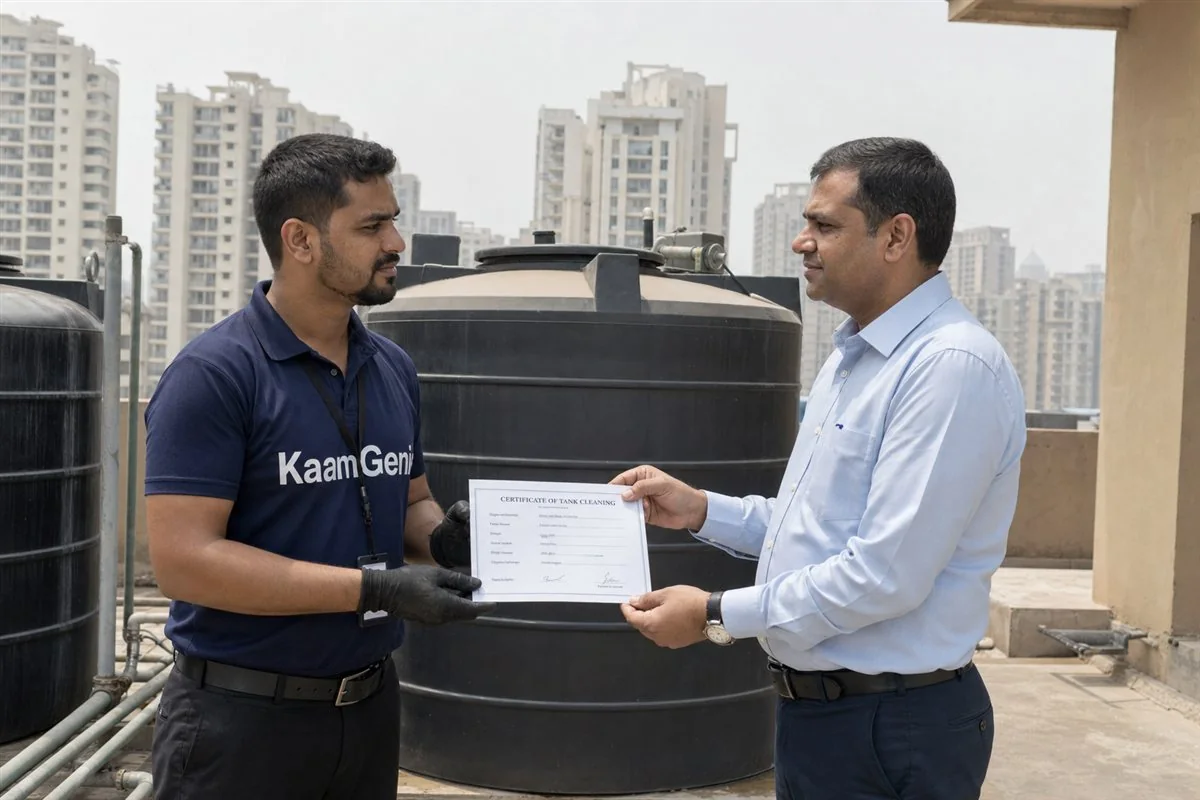
Whether it’s a single builder-floor tank or a condo’s underground reservoir, the method is the same eight steps — what changes is scale and access:
- Inspect the tank, check fittings, take before-photos.
- Drain the old water (inlet shut first so nothing refills mid-job).
- Remove the sludge — the sand and silt layer that tanker water leaves on the floor, scooped out by hand and disposed of, never flushed back into the building.
- Manually scrub walls, floor and corners with food-grade brushes — this is where Gurgaon’s hard-water scale actually comes off.
- High-pressure jet wash to clear bio-film and scale from corners, seams and behind fittings.
- Wet-vacuum the residual dirty water so nothing resettles on refill.
- Disinfect with food-grade sodium hypochlorite at 50–100 PPM, with proper contact time, then rinse.
- Refill, final inspection and a cleaning certificate with before/after photos.
For condos and societies, this is done at both stages: the underground reservoir, which collects the heaviest sediment, and each rooftop tower tank. The full step-by-step is laid out in our NCR-wide water tank cleaning process guide, and you can see the complete range of our water tank cleaning services on the main service page. The one rule that never changes: if a crew finishes a residential tank in 20 minutes, they skipped the de-sludging, the scrubbing or the disinfection. That’s a rinse, not a cleaning — and in a hard-water, tanker-fed city like Gurgaon, a rinse barely buys you a few weeks.
Why Gurgaon tanks need cleaning more often — sludge build-up by water source
Relative sediment and scale accumulation over 6 months (illustrative, based on field experience)
The more your supply leans on raw borewell and tanker water, the faster the floor silts up and the walls scale — which is why heavy tanker users should shorten the gap to every 3–4 months.
What water tank cleaning costs in Gurgaon
Pricing is the question everyone asks first, so here’s the honest version. Residential overhead tank cleaning starts at ₹699 onwards. That covers a standard home tank done properly — all eight steps, food-grade disinfectant, photos and a certificate.
Underground sumps, large society reservoirs and commercial tanks aren’t fixed-price because they vary too much: a 1,000-litre rooftop tank and a 20,000-litre condo UGR are not the same job. These are quoted on capacity, access and the number of tanks after a quick site assessment. For the full breakdown by tank type and a look at why quotes vary so wildly, see our dedicated water tank cleaning cost in Gurgaon guide, and for recurring upkeep, builder-floor owners often prefer the predictability covered in our builder floor tank cleaning guide.
One warning specific to this market: be very wary of quotes far below ₹699. Gurgaon has plenty of operators advertising ₹200–₹300 cleanings, and at that price the economics simply don’t allow for de-sludging, manual scrubbing or food-grade chemical. You’re paying someone to spray water down from the top and leave — which in this hard-water city means you’ll be calling again within weeks.
Not sure which clean your property needs?
Tell us your area and tank type — we’ll recommend the right job and a fixed price. Residential ₹699 onwards; societies and sumps custom-quoted.
How often should a Gurgaon tank be cleaned?
The Indian standard for stored drinking water points to regular tank cleaning, and in practice the right interval depends on your water source. For most Gurgaon homes on a mix of piped and tanker supply, every six months is the sensible baseline. If you rely heavily on tankers or raw borewell water — common across the newer sectors and the SPR / Dwarka Expressway belt — tighten that to every three to four months, because the floor silts up and the walls scale much faster.
New flats are a special case. After possession, the very first clean matters most: handover tanks routinely hold cement dust, grit and construction debris that you don’t want anywhere near drinking water. Clean once at move-in, then settle into the regular schedule. Societies and condos should hold a fixed half-yearly schedule for the UGR and every rooftop tank, with certificates filed for AOA and audit records.
Book water tank cleaning in Gurgaon
If your tank hasn’t been done in over six months — or you’ve just taken possession of a new flat — this is your sign. We clean overhead tanks, underground sumps, society reservoirs and rooftop tower tanks right across the city, from DLF colonies and Golf Course Road to Sohna Road, the new sectors and Cyber City. Every job comes with before/after photos and a cleaning certificate, no shortcuts.
See live pricing and slots on our water tank cleaning in Gurgaon hub, call +91 95603 66362, or use the booking form on this site — we’ll confirm shortly, often the same day.
Frequently asked questions
How often should I clean my water tank in Gurgaon?
Every 6 months for most Gurgaon homes, and every 3-4 months if you rely heavily on tanker water or raw borewell supply. Tanker and borewell water carry more sediment and hardness than treated municipal water, so sludge builds up faster. Societies on shared underground reservoirs should be on a fixed half-yearly schedule with per-tank certificates.
Why does Gurgaon water leave so much sediment and scale in tanks?
Most of Gurgaon runs on hard borewell groundwater and tanker supply rather than fully treated piped water. Hard water is high in dissolved calcium and magnesium, which precipitate out as white-grey scale on tank walls, while tanker and borewell water carry suspended sand and silt that settle as sludge on the floor. Both build up faster here than in areas on treated municipal supply.
What does a proper water tank cleaning in Gurgaon actually involve?
Inspection and before-photos, full draining, hand-removal of the sludge layer, manual scrubbing with food-grade brushes, a high-pressure jet wash, wet-vacuuming the residual water, disinfection with food-grade sodium hypochlorite at 50-100 PPM with proper contact time, then refill and a cleaning certificate. For condos and societies the underground reservoir and the rooftop tower tanks are both done. Anything that skips the draining, scrubbing or disinfection is a rinse, not a cleaning.
How much does water tank cleaning cost in Gurgaon?
Residential overhead tank cleaning starts at ₹699 onwards. Underground sumps, large society reservoirs and commercial tanks are quoted on capacity, access and the number of tanks, so they are custom-priced after a site assessment. Beware quotes far below ₹699 — at that price the crew is almost certainly skipping sludge removal, scrubbing or food-grade disinfection.
Who arranges tank cleaning in a DLF condominium or AOA society?
In most Gurgaon condominiums and AOA-managed societies the maintenance team or facility manager arranges cleaning of the shared underground reservoirs and rooftop tower tanks under a society contract. Individual flat owners usually don’t have their own tank in a high-rise. In independent builder floors and plotted houses, the owner or tenant books the cleaning directly.
Do you clean both the underground reservoir and the rooftop tanks?
Yes. Gurgaon high-rises and condos typically store water in a large underground reservoir (UGR) that is pumped up to rooftop tower tanks. Both stages need cleaning — the UGR collects the heaviest sediment from tanker and borewell water, and the rooftop tanks develop scale and bio-film. We clean and disinfect both, and issue a per-tank certificate for society records.
Is tank cleaning different for new towers on Dwarka Expressway and SPR?
The process is the same, but new towers on the Dwarka Expressway and Southern Peripheral Road (SPR) belt often run heavily on tanker water during their first years before piped supply stabilises, so their tanks silt up quickly. Newly handed-over flats also frequently have construction debris, cement dust and grit left in the tanks, which makes the first cleaning after possession important before anyone drinks the water.
Do I need to be home when you clean my Gurgaon tank?
For an independent floor or plotted house, someone needs to give the crew rooftop and sump access, but you don’t have to supervise — many customers check the before/after photos and certificate on WhatsApp afterwards. In condos and societies the facility manager or caretaker coordinates access, and residents are notified of the brief supply interruption in advance.
How do I book water tank cleaning in Gurgaon?
Use the booking form on this site, call +91 95603 66362, or message us on WhatsApp. Tell us your area — DLF Phase 5, Golf Course Road, Sohna Road, Sector 82, Cyber City or anywhere else in Gurgaon — your tank type and capacity, and whether it’s a home, builder floor or society. Residential bookings are confirmed quickly and often same-day; society and commercial jobs are scheduled after a quick site assessment.
Sources & references
- Bureau of Indian Standards (BIS) — IS 10500:2012 is the canonical Indian Standard for drinking water specification, defining acceptable limits for physical, chemical, and biological parameters.
- WHO Guidelines for Drinking-water Quality, 4th edition — the global reference for water quality standards, including guidance on storage and disinfection.
- Food Safety and Standards Authority of India (FSSAI) — defines water quality requirements for food businesses, including hygiene standards for stored water and acceptable disinfection chemicals.
- WHO Fact Sheet on Drinking Water — overview of safe drinking water requirements and contamination risks.
- CPHEEO — Manual on Water Supply and Treatment — the Government of India’s engineering manual covering tank design, cleaning protocols, and disinfection practices.
Last verified: 29 June 2026. If you find any of these links broken, please let us know.