
The short version
- Most Gurgaon societies and new sectors depend heavily on water tankers, not steady piped supply.
- Tanker water arrives in one fast gush carrying silt, sand and variable contamination — the heavy particles settle on your tank floor within hours.
- The underground reservoir (UGR) catches the worst of it, then pumps a share up to the rooftop tower tanks.
- Tanker-fed tanks build up sediment roughly twice as fast as piped-only tanks, so they need cleaning more often — quarterly for most UGRs.
- This is a different problem from hard-water scale. If your concern is mineral build-up, read our Gurgaon hard-water tank cleaning guide as well.
Quick rule of thumb: if your building takes regular tanker deliveries, put the UGR on a 3-month schedule and the tower tanks on 3–4 months. Anything less and the sediment wins.
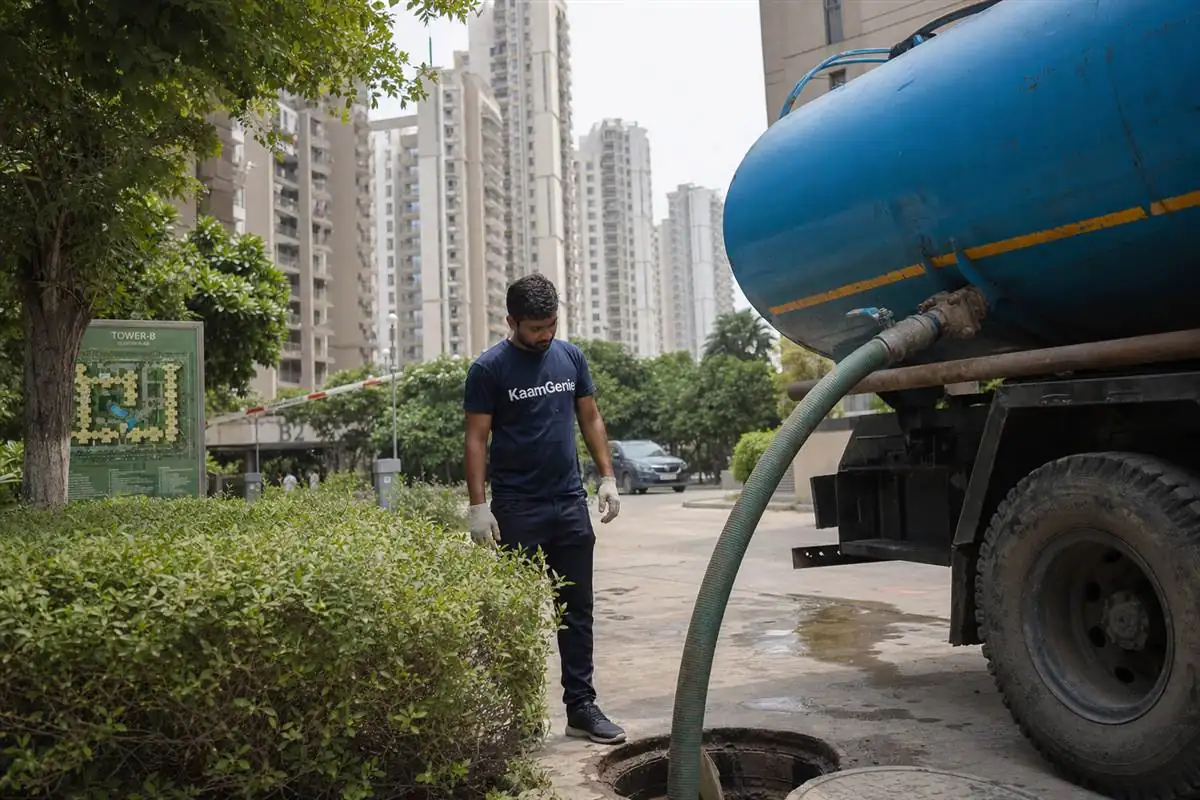
If you live in a Gurugram condominium off Golf Course Road, a builder floor in DLF, or one of the newer towers along Sohna Road, the Southern Peripheral Road (SPR) or Dwarka Expressway, there’s a good chance your water doesn’t arrive entirely through a pipe. It arrives on a truck. The Millennium City grew faster than its piped network, so private and municipal water tankers fill the gap — topping up huge underground reservoirs that then feed the rooftop tower tanks above each block.
It’s a system that works. But it has a side effect most residents never connect to their water: tanker supply makes your tank dirty far faster than piped supply does. After years of opening tanks across Gurgaon, the pattern is consistent — the tanker-fed buildings always have the heaviest sediment loads. This is why those buildings need water tank cleaning in Gurgaon on a tighter schedule than the textbook “once a year” advice suggests.
Why tanker water carries more dirt
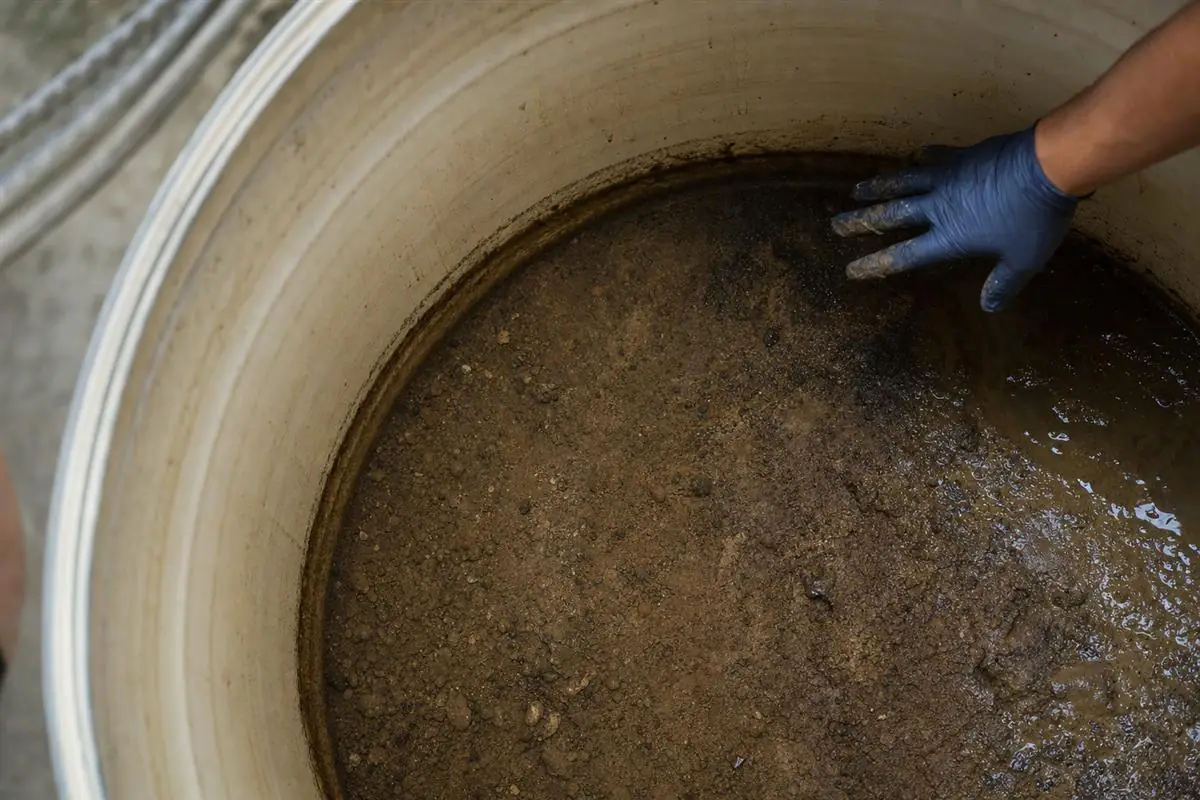
Piped municipal water trickles into your tank slowly and has usually passed through some level of treatment and filtration first. Tanker water is a different animal, for three reasons:
- The source varies. Tankers are filled from borewells, filling stations, and bulk points whose quality nobody at your building can verify. One day’s load is clear; the next day’s carries visible silt. You’re storing whatever that day’s source happened to contain.
- The tanker itself is rarely cleaned. The internal barrel of a water tanker is a closed metal or plastic tank that does its own job of accumulating rust, scale and sludge. Every load picks up a little of that and delivers it to you.
- It arrives all at once. A tanker discharges thousands of litres in a few minutes. That fast, turbulent gush stirs up and carries heavy sand and silt that simply doesn’t have time to be filtered out. Once it’s sitting still in your reservoir, gravity does the rest — the heavy particles drop to the floor.
Add Gurgaon’s hard borewell groundwater into the mix — which many buildings blend with tanker supply depending on the season — and you get sediment plus mineral scale building up together. That combination is exactly what we find caked on UGR floors across the city.
| Factor | Piped supply | Tanker supply |
|---|---|---|
| How water enters | Slow trickle, filtered | Fast gush, minimal filtration |
| Source consistency | Single known source | Varies load to load |
| Sediment delivered | Low | High (silt, sand, rust) |
| Where it settles | Mostly stays suspended | Drops to UGR & tank floor |
| Typical floor layer after 1 year | Thin film | Half-inch to 1 inch+ of sludge |
| Recommended UGR cleaning | Every 6 months | Every 3 months |
On tanker supply? Get the tank cleaned properly
UGR, tower tanks, sump — documented, before/after photos, fixed price. Residential ₹699 onwards; society & commercial UGRs quoted on capacity.
The UGR is where it all collects first
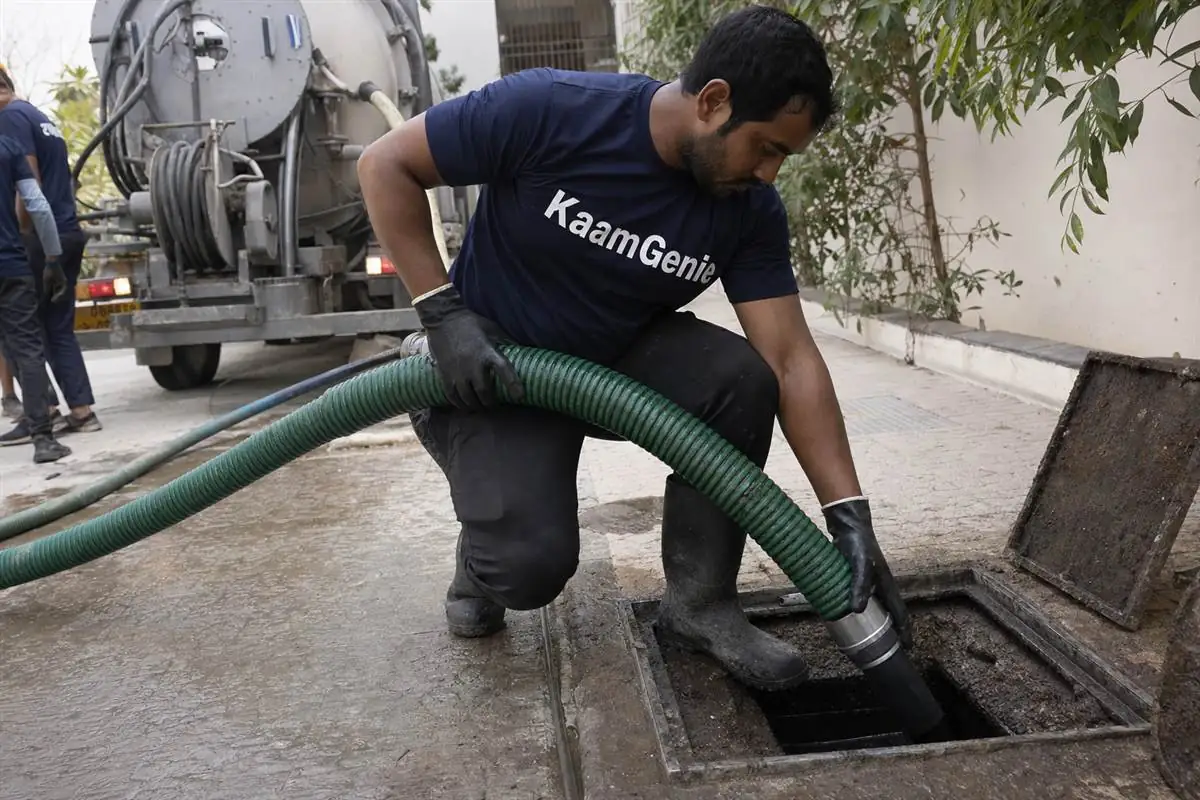
In almost every Gurgaon condominium and society, the plumbing follows the same logic: tankers (and any borewell or piped supply) discharge into a large underground reservoir at ground level. From there, pumps lift water up to the rooftop tower tanks on each block, which then gravity-feed the flats below.
That makes the UGR the single most important tank to keep clean — and the dirtiest. It’s the first thing the tanker hits, so it catches the heaviest silt before anything gets pumped upstairs. It’s usually the largest tank in the system, with a big dark floor that’s perfect for sediment to settle and for bio-film to grow undisturbed. And because it’s underground and out of sight, it’s the tank residents forget exists until the water starts tasting or smelling off.
By the time we open a neglected tanker-fed UGR, we’re often looking at an inch or more of compacted silt across the floor, mineral scale on the walls, and a layer of bio-film that can’t be removed by draining alone. The proper fix is the same disciplined process we use everywhere — hand-scooping the sludge, manual scrubbing, high-pressure jet wash, wet vacuum, and food-grade disinfection — just scaled up for the reservoir. We cover the reservoir-specific approach in detail in our Gurgaon underground sump cleaning guide.
What actually builds up in a tanker-fed tank
When we drain a tanker-fed tank, the bottom layer is noticeably heavier and grittier than what we find in a piped-only tank. It’s typically a mix of:
- Fine silt and sand — the signature of tanker water, carried straight from the source and the tanker barrel.
- Calcium and mineral scale — from hard groundwater blended into the supply; this hardens onto walls and the floor over time.
- Rust and metal flakes — from older metal fittings, pump lines, or the tanker’s own internals.
- Organic sediment and bio-film — the silt becomes a bed for bacteria, which is what eventually causes odour, taste problems and the slippery film on the walls.
This sediment doesn’t just sit there harmlessly. Every time a fresh tanker discharges and stirs the water, some of it lifts back into suspension and travels up to your taps and into your water tank cleaning services checklist as a recurring complaint. It also clogs RO pre-filters far faster, so households on tanker supply tend to burn through purifier cartridges quicker than they should.
How fast the floor sludge builds — tanker-fed vs piped-only tank
Approximate sediment depth on the tank floor over time (typical Gurgaon UGR/tower tank)
Indicative depths from tanks we’ve opened across Gurgaon — actual build-up varies with tanker frequency, source quality and tank size. The pattern is consistent: tanker-fed tanks reach a problem layer in roughly half the time.
So how often should you really clean?
The generic advice you’ll read everywhere is “clean your tank twice a year.” That’s reasonable for a clean piped supply. For tanker-fed Gurgaon buildings, it’s not enough. Based on what we actually find on the floor:
- Underground reservoir (UGR): every 3 months. This is the non-negotiable one — it catches the heaviest load.
- Rooftop tower tanks: every 3–4 months. They get cleaner water than the UGR but still accumulate carried-over silt.
- Individual flat / builder-floor tanks on tanker top-ups: every 3–4 months.
- High-rises taking multiple loads a day (much of the Golf Course Road, Sohna Road and SPR/Dwarka Expressway tower belt): quarterly UGR cleaning, no exceptions.
For societies and AOAs, the simplest way to stay on schedule is an annual maintenance arrangement so the UGR and tower tanks are cleaned on a fixed calendar instead of only after a complaint. We work with RWAs and condominium managements across the city — our Gurgaon society tank cleaning guide walks through how those contracts are structured.
How we clean a tanker-fed system
The method doesn’t change — the discipline does. Because tanker-fed tanks carry more sediment, the sludge-removal and scrubbing steps take longer, and we plan disposal of a heavier sludge load. A full job runs:
- Inspect and photograph the UGR and tower tanks, noting sediment depth and any scale or damage.
- Drain the tank, preserving usable water where possible.
- Hand-scoop the sludge — the heavy silt layer is removed into sealed buckets and taken off-site, never flushed back into building plumbing.
- Manual scrub walls, floor and corners with food-grade brushes to lift scale and bio-film.
- High-pressure jet wash to clear what scrubbing can’t reach — especially important on large RCC reservoir walls.
- Wet vacuum the residual dirty water so nothing resettles on refill.
- Food-grade disinfection with sodium hypochlorite at the correct concentration and contact time, then rinse.
- Refill, final inspection, photos and a cleaning record for the society’s files.
If your worry is the chalky scale and white residue rather than the silt, that’s a hard-water problem and a slightly different treatment — we keep that separate in our Gurgaon hard-water tank cleaning guide so neither article repeats the other. Most tanker-fed buildings, honestly, have a bit of both.
Society or condo on tanker supply?
We clean UGRs and tower tanks across DLF, Sohna Road, the SPR and Dwarka Expressway belt — documented, scheduled, procurement-ready. Quoted on capacity.
Book tanker-fed tank cleaning across Gurgaon
If your building runs on tankers — and most of Gurgaon does — the single best thing you can do for your water is keep the reservoir and tower tanks on a tight cleaning schedule. We clean across the city, from the established DLF colonies and Sohna Road condominiums to the newer tower belt in New Gurgaon and Sector 82. See coverage, pricing and how to book on our Gurgaon water tank cleaning hub, or just call and we’ll arrange a visit.
To book, call +91 95603 66362 or use the booking form on this site — we’ll confirm shortly.
Frequently asked questions
Why does tanker water make my tank dirtier than piped supply?
Tanker water is loaded into the tanker, driven across the city, and discharged in one fast gush. It picks up fine silt and sand from the source (often a borewell or filling point with its own sediment), and the tanker’s own internal tank is rarely cleaned. That whole load arrives in your underground reservoir in minutes, so the heavier particles settle on the floor instead of staying suspended. Piped supply trickles in slowly and is usually better filtered, so it deposits far less.
How often should a tanker-fed tank in Gurgaon be cleaned?
For tanks that rely mostly on tankers, we recommend cleaning every 3 months for the underground reservoir and every 3–4 months for rooftop tower tanks — roughly twice as often as a purely piped supply would need. High-rise condominiums on Golf Course Road, Sohna Road and the SPR/Dwarka Expressway belt that take multiple tanker loads a day often need the UGR done quarterly without exception.
What actually builds up at the bottom of a tanker-fed tank?
A layer of fine silt and sand, calcium and mineral scale from hard groundwater, rust flakes if there is any metal in the line, and organic sediment that becomes a base for bio-film. In a tanker-fed Gurgaon UGR that hasn’t been opened in a year, this layer is commonly half an inch to over an inch thick across the floor. It is much heavier and grittier than what you find in a piped-supply tank.
Is tanker water safe to drink after it sits in my tank?
Tanker water quality is variable — it depends entirely on the source and the cleanliness of the tanker itself, neither of which you can verify. Even if the water arrives acceptable, the sediment it deposits feeds bacteria and bio-film over the following weeks. We always recommend treating tanker water as needing both a clean tank and point-of-use purification (RO/UV) before drinking. A clean tank is the foundation; the purifier is the last line.
Does the underground reservoir need cleaning more often than the rooftop tank?
Yes. The UGR is where the tanker discharges first, so it catches the heaviest silt before water is pumped up to the tower tanks. The reservoir floor is also large, dark and rarely opened, which is ideal for sediment and bio-film. In tanker-fed buildings the UGR is almost always the dirtiest tank in the system and should be on the tightest cleaning schedule.
Can I tell tanker quality from how the water looks?
Sometimes, not always. Visibly cloudy or muddy water from a tanker is an obvious warning. But clear-looking tanker water can still carry dissolved minerals and fine suspended silt that only settle out once the water is sitting still in your tank. The reliable signal is what we find on the tank floor when we open it — that tells the real story of what your tankers have been delivering.
Does an RO or water purifier make tank cleaning unnecessary?
No. An RO purifier treats only the small amount of water you drink. The rest of the tanker water — for bathing, cooking rinse, washing — comes straight from the tank. A dirty tanker-fed tank also clogs RO pre-filters far faster, so you end up replacing cartridges more often and paying more in the long run. Cleaning the tank protects both your household and your purifier.
We get a mix of borewell and tanker water — does that change anything?
It makes cleaning more important, not less. Borewell groundwater in Gurgaon is hard and leaves mineral scale; tanker water adds silt and variable contamination on top. The two together build up faster than either alone. If your building switches between borewell and tankers depending on the season, plan for the more frequent of the two cleaning schedules — quarterly for the UGR is a safe default.
How much does it cost to clean a tanker-fed tank in Gurgaon?
Standard residential overhead tanks start at ₹699 onwards. Underground reservoirs, large society UGRs and commercial tanks are quoted on capacity, access and how heavy the sediment load is — tanker-fed reservoirs usually carry more sludge, so the quote reflects the extra removal and disposal work. We give a fixed price after seeing the tank or its specifications, with no surprise add-ons.
Sources & references
- Bureau of Indian Standards (BIS) — IS 10500:2012 is the canonical Indian Standard for drinking water specification, defining acceptable limits for physical, chemical, and biological parameters.
- WHO Guidelines for Drinking-water Quality, 4th edition — the global reference for water quality standards, including guidance on storage and disinfection.
- Food Safety and Standards Authority of India (FSSAI) — defines water quality requirements for food businesses, including hygiene standards for stored water and acceptable disinfection chemicals.
- WHO Fact Sheet on Drinking Water — overview of safe drinking water requirements and contamination risks.
- CPHEEO — Manual on Water Supply and Treatment — the Government of India’s engineering manual covering tank design, cleaning protocols, and disinfection practices.
Last verified: 29 June 2026. If you find any of these links broken, please let us know.