
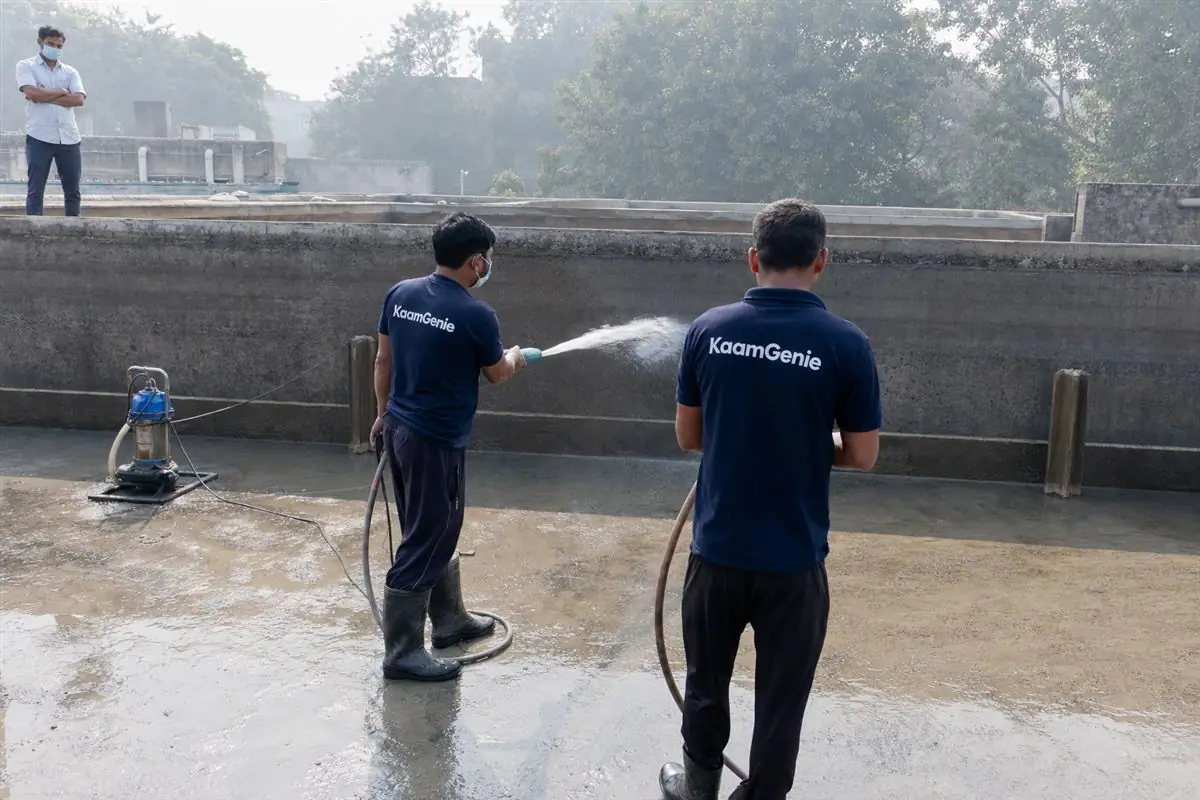
Quick answer — hospital water tank cleaning in Gurgaon (2026)
- Who needs it: Hospitals, nursing homes, clinics, dialysis centres, IVF clinics, diagnostic labs — any Gurgaon facility whose water touches patients or instruments.
- Frequency: Quarterly minimum for potable tanks and the UGR (NABH-aligned). Monthly for OT-zone and dialysis-feed tanks. Annual is not enough for a healthcare facility.
- Protocol: PPE confined-space entry, food-grade disinfection with measured contact time, microbiological swab testing (HPC, E. coli, Pseudomonas, Legionella where required).
- Local reality: Hard borewell groundwater + tanker supply means heavy scale and biofilm on very large underground reservoirs — more descaling, longer contact time.
- Downtime: Zone-by-zone with bypass supply; after-hours windows (11pm–5am) so wards never lose water at once.
- Documentation: Pre/post photos, chemical batch certificate, contact-time log, NABL swab report, signed sterility certificate for the infection-control file.
- Coverage: The Golf Course Road, Sushant Lok and sector medical belt. Residential cleaning from ₹699; hospital/UGR work is a custom AMC quote.
| Tank / system | Typical size | Cleaning frequency | Testing |
|---|---|---|---|
| Underground reservoir (UGR, raw inlet) | 30,000–100,000L+ | Quarterly | HPC + Coliform |
| Rooftop primary potable tanks | 10,000–25,000L | Quarterly | HPC + Coliform + E. coli |
| OT-zone / CSSD tank | 2,000–5,000L | Monthly | Full panel + Pseudomonas |
| Dialysis-feed (pre-RO) tank | 2,000–5,000L | Monthly | + Endotoxin (AAMI/ISO 23500) |
| Kitchen / dietary tank | 2,000–5,000L | Quarterly | FSSAI food-grade + Coliform |
| Fire-reserve tank | 20,000L+ | Annually | Visual + cleaning record |
Need an NABH-ready protocol for your Gurgaon facility?
Free healthcare site walk + AMC quote for hospitals, nursing homes and clinics across Gurgaon. After-hours scheduling, infection-control file ready, NABL-routed lab reports. ₹699 onwards for residential; hospital UGR work is custom-quoted.
Why a hospital tank in Gurgaon is a different category of risk
A residential cleaning protects a family of four from stomach bugs, skin irritation and yellow water. A hospital cleaning protects against the same risks, multiplied across hundreds of vulnerable patients a day — people whose immune systems are already compromised by illness, surgery, chemotherapy, or transplant medication. The same waterborne organism that gives a healthy adult a mild upset stomach can cause a post-op wound infection, a urinary-catheter infection, or a fatal bloodstream infection in someone in the ICU. The arithmetic is brutal: one contaminated reservoir in a 200-bed Gurgaon hospital can seed a hospital-acquired infection cluster within a week.
The organisms a hospital worries about are not the ones a home worries about. In a Gurgaon home tank the realistic concern is total coliform and the occasional E. coli. In a hospital tank the real risks include Legionella pneumophila (the cause of Legionnaires’ disease, spread by aerosols from showers and cooling towers), Pseudomonas aeruginosa (a major cause of post-op and burn-unit infections that colonises tank biofilm), non-tuberculous mycobacteria, and Acinetobacter baumannii. None of these are killed by a casual residential-grade rinse. They live in the biofilm lining the tank wall and the pipework downstream, and clearing them needs a documented disinfection protocol with measured contact time and post-clean microbiological proof that the colony has actually been knocked down.
This is why the same crew that cleans a builder floor in DLF for ₹699 cannot show up at a Golf Course Road hospital with the same kit and the same protocol. Different chemistry, different contact times, different testing, different PPE, different paperwork. The scope difference is real — not a brand markup — which is why our water tank cleaning services are priced by scope rather than by tank size alone.
The Gurgaon factor — hard groundwater, tankers, and very large UGRs
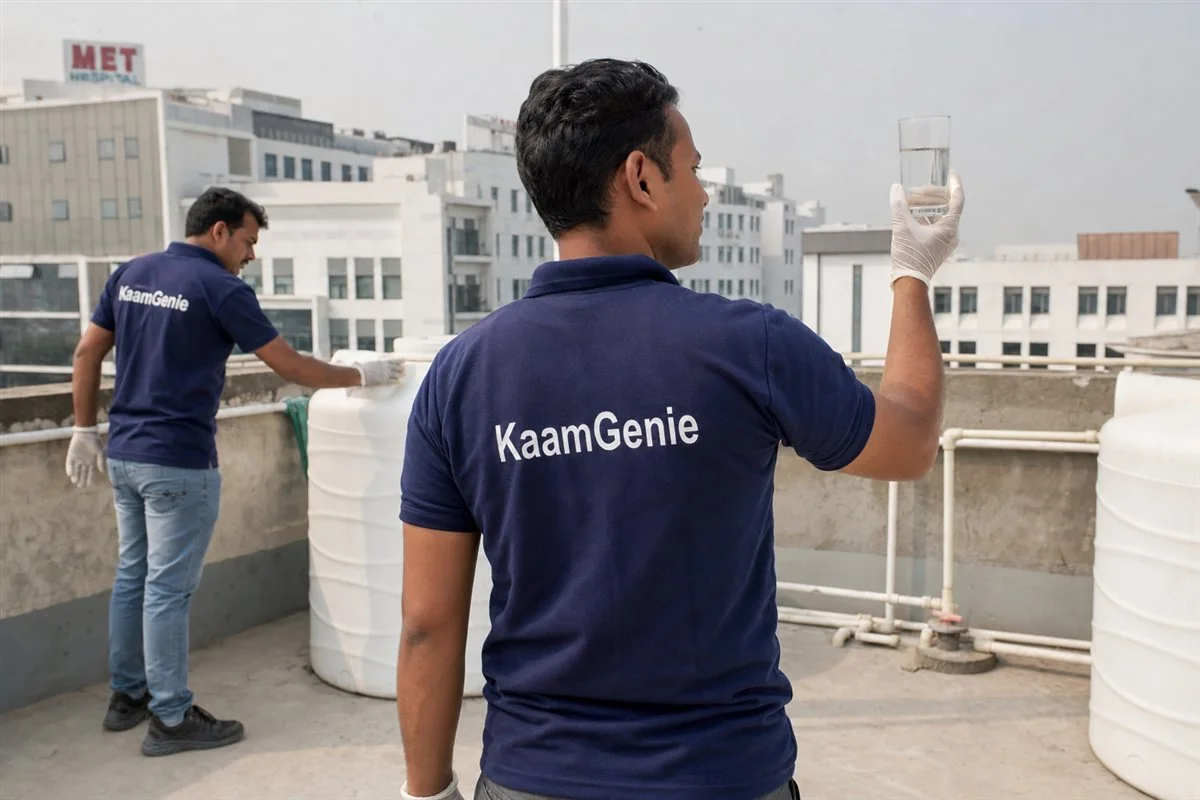
Gurgaon’s water situation shapes the whole job. Large parts of the Millennium City — from the older Sushant Lok and DLF colonies to the newer Golf Course Extension and Sohna Road high-rises — depend on a mix of hard borewell groundwater and water tankers, with municipal supply patchy or absent in many pockets. Hospitals respond by building very large underground reservoirs (UGRs), frequently 50,000 litres or more, that act as a buffer and are topped up by tanker through the day, then pumped up to zoned rooftop tower tanks.
That hard water leaves heavy calcium and iron scale on tank walls and across the UGR floor. The scale matters clinically: it is exactly the rough, porous surface where biofilm anchors and where organisms like Pseudomonas survive routine chlorination. A hospital tank in Gurgaon therefore needs more aggressive mechanical descaling and a longer disinfectant contact time than a comparable tank on softer water — the same hard-water dynamics we cover in depth in our guide to hard water tank cleaning in Gurgaon. Tanker dependence adds a second variable: every tanker load is an opportunity for re-contamination, so the cleaning frequency and the post-clean swab both have to account for the supply, not just the storage.
The big underground reservoir is also the hardest tank to clean well. It is a confined space that needs gas-detection entry, it holds a deep sediment layer that has to be hand-scooped and vacuumed rather than rinsed, and it cannot simply be drained dry during the day without cutting the whole campus off. Cleaning it properly is closer to the work in our underground sump cleaning in Gurgaon guide than to a rooftop drum — just at hospital scale and under infection-control discipline.
Mapping the hospital water system before anyone enters a tank
A residential building has one or two tanks. A Gurgaon hospital has anywhere from five to twenty separate water systems, each with its own risk profile and frequency. Walking in cold means missing tanks, double-booking others, and creating cross-contamination risk. Our first visit to a new healthcare client is always a free site walk with the infection-control nurse and the maintenance manager, where we map every tank and feed line before we quote. The typical layout:
Rooftop primary potable tanks. The largest rooftop tanks, usually 10,000–25,000 litres in food-grade HDPE or stainless, feeding drinking, hand-wash, patient-bath and general utility lines. Quarterly is the floor.
Underground reservoir (raw inlet). Tanker and borewell water lands here first. Deep sediment, confined-space entry, quarterly cleaning paired with the rooftop visit.
Dialysis-feed (pre-RO) tanks. Dialysis water is treated through reverse osmosis to strict AAMI / ISO 23500 microbial and endotoxin limits — far tighter than drinking water. The feed tank upstream of the RO plant needs monthly cleaning and monthly endotoxin testing. We do not touch the post-RO storage (that is the RO vendor’s scope), but the pre-RO feed tank is ours.
OT-zone and CSSD tanks. Dedicated to the operating theatres, the sterile supply department and scrub stations. Monthly cleaning, monthly swab testing, and the tightest documentation in the building. The crew assigned to this tank gowns up to the same standard as OT staff during the cleaning window.
Kitchen / dietary tanks. FSSAI rules apply to the patient-meal kitchen, so these get the food-grade protocol plus the infection-control file copy — quarterly, with an FSSAI-grade certificate.
Laundry and fire-reserve tanks. Laundry tanks (quarterly) feed thermal disinfection of linen; fire-reserve tanks (annual minimum) sit stagnant and accumulate heavy biofilm, so they take longer than a potable tank of the same size.
The hospital cleaning protocol — what’s different from residential
The eight-step skeleton — inspect, drain, sludge removal, scrub, jet wash, disinfect, refill, certify — is the same as a home tank. But every step has a stricter version, and there are extra steps a residential job never sees.
Pre-clean coordination meeting. 48 hours before the visit we meet the infection-control nurse, the maintenance manager and the affected ward in-charges. We confirm which tank, which feed lines, which wards lose water and for how long, and we lock the after-hours window. Engineering isolates the tank and arranges bypass supply.
PPE and confined-space entry control. Full PPE — N95, eye protection, gowns, dedicated boots not worn outside the campus. For UGR and sump entry we add a harness, lifeline and a gas-detection meter (oxygen, hydrogen sulphide, methane), because Gurgaon reservoirs can hold gas pockets. Entry is logged at the security desk.
Pre-clean swab. Before any chemical, we swab the inner wall and outlet pipe for a baseline microbial load. Without the pre-clean sample, the post-clean improvement is unprovable.
Drain to the biomedical-waste route, then descale and scrub. The effluent carries biofilm and chlorine residue, so it goes to the drain line the biomedical-waste officer designates, never a storm drain. Inside, hard-water scale is mechanically descaled and the walls scrubbed with food-grade, non-abrasive brushes — no abrasive pads on stainless, which leave micro-scratches that biofilm colonises.
Disinfection with measured contact time. Food-grade sodium hypochlorite at hospital-grade concentration — significantly above residential dosing — with a 30–60 minute contact time depending on the post-test target. Concentration, contact time, chemical batch number and certificate of analysis all go into the log.
Neutralise, refill, post-clean swab, document. Residual chlorine is neutralised to drinking-water levels and metered, the system is flushed through the distribution lines, and a second swab is taken from the same location. 3–5 days later the comparative NABL report comes back — the document the infection-control committee actually wants.
Hospital tank cleaning frequency in Gurgaon — visits per year by system
OT-zone and dialysis-feed tanks drive the calendar; an annual-only programme fails the HIC review
Illustrative AMC cadence for a mid-size Gurgaon hospital. Monthly tanks (OT-zone, dialysis-feed) and quarterly potable/UGR cleaning together keep the cleaning log continuous and audit-ready.
Microbiological water testing — the proof that justifies the protocol
The single biggest difference between residential and hospital cleaning is the swab testing. Without it you have a cleaning event but no proof of outcome. With it you have a documented microbiological improvement the NABH assessor and the infection-control committee can verify. For every Gurgaon hospital and clinic client we run:
Heterotrophic Plate Count (HPC). The general microbial-load indicator. BIS IS 10500:2012 sets the drinking-water limit at 100 CFU/mL or less. Pre-clean readings of several hundred to several thousand CFU/mL are common in tanks neglected for months; post-clean should drop to single digits or undetectable. The before/after number on the same NABL report is the headline metric.
Total Coliform and E. coli. BIS limit: not detectable in 100 mL. Any positive post-clean reading is treated as a non-conformance — usually inadequate contact time or downstream pipe biofilm — and we re-clean at no charge.
Pseudomonas aeruginosa. Standard add-on for OT-zone and burn-unit-feeding tanks, where Gurgaon’s hard-water scale gives biofilm a foothold. Detection needs selective media; pre/post sampling is the only way to confirm the colony broke.
Legionella pneumophila (culture or PCR) for JCI-tier hospitals and any facility with transplant, ICU or neonatal cohorts; and endotoxin testing against AAMI / ISO 23500 limits for dialysis-feed tanks. We route every sample to NABL-accredited microbiology labs in Gurgaon — a report from a non-accredited lab is worthless to your assessor. We deliver the full pack (signed sterility certificate plus NABL report) within 7 days of the visit, and if a result is non-conforming we re-treat within 48 hours until it passes.
Quarterly AMC for Gurgaon healthcare facilities — honest pricing, no surprises
Free site walk with your infection-control nurse and maintenance manager. AMC quote within 24 hours. NABL-routed lab reports, after-hours scheduling, infection-control file copy every visit.
Zero-downtime scheduling and coordination across the Gurgaon medical belt
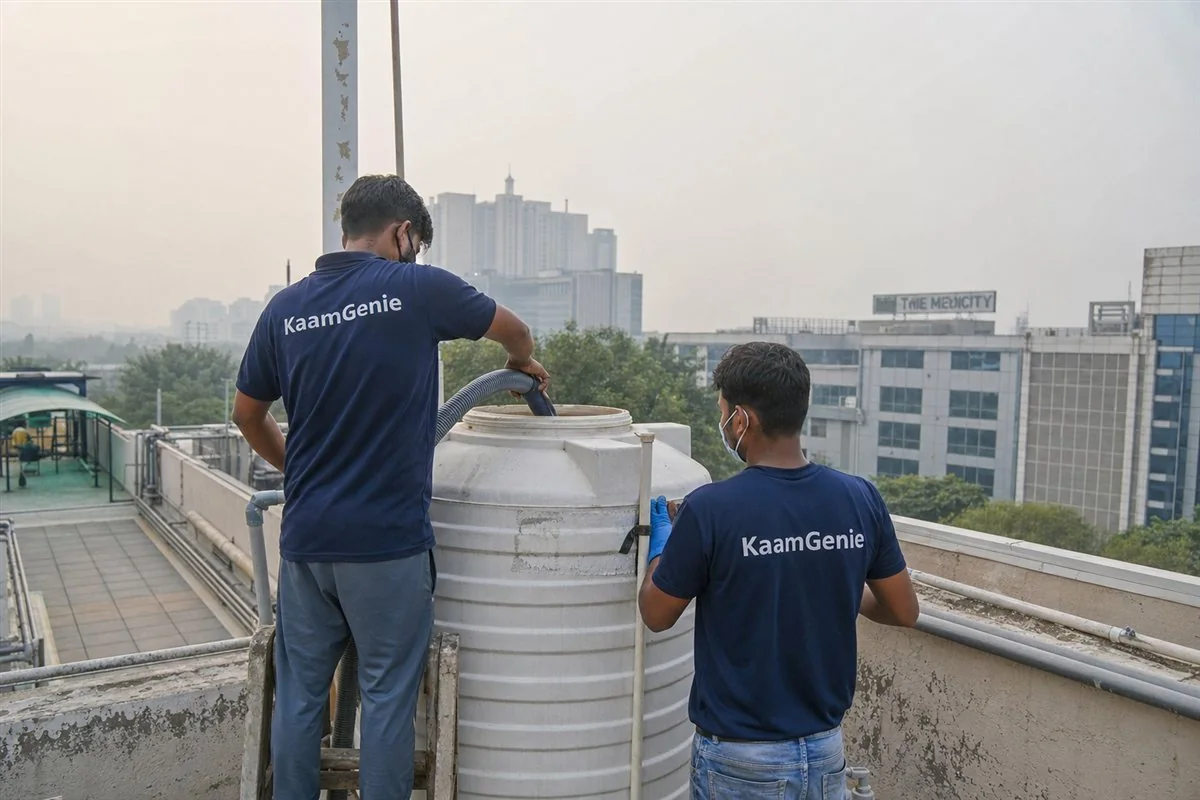
A hospital cannot lose water. The way we square infection-control-grade cleaning with that constraint is to work the campus zone-by-zone, on bypass supply, in low-occupancy windows. A single rooftop tank’s distribution lines are offline 4–6 hours from drainage to refill and flush; a large multi-tank Gurgaon hospital is staged across several nights so the whole facility never loses water at once. Inpatient zones are scheduled 11pm–5am on weekdays; OPD-only clinics and diagnostic labs go on weekends. The pre-clean meeting produces a written downtime estimate per ward so the nursing team can pre-stock bedside water and IV solutions.
Every visit also runs through three internal stakeholders. The infection-control nurse or HICC chair signs off on the protocol match and receives the post-clean swab report and sterility certificate. The biomedical-waste officer approves the drain route for the effluent. The engineering/maintenance manager handles tank isolation, bypass and downstream flushing, and keeps the master register of tank locations and last-cleaning dates — which we update after every visit. This coordination is what converts a residential-style cleaning into a hospital-grade one.
Geographically, the dense end of this work sits along the Golf Course Road corridor, where the large multi-specialty and JCI-tier hospitals cluster with the strictest documentation bar and routine Legionella surveillance. The Sushant Lok belt and the surrounding Sector 56 pocket carry a heavier concentration of nursing homes, polyclinics and diagnostic labs — mostly NABH or NABH-SHCO accredited, lighter on documentation but on the same swab-and-certificate standard. We serve all of these zones under one protocol; the difference between them is scheduling logistics, not protocol depth.
Why healthcare facilities should always be on AMC
For a home, the AMC-versus-one-time decision depends on the building’s reinfection risk. For a healthcare facility it is settled: AMC, always. NABH expects a continuous quarterly log and monthly records for OT-zone and dialysis tanks — booking one cleaning at a time leaves gaps, and one missed quarter breaks the audit trail. The same crew every visit keeps the institutional knowledge (where the dialysis-feed tank is, the OT gowning rules, the security-desk routine). Downtime windows become predictable so wards can plan. The contract includes free re-cleaning if a post-clean swab fails. And the per-visit math runs 15–25% below one-off rates. The mechanics are the same ones we set out in our guide to water tank cleaning AMC in Gurgaon — healthcare simply makes the case unanswerable.
If your facility also runs corporate canteens, attached commercial blocks or staff housing, those tanks can ride on the same contract; the scoping logic mirrors our commercial water tank cleaning in Gurgaon work, and shared-society medical complexes overlap with society water tank cleaning in Gurgaon. For a sense of where the numbers land before the site walk, our water tank cleaning cost guide for Gurgaon sets the residential baseline; hospital UGR and multi-tank work is always custom-quoted after we map the campus.
Booking hospital tank cleaning in Gurgaon
If you run a hospital, nursing home, dialysis centre, IVF clinic or diagnostic lab anywhere in Gurgaon, the starting point is a free healthcare site walk. We map every tank and feed line with your infection-control nurse and maintenance manager, confirm the after-hours windows, and return an AMC quote within 24 hours. You can see the full local service area and book on the water tank cleaning in Gurgaon hub page, or call +91 95603 66362 and ask for the hospital protocol — we’ll confirm shortly.
Frequently asked questions
How often should a Gurgaon hospital or clinic clean its water tanks?
Quarterly at minimum for general potable tanks and the underground reservoir, which is the NABH-aligned cadence your assessor expects. Monthly for OT-zone tanks, dialysis-feed tanks, and any tank with a documented past contamination event. Annually for fire-reserve tanks. An annual-only programme will not clear the Hospital Infection Control chapter review. We schedule AMC visits on fixed quarter-end dates so the cleaning log has no gaps.
Are you NABH-accredited, and what documentation do you provide?
Vendors don’t hold NABH accreditation — that’s for the healthcare facility. What we provide is an NABH-ready documentation pack: pre and post-clean photos, the chemical batch certificate, a measured contact-time log, residual chlorine readings, crew police-verification IDs, NABL-accredited microbiological swab reports, and a signed sterility certificate. This is the exact paperwork a Gurgaon hospital’s NABH assessor reviews under the HIC chapter and that the infection-control committee files at its monthly meeting.
Can the cleaning be done without shutting down the hospital?
Yes. We work zone-by-zone with bypass arrangements so the whole campus never loses water at once. The underground reservoir and rooftop potable tanks are scheduled in low-occupancy windows — typically 11pm to 5am for inpatient zones and weekends for OPD-only clinics. A single rooftop tank’s distribution lines are offline 4–6 hours; a large multi-tank Gurgaon campus is staged across nights so wards can pre-stock bedside water. The downtime estimate per ward is written into the pre-clean coordination meeting.
What microbiological water tests do you run before and after cleaning?
The standard panel for every hospital tank is Heterotrophic Plate Count (HPC), Total Coliform, and E. coli, matched against BIS IS 10500:2012 limits, on a pre-clean and a post-clean sample from the same NABL-accredited Gurgaon lab. We add a Pseudomonas aeruginosa swab for OT-zone and burn-unit-feeding tanks, Legionella pneumophila culture or PCR for JCI-tier facilities and ICU/transplant/neonatal-feeding tanks, and an endotoxin test against AAMI / ISO 23500 limits for dialysis-feed tanks. Standard panel turnaround is 3–5 days; 7–10 days if Legionella culture is included.
Why does Gurgaon groundwater make hospital tank cleaning harder?
Much of Gurgaon runs on hard borewell groundwater plus tanker top-ups, which leaves heavy calcium and iron scale on tank walls and at the floor of large underground reservoirs. That mineral scale is exactly where biofilm — and organisms like Pseudomonas — anchor and survive routine chlorination. A hospital tank in Gurgaon therefore needs more aggressive descaling and a longer disinfectant contact time than a comparable tank on softer municipal water, which is why post-clean swab proof matters even more here.
What does a typical Gurgaon hospital water system look like?
Larger Gurgaon hospitals on the Golf Course Road and Sushant Lok medical belt run very large underground reservoirs (UGRs) — often 50,000 litres or more — fed by tankers and borewell, pumping up to multiple zoned rooftop tanks. On top of the primary potable tanks there are usually separate dialysis-feed tanks, kitchen/dietary tanks under FSSAI rules, laundry tanks, OT-zone tanks, and fire-reserve tanks. Each has its own risk profile and cleaning frequency, so the first job is always mapping every tank with the maintenance manager before we quote.
What happens if a post-clean swab test fails?
Under our AMC contract we re-clean within 48 hours at no extra charge and re-test until the report lands inside drinking-water limits. A non-conforming result usually points to inadequate disinfectant contact time, downstream pipe biofilm beyond the tank itself, or a recontamination event during refill. If downstream pipe biofilm is suspected, we flag a flushing protocol or pipe-replacement recommendation for the facility’s engineering team — outside our scope but recorded in the report. We don’t close out the cleaning event until the result passes.
Who at the hospital signs off on the cleaning?
Three internal stakeholders are involved on every visit. The infection-control nurse or HICC chair signs off on the protocol match and receives the post-clean swab report and sterility certificate. The biomedical-waste officer approves the wastewater drain route, since the effluent carries biofilm and chlorine residue and cannot go to a storm drain. The engineering/maintenance manager coordinates tank isolation, bypass supply, and distribution-line flushing. The sterility certificate is typically signed by the infection-control nurse and countersigned by the maintenance manager.
Do you clean small clinics and nursing homes, or only large hospitals?
Both. Our smallest healthcare clients in Gurgaon are single-doctor day-care surgical units, IVF clinics, and diagnostic labs with one rooftop tank. Mid-size nursing homes and polyclinics across Sushant Lok and the sectors are our most common segment, and large multi-specialty hospitals are a custom-quote category. The swab testing, PPE, and documentation handover are the same standard regardless of facility size — a small clinic gets the same NABL lab routing as a 200-bed hospital.
How do we book a hospital tank cleaning or AMC in Gurgaon?
Call 95603 66362 or use the booking form on this site and ask for a healthcare site walk. We do a free walk-through with your infection-control nurse and maintenance manager, map every tank and feed line, confirm the after-hours windows, and return an AMC quote within 24 hours. We cover the Golf Course Road, Sushant Lok, and sector medical belt, with a same-day callback for emergency contamination events on existing AMC clients.
Sources & references
- Bureau of Indian Standards (BIS) — IS 10500:2012 is the canonical Indian Standard for drinking water specification, defining acceptable limits for physical, chemical, and biological parameters.
- WHO Guidelines for Drinking-water Quality, 4th edition — the global reference for water quality standards, including guidance on storage and disinfection.
- Food Safety and Standards Authority of India (FSSAI) — defines water quality requirements for food businesses, including hygiene standards for stored water and acceptable disinfection chemicals.
- WHO Fact Sheet on Drinking Water — overview of safe drinking water requirements and contamination risks.
- CPHEEO — Manual on Water Supply and Treatment — the Government of India’s engineering manual covering tank design, cleaning protocols, and disinfection practices.
Last verified: 30 June 2026. If you find any of these links broken, please let us know.