
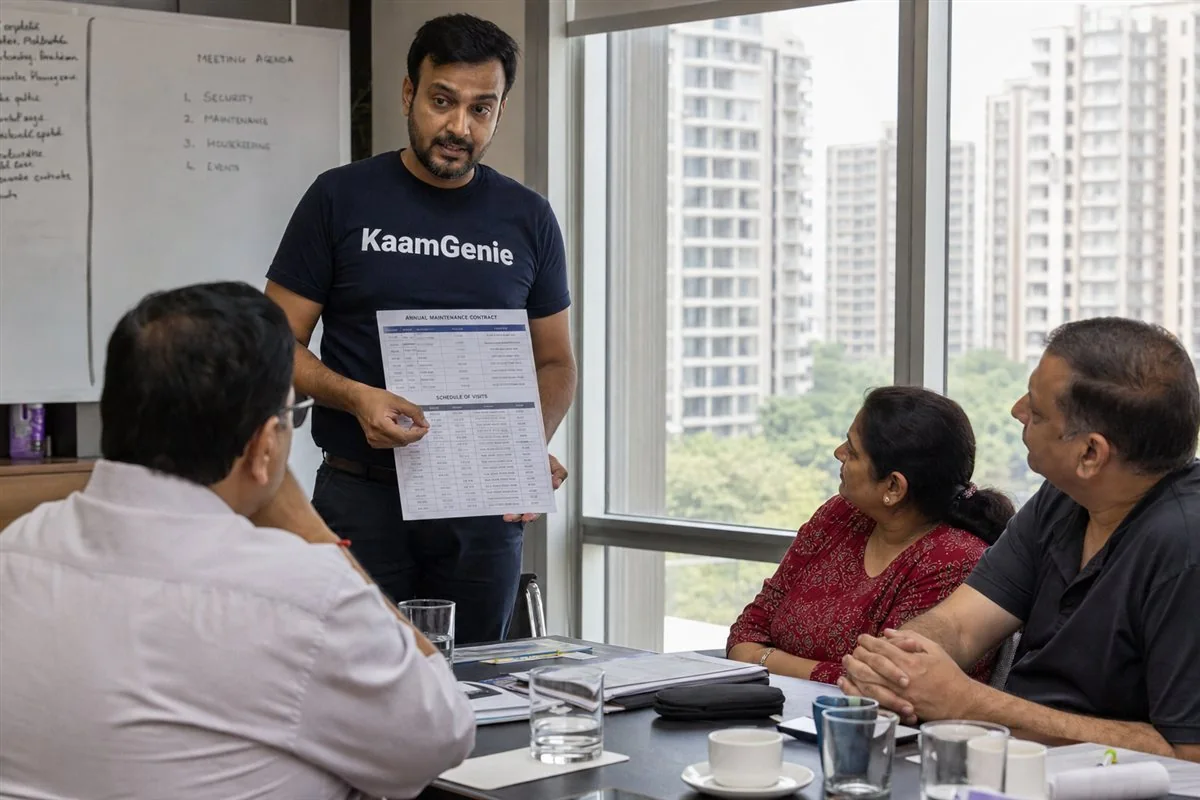
The short version for managing committees
- Quarterly beats ad-hoc — Gurgaon’s hard borewell water and tanker dependence load tanks with sediment fast, so cleaning needs to happen before complaints, not after.
- A real AMC covers the whole chain — every underground reservoir (UGR), mid-level sump and rooftop tower tank, not just the overhead tanks.
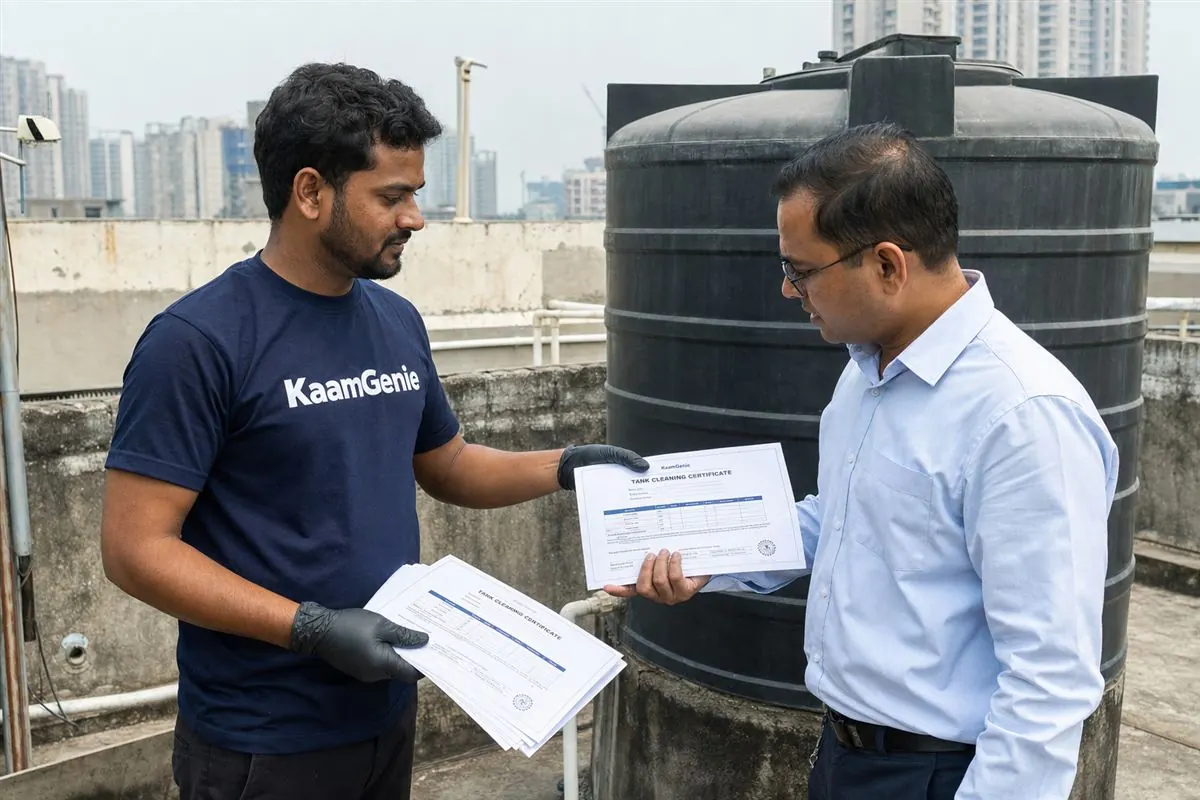
- You get documentation — a per-tank certificate, before/after photos and a consolidated report each cycle, plus GST invoicing.
- It has an SLA — fixed visit dates, a guaranteed emergency response window, and a set number of call-outs inside the annual fee.
- Pricing is custom and per-tank — priced after a physical survey, by capacity and access, not a flat per-flat guess.
If a quote skips the UGR, skips the survey, or has no certificate — it is a price, not a contract.
Gurgaon is a city of towers, and almost every one of them runs on the same water plumbing logic: a tanker or borewell fills a large underground reservoir, booster pumps lift that water up to rooftop tanks on each block, and gravity feeds it down to the flats. That chain has multiple storage points, and contamination at any one of them reaches every kitchen tap above it. Cleaning it properly is a coordination job — which is exactly why it suits a contract rather than a phone call once a year.
We run scheduled cleaning across DLF colonies, the Golf Course Road corridor, Sohna Road and the newer SPR and Dwarka Expressway belts, and the pattern that separates the well-run societies from the troubled ones is simple: the good ones have a standing schedule. If you want the wider picture of how we service the city, the water tank cleaning in Gurgaon hub lays out coverage and pricing; this guide is specifically about putting that on an annual contract for an AOA or condo society.
| Factor | Ad-hoc / on-complaint | Quarterly AMC |
|---|---|---|
| Trigger | A resident complains (water already bad for weeks) | Calendar date, before contamination shows |
| UGR coverage | Often forgotten until a crisis | Scheduled every cycle, by capacity |
| Price | Re-negotiated each time, peak-season surcharges | Locked per-tank for the year |
| Accountability | Different crew each time, no memory of your plumbing | One vendor, single point of contact |
| Documentation | Patchy or none | Per-tank certificate + photos every visit |
| Emergencies | Pay full rate, wait for availability | Guaranteed response window in the SLA |
Get an AMC quote for your society
We survey every tank on the property first, then price per tank. Residential cleaning ₹699 onwards; society and UGR contracts are custom.
Why quarterly beats ad-hoc in Gurgaon specifically
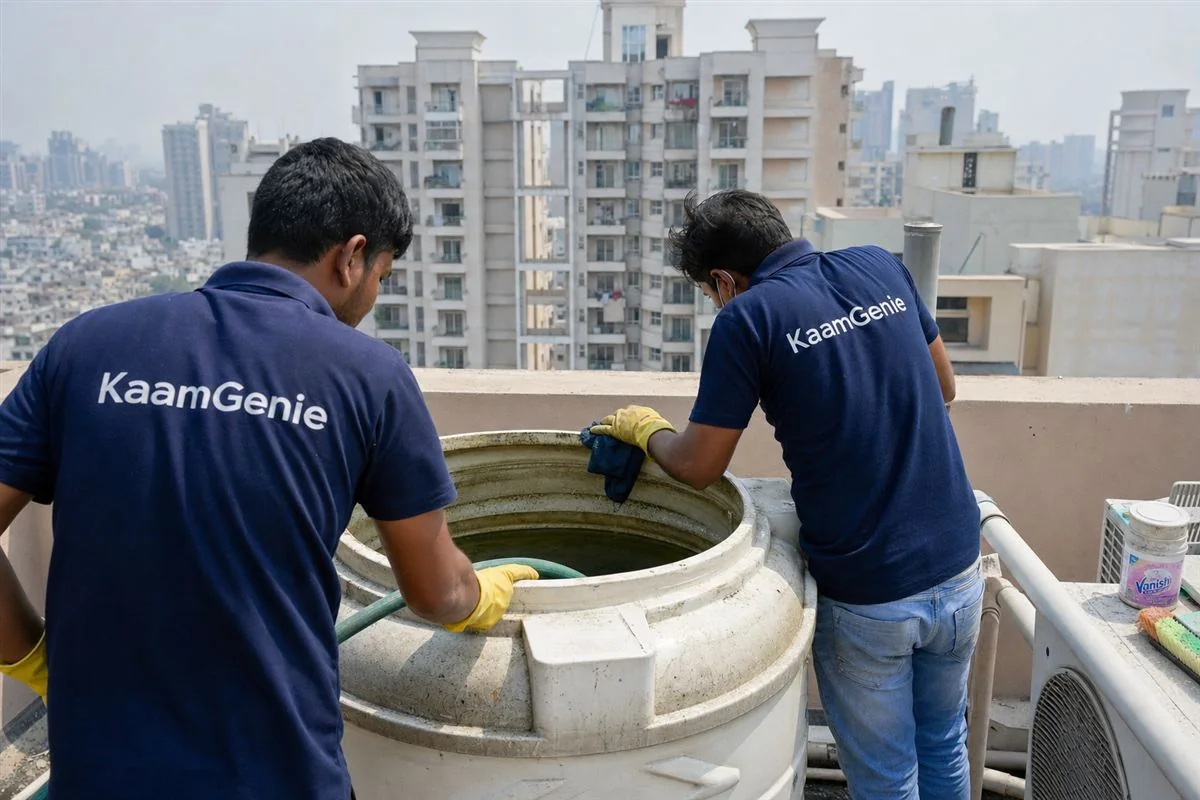
Two things make Gurgaon harder on storage tanks than most of NCR. The first is the hard borewell groundwater — high in dissolved minerals that precipitate out as calcium and magnesium scale on tank walls and around inlet fittings. The second is the city’s heavy reliance on water tankers. Tanker water varies in quality load to load, and it carries silt that settles straight to the bottom of your UGR. A society on a clean piped supply might get away with twice-yearly cleaning; a tanker-fed Gurgaon tower accumulates sediment several times faster.
Ad-hoc cleaning is reactive by definition — you only book it once water already smells, looks off, or a child in the tower has a stomach upset. By then the contamination has been sitting in the supply for weeks. A quarterly schedule means the tanks are emptied, scrubbed and disinfected on a calendar rhythm that stays ahead of the sediment, so residents simply never see the bad-water phase. For an honest look at frequency by building type, our team also keeps a guide on society water tank cleaning in Gurgaon that complements this contract-focused piece.
What a real AMC actually covers
This is where most cheap contracts quietly fall apart. A complete AMC is not “we will come four times a year.” It is a defined scope for every storage point, with documentation attached. At minimum, insist the contract spells out:
- Every tank on the property, by ID and capacity — all underground reservoirs, any intermediate or booster sumps, and the rooftop tank on every block. Not “the overhead tanks.” The actual list.
- The full process each visit — drain, hand-scoop sludge, manual scrub with food-grade brushes, high-pressure jet wash, wet-vacuum the residue, and food-grade disinfection with the correct contact time. A genuine cleaning, not a rinse.
- A per-tank cleaning certificate — tank ID, capacity, date, chemicals used and crew names, for every single tank, every cycle.
- Before/after photos for each tank, delivered to the managing committee, plus a consolidated service report.
- An SLA — fixed scheduled dates, a guaranteed emergency response window, and a defined number of emergency call-outs included before extra charges.
- GST invoicing against the AMC, so the spend is clean in the society’s books.
The UGR clause is the one to guard hardest. In a Gurgaon tower the underground reservoir is the heart of the system — if it is dirty, every rooftop tank above it is re-seeded with sediment within days of being cleaned. A contract that lists only the rooftop tanks looks cheaper on paper and leaves your worst tank untouched. We treat the UGR and any deep sump as the priority items, which is also why water tank cleaning services for societies are always priced after seeing the reservoir, never sight-unseen.
How per-tank pricing works (and what to be suspicious of)
Residential cleaning has a published rate — ₹699 onwards for a standard home tank. Society and UGR work does not, and it should not, because no two towers are the same. A 50,000-litre underground reservoir with a tight access hatch is a completely different job from a 1,000-litre rooftop Sintex. Honest AMC pricing follows a simple logic:
- Survey first. A supervisor walks the property, opens each tank, logs capacity and access difficulty, and counts every storage point including the ones the committee forgot about.
- Price per tank. Each tank gets a per-visit price based on its capacity and how hard it is to reach and work in.
- Multiply by the schedule. The annual fee is the sum of all tanks across all visits in the year — usually with a modest discount for committing to the full cycle versus paying ad-hoc.
Be cautious of anyone who quotes a flat per-flat number or a single annual figure without having seen the tanks. That number is a guess, and the way it gets “made profitable” later is by skipping the UGR or the deepest sump on the day. For a transparent breakdown of how cleaning is costed across the city, the water tank cleaning cost in Gurgaon guide is worth sharing with your committee before you compare AMC quotes.
Typical AMC visit time by tank — a mid-size Gurgaon condo tower
The underground reservoir is the longest job and the one most often skipped by cut-price vendors
Indicative only — actual times depend on access, sediment load and crew size. A real society visit is often a full day across multiple crews; this is why the UGR is the line item to protect in any AMC.
The SLA: what “service level” should mean on paper
An AMC without an SLA is just a discount card. The service-level part is what gives the managing committee something to hold the vendor to. A workable SLA for a Gurgaon society fixes:
- Scheduled dates for the year, agreed in advance so residents can be notified and water can be managed during the cleaning window.
- An emergency response window — for example, a crew on-site within 24–48 hours of a contamination complaint, separate from the scheduled visits.
- A set number of emergency call-outs included in the annual fee before any extra charge applies.
- A single point of contact on both sides, so the facility manager is not chasing a different number each time.
- A rescheduling clause — what happens if a visit clashes with a water shortage or a society event.
This matters most for the tanker-fed belts. Towers along Sohna Road, the Southern Peripheral Road and Dwarka Expressway push so much variable tanker water through the UGR that an emergency clean is a realistic mid-year possibility, not a hypothetical. We routinely run tighter cycles on the reservoirs for societies in areas like Sohna Road and the new-tower sectors precisely for this reason.
How to evaluate AMC vendors before signing
Put every shortlisted vendor through the same checklist. The cheapest annual number is almost never the cheapest contract once you account for scope:
- Did they survey the tanks before quoting? If the quote arrived without anyone opening your reservoir, it is a guess.
- Is the UGR explicitly listed with its capacity, alongside every rooftop tank and sump?
- Can they show sample certificates and photos from existing society clients — ideally nearby, in DLF, Sushant Lok or your own sector?
- Do they use food-grade chemicals and carry confined-space safety gear for deep sump work? Reservoir cleaning is genuinely hazardous; corner-cutters skip the safety kit.
- Is the SLA written down, with response times and included call-outs, not just promised verbally?
- Is there GST invoicing and a named point of contact?
We service condos right across the city, from the established DLF colonies to the newer high-rise belts — if you want to see how the per-area scope reads, the DLF Phase 5 and Sector 65 pages show the kind of building mix we contract for. For societies that also run a clubhouse cafe, gym juice bar or banquet kitchen, ask the vendor to fold those FSSAI-relevant tanks into the same AMC; our note on commercial water tank cleaning in Gurgaon covers what that documentation needs to look like.
Ready to put your tanks on a schedule?
We’ll survey every tank, send a per-tank scope and a written SLA, and hold the price for the year. Society and UGR contracts are custom-priced.
Putting it on the books: getting the AOA to sign
The last hurdle is usually internal — getting the managing committee to approve a recurring spend. The argument that lands is the one about risk and predictability, not price. An AMC turns an unbudgeted, panic-priced emergency into a fixed annual line item, removes the liability of a contamination event no one scheduled around, and hands the next committee a clean, continuous record instead of a gap. Fund it from the maintenance corpus, present the per-tank scope and the SLA at the AGM, and the resident question — “is our water safe?” — finally has a documented answer.
When you are ready to move, the simplest first step is a survey: we walk the property, count and log every tank, and come back with a per-tank scope, a written SLA and an annual price your committee can vote on. You can start from the water tank cleaning in Gurgaon hub, or just call and tell us which society and how many blocks — we will take it from there.
Frequently asked questions
What exactly does a water tank cleaning AMC cover for a Gurgaon society?
A proper AMC covers every storage point on the property — the underground reservoirs (UGR), the intermediate sumps, and all rooftop tower tanks on every block — cleaned on a fixed schedule with the full process each visit: drain, sludge removal, manual scrub, jet wash, vacuum and food-grade disinfection. It should also include a per-tank cleaning certificate, before/after photos, and a defined number of emergency call-outs within the year. Anything that only lists the overhead tanks and leaves the UGR out is not a complete contract.
How often should a Gurgaon condo society clean its tanks under an AMC?
Quarterly — every three months — is the right baseline for most Gurgaon societies because of hard borewell groundwater and heavy reliance on water tankers, both of which load tanks with sediment far faster than a single municipal line would. High-footfall towers, tanker-fed blocks, or societies that have had a contamination complaint are often better on a bi-monthly cycle for the UGR. Annual cleaning is the bare legal-comfort minimum and is not enough for a shared tanker-fed system.
Why is an AMC better than calling someone ad-hoc each time?
Ad-hoc cleaning only happens after someone complains — by which point the water has already been bad for weeks. An AMC fixes the schedule in advance so cleaning happens before contamination shows up, locks the per-tank price for the year so the managing committee can budget cleanly, keeps one accountable vendor who knows your plumbing, and produces a continuous paper trail of certificates the AOA can show residents and auditors. It usually works out cheaper per visit than ad-hoc call-outs too.
How is AMC pricing calculated for a society with many tanks?
Society and UGR pricing is custom, not the residential rate. A vendor should survey the property first and price per tank by capacity and access difficulty — a 50,000-litre UGR is very different work from a 1,000-litre rooftop Sintex. The annual fee is then the sum of all tanks multiplied by the number of visits per year, usually with a small discount for committing to the full schedule. Be wary of a flat per-flat or per-visit number quoted without anyone having seen the tanks.
Does the AMC cover both the underground reservoir (UGR) and the rooftop tower tanks?
It must. In most Gurgaon towers the tanker or borewell fills a large underground reservoir, and pumps lift that water to the rooftop tanks. If the UGR is dirty, every tower tank above it gets recontaminated within days no matter how clean they are. A real AMC schedules the UGR, any mid-level sumps, and all rooftop tanks together so the whole chain is clean at once. Check the contract lists the UGR explicitly with its capacity.
What documentation should the AMC produce for the AOA or RWA?
Each visit should generate a per-tank cleaning certificate stating the tank ID, capacity, date, chemicals used and crew names, plus before/after photos for every tank, and a consolidated service report for the managing committee. A GST invoice should accompany each cycle. This pack is what the AOA shows residents in the AGM, what an incoming committee inherits, and what you produce if a resident ever raises a water-quality concern.
What is a reasonable SLA and emergency call-out clause?
A workable SLA fixes the scheduled visit dates for the year, guarantees a response window for emergencies (for example, on-site within 24-48 hours of a contamination complaint), and includes a set number of emergency cleanings within the annual fee before extra charges apply. It should also name who the society’s single point of contact is and how rescheduling is handled. Vague promises of “we’ll come when you call” are not an SLA.
We are a tanker-fed tower on SPR or Dwarka Expressway - does that change the AMC?
Yes. Towers on the Southern Peripheral Road and Dwarka Expressway belt that run largely on tanker water push far more silt and variable-quality water through the UGR than a piped-supply society. For those buildings we usually recommend a tighter cycle on the underground reservoir specifically — bi-monthly rather than quarterly — while keeping the rooftop tanks on the standard quarterly schedule. The AMC should reflect that split rather than treating every tank the same.
How do we evaluate and compare AMC vendors before signing?
Insist on a physical tank survey before any quote, a written per-tank scope listing every tank including the UGR, sample certificates and photos from existing society clients, proof of food-grade chemicals and confined-space safety gear for sump work, and a clear SLA with named emergency response times. Compare on scope and documentation, not just the headline annual number — the cheapest contract that quietly excludes the UGR or the deepest sump is the most expensive mistake.
Can individual flat owners opt out, or is the AMC building-wide?
Because the UGR and shared rooftop tanks supply the whole block, the AMC is signed by the AOA or managing committee on behalf of all residents and funded from the maintenance corpus — individual flats cannot opt out of shared-tank cleaning. Where a tower has dedicated per-flat tanks, those can be added as an optional line item, but the core shared system has to be covered building-wide for the contract to mean anything.
Sources & references
- Bureau of Indian Standards (BIS) — IS 10500:2012 is the canonical Indian Standard for drinking water specification, defining acceptable limits for physical, chemical, and biological parameters.
- WHO Guidelines for Drinking-water Quality, 4th edition — the global reference for water quality standards, including guidance on storage and disinfection.
- Food Safety and Standards Authority of India (FSSAI) — defines water quality requirements for food businesses, including hygiene standards for stored water and acceptable disinfection chemicals.
- WHO Fact Sheet on Drinking Water — overview of safe drinking water requirements and contamination risks.
- CPHEEO — Manual on Water Supply and Treatment — the Government of India’s engineering manual covering tank design, cleaning protocols, and disinfection practices.
Last verified: 29 June 2026. If you find any of these links broken, please let us know.