
The short version for facility managers
- Whole system, not one tank. Commercial buildings run an underground reservoir (UGR) plus rooftop tower tanks — both have to be cleaned for the water to actually be clean.
- Zero downtime is the default. We clean in phases or after hours so offices, malls and hotels never lose supply during working time.
- Documentation is the deliverable. Per-tank certificate, before/after photos and a post-refill TDS reading — the records your audits and landlord duty-of-care need.
- Twice a year minimum. Gurgaon’s hard borewell water and heavy tanker reliance push high-footfall buildings toward quarterly cleaning, best handled on an AMC.
- Pricing is custom. Residential is ₹699 onwards; commercial reservoirs and multi-tank systems are quoted after a quick site survey.
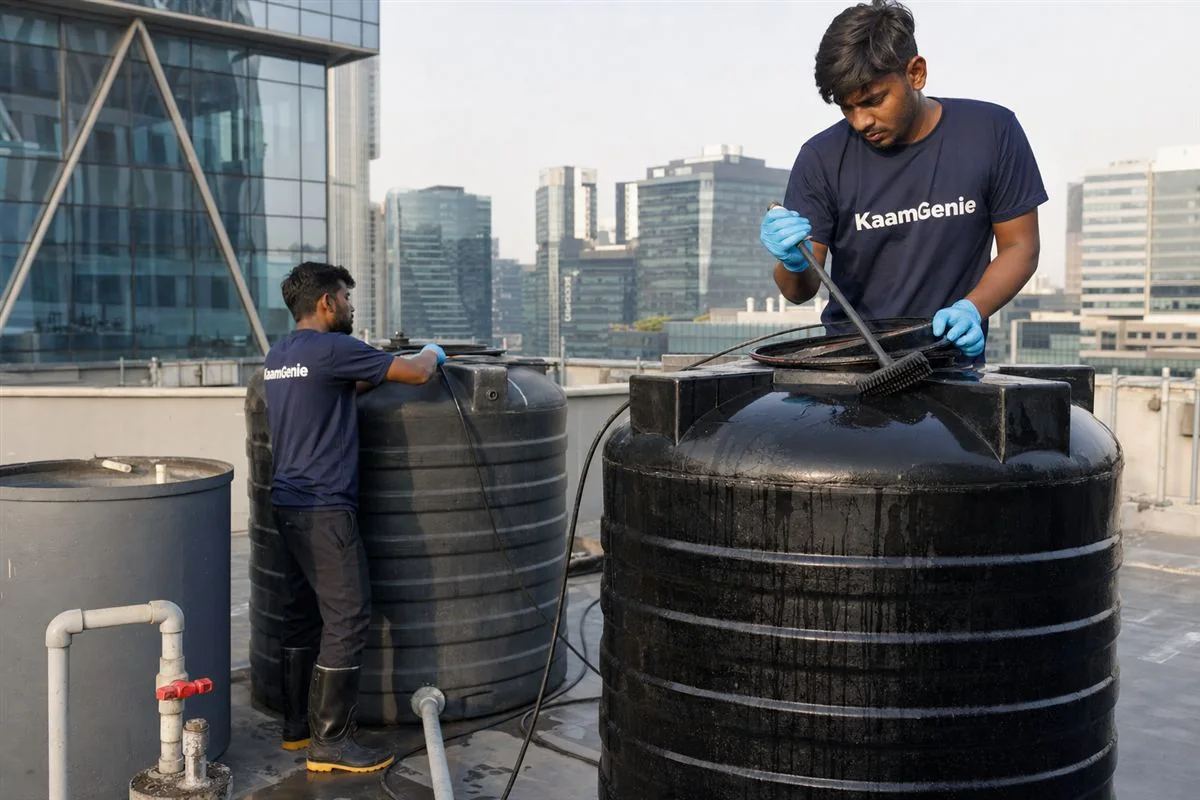
Walk into any tower in Cyber City or a glass block off Golf Course Road and you don’t think about where the water in the washroom tap, the pantry, the cafeteria or the cooling system came from. But almost none of it arrives straight from the mains. Gurgaon’s commercial belt runs largely on borewell groundwater and bulk water tankers, stored in large underground reservoirs and then pumped up to rooftop and terrace tanks. Every drop a thousand-person office uses has sat in those tanks first.
That makes the tank, not the tap, the real hygiene control point. When a reservoir isn’t cleaned on schedule, sediment, scale and bio-film accumulate quietly, and the first sign is usually a complaint — cloudy water, an odd smell in the pantry, or a facility audit flagging missing records. This guide is about getting ahead of that: how water tank cleaning in Gurgaon is done properly for commercial buildings, and what corporate facility teams should expect.
Why Gurgaon’s corporate water needs more attention, not less
Gurgaon (Gurugram) grew faster than its piped water network, so commercial buildings lean heavily on two sources that both push contamination into storage:
- Hard borewell groundwater. Gurgaon’s groundwater is hard — high in dissolved minerals — so calcium and magnesium scale forms on tank walls and fittings far faster than in soft-water cities. Scale is also where bio-film likes to anchor.
- Tanker-delivered water. When borewells and supply fall short, buildings top up with water tankers. Tanker water varies in quality and often carries more suspended sediment, which settles to the bottom of the reservoir as sludge.
- High, continuous occupancy. An office of a few thousand people, a mall with weekend footfall, or a hotel running 24/7 cycles enormous volumes of water through the same tanks — more throughput, more disturbance of settled sediment, more reason to clean often.
Put those together and the practical takeaway is simple: corporate Gurgaon tanks get dirty faster than the textbook six-month assumption, and high-footfall buildings should plan accordingly.
The commercial systems we clean in Gurgaon
“Commercial” covers a wide range in this city, and the cleaning approach changes with the building. The common thread is scale — large reservoirs, multiple rooftop tanks, and a working day that can’t be interrupted.
| Facility type | Typical water system | Best scheduling | Key documentation |
|---|---|---|---|
| Corporate offices & IT parks (Cyber City, Udyog Vihar) | Large UGR + multiple rooftop tower tanks | After hours / night shift, phased | Per-tank certificate + TDS + audit-ready records |
| Co-working & managed offices | Shared building UGR + floor/terrace tanks | Weekend or early morning | Certificate for landlord & operator |
| Malls & retail (Golf Course Rd, MG Road) | Multiple reservoirs + tower tanks; F&B feeds | Pre-opening hours, zone by zone | Certificate + food-court tanks documented separately |
| Hotels & banquets | Large UGR, rooftop tanks, kitchen feeds | Low-occupancy window, phased | Certificate + TDS + F&B compliance records |
| Standalone commercial buildings | Single/twin UGR + terrace tanks | Sunday or after-hours single shutdown | Certificate + photos + TDS |
Book the real 8-step cleaning
All 8 steps documented, before/after photos, fixed price. Anything short of this is a rinse. ₹699 onwards.
Zero downtime: how we clean without stopping the building
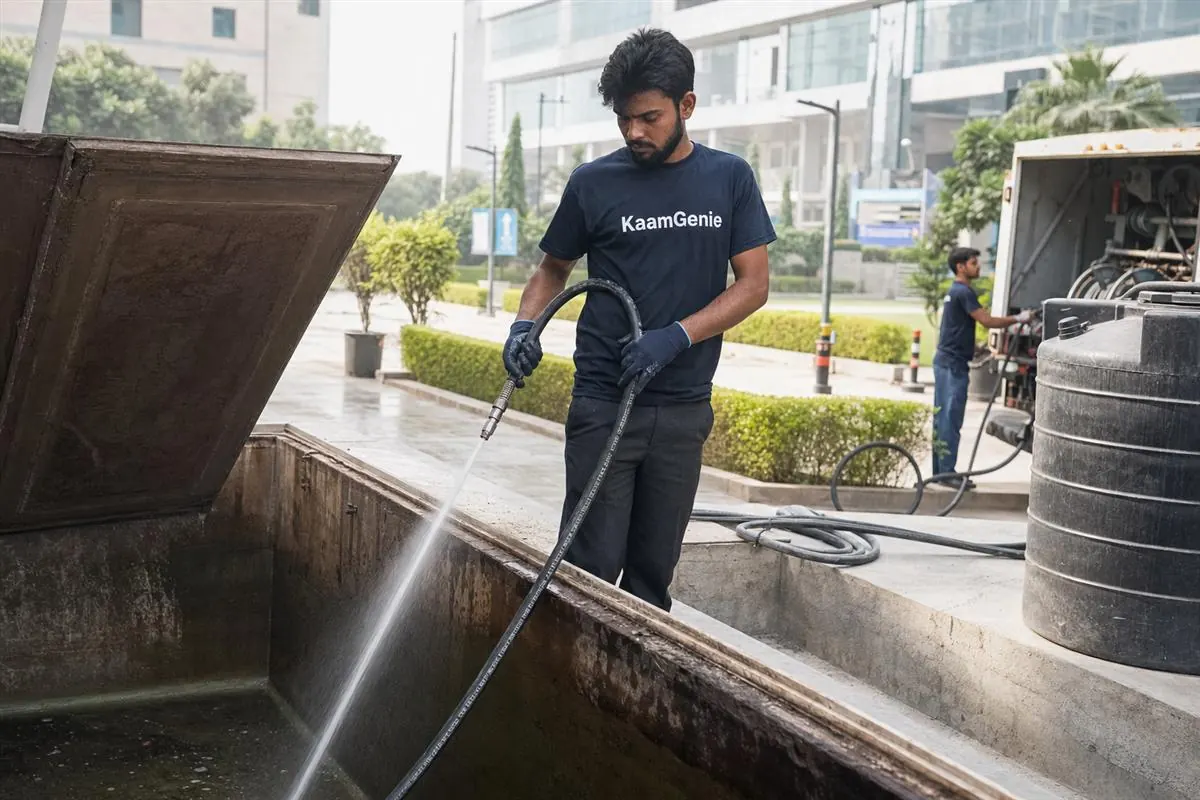
The single biggest concern a facility manager raises is “you can’t cut our water during working hours.” Fair. The good news is that the architecture of a commercial building is what makes zero-downtime cleaning possible. Most have either multiple rooftop tanks or a compartmentalised reservoir, so we can isolate one tank at a time.
In practice we use three approaches, often combined:
- Phased / tank-by-tank cleaning. We take one rooftop tank or one reservoir compartment offline, clean it, refill and disinfect it, then move to the next — the building stays supplied from the rest throughout. This is the standard for large offices and IT parks in Cyber City and Udyog Vihar.
- After-hours and night shifts. For buildings that prefer a clean-everything-at-once approach, we work the night window — arrive after the floor empties, finish before it fills.
- Weekend / low-occupancy windows. Malls and hotels often prefer pre-opening hours or a quiet Sunday so footfall and F&B service are never disrupted.
Whichever we use, we agree the downtime window in writing first, coordinate with your facility and security teams for access and lift/terrace permissions, and confirm tank levels so taps never run dry. The aim is that on Monday morning nobody can tell the cleaning happened — except that the water’s better and the certificate is on file.
What a proper commercial clean actually includes
The cleaning method is the same proven sequence we use everywhere — drain, sludge removal, manual scrubbing, high-pressure jet wash, wet vacuum, food-grade disinfection and refill — just scaled up and run with confined-space safety for large reservoirs. If you want the step-by-step mechanics, our water tank cleaning services page lays out the full process. For commercial clients, the parts that matter most are:
- Both UGR and rooftop tanks. The reservoir is where sediment settles; the rooftop tanks feed the taps. We clean the whole chain plus inlet/outlet lines — cleaning one and skipping the other leaves the system contaminated.
- Confined-space safety for big reservoirs. Large UGRs are confined spaces. Our crews use proper entry procedure, ventilation and gear — non-negotiable on any commercial job.
- Food-grade disinfection. FSSAI-acceptable sodium hypochlorite at the correct concentration with real contact time, never hardware-shop bleach — especially for tanks feeding pantries and cafeterias.
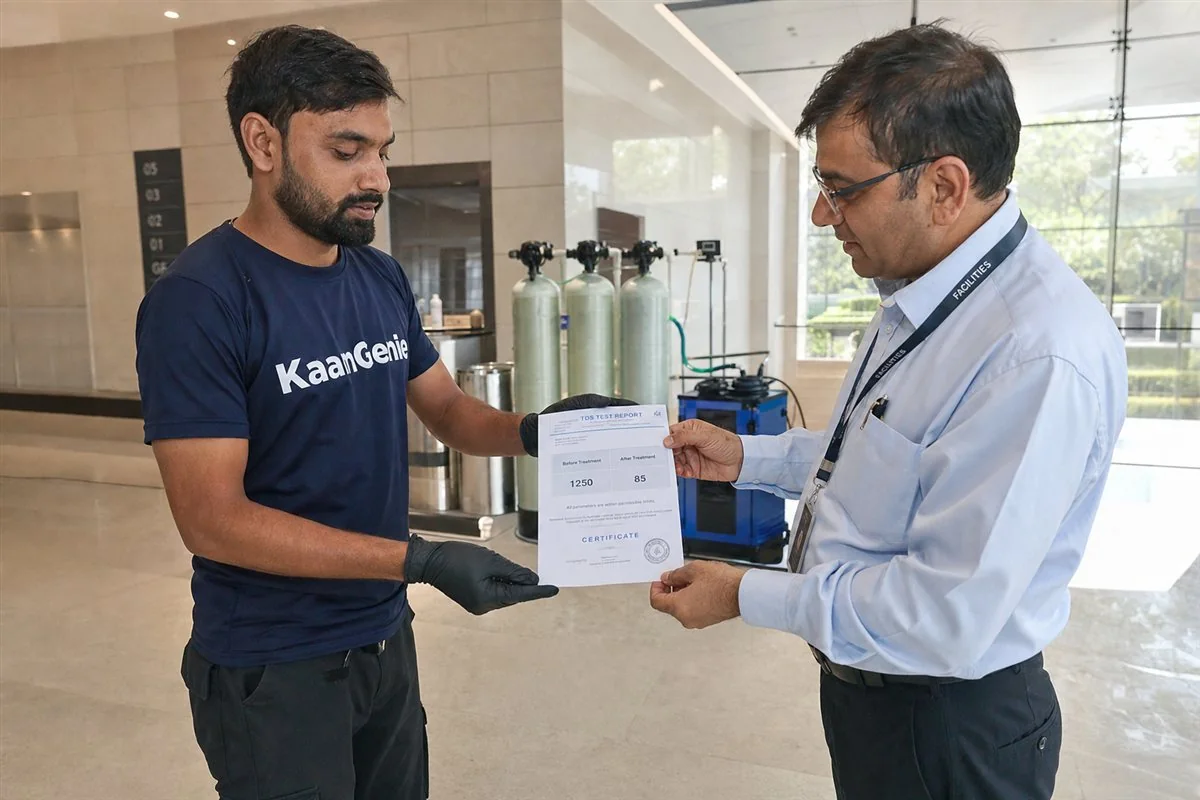
- TDS reading after refill. A measured TDS value on the certificate gives your team an objective before/after data point, not just a photo.
- Per-tank documentation. Each tank gets its own record: capacity, chemicals, crew, date, photos. This is what survives an audit.
Compliance, duty-of-care and the records that protect you
For a corporate occupier or building owner, clean water isn’t only a comfort issue — it’s a duty-of-care obligation to employees, tenants and visitors, and increasingly an audit line item. When an internal HSE review, an ISO audit, a landlord inspection or a tenant query lands, the question is the same: can you show the tanks are cleaned on a schedule and the water was tested?
That’s why our deliverable is the paperwork as much as the cleaning. A dated certificate per tank, photographic before/after evidence, and a TDS reading give facility teams a defensible record. We can also align the cleaning calendar and report format with your vendor-management or audit system so it slots straight in.
If any of the tanks feed a cafeteria, food court or F&B outlet, the bar is higher — food-safety rules apply to the stored water too. The specifics of frequency, food-grade chemicals and record-keeping are covered in our guide to FSSAI water tank requirements for restaurants, and we document F&B-feeding tanks separately so they’re inspection-ready.
Typical after-hours cleaning window by Gurgaon facility type
Phased scheduling means the building stays supplied throughout — this is crew time on site, not downtime
Indicative on-site windows for a full-system clean; actual time depends on reservoir size, number of rooftop tanks and access. Larger and multi-reservoir sites are cleaned over staged phases with no supply interruption.
How often — and why an AMC makes sense for corporates
For commercial buildings, twice a year is the sensible floor, and high-footfall offices, malls and hotels often move to quarterly because of Gurgaon’s hard water and tanker dependence. The hard part isn’t deciding the frequency — it’s never missing it across a busy facility calendar.
That’s what an annual maintenance contract solves. An AMC fixes the cleaning dates in advance, locks per-tank pricing so there are no per-visit negotiations, and bundles the certificates and TDS reports automatically. Your facility team gets reminders, not last-minute scrambles, and your audit file builds itself. We explain how plans are structured in our Gurgaon AMC guide. If your building is a managed residential-plus-commercial complex or you handle an AOA/RWA mandate alongside the corporate floors, our society water tank cleaning guide covers that side too.
What commercial cleaning costs in Gurgaon
Residential cleaning is simple to price — ₹699 onwards for a standard overhead tank. Commercial work is custom because the variables are real: reservoir capacity, number of rooftop tanks, ease of access, confined-space requirements, and the scheduling window you need. A standalone building with a single UGR and two terrace tanks is a different job from a multi-tower IT park.
Our approach is a quick site survey, then a fixed per-job or per-AMC quote with no surprises on the day. For a sense of what drives the number — and why suspiciously cheap quotes usually mean a rinse, not a clean — see our Gurgaon cost guide. The cost of doing it right is small; the cost of a contamination complaint across a thousand-person office is not.
Book commercial water tank cleaning in Gurgaon
From Cyber City and Cyber Hub to Golf Course Road, Cyber City, Sohna Road and the SPR / Dwarka Expressway tower belt, we clean corporate reservoirs and rooftop tanks with zero-downtime scheduling, certificates and TDS reports. Start at the Gurgaon water tank cleaning hub to see coverage and book a site survey, or call us directly and we’ll plan the window around your building.
To arrange a survey, call +91 95603 66362 or use the booking form on this site — we’ll respond within the hour during business hours.
Get a commercial site survey
Free survey, fixed per-job or AMC quote, zero-downtime scheduling. Certificates and TDS reports every visit. Residential ₹699 onwards; commercial custom-quoted.
Frequently asked questions
Will our office lose water supply during a commercial tank cleaning?
Not if it is planned properly. Most Gurgaon corporate buildings have a large underground reservoir plus rooftop tower tanks, so we clean in phases — one tank or one reservoir compartment at a time — while the building runs on the rest. For single-tank setups we schedule after hours or over a weekend so the working day is never affected. We confirm the downtime window in writing before the job.
Can you clean after office hours or on weekends in Cyber City and Udyog Vihar?
Yes — after-hours and weekend slots are the norm for commercial work in Gurgaon’s corporate belt. We routinely clean Cyber City, Cyber Hub, Udyog Vihar, Golf Course Road and Sohna Road / SPR buildings on night shifts or Sunday mornings, coordinate with facility and security teams in advance, and hand back a fully refilled, disinfected system before the building opens.
How large are the tanks in a typical Gurgaon corporate building?
Bigger than people expect. A mid-sized Gurgaon office block usually has an underground reservoir (UGR) of 30,000 to 100,000 litres or more feeding rooftop or terrace tanks of 5,000 to 20,000 litres each. IT parks, malls and hotels run multiple reservoirs and dozens of tower tanks. We size the crew, equipment and schedule to the actual system after a site survey.
Do you provide TDS reports and cleaning certificates for audits and compliance?
Yes. Every commercial job comes with before/after photos, a dated cleaning certificate per tank listing capacity, chemicals used and crew, and a TDS reading taken after refill. This is the documentation facility managers need for ISO/internal audits, landlord duty-of-care records and tenant assurance. We can format records to match your audit or vendor-management system.
How often should a commercial building in Gurgaon clean its tanks?
Every six months is the practical standard for offices, malls and hotels, and many high-occupancy buildings move to quarterly. Gurgaon’s hard borewell groundwater and heavy tanker dependence mean sediment and scale build faster than in piped-supply cities, so high-footfall commercial reservoirs benefit from a tighter cycle. An AMC keeps this on a fixed calendar so it is never missed.
We run a cafeteria or food court — are there extra requirements?
Yes. Any tank that feeds a kitchen, cafeteria, food court or F&B outlet falls under food-safety duty-of-care, so cleaning frequency, food-grade disinfection and record-keeping matter more. We cover the specifics in our guide to FSSAI water tank requirements for restaurants, and we make sure F&B-feeding tanks are documented separately for inspection.
Do you offer an annual maintenance contract for corporate buildings?
Yes — most of our commercial clients are on an AMC. A contract fixes the cleaning calendar (typically twice or four times a year), locks per-tank pricing, and bundles the certificates and TDS reports your facility team needs. See our Gurgaon AMC guide for how plans are structured for offices and complexes.
How much does commercial water tank cleaning in Gurgaon cost?
Residential cleaning starts at ₹699 onwards, but commercial work is custom-quoted because it depends on reservoir size, number of rooftop tanks, access, confined-space requirements and the scheduling window. After a quick site survey we give a fixed per-job or per-AMC price with no surprises. Our Gurgaon cost guide explains what drives the number.
Do you clean both the underground reservoir and the rooftop tanks?
Yes — a real job does the whole system. The underground reservoir (UGR) is where most sediment settles, and the rooftop tower tanks are what actually feed the taps, so cleaning one without the other leaves the system contaminated. We clean the UGR and every rooftop tank, plus inlet and outlet lines, and document each one separately.
Sources & references
- Bureau of Indian Standards (BIS) — IS 10500:2012 is the canonical Indian Standard for drinking water specification, defining acceptable limits for physical, chemical, and biological parameters.
- WHO Guidelines for Drinking-water Quality, 4th edition — the global reference for water quality standards, including guidance on storage and disinfection.
- Food Safety and Standards Authority of India (FSSAI) — defines water quality requirements for food businesses, including hygiene standards for stored water and acceptable disinfection chemicals.
- WHO Fact Sheet on Drinking Water — overview of safe drinking water requirements and contamination risks.
- CPHEEO — Manual on Water Supply and Treatment — the Government of India’s engineering manual covering tank design, cleaning protocols, and disinfection practices.
Last verified: 29 June 2026. If you find any of these links broken, please let us know.