
The short answer, by tank type
- Single overhead tank (500–1,000L): 60–90 minutes
- Underground sump only (up to ~5,000L): 90 minutes–2 hours
- Sump + overhead together (typical Gurgaon house/builder floor): 2–3 hours
- Society shared rooftop tank: 90 minutes–2 hours per tank
- High-rise underground reservoir (UGR) + multiple tower tanks: staged over a full day, sometimes two
Three things stretch the clock: hard-water scale, sludge buildup from a long-neglected tank, and difficult terrace or sump access. A “20-minute” cleaning isn’t fast — it’s incomplete.
Gurgaon — Gurugram — is a city of extremes when it comes to water storage. On one street you have independent builder floors with a small Sintex drum on the terrace and a sump below. A kilometre away, a Golf Course Road condominium runs a giant underground reservoir that pumps up to a dozen rooftop tanks across several towers. The honest answer to “how long does it take?” changes completely depending on which of these you own. Below we break it down by tank type and size, then explain exactly what speeds the job up or slows it down. If you just want it booked, here’s water tank cleaning in Gurgaon with fixed timings.
| Tank setup | Typical capacity | Cleaning time | Water-down window |
|---|---|---|---|
| Single overhead tank | 500–1,000L | 60–90 min | ~1.5–2.5 hrs incl. refill |
| Underground sump only | 2,000–5,000L | 90 min–2 hrs | Sump refills after; overhead unaffected |
| Sump + overhead together | Combined | 2–3 hrs | Half a morning — store a few buckets |
| Society shared rooftop tank | 2,000–5,000L | 90 min–2 hrs each | Tower-by-tower; most flats keep supply |
| High-rise UGR + tower tanks | 20,000L+ | Staged full day | Phased so no full cut-off |
Get an honest time estimate for your tank
Tell us your tank setup and area and we’ll give you a realistic window before we arrive — no rushed jobs. ₹699 onwards for residential.
A single overhead tank: 60–90 minutes
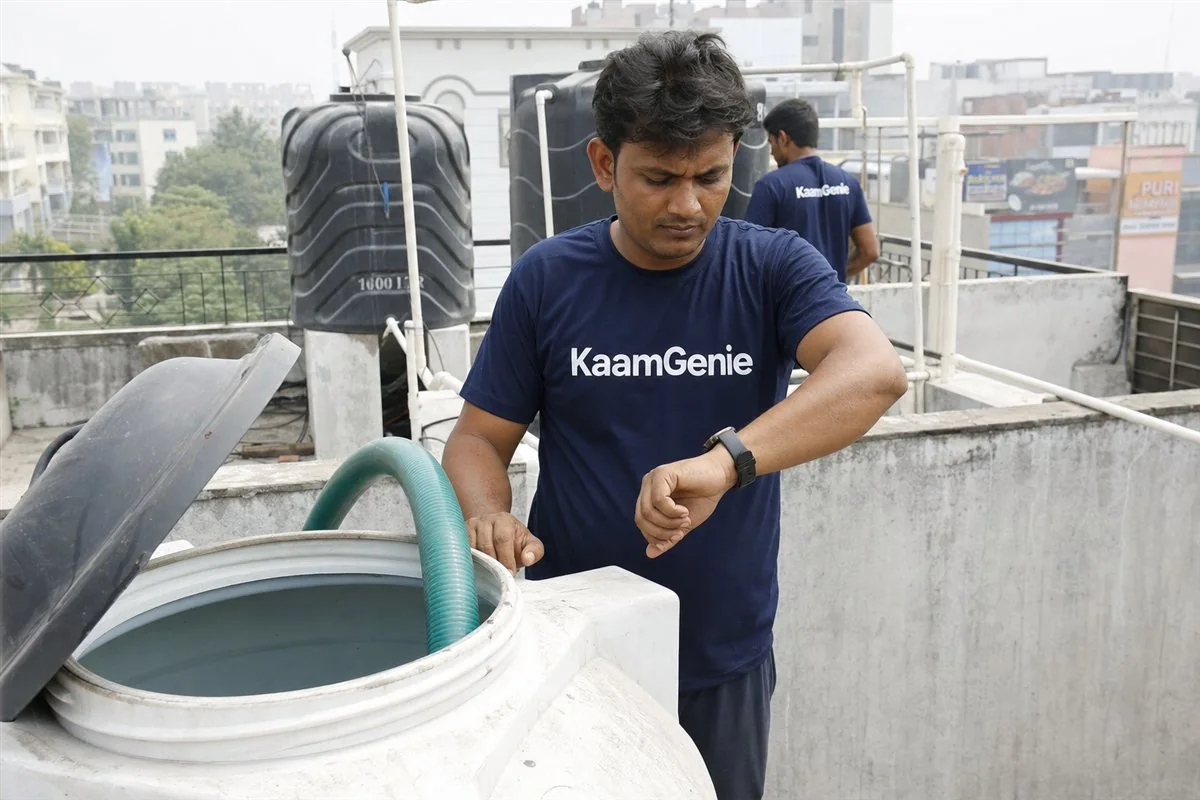
This is the most common residential job in Gurgaon — one plastic or Sintex overhead tank on a builder-floor or independent-house terrace, holding 500 to 1,000 litres. From the moment the crew opens the lid to the moment fresh water starts refilling, expect around 60 to 90 minutes.
Why that range and not faster? Because a proper cleaning has fixed, non-negotiable stages. The tank has to be drained and the inlet shut. The sludge on the floor — the layer your filter never catches — has to be scooped out by hand. Every wall and the floor get scrubbed with food-grade brushes, then a jet-wash pass, then the dirty residual water is vacuumed out, then a food-grade disinfectant is applied and given contact time before a final rinse. None of those steps can be skipped without leaving contamination behind. We walk through each one in our Gurgaon water tank cleaning guide.
A tank in a low-floor home in Sector 82 with easy terrace access and yearly cleaning history sits at the 60-minute end. A first-time clean in years, crusted with hard-water scale, on a high terrace with no service lift, runs to 90.
Sump and overhead together: 2–3 hours
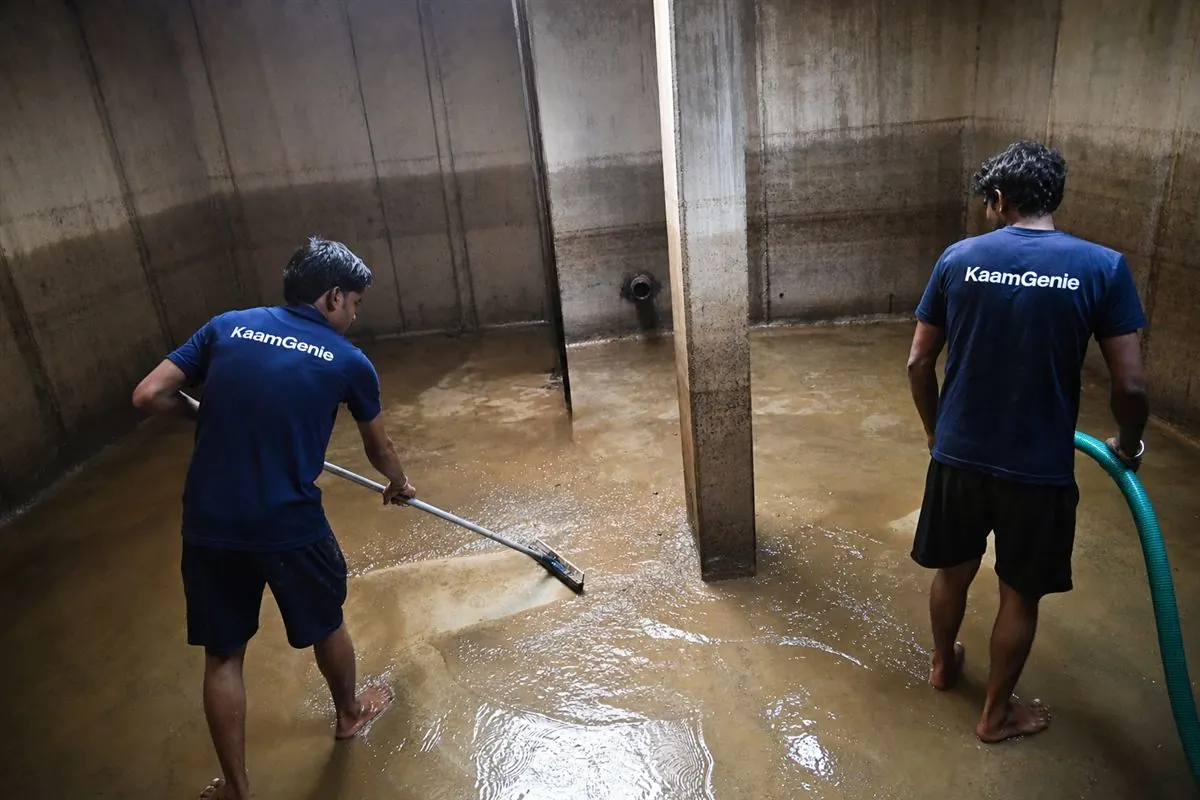
Most Gurgaon independent houses and builder floors store water in two stages: an underground sump that receives the tanker or borewell supply, and a rooftop overhead tank the sump pumps into. When you clean properly, you do both — there’s no point sterilising the overhead tank if dirty sump water flows straight back into it.
The sump alone takes 90 minutes to 2 hours. It holds more water, so pump-out is slower, and it’s a confined space, which means safety setup and careful entry before any scrubbing starts. The overhead tank above adds the usual 60–90 minutes. Together that’s a 2–3 hour visit. If your sump hasn’t been touched in years, the sediment load alone can add half an hour — we cover that in detail in our piece on underground sump cleaning in Gurgaon.
This is the typical setup in areas like DLF Phase 4, where older independent kothis and builder floors almost all run a sump-plus-overhead arrangement.
High-rise reservoirs: staged over a day
The Golf Course Road and DLF condominium belt is a different world. A single tower can have an underground reservoir of 20,000 litres or more, plus a set of rooftop tanks, plus intermediate tanks on service floors. A full condominium has several towers, all fed from one or two central reservoirs.
You cannot clean that in a couple of hours, and you shouldn’t try. The central UGR by itself can be a 4–6 hour job — large surface area, deep sludge, confined-space protocol, and a slow controlled pump-out so the building isn’t left dry. Each tower’s rooftop tanks add more time on top. For a multi-tower society this becomes a planned, staged operation across the working day, occasionally spilling into a second day for the largest complexes.
The key is sequencing. We work tower by tower with the AOA or facility manager so water is never cut to every flat at once — one tower’s tanks are cleaned and refilled while the others stay live. If you manage an AOA, our society water tank cleaning guide for Gurgaon explains how we structure these contracts and schedules. Condominiums along Golf Course Road are almost always this staged, full-day model.
What actually changes the clock
Two tanks of identical size can take very different amounts of time. Here’s what makes the difference in Gurgaon specifically.
Hard-water scale. Large parts of Gurgaon run on hard borewell groundwater. Hard water leaves calcium and mineral scale baked onto the walls and floor, and that scale does not rinse off — it needs longer manual scrubbing and a more thorough jet-wash pass. On a residential tank that can add 15–30 minutes versus a soft-water tank of the same size. If your supply is mostly hard borewell water, our guide to hard water tank cleaning in Gurgaon explains why the scale builds so fast.
Sludge from neglect. A tank cleaned every six to twelve months has a thin film. A tank untouched for three years can have half an inch of black sludge across the floor — sand, iron particles, dead insects, dried algae. Scooping that out by hand is slow, deliberate work, and it’s the step cheap operators skip to save time. The longer you wait between cleanings, the longer each cleaning takes.
Access. A tank on an open, easy-to-reach terrace cleans fast. A tank tucked behind a parapet, raised on a tall stand, or reached by a narrow ladder adds setup and handling time. High builder-floor terraces with no service lift mean the crew carries the pump, jet washer and vacuum up by hand — that alone can add 15–20 minutes before any cleaning begins.
Equipment matters too: a crew that brings a proper submersible pump, a 100–150 PSI jet washer and a wet vacuum works faster and more thoroughly than someone with a bucket and a bottle of bleach. This is part of what you’re paying for with professional water tank cleaning services.
Typical cleaning time by tank setup in Gurgaon
Bigger storage and confined-space reservoirs scale the time up, not down
Indicative ranges for a tank in average condition. Heavy hard-water scale, deep sludge, or difficult access push every figure upward. A full multi-tower condominium is staged across a working day.
How long is the water actually off?
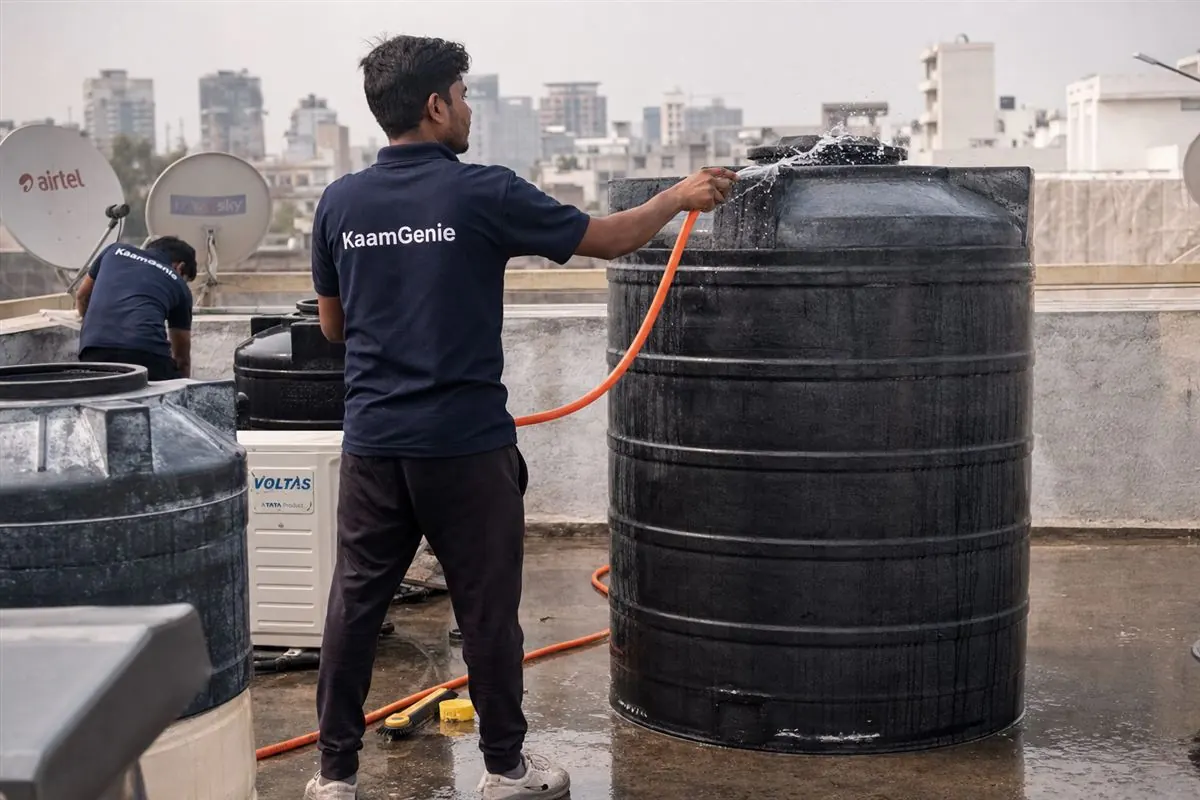
The cleaning time and the water-down window aren’t the same thing. For a single overhead tank, the practical downtime is roughly 1.5 to 2.5 hours — the cleaning window plus the refill once we’re finished. We shut the inlet at the start so no fresh water is wasted mid-job, and taps only run dry in between. Keeping a couple of buckets filled in advance covers you comfortably.
For a sump-plus-overhead job, plan for a longer dry stretch — effectively half a morning — because both stores are offline while we work. In societies it’s different again: because we stage tower by tower, most flats never lose supply at all. If you genuinely can’t afford downtime, a planned same-day cleaning slot in Gurgaon at an off-peak hour keeps disruption to a minimum.
Why “fast” is a warning sign, not a feature
In a hard-water city, a quick cleaning is a contradiction. The scale takes longer to scrub, not less. So when someone offers to do your tank in 20 minutes for a couple of hundred rupees, what they’re really telling you is that they’ll skip the sludge removal and the disinfection — the two steps that make the water safe to drink. You end up paying for a rinse that leaves the bottom layer of contamination exactly where it was.
A realistic time estimate is one of the simplest ways to tell a real cleaner from a corner-cutter. If you want to compare what proper timing should cost, our Gurgaon cost guide breaks down honest pricing by tank type. And if you want to plan ahead, get the full picture and book through the Gurgaon water tank cleaning hub — we’ll give you a time window before the crew leaves the depot, and we stick to it.
Book a cleaning that takes the time it should
Drained, scrubbed, jet-washed, disinfected and documented — the full job, with photos and a certificate. ₹699 onwards; society and UGR quoted after a survey.
Plan your cleaning around the right time window
The single most useful thing you can do is match the booking to your tank. Know whether you have one overhead tank, a sump-plus-overhead, or a shared society reservoir, and you already know roughly how long it’ll take and how long water will be off. From there it’s a matter of picking a slot — an off-peak morning for high-rises, a weekday window for societies before residents leave. To see pricing, coverage and same-day availability across DLF, Golf Course Road, Sohna Road, Cyber City and the new-tower belt, start at our water tank cleaning in Gurgaon hub and we’ll handle the scheduling around your supply.
Frequently asked questions
How long does it take to clean a single overhead tank in a Gurgaon flat?
About 60 to 90 minutes from when the crew opens the lid to when fresh water starts refilling. A 500–1,000 litre Sintex or plastic overhead tank on a builder-floor or independent-house terrace sits at the lower end. Heavy hard-water scale, a long-neglected tank, or an awkward terrace climb pushes it toward 90 minutes. Anything finished in 20–30 minutes is a rinse, not a real cleaning.
How long does a sump-plus-overhead cleaning take in Gurgaon?
Plan for 2 to 3 hours when both the underground sump and the rooftop overhead tank are done in the same visit. The sump alone is usually 90 minutes to 2 hours because it holds more water, needs slow pump-out, and is a confined space requiring safety setup. The overhead tank above it adds another 60–90 minutes. Most Gurgaon independent houses and builder floors are this configuration.
How long does a high-rise underground reservoir (UGR) take in a DLF or Golf Course Road condominium?
A large UGR feeding multiple tower tanks is a staged, often full-day job — sometimes spread across two days for big condominiums. The central reservoir can take 4–6 hours on its own, and each tower’s rooftop tank adds time. We schedule these in phases with the AOA so water is never fully cut to all towers at once. A precise estimate comes after a site survey of reservoir capacity and tower count.
Why does Gurgaon hard water make the cleaning take longer?
Much of Gurgaon runs on hard borewell groundwater, which leaves calcium and mineral scale crusted onto tank walls and floors. That scale does not rinse off — it needs longer manual scrubbing and a stronger jet-wash pass, which can add 15–30 minutes to a residential tank versus a soft-water tank of the same size. Tanks fed mostly by tanker or treated supply usually scale less and clean a little faster.
How long will my water supply be off during the cleaning?
For a single overhead tank, the practical downtime is roughly 1.5 to 2.5 hours — the cleaning window plus refill time. We close the inlet at the start and the tank refills once we finish, so taps run dry only in between. For a sump-plus-overhead job, plan for a longer dry window or store a few buckets in advance. In societies we stage tower by tower so most flats keep supply.
Can you finish a whole DLF or Golf Course Road tower in one day?
A single tower with one underground reservoir and one set of rooftop tanks is usually a one-day job. A full multi-tower condominium on Golf Course Road or in DLF phases is staged across the working day, and very large complexes may run into a second day. We send enough crew and equipment to keep it moving, and we share a phase schedule so residents know when their tower is on.
Does the booking slot or time of day change how long it takes?
The cleaning itself takes the same time whenever we come, but early-morning or off-peak slots are smoother in high-rises because lifts and terraces are less congested and water demand is lower. Societies often prefer a mid-morning window after residents leave for work. The job duration is driven by tank size, scale and access — not the clock.
If a cleaner finishes my Gurgaon tank in 20 minutes, is that enough?
No. A genuine cleaning has to drain the tank, scoop the sludge, scrub every wall and the floor, jet-wash, vacuum the residual water, and disinfect with a contact time. In hard-water Gurgaon the scrubbing alone takes longer, not less. A 20-minute job almost always skips sludge removal and disinfection — the two steps that actually make the water safe. Speed is not a feature here; it usually means corners were cut.
Does terrace access change how long the job takes in Gurgaon?
Yes. Tanks tucked behind a parapet, raised on a tall stand, or reached by a narrow ladder add setup and handling time — often 15–20 minutes. High-floor builder-floor terraces with no service lift mean carrying the pump, jet washer and vacuum up by hand. Easy, open terrace access keeps a residential job at the quicker end of the range; difficult access pushes it longer.
Sources & references
- Bureau of Indian Standards (BIS) — IS 10500:2012 is the canonical Indian Standard for drinking water specification, defining acceptable limits for physical, chemical, and biological parameters.
- WHO Guidelines for Drinking-water Quality, 4th edition — the global reference for water quality standards, including guidance on storage and disinfection.
- Food Safety and Standards Authority of India (FSSAI) — defines water quality requirements for food businesses, including hygiene standards for stored water and acceptable disinfection chemicals.
- WHO Fact Sheet on Drinking Water — overview of safe drinking water requirements and contamination risks.
- CPHEEO — Manual on Water Supply and Treatment — the Government of India’s engineering manual covering tank design, cleaning protocols, and disinfection practices.
Last verified: 30 June 2026. If you find any of these links broken, please let us know.