
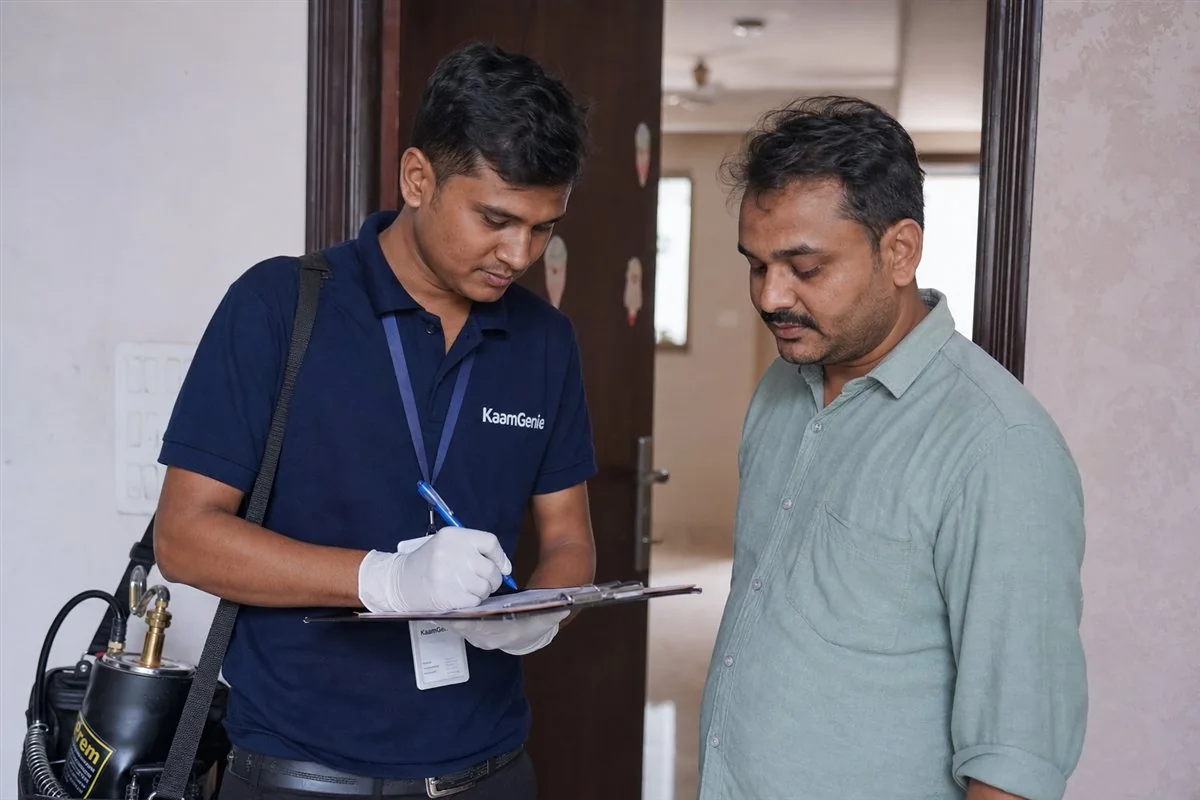
Quick answer — the Delhi pest control checklist (2026)
- Before you book: ask five questions — are the technicians licensed and trained, are the chemicals CIB&RC-approved, exactly what’s covered, is there a written warranty with free follow-up, and will you get a proper GST invoice?
- During the job: a real treatment is 45–90 minutes, not 10. Watch that kitchen cracks, drains, skirting, hinges and entry points are all treated — and that the technician walks you through safety steps for kids and pets.
- After the job: get before/after photos, a clear results timeline (most pests fade over 7–15 days, not the same hour), and the re-treatment window in writing.
- Real cost (2026): general home pest control from ₹999, cockroach gel from ₹599, an AMC from ₹2,999/year — GST 18% extra. A ₹200 “spray” is theatre.
- Red flags: no licence shown, no written scope, a price that’s suspiciously round and cash-only, and a refusal to put the warranty on paper. We cover all of Delhi NCR.
Why you need a checklist at all in Delhi
Pest control in Delhi is a strange market. At one end you have trained, licensed teams doing genuine work; at the other, a man on a scooter with an unlabelled bottle who undercuts everyone and vanishes the moment the cockroaches return. To a customer standing at the door, both look identical — same uniform, same confident patter, same “don’t worry madam, fully guaranteed.” The difference only shows up two weeks later, and by then your money is gone and the pests are back.
That’s why the smartest thing a Delhi resident can do isn’t to hunt for the cheapest quote — it’s to learn what a proper job actually involves, so you can tell the two apart at the door. A checklist does that. It turns a vague feeling of “I think I’m being short-changed” into specific questions a real professional answers easily and a corner-cutter dodges. The same checklist protects an RWA spending lakhs a year on a society-wide contract — the stakes are just bigger. This guide breaks it into the three moments that matter: before you book, during the treatment, and after the technician leaves.
Before you book: the five questions that filter out the cowboys
Ninety per cent of bad experiences are avoidable at this stage, on the phone, before anyone enters your home. Ask these five things. A real service answers each without hesitation; a corner-cutter gets vague, defensive, or changes the subject to price.
- “Are your technicians trained and licensed?” Professional pest management means trained staff handling regulated chemicals. Ask whether the company holds a pest-control licence and whether the specific person coming to your home is trained. A “yes, of course” with no detail is not the same as “yes, our technicians are trained on the products and we’re a registered firm.”
- “What chemicals will you use, and are they CIB&RC-approved?” Every insecticide used legally in India is approved by the Central Insecticides Board & Registration Committee (CIB&RC) for a specific use and dose. A real service will name the product type (gel bait, residual spray, larvicide) and tell you it’s approved and applied at label dose. A cowboy says “medicine” and won’t name anything.
- “Exactly what’s covered — which pests, which areas, how many visits?” “Full home treatment” means nothing until it’s defined. Does it cover cockroaches only, or also ants and silverfish? Kitchen only, or the whole flat? One visit or an initial-plus-follow-up? Get it specified before you agree a price.
- “Is there a written warranty, and is follow-up free within it?” Honest pest control comes with a warranty window — commonly 30 to 45 days for general work, longer for termite jobs — during which return visits are free if pests persist. Verbal “guarantee” is worthless. Ask for the window and what triggers a free re-treatment, in writing.
- “Will I get a proper GST invoice?” This is the cleanest single filter. A registered, tax-paying firm issues a GST invoice as a matter of course. A cash-only operator who flinches at the word “invoice” is telling you everything about how the rest of the job will go. The invoice is also your proof if you ever need to enforce the warranty.
| Ask this | Good answer | Walk away if… |
|---|---|---|
| Are your technicians trained and licensed? | Registered firm, trained staff named | “Don’t worry” with no detail |
| Are the chemicals CIB&RC-approved? | Names product type and dose | Calls it “medicine,” won’t name it |
| What exactly is covered? | Pests, areas and visit count in writing | Vague “full treatment” |
| Is there a written warranty? | 30–45 day window, free follow-up | Only a verbal “guarantee” |
| Will I get a GST invoice? | Yes, issued by default | Cash-only, flinches at “invoice” |
Want a service that passes this checklist on the first call?
Licensed technicians, CIB&RC-approved chemicals, a written scope and a proper GST invoice — general home pest control from ₹999 (GST 18% extra).
During the job: what a real treatment looks like in your home
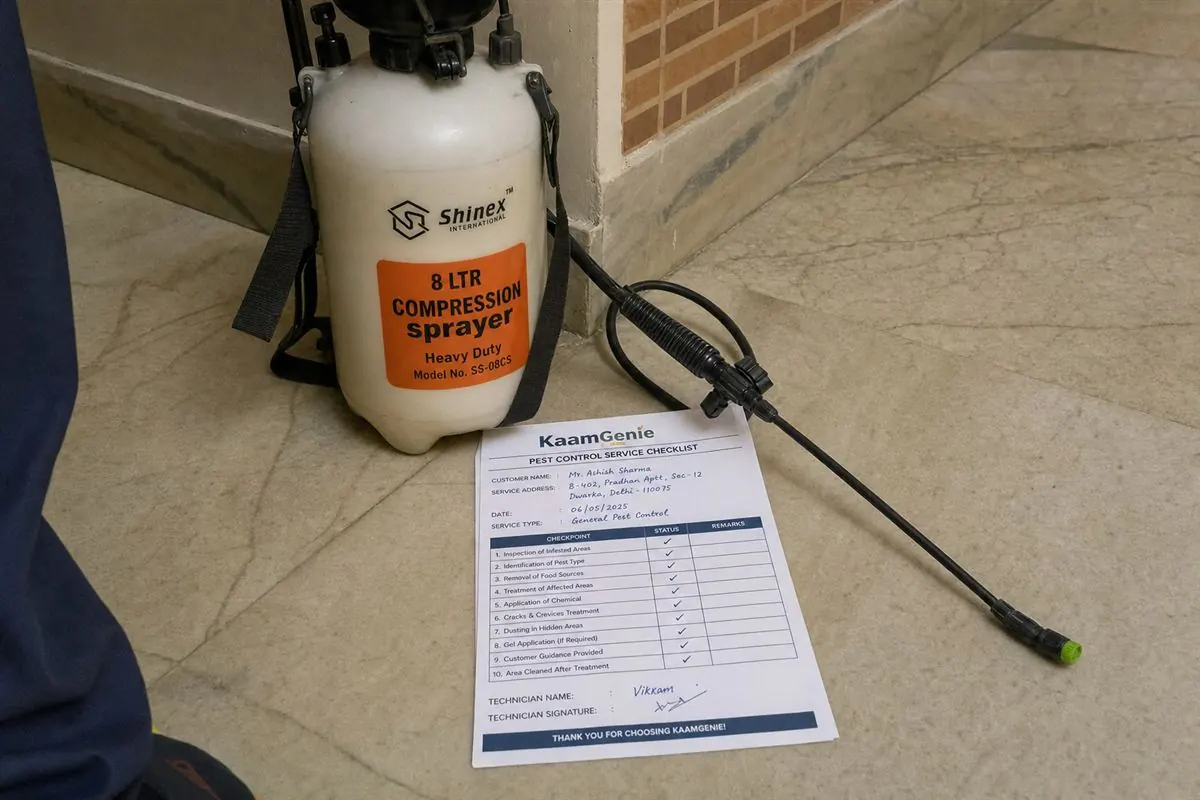
Here’s the single biggest tell, and you can time it on your phone: a genuine general pest treatment for a Delhi flat takes roughly 45 to 90 minutes, depending on size and pest. If someone is in and out in ten minutes having misted a bit of liquid around, you have been robbed politely. Speed is the corner-cutter’s signature, because doing it properly is slow, fiddly work. Stay home, watch, and look for these things.
- An inspection first, not a spray first. The technician should look before treating — under the sink, behind the fridge, along skirting, inside the cabinet hinges, around drains and pipe entry points. The treatment plan follows what they find. No look means no plan.
- The right method for the pest, in the right place. Cockroaches need gel bait placed precisely in cracks, hinges and crevices — not a blanket spray that just scatters them. Ants and silverfish need crack-and-crevice treatment. Termites need drilling and a soil/wood treatment. Rodents need baiting and proofing, not poison alone. If everything gets the same spray regardless of pest, that’s a generic job.
- The hidden spots, not just the obvious floor. The places pests actually live — cabinet interiors, behind appliances, drain mouths, the gap under the kitchen platform, window and door frames, the meter cupboard — should all be treated. Watch that the technician opens cupboards and moves things, not just walks the open floor.
- Safety steps spelled out for kids and pets. A professional tells you which rooms to vacate and for how long, to cover or remove fish tanks, to keep pets and children out until surfaces dry, and to ventilate after. Crucially, gel bait in cracks is low-exposure, while open spraying needs more care — a good technician explains the difference. Silence on safety is a red flag about the whole job.
One more during-the-job habit worth its weight: a good technician tells you what they’re doing as they go — “this is gel bait in the hinge here, this drain gets a residual treatment, don’t wash this corner for a few hours.” That running commentary isn’t salesmanship; it’s how trained people work, and it’s the easiest quality you’ll ever spot.
After the job: how to verify you actually got what you paid for
The treatment is done, the technician is leaving, and this is where most people relax too early. The after-stage is where you lock in proof and set expectations, so you’re not arguing from memory in three weeks. Insist on four things.
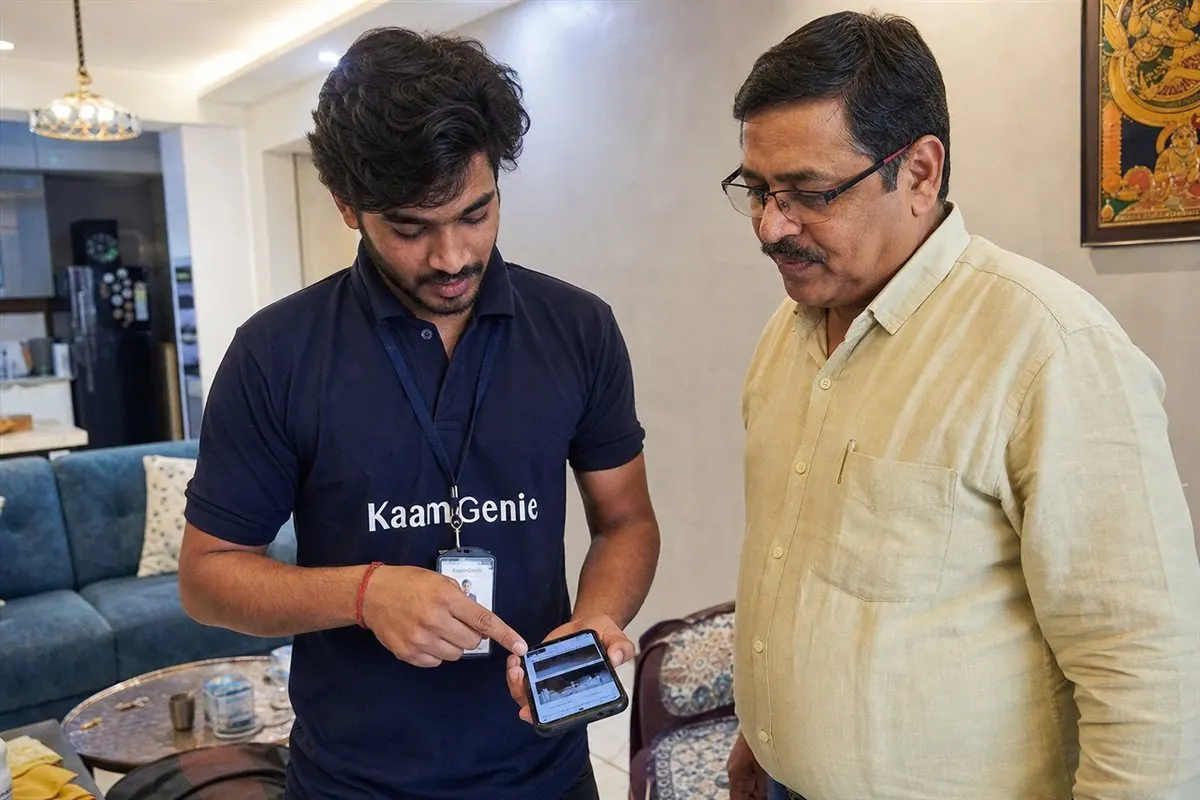
- Before/after photos and a record of what was done. Ask for photos of the treated areas and a written or app-based record of the chemicals used and zones covered. This is your audit-ready record — the thing that lets you hold the company to its warranty, and exactly what an RWA needs for its files. (Note: this is a treatment record and invoice, not some “certificate” — be wary of anyone waving an official-looking paper as a substitute for actually doing the work.)
- A realistic results timeline. Good pest control is not instant, and anyone promising “all gone today” is lying. With gel bait, cockroaches feed, return to harbourage and die over 7 to 15 days; you may actually see more roaches out in the open for a day or two as they’re flushed. Ants taper over a week or two. Knowing this stops you panicking — or being told the job failed when it’s working normally.
- The re-treatment window, in writing. Confirm the exact warranty dates and what you do if pests persist within them — usually a free callback. Get the date on the invoice or a message, not just a friendly “call us anytime.”
- What to watch and what to do. Ask what normal looks like over the next fortnight, when to clean treated surfaces, and what would count as the treatment not working. A service confident in its work is happy to tell you exactly when to call it back.
The full tick-list: copy this and use it
Here is the whole thing in one place — print it, screenshot it, paste it into your RWA WhatsApp group. If a service clears every row, you’re in good hands. If it stumbles on three or more, keep dialling.
| Stage | Tick when confirmed |
|---|---|
| Before | Firm is registered; technicians trained/licensed |
| Before | Chemicals named and CIB&RC-approved |
| Before | Scope in writing: pests, areas, number of visits |
| Before | Written warranty window with free follow-up |
| Before | GST invoice promised |
| During | Inspection done before any treatment |
| During | Job takes ~45–90 min, not 10 |
| During | Right method per pest (gel/crack-crevice/drilling) |
| During | Hidden spots treated, not just open floor |
| During | Safety steps explained for kids and pets |
| After | Before/after photos and treatment record given |
| After | Results timeline explained (7–15 days) |
| After | Re-treatment window confirmed in writing |
| After | GST invoice received and filed |
Red flags: the corner-cutter’s greatest hits
After years of cleaning up other people’s botched jobs, the warning signs are depressingly consistent. Any one of these on its own might be forgivable; two or more together, and you’re looking at a job that won’t hold. The chart below is the rough split I see between complaints that come from corner-cutting versus genuinely difficult infestations.
Where Delhi pest-control complaints actually come from (2026)
Rough split of the “it didn’t work” calls we hear, from what we see on the ground.
The specific red flags to watch for:
- A price that’s suspiciously low and round. “₹200 full home, cash.” Real work has real costs — trained labour, approved chemicals, the time to do it properly. A rock-bottom round number means one bottle, no survey, no follow-up.
- No licence, no name, no paperwork. No company name on the receipt, no GST invoice, no written scope. If there’s nothing on paper, there’s nothing to enforce.
- The ten-minute treatment. Covered above, but it’s the most reliable tell of all. Fast equals shallow.
- Won’t name the chemical or show the label. “It’s our special medicine.” A professional is happy to tell you it’s a CIB&RC-approved product and what it targets.
- Refuses to put the warranty in writing. “Trust me, any problem just call.” If they won’t date it, they won’t honour it.
- Pressure and panic. “Your whole building is infested, pay now for all flats.” Honest services assess, then quote. Fear-selling is a tell.
RWA or society committee comparing quotes?
Get an audit-ready proposal with scope, chemical list, schedule and warranty in writing — AMC plans from ₹2,999/year, custom quotes for whole complexes.
A special word for RWAs and societies
If you sit on a managing committee, the checklist matters even more, because you’re spending other people’s money on a contract that runs all year. The same before/during/after logic applies, with a few additions. Insist on a written proposal that lists the pests covered, the chemicals and their CIB&RC approval, the treatment schedule (monthly fogging, quarterly general treatment, on-call for termites and rodents), and the warranty terms. Demand a treatment record after every visit — date, areas covered, products used, technician name — so you build an audit-ready file the next committee can rely on, and residents can’t claim “they never came.”
On price, get at least two or three comparable quotes, but compare scope, not just the bottom line — a cheaper AMC that skips anti-larval work or never proofs the rodent entry points isn’t cheaper, it’s just smaller. A society-wide AMC is the right model here: one flat treating its kitchen while the next-door stack is untouched is a losing game, because cockroaches and rodents move through shared risers and drains. For most Delhi societies an annual contract from around ₹2,999 per unit-equivalent, scaled to the complex, buys consistent coverage and a single accountable team — far better than per-panic callouts. And always pay against a GST invoice; it’s the committee’s protection at audit time.
What honest pest control costs in Delhi (2026)
So you can sanity-check any quote against reality, here’s the honest 2026 range. These are starting prices for proper work — trained technician, approved chemicals, a survey and a warranty. GST 18% is extra, and final price depends on home size and severity. If a number comes in far below this, the difference is being cut from somewhere on your checklist.
| Service | Starting price (2026) |
|---|---|
| General / home pest control | From ₹999 |
| Cockroach gel treatment | From ₹599 |
| Mosquito control | From ₹699 |
| Rodent control | From ₹999 |
| Bed bug treatment | From ₹1,299/room |
| Termite treatment | From ₹2,499 |
| Annual pest control AMC | From ₹2,999/year |
| Commercial / society contract | Custom quote |
The point of this whole guide isn’t to make you suspicious of everyone — it’s to make you informed enough that good services love working with you and bad ones quietly move on. Run the checklist, keep your invoice, and you’ll never be the person on the phone in three weeks wondering where the money went. We serve homes, shops and societies across Delhi NCR — from Saket, Greater Kailash and Lajpat Nagar in the south to Dwarka, Janakpuri and Rohini in the west and north, and Mayur Vihar and Preet Vihar in the east. Call 95603 66362 and put us through every row of it.
Frequently asked questions
What should I check before booking pest control in Delhi in 2026?
Ask five things before anyone enters your home: are the technicians trained and licensed; are the chemicals CIB&RC-approved; exactly what is covered (which pests, which areas, how many visits); is there a written warranty with free follow-up; and will you get a proper GST invoice. A real service answers all five easily. A corner-cutter gets vague or steers you back to price.
How long should a proper pest control treatment take?
For a general treatment of a Delhi flat, roughly 45 to 90 minutes depending on size and pest. If the technician is in and out in ten minutes after misting some liquid around, the job was too shallow to work. A real treatment includes an inspection first, then the right method placed in cracks, drains, hinges and entry points — and that is slow, fiddly work.
How do I know if the pest control chemicals are safe and legal?
Every insecticide used legally in India is approved by the Central Insecticides Board & Registration Committee (CIB&RC) for a specific use and dose. Ask the service to name the product type — gel bait, residual spray, larvicide — and confirm it is CIB&RC-approved and applied at label dose. A professional will tell you. Someone who calls it “special medicine” and won’t name it is a warning sign.
What should I get from the technician after the treatment?
Four things: before/after photos and a written or app record of areas treated and chemicals used; a realistic results timeline; the re-treatment warranty window in writing; and a GST invoice. The photos and record are your audit-ready proof, and the invoice is what lets you enforce the warranty if pests persist.
How soon should pests disappear after treatment?
Not the same hour — anyone promising instant results is overselling. With gel bait, cockroaches feed and die over about 7 to 15 days, and you may briefly see more in the open as they are flushed out. Ants taper over a week or two. Knowing this normal timeline stops you panicking or being told a working treatment has failed.
What is the re-treatment or warranty window for pest control in Delhi?
Honest general pest control usually comes with a 30 to 45 day warranty during which return visits are free if pests persist; termite jobs often carry longer warranties. Always get the exact dates and the free-callback terms in writing on the invoice or a message — a verbal “call us anytime” is not enforceable.
What are the red flags of a cheap or fake pest control service?
A suspiciously low, round, cash-only price; no company name, licence or GST invoice; a ten-minute treatment; refusing to name the chemical or show a label; declining to put the warranty in writing; and fear-selling like “your whole building is infested, pay now.” Any two of these together and the job is unlikely to hold.
Is the cheapest pest control quote ever worth it?
Rarely. A rock-bottom price almost always means one bottle, no survey, the wrong method and no follow-up — so the pests return and you pay again. Compare quotes on scope, not just the bottom line. A ₹200 spray that fails is more expensive than a ₹999 treatment that works, once you count the repeat visits and wasted weeks.
What should an RWA or society check before signing a pest control contract?
Get a written proposal listing pests covered, CIB&RC-approved chemicals, the treatment schedule and warranty terms. Demand a treatment record after every visit (date, areas, products, technician name) for an audit-ready file. Compare two or three quotes on scope, prefer a complex-wide AMC over per-flat callouts since pests move through shared drains and risers, and always pay against a GST invoice.
Should I stay home during the pest control treatment?
Yes, if you can. Staying home lets you confirm the inspection happens, the hidden spots get treated and the safety steps are explained — the things a corner-cutter skips when no one is watching. A good technician also gives a running commentary of what they are applying and what not to clean, which is the easiest quality signal to spot.
Is pest control safe for children and pets in my home?
When done properly, yes. The technician should tell you which rooms to vacate and for how long, to cover or remove fish tanks, and to keep kids and pets off treated surfaces until dry, then ventilate. Gel bait placed in cracks is low-exposure, while open spraying needs more care — a professional explains the difference. Silence on safety is itself a red flag.
How much should pest control cost in Delhi in 2026?
As a benchmark for proper work (GST 18% extra): general home pest control from ₹999, cockroach gel from ₹599, mosquito control from ₹699, rodent control from ₹999, bed bug from ₹1,299 per room, termite from ₹2,499, and an annual AMC from ₹2,999 a year. Commercial and society contracts are custom-quoted. A price far below these ranges means the difference is being cut from your checklist.
Put a pest control service through the whole checklist
Licensed technicians, CIB&RC-approved chemicals, written scope and warranty, before/after photos and a GST invoice — every row, every time. We cover all of Delhi NCR.
Sources & references
- Central Insecticides Board & Registration Committee (CIB&RC) — the Indian regulator that approves pest-control chemicals and the doses a licensed service must use.
- National Centre for Disease Control (NCDC) — tracks urban pest and vector-borne disease patterns across Indian cities including Delhi.
- Food Safety and Standards Authority of India (FSSAI) — sets the pest-management and record-keeping expectations referenced for food premises and audits.
- Indian Council of Medical Research (ICMR) — publishes research on pest biology and integrated pest management protocols.
Last verified: 30 June 2026. If you find any of these links broken, please let us know.