
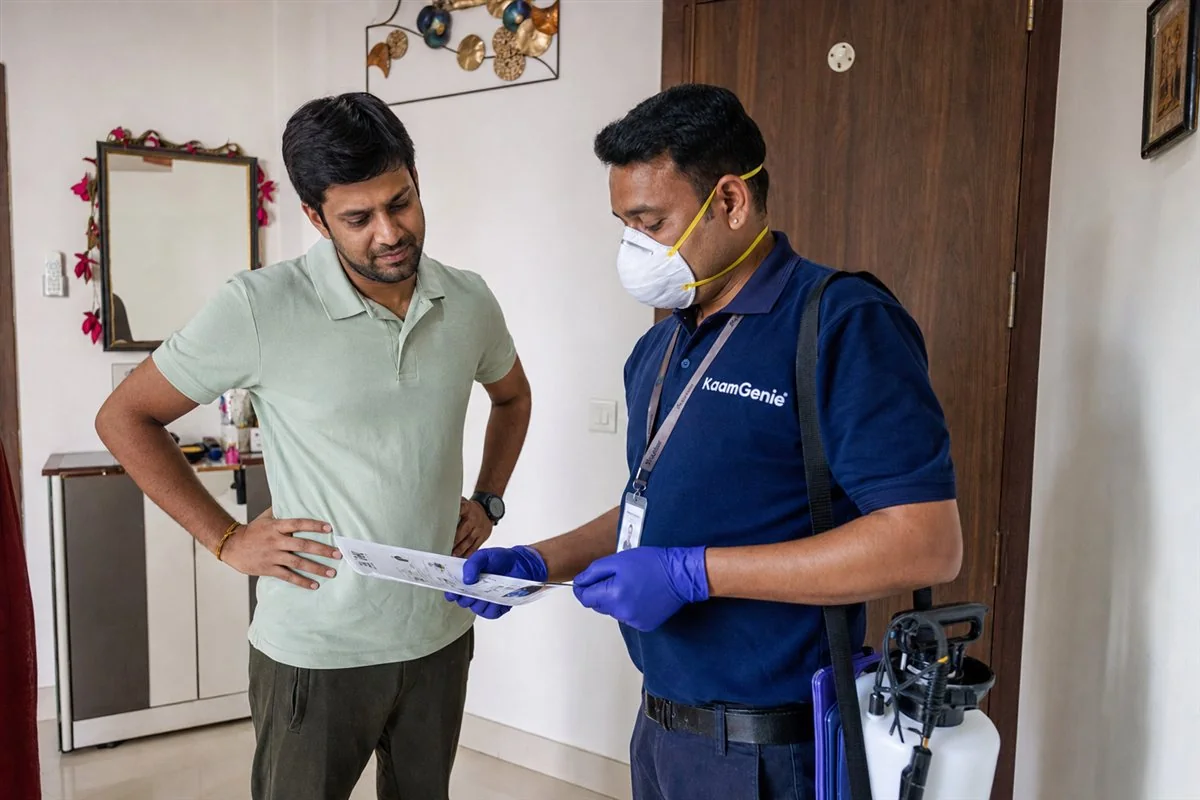
Quick answer — who pays for pest control in a Delhi rental (2026)
- The rent agreement decides first. Whatever the signed agreement says about maintenance and pest control wins. If it’s silent — and most Delhi agreements are — you fall back to fairness and negotiation, not law.
- Pre-existing infestation = landlord’s problem. If termites, bed bugs or a heavy roach problem were there before you moved in, it’s reasonable to ask the owner to pay. Raise it in the first week, in writing.
- Problems you caused = your problem. Pests that turn up months in from poor housekeeping, uncovered food or stored clutter are usually the tenant’s to handle.
- Structural pests usually land on the owner: termites, rodents getting in through the building, drainage and damp issues are the owner’s asset to protect.
- Real cost (2026): general/home treatment from ₹999, cockroach gel from ₹599, bed bugs from ₹1,299/room, termite from ₹2,499, rodent from ₹999, AMC from ₹2,999/year. GST 18% extra.
- Get it in writing. A two-line WhatsApp or email beats a verbal promise every time. We cover homes and rentals across Delhi NCR.
The honest answer: there is no “tenant pest control law” in Delhi
Let me start by killing the myth that sends people down a rabbit hole. There is no special clause in Indian law that says “the landlord must pay for pest control.” The Delhi Rent Control Act is old, applies mostly to very low rents, and says nothing useful about cockroaches. The Model Tenancy Act that the Centre pushed in 2021 talks about the landlord keeping the “structure” in good repair and the tenant handling “day-to-day” minor maintenance — but Delhi hasn’t adopted it as binding law, and even where it applies it doesn’t spell out who buys the roach gel. So stop looking for a section number to wave at your landlord. It doesn’t exist.
What actually governs you is your rent agreement — the eleven-month one you signed and probably never re-read — plus plain fairness when the agreement is silent. That’s genuinely the whole framework. In nineteen years of dealing with Delhi tenants and owners, almost every dispute I’ve seen comes down to two questions: what did you sign, and when did the problem start? Get those two straight and you’ll know where you stand, and so will your landlord. The rest of this guide is about working through them calmly, because the worst outcome here isn’t paying ₹999 — it’s souring a tenancy over a fight you could have settled with one polite message.
Pre-existing vs during-tenancy — the line that decides who pays
This is the heart of it. The single most useful test, whether or not your agreement mentions pests, is: was the problem already there when you got the keys, or did it appear on your watch?
If the flat came with the pests — you opened a kitchen cabinet on day one and roaches scattered, you found termite mud-tubes on the back wall, the previous tenant clearly left bed bugs behind — that is fairly the owner’s responsibility. You’re paying rent for a habitable home, and an active infestation on handover means it wasn’t fully habitable. The catch is timing: you have to flag it immediately. If you say nothing for four months and then claim the bed bugs were “already there,” no landlord will believe you, and honestly they shouldn’t. Do a proper walk-through on move-in day, check the kitchen, bathrooms, wardrobe seams and skirting, and put anything you find in a dated WhatsApp message with photos that same evening.
If the problem grows during your tenancy from how the home is lived in — food left out, bins not cleared, damp towels and clutter that invite cockroaches, crumbs that feed an ant trail — that’s reasonably on you. The landlord handed over a clean-enough flat; keeping it pest-light day to day is ordinary tenant housekeeping, the same way you’d replace a fused bulb without calling the owner. The grey zone in the middle — pests that appear months in for no obvious reason — is where you split it or negotiate, and I’ll come to that.
| Situation | Fairly whose cost | Why |
|---|---|---|
| Infestation present on move-in day | Landlord | Home must be handed over habitable; flag it in week one |
| Termites in walls / woodwork | Landlord | Structural damage to the owner’s asset |
| Rodents entering through building gaps / drains | Landlord | Building fabric and drainage are the owner’s |
| Bed bugs left by previous tenant | Landlord | Pre-existing; not caused by you |
| Cockroaches/ants from daily housekeeping | Tenant | Day-to-day upkeep, like a fused bulb |
| Pests months in, cause unclear | Split / negotiate | Grey zone — share the cost or alternate |
What your rent agreement probably says (and the clause to add)
Go and find your agreement right now. Look under the “maintenance” or “repairs” clause. In most Delhi agreements — the standard broker-printed eleven-month type for DDA flats, builder floors and society apartments — you’ll find one of three things. Either it says nothing about pests at all (the most common, and the source of every argument), or it lumps pest control under vague “minor repairs and day-to-day maintenance shall be borne by the Tenant,” or, occasionally in better-drafted corporate leases, it names pest control explicitly and assigns it.
If yours is silent, you’re not stuck — you just don’t have paper to point at, so it becomes a fairness conversation. If it says “day-to-day maintenance by tenant,” understand that this is genuinely meant for small recurring upkeep, not a one-time ₹2,499 termite job on the owner’s woodwork; a reasonable owner will see that distinction. The real lesson is for next time you sign or renew: add one clean line. Something like — “The Landlord shall ensure the premises are free of termite, rodent and major pest infestation at the time of handover. Routine pest control during the tenancy shall be borne by the Tenant; treatment of pre-existing or structural infestations shall be borne by the Landlord.” That single sentence prevents almost every dispute I see. Most owners will agree to it because it’s fair to them too.
Moved into a flat that came with cockroaches?
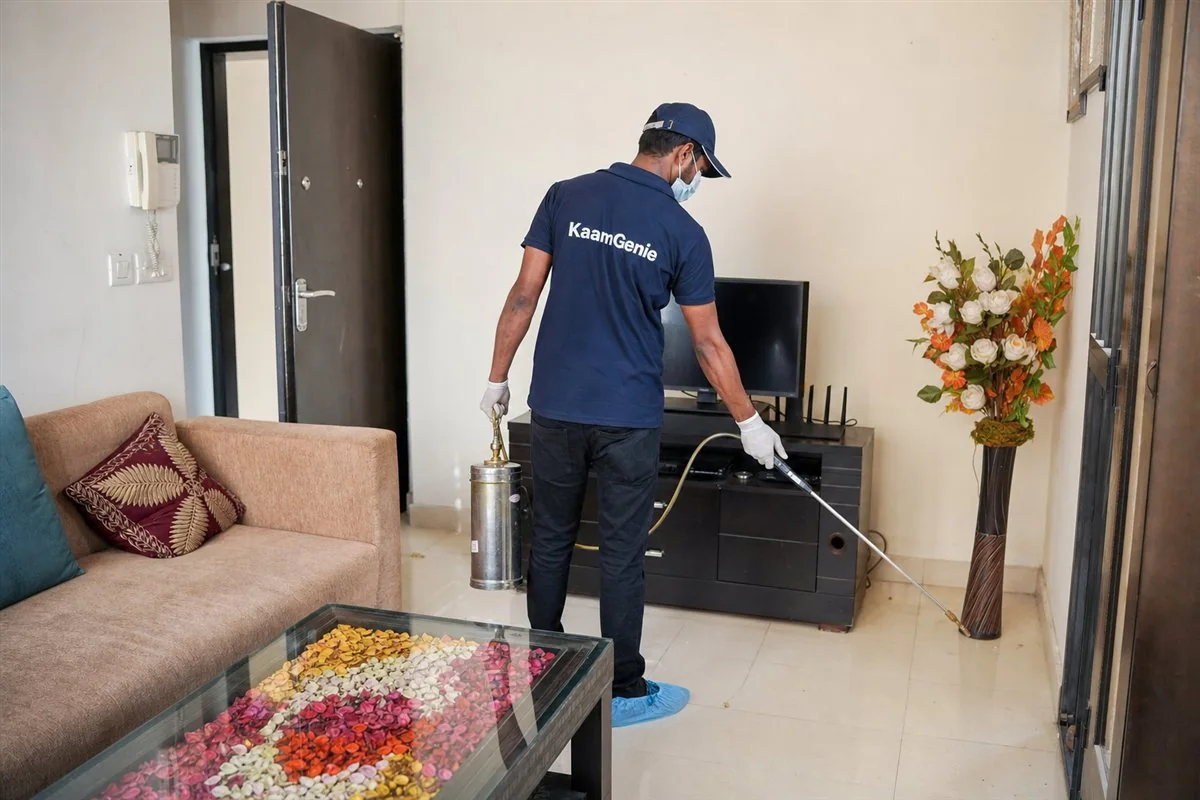
Get a clean general treatment before you unpack — survey plus gel and spray, with before/after photos and a GST invoice you can forward to your landlord. From ₹999 (GST 18% extra).
How to raise it with your landlord without a fight
Most tenants get this wrong by going in hot — “the flat is infested, fix it” — and the owner goes defensive. You’ll get a far better result with a calm, documented approach. Here’s the script that works.
- Document first, message second. Take clear, dated photos or a short video. Roaches in the cabinet, termite tubes on the wall, droppings under the sink — whatever it is, show it. Evidence ends the “are you sure?” back-and-forth.
- Use WhatsApp or email, not just a call. A verbal “haan haan main dekh leta hoon” (yes yes I’ll look into it) is worth nothing in three weeks. Put it in text so there’s a record of when you raised it and what was promised.
- Lead with fairness, not threats. Try: “Hi, found termite tubes on the bedroom wall — looks like it predates my move-in. Can we sort treatment? Happy to get a professional and share the quote and invoice.” You’ve named the problem, signalled it’s pre-existing, and offered to help.
- Offer to organise it. Many owners, especially NRIs or those living in another city, just want the hassle handled. Saying “I’ll book it and send you the GST invoice” often gets a faster yes than asking them to find a service.
- Propose a split if it’s a grey case. “Shall we go 50:50?” is a reasonable, face-saving offer for an infestation neither side clearly caused. It usually closes the matter quickly.
One more thing: never just deduct the cost from rent without agreement, however justified you feel. In Delhi that’s the fastest way to a deposit dispute when you leave. Get the yes in writing first, then act.
What a tenant can fix cheaply, themselves
For a lot of everyday pest niggles you don’t need the landlord or a big bill at all — a few hundred rupees and an evening sorts it, and it keeps your deposit and your relationship clean. Here’s what’s genuinely worth doing yourself before you escalate anything.
- Cockroach gel bait (₹150–₹300 a tube). For a light roach problem, a good over-the-counter gel applied in cabinet hinges, behind the fridge and under the sink works well. Far better than spray, which just scatters them. This is the single most useful DIY for a Delhi kitchen.
- Seal the entry points. Door sweeps on gaps under doors, mesh on windows and the bathroom exhaust, steel wool stuffed into the gap where pipes enter the wall — cheap, and it stops both roaches and mice. Use removable fixes so you’re not altering the owner’s property.
- Kill the breeding and feeding. Empty the dustbin nightly, never leave dirty dishes overnight, store grains and snacks in sealed containers, and fix that slow-dripping tap that’s feeding everything. Most kitchen pests are a housekeeping problem wearing a costume.
- Ant lines and mosquitoes. Ant bait gel and basic source reduction — tipping out water from cooler trays and plant saucers — handle the two most common seasonal complaints without a call-out.
Where DIY stops: termites, bed bugs and rodents. These three genuinely need a professional. Termites hide inside walls and woodwork and a shop spray just drives them deeper; bed bugs survive everything except a proper heat or chemical protocol and breed faster than you can chase them; rodents need exclusion work, not just a glue board. If you’ve got any of those, that’s the moment to involve the landlord and book a real service — and exactly where a GST invoice matters.
Need an invoice to claim it back from your landlord?
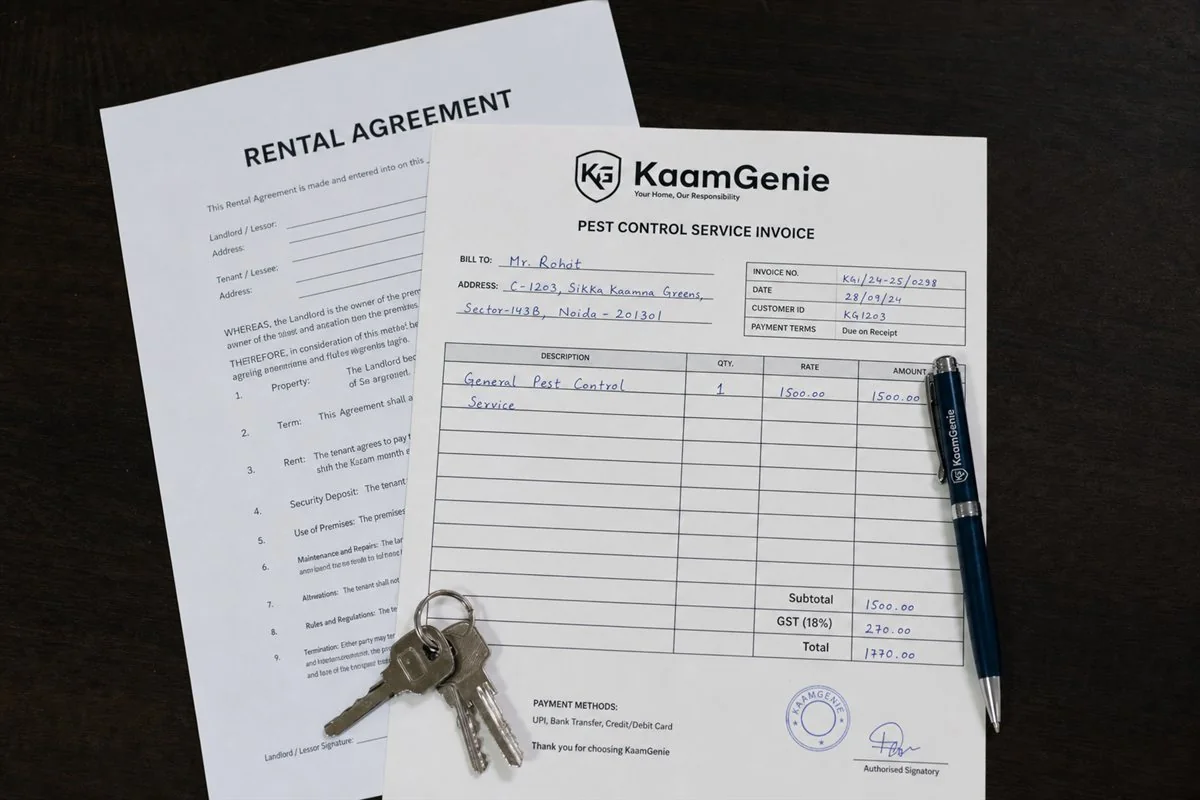
We send a proper GST invoice and dated before/after photos for every job — exactly what you need to ask for reimbursement or a rent adjustment. Treatments from ₹599.
Real pest control costs in Delhi (2026) — so you can argue fairly
Whether you’re paying yourself, splitting, or claiming it back, knowing the honest 2026 numbers stops you being overcharged and helps you make a fair ask. These are typical KaamGenie starting prices across Delhi; GST 18% is extra on all of them, and a one-room flat sits at the lower end.
| Treatment | Best for | Starting price (2026) |
|---|---|---|
| General / home pest control | Cockroaches, ants, spiders — a fresh-flat clean-up | From ₹999 |
| Cockroach gel treatment | Targeted kitchen roach problem | From ₹599 |
| Bed bug treatment | Per room, mattress and frame seams | From ₹1,299/room |
| Termite treatment | Structural — usually the owner’s cost | From ₹2,499 |
| Rodent control | Mice/rats entering the flat | From ₹999 |
| Mosquito control | Seasonal, monsoon flats | From ₹699 |
| Annual AMC | Long stays — multiple visits a year | From ₹2,999/year |
For a quick reference on who typically foots which of these, the chart below shows how the cost usually falls between owner and tenant once you apply the pre-existing-versus-housekeeping test. It’s not a rule — it’s the fair pattern most reasonable Delhi landlords and tenants land on.
Who typically pays, by pest type — Delhi rentals (2026)
Rough share that lands on the landlord versus the tenant, from cases we see on the ground.
PGs, shared flats and brokers — the messy real world
Plain landlord-tenant logic gets muddier in the setups most young Delhi renters actually live in, so let’s deal with the common ones honestly.
PGs and co-living. In a paying-guest or co-living setup — the dense ones around Mukherjee Nagar, Laxmi Nagar, Kotla and the corporate PGs near Gurgaon’s border — pest control is the operator’s job, full stop. You’re paying an all-in monthly fee for a serviced bed; bed bugs and roaches in a PG are the operator’s responsibility to treat, and a decent one runs a regular schedule. If yours won’t act on bed bugs, that’s a red flag about the whole place. We cover that scenario in detail in our PG and co-living pest guide linked below.
Shared flats (you and flatmates on one lease). Here the cost is between you, not just with the landlord. Split a general treatment evenly — everyone benefits, everyone pays a third. The exception is bed bugs traced to one person’s room or mattress; fairly, that’s closer to their cost, though in practice splitting keeps the peace. Agree the rule before there’s a problem.
Brokers and the deposit. A lot of Delhi tenancies run through a broker, and brokers vanish the moment the deal closes — don’t expect them to mediate a roach dispute later. The bigger thing to protect is your security deposit. If you leave a flat with an infestation that arguably you caused, the owner may try to dock it. Conversely, keep your before/after photos and the GST invoice from any treatment you funded — that’s your evidence at the exit walkthrough that you handed the flat back in good shape. Records are what win the deposit conversation, not memory.
The bottom line for Delhi tenants in 2026
Strip away the myths and it’s simple. There’s no magic law — your rent agreement and basic fairness decide it. Pre-existing and structural problems (termites, rodents, inherited bed bugs) are fairly the owner’s to fix; everyday roaches and ants from how you live are yours. Flag anything you inherit in writing in week one, raise it calmly with photos, fix the small stuff yourself for a few hundred rupees, and always get the yes in writing before you spend. Do that and a pest problem stays a ₹999 errand instead of a deposit war. If you want a clean job with a proper GST invoice and dated before/after photos to back your case — whether you’re paying or claiming it back — we handle homes and rentals across Delhi NCR. Call 95603 66362 and we’ll sort it without the drama.
Frequently asked questions
Is the landlord or the tenant responsible for pest control in Delhi?
It depends on your rent agreement and when the problem started. If the agreement assigns pest control, that wins. If it’s silent — as most Delhi agreements are — fall back to fairness: pre-existing and structural infestations (termites, rodents, inherited bed bugs) are reasonably the landlord’s, while everyday cockroaches and ants from daily housekeeping are the tenant’s. There is no specific Indian law that forces the landlord to pay.
Is there a law in Delhi that says the landlord must pay for pest control?
No. The Delhi Rent Control Act doesn’t cover it and the Model Tenancy Act of 2021 hasn’t been adopted as binding law in Delhi. What governs you is your signed rent agreement plus plain fairness. Don’t go looking for a section number to wave at your landlord — settle it through the agreement and a calm conversation instead.
The flat had cockroaches when I moved in — whose problem is that?
Fairly the landlord’s, because a home should be handed over habitable. But you must flag it immediately — do a move-in walkthrough, photograph what you find, and send it in a dated WhatsApp or email that same day. If you wait months and then claim it was pre-existing, no owner will accept it, and reasonably so.
Who pays for termite treatment in a rented Delhi flat?
Almost always the landlord. Termites attack the structure and woodwork — the owner’s asset — so treating them protects the owner’s property. Professional termite treatment starts around ₹2,499 plus GST. Raise it with photos of the mud-tubes and offer to organise the service and forward the invoice.
What does a standard Delhi rent agreement say about pest control?
Usually nothing specific. Most broker-printed eleven-month agreements for DDA flats, builder floors and society apartments either don’t mention pests at all, or lump them under vague ‘day-to-day maintenance by the tenant’. That silence is the main source of disputes, which is why adding one clear clause at renewal is worth it.
What clause should I add to my rent agreement about pest control?
Add a line like: ‘The Landlord shall ensure the premises are free of termite, rodent and major pest infestation at handover. Routine pest control during the tenancy shall be borne by the Tenant; treatment of pre-existing or structural infestations shall be borne by the Landlord.’ It’s fair to both sides and prevents almost every dispute.
How do I ask my landlord to pay for pest control without a fight?
Document first with dated photos, then message on WhatsApp or email rather than only calling. Lead with fairness, not threats — name the problem, note if it predates your move-in, and offer to organise the service and share the quote and GST invoice. Propose a 50:50 split for grey cases. Never deduct from rent without written agreement first.
Can I deduct pest control cost from my rent in Delhi?
Not without the landlord’s written agreement, however justified you feel. Deducting unilaterally is the fastest route to a security-deposit dispute when you move out. Get a clear yes in writing first — on WhatsApp or email — then book the treatment and keep the invoice and before/after photos.
What pest problems can a tenant fix cheaply themselves?
Light cockroach problems with over-the-counter gel bait (₹150–₹300), ant lines with bait gel, mosquitoes with source reduction, and basic exclusion — door sweeps, window mesh and steel wool in pipe gaps. Good housekeeping (sealed food, nightly bins, no standing water) handles most everyday pests for a few hundred rupees.
Which pests need a professional rather than DIY?
Termites, bed bugs and rodents. Termites hide inside walls and a shop spray just drives them deeper; bed bugs survive ordinary sprays and breed fast, needing a proper protocol; rodents need exclusion work, not just glue boards. For these, involve the landlord and book a real service — and keep the GST invoice.
Who pays for pest control in a PG or co-living in Delhi?
The operator. In a paying-guest or co-living setup you pay an all-in monthly fee for a serviced bed, so treating bed bugs, cockroaches and other pests is the operator’s responsibility and a decent one runs a regular schedule. If a PG won’t act on bed bugs, treat it as a red flag about the whole place.
In a shared flat, how do we split pest control costs?
Split a general treatment evenly among flatmates — everyone benefits, everyone pays a share. The exception is bed bugs clearly traced to one person’s room or mattress, which fairly sits closer to their cost, though many flats split anyway to keep the peace. Agree the rule before a problem appears.
Why does a GST invoice and before/after photos matter for tenants?
They’re your evidence. A GST invoice and dated before/after photos let you claim reimbursement or a rent adjustment from your landlord, and they protect your security deposit at the exit walkthrough by proving you handed the flat back in good shape. Records win the deposit conversation; memory doesn’t.
Renting in Delhi and dealing with pests?
Whether you’re paying yourself or claiming it back from your landlord, we do a clean job with a GST invoice and dated before/after photos. Homes and rentals across Delhi NCR.
Sources & references
- Ministry of Housing & Urban Affairs — Model Tenancy Act, 2021 — the central framework dividing structural upkeep (landlord) from day-to-day maintenance (tenant), context for who handles pests.
- Central Insecticides Board & Registration Committee (CIB&RC) — the Indian regulator that approves the pest-control chemicals and doses used in licensed treatments referenced here.
- National Centre for Disease Control (NCDC) — tracks urban pest and vector patterns across Indian cities including Delhi.
- National Center for Vector Borne Diseases Control (NCVBDC) — India’s nodal body for mosquito-borne disease prevention, relevant to seasonal pests in rentals.
Last verified: 30 June 2026. If you find any of these links broken, please let us know.