
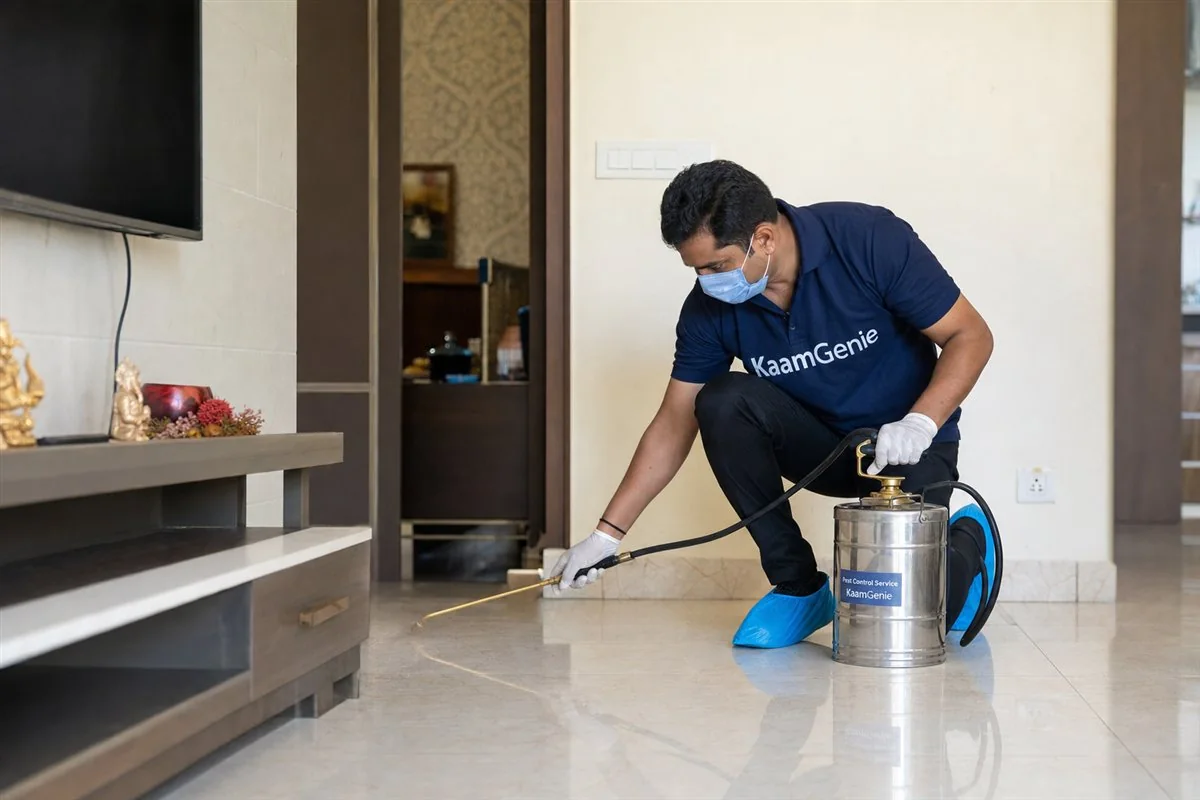
Quick answer — what happens during a pest control treatment in Delhi (2026)
- It starts with an inspection, not a spray: a good technician walks your home first, identifies the pest, finds the harbourage, and only then chooses the method.
- Your prep matters: cover or store food and utensils, move pets and fish, clear under sinks and beds, and let the team reach corners. Ten minutes of prep makes the job far better.
- The treatment is targeted, not a fog-the-whole-house affair: gel for cockroaches, spray and steam for bed bugs, dusting for ants, baiting and proofing for rodents, drilling for termites, fogging mainly for mosquitoes.
- Time & re-entry: most homes take 30–90 minutes. With odourless gel you can stay in; after a wet spray, vacate 3–4 hours and ventilate before re-entry.
- There’s a follow-up: serious treatments include a second visit (often around 10–15 days) to break the breeding cycle — ask about it before you pay.
- Real prices (2026): cockroach from ₹599, general/home from ₹999, mosquito from ₹699, rodent from ₹999, bed bug from ₹1,299/room, termite from ₹2,499, AMC from ₹2,999/year. GST 18% extra. We cover all of Delhi.
Step 1 — Booking and the inspection (the part that decides everything)
Let me start with the bit that matters most and that the cheapest services skip entirely: a real treatment begins with someone looking, not spraying. When you call us — or any serious team — the first conversation is a few quick questions. What are you seeing, and where? Cockroaches scattering when you switch on the kitchen light at night? Bites in a row on your arm in the morning? Mud lines crawling up a wall in the back bedroom? Droppings near the gas pipe? Each of those points to a different pest and a completely different treatment, so we want the detail before we send anyone.
On site, the technician does a walk-through, usually ten to twenty minutes. They’ll go behind the fridge and under the sink, open the kitchen cabinets, check the bathroom plumbing gaps, look along skirting boards, behind the headboard and along mattress seams, and step out to the balcony, the meter cupboard and the drain. They are reading the home: how bad it is, where the pest is living and breeding (the “harbourage”), how it’s getting in, and which method will actually work without dousing your house in chemical for no reason. A genuine inspection is also when you get an honest quote. If someone gives you a price over the phone without ever seeing the kitchen, treat that as a flag — they’re selling a bottle, not solving your problem.
This is also your moment to talk. Tell the technician about a baby, a pregnant family member, anyone with asthma, the dog, the cat, the aquarium, and whether anyone is bed-bound. All of that changes the products and the plan. A team that listens here is a team that will do the rest properly.
Step 2 — Prep you should do before the technician arrives
Here is where you make the difference between a good result and a wasted visit. The technician needs to reach the places the pest lives, and your kitchen and food need to be out of harm’s way. None of this is hard — ten to fifteen minutes the evening before. For a kitchen-pest job (cockroaches, ants), clear the counters, empty the lower cabinets where they hide, and store food and crockery away. For bed bugs, strip the beds and have laundry ready to wash hot. For a general treatment, just give the team a clear run at the edges of every room.
| Do this before the visit | Why it matters |
|---|---|
| Cover or store all food, water and utensils | Keeps treatment surfaces clean and your kitchen safe |
| Empty lower kitchen cabinets and clear counters | Lets gel and spray reach the cracks roaches actually live in |
| Move pets out; cover and switch off fish tanks | Most insecticides are toxic to fish; pets should stay clear during application |
| Pull furniture a little off the walls; clear under beds | Skirting, bed frames and corners are prime resting spots |
| Take down loose food, plants and toys from balconies | Outdoor edges get treated too in a full job |
| Strip beds and bag laundry (bed-bug jobs) | Hot wash and a clear mattress are half the bed-bug battle |
| Plan to be out for a few hours if a wet spray is used | Standard re-entry caution, especially with kids or elders at home |
One thing people get wrong: do not deep-mop the kitchen with strong floor cleaner right before a cockroach gel job. A surface drowning in phenyl can stop the gel sticking and put roaches off feeding on it. A normal clean is fine; a chemical scrub an hour before is counter-productive. And please don’t spray your own market insecticide the morning of — it scatters the pest deeper and makes the professional’s job harder.
Not sure which treatment your home actually needs?
Our technician inspects first, names the pest, and quotes honestly — general/home treatment from ₹999, cockroach gel from ₹599 (GST 18% extra). No guesswork, no upsell.
Step 3 — The treatment itself, pest by pest
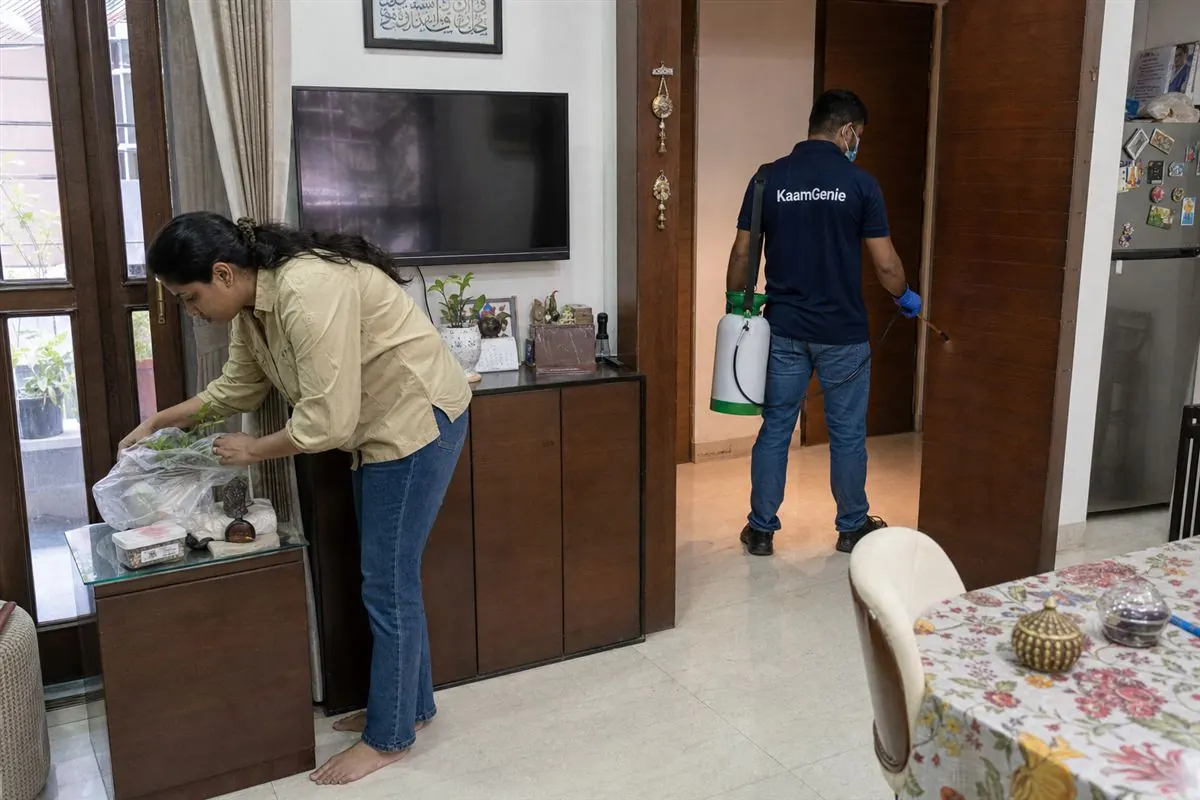
Now the part everyone pictures — and it’s usually less dramatic than imagined. There is no single “pest control spray.” The method is chosen for the pest, and a good technician will often use two or three together. Here’s what actually happens for the common Delhi jobs.
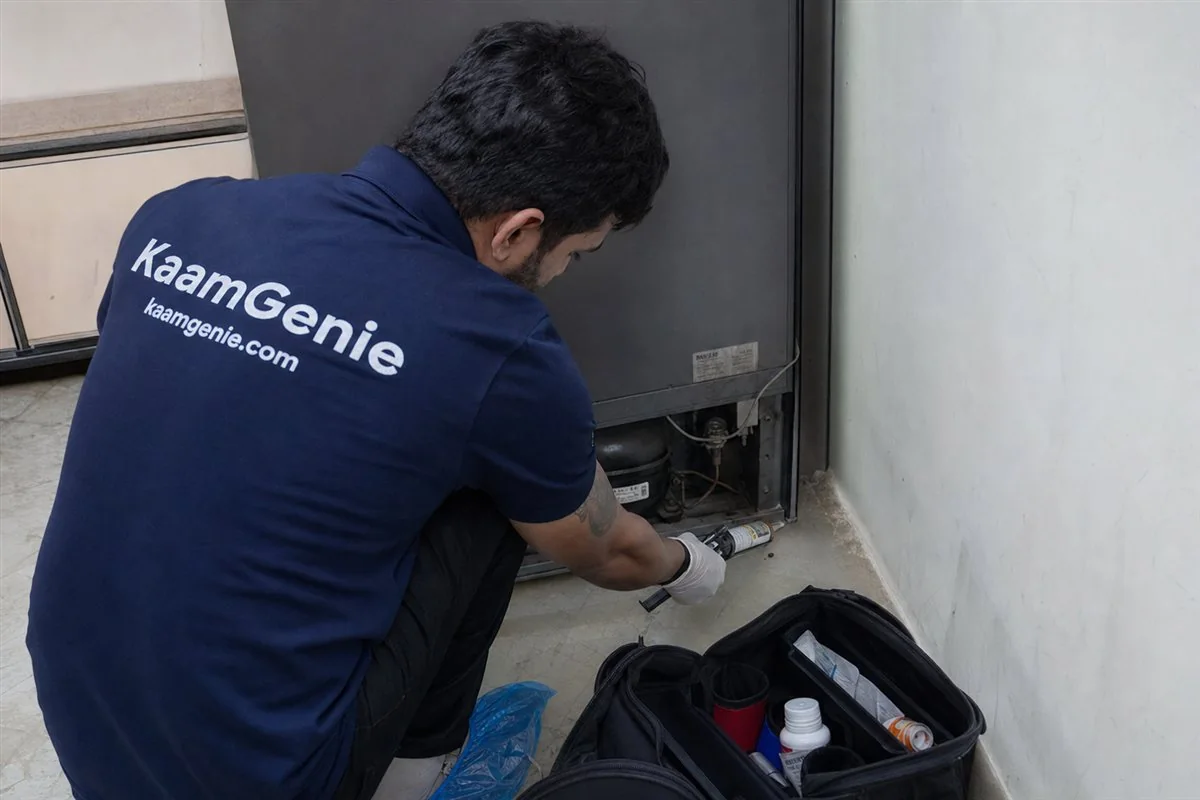
- Cockroaches — gel baiting (mostly), targeted spray where needed. The technician places tiny dots of odourless gel bait inside cabinet hinges, behind the fridge motor, along drawer runners and near the sink — exactly where roaches travel. They eat it, carry it back, and it works through the colony. Modern kitchen jobs are mostly gel, so there’s little smell and you can usually stay home. Heavy infestations may add a crack-and-crevice spray.
- Bed bugs — spray plus steam, in detail. This is the most thorough job in the book. The technician treats every mattress seam, the bed frame joints, headboard, skirting and cracks around the bed, often with a residual spray and a steamer for the seams. It is slow and meticulous, and it almost always needs the follow-up visit because eggs survive the first round.
- Ants — gel and dusting. Ant gel along trails plus an insecticidal dust puffed into wall cracks, switchboards and the gaps where they nest. Spraying the visible trail alone never works — the nest is the target.
- Rodents (rats and mice) — baiting, traps and proofing. No spray here. The technician places tamper-resistant bait stations and snap traps along runways, and — the part that matters — finds and seals the entry holes around pipes, drains and door gaps. Without proofing, new rats simply replace the old ones.
- Termites — drilling and chemical injection. For an existing home, the technician drills small holes at the skirting/floor junction and into affected wood, injects a termiticide to create a treated zone, and seals the holes. It’s dusty work and the most involved treatment, which is why it carries a longer warranty.
- Mosquitoes — larviciding plus fogging. Anti-larval treatment of standing water and a residual spray on resting surfaces, with thermal fogging outdoors or in common areas. Fogging is the part people picture, but it’s the supporting act — killing the larvae is what lasts.
Notice the pattern: dusting, gel and bait stations are dry and low-odour; sprays are wet; fogging is for mosquitoes and outdoor areas, not your whole flat. If a service turns up and just fogs every room of your apartment for any pest, they’re doing theatre. The right method is specific.
| Pest | Main method | Typical time | Starting price (2026) |
|---|---|---|---|
| Cockroaches | Odourless gel bait (+ spray if heavy) | 30–45 min | From ₹599 |
| General / home (multi-pest) | Spray + gel + dusting | 45–90 min | From ₹999 |
| Mosquitoes | Larvicide + residual spray + fogging | 30–60 min | From ₹699 |
| Rodents | Bait stations, traps, entry proofing | 45–60 min | From ₹999 |
| Bed bugs | Detailed spray + steam, per room | 60–120 min | From ₹1,299/room |
| Termites | Drill + chemical injection + seal | 2–4 hours | From ₹2,499 |
Prices are starting points for a typical Delhi flat and GST at 18% is extra. A bigger home, a worse infestation or a bungalow with a garden costs more — which is exactly why the inspection in Step 1 comes before any firm number.
Step 4 — How long it takes, drying time and when you can go back in
The question everyone asks: “When can we go home and cook?” The honest answer depends on the method, and a good technician tells you before they start, not after. Dry treatments — gel baiting, dusting, bait stations — have effectively no lockout. The gel is hidden in cracks, it’s odourless, and you can carry on with a normal kitchen the same day; just wipe counters as usual and leave the bait dots where they’re placed. Wet treatments are different. After a residual spray you should keep the family, and especially children, pregnant women and pets, out of the treated rooms until the surfaces are dry — usually about 3 to 4 hours — then open the windows and let the place air out before everyone settles back in.
Re-entry & ventilation guide after a Delhi treatment (2026)
Rough hours to stay out and air the rooms, by method — always follow the technician’s specific advice for the product used.
A few practical notes for after re-entry. Don’t mop the treated skirting and corners for a few days — that’s where the residual film is doing its work, and scrubbing it off cuts the result short. The kitchen counters where you prepare food are always fine to wipe; the chemical goes on the cracks and edges, not your cooking surfaces. Ventilate well — Delhi flats can hold a faint smell after a spray, and an hour with the windows open clears it. And expect to see more activity for a day or two, especially with roaches: a good gel flushes them out before it kills them, so a brief increase means it’s working, not failing.
Step 5 — The follow-up visit and what your warranty really means
This is the step that separates a real service from a one-and-done. Many pests — cockroaches, bed bugs, ants — lay eggs that the first treatment can’t fully reach. The eggs hatch days later, and if nobody comes back, you’re back to square one in a fortnight and blaming the company. That’s why a serious treatment includes a follow-up visit, usually around 10 to 15 days later, timed to catch the newly hatched batch before they breed again. For bed bugs it’s essential; for a heavy cockroach job it’s strongly advised. Ask, before you pay, whether the follow-up is included or extra — and get the warranty period in writing.
On warranties: most one-time home and cockroach treatments come with a service warranty in the region of 30 to 45 days — if the pest returns in that window, they re-treat free. Termite work carries far longer cover, often several years, because of the scale of the job. What you should get on paper is a clear GST invoice listing what was done and the warranty terms, plus simple before/after photos for bigger jobs and, for offices and societies, audit-ready records of each visit. Keep that invoice safe — it’s what you’ll wave if you need the free re-treatment, and for an AMC it’s your schedule of visits for the year.
Want the job done right the first time?
A proper treatment plus the follow-up visit is what actually breaks the cycle. Annual AMC plans with scheduled visits start from ₹2,999/year.
Step 6 — Aftercare: making the treatment last
The treatment does the heavy lifting, but the next few weeks are yours, and a little care decides whether the result holds. The rules are simple. Leave the gel dots and bait stations alone — don’t wipe them off because they look untidy; they’re the whole point. Hold off on heavy mopping of the treated edges and skirting for three or four days. Fix the conditions that invited the pest in the first place: a dripping tap that keeps the kitchen damp, food left out overnight, an overflowing dustbin, a gap under the back door, standing water on the balcony. A treated home that stays damp and crumb-strewn will draw pests back faster than any chemical can hold.
Watch and report. A handful of dead or dying insects over the following days is normal and good. What’s not normal is the original problem carrying on unchanged after a week or two — that’s your cue to call for the free re-treatment your warranty covers. Don’t suffer in silence or rush to buy a market spray that undoes the residual film; just ring the team. For homes that have fought the same pest for years — an old building, a shared wall, a perennially damp kitchen — the sensible answer is an annual AMC from around ₹2,999 a year, with scheduled visits across the seasons so the problem never gets a foothold again.
Step 7 — Is it safe? The reassurance, plainly
The worry I hear most often is safety, especially from parents and pet owners, and it deserves a straight answer. Done by a licensed team, a modern home treatment is targeted and low-dose — gel hidden in cracks, dust puffed into wall gaps, a thin residual film on edges you don’t touch. The products used in proper work are approved by the Central Insecticides Board & Registration Committee (CIB&RC), the Indian regulator, and applied at the registered dose, not splashed around. The simple precautions — vacate during a wet spray, keep kids and pets out until surfaces dry, cover the fish tank, ventilate afterwards — are exactly what keep it safe, which is why a good technician insists on them. For the full breakdown of what’s safe for babies, pregnancy and pets, read our dedicated guide on whether pest control is safe for babies and pets in Delhi.
That’s the whole process — inspect, prep, treat the right way for the pest, respect the drying time, come back for the follow-up, and look after it afterwards. None of it is mysterious once you’ve seen it laid out. If you’d rather have a trained technician handle it end to end, that’s exactly what we do. We serve homes, offices and societies across Delhi — from Dwarka, Janakpuri and Rohini in the west and north, to Saket, Lajpat Nagar and Greater Kailash in the south, to Mayur Vihar, Preet Vihar and Laxmi Nagar in the east, plus Central and North Delhi. Coming soon: Gurgaon, Noida, Faridabad and Ghaziabad. Call 95603 66362 and we’ll start with an honest inspection.
Frequently asked questions
What happens during a pest control treatment in Delhi?
It runs in clear steps: a phone chat about what you’re seeing, an on-site inspection to identify the pest and where it’s living, your quick prep (cover food, move pets, clear edges), then the targeted treatment — gel for cockroaches, spray and steam for bed bugs, dusting for ants, baiting and proofing for rodents, drilling for termites, fogging for mosquitoes. After that there’s a drying and re-entry period, and for serious jobs a follow-up visit around 10 to 15 days later.
Do I need to do anything before the technician arrives?
Yes, and it makes a real difference. Cover or store food, water and utensils; empty lower kitchen cabinets and clear counters; move pets out and cover the fish tank; pull furniture a little off the walls and clear under beds; and for bed bugs strip and bag the bedding for a hot wash. Don’t deep-mop with strong cleaner or spray your own insecticide right before — both make the professional job less effective.
How long does a pest control treatment take?
Most home treatments take 30 to 90 minutes. A cockroach gel job is about 30 to 45 minutes, a general multi-pest treatment 45 to 90 minutes, bed bugs 60 to 120 minutes per room, and termite drilling and injection can run 2 to 4 hours because it is the most involved job.
Do I have to leave my home during the treatment?
Only for wet treatments. Dry methods — odourless gel, dusting and bait stations — have effectively no lockout and you can usually stay. After a residual spray you should keep the family, especially children, pregnant women and pets, out of treated rooms until the surfaces dry, typically 3 to 4 hours, then ventilate before going back in.
How soon can I cook and use the kitchen again after pest control?
With odourless gel baiting you can use the kitchen the same day — the gel sits in cracks, not on your cooking surfaces, and counters are always fine to wipe. After a wet spray, wait until surfaces are dry (about 3 to 4 hours), open the windows to air the room, then resume. The food and utensils you covered before the visit stay protected throughout.
Should I clean or mop after a pest control treatment?
Wipe your kitchen counters and prep surfaces as normal, but avoid heavy mopping of the treated skirting, corners and edges for three to four days — that’s where the residual film is working, and scrubbing it off cuts the result short. Leave gel dots and bait stations in place; don’t wipe them away even if they look untidy.
Is it normal to see more pests right after the treatment?
Yes, especially with cockroaches. A good gel flushes them out of hiding before it kills them, so you may see more activity for a day or two and then a steady drop. A handful of dead or dying insects over the following days is a sign it’s working. If the original problem is unchanged after a week or two, call for the free re-treatment your warranty covers.
Is there a follow-up visit, and why does it matter?
For serious jobs, yes. Pests like cockroaches, bed bugs and ants lay eggs the first treatment can’t fully reach, and those hatch days later. A follow-up visit, usually around 10 to 15 days after, is timed to catch the new batch before they breed again. It’s essential for bed bugs and strongly advised for heavy cockroach jobs. Always ask whether it’s included before you pay.
What warranty comes with a pest control treatment in Delhi?
Most one-time home and cockroach treatments carry a service warranty of roughly 30 to 45 days — if the pest returns in that window, the team re-treats free. Termite work carries far longer cover, often several years, because of the scale of the job. You should get the warranty terms on a clear GST invoice; keep it safe, as it’s what you’ll use to claim the free re-treatment.
How much does a pest control treatment cost in Delhi in 2026?
Starting prices for a typical Delhi flat in 2026: cockroach from ₹599, general/home from ₹999, mosquito from ₹699, rodent from ₹999, bed bug from ₹1,299 per room, and termite from ₹2,499. An annual AMC with scheduled visits starts from ₹2,999 a year. GST at 18% is extra, and a bigger home or worse infestation costs more — which is why an inspection comes before any firm quote.
Is the pest control treatment safe for babies and pets?
When done by a licensed team, yes. Modern treatments are targeted and low-dose — gel hidden in cracks, dust in wall gaps, a thin residual film on edges — using CIB&RC-approved products at the registered dose. Tell the technician about babies, pregnancy, asthma, pets and fish; vacate during a wet spray; keep kids and pets out until surfaces dry; and ventilate afterwards. See our full guide on whether pest control is safe for babies and pets in Delhi.
Why does the technician inspect before quoting a price?
Because the pest, the severity and the layout decide both the method and the cost. Cockroaches need gel, bed bugs need detailed spray and steam, rodents need proofing, termites need drilling — and a 1 BHK is not a bungalow. A price quoted over the phone without seeing your kitchen usually means a one-bottle spray job rather than a real, lasting treatment.
Ready to book a proper pest control treatment?
We start with an honest inspection, treat the right way for your pest, and include the follow-up where it’s needed. Homes, offices and societies across Delhi.
Sources & references
- Central Insecticides Board & Registration Committee (CIB&RC) — the Indian regulator that approves the insecticides, gels and termiticides used in licensed treatments.
- National Centre for Disease Control (NCDC) — tracks urban pest and vector patterns across Indian cities including Delhi.
- Food Safety and Standards Authority of India (FSSAI) — sets the pest-management and record-keeping expectations referenced for kitchens and food premises.
- Indian Council of Medical Research (ICMR) — publishes research on pest biology and integrated pest management protocols.
Last verified: 30 June 2026. If you find any of these links broken, please let us know.