
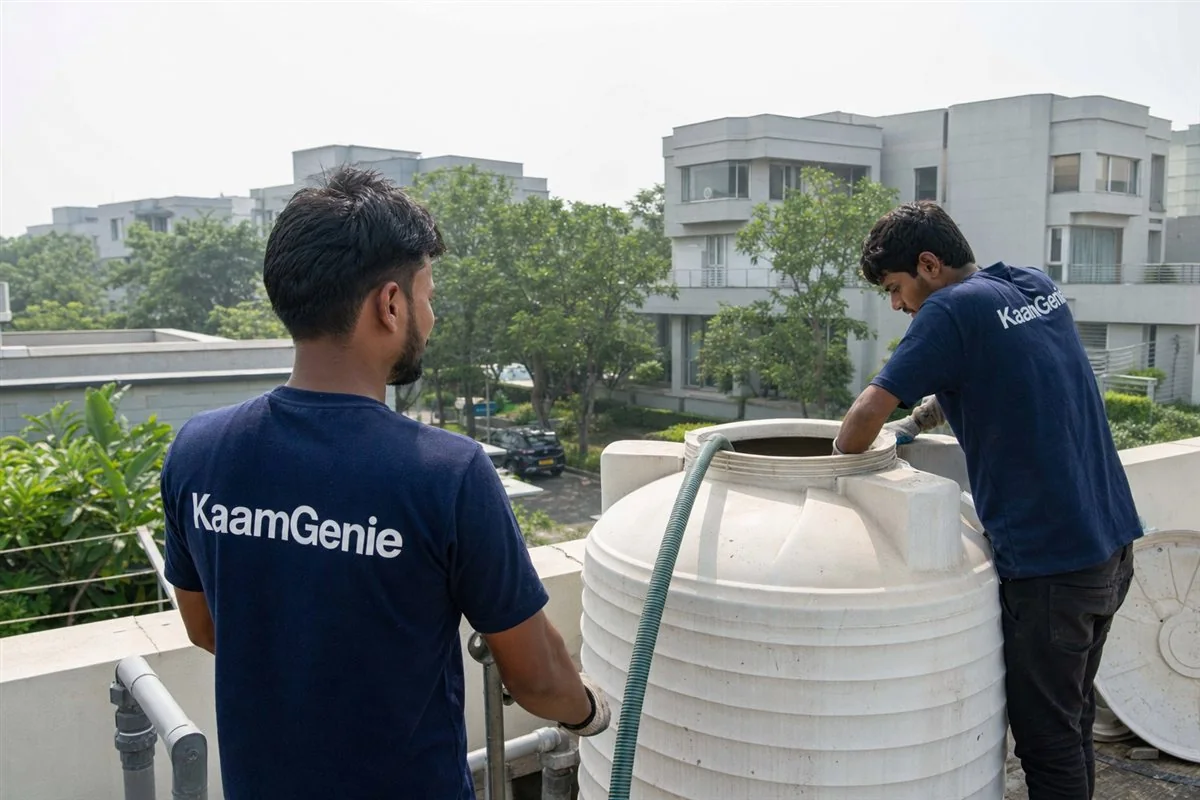
The short version
- A Gurgaon villa or independent floor usually has an underground sump plus one or more rooftop tanks — more storage points than a flat, and all of them yours to maintain.
- There’s no RWA or maintenance contract behind a plotted home, so cleaning gets forgotten until the water tastes or smells wrong.
- Hard borewell groundwater and tanker water both drop heavy sediment into the sump — the first thing that needs cleaning, because it feeds everything above it.
- Let-out floors, household staff and family all drink and bathe in that water; a neglected low-use tank is often the dirtiest in the house.
- Cleaning starts at ₹699 onwards per tank, with a discount when several tanks and the sump are done in one visit.
Gurgaon — Gurugram — is mostly known for its glass towers, but a large slice of the city lives in low-rise housing: villas in gated townships like Nirvana Country and Malibu Towne, builder floors across the DLF phases, Sushant Lok and Ardee City, and plotted homes in the older and newer sectors alike. These homes are premium, well-built and well-kept on the surface. Underneath, the water plumbing is almost always managed by the household itself, and that is exactly where the neglect creeps in.
In a condominium or society, an Apartment Owners’ Association schedules the tank cleaning and splits the cost. In a villa, nobody does. The result is that some of the most expensive homes in the city are running on water tanks that haven’t been opened in years. If you want the full picture of how cleaning works across the city, our guide to water tank cleaning in Gurgaon covers every housing type; this article is specifically about villas and independent floors.
| Feature | Society flat | Villa / independent floor |
|---|---|---|
| Who schedules cleaning | RWA / AOA, on a fixed cycle | The household — usually nobody |
| Storage points | Shared sump + shared tower tank | Private sump + 1–3 rooftop tanks, all yours |
| Water source | Society reservoir, managed bulk supply | Borewell + tanker, straight to your sump |
| Usage pattern | Steady, daily turnover | Uneven — floors let or empty, staff, guests |
| Who notices a problem | Many residents complain quickly | One family — often after months |
| Cost responsibility | Split across all flats | One owner pays — but for one home only |
Book your villa’s tanks and sump together
One visit, every tank and the sump cleaned, before/after photos and a record. ₹699 onwards per tank, with a multiple-tank discount.
Why “it’s just our house” is the problem
The most common thing we hear at a villa is some version of “it’s only our family, the water can’t be that dirty.” The logic feels right and it’s wrong. Tank contamination has almost nothing to do with how many people use the water and almost everything to do with what comes into the tank and how long it sits there.
A villa in Gurgaon collects water from a borewell, a tanker, or both. Hard groundwater carries dissolved minerals that precipitate out as scale on the tank walls. Tanker water carries fine silt that settles to the bottom. Dust blows in through imperfect lids. Over months, all of it builds into a sediment layer on the floor of the sump and every rooftop tank — regardless of whether two people live there or twelve. A family of four in an independent floor is drinking from exactly the same sediment a society of forty would be, except no RWA has been quietly scheduling a clean every six months on their behalf.
The second issue is uneven usage. Many independent floors in Gurgaon are let out, or kept for visiting family, or used by household staff who live in. A floor that’s been empty for three months has a rooftop tank full of standing water — the perfect conditions for bio-film and bacteria. The day a new tenant moves in, that stagnant tank is the first thing feeding their taps.
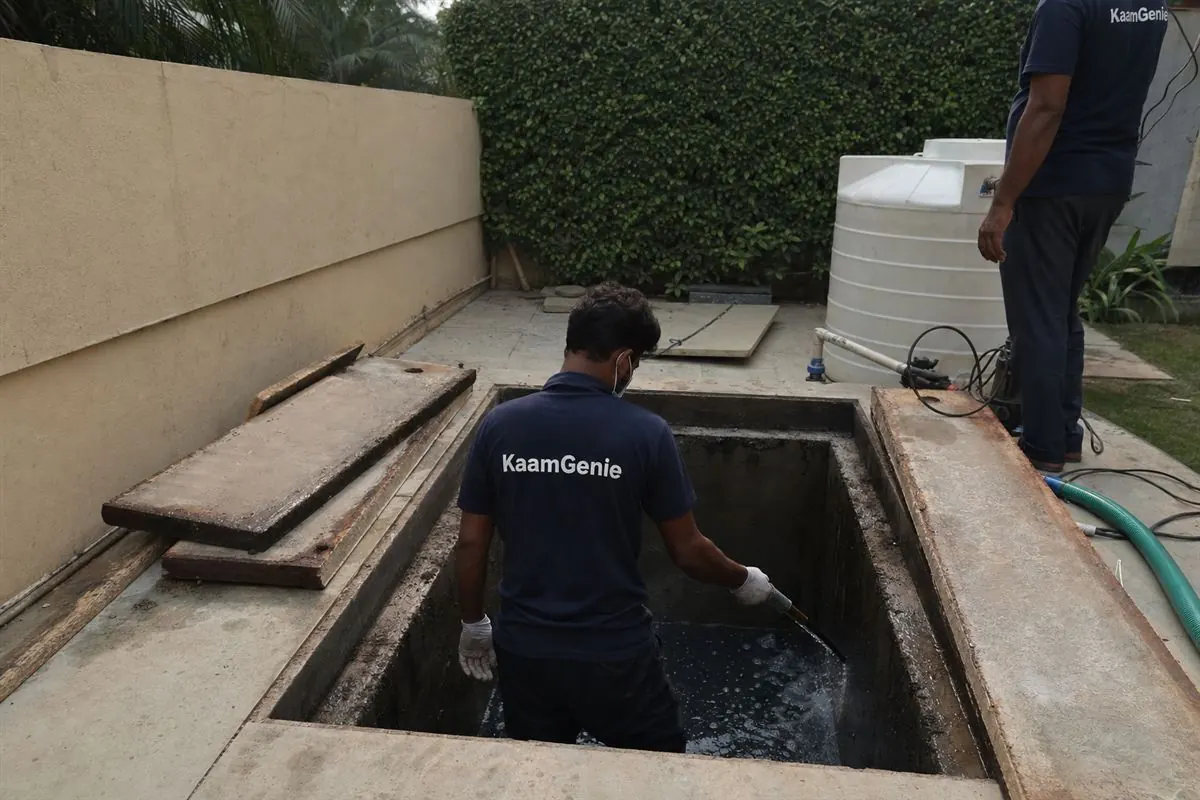
The sump is where it starts
Almost every villa and independent house in Gurgaon has an underground sump (sometimes called a UGR — underground reservoir). This is the heart of the system: tanker deliveries are dumped into it, the borewell feeds it, and a pump lifts water from it up to the rooftop tanks. If the sump is dirty, it doesn’t matter how clean the rooftop tanks are — every pump cycle pushes contaminated water upward and re-dirties them.
Sumps are also the most neglected part of any villa system because they’re out of sight, often under the driveway or a side yard, with a heavy concrete lid nobody lifts. We routinely open villa sumps that have never been cleaned since the house was built, with several inches of silt, and sometimes worse, sitting on the floor. Cleaning a sump properly means draining it, removing the sludge by hand, scrubbing and jet-washing the walls, vacuuming out the residue and disinfecting — with proper confined-space safety gear, because a deep concrete reservoir is not somewhere to climb into casually. We cover this in more depth in our guide to underground sump cleaning in Gurgaon, but for a villa the rule of thumb is simple: clean the sump first, then the tanks it feeds, in the same visit.
Multiple rooftop tanks — and why the spare one is the worst
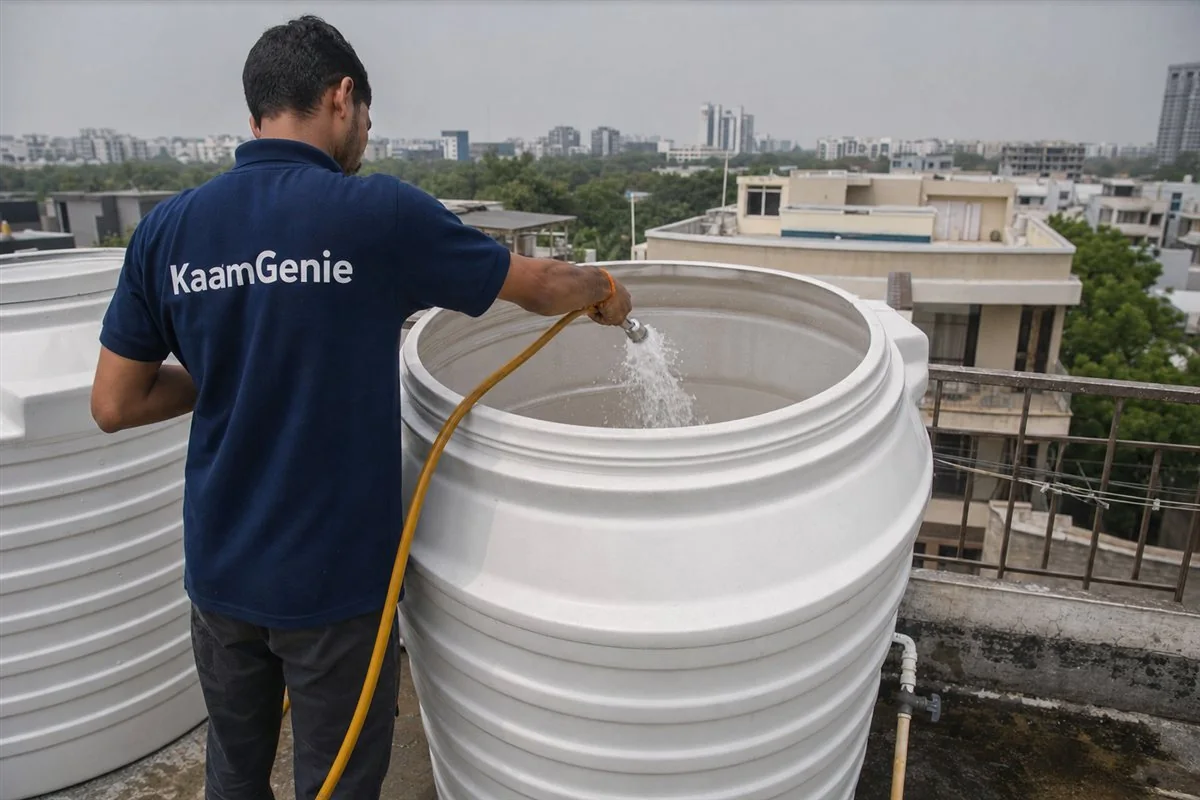
Villas and independent floors rarely have a single rooftop tank. A typical setup is a tank per floor, or a main tank plus a smaller one for an overhead supply or a specific section of the house. That’s good for water pressure and bad for maintenance, because the tank that gets used least is the one that gets cleaned never.
The water in a high-turnover tank at least moves — it’s drawn down and refilled daily, which limits how long anything sits. The water in a low-use tank just stagnates. We’ve opened second-floor tanks in let-out floors that looked far worse than the main family tank below them, purely because the water had been standing for months. If your villa has a tank you “don’t really use,” that’s the one to worry about most, not least. Gurgaon’s hard water makes this faster — the scale that mineral-heavy groundwater leaves behind gives bacteria a textured surface to cling to, which is why we always recommend reading up on hard water tank cleaning in Gurgaon alongside this.
Sediment depth we typically find in a villa rooftop tank, by time since last cleaning
Gurgaon villas on borewell + tanker water — a low-use tank fills the bottom faster than people expect
Indicative of what our crews see on the ground in Gurgaon villa tanks — not a lab measurement. Hard water and tanker silt both speed up the build-up; the figures are a guide, not a guarantee.
What a proper villa cleaning visit looks like
The method is the same one we use everywhere, scaled to a villa’s multiple storage points. A typical visit runs in this order:
- Walk the system first. The crew traces the water path — tanker inlet to sump, sump to pump, pump to each rooftop tank — so nothing gets missed and the cleaning happens in the right sequence.
- Sump before tanks. The underground reservoir is drained, de-sludged by hand, scrubbed, jet-washed, vacuumed and disinfected. Cleaning it after the rooftop tanks would simply re-dirty them.
- Each rooftop tank in turn. Drain, scoop the sediment, scrub the walls and floor with food-grade brushes, jet wash the corners and fittings, wet-vacuum the residue, then disinfect with food-grade chlorine and rinse.
- Don’t skip the low-use tank. The spare or empty-floor tank gets the same treatment — it’s usually the one that needed it most.
- Photos and a record. Before-and-after photos of each tank and the sump, plus a dated cleaning record listing capacities, chemicals and the service date.
The chemicals matter as much as the scrubbing. We use food-grade sodium hypochlorite at the correct concentration — the same class of disinfectant municipal supplies use — never hardware-shop bleach, which leaves residue you don’t want in drinking water. The same standards apply whether it’s a villa, a builder floor or a full society. If you want to compare how the household-managed approach differs from a managed building, our pieces on builder floor water tank cleaning and DLF condominium tank cleaning in Gurgaon are worth a look. For the full breakdown of what each step involves and the chemicals and equipment behind them, see our pillar on water tank cleaning services.
Water quality, staff, tenants and resale
There are three practical reasons villa owners in Gurgaon come round to regular cleaning. The first is plain water quality — the difference between water from a freshly cleaned tank and a neglected one is obvious in taste, clarity and smell, and it shows up at every tap and shower in the house. A premium home should not have water that disappoints.
The second is the people the water serves. Household staff who live in, drivers and helpers who drink from an outdoor tap, and tenants in a let-out floor are all relying on the same storage you are. A waterborne stomach bug doesn’t check who owns the house. Keeping the tanks clean is a basic duty of care for everyone using the property.
The third is resale and rental value. Gurgaon’s premium buyers and tenants increasingly ask pointed questions about water, plumbing and maintenance history. A villa that comes with a recent tank-cleaning record and clean, clear water at the tap presents far better than one where the answer to “when was the tank last cleaned?” is a shrug. It’s a small, cheap thing that quietly signals a well-maintained home.
How often, and what it costs
For a Gurgaon villa we recommend cleaning the rooftop tanks and the sump every six months. Homes that run heavily on tanker water, or that have busy staff and tenant usage, do better on a four-month cycle. Twice a year is the floor, not the target. Doing it on a predictable schedule is far cheaper and easier than reacting to discoloured water or a stomach bug after the fact.
On price, a standard residential tank cleaning is ₹699 onwards. A villa is rarely one tank, so the honest way to quote it is per tank, with a clear discount when several tanks and the sump are cleaned in a single visit — the crew is already on site with the equipment set up, so it makes no sense to charge each one as a separate trip. You get one combined price for the whole system before any work starts, and there are no surprise add-ons after. If you want to see how charges break down across different home types and tank sizes first, our water tank cleaning cost guide for Gurgaon lays it all out.
Get your whole villa system quoted in one call
Sump plus every rooftop tank, one combined price, photos and a record at the end. ₹699 onwards per tank with a multiple-tank discount.
Book villa tank cleaning across Gurgaon
We clean villa and independent-floor tanks right across the city — the township belts of Nirvana Country and Malibu Towne, the luxury colonies of DLF Phase 5, and plotted homes through Sushant Lok, Sohna Road, Ardee City and the newer sectors. Whatever your setup — one rooftop tank or three, with or without an underground sump — the same trained crew handles it, with photos and a record every time. Start at the Gurgaon water tank cleaning hub, call +91 95603 66362, or use the booking form on this page and we’ll confirm shortly.
Frequently asked questions
How much does villa water tank cleaning cost in Gurgaon?
A standard residential tank cleaning starts at ₹699 onwards. A villa is rarely a single tank, though — most have one or two rooftop tanks plus an underground sump, so the realistic figure is a per-tank rate with a discount when several tanks and the sump are done together in one visit. The crew quotes the full set after seeing the layout; there are no surprise add-ons once the price is agreed.
My villa has several tanks and a sump — do you charge for each one?
Each tank and the sump is a separate cleaning job, so each has a price. But because the crew is already on site with all the equipment set up, we apply a multiple-tank discount when you do them together. Cleaning two rooftop tanks and the underground sump in one visit costs noticeably less than booking them on three separate days.
We barely use the upper-floor tank since the tenant moved out. Does it still need cleaning?
A low-use or standing tank is often the dirtiest in the house. Water that sits still grows bio-film and breeds bacteria faster than water that turns over daily. When the floor is re-let or family moves back in, that stagnant tank feeds straight into the taps. A tank that has been sitting idle for months should be cleaned and disinfected before it is put back into regular use.
How often should a Gurgaon villa get its tanks and sump cleaned?
Every six months for the rooftop tanks and the sump is the sensible cycle in Gurgaon, because of hard borewell groundwater and heavy reliance on tanker water that both drop a lot of sediment. Homes that run almost entirely on tankers, or that have staff and tenants using the supply heavily, are better off on a four-month cycle. Twice a year is the minimum we recommend for any villa.
Do you clean the underground sump as well as the rooftop tanks?
Yes, and in a villa the sump matters most because it is the first storage point — tanker and borewell water lands there before being pumped up. If the sump is dirty, every rooftop tank above it is being re-contaminated on every pump cycle. We drain, de-sludge, scrub, jet wash, vacuum and disinfect the underground reservoir using confined-space safety gear, then do the rooftop tanks it feeds.
Our villa runs mostly on tanker water — does that change anything?
It makes cleaning more important, not less. Tanker water varies in quality from trip to trip and often carries fine silt that settles in the sump and tanks. Homes on Golf Course Extension, Sohna Road and the new-tower belt that depend on tankers usually show a thicker sediment layer than homes on a steady piped supply. We see it on the floor of the sump every time.
Can the cleaning be done without disturbing the tenants or staff using the house?
Yes. Most of the work happens on the rooftop and at the sump, away from living areas. We coordinate through one point of contact — the owner, a family member, the house manager or the caretaker — and only need water shut off briefly during the drain and refill. For let-out independent floors we can schedule around the tenant and share the photos and record with the owner afterwards.
Do you provide a cleaning record for resale or rental paperwork?
Every job ends with before-and-after photos and a dated cleaning record listing tank types, capacities, chemicals used and the service date. For a villa you are selling or renting out, that record is a simple, credible proof that the water system has been maintained — buyers and tenants of premium homes increasingly ask for it.
Which Gurgaon township areas do you cover for villas and independent floors?
We cover villa and builder-floor belts right across Gurgaon — Nirvana Country, Malibu Towne, Ardee City, the DLF phases including DLF Phase 5, Sushant Lok, Sohna Road and the newer sectors. If you are in a plotted colony or gated township in Gurugram, we can reach you, usually same day or next day.
Sources & references
- Bureau of Indian Standards (BIS) — IS 10500:2012 is the canonical Indian Standard for drinking water specification, defining acceptable limits for physical, chemical, and biological parameters.
- WHO Guidelines for Drinking-water Quality, 4th edition — the global reference for water quality standards, including guidance on storage and disinfection.
- Food Safety and Standards Authority of India (FSSAI) — defines water quality requirements for food businesses, including hygiene standards for stored water and acceptable disinfection chemicals.
- WHO Fact Sheet on Drinking Water — overview of safe drinking water requirements and contamination risks.
- CPHEEO — Manual on Water Supply and Treatment — the Government of India’s engineering manual covering tank design, cleaning protocols, and disinfection practices.
Last verified: 29 June 2026. If you find any of these links broken, please let us know.