
The short version for condo towers
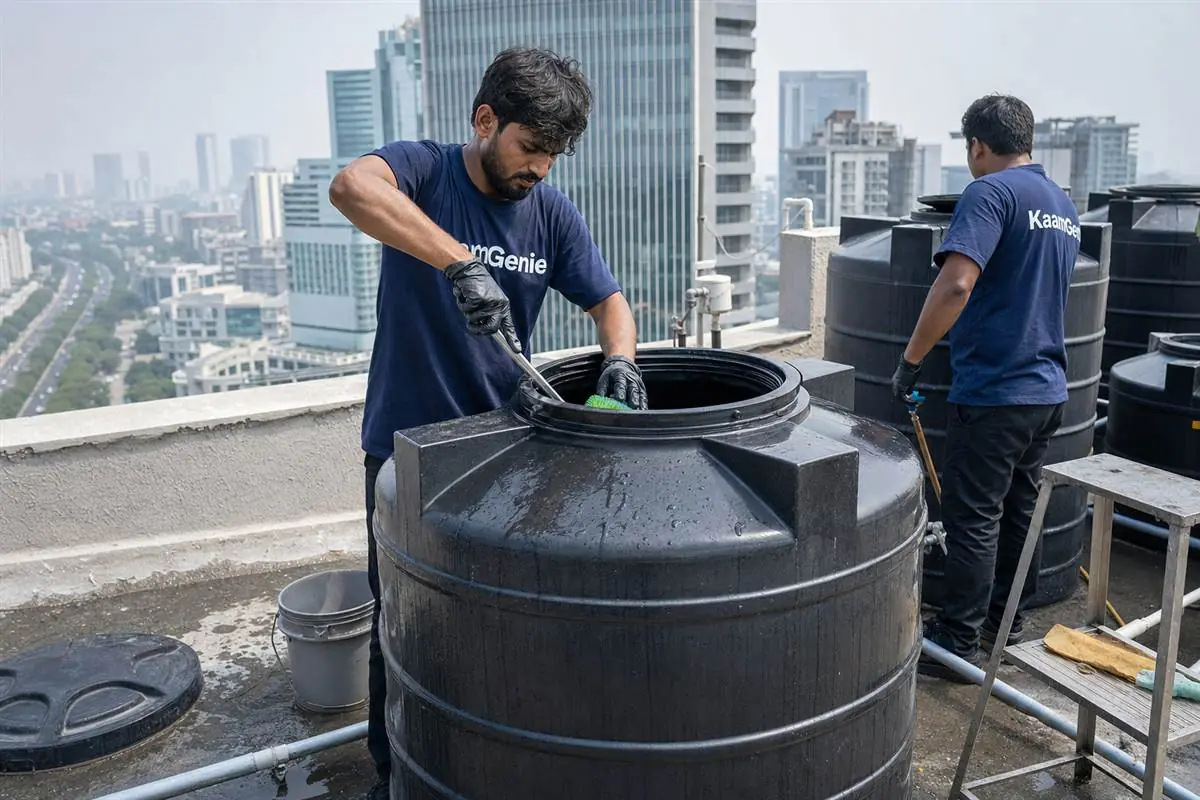
- A luxury tower runs a chain of tanks — underground reservoir (UGR) → pumps → intermediate/rooftop tanks — not a single tank.
- Cleaning is staged tower-by-tower and zone-by-zone so upper floors never lose supply for long.
- Hard-water scale is descaled with a food-grade acidic descaler, then neutralised, scrubbed, and disinfected.
- Work is coordinated with the AOA/RWA and the facility-management team, with a single point of contact.
- You get a certificate per tank plus a consolidated summary — audit-ready, not one vague invoice.
If a vendor quotes a flat per-tank price without surveying the reservoir or asking how the towers are zoned, they haven’t understood the building.
Across DLF Phase 5, Golf Course Road, Golf Course Extension and the newer towers along Southern Peripheral Road, the same picture repeats: gleaming 25-to-40-floor condominiums sitting on a water system that almost no resident ever sees. The water that arrives at a 32nd-floor kitchen tap has travelled from a large underground reservoir, through booster pumps, up to a rooftop or intermediate tank, and back down. Every tank in that journey collects sediment and hard-water scale — and in Gurgaon, where supply leans heavily on borewell groundwater and water tankers, that buildup is faster and chalkier than most owners expect.
This guide is specifically about the high-end tower scenario. If you manage or live in one of these complexes, the cleaning job is a logistics exercise as much as a hygiene one. For the general approach to water tank cleaning in Gurgaon, or the broader society angle, we link those out below rather than repeating them here.
| Stage | What it is | Typical capacity | Key cleaning concern |
|---|---|---|---|
| Underground reservoir (UGR) | Central RCC reservoir storing municipal + tanker water | 50,000–200,000L+ | Heavy sludge, confined-space safety, scale on floor |
| Booster / pump room | Pumps lifting water up the tower | — | Foot-valve and suction-pit silt, access for staging |
| Intermediate tanks | Mid-tower break tanks in very tall towers | 5,000–20,000L | Often forgotten; same scale and bio-film risk |
| Rooftop / overhead tanks | Gravity-feed tanks serving the upper floors | 10,000–40,000L | Scale on walls/fittings, lid hygiene, dust ingress |
| Domestic / flushing split | Separate lines for potable vs flushing in many towers | Varies | Both sets need cleaning; don’t skip the flushing tanks |
Get a tower-by-tower survey first
For condominiums we survey the full tank chain, then quote per tank with a staging plan. Residential single-tank cleaning starts at ₹699 onwards; society, UGR and tower work is custom-quoted.
Why a luxury tower is a different job entirely
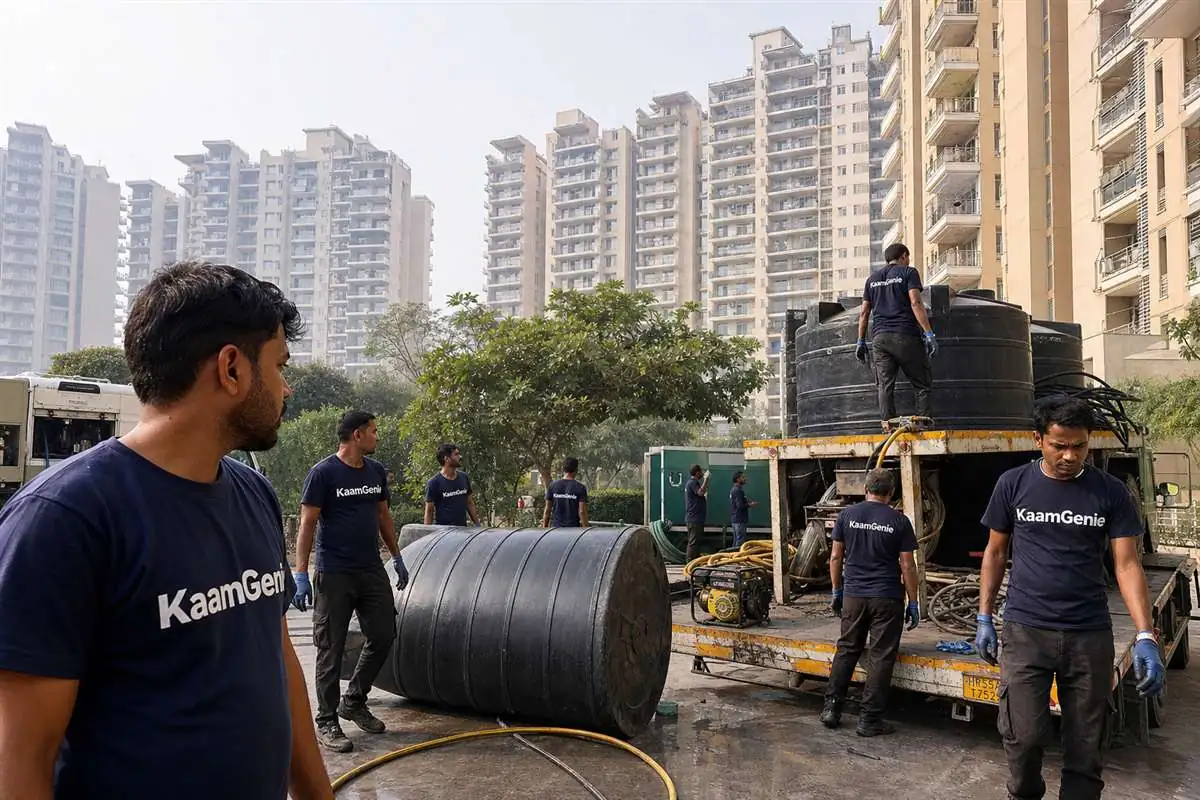
In an independent house or a small builder floor, cleaning is one or two tanks and a couple of hours. A DLF-grade condominium is a different animal. The reservoir alone can hold 50,000 litres to well over 200,000 litres, sitting in a basement pump room that counts as a confined space — meaning trained entry, ventilation, and a standby person, not someone simply climbing in with a bucket.
Above ground, the same water is pushed up to rooftop tanks — and in the tallest towers, to intermediate break tanks partway up — before it gravity-feeds the flats. Every one of those tanks builds its own layer of sediment and scale. Miss the intermediate tank because it’s tucked into a service floor and you’ve cleaned the chain with a dirty link still in it.
Then there’s the dependency problem. You cannot tell 200 families on Golf Course Road that the water is off all day. The whole job has to be designed so supply keeps flowing — which is the heart of staged cleaning.
Staged, tower-by-tower cleaning
Staging is the difference between a clean complex and a flood of angry resident calls. The principle is simple: only ever take one part of the supply chain offline at a time, and always leave a buffer.
- Survey and map first. We walk the pump room, reservoir, terraces and service floors with the facility team and list every tank, its capacity, and how the towers are zoned for supply.
- Sequence by zone. Towers or risers are cleaned one at a time. While one rooftop tank is drained and scrubbed, a parallel tank or the pumping cycle keeps that tower fed.
- Top up before draining. For single-reservoir towers, the tank is filled to give residents a buffer, and the clean is timed to the lowest-demand window — usually mid-morning on a weekday.
- Communicate the window. Residents get advance notice of the short period when supply may be intermittent, posted through the FM team and lift-lobby notices.
- Reservoir last or split. Large UGRs are often cleaned in compartments, or scheduled when the towers are running off topped-up overhead tanks.
This is the same discipline behind the broader society water tank cleaning approach, scaled up for height and headcount. For complexes near the metro and commercial belt, our Golf Course Road tank cleaning and DLF Phase 5 crews plan staging around peak office-commute hours specifically.
Hard water and the scale problem
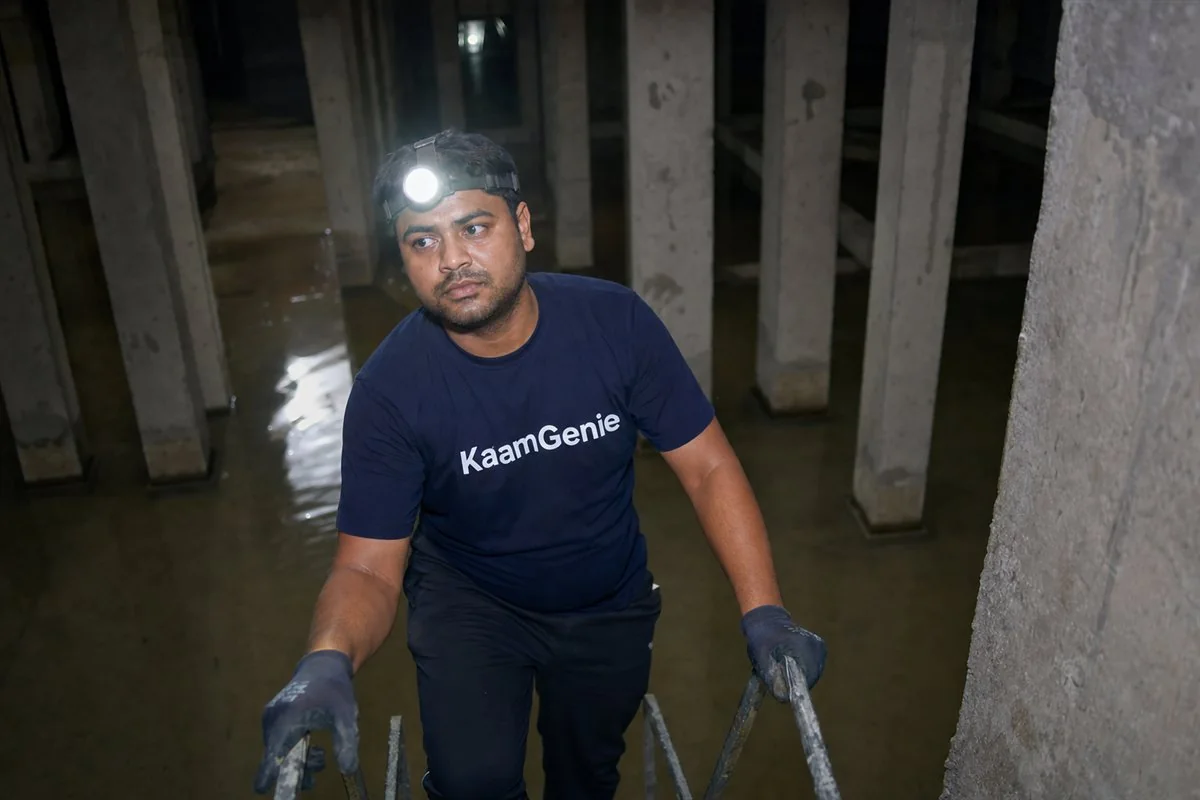
Gurgaon’s groundwater is hard, and a lot of condominium supply is topped up by tankers drawing on the same aquifers. The result is a chalky calcium-and-magnesium scale that coats tank walls, floors, and especially the inlet and outlet fittings. Left alone it narrows pipes, harbours bio-film in its rough surface, and gradually drops flow pressure on the upper floors.
Plain detergent and a brush will not remove established scale. The right approach is to descale with a food-grade acidic descaler at a controlled concentration, give it a measured contact time, then neutralise and re-rinse thoroughly before disinfection. Heavily scaled reservoirs sometimes need a longer dwell or a second pass — which we flag and price upfront, never quietly leave behind. We go deeper into this in the dedicated Gurgaon hard-water tank cleaning guide; for towers it simply becomes a built-in step on the UGR and overhead tanks.
Coordinating with the AOA and facility-management team
Nothing in a luxury condominium happens without sign-off. In most complexes the Apartment Owners Association (AOA) or RWA approves the scope and budget, while the on-site facility-management (FM) company controls access to the pump room, reservoir, terraces and service lifts. We work to both:
- One written schedule shared with the AOA and FM team, listing tanks, sequence, dates and access windows.
- A single point of contact on each side during the job, so decisions don’t bounce between WhatsApp groups.
- Lift and access clearances arranged in advance — service-lift slots, terrace keys, pump-room entry, parking for equipment.
- Resident notices drafted with the FM team so the messaging is consistent and professional.
This coordination is exactly why complexes prefer a standing arrangement — an annual contract means the survey, staging plan and access protocol are already on file, and each cycle just runs. It also keeps the documentation current, which matters more than owners realise at audit time.
Where the time goes — cleaning one luxury tower (UGR + rooftop chain)
Indicative split for a single tower with a large reservoir; multi-tower complexes repeat the rooftop phase per tower
Indicative only — actual time depends on reservoir size, scale severity and access. A multi-tower complex is staged across several days or weekends so no zone loses supply for long.
Per-tank certificates and premium documentation
For a condominium, the paperwork is part of the deliverable, not an afterthought. We issue a cleaning certificate for every tank — each UGR compartment, every intermediate and rooftop tank — listing capacity, date, crew, the food-grade chemicals and concentrations used, and before/after photos. A consolidated complex summary then maps every certificate to its physical tank location.
Why it matters: an AOA needs this for its maintenance register; an FM company needs it for handover audits and to answer resident queries; and any resident running a home business or clinic in a mixed-use tower may need proof of a maintained potable-water system. The standard we apply mirrors the documentation expected for professional water tank cleaning services across NCR — potable-water-grade chemicals, recorded contact times, and an auditable trail rather than a one-line bill. If you want the full background on what a thorough Gurgaon clean involves end to end, the complete Gurgaon water tank cleaning guide covers it.
What this looks like across Gurgaon’s tower belt
The luxury-tower pattern isn’t confined to one pocket. DLF Phase 5 and the Golf Course Road corridor set the template, but the same chain-of-tanks logic applies to the high-rises along Golf Course Extension, Southern Peripheral Road, and the newer Dwarka Expressway developments. Demand profiles differ — older DLF colonies skew owner-occupied, while many newer towers carry a large rental and expat population with high turnover — but the cleaning discipline is identical: survey the chain, stage by zone, descale, disinfect, certify per tank. We run the same protocol for condominiums in Sector 65 and across the wider belt.
Plan your complex’s next clean
Tell us the number of towers and the reservoir size, and we’ll schedule a survey and a staged plan that keeps every floor supplied. Per-tank certificates included.
Book a condominium survey in Gurgaon
If you’re on an AOA managing committee or running facilities for a DLF or Golf Course Road tower, the first step is a survey of your tank chain — reservoir, pumps, intermediate and rooftop tanks — followed by a staged plan and a per-tank quote. You’ll find pricing, coverage and booking on our water tank cleaning in Gurgaon hub.
To start, call +91 95603 66362 or use the booking form on this site — tell us the number of towers and the reservoir size, and we’ll confirm a survey slot shortly.
Frequently asked questions
How is cleaning a DLF condominium tower different from cleaning a regular society tank?
Scale and dependency. A luxury condominium runs a large underground reservoir (UGR) that is pumped up to rooftop tanks serving 20-40 floors, often across several towers. You cannot simply switch the water off for a day. Cleaning has to be staged tower-by-tower and zone-by-zone so residents on the upper floors keep supply, and every tank in the chain — UGR, intermediate, and overhead — has to be cleaned, not just the one that is easy to reach.
How do you stage cleaning across a 30-floor tower without cutting off water?
We work from a tank schedule agreed with the facility team. Typically we clean one overhead tank or one UGR compartment at a time while the parallel tank or the pumping cycle keeps the tower supplied. Towers with a single reservoir are cleaned during the lowest-demand window — usually mid-morning on a weekday — with the tank topped up beforehand so there is a buffer. Residents get advance notice of the short window when supply may be intermittent.
Who do you coordinate with — the AOA or the facility management company?
Both, in practice. The Apartment Owners Association (AOA) or RWA usually approves the scope and budget, and the on-site facility management (FM) company gives us access to the pump room, UGR, terraces, and lift clearances. We share a written schedule with both, run a single point of contact during the job, and hand the signed paperwork to whoever maintains the complex’s compliance records.
Do you provide a separate certificate for each tank?
Yes. For condominium work we issue a per-tank cleaning certificate — UGR compartments, intermediate tanks, and each tower’s overhead tanks are listed individually with capacity, date, crew, chemicals used, and before/after photos. A consolidated summary sheet maps every certificate to its tank location so the FM team and AOA have an auditable record rather than one vague invoice.
How do you handle the hard-water scale in Gurgaon condominium tanks?
Gurgaon’s borewell groundwater and a lot of tanker supply are hard, so tanks build a chalky calcium and magnesium scale on walls, floors, and around inlet and outlet fittings. We descale with a food-grade acidic descaler at a controlled concentration, then neutralise, scrub, and re-rinse before disinfection. Heavily scaled UGRs sometimes need a longer contact time or a second descaling pass, which we flag and price upfront rather than leaving the scale behind.
How long does it take to clean a full condominium complex?
It depends on the number of towers and the size of the reservoir. A single tower with one UGR compartment and rooftop tanks is usually a half-day. A multi-tower complex with a large central reservoir is planned across several days or staged weekends so no zone loses supply for long. We give a tank-by-tank timeline at survey stage so the FM team can schedule resident communication.
Can the work be done after hours or on weekends to minimise resident disruption?
Yes. Premium condominiums often prefer early-morning, late-evening, or weekend slots so common areas and lifts are quieter and supply interruptions land outside peak hours. We plan the staging around the building’s demand curve and the FM team’s preferred access windows. There is no cutting corners for an odd-hour job — the same full process and documentation apply.
What documentation do you hand over for facility audits and AOA records?
Per-tank certificates, a consolidated complex summary, before/after photos for each tank, the list of food-grade chemicals and concentrations used, crew details, and the service date. This is the paperwork an AOA needs for its maintenance register and an FM company needs for handover audits or resident queries. If the complex follows a periodic schedule, we date the next-due cycle on the summary.
How often should a luxury condominium get its tanks cleaned?
Twice a year is the sensible baseline for condominium UGRs and overhead tanks, and many premium complexes in Gurgaon clean quarterly because of hard-water scale and heavy tanker dependence. High occupancy, dust ingress during construction-heavy seasons, and any taste, colour, or smell complaints are reasons to clean sooner. A standing schedule on an annual contract is cheaper per visit and keeps the certificates current for audits.
Sources & references
- Bureau of Indian Standards (BIS) — IS 10500:2012 is the canonical Indian Standard for drinking water specification, defining acceptable limits for physical, chemical, and biological parameters.
- WHO Guidelines for Drinking-water Quality, 4th edition — the global reference for water quality standards, including guidance on storage and disinfection.
- Food Safety and Standards Authority of India (FSSAI) — defines water quality requirements for food businesses, including hygiene standards for stored water and acceptable disinfection chemicals.
- WHO Fact Sheet on Drinking Water — overview of safe drinking water requirements and contamination risks.
- CPHEEO — Manual on Water Supply and Treatment — the Government of India’s engineering manual covering tank design, cleaning protocols, and disinfection practices.
Last verified: 29 June 2026. If you find any of these links broken, please let us know.