
Short version
- A Gurgaon builder floor usually has one private tank per floor fed by one shared underground sump.
- Each floor cleans its own rooftop tank; the shared sump gets neglected because no one owns it and there’s no RWA to organise it.
- Cleaning every floor’s tank plus the sump in one visit is far cheaper per tank than booking floors separately.
- Rule of thumb: the floor’s own tank is the resident’s job; the shared sump is split between owners.
- On Gurgaon’s hard borewell water, clean both every six months.
If your floor’s tank is spotless but the sump under the building hasn’t been touched in years, you’re drinking the sump’s problem before it ever reaches your roof.
Drive through DLF Phase 4, South City or Sushant Lok and you’re looking at thousands of them: trim G+3 and G+4 buildings, four families, four separate homes stacked on one plot. The builder floor is what made Gurugram — the Millennium City — liveable for owners who wanted an apartment without a 30-storey tower. But the plumbing that comes with it is its own little system, and water tank cleaning on a builder floor works nothing like a high-rise condominium or a standalone house.
This guide is the honest version: how the tanks are actually arranged, why the shared sump is the part that quietly rots, who should pay for what, and why doing the whole stack in one go is the only sensible way to book it. If you want pricing and slots first, the fastest route is our page for water tank cleaning in Gurgaon.
How the tanks are actually plumbed on a builder floor
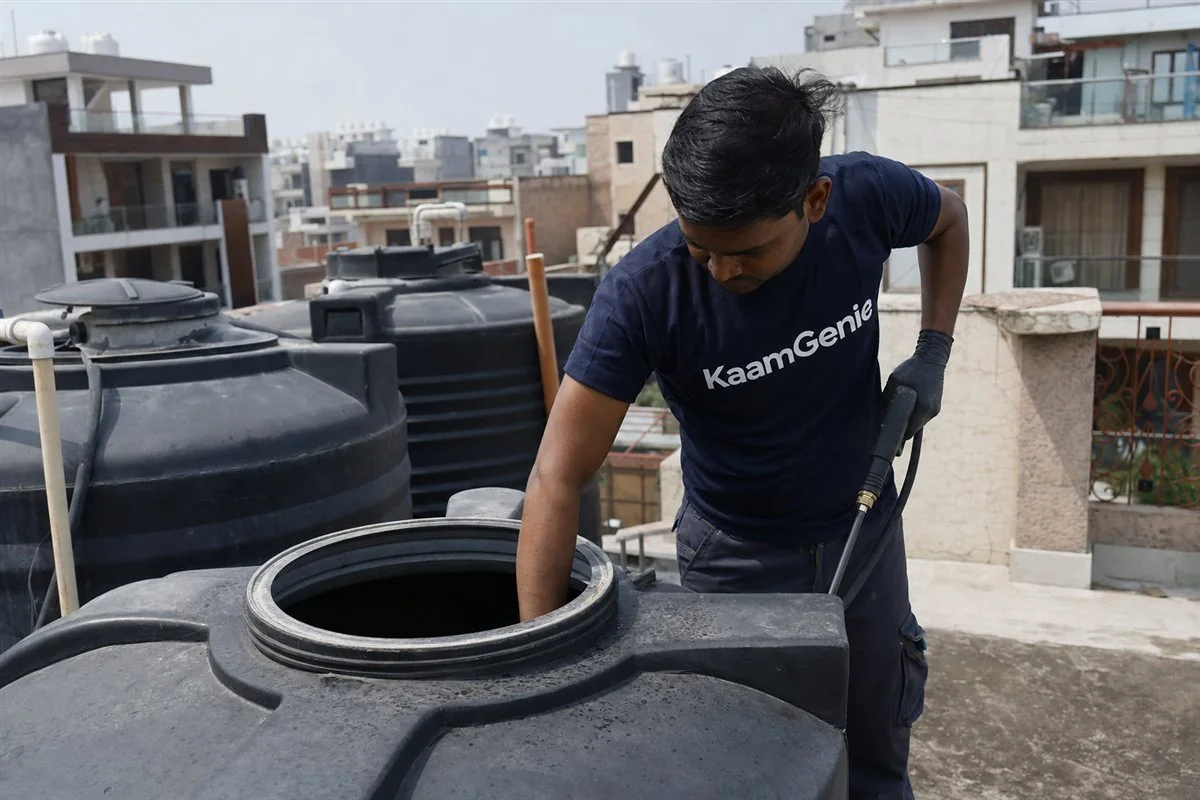
Almost every builder floor in Gurgaon follows the same water path. A borewell and/or a water tanker fills a large underground sump (the UGR) at the bottom of the building — in the basement, the stilt, or a chamber in the front setback. From there a pump lifts water up to individual rooftop tanks, one per floor, sitting together on the common terrace. Each floor draws its daily supply from its own rooftop tank.
So a typical four-floor stack has five tanks that need cleaning: four private rooftop tanks plus one shared sump. That shared sump is the single most important one, because every drop every family drinks passes through it first — and it’s the one with the least clear owner.
| Tank | Where it sits | Serves | Who normally arranges cleaning |
|---|---|---|---|
| Shared underground sump | Basement / stilt / front chamber | All floors (fills first) | Split between all owners |
| Ground-floor tank | Rooftop or rear | Ground-floor home | Ground-floor resident |
| First-floor tank | Common rooftop | First-floor home | First-floor resident |
| Second-floor tank | Common rooftop | Second-floor home | Second-floor resident |
| Top-floor tank | Common rooftop | Top-floor home | Top-floor resident |
Clean the whole builder floor in one visit
All floor tanks plus the shared sump, done together, documented per tank — the cheapest way to do it. ₹699 onwards per tank.
The shared-sump problem — the tank nobody cleans
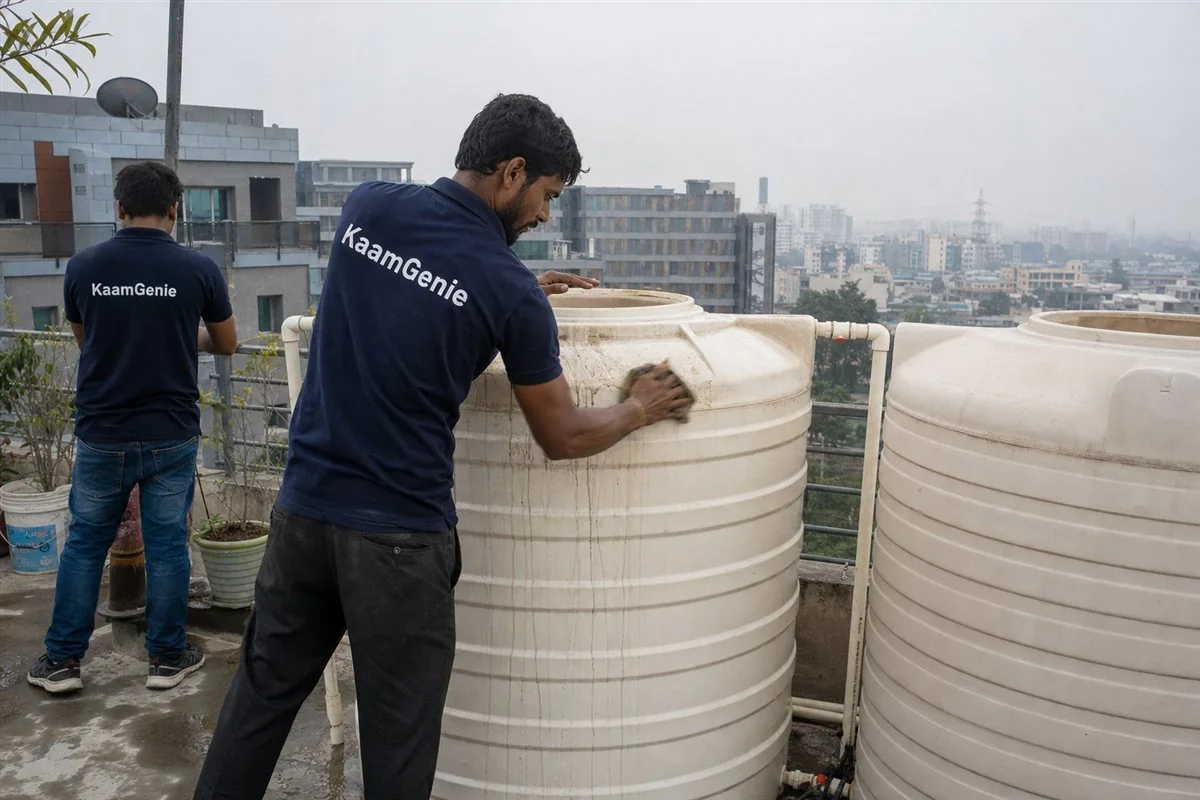
Here is the pattern we see on builder floors across Gurgaon. The rooftop tanks get cleaned semi-regularly, because each is private property — the family can see it, it’s theirs, and the cost is theirs alone. The shared underground sump, on the other hand, gets forgotten for years. Not because anyone decides to ignore it, but because it belongs to everybody, and a thing that belongs to everybody belongs to no one.
A high-rise condominium has an AOA or facility manager whose job is to remember the sump. A builder floor almost never does. There’s no committee, no maintenance fund, no one whose job it is to call the meeting, collect a few thousand rupees from each floor, and book the cleaning. So the sump — the very first tank Gurgaon’s hard borewell water and tanker water land in — collects sediment, scale and biofilm undisturbed.
And because the sump fills first and feeds every rooftop tank, a dirty sump quietly contaminates every clean tank above it. You can keep your own rooftop tank immaculate and still be drinking what the sump pushed up. This is the single most common avoidable problem on Gurgaon builder floors, and it’s exactly the kind of shared sump our team handles through the main water tank cleaning services.
Why doing all floors in one visit is cheaper per tank
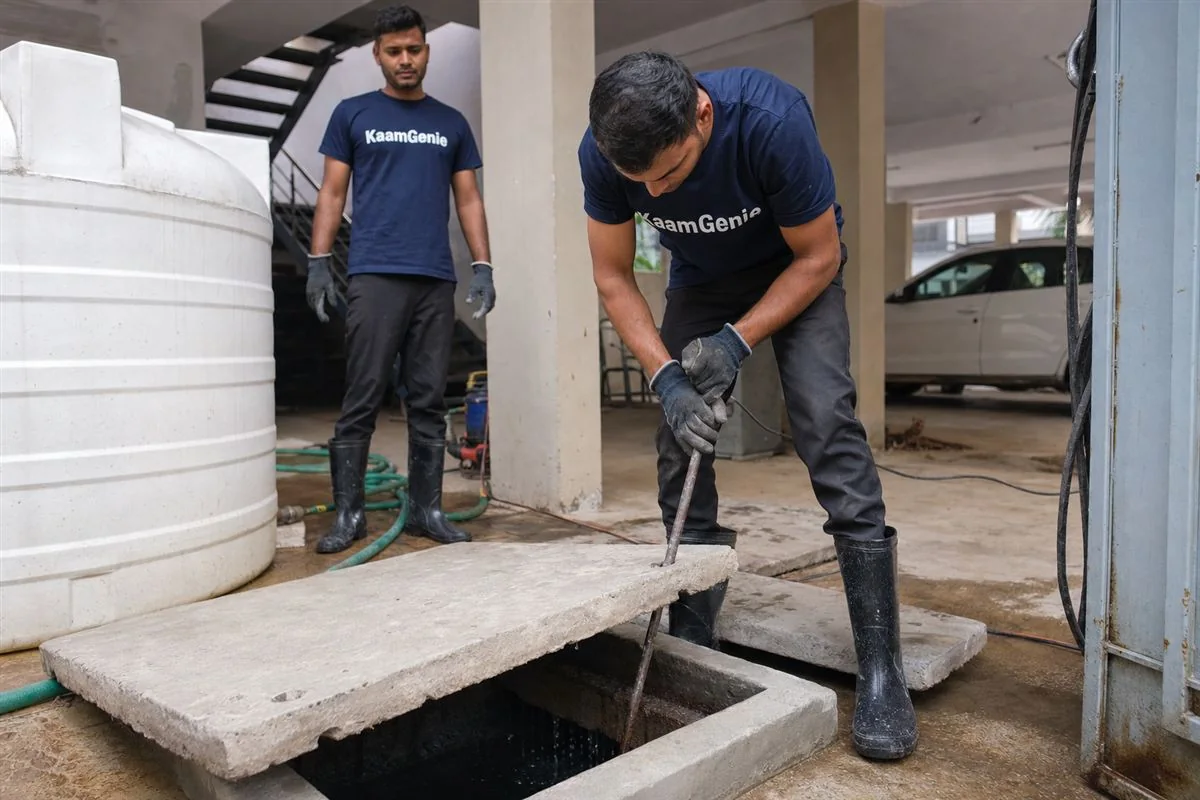
The economics of a builder floor reward coordination. A large share of any tank-cleaning job is the things that happen once regardless of how many tanks you do: travelling to site, hauling the jet washer, pump, vacuum and food-grade chemicals up, and setting up. When a crew cleans one isolated rooftop tank, that whole overhead is loaded onto a single tank. When the same crew cleans four rooftop tanks plus the sump in one visit, the overhead spreads across five tanks — so the price per tank falls sharply.
Practically, a four-floor stack with five tanks is comfortably a half-day job for one crew. The rooftop tanks are usually clustered on the same terrace, so they’re done back to back, and the sump is done in the same trip. Compare that with four families separately booking four crews on four different days, each paying the full call-out — it costs everyone more for an identical result.
The catch is organisation, which is the same reason the sump gets neglected. Someone on the stack has to be the person who messages the group, picks a date, and gives us one point of contact for access. Do that once and the building can settle into a rhythm. This is the same money-saving logic that applies to a full DLF condominium water tank cleaning — bulk the tanks, share the overhead.
Typical gap since last cleaning — builder-floor tanks in Gurgaon
The shared sump goes years longer than the private rooftop tanks above it
Illustrative pattern from builder-floor jobs across Gurgaon — private rooftop tanks get cleaned within a year or so, while the shared sump routinely goes three years or more. Both should be on a six-month cycle.
Owner or tenant — who actually pays?
Gurgaon has an enormous rental and expat population, and a lot of builder floors are let out, so this question comes up constantly. There’s no single law, but there’s a fair convention that avoids most arguments:
- The floor’s own rooftop tank is a running cost of living there. A tenant on a long lease usually arranges and pays for their own floor’s tank cleaning, the same way they’d pay for the gas or the RO service. The owner typically gets it cleaned between tenancies so a new tenant starts fresh.
- The shared underground sump serves the whole building, so it’s an owners’ cost, split between the floors — not something a single tenant should be lumped with.
If your rent agreement is silent on it, that split — tenant handles their floor’s tank, owners share the sump — is the cleanest way to settle it. We break the tenant side of this down further in our guide to tenant water tank cleaning in Gurgaon, and if you’re moving in, see water tank cleaning for a new flat in Gurgaon.
The cleaning itself — what we actually do
The method on a builder floor is the same proven eight-step process we use everywhere: inspect and photograph, drain, scoop out the sludge by hand, scrub every wall and the floor with food-grade brushes, high-pressure jet wash the corners and fittings, wet-vacuum the residue, disinfect with food-grade chlorine and a proper contact time, then refill and document. What changes on a builder floor is the logistics, not the chemistry:
- Sequencing. We work through the rooftop tanks in order, then the sump, so each home loses water for the shortest possible window.
- The sump gets the heavy work. Being larger and the most neglected, the shared sump usually carries the thickest sediment and the most hard-water scale, so it takes the longest.
- Per-tank documentation. Each floor gets its own before/after photos and record, which matters when costs are being split and everyone wants to see their tank was actually done.
Gurgaon’s hard groundwater is the reason none of this can be skipped. Borewell and tanker water both leave more mineral scale and a heavier sediment layer than treated municipal supply, and the longer it sits — especially in a forgotten sump — the harder it sets. A six-month cycle keeps it as a soft layer that lifts off easily instead of a cemented crust.
Builder floors across DLF, South City and Sushant Lok
The colonies where the builder-floor format is densest are exactly the ones where this shared-sump pattern bites hardest — large, established neighbourhoods full of independent floors and almost no formal building management. We work across all of them, including DLF Phase 4, the leafy plots of Sushant Lok, and the builder floors of South City. If your stack is anywhere in this belt, the same advice holds: book the whole building together, and don’t let the sump be the tank everyone forgets.
Get one quote for the whole stack
Tell us the number of floors and the sump size — we’ll quote the full building and the cheaper per-tank rate on a quick call. ₹699 onwards per tank.
Get your builder floor on a schedule
Builder floors are wonderful homes and a genuinely awkward water system — the convenience of an apartment without anyone whose job it is to mind the shared parts. The fix is simple: treat the floor’s own tank as the resident’s responsibility, treat the shared sump as a cost the owners split, and book the whole stack together every six months so the sump never becomes the tank everyone forgot. Start from our hub for water tank cleaning in Gurgaon, or just call +91 95603 66362 with the number of floors and the sump size and we’ll quote the whole building.
Frequently asked questions
What is a builder floor and why is its water tank setup different?
A builder floor is one independently-owned apartment that takes up a whole floor of a low-rise (typically G+3 or G+4) building — the classic Gurgaon format in DLF, South City and Sushant Lok. Unlike a high-rise society, each floor usually has its own rooftop or stilt tank fed by a single shared underground sump at the bottom. That split — many private tanks, one common sump — is what makes the cleaning logistics unusual.
Each floor has its own tank — can you clean all of them in one visit?
Yes, and it’s the smart way to do it. When we clean every floor’s tank plus the shared sump in a single visit, the crew, equipment haul, and travel are shared across all the tanks, so the per-tank price drops well below booking each floor separately on different days. Most builder-floor stacks of 3-4 floors get done in a half-day. We just need someone to coordinate access to each floor.
Who pays for the tank cleaning on a builder floor — owner or tenant?
For the individual floor’s own tank, it’s usually the resident who benefits — so a tenant on a long lease often arranges and pays for their own floor’s tank, while the owner handles it between tenancies. The shared underground sump is different: it serves everyone, so the cost is normally split equally between the floors. If your rent agreement is silent, treat the private rooftop tank as a tenant running-cost and the shared sump as a building cost shared by all owners.
Why does the shared underground sump get neglected on builder floors?
Because nobody owns it alone. Each floor happily cleans its own rooftop tank — they can see it and it’s theirs — but the common sump in the basement or stilt belongs to everyone and therefore to no one. With no RWA or facility manager (which builder floors rarely have), there’s no one to call the meeting, collect the money, and book the job. So the sump — the tank every floor actually drinks from first — goes years without a clean.
How much does it cost to clean a builder floor tank in Gurgaon?
A single residential rooftop tank starts at ₹699 onwards. The shared underground sump is priced on capacity because builder-floor sumps are larger. The best value is booking the whole stack together — all floor tanks plus the sump in one visit — which brings the per-tank cost down sharply versus separate bookings. We quote the exact figure on a quick call once we know the number of floors and the sump size.
How often should a Gurgaon builder floor tank be cleaned?
Every six months for both the rooftop tanks and the shared sump. Gurgaon runs heavily on hard borewell groundwater and tanker top-ups, both of which drop more sediment and scale than treated municipal supply. On hard-water stacks we often suggest the sump on a six-month cycle and rooftop tanks aligned to it so the whole building gets done in one visit.
My builder floor runs on hard borewell water — does that change the cleaning?
It makes regular cleaning more important, not less. Hard Gurgaon groundwater leaves calcium and mineral scale on tank walls and a heavier sediment layer at the bottom of the sump, where it sits longest. The cleaning method is the same eight-step process, but scaled-up tanks need more scrubbing and jet-wash time. Skipping cleaning on hard water just lets the scale harden into a layer that’s far tougher to remove later.
The ground-floor owner won’t share the sump cleaning cost — what can we do?
It’s a common stand-off because the ground floor sometimes draws less from the shared sump. The fairest framing is that the sump feeds every floor’s supply, so the health risk is shared even if usage isn’t identical. If a full split won’t happen, the upper floors can still book the sump and the cost is split among those who agree — the job and the cleanliness still benefit everyone downstream of it. Many stacks settle on a fixed half-yearly contribution to avoid re-arguing every time.
Do you need access to every floor for a full building clean?
We need access to wherever each floor’s tank physically sits — usually the common roof for the top tanks, plus the basement or stilt for the shared sump. Many builder floors keep all rooftop tanks together on the terrace, so one roof visit covers several floors. We coordinate the sequence through one point of contact so residents aren’t all waiting around; each floor only needs to be reachable when its tank is being done.
We just bought a resale builder floor — should we clean before moving in?
Yes. A resale floor’s rooftop tank could be months or years since its last clean, and you have no record of how the previous owner maintained it. Clean the floor’s own tank before you move in, and use the handover as the moment to push the whole stack — including the shared sump — onto a common six-monthly schedule. Buyers moving into a new flat have the most leverage to reset the building’s cleaning habit.
Sources & references
- Bureau of Indian Standards (BIS) — IS 10500:2012 is the canonical Indian Standard for drinking water specification, defining acceptable limits for physical, chemical, and biological parameters.
- WHO Guidelines for Drinking-water Quality, 4th edition — the global reference for water quality standards, including guidance on storage and disinfection.
- Food Safety and Standards Authority of India (FSSAI) — defines water quality requirements for food businesses, including hygiene standards for stored water and acceptable disinfection chemicals.
- WHO Fact Sheet on Drinking Water — overview of safe drinking water requirements and contamination risks.
- CPHEEO — Manual on Water Supply and Treatment — the Government of India’s engineering manual covering tank design, cleaning protocols, and disinfection practices.
Last verified: 29 June 2026. If you find any of these links broken, please let us know.