
The short answer
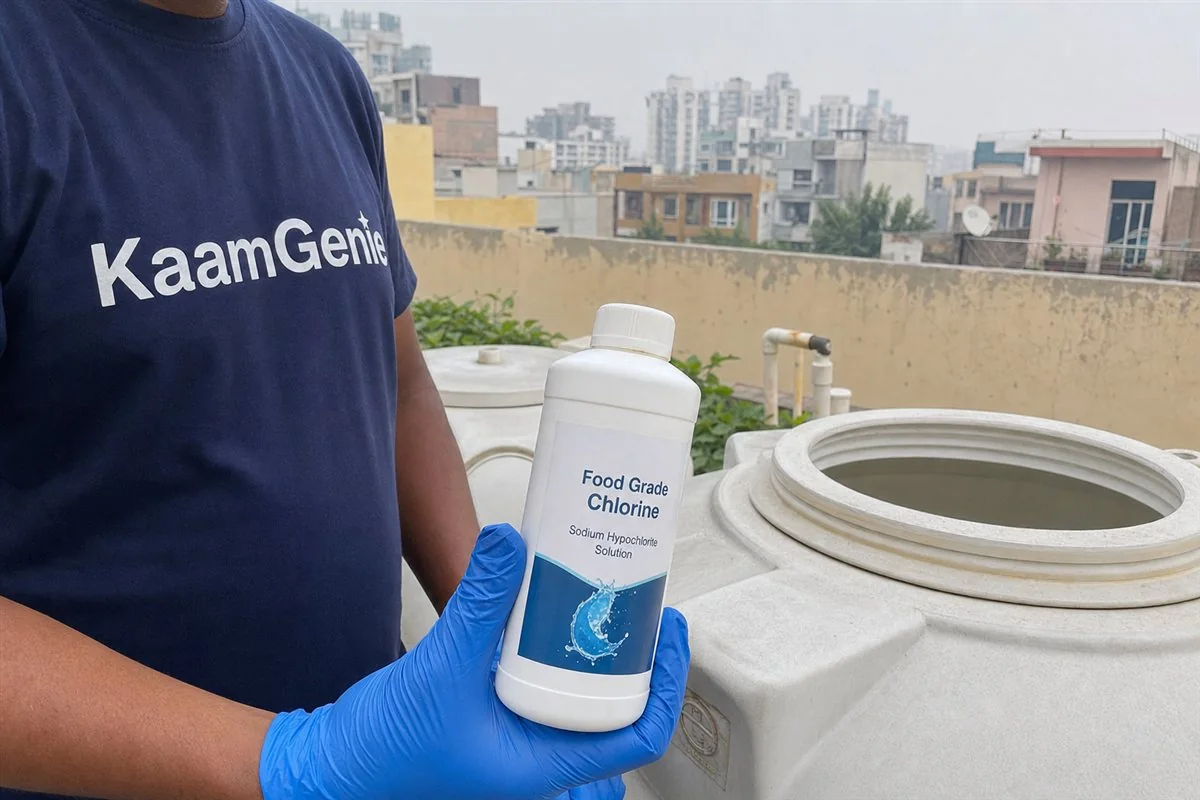
- Food-grade sodium hypochlorite (chlorine) — the actual disinfectant, the same family used to treat municipal drinking water
- A mild food-grade cleaning agent — to lift bio-film and grime during the wash, before disinfection
- A food-safe descaling agent — only where Gurgaon’s hard borewell water has left mineral scale
- What we never use: acid, household detergent, industrial bleach, pool chlorine, or anything with fragrance
- The catch: chemicals only work on a physically clean surface, and only with proper contact time before rinsing
If someone “cleans” your tank by tipping a bottle of bleach into dirty water, you paid for theatre, not disinfection.
Gurgaon — Gurugram, the Millennium City — throws up a particular set of water problems. Much of the city runs on hard borewell groundwater, topped up heavily by water tankers. DLF colonies, Sushant Lok and the luxury condominiums off Golf Course Road store water in big underground reservoirs that pump up to rooftop tower tanks. Independent builder floors across New Gurgaon and Sohna Road have their own rooftop drums. Every one of those tanks needs the same thing: a real clean, finished with the right chemistry. This guide explains the chemistry part — what’s in the bottle and why it matters. If you want the full method, our complete Gurgaon tank cleaning guide walks through the whole process.
| Chemical / agent | What it does | Why food-grade matters |
|---|---|---|
| Sodium hypochlorite (food-grade chlorine) | Kills bacteria, viruses and bio-film on the clean surface | Certified for potable water; no fragrances, stabilizers or heavy-metal additives |
| Mild food-grade cleaning agent | Lifts grease, organic film and grime during the wash stage | Rinses clean without leaving residue or foam in drinking water |
| Food-safe descaling agent | Dissolves hard-water mineral scale before disinfection | Removes the crust bacteria hide under — without acid attacking the tank |
| Fresh rinse water | Flushes out loosened debris and residual disinfectant | Leaves only a tiny safe residual, the way municipal water arrives |
| Acid / household detergent | NOT USED — belongs on floors and bathrooms | Corrodes fittings, pits concrete, leaves unsafe residue |
Want it done with food-grade chemicals only?
Food-grade disinfectant, proper contact time, before/after photos and a record of what we used. ₹699 onwards for homes; societies and reservoirs custom-quoted.
The main chemical: food-grade chlorine (sodium hypochlorite)
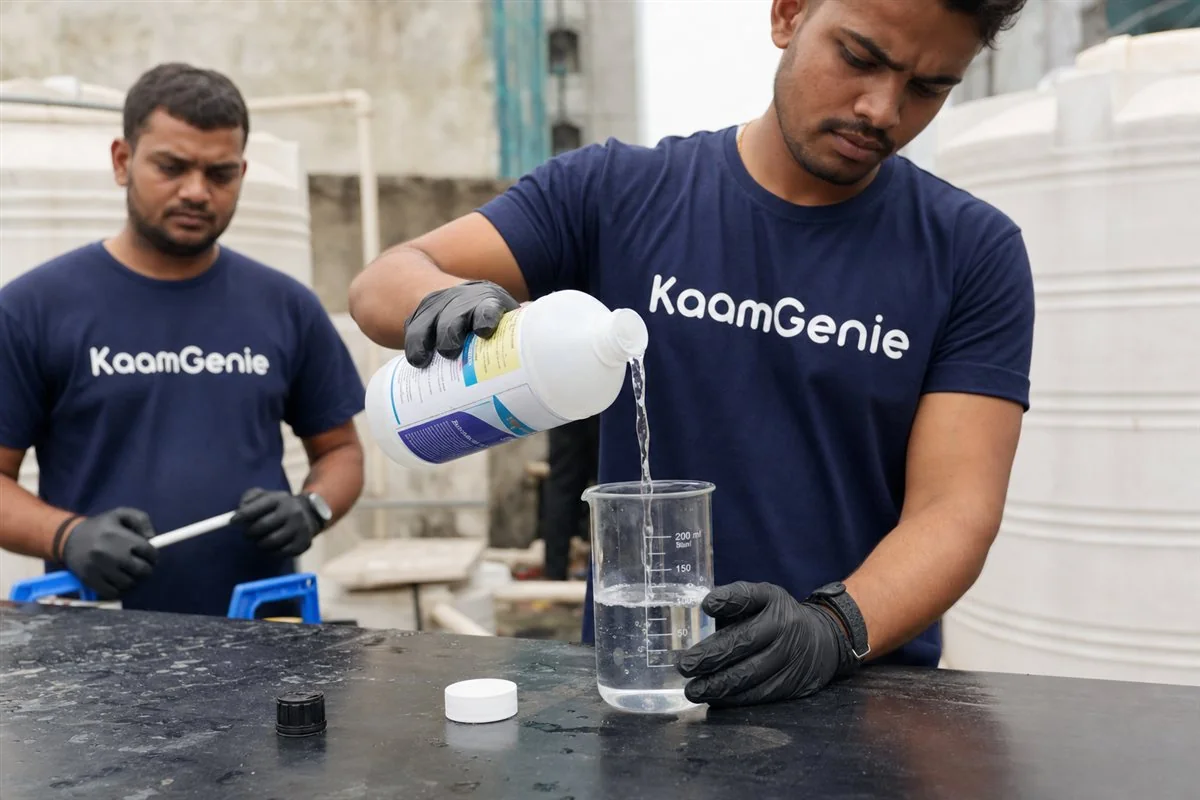
The chemical that actually disinfects your tank is sodium hypochlorite — chlorine, in liquid form. If that word makes you uneasy, it shouldn’t: chlorine is the most widely used drinking-water disinfectant on earth. The municipal water arriving in your building already carries a small chlorine residual, deliberately, to keep it safe in the pipes. The World Health Organization and the Bureau of Indian Standards both treat chlorination as a standard, proven method.
The word that matters is food-grade. Food-grade sodium hypochlorite is certified for contact with potable water — no fragrances, no stabilizers, no heavy-metal contaminants. It is a completely different product from the industrial bleach or pool chlorine sold cheaply in hardware shops, which often carry additives that are fine for a swimming pool but have no place in water you cook with. We use the food-grade product at a controlled, low concentration consistent with potable-water disinfection — enough to kill bacteria, low enough that after rinsing only a tiny safe residual remains, the same way your tap water already does. We don’t publish a fixed recipe because the right amount depends on tank size, material and how soiled it is — that’s a judgement the crew makes on site, not a number off the internet.
The wash stage: a mild food-grade cleaning agent
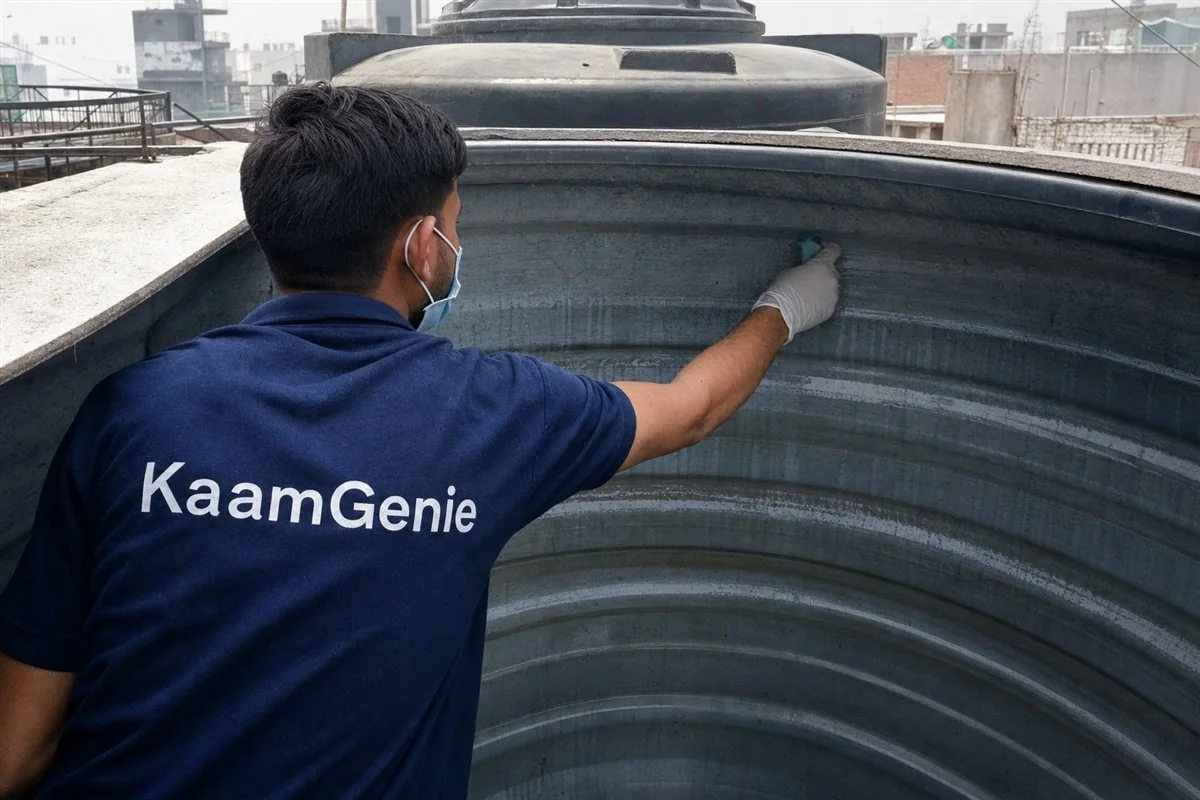
Before any disinfectant goes in, the tank has to be physically clean. Over months, tank walls develop a slimy bio-film — a thin organic layer that bacteria live inside — plus general grime and, in many Gurgaon homes, a stubborn mineral film from hard water. Chlorine cannot get through that film to the bacteria underneath. So the wash stage uses a mild food-grade cleaning agent together with manual scrubbing using food-grade nylon brushes (never metal, which scratches plastic and creates new hiding spots for bacteria).
This is the unglamorous, labour-heavy part — and the part corner-cutters skip, because it’s the work, not the bottle, that costs them time. A cleaning agent that lifts grime but rinses away cleanly, leaving no foam or fragrance behind, is what separates a food-safe wash from someone splashing dishwashing liquid into your tank. If you want to compare what an honest job should cost versus the suspiciously cheap quotes, our Gurgaon cost guide breaks it down.
Descaling: the Gurgaon hard-water problem
Here’s where Gurgaon differs from much of Delhi. Large parts of the city — New Gurgaon, Sohna Road, the Southern Peripheral Road belt, and countless independent builder floors — depend on hard borewell groundwater, often supplemented by tanker deliveries. Hard water is loaded with dissolved calcium and magnesium, and when it sits in a tank it leaves a chalky white or rusty-brown scale baked onto the walls and crusted around the inlet, outlet and fittings.
That scale is a problem for two reasons. First, it is rough and porous, so bacteria and bio-film shelter inside it where chlorine can’t reach. Second, it makes a tank look dirty again within weeks of a so-called cleaning if it was never removed. Disinfectant does nothing to scale. So in hard-water sectors we add a food-safe descaling agent — applied after scrubbing to dissolve the mineral crust — and only then disinfect the genuinely clean surface beneath. This is deliberately a food-safe descaler, not acid: acid would dissolve scale too, but it also pits RCC concrete and corrodes metal fittings, and you do not want acid residue near your drinking water. For a deeper look at this specific issue, see our guide to hard water tank cleaning in Gurgaon. We see exactly this on jobs across Sohna Road and the newer sectors every week.
What we deliberately do NOT use
Just as important as what goes in is what stays out. A potable water tank is not a bathroom floor, and the products meant for one have no place in the other. We never use:
- Strong acids (muriatic / hydrochloric acid) — cheap and aggressive on scale, but they corrode metal fittings, pit concrete reservoirs, and leave residue you would be drinking. The short-term sparkle isn’t worth the long-term damage.
- Household detergent / dishwashing liquid — foams heavily, clings to walls, and carries fragrances and additives that are not food-safe. Designed to be rinsed off plates, not left in a drinking water system.
- Industrial bleach & pool chlorine — not the same as food-grade chlorine. They often contain stabilizers and additives fine for a pool but unsafe for potable water.
- Fragranced or coloured cleaners — anything that perfumes or tints the water is masking a problem, not solving one.
If a cleaner can’t tell you exactly what they’re putting in your tank, or reaches for a bottle of hardware-shop bleach, that tells you everything about the job you’re going to get. The cheapest end of the Gurgaon market often skips the wash and descale entirely and just tips bleach into the water — which is why those tanks look no better a fortnight later.
Why food-grade safety and contact time decide the result
Two ideas do most of the heavy lifting in this whole subject: food-grade safety and contact time.
Food-grade means every product that touches the water is certified safe for potable systems — it is the line between disinfecting your water and contaminating it. FSSAI defines acceptable disinfection practice for water used by food businesses, and the same principle applies to a family kitchen: only food-safe chemistry near drinking water.
Contact time is the part almost nobody talks about and the part that actually makes disinfection work. Chlorine does not kill bacteria the instant it touches them — it needs time in contact with the surface to complete the job. A crew that sprays disinfectant and rinses it straight off has gone through the motions without doing the chemistry. We apply the disinfectant to every interior surface — walls, floor, lid underside, around the inlet and outlet — and let it dwell for the required period before the final rinse. On a large condominium reservoir feeding a tower, that dwell time and the volume of product both scale up, which is one reason society tank cleaning in Gurgaon is a bigger job than a single rooftop drum. The same care applies whether we’re working a builder floor in Sector 56 or a luxury condo in DLF Phase 5.
Where the chemistry sits in a real cleaning — rough share of effort
The disinfectant is the smallest part; the wash and descale that make it work are the most
Indicative only — the exact split varies by tank size, material and how much hard-water scale has built up. The point stands: the disinfectant works only because of the scrubbing and descaling that come before it.
Different tanks, same food-grade rule
Gurgaon’s tanks come in every shape: rooftop plastic and Sintex drums on builder floors, large RCC underground reservoirs (UGRs) feeding condominium towers, stainless and concrete tanks in corporate buildings around Cyber City and Udyog Vihar. The chemicals belong to the same food-grade family across all of them — what changes is the quantity, the scrubbing time and the contact time, scaled to the surface area and volume. Food-grade chlorine is safe on plastic, Sintex, RCC and stainless alike; the damage risk only appears when the wrong products (acids, abrasives, metal tools) are used on the wrong material. Matching agent and tool to the tank is part of the job, not an upsell. If your tank is a large underground reservoir, our underground sump cleaning guide covers the extra safety and process that come with confined spaces, and businesses can read more on commercial tank cleaning in Gurgaon.
Book a clean done with food-grade chemicals only
If you’ve read this far, you already know more about tank chemistry than most cleaners will admit to. The summary is simple: food-grade chlorine to disinfect, a food-safe cleaning agent and descaler to make that disinfection possible, proper contact time, and absolutely no acid or detergent. That’s the standard for every job we do, whether it’s a single home tank or a society reservoir. You can book through our water tank cleaning in Gurgaon page, or read about our wider NCR water tank cleaning services. Either way, you’ll get before/after photos and a written record of exactly what touched your water.
Not sure what your last cleaner used?
Book a proper clean and find out — food-grade chemicals, descaling for hard water, and a record of what went in. ₹699 onwards.
Frequently asked questions
What chemicals do you actually use to clean a water tank in Gurgaon?
The core disinfectant is food-grade sodium hypochlorite — the same chlorine compound used to treat municipal drinking water and accepted by FSSAI for potable water systems. For the wash stage we use a mild food-grade cleaning agent to lift bio-film, and where Gurgaon’s hard borewell water has left mineral scale, a food-safe descaling agent. We do not pour industrial bleach, acid, or household detergent into a tank that supplies your kitchen taps.
Why don’t you use acid or strong detergent inside the tank?
Strong acids (like muriatic/hydrochloric acid) and household detergents are made for floors and bathrooms, not drinking water. Acid can pit RCC concrete and corrode metal fittings, and any residue left behind ends up in water you drink. Detergent foams and clings to walls, and the fragrances and additives are not food-safe. Anything that needs heavy rinsing to be safe has no business in a potable water tank. We use food-grade products designed for contact with drinking water.
Is chlorine safe for a drinking water tank?
Yes, when it is food-grade and used correctly. Chlorine (as sodium hypochlorite) is the most widely used drinking-water disinfectant in the world — your municipal supply already contains a small chlorine residual. The key is using a food-grade product at a controlled, low concentration, giving it proper contact time, then rinsing so only a tiny safe residual remains. Industrial or pool chlorine is a different product with additives that are unsafe for drinking water.
How do you deal with the hard borewell water and scale common in Gurgaon?
Much of Gurgaon runs on hard borewell groundwater, so tanks build up chalky white or brown mineral scale on the walls and around fittings. Disinfectant alone does not remove scale — bacteria hide underneath it. We first physically scrub and, where needed, apply a food-safe descaling agent to dissolve the mineral crust, then disinfect the clean surface. Skipping descaling is why a “cleaned” tank in a hard-water sector can look dirty again within weeks.
What is contact time and why does it matter?
Contact time is the period the disinfectant is left in touch with the tank surface before rinsing. Chlorine does not kill bacteria instantly — it needs time to work. If a cleaner sprays disinfectant and immediately rinses it off, the chemistry never completes and bacteria survive. We apply the disinfectant to every interior surface and let it dwell for the required period before the final rinse. Contact time is the single most skipped step by corner-cutters.
Will there be a chlorine smell, and when can I drink the water?
A faint chlorine smell right after refill is normal and harmless — it is the same smell municipal water can have. For washing and bathing the water is fine to use immediately. For drinking, give it a few hours and run it through your RO/UV purifier as usual; the residual dissipates quickly. A strong, lingering chemical smell is a sign the wrong product was used or the rinse was rushed — that should not happen with food-grade chemicals.
Are the chemicals safe for plastic (Sintex) and RCC tanks?
Yes. Food-grade sodium hypochlorite at cleaning concentration is safe on plastic, Sintex, RCC concrete and stainless tanks alike. The damage risk comes from the wrong chemicals — acids attack concrete and metal, and abrasive or metal tools scratch plastic and create hiding spots for bacteria. We match the cleaning agent and tools to your tank material, which matters across Gurgaon’s mix of rooftop plastic drums, builder-floor tanks and large RCC underground reservoirs.
Do you use the same chemicals for a society reservoir as for a home tank?
The chemistry is the same family — food-grade disinfectant and food-safe cleaning and descaling agents — but the quantities and process scale up. A large underground reservoir (UGR) feeding a condominium tower holds far more water and surface area than a single home tank, so it needs more product, longer scrubbing and longer contact time. What never changes is that everything used is food-grade and safe for potable water, whether it’s a 1,000-litre rooftop tank or a society’s main reservoir.
Can I just pour chlorine or bleach in myself instead of hiring a service?
Pouring bleach into a dirty tank does very little. Disinfectant cannot penetrate sludge, bio-film and mineral scale — it only works on a physically clean surface. DIY also risks using the wrong product (kitchen bleach has fragrances and additives), the wrong concentration, and no contact time or rinse. Confined rooftop tanks and underground sumps also carry real safety risks. The chemicals are only one part; the scrubbing, descaling, contact time and safe rinsing are what make them effective.
Do you give any proof of which chemicals were used?
Yes. Every job ends with before/after photos and a cleaning record that notes the tank type and capacity, the chemicals used, the crew, and the date of service. For AOA/RWA societies and commercial premises in Gurgaon this record is useful proof of a maintenance schedule, and for food businesses it supports FSSAI hygiene compliance. If you ever want to know exactly what touched your water, it is written down.
Sources & references
- Bureau of Indian Standards (BIS) — IS 10500:2012 is the canonical Indian Standard for drinking water specification, defining acceptable limits for physical, chemical, and biological parameters.
- WHO Guidelines for Drinking-water Quality, 4th edition — the global reference for water quality standards, including guidance on storage and disinfection.
- Food Safety and Standards Authority of India (FSSAI) — defines water quality requirements for food businesses, including hygiene standards for stored water and acceptable disinfection chemicals.
- WHO Fact Sheet on Drinking Water — overview of safe drinking water requirements and contamination risks.
- CPHEEO — Manual on Water Supply and Treatment — the Government of India’s engineering manual covering tank design, cleaning protocols, and disinfection practices.
Last verified: 30 June 2026. If you find any of these links broken, please let us know.