
The short version for committee members
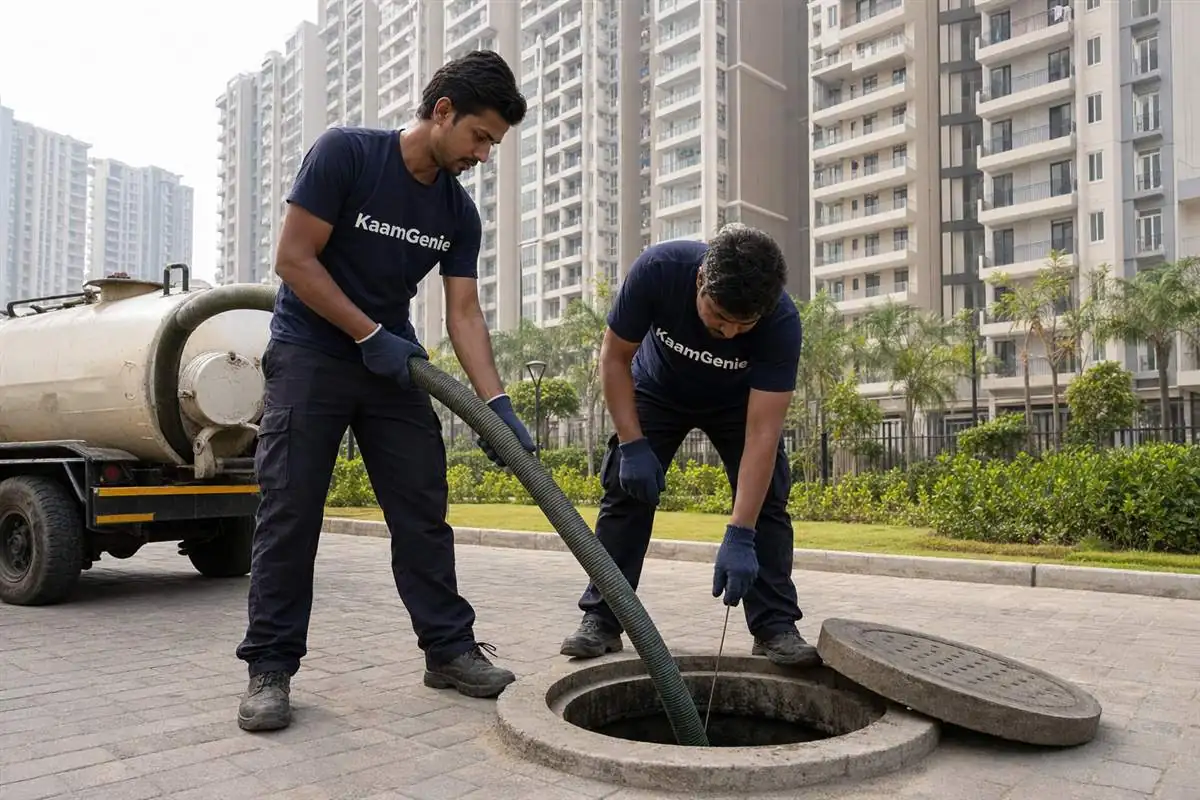
- Greater Noida West is high-rise group housing. Big tower clusters, one shared underground reservoir per society feeding every tower — one dirty reservoir means dirty water for hundreds of flats.
- New towers carry construction debris. Cement slurry, sand, grit and pipe-flushing residue sit in the reservoir and rooftop tanks at handover.
- Hard groundwater scales tanks fast — the Noida Extension belt runs largely on borewell water, so calcium and iron build up within months.
- That means quarterly cleaning, not the once-a-year clean that might pass on soft municipal water.
- Staged tower-by-tower so no block ever loses water; the underground reservoir is cleaned compartment-by-compartment.
- The handover gap is the killer: when the builder hands over to the AOA, nobody owns the cleaning contract and tanks sit uncleaned for months. Commission a clean at handover.
- Per-flat cost is tiny — shared across hundreds of flats, it’s a few rupees per month.
If your tower handed over in the last couple of years and the reservoir hasn’t had a real food-grade clean, you’re probably drinking over build residue right now.
Why Greater Noida West is a special case
Most of Greater Noida West — the belt residents still call Noida Extension — is not low-rise. It is overwhelmingly large group-housing clusters: tower after tower, handed over in waves over the last several years, with thousands of families packed into each society. Almost none of it is on the soft, treated municipal supply you might find in older parts of the city. The Noida Extension belt runs largely on hard borewell groundwater, high in calcium and iron.
Put those two facts together and you get a tank problem that is genuinely specific to this area. First, because the towers are new, their tanks were never properly commissioned for drinking water — they carry construction debris from the build. Second, because the water is hard, even a freshly cleaned tank starts scaling within months. A once-a-year clean that might just about pass in a soft-water locality is nowhere near enough here. This is why society and RWA water tank cleaning across the Noida Extension belt is its own discipline, and why we cover it as part of our wider water tank cleaning in Noida service. The resident-level companion to this guide is our society & high-rise tank cleaning guide for Noida.
The UGR-plus-tower setup in a Noida Extension society
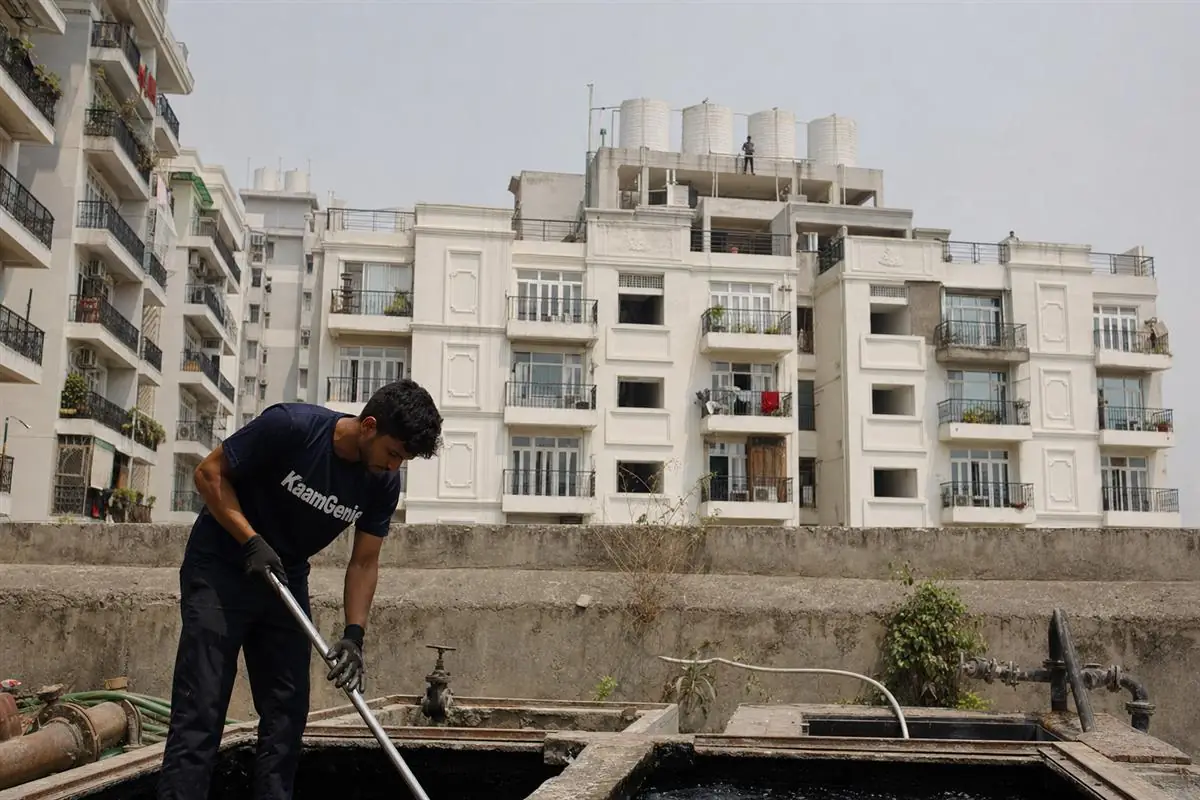
Almost every high-rise society in Greater Noida West stores water in two stages, and a real clean has to cover both:
- The underground reservoir (UGR). A large below-ground tank, usually split into compartments — commonly a domestic/drinking side and a flushing or fire-line side. Incoming borewell or supply water lands here first. It is the single most important tank in the society because everything downstream draws from it.
- The pump room. Pumps lift water from the UGR up the riser to each tower.
- The tower rooftop overhead tanks. Every tower has its own rooftop tanks, where water sits before gravity-feeding down to the flats.
So the water in your 14th-floor kitchen tap passed through two shared tanks before it reached you — the common UGR and your tower’s rooftop tank. If construction sludge, iron sediment or calcium scale sits in that single underground reservoir, it gets pumped into every tower and every flat above it. One neglected reservoir is not one family’s problem; it is the drinking water of an entire group-housing cluster. The compartment split in the UGR is actually a gift for cleaning — one half can feed the society while the other is drained and cleaned. Most cheap operators ignore the UGR entirely and only do the easy rooftop tanks, which is exactly backwards, because the source tank is the one that contaminates everything else. Our underground sump & reservoir cleaning service is built specifically for that below-ground work.
Problem one: construction debris in newly handed-over towers
The most common thing we find in a brand-new Greater Noida West tower is not contamination from neglect — it is leftover from the build itself. During construction and commissioning, the plumbing risers are flushed, and that flushing carries cement slurry, fine sand and grit, brick dust and pipe residue straight into the underground reservoir and the rooftop overhead tanks. It settles as a layer of sludge on the tank floors.
The builder’s housekeeping team nominally “maintains” the tanks during this period, but they almost never do a proper food-grade clean — a quick rinse is the most you can expect. So when the first residents move in, they are drawing drinking water straight over a bed of construction debris. This is why a fresh AOA in the Noida Extension belt should treat the first clean at handover as non-negotiable: a full UGR-plus-tower clean to clear the build residue, documented with per-tank certificates as the society’s baseline, before the quarterly contract even begins. If your society is in one of the fast-occupying pockets like Greater Noida West (Noida Extension) or the newer high-rise belts at Sector 150, this is the single most valuable clean you will ever commission. Our companion guide on water tank cleaning for a new flat in Noida covers the resident-level version of the same problem.
| Contract clause | What it should say | Why it matters to the society |
|---|---|---|
| Full tank inventory | Every UGR compartment and every tower overhead tank listed by ID and capacity | Proves the whole system is covered, not just easy tanks |
| Handover baseline clean | A documented first clean to clear construction debris before the contract starts | Removes cement slurry and grit from new towers |
| Defined scope per tank | 8-step process: inspect, drain, de-sludge, scrub, jet-wash, vacuum, disinfect, certify | Stops “rinse-and-run” on the UGR |
| Food-grade disinfectant | FSSAI-acceptable sodium hypochlorite named by spec, not “bleach” | Safe for drinking water shared by all flats |
| Per-tank certificate | Separate certificate + before/after photos for every tank | Audit trail residents and the committee can verify |
| Staging plan | Tower-by-tower sequence; UGR compartment-by-compartment | No block loses water supply |
| Quarterly schedule | Four fixed dates a year with advance resident notice | Keeps up with fast scaling on hard groundwater |
| Fixed per-tank price | Per-tank / per-tower pricing totalled, no surprise add-ons | Transparent for the maintenance budget |
Get a society UGR + tower quote
We’ll survey your tank inventory, clear any handover debris, stage the work tower-by-tower, and quote per tank with per-tank certificates. Residential single-tank cleaning ₹699 onwards; society/UGR custom-quoted.
Problem two: hard groundwater means quarterly, not annual
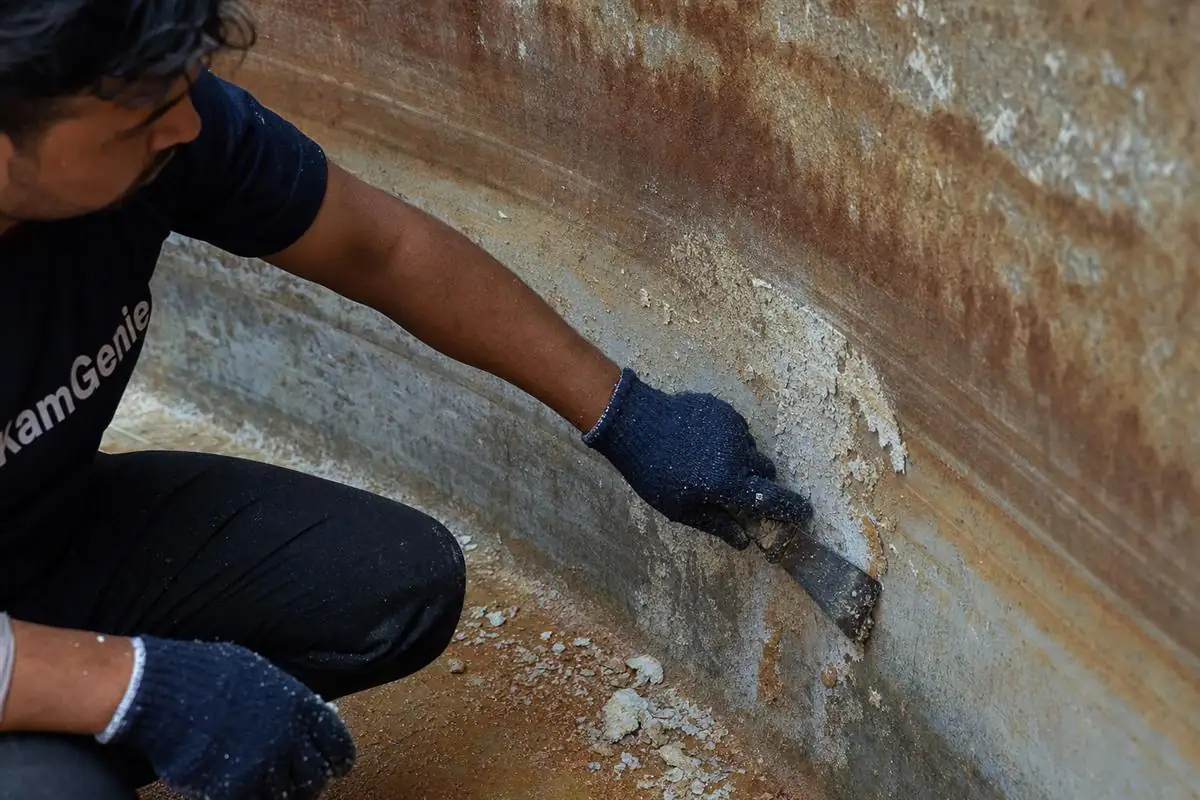
The second problem is the water itself. Much of Greater Noida West draws on borewell and groundwater that is genuinely hard — high in calcium and iron. That mineral load drops out as chalky scale and rust-coloured sediment on tank walls and floors far faster than it would on soft, treated municipal water. Even a tank cleaned to a perfect finish starts re-scaling within a few months on this supply.
BIS IS 10500 and CPHEEO guidance support cleaning stored drinking-water tanks at least twice a year as a floor. But “at least twice a year” is a minimum written for benign water. On the hard groundwater across the Noida Extension belt, a six-monthly clean means the UGR walls are already re-scaling and the rooftop tanks accumulating sediment well before the next visit. The realistic standard here is quarterly — four cleans a year keeps the whole system genuinely clean rather than clean-on-paper. For a deeper look at how hard water behaves in storage and what it does to tank walls, see our dedicated hard water tank cleaning guide for Noida.
How a society clean is staged tower-by-tower
The single biggest worry a committee has is “will residents lose water?” With proper planning the honest answer is: barely, and only for the short refill window on the specific tower being serviced. Here is how the staging works for a typical Greater Noida West cluster:
- UGR first, compartment by compartment. We isolate one compartment, let the society draw from the other, then drain, de-sludge, scrub, jet-wash, vacuum and disinfect the isolated half. Then we swap and do the other compartment. The society never loses its source.
- Then towers in sequence. While Tower A’s rooftop tanks are being cleaned, the other towers keep drawing from their own full rooftop tanks. We refill Tower A, move to Tower B, and so on across the cluster.
- Refill windows are short and announced. Each tower’s overhead tanks are out of service only for the clean-plus-refill window. With advance notice posted in the lift lobby, residents store a little water for that window — or, on most towers, never notice because the tank is cleaned during low-usage hours.
A large group-housing society is typically completed across one or two days. No block loses water for more than its own short window, and the UGR is handled without interrupting supply at all. This is the difference between a planned society contract and a chaotic one-off where someone “turns off the water for the day.” We run this staging across Greater Noida West and the wider Expressway corridor, including established high-rise pockets at Sector 137.
Cost of a quarterly society clean, shared per flat
A full UGR + tower clean costs each flat very little once spread across a Greater Noida West society
Illustrative: a society clean is quoted per tank, then shared across all flats. Because a Greater Noida West cluster has hundreds of homes, each flat’s share of a full quarterly UGR-plus-tower clean is roughly the price of one bottled-water can a month. Actual figures depend on tank count, capacity and access — ask for a per-tank quote.
Why the per-flat cost is so small
Society work is never priced “per flat” up front — it’s priced per tank, then divided across the society. Each item in the inventory is quoted on two things: capacity (a 50,000-litre UGR compartment takes far longer to drain, de-sludge and disinfect than a tower’s 5,000-litre rooftop tank) and access difficulty (a below-ground UGR needs confined-space safety gear and a standby person; a rooftop tank needs harness work).
Add up every UGR compartment and every tower’s rooftop tanks and you have the society’s total per-clean cost. Divide it across the hundreds of flats in a Greater Noida West cluster, and again across a quarter, and each resident’s monthly share is roughly the cost of a single bottled-water can. Set against the alternative — iron-stained water and stomach complaints across hundreds of flats — it is one of the cheapest line items in the entire maintenance budget. For how a quote is actually built up, our water tank cleaning cost guide for Noida breaks down every driver.
The handover gap, and how a committee should close it
The most common failure we see in new Greater Noida West societies isn’t a bad clean — it’s no clean, for months, because of the builder-to-AOA handover gap. During construction the builder’s facility team nominally maintains the tanks. At handover, responsibility for common-area maintenance passes to the residents’ AOA or RWA. But in that messy transition — the builder’s team winding down, the committee still forming — nobody clearly owns the cleaning contract. So the tanks, still carrying construction debris, sit uncleaned while residents move in and start drinking from them.
If you’re on the committee inheriting (or fixing) the arrangement, here’s the practical sequence:
- Commission a handover baseline clean. Get a full UGR-plus-tower clean done to clear the construction residue, documented with per-tank certificates as the society’s baseline record.
- Make the inventory. Walk the property and list every tank — UGR compartments and each tower’s rooftop tanks — with capacities and access notes. This is the spine of any honest quote.
- Ask for a per-tank quote, not a lump sum. A lump sum hides whether the UGR is actually included. Per-tank pricing forces the whole inventory into the contract.
- Demand per-tank certificates and photos. One certificate per tank, so the committee can prove to residents that every tank — not just the convenient ones — was done.
- Lock the staging plan in writing. Tower-by-tower sequence and UGR compartment-by-compartment, so no block loses supply.
- Fix a quarterly calendar with notice. Put four dates a year on the society calendar with a standard resident-notice template for the lift lobbies, then keep every quarter’s certificates on file.
The dedicated society / RWA water tank cleaning service page lays out exactly what we deliver for committees, and we serve the whole belt — from the Noida Extension high-rises through to the established sectors and across into our Delhi water tank cleaning coverage for groups that own property on both sides.
Book a society clean in Greater Noida West
Whether your AOA is commissioning the first clean after a builder handover, clearing long-neglected construction debris, or simply moving to a proper quarterly schedule on hard groundwater, we cover the high-rise clusters right across Greater Noida West and the Noida Extension belt — UGR plus every tower, staged so no block loses water, with a per-tank certificate for each one. Start at our water tank cleaning in Noida hub for area coverage and booking, or call us to arrange a free tank-inventory survey for your committee.
To book, call +91 95603 66362 or use the booking form on this site — we’ll confirm shortly. Residential single-tank cleaning is ₹699 onwards; society and UGR work is custom-quoted after a free survey.
Setting up your society contract?
We’ll do a free tank-inventory survey, give you a per-tank quote and a written staging plan. Per-tank certificates every quarter. Society/UGR custom-quoted; residential ₹699 onwards.
Frequently asked questions
Why is Greater Noida West (Noida Extension) different for water tank cleaning?
Greater Noida West is almost entirely high-rise group housing — large clusters of towers handed over in recent years, drawing on hard borewell groundwater. That combination creates two specific problems most other areas don’t face at the same scale: newly handed-over towers carry construction debris in their tanks, and the hard groundwater scales those tanks fast. So societies here need a thorough first clean at handover, then a quarterly schedule, not the once-a-year clean that might just about pass elsewhere.
What construction debris is left in new tower tanks at handover?
New towers in Greater Noida West routinely carry cement slurry, fine sand and grit, brick dust, and pipe-flushing residue left behind from the build. When the plumbing is commissioned, the lines are flushed and that debris settles in the underground reservoir and the rooftop overhead tanks. The builder’s housekeeping rarely does a proper food-grade clean, so it sits there until the new AOA commissions a real clean. Drinking water in a brand-new flat can therefore be drawn straight over a layer of construction sludge.
How often should a Greater Noida West society clean its water tanks?
Quarterly. Greater Noida West largely runs on hard borewell groundwater — high in calcium and iron — which leaves scale and rust-coloured sediment on tank walls far faster than soft municipal water. BIS IS 10500 and CPHEEO guidance set a floor of at least twice a year for stored drinking-water tanks, but that floor is for benign water. On the hard groundwater across the Noida Extension belt, a six-monthly clean means tanks are already re-scaling before the next visit, so quarterly is the realistic default.
How is a Greater Noida West society cleaned without any tower losing water?
By staging the work tower-by-tower. The shared underground reservoir is usually split into compartments, so one compartment feeds the society while the other is drained and cleaned, then they swap — the source never runs dry. Then each tower’s rooftop tanks are cleaned in sequence while the other towers keep drawing from their own full tanks. With advance notice posted in each block, a typical group-housing cluster is completed across one or two days and no block loses water for more than its own short refill window.
Why does the builder-to-AOA handover leave tanks uncleaned for months?
At handover, responsibility for common-area maintenance passes from the builder’s facility team to the residents’ AOA or RWA. In that transition nobody clearly owns the tank-cleaning contract — the builder’s team is winding down and the committee is still forming. So the tanks, still carrying construction debris, sit uncleaned while residents move in and start drinking from them. The fix is for the new committee to deliberately commission a full underground-reservoir-plus-tower clean at handover and document it as the society’s baseline.
What should a Greater Noida West AOA/RWA cleaning contract include?
A full tank inventory listing every underground reservoir compartment and every tower’s overhead tank by ID and capacity, a defined 8-step scope per tank, food-grade disinfectant specified by name, a separate per-tank certificate with before/after photos, the tower-by-tower staging plan so no block loses water, a fixed quarterly schedule with advance resident notice, confined-space safety provisions for the underground reservoir, and a fixed per-tank price with no surprise add-ons.
How much does it cost per flat in a Greater Noida West society?
Society work is quoted per tank — each underground reservoir compartment and each tower’s overhead tank priced by capacity and access, then totalled. Because a Greater Noida West cluster has hundreds of flats sharing that cost, each flat’s share of a full quarterly clean works out to roughly the price of one bottled-water can a month. Residential single-tank cleaning starts at ₹699 onwards; society and underground-reservoir work is custom-quoted after a free tank-inventory survey.
Do you give a separate certificate for each tank in a Noida Extension society?
Yes. Each underground reservoir compartment and each tower’s overhead tank gets its own certificate listing the tank ID, capacity, date, crew, chemicals used and before/after photos. For a Greater Noida West committee this matters because it is the only honest proof that the whole inventory — not just the easy rooftop tanks — was actually cleaned. The committee keeps the per-tank records to show residents, satisfy audits and protect itself at AGMs and if a water-quality complaint ever arises.
Sources & references
- Bureau of Indian Standards (BIS) — IS 10500:2012 is the canonical Indian Standard for drinking water specification, defining acceptable limits for physical, chemical, and biological parameters including calcium and iron.
- WHO Guidelines for Drinking-water Quality, 4th edition — the global reference for water quality standards, including guidance on storage and disinfection.
- WHO Fact Sheet on Drinking Water — overview of safe drinking water requirements and contamination risks.
- CPHEEO — Manual on Water Supply and Treatment — the Government of India’s engineering manual covering tank design, cleaning protocols, and disinfection practices.
Last verified: 26 June 2026. If you find any of these links broken, please let us know.