
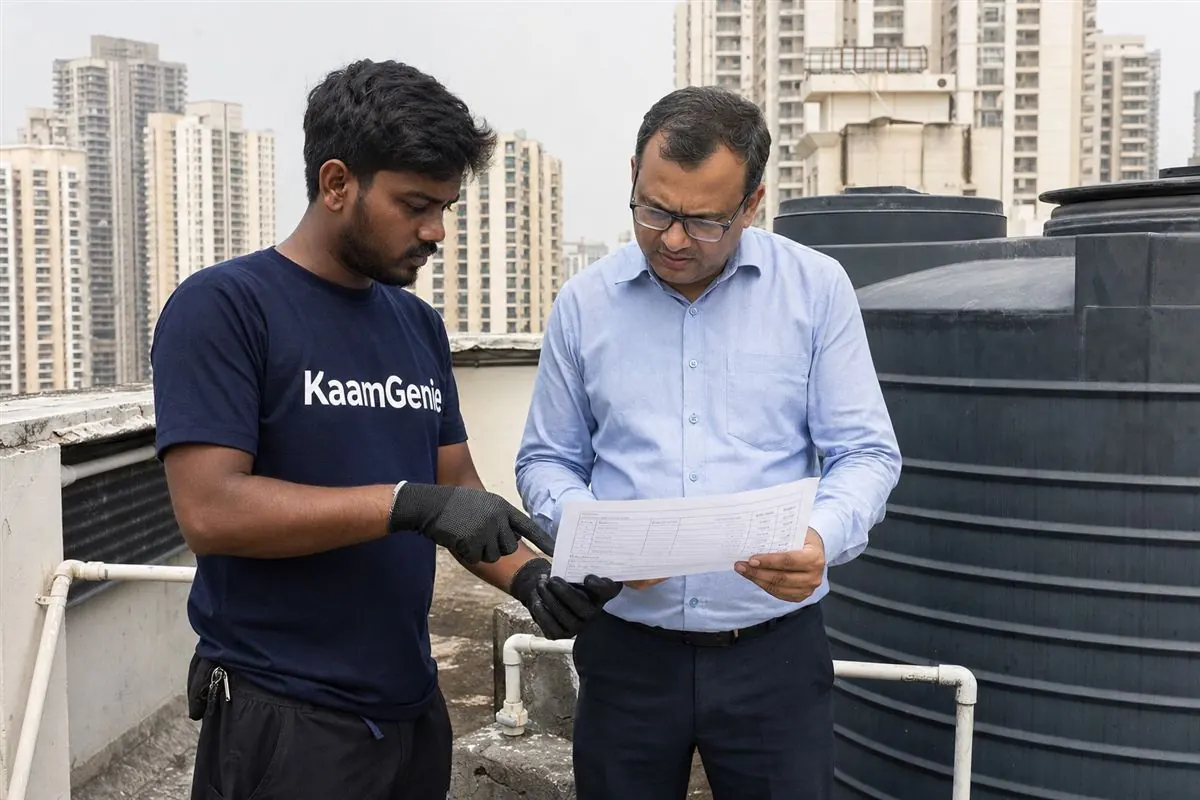
The short answer on Noida pricing
- Individual flat / loft tank (overhead, up to 1,000L): ₹699 onwards — a real, documented job.
- Society work is quoted per tank, not as one number: underground reservoir (UGR) + (number of tower tanks × per-tank rate).
- Underground sumps cost more than the same-size rooftop tank — confined-space work, more draining, more sludge.
- A combined sump + overhead visit is cheaper than booking the two separately.
- What pushes the price up in Noida: tank size, hard-water calcium scale needing descaling, tower height & access, number of tanks, and far-Expressway / Greater Noida West distance.
- Annual AOA contracts lock the rate and work out cheaper per visit than ad-hoc calls.
For the generic, tank-by-tank price breakdown that applies across NCR, see our Delhi water tank cleaning cost guide. This page is the Noida-specific version — high-rises, towers, and reservoirs.
| Tank / job type | Typical size | Indicative price | Notes |
|---|---|---|---|
| Individual flat / loft overhead tank | Up to 1,000L | ₹699 onwards | Standard residential rate |
| Larger individual overhead tank | 1,000–2,000L | ₹999–₹1,499 | Scales with litres |
| Residential underground sump | Up to 5,000L | ₹1,800–₹3,500 | Confined-space job |
| Combined sump + overhead | Home with both | Bundled (less than sum) | One visit, shared travel |
| Society rooftop tower tank | 2,000–5,000L each | Per-tank rate (drops with volume) | Priced × number of tanks |
| Society underground reservoir (UGR) | 10,000L+ | Site-quoted | Largest single item |
| Annual AOA contract | Whole society, 2×/yr | Per-year, locked rate | Cheaper per visit |
Get a real Noida quote — itemised, no surprises
Flat tank, sump, or a whole society of towers plus the UGR. We quote the full price before we start. Individual tanks ₹699 onwards.
Individual flat tank in a Noida society — ₹699 onwards
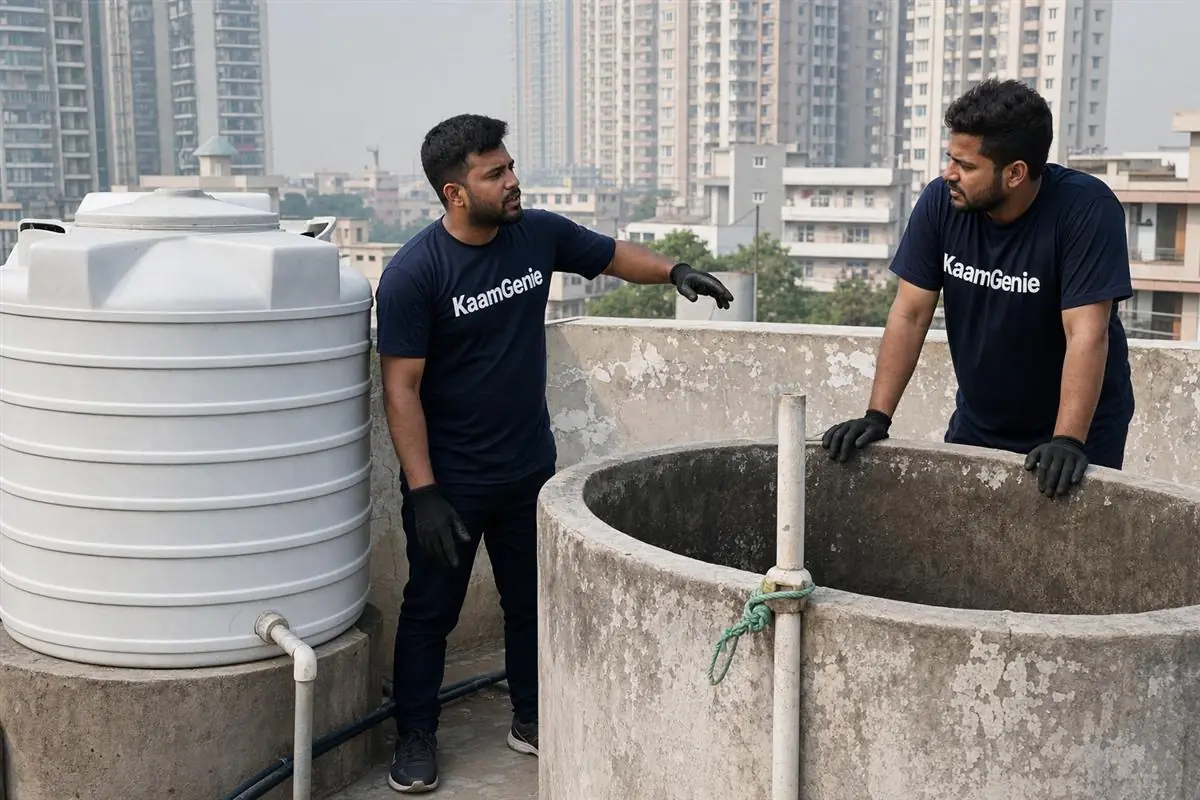
Plenty of Noida flats have their own dedicated overhead or loft tank — a Sintex or plastic tank, usually 500 to 1,000 litres, that feeds just your apartment. This is the simplest, cheapest job, and it starts at ₹699 for a standard tank up to 1,000 litres. That price buys the full job: drain, sludge removal, manual scrubbing, jet wash, food-grade disinfection, and before/after photos. It is not a rinse.
The reason the ₹699 figure is real and not bait is that an individual flat tank is small and accessible. The crew can finish a proper 75–90 minute cleaning in one visit. If your tank is bigger — a 1,500 or 2,000L unit serving a larger flat or a duplex — the price scales up with the litres, because there’s simply more wall, floor, and sludge to deal with. Booking your own flat tank is the same process as our wider water tank cleaning in Noida service, just at the smallest scale.
Society pricing — per tank, per tower, plus the reservoir
This is where most people get confused, and where padded quotes hide. A Noida high-rise society does not have “a tank.” It typically has:
- One large underground reservoir (UGR) at ground level, where the municipal or borewell supply collects.
- Pumps that lift water up to rooftop tower tanks — often one tank (or a cluster) per tower or per wing.
- Sometimes intermediate / mid-level tanks in very tall towers.
Every one of those is a separate cleaning. So a fair society quote is never a single magic number — it reads as UGR + (number of rooftop tanks × per-tank rate). The per-tank rate usually drops with volume: cleaning ten tower tanks in one society visit costs less per tank than cleaning one in isolation, because the crew and equipment are already on site. The UGR is the biggest single line because it’s a confined-space job with the most sludge and the hardest access.
If you manage a society in a sector like Sector 137 or out in Sector 150, ask us to walk the towers once and itemise: tank count, sizes, UGR capacity. You get a line-by-line quote you can take to the AOA, not a lump sum. Our siblings on society tank cleaning in Noida and the full Noida cleaning guide go deeper on how a society job is run end to end.
Underground reservoir & combined sump + overhead
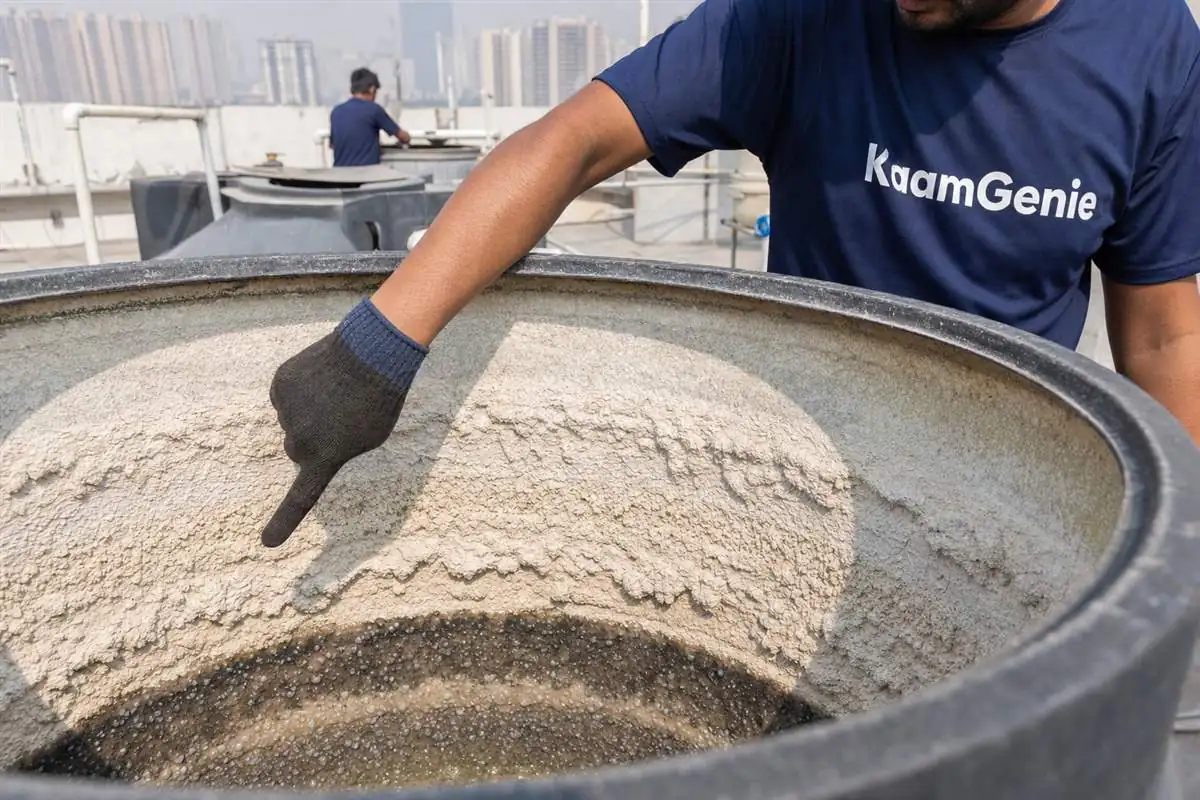
An underground reservoir or residential sump always costs more than a rooftop tank of the same capacity. The work is genuinely harder: it’s a confined space that needs safety gear and ventilation, there’s far more standing water to pump out, and the sediment that settles at ground level is heavier — sand and grit washed in with the supply, plus construction debris in newer Greater Noida West towers where the building is only a few years old.
If your home has both a ground sump and a rooftop tank — common in independent houses and ground-floor flats across Noida — book them together. A combined sump + overhead visit is cheaper than two separate trips because the crew, the pump, the jet wash, and the travel are all shared across one booking. The bundled price is always less than the two jobs added up on their own.
What actually drives the Noida price up
Five factors move the charge, and a fair cleaner will point to whichever ones apply to your building rather than quoting a vague high number:
| Factor | Why it adds cost | Where it bites in Noida |
|---|---|---|
| Tank size (litres) | More wall, floor, sludge & chemical; longer scrub time | Large tower & reservoir tanks |
| Hard-water calcium scale | Needs a descaling pass with acid-based food-grade cleaner | Borewell-fed towers, GN-West |
| Tower height & access | Time to reach the roof, rig equipment, manage water | 20th–30th-floor high-rises |
| Number of tanks | Each tank is a separate cleaning (rate drops with volume) | Multi-tower societies / AOAs |
| Distance / location | Travel time to far-flung sites adds to the job | Far-Expressway, Noida Extension |
The hard-water point is the one most specific to Noida. A lot of the city and almost all of Noida Extension (Greater Noida West) runs partly on borewell groundwater, which is high in calcium and magnesium. That mineral load bakes a chalky white scale onto tank walls and around fittings. Light scale is part of a normal clean; a heavy crust needs a descaling pass — extra scrubbing time and a food-grade acid-based cleaner — which carries a modest, clearly-stated add-on. We show you the scale in the before-photos so the charge is never a mystery.
Where the rupees go — indicative cost share, society multi-tank job
The underground reservoir is the single biggest line; tower tanks scale with how many there are
Illustrative split for a typical multi-tower Noida society with one UGR — exact shares vary with tank count, scale severity, and tower height. Your itemised quote will show the real numbers.
Annual contracts & how to read a fair society quote
For a society or AOA cleaning every tank twice a year — the schedule we recommend for high-rises on borewell supply — an annual contract is cheaper per visit than booking ad-hoc, and it locks the rate so it doesn’t drift with each call. You also get a fixed schedule and a documented record for the AOA file, which matters when a resident asks when the tanks were last done. The structure is simple: a per-year price covering a set number of cleanings across all the tower tanks and the UGR. Our RWA annual contract guide and AMC plans explainer lay out the contract mechanics in full.
When a quote lands, read it like this:
- Is it itemised? Number of rooftop tanks, their sizes, the UGR capacity, the per-tank rate. A fair quote adds up tank-by-tank.
- What’s included per tank? Drain, sludge removal, manual scrubbing, jet wash, food-grade disinfection, before/after photos, certificate. If those aren’t listed, ask.
- Is there a single round number with no breakdown? That’s a red flag — you can’t tell what you’re paying for.
- Is it suspiciously cheap? A real multi-tank society clean plus a UGR is hours of labour. A price that only works as a rinse isn’t a saving — in Noida’s scale-prone towers the buildup is back within weeks.
For the underlying tank-by-tank cost logic that holds across NCR — overhead vs sump, plastic vs concrete, how litres map to price — our Delhi cost breakdown is the companion read. This page just localises it to Noida’s high-rise reality.
Want your society itemised properly?
We’ll walk the towers, count and size every tank plus the UGR, and hand the AOA a line-by-line quote. Individual flats ₹699 onwards.
Book water tank cleaning in Noida
Whether it’s your own ₹699 flat tank or a whole society of towers plus the reservoir, we quote the full price up front and back every job with before/after photos and a certificate. See the full service, sectors covered, and how we work on our water tank cleaning in Noida page — including dedicated coverage in Sector 137, Sector 150, and across Noida Extension.
To book, call +91 95603 66362 or use the booking form on this site — we’ll confirm a fixed, itemised price shortly.
Frequently asked questions
How much does water tank cleaning cost in Noida in 2026?
For an individual flat or loft tank in a Noida society, cleaning starts at ₹699 for a standard overhead tank up to 1,000 litres. Larger individual tanks, underground sumps, and society reservoirs are priced on size and access — a society job is usually quoted per tank plus the underground reservoir, not as one flat number. The honest answer is that the ₹699 covers a real flat-level job; society and UGR work is custom because tank counts and sizes vary tower to tower.
Why is a society quote higher per tank than a single flat?
It usually isn’t, per tank — the total is higher because there are more tanks. A society has one large underground reservoir (UGR) feeding multiple rooftop tower tanks, sometimes one tank per tower or per wing. Each of those is a separate cleaning. The per-tank rate often drops with volume, but the underground reservoir is a bigger, confined-space job priced separately. Always read a society quote as UGR + (number of tower tanks × per-tank rate), not one lump figure.
What makes water tank cleaning more expensive in some Noida areas?
Five things drive the price up: tank size (litres), hard borewell water that leaves calcium scale needing extra descaling, tower height and rooftop access (30th-floor tanks take longer to reach and rig), the number of tanks in the building, and distance — far-Expressway sectors and Greater Noida West add travel. A small ground-floor plastic tank on soft supply is the cheapest; a scaled 5,000L rooftop tank on the 25th floor of a Noida Extension tower is the most.
Is the ₹699 price the final amount or are there hidden charges?
₹699 onwards is the genuine starting price for a standard individual overhead tank, and we quote the full amount before we start — no surprise add-ons after the job. The only reason the figure moves is a clearly stated factor you can see: a bigger tank, an underground sump instead of overhead, heavy scale needing descaling, or multiple tanks. We tell you the number on the call or on arrival, not at the end.
Do you charge extra for descaling hard-water calcium deposits?
Light scale is part of a normal cleaning and isn’t charged extra. Heavy calcium scale — the chalky white crust you get on borewell-fed tanks in parts of Noida and Greater Noida West — needs a descaling pass with food-grade acid-based cleaner and extra scrubbing time, so it carries a modest add-on. We show you the scale on the before-photos so you can see why it’s there. It is never a default upsell.
How is an underground reservoir (UGR) priced versus a rooftop tank?
A UGR costs more than a same-size rooftop tank because it’s a confined-space job: more draining, harder access, safety gear, and usually more sludge at the bottom. Pricing is by capacity — a small residential sump is in the low thousands, a society UGR holding tens of thousands of litres is quoted after a site look. Rooftop tower tanks are quicker and cheaper per unit, which is why society quotes split the two.
Can I get a combined sump-plus-overhead cleaning at a better rate?
Yes — doing the underground sump and the overhead tank in the same visit is cheaper than two separate trips because the crew, equipment, and travel are shared. Most Noida homes with both a ground sump and a rooftop tank book them together. We quote a combined price that is lower than the two jobs added up individually.
Do annual contracts work out cheaper for societies?
For a society or AOA cleaning every tank twice a year, an annual contract is meaningfully cheaper per visit than ad-hoc bookings, and it locks the rate so it doesn’t move with each call. You also get a fixed schedule and documented records for the AOA. We structure annual contracts as a per-year price covering a set number of cleanings across all tanks and the UGR.
How do I know a society quote is fair and not padded?
Ask for the quote itemised: number of rooftop tanks, their sizes, the UGR capacity, the per-tank rate, and what’s included (scrubbing, jet wash, food-grade disinfection, before/after photos, certificate). A fair quote lines up tank-by-tank and the total is just the sum. Be wary of a single round number with no breakdown, or a price so low it can only mean a rinse — a real society cleaning of multiple tanks plus a UGR is real labour.
Is the cheapest Noida tank cleaning quote a good deal?
Usually not. A ₹200–300 quote for a tank that should take 75–90 minutes of real work means they’re skipping the sludge removal, manual scrubbing, jet wash, or food-grade disinfection — you’re paying for a rinse. The right comparison isn’t who’s cheapest, it’s who does the full job for a fair fixed price and shows you the before/after proof. In Noida’s hard-water towers, a half-done cleaning means the scale and bio-film are back within weeks.
Sources & references
- Bureau of Indian Standards (BIS) — IS 10500:2012 is the canonical Indian Standard for drinking water specification, defining acceptable limits for physical, chemical, and biological parameters.
- WHO Guidelines for Drinking-water Quality, 4th edition — the global reference for water quality standards, including guidance on storage and disinfection.
- Food Safety and Standards Authority of India (FSSAI) — defines water quality requirements for food businesses, including hygiene standards for stored water and acceptable disinfection chemicals.
- WHO Fact Sheet on Drinking Water — overview of safe drinking water requirements and contamination risks.
- CPHEEO — Manual on Water Supply and Treatment — the Government of India’s engineering manual covering tank design, cleaning protocols, and disinfection practices.
Last verified: 26 June 2026. If you find any of these links broken, please let us know.