
The short version
- New does not mean clean. Construction debris — cement slurry, sand, grout, packing, metal filings — settles in the UGR and tower tanks during the build.
- The first clean after possession is the most important one you’ll ever do. It removes a one-time debris load no later routine clean will face.
- Set cement is the enemy. The longer slurry sits, the harder it bonds to the tank floor — book early.
- Know who owns what: the shared UGR and rooftop tower tanks are the builder’s/AOA’s job; the loft or overhead tank inside your flat is yours.
- Your own flat tank: ₹699 onwards. Society UGR/tower cleaning is custom-quoted — and worth pushing the AOA for.
Move-in checklist at the bottom. Do your flat tank now; push for the society-wide clean in parallel.
Why a brand-new tower’s tanks are NOT clean
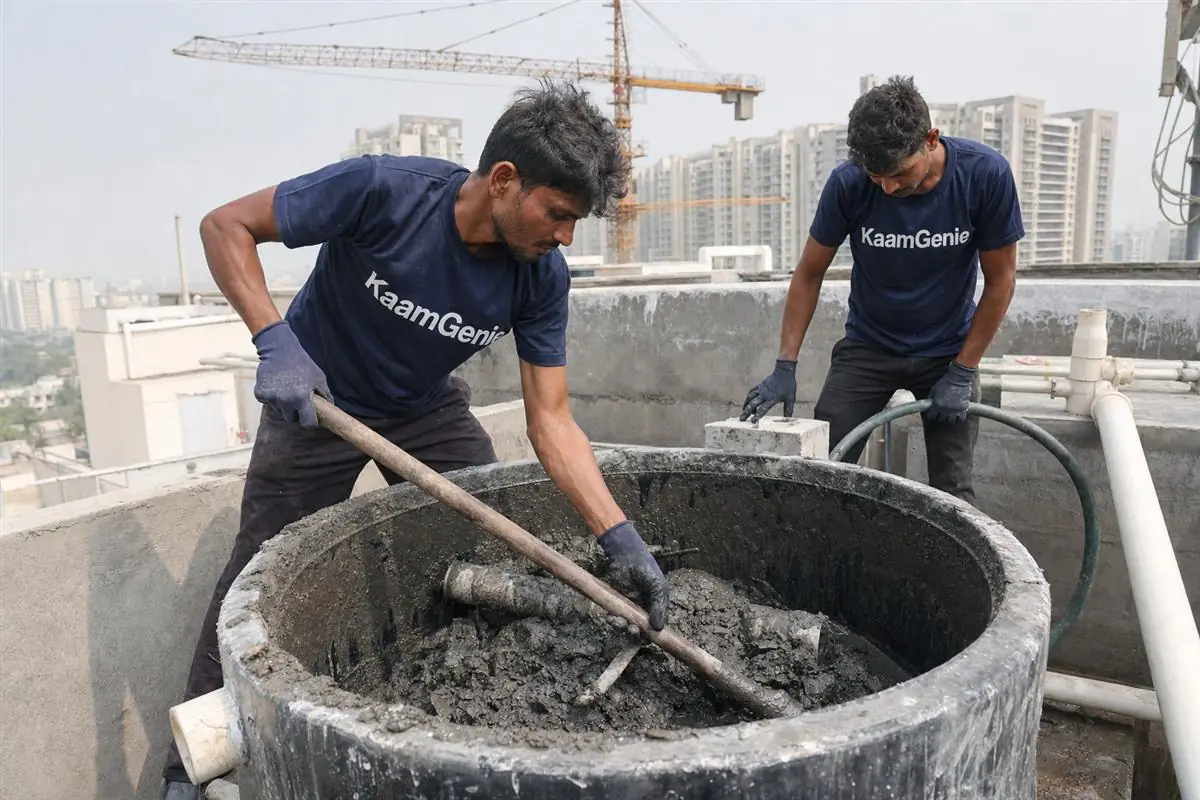
Picture how a Noida high-rise actually gets built. The underground reservoir (UGR) and the rooftop tower tanks are cast or installed early — often before the plastering, tiling, and finishing work on the floors above is anywhere near done. For months, those tanks sit open or under a loose, ill-fitting cover while masons, plumbers, and finishers work all around and above them. Everything that gets washed, cut, mixed, or dropped near an open tank ends up inside it.
So when you take possession of a shiny new flat in Sector 150 or Greater Noida West, the water reaching your taps has very likely passed through a UGR with a layer of construction silt on its floor and a tower tank that was never cleaned after the building was finished. The water looks fine in the glass — until you actually drain and open the tank.
This is the single most common surprise we see across new societies on the Noida and FNG corridor: residents assume a new building means clean water infrastructure, when in reality those tanks have simply never been cleaned. New isn’t clean. New is un-cleaned.
What construction debris is actually sitting in there
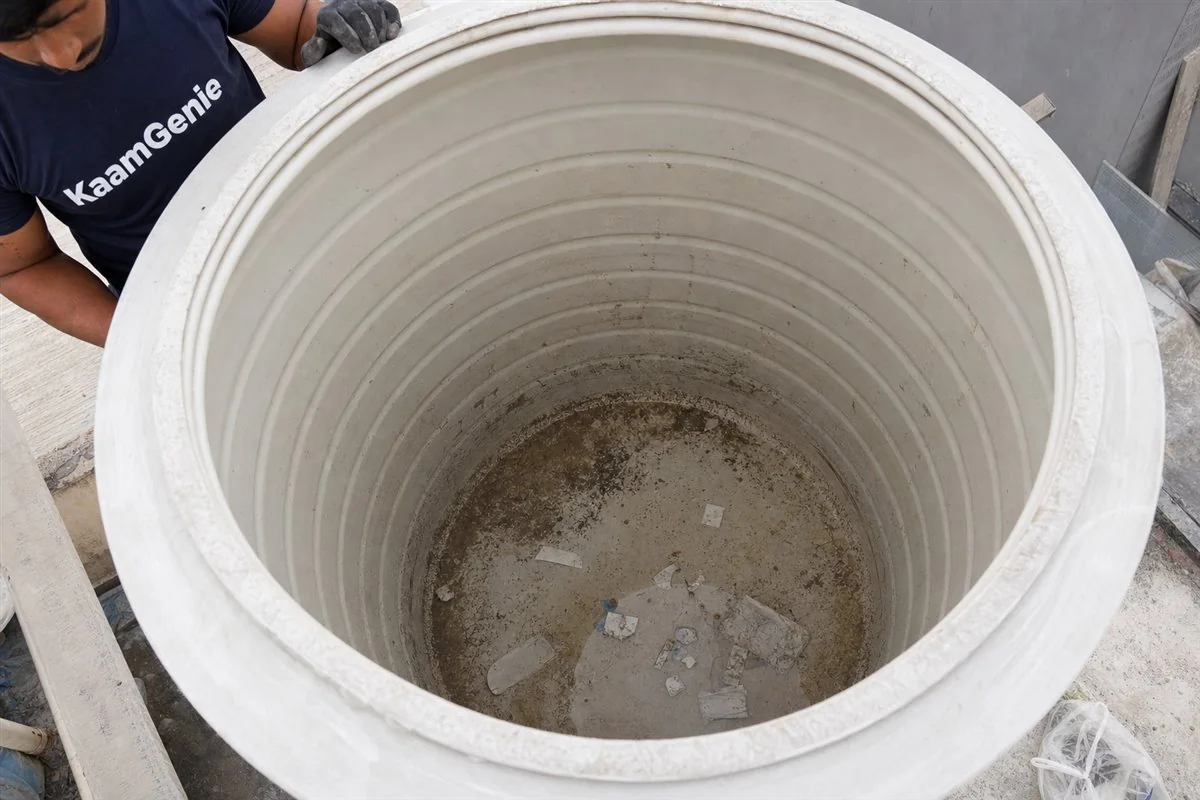
It’s worth being specific, because “debris” sounds vague and harmless. Here is what we routinely scoop out of a tank in a building that’s only months old — where it sits, and why it matters.
| Debris type | Where it sits | Why it matters |
|---|---|---|
| Cement slurry & grout washings | Sets hard on the tank floor and lower walls | Bonds permanently if left — raises water alkalinity, shelters bacteria in the rough surface |
| Fine construction sand & silt | Loose layer across the UGR and tower-tank floor | Recirculates into taps, clogs aerators, geyser inlets and RO pre-filters |
| Plaster & POP flakes | Floating and settled, especially near the lid | Cloud the water, break down into fine grit over time |
| Plastic packing & pipe offcuts | Wedged in corners and around inlet/outlet | Obstruct flow, snag other debris, harbour bio-film |
| Jute / thread & pipe sealant | Around threaded fittings and joints | Sheds fibres into water, rots and smells over months |
| Metal filings & shavings | Bottom of the tank from cutting/threading pipe | Rust into the water, leave orange staining, scratch surfaces |
| Pooled site water | Standing in the UGR before first commissioning | Was never meant for storage — stagnant, untreated, a bacterial head-start |
None of this is caught by a domestic filter or RO membrane — those are designed for dissolved impurities and fine sediment, not half-an-inch of set cement and metal shavings on a tank floor. The only thing that removes a construction debris load is a physical drain, scoop, scrub, and vacuum. That’s the first clean.
Just got possession? Book the first clean
Drain, scoop, scrub, jet, vacuum, food-grade disinfect, certificate — the proper first clean for your new flat’s tank. ₹699 onwards.
Why the first clean after possession matters most
Every later clean deals with the slow, predictable stuff — sediment from the supply, bio-film, calcium scale from borewell water in your sector. That’s why the standard cycle is roughly 6-monthly. The first clean is different in kind, not just degree: it’s the only one that removes a one-time construction load that will never be there again.
Two reasons it’s genuinely urgent:
- Cement sets. Wet slurry scoops out in minutes. The same slurry left for a few months bonds to the tank floor and lower walls, and removing it then needs aggressive scraping and longer jetting — or it simply stays put, roughening the surface so bio-film and scale cling harder forever after.
- The debris is feeding your taps right now. Until the tank is drained and scooped, fine sand and metal filings keep getting pulled into your supply — clogging aerators, fouling geyser inlets, and shortening the life of every RO pre-filter in the flat. You’re effectively running a sediment trap through your own appliances.
Get the first clean right and you’ve reset the tank to a true baseline. From there, the normal 6-monthly rhythm keeps it clean with far less effort. Skip it, and you’re fighting set cement and recirculating grit for years. If you want the full picture of what a thorough clean covers, our step-by-step water tank cleaning process walks through every stage.
What a proper first-clean involves
A first clean after possession follows the same disciplined sequence as any real clean, with extra attention paid to the heavy, set construction debris:
- Drain fully. The tank is emptied completely — you can’t reach a debris floor with water sitting on it.
- Scoop the debris. Set cement, sand, packing, jute, and metal filings are hand-scooped into sealed buckets and carried off-site — never flushed into the building’s plumbing, where they’d just resettle downstream.
- Manually scrub. Walls and floor are scrubbed with food-grade brushes (never metal, which scratches the surface) to lift the bonded cement film and any early bio-film.
- High-pressure jet wash. A 100–150 PSI jet clears corners, lid threads, and the area around the inlet/outlet — exactly where slurry and packing wedge themselves.
- Wet vacuum. The residual slurry-laden rinse water is vacuumed out so nothing resettles when the tank refills.
- Food-grade disinfect. Food-grade sodium hypochlorite (FSSAI-acceptable, the same family used in municipal treatment) is applied, given contact time, then rinsed — killing anything the stagnant site water left behind.
- Certificate & photos. You get before/after photos and a cleaning certificate. Keep it: it’s your move-in baseline record, and useful evidence if you later raise the UGR/tower tanks with the AOA.
This is the same standard we apply across water tank cleaning in Noida, whether it’s a single flat tank or a society reservoir.
Who is responsible — builder, AOA, or you?
This trips up almost every new resident, so let’s be precise. A Noida high-rise has a layered water system: a common UGR at ground level, which pumps up to shared tower tanks on the roof, which gravity-feed down to your flat — sometimes via a small loft or overhead tank inside the flat itself.
- The UGR and shared rooftop tower tanks are society infrastructure. During the initial maintenance period that’s the builder’s facility team; once the Apartment Owners’ Association (AOA) is formed and takes over maintenance, it becomes the AOA’s responsibility under its annual contracts.
- The loft or overhead tank inside your own flat is yours. No builder and no AOA will clean it for you. This is the one you control completely — and the one most worth doing on day one.
The honest reality: builders rarely do a thorough first clean of the UGR and tower tanks before handover. It’s often a quick rinse, if anything. So you have two parallel jobs — get your flat tank professionally cleaned now, and push for the shared tanks to be done properly at the society level. Societies in Sector 134 and across the Expressway corridor handle the shared tanks exactly this way once their AOA is active.
How long the construction load really lingers
To make the “book early” point concrete, here’s roughly how the effort of removing each debris type grows the longer you wait after possession.
Removal difficulty by debris type — fresh vs. left for months
Higher bar = harder and slower to remove. Set cement is the one that runs away from you.
Indicative, based on what our crews see across new Noida and Greater Noida West towers. Wet slurry scoops out in minutes; the same slurry left to cure can need scraping and extended jetting — the case for booking the first clean before, or just after, you move in.
Should you push the AOA for a society-wide first clean?
Yes — and here’s the logic. Your flat tank can be spotless, but every drop reaching it has already passed through the common UGR and the shared tower tanks. If those still hold construction silt, you’re re-contaminating your clean flat tank with every fill. The shared tanks are the bottleneck, and they’re a collective responsibility.
Practical steps that work in new societies:
- Raise it at the first AOA / RWA meeting (or with the builder’s facility manager if the AOA isn’t formed yet). Frame it as a one-time commissioning clean, not an optional extra.
- Ask for documentation: before/after photos and a disinfection certificate for the UGR and each tower tank. If the builder claims it was already done, ask to see that proof.
- Make it the start of a contract. Roll the first clean into a 6-monthly society schedule so it doesn’t get forgotten once everyone’s busy. Our guide to society water tank cleaning in Noida covers how AOAs structure these, and the broader Noida water tank cleaning guide puts it in context for the whole city.
- Cost-share is cheap per flat. A society-wide UGR and tower-tank clean, split across dozens of flats, costs each household a fraction of chasing it alone — and protects everyone’s water at the source.
New towers in Noida Extension and along the Expressway typically run partly on borewell or groundwater, which is hard and scale-forming. So beyond the one-time construction load, the shared tanks need that regular cycle anyway — another reason to lock in a contract from the start.
Your move-in tank checklist
Print this, or keep it on your phone for the first week after possession:
- ☐ Don’t assume the tanks are clean. New means un-cleaned, not clean.
- ☐ Book your own flat’s loft/overhead tank clean before you move in, or within the first two weeks.
- ☐ Insist on a real clean — drain, scoop, scrub, jet, vacuum, food-grade disinfect — not a rinse.
- ☐ Get the certificate and before/after photos. File them as your baseline record.
- ☐ Check your aerators and RO pre-filter after the clean — clean out any grit that came through before the tank was done.
- ☐ Ask the AOA / builder whether the UGR and tower tanks have been professionally cleaned post-construction, with proof.
- ☐ Push for a documented society-wide first clean if they haven’t, and roll it into a 6-monthly contract.
- ☐ Diarise the next clean — roughly 6 months out, sooner if you’re on hard borewell water.
New flat, clean water from day one
We’ll clear the construction debris, disinfect, and hand you a certificate you can keep as your move-in baseline. Individual flat tank ₹699 onwards; society UGR/tower custom-quoted.
Start your new Noida home with clean water
Possession is the right moment to deal with the tanks, while the debris is fresh and before it sets. Book your own flat’s tank now, push the AOA for the shared UGR and tower tanks, and you’ll have a documented baseline from day one. See pricing and book on our water tank cleaning in Noida page, with crews working across the Expressway and Greater Noida West — from Sector 150 and Sector 137 to Sector 134 and Noida Extension.
To book, call +91 95603 66362 or use the booking form on this site — we’ll confirm shortly.
Frequently asked questions
My Noida flat is brand new — surely the tanks are already clean?
No. A brand-new tower’s tanks are the dirtiest they will ever be, because they were built, plastered, and fitted out around open or loosely covered tanks. Cement slurry, sand, grout washings, plaster flakes, packing material, and metal filings settle in the underground reservoir (UGR) and the rooftop tower tanks during construction. New does not mean clean — it means never cleaned.
Why is the first clean after possession the most important one?
Because it removes the one-time load of construction debris that no later routine clean will ever face again. Cement slurry that is allowed to set bonds to the tank floor and becomes far harder to remove. Fine sand and metal filings keep recirculating into your taps and RO until the tank is properly drained, scooped, scrubbed, and jetted. Getting the first clean right resets the tank to a true baseline before your normal 6-monthly cycle begins.
What debris is actually left in a new tower’s tanks?
Typically cement slurry and grout washings (which set hard on the floor), fine construction sand and silt, plaster and POP flakes, plastic packing and pipe offcuts, jute or thread from fittings, and metal filings or shavings from cutting and threading the pipework. In the UGR you also often find pooled site water that was never meant to be stored.
Who is responsible for cleaning the tanks in a new society — the builder, the AOA, or me?
It depends on the tank. The common underground reservoir (UGR) and the shared rooftop tower tanks are the society’s responsibility — handled by the builder during the maintenance period, then by the Apartment Owners’ Association (AOA) once it is formed. Any loft tank or overhead tank inside your own flat is yours. In practice the builder rarely does a proper first clean, so it is worth pushing for one and cleaning your own flat tank yourself.
How much does the first clean of my flat’s own tank cost?
An individual flat overhead or loft tank clean starts at ₹699 onwards. A first clean after possession can take a little longer than a routine clean because of the set cement and packing debris, but for a standard residential tank it stays in the same residential price band. Society-wide UGR and tower-tank cleaning is custom-quoted by capacity and number of tanks.
Should I push the AOA for a society-wide first clean?
Yes. The UGR and tower tanks feed every flat, so debris sitting there reaches your taps no matter how clean your own flat tank is. Raise it at the first AOA meeting or with the builder’s facility team, ask for a documented first clean with before/after photos and a disinfection certificate, and make it the start of a 6-monthly contract. It is far cheaper per flat to do it society-wide than for everyone to chase it alone.
Can I just run the taps for a few days to flush the debris out instead?
No. Flushing moves the lightest particles but leaves the heavy debris — set cement, sand, metal filings — sitting on the tank floor, where it keeps shedding into the water for months. Fine grit also clogs aerators, geyser inlets, and RO pre-filters. Only a physical drain, scoop, scrub, jet, and vacuum removes the construction load. Flushing is not a substitute for the first clean.
What does a proper first clean after possession involve?
Drain the tank fully, hand-scoop the construction debris and set cement off the floor, manually scrub the walls and floor with food-grade brushes, high-pressure jet wash the corners and around fittings, wet-vacuum the residual slurry, then disinfect with food-grade sodium hypochlorite and rinse. You should get before/after photos and a cleaning certificate at the end — keep it as your move-in baseline record.
Is the borewell or groundwater in new Noida and Greater Noida West societies hard?
Often yes. Many new societies along the Noida Expressway and in Greater Noida West (Noida Extension) run partly on borewell or groundwater, which carries calcium and mineral hardness. That means scale builds on tank walls over time — separate from the one-time construction debris. The first clean removes the construction load; the regular 6-monthly cycle keeps the scale in check.
When after possession should I book the first clean?
Before you move in if possible, or within the first couple of weeks. The sooner you book, the less time cement slurry has to set hard on the floor and the sooner you stop pulling fine grit through your RO and geyser. If the society hasn’t done the UGR and tower tanks yet, do your own flat tank now and push the AOA for the shared tanks in parallel.
Sources & references
- Bureau of Indian Standards (BIS) — IS 10500:2012 is the canonical Indian Standard for drinking water specification, defining acceptable limits for physical, chemical, and biological parameters.
- WHO Guidelines for Drinking-water Quality, 4th edition — the global reference for water quality standards, including guidance on storage and disinfection.
- Food Safety and Standards Authority of India (FSSAI) — defines water quality requirements for food businesses, including hygiene standards for stored water and acceptable disinfection chemicals.
- WHO Fact Sheet on Drinking Water — overview of safe drinking water requirements and contamination risks.
- CPHEEO — Manual on Water Supply and Treatment — the Government of India’s engineering manual covering tank design, cleaning protocols, and disinfection practices.
Last verified: 26 June 2026. If you find any of these links broken, please let us know.