
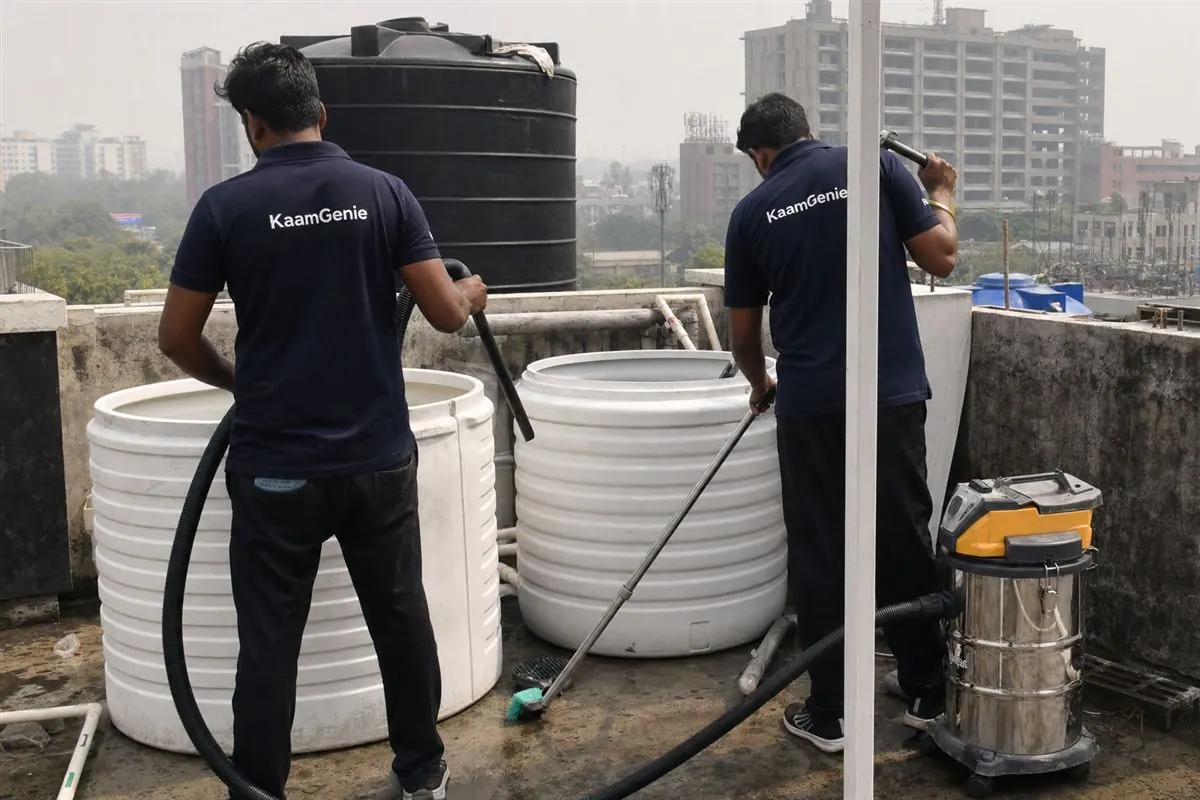
The Gurgaon process in plain English
- Inspect the UGR and rooftop tank, take “before” photos
- Drain the old water (and shut the inlet)
- De-sludge and vacuum the sand, silt and scale off the floor
- Hand-scrub walls, floor and corners with food-grade brushes
- High-pressure jet wash to break hard-water scale and bio-film loose
- Anti-bacterial wash, then rinse and vacuum out the dirty water
- Food-grade chlorine disinfection, hold contact time, rinse
- Refill, before/after photos, hand over the certificate
In a Gurgaon high-rise we always do the underground reservoir before the rooftop tanks — otherwise dirty sump water re-contaminates the clean tanks above.
| # | Step | Time | Key equipment |
|---|---|---|---|
| 1 | Inspection + photos | 5-10 min | Camera, torch |
| 2 | Drain old water | 10-20 min | Pump, transfer drum |
| 3 | De-sludge + vacuum | 10-20 min | Scoop, wet vacuum, sealed bucket |
| 4 | Hand scrubbing (hard-water scale) | 20-30 min | Food-grade nylon brushes |
| 5 | High-pressure jet wash | 10-15 min | 100-150 PSI industrial jet |
| 6 | Anti-bacterial wash + rinse | 10-15 min | Food-grade detergent, wet vacuum |
| 7 | Chlorine disinfection (contact time) | 20-30 min | Food-grade sodium hypochlorite (50-100 ppm in use) |
| 8 | Refill + photos + certificate | 10-15 min | WhatsApp + clipboard |
Book the real step-by-step cleaning
Every step documented, before/after photos, fixed price, certificate at the end. Anything short of this is a rinse. ₹699 onwards.
Why Gurgaon changes the running order
Before getting into the steps, it helps to understand why a Gurgaon job is sequenced differently from a single tank in an old Delhi flat. Most of Millennium City — the DLF colonies, the condominium towers along Golf Course Road and Sohna Road, and the new high-rise belt across New Gurgaon and the Dwarka Expressway — runs on a two-stage storage system. Water arrives from a borewell or, very often, a private tanker, and lands first in a large underground reservoir (UGR) at ground or basement level. From there a pump lifts it up to the rooftop tower tanks that feed the flats by gravity.
That two-stage system is the whole reason the order matters. The UGR is where gravity does its work: sand, silt, rust off tanker fittings, and the chalky hard-water scale all settle to the bottom of the sump. If a crew cleans the shiny rooftop tanks first and leaves the UGR for last, the first pump cycle pushes dirty sump water straight back up into the tanks you just cleaned. So on any society, condominium, or villa with both, we always do the underground reservoir first, then move up to the rooftop tanks. On a plotted builder floor with only a single overhead Sintex tank, the sequence collapses to one tank — but the eight steps below are the same. If you want the bigger picture of how the city is supplied, our complete guide to water tank cleaning in Gurgaon covers the building types in detail.
Step 1 — Inspection and before-photos
The first thing our crew does is open the tank — UGR hatch and the rooftop lid — and look. We are checking three things: how much sludge and scale has actually built up, whether the fittings (inlet, outlet, overflow, lid gasket) are intact, and whether anything is wrong — cracks in an RCC sump, a missing tank lid letting dust and lizards in, or chemical staining.
In Gurgaon this inspection has a local flavour. We specifically look at the inlet area, because hard water leaves a crust of white scale right where tanker or borewell water enters. We also gauge how much tanker silt has settled — homes that buy a lot of tanker water tend to carry more grit at the bottom of the UGR. This read decides the rest of the job: a sump that has not been touched in two years needs more chemical and a longer scrub than a society tank done every quarter. We take four to six before-photos at this stage, and they go into your service report.
Step 2 — Drain the old water
We close the inlet valve so no fresh water enters mid-clean, then drain the tank. If your home or society just took a tanker delivery and the water is still usable, we pump it into a temporary storage drum so it is not wasted — you can use it for floor washing, the garden, or the wash area. The dirty bottom layer, where the real contamination sits, then gets drained through the outlet valve or a submersible pump.
A rooftop tank drains in 10 to 20 minutes. A large basement UGR holds far more and the pump-out is slower, so on society jobs this step alone can run longer. Either way, the tank has to come fully empty — you cannot clean the floor of a tank with water sitting on top of it.
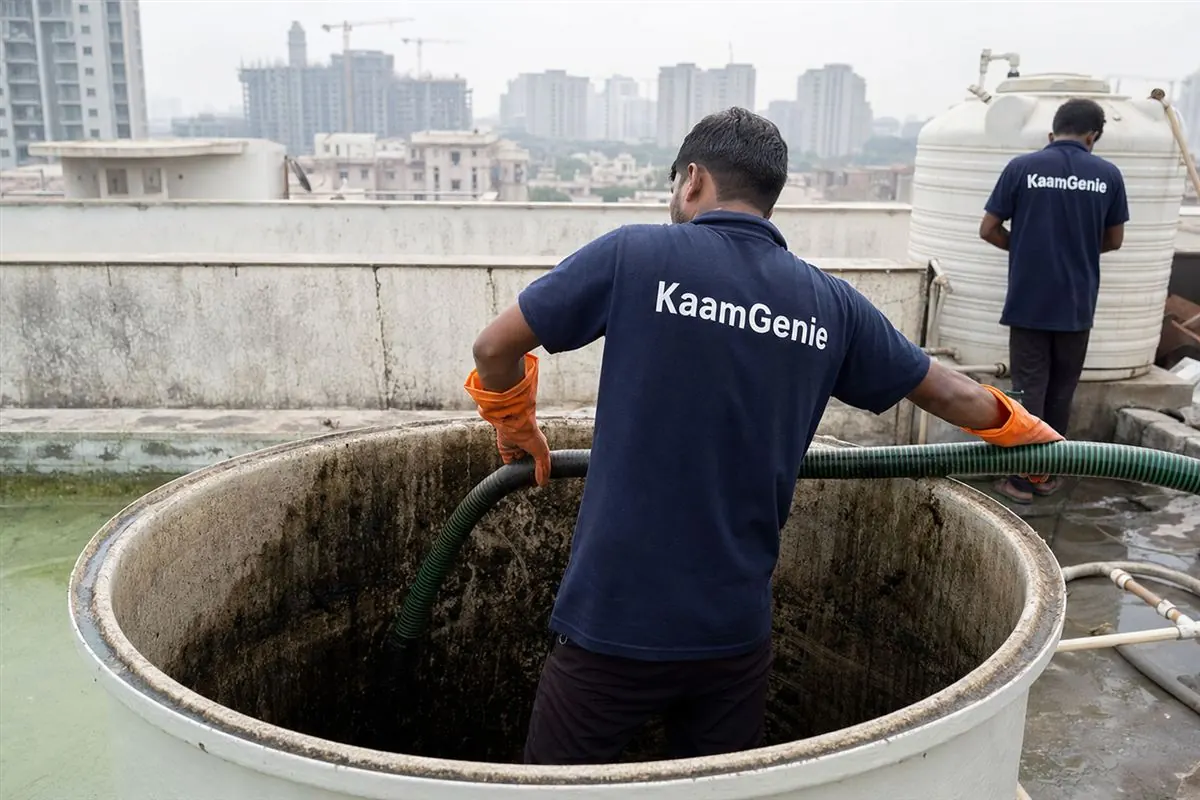
Step 3 — De-sludge and vacuum the bottom
Once the water is gone, the floor of every Gurgaon tank carries a layer of sediment your taps and filters never catch — fine sand, silt carried in by tankers, rust off old fittings, dead insects, and the grey-white hard-water deposit. In a UGR that has not been cleaned in two or three years, this can be half an inch of compacted sludge across the floor.
A crew member goes in (or reaches in, depending on tank size) with a wide scoop and a bucket, lifts out the bulk of the sludge by hand, then runs a wet vacuum over the floor to pull up the rest. The sludge goes into a sealed bucket and is taken off-site — never flushed back into the building’s drain, where in a Gurgaon tower it just settles in the riser pipes downstream. This is the dirtiest step, and it is the one cheap operators skip. A cleaner who only sprays water from the top is leaving the worst contamination exactly where it sits.
Step 4 — Hand-scrub walls and floor
With the sludge out, the walls and floor still carry a bonded film — bio-film, organic deposit, and the hard-water scale that Gurgaon’s groundwater is notorious for. None of it rinses off. Our crew goes in with food-grade brushes (stiff nylon bristles, never metal — metal scratches plastic and RCC and creates new homes for bacteria) and a food-grade detergent solution, and scrubs:
- The walls top-to-bottom
- The floor in overlapping passes
- The corners and seams where bio-film hides
- The inlet and outlet pipe mouths, where scale crusts thickest
- The underside of the lid, where condensation collects bacteria
This is the longest step in a hard-water city. Where a soft-water tank wipes nearly clean, a Gurgaon tank needs real elbow grease to break the calcium scale loose — which is exactly why our approach to hard-water tank cleaning in Gurgaon leans heavily on this stage. A scrupulous scrub on a 1,000-litre rooftop tank runs 20 to 30 minutes; a large society reservoir can be an hour or more. This is the step that separates a 90-minute job from a 20-minute fake.
Step 5 — High-pressure jet wash
After hand scrubbing, we run a high-pressure water jet (100-150 PSI) across the whole interior. The jet blasts off the scale and bio-film that scrubbing loosened but did not fully clear, and reaches into corners, behind the inlet pipe, and into the lid threads — places a brush physically cannot get to. It also drives the loose debris toward the drain so the next vacuum has less to lift.
For the concrete (RCC) underground reservoirs common under Gurgaon societies, the jet wash is critical. Concrete develops a porous, textured surface over the years, and hard-water scale grinds into those pores — only pressure clears it. We match the pressure to the tank: full strength on a concrete sump, eased off on an older sun-aged Sintex rooftop tank so the plastic is not damaged.
Step 6 — Anti-bacterial wash and rinse
With the surfaces physically clean, we apply a food-grade anti-bacterial wash across the walls and floor to lift any remaining organic film, then rinse the tank down with clean water and run the wet vacuum one more time. The reason the vacuum matters: if you skip it and just open the drain, gravity gets most of the water out but a thin dirty layer stays on the floor — and on refill that layer redistributes everything you just dislodged back into the fresh water. The vacuum gets the floor as close to dry as possible before disinfection.
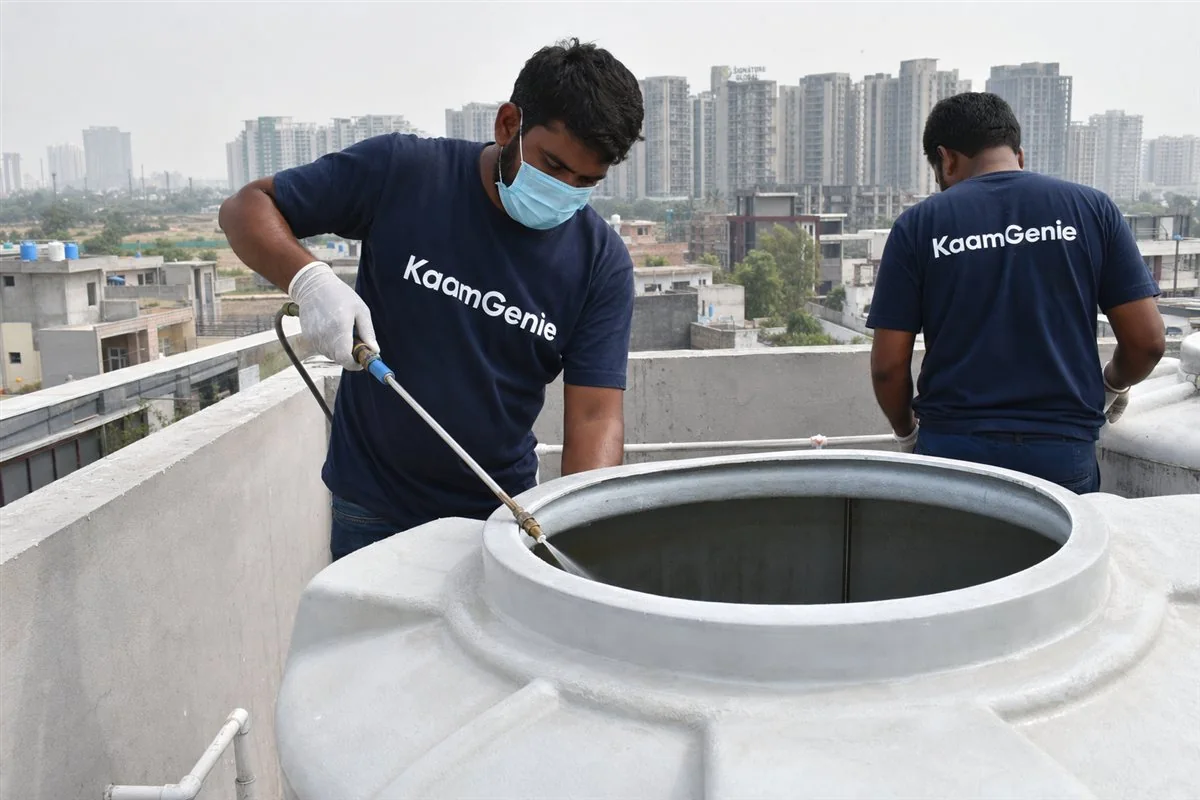
Step 7 — Food-grade chlorine disinfection
This is the step that actually kills bacteria, and the one cheap operators get wrong — by skipping it, or using the wrong chemical. We use food-grade sodium hypochlorite at 50-100 PPM (concentration scaled to tank size). It is the same compound municipal supply uses, and it is acceptable under FSSAI for potable water systems. Industrial or pool bleach from a hardware shop is not food-grade; it carries additives and residue you do not want in drinking water.
The disinfectant is sprayed across every interior surface — walls, floor, lid, inlet and outlet area — and held for its contact time. That hold is what actually kills E. coli, salmonella, and the other organisms behind stomach trouble and skin complaints. After contact time we rinse the tank with clean water and vacuum it out a final time, so only a minimal, safe chlorine residual remains. The tank is now disinfected, empty, and ready for refill.
Step 8 — Refill, before/after photos and certificate
We close the drain, restore the inlet, and let the tank refill. On a society we restart the lift pump so the freshly cleaned rooftop tanks fill from a now-clean UGR — the whole reason for the running order. While it fills, we check the inlet seals properly with no slow leak, the outlet flow is normal at the taps below, and the lid closes flush against its gasket.
Then we take four to six “after” photos at the same angles as the “before” ones, so the difference is obvious, and hand over a dated cleaning certificate listing tank type and capacity, chemicals used, and the crew. That record matters more than people realise in Gurgaon: AOAs and RWAs increasingly ask flats and societies for proof of a maintenance schedule, and any restaurant or office facing an FSSAI check needs documentation that its stored water is cleaned on record. If you want the underground side covered in depth, our guide to underground sump cleaning in Gurgaon goes deeper on the UGR stage.
Time spent per step — 1,000L overhead tank in Gurgaon, full process
Scrubbing and disinfection run longest — hard-water scale and chemical contact time
Total: ~100 minutes for a single 1,000L rooftop tank in Gurgaon including setup and pack-up. A society with a UGR plus tower tanks scales the scrub and disinfection steps proportionally — often a half- or full-day job.
How long the whole thing takes in Gurgaon
Realistic timings, end to end:
- Builder floor / single rooftop tank (up to 1,000L): 75-90 minutes
- Independent home or villa (UGR + overhead): 2-3 hours
- Society shared tower tank (one tower): 90-150 minutes
- Society UGR (10,000L+) plus multiple tower tanks: half-day to full-day, often two crews
- Office / commercial reservoir: 3-5 hours, frequently after working hours
If a cleaner finishes a Gurgaon UGR or a rooftop tank in 20-30 minutes, they did not de-sludge, scrub, or hold the disinfection contact time. That is a rinse, not a cleaning. For a full breakdown of what each tank type should cost, see our Gurgaon price guide.
What corner-cutters skip — and why it matters here
The cheap end of the Gurgaon market typically cuts the same steps every time:
- De-sludging (step 3) — the hardest, dirtiest step; skipping it leaves tanker silt and scale on the floor.
- Hand scrubbing (step 4) — 20-30 minutes of physical work; skipping it leaves hard-water scale bonded to the walls.
- Jet wash (step 5) — needs a pressure washer most cheap operators do not own, and it is the only thing that clears scale from concrete pores.
- Vacuum (step 6) — skipping it means dislodged dirt resettles on refill.
- Food-grade chlorine (step 7) — using hardware-shop bleach leaves residue and may not reliably kill bacteria.
- Certificate (step 8) — no photos, no record, no recourse, and nothing to show your AOA or an FSSAI inspector.
Each shortcut saves the cleaner 10-30 minutes. That is why a fake cleaning takes 20 minutes and a real one in Gurgaon takes 90 minutes to a half-day.
How to verify the job was done properly
If you are on site during the cleaning, here is what to watch for:
- Did they open and photograph the UGR and the rooftop tank before starting?
- Did they clean the underground reservoir before the rooftop tanks? (The order is the giveaway in a high-rise.)
- Did someone physically scrub the inside rather than spray from the top?
- Did you see a bucket of sludge carried away? (If not, step 3 was skipped.)
- Did you hear the jet washer running? (It is loud — you will know.)
- Did they apply chemical and wait? (A 15-30 minute pause is the contact time.)
- Did they hand you a certificate and the after-photos?
If any of these are missing, ask why — politely. A real crew explains. A corner-cutter gets defensive.
Curious about your own tank in Gurgaon?
Book a cleaning — the before-photos surprise even longtime residents. Standard residential cleaning ₹699 onwards; society and UGR jobs quoted on site.
Want this done at your tank in Gurgaon?
If it has been more than a year — or you have never had a real crew do it — this is the process you should expect: UGR first, every step documented, photos before and after, and a certificate at the end. We run the same trained crews and fixed prices across the city, so you can book water tank cleaning in Gurgaon for a tower in Sector 82, a builder floor in DLF Phase 4, or a new high-rise across New Gurgaon. The same step-by-step method underpins our wider water tank cleaning services across Delhi NCR.
To book, call +91 95603 66362 or use the booking form on this site — we’ll confirm shortly.
Frequently asked questions
In a Gurgaon high-rise, do you clean the underground reservoir or the rooftop tank first?
The underground reservoir (UGR) first, then the rooftop tower tanks. Tanker and borewell water lands in the UGR before it is pumped up, so the UGR is where most sand, silt and hard-water scale settles. Cleaning it first means the freshly cleaned rooftop tanks are not re-contaminated by dirty water rising from a still-dirty sump.
How long does the full process take for a Gurgaon home versus a society?
A single rooftop tank on a builder floor or independent home takes about 75-90 minutes. A villa or floor with a UGR plus an overhead tank takes 2-3 hours. A society with a large basement reservoir and multiple tower tanks is a half-day or full-day job with two crews, depending on capacity and access.
Why does Gurgaon hard water make the scrubbing step take longer?
Gurgaon’s borewell and tanker water is hard, so calcium and magnesium leave a chalky white scale that bonds to the tank floor and walls. It does not rinse off — it has to be scrubbed loose by hand and then cleared with the high-pressure jet. That is why a scrupulous Gurgaon cleaning spends more time on steps 4 and 5 than a soft-water city would.
What disinfectant do you use, and is it safe for drinking water?
Food-grade sodium hypochlorite at 50-100 PPM — the same compound used in municipal treatment and acceptable under FSSAI for potable water systems. We never use hardware-shop or pool bleach because those carry additives and residue you do not want in drinking water. After the contact time the tank is rinsed so only minimal safe residual remains.
Do I need to be home, and what about access to the terrace and basement?
One person needs to arrange access — for a society that is usually the facility manager or guard who opens the UGR room and terrace; for a home it can be you, family, or household help. Many Gurgaon customers leave us to it and review the before/after photos and certificate on WhatsApp afterwards.
What happens to the sludge and dirty water you remove?
The bulk drains to the building’s drain line. The thick sludge scooped from the bottom — sand, silt, rust and scale — goes into a sealed bucket and is disposed of off-site. We do not flush sludge back into the building’s plumbing, because in a Gurgaon tower it simply settles in the riser pipes and stagnant lines downstream.
Will the jet wash damage a black Sintex rooftop tank?
Not when pressure is matched to the tank. We run 100-150 PSI and ease off on older or sun-aged plastic tanks, which are common on Gurgaon terraces. We use food-grade nylon brushes, never metal, so the inner surface is not scratched. Damage from a competent crew is the exception, not the norm.
We just got tanker water delivered — can the tank still be cleaned today?
Yes. We pump the usable water into a temporary drum so it is not wasted (you can use it for washing or the garden), then drain the dirty bottom layer where the real contamination sits. A real cleaning cannot be done with water left in the tank, so the bottom layer has to come out either way.
Do you give a cleaning certificate, and why does it matter in Gurgaon?
Yes — every job ends with before/after photos and a dated cleaning record listing tank type, capacity, chemicals used and crew. It matters because Gurgaon AOAs and RWAs increasingly ask for proof of a maintenance schedule, and a restaurant or office facing an FSSAI check needs documentation that its stored water is cleaned on record.
How soon after cleaning is the water safe to use?
For washing and bathing, water is fine to use as soon as the tank refills. For drinking, give it 2-3 hours after refill and run it through your RO/UV purifier as usual — the post-disinfection rinse keeps any chlorine residual at minimal safe levels.
Sources & references
- Bureau of Indian Standards (BIS) — IS 10500:2012 is the canonical Indian Standard for drinking water specification, defining acceptable limits for physical, chemical, and biological parameters.
- WHO Guidelines for Drinking-water Quality, 4th edition — the global reference for water quality standards, including guidance on storage and disinfection.
- Food Safety and Standards Authority of India (FSSAI) — defines water quality requirements for food businesses, including hygiene standards for stored water and acceptable disinfection chemicals.
- WHO Fact Sheet on Drinking Water — overview of safe drinking water requirements and contamination risks.
- CPHEEO — Manual on Water Supply and Treatment — the Government of India’s engineering manual covering tank design, cleaning protocols, and disinfection practices.
Last verified: 29 June 2026. If you find any of these links broken, please let us know.