
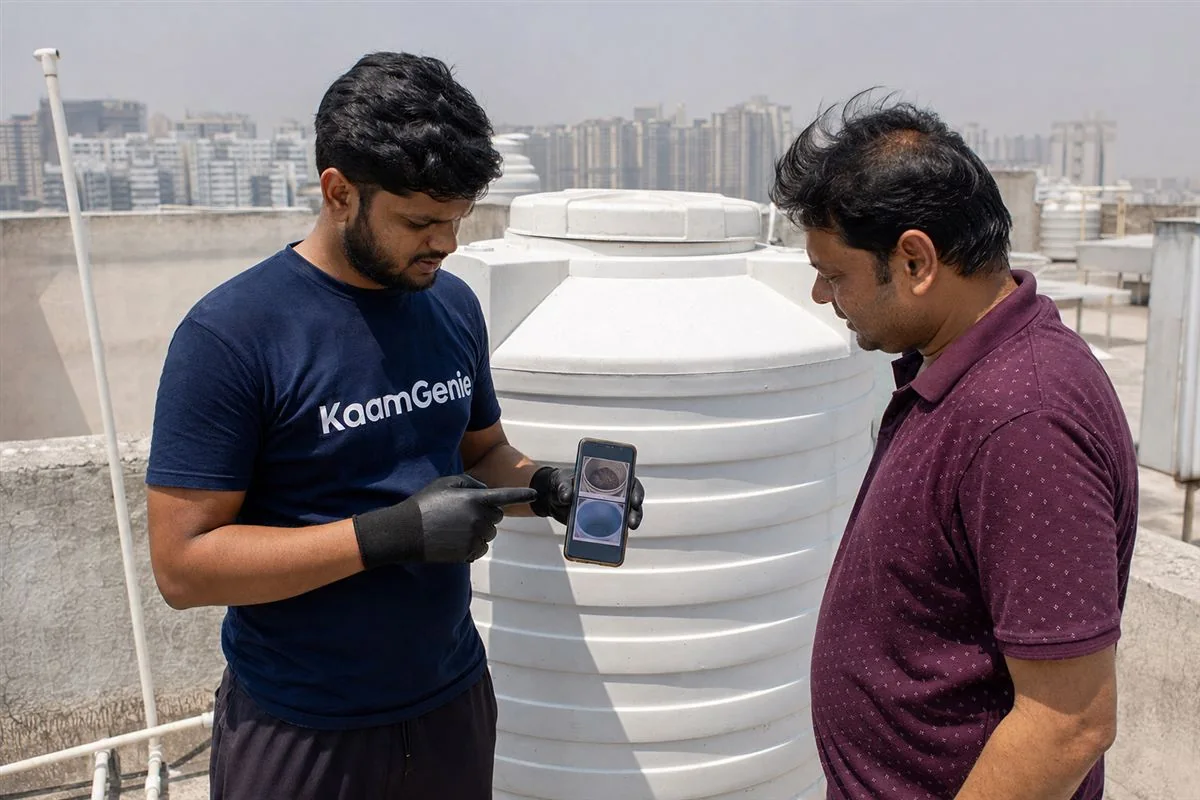
The short version
- The cheapest quote is rarely the best value — a 20-minute rinse leaves Gurgaon’s hard-water scale and tanker sediment right where it sits.
- Demand five things: full drainage and sludge removal, food-grade disinfection, before/after photos, a dated certificate, and trained, verified crew.
- Ask how the job is actually done before booking — an honest crew answers fast; a corner-cutter gets vague or defensive.
- Insist on a fixed, all-inclusive price (labour, chemicals, disposal). ₹699 onwards for homes; sumps, society reservoirs and commercial tanks are quoted on size.
- Local knowledge matters — Gurgaon’s borewell hard water, tanker reliance and UGR-to-tower-tank plumbing change how the job should be done.
| What to check | Trustworthy crew | Quick-job operator |
|---|---|---|
| Time on a home tank | 75–90 minutes | 15–25 minutes |
| Sludge removal | Drained & hand-scooped out | Skipped — rinsed from top |
| Disinfectant | Food-grade, FSSAI-acceptable | Hardware-shop bleach (or none) |
| Before/after photos | Always — sent on WhatsApp | None |
| Cleaning certificate | Dated, itemised, signed | Not offered |
| Crew | Trained, background-verified | Random day-labour |
| Pricing | Fixed, all-inclusive | Cheap headline, extras later |
Want the documented version?
Full drainage, food-grade disinfection, before/after photos and a dated certificate — fixed price, no upsell. ₹699 onwards.
Why choosing is harder in Gurgaon than it looks
Gurgaon’s water situation makes the “who do I trust” question more important here than almost anywhere in the NCR. Large parts of the city run on hard borewell groundwater, and even the DLF colonies and luxury condominiums on Golf Course Road and the Southern Peripheral Road lean heavily on water tankers to top up supply. That water is stored in big underground reservoirs (UGRs) that pump up to rooftop tower tanks — which means sediment and hard-water scale have two places to settle and far more chances to build up.
The result: a tank in Sushant Lok or an independent builder floor in the older sectors can foul faster than the same tank in a soft-water city. And because so many residents are tenants or expats on the move, plenty of people book the first cheap number that appears, get a 20-minute rinse, and never find out the sludge at the bottom was never touched. Picking the right crew is the whole game. If you want the full local picture first, our Gurgaon water tank cleaning guide covers the supply realities in depth.
The seven things that separate a real crew from a rinse-and-run
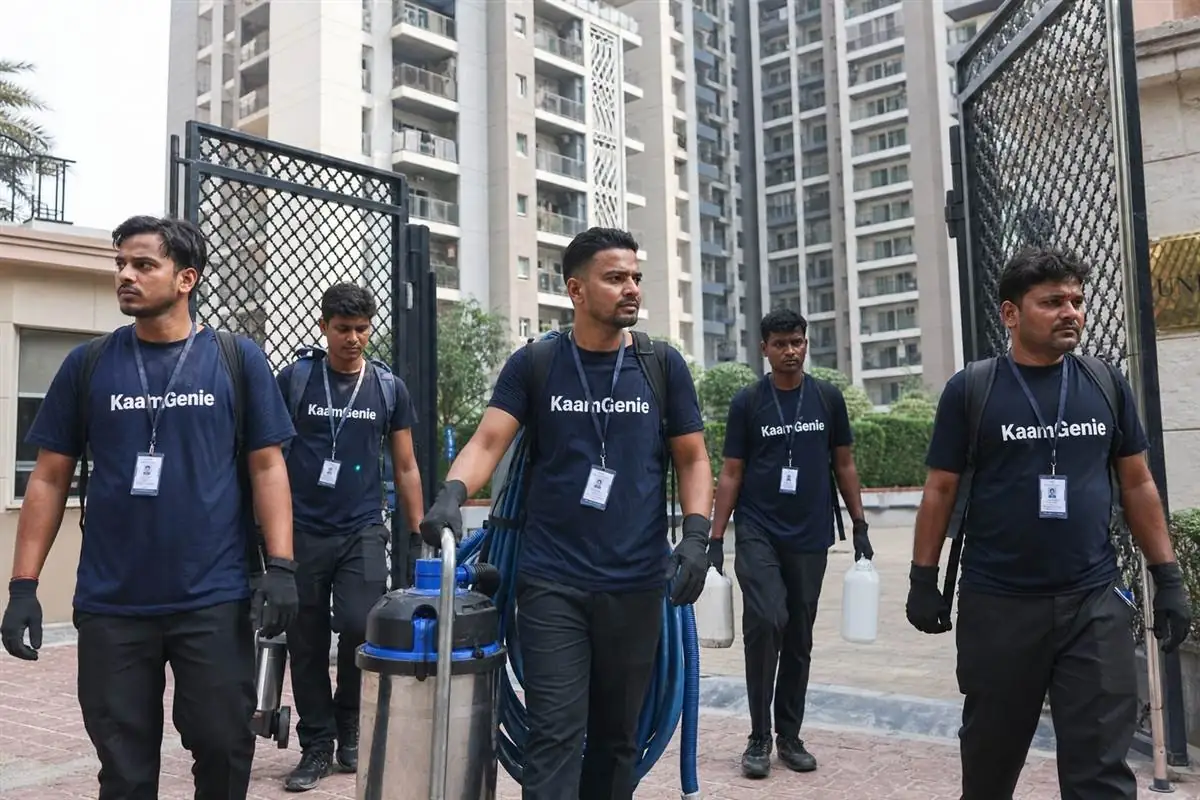
Strip away the marketing and a trustworthy Gurgaon service comes down to these seven, in roughly the order that matters:
- Full drainage and sludge removal. The tank is emptied and the bottom layer of scale and sediment is physically scooped out — not rinsed from the top with water still in it.
- Manual scrubbing plus a jet wash. Food-grade brushes on every wall and corner, then a 100–150 PSI jet to reach behind fittings. This is the longest, most physical part of the job.
- Food-grade disinfection. Sodium hypochlorite or hydrogen peroxide at the correct concentration, FSSAI-acceptable for potable water, left to dwell and then rinsed — never hardware-shop bleach.
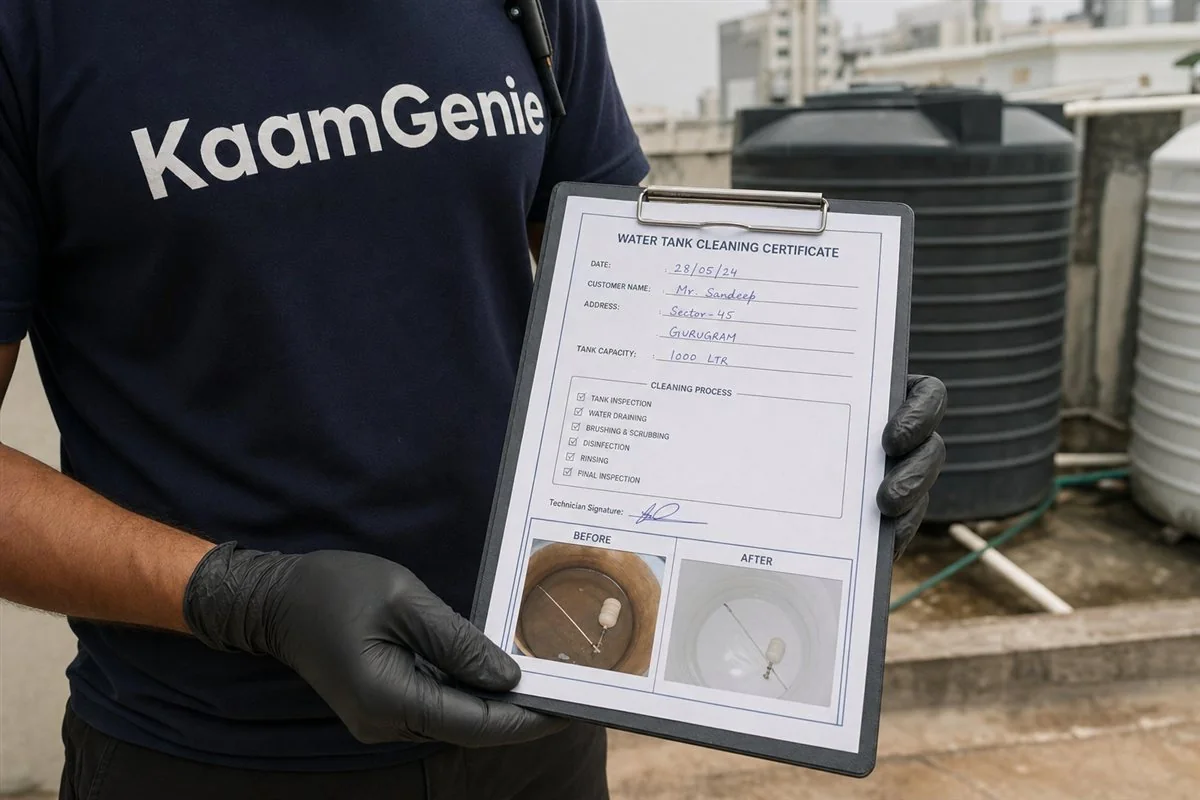
- Before/after photos. Sent to you on WhatsApp. They prove the tank was opened, drained and scrubbed — not just visited.
- A dated cleaning certificate. Listing tank type, capacity, chemicals used and crew names. This is your record for an RWA or AOA, and your proof for any FSSAI inspection.
- Trained, verified crew with safety gear. Especially for underground reservoirs, which are confined-space jobs needing ventilation, a harness and a second person outside.
- Transparent, fixed pricing. One all-inclusive number covering labour, chemicals and disposal — no “extra for chemicals” surprise at the end.
Notice that the same standards apply whether you’re comparing services in any city — if you’re also weighing options outside Gurugram, our generic guide to choosing the best tank cleaning service in Delhi walks through the same checklist for the wider capital. The principles travel; the local execution is what changes.
The questions to ask before you book
You don’t need to be a plumber to vet a service. Ask these five on the phone before you commit:
- “Do you drain the tank fully and remove the bottom sludge, or only rinse from the top?” The right answer describes draining, scooping and scrubbing. “We clean it properly” with no detail is a dodge.
- “What disinfectant do you use — is it food-grade?” You want to hear “food-grade sodium hypochlorite” or “hydrogen peroxide.” “Regular bleach” or a long pause is a fail.
- “Will I get before/after photos and a certificate?” Yes, every time, should be instant. Hesitation means they don’t do it as standard.
- “Are your crew trained and verified, and do you carry safety gear for sumps?” Particularly important for UGRs in condominiums and high-rises.
- “Is the price fixed and all-inclusive?” Get the number in writing on WhatsApp. A real operator is happy to.
A genuinely local crew will also know your area without prompting — tanker dependence on Sohna Road and the SPR belt, hard water in the older sectors, and the reservoir-to-tower-tank setup in the DLF colonies. If you’re in DLF Phase 4, Sushant Lok or Sector 82, a service that regularly works there can give realistic timing and pricing on the first call instead of a generic NCR-wide script. You can see all neighbourhoods we cover on the water tank cleaning in Gurgaon hub, and the wider menu on our NCR water tank cleaning services page.
Where a real Gurgaon crew spends the time — UGR + rooftop tower tank job
A quick-job operator skips the shaded-heavy phases and finishes in a fraction of the time
Illustrative timings for a mid-size society reservoir feeding a tower tank — the exact split varies with capacity and access. The point: the phases a corner-cutter skips (drain, sludge, disinfection) are the ones that actually make water safe.
Red flags that should make you walk away
Some signals are reliable enough that you can end the call right there:
- A price that’s too good to be true. Sub-₹300 for a home tank means a rinse, not a cleaning. The work simply can’t be done for that.
- Refusal to drain the tank fully. “We don’t need to empty it” is the clearest tell that the bottom sludge will be left behind.
- Can’t name the disinfectant. Or admits to ordinary bleach — not safe behind your drinking water.
- No photos, no certificate. You’ll have zero proof and zero recourse.
- Full cash up front before any work. Pay on completion, after you’ve seen the after-photos.
- Gets defensive when questioned. A real crew is proud of how they work; the questions above are their pitch, not an insult.
If cost is your main worry, the answer isn’t the cheapest quote — it’s an honest, itemised one. Our Gurgaon water tank cleaning cost guide breaks down what a fair price actually covers, and if you’re not sure whether you need a clean yet, the warning signs to watch for in Gurgaon will help you decide before you pick up the phone.
Get a fixed quote for your Gurgaon tank
Tell us your tank type and area — we’ll give one all-inclusive number, photos and a certificate included. Residential ₹699 onwards.
Putting it together for your home or society
Choosing well isn’t complicated once you know what to look for. Run the five questions, insist on the seven standards, and watch for the red flags. The right crew will be the one that answers plainly, quotes a fixed all-inclusive price, documents the job with photos and a certificate, and treats your drinking water like it matters — because in Gurgaon’s hard-water, tanker-fed reality, it does.
When you’re ready, you can see coverage, pricing and area-by-area details on our water tank cleaning in Gurgaon hub, then book in a couple of minutes. Ask the questions first — a service worth hiring will be glad you did.
Frequently asked questions
What separates a trustworthy Gurgaon tank cleaning crew from a quick-job operator?
A real crew physically empties and scrubs the tank, removes the bottom sludge, jet-washes the corners, disinfects with food-grade chemical, and hands you before/after photos plus a dated cleaning certificate. A quick-job operator sprays water from the top, finishes a residential tank in 20 minutes, uses hardware-shop bleach, and leaves no record. In Gurgaon, where most homes run on hard borewell water and tanker supply, the sludge and scale at the bottom are exactly what a quick job leaves behind.
What questions should I ask before booking a water tank cleaning service in Gurgaon?
Ask five things: (1) Do you physically drain the tank and remove the bottom sludge, or only rinse from the top? (2) What disinfectant do you use — is it food-grade and FSSAI-acceptable? (3) Do I get before/after photos and a dated cleaning certificate? (4) Are your crew trained and background-verified? (5) Is the price fixed and all-inclusive, or are there extras for chemicals and disposal? Honest answers come quickly; vague or defensive answers are a red flag.
Why does a proper cleaning cost more than the cheap quotes I see online?
A genuine 8-step cleaning takes 75–90 minutes for a home tank and needs a jet washer, a wet vacuum, food-grade disinfectant and trained labour. A ₹200–300 quote covers a 20-minute rinse with a bucket and bleach. The price gap is the work gap. Honest residential cleaning in Gurgaon starts at ₹699 onwards; society reservoirs, underground sumps and commercial tanks are quoted on size and access.
What is food-grade disinfection and why does it matter?
Food-grade disinfection uses sodium hypochlorite (or hydrogen peroxide) certified for potable water contact at the correct concentration — typically 50–100 PPM — left to dwell before rinsing. It kills E. coli, salmonella and bio-film without leaving the additives found in industrial or pool chlorine. Since your tank feeds your kitchen and bathing water, the disinfectant must be safe to drink behind. Hardware-shop bleach is not, and is one of the most common corner-cuts.
Should the crew give me before/after photos and a cleaning certificate?
Yes — this is the single easiest way to tell a real service from a fake one. Before/after photos prove the tank was actually opened, drained and scrubbed. A dated certificate listing tank type, capacity, chemicals used and crew names is your proof for an RWA or AOA maintenance record, and for any FSSAI inspection if you run a food business. If a service cannot provide these, you have no recourse if the job was skipped.
How do I know the cleaning crew is trained and verified?
Ask whether crew are background-verified employees or random day-labour, and whether they carry confined-space safety gear for underground reservoirs. Underground sump cleaning in Gurgaon is a confined-space job — it needs ventilation, a harness and a buddy outside the tank. A trustworthy service uses the same trained crew repeatedly, can name them on the certificate, and follows safety protocol rather than sending one person down a sump alone.
How much does professional water tank cleaning cost in Gurgaon?
Residential overhead tanks start at ₹699 onwards. Underground sumps, society underground reservoirs feeding rooftop tower tanks, and commercial or restaurant tanks are quoted on capacity, access and the number of tanks. The honest number depends on litres and how the building is plumbed — a fixed all-inclusive quote (labour, chemicals, disposal) is the sign of a transparent operator. For a full breakdown, see our Gurgaon cost guide.
How do I check that a service is genuinely local to Gurgaon?
A genuinely local service knows the supply realities of your area — tanker dependence on Sohna Road and the SPR belt, hard borewell water in the older sectors, and the underground-reservoir-to-tower-tank setup in DLF colonies and condominiums. Ask if they regularly serve your specific area, whether DLF Phase 4, Sushant Lok or Sector 82. Local crews can give realistic timing and pricing on the first call rather than a generic NCR-wide script.
What are the biggest red flags to walk away from?
Walk away if: the quote is suspiciously cheap (under ₹300); they refuse to drain the tank fully; they cannot name their disinfectant or admit it is regular bleach; they offer no photos or certificate; they finish a home tank in 20 minutes; they want full cash payment before any work; or they get defensive when you ask how the job is done. A trustworthy crew welcomes these questions because the answers are their selling point.
How often should a Gurgaon water tank be cleaned given the hard water?
Every 6 months is the practical standard for most Gurgaon homes and societies, and BIS and WHO guidance supports regular cleaning of stored-water systems. Gurgaon’s hard borewell groundwater leaves heavy calcium scale, and frequent tanker top-ups carry in sediment, so tanks here foul faster than soft-water areas. If you rely heavily on tanker water or notice scale, smell or cloudy water sooner, clean more often.
Sources & references
- Bureau of Indian Standards (BIS) — IS 10500:2012 is the canonical Indian Standard for drinking water specification, defining acceptable limits for physical, chemical, and biological parameters.
- WHO Guidelines for Drinking-water Quality, 4th edition — the global reference for water quality standards, including guidance on storage and disinfection.
- Food Safety and Standards Authority of India (FSSAI) — defines water quality requirements for food businesses, including hygiene standards for stored water and acceptable disinfection chemicals.
- WHO Fact Sheet on Drinking Water — overview of safe drinking water requirements and contamination risks.
- CPHEEO — Manual on Water Supply and Treatment — the Government of India’s engineering manual covering tank design, cleaning protocols, and disinfection practices.
Last verified: 29 June 2026. If you find any of these links broken, please let us know.