
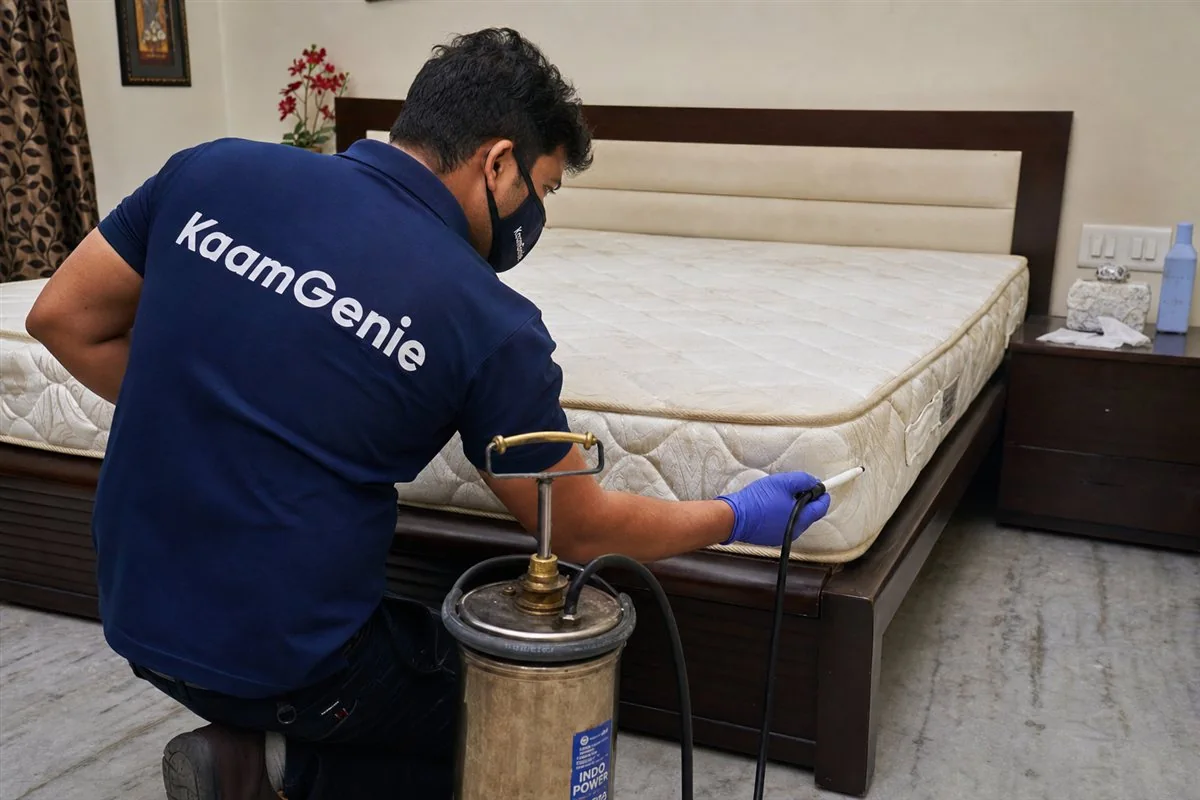
Quick answer — heat vs chemical bed bug treatment in Delhi (2026)
- Both can work; neither is a one-visit miracle. Bed bugs are killed by sustained heat (about 50–60°C held long enough) or by a proper residual chemical protocol — but eggs and deep-hiding bugs make a single pass unreliable either way.
- Why they’re so hard to kill: a female lays hundreds of eggs, eggs resist many sprays, and the bugs hide flat in mattress seams, bed-frame joints, skirting and switchboards. Miss a few eggs and you’re back in three weeks.
- What KaamGenie does (2026): a thorough chemical protocol from ₹1,299/room — targeted residual spray of every harbourage, then a mandatory follow-up visit (usually around day 14–21) to catch the eggs that hatch. GST 18% extra.
- Heat treatment: chemical-free and good for severe or repeat infestations — offered for select cases where it makes sense. Ask us; we’ll tell you honestly if your situation actually needs it.
- Prep matters as much as the method: wash and hot-dry bedding, declutter, pull beds off the wall. Skipping prep is the single biggest reason any treatment fails.
- No honest service promises “100% in one visit.” The follow-up is the treatment, not an upsell. We cover homes, PGs, hostels and hotels across Delhi.
Why bed bugs are so hard to kill (and why “one spray” fails)
Before you can choose between heat and chemical, you have to understand what you’re fighting — because almost everyone underestimates it. A bed bug, khatmal, is a flat, reddish-brown insect about the size of an apple seed. Flat is the whole problem: it slides into a gap thinner than a credit card and sits there, invisible, all day. It only comes out to feed on you at night, then vanishes again. By the time you actually see one, there are usually dozens you don’t.
Three biological facts make them genuinely difficult, and they’re the reason a single ₹200 spray bottle is wasted money:
- The eggs. A single female lays around 200–500 eggs in her life, cemented into cracks in tiny clusters. Most ordinary sprays kill crawling adults and nymphs but do not reliably kill eggs. So you spray, you feel victorious, and 7–10 days later a fresh batch hatches and the colony rebuilds. This single fact is why every honest treatment — heat or chemical — is built around the egg cycle, not around one visit.
- The hiding. Bed bugs don’t live on you; they live near you. Mattress piping and seams, the joints and screw-holes of a wooden bed frame, behind the headboard, inside the bedside table, along skirting boards, behind loose wallpaper, even inside electrical switchboards and power sockets. In a Delhi barsati or a tightly packed PG room, that’s a hundred hiding spots per bed. Miss one harbourage and you’ve missed the infestation.
- The resilience. Bed bugs can survive months without a blood meal, so “leaving the room empty for a while” doesn’t starve them out. And populations in many Indian cities have developed real resistance to older pyrethroid chemicals — which is exactly why method and product choice matter, and why cheap operators using one tired chemical keep failing.
So the goal of any treatment is not “kill the bugs I can see today.” It’s “reach every harbourage, and account for the eggs that will hatch after.” Heat and chemical are just two different ways of solving that same problem.
How bed bug heat (thermal) treatment actually works
Heat treatment is the method that gets all the hype online, so let’s explain it properly. Bed bugs and their eggs die when their body temperature is pushed past a lethal threshold — roughly 45°C and above — and held there long enough. In practice a professional heat treatment raises the air in the room to around 50–60°C using industrial electric heaters, then holds that temperature for several hours while fans circulate the hot air into every crack. Technicians use probes to confirm the heat actually reaches the cold spots — the centre of the mattress, the deep corner of the wardrobe — because a bug sitting in a cool pocket survives.
The genuine appeal is real: done correctly, heat penetrates everywhere at once and kills all life stages including the eggs in a single session, and it leaves no chemical residue — which matters for nurseries, asthmatics, hospitals and anyone nervous about spray. That “kills eggs in one go” line is the one true advantage heat has over a basic chemical pass.
But here is the honest other side, the part the YouTube videos skip. Heat treatment needs specialised high-wattage equipment and a power supply that can run it — not trivial in an old Delhi neighbourhood with shaky wiring or a PG on a single overloaded meter. It can damage heat-sensitive belongings: candles, vinyl records, certain electronics, pressurised cans, some plastics and cosmetics have to be removed first. Critically, heat gives you no residual protection — the moment the room cools, if a single bug walked in from the next room or arrives next week in a guest’s bag, nothing stops it, because there’s no chemical barrier left behind. And it is more expensive and more disruptive to set up. That’s why, for a normal one-bedroom infestation, it’s often overkill.
| Heat (thermal) treatment | Chemical (residual) protocol | |
|---|---|---|
| How it kills | Sustained 50–60°C heat, all life stages at once | Targeted residual insecticide on every harbourage |
| Kills eggs? | Yes, in one session if heat reaches them | Eggs survive the first pass — the follow-up visit handles them |
| Visits needed | Often one (severe cases may repeat) | Two: initial treatment + follow-up around day 14–21 |
| Residual protection | None once the room cools | Yes — keeps killing for some weeks |
| Chemical exposure | None | Low when done correctly; vacate & ventilate as advised |
| Belongings risk | Heat-sensitive items must be removed | Minimal; cover food, fish tanks |
| Best for | Severe / repeat cases, chemical-free needs | Most homes, PGs and hostels — the practical default |
The chemical protocol — what KaamGenie actually does
Let me be straight about what we do, because honesty is the whole point of this page. KaamGenie’s bed bug service is primarily a thorough, professional chemical protocol — not a one-spray drive-by, and not a heat rig we roll into every flat. It works because it respects the two hard facts above: reach every harbourage, and plan for the eggs. Here’s how a real job runs.
- Inspection first. The technician opens up the bed, lifts the mattress, checks the seams and piping, the frame joints, the headboard, bedside tables, the skirting near the bed, and the obvious cracks. We’re mapping where the bugs actually live, because that’s where the treatment goes.
- Targeted residual spray of every harbourage. We treat the seams, the frame joints, the cracks and crevices, skirting and gaps — with CIB&RC-approved insecticides applied at the correct dose. Not a fog of the room’s open air, where bed bugs don’t sit — into the gaps where they hide. The residual keeps working for weeks as bugs move across treated surfaces.
- The mandatory follow-up visit. This is the non-negotiable part, and the bit cheap operators skip. We come back, usually around day 14 to 21, and treat again — because that’s when the eggs that survived the first round have hatched into nymphs you can now kill. One visit treats the bugs; the follow-up treats the next generation. Skip it and you’ve wasted the first visit.
Our bed bug treatment starts at ₹1,299 per room (GST 18% extra), and that price is built around this protocol — including the follow-up, not as a surprise add-on. A 2 BHK with two affected bedrooms is priced per room; a heavily infested PG floor is quoted on the room count. What you will never get from us is a fake guarantee of “100% gone in one visit” — anyone promising that either doesn’t understand the egg cycle or is lying to close the sale.
| Setting | What’s covered | Starting price (2026) |
|---|---|---|
| Single bedroom | Inspection + targeted residual treatment + one follow-up visit | From ₹1,299/room |
| 2–3 BHK home | Per affected room, treated and followed up; priced on room count | From ₹1,299/room |
| PG / hostel floor | Affected + adjacent rooms, floor-by-floor, scheduled visits | Per-room quote |
| Hotel rooms | Per-room protocol; heat treatment for severe / fast turnaround where offered | Custom quote |
| Heat (thermal) treatment | Severe or chemical-free cases — specialised equipment, single session | Quote on inspection |
Bitten every night and done guessing?
Our technician inspects the seams, frame joints and skirting, then runs a targeted residual protocol with a mandatory follow-up. Bed bug treatment from ₹1,299/room (GST 18% extra).
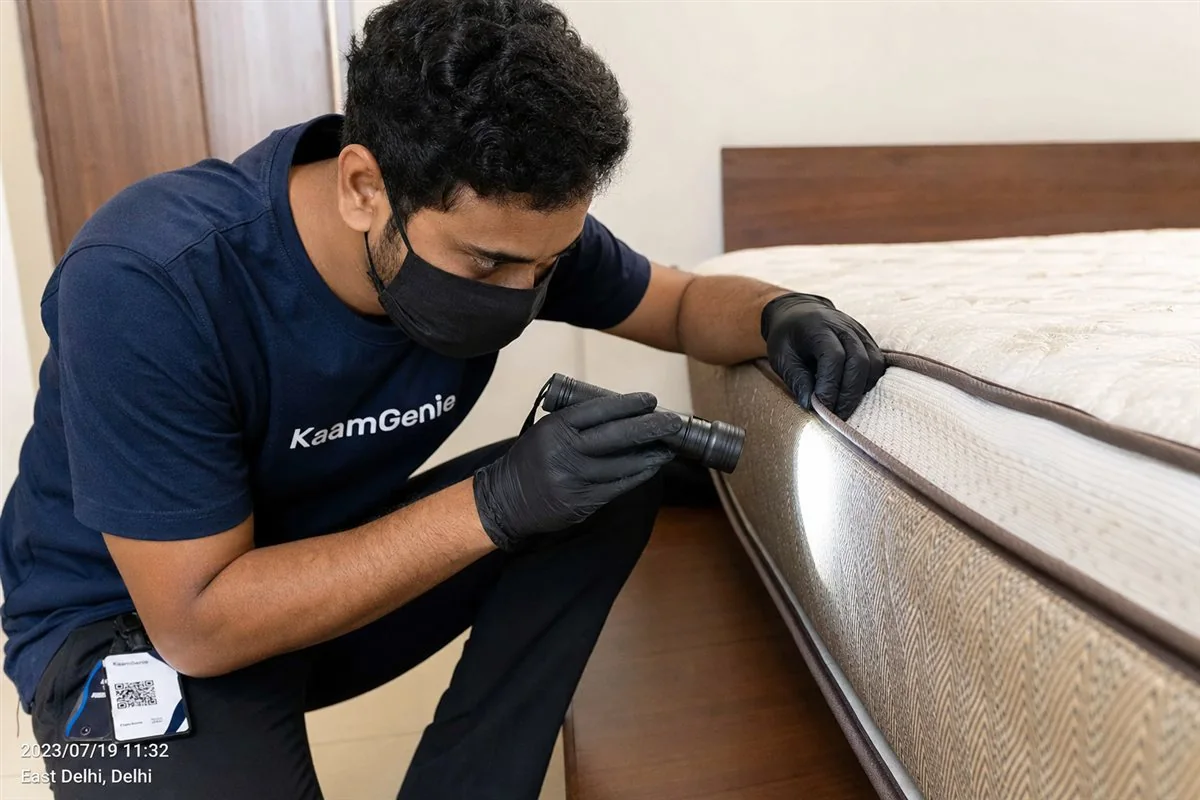
So which should you choose — heat or chemical?
Here’s the honest decision, the way I’d tell a friend. For the vast majority of Delhi homes — a couple of rooms, a normal infestation caught within a month or two — the chemical protocol with a proper follow-up is the right call. It’s cheaper, it leaves residual protection behind so a stray bug from the corridor doesn’t restart everything, and the follow-up visit handles the eggs that the “heat kills eggs” crowd think only heat can manage. The eggs aren’t a heat-only problem; they’re a timing problem, and a second visit solves the timing.
Heat treatment earns its place in specific situations: a severe, long-running infestation that’s spread through a whole flat; a repeat case where chemical rounds genuinely haven’t held; a household that cannot have any chemical at all (a newborn, a serious asthmatic, certain medical setups); or a hotel room that has to be turned around fast and chemical-free for the next guest. We offer heat treatment for select cases where it makes sense — tell us the situation and we’ll say honestly whether it’s worth the extra cost or whether a thorough chemical protocol will do the same job for less. A service that pushes heat on every single enquiry is selling its equipment, not solving your problem.
One more honest point: the method matters far less than people think, and the thoroughness matters far more. A meticulous chemical treatment that reaches every seam and comes back for the follow-up beats a rushed heat job that left a cold pocket in the wardrobe. And the single biggest variable of all isn’t even the technician — it’s your prep.
Why bed bug jobs fail in Delhi — what we see on repeat call-outs (2026)
Rough share of “they came back” complaints by root cause, from our own follow-up visits.
Your prep checklist — this is half the result
I’ll repeat it because it’s that important: prep decides whether the treatment works. Do these before the technician arrives, whether you choose heat or chemical, and the job has a real chance of being one-and-done (plus the follow-up). Skip them and you’re likely to be on the phone again in a month.
- Strip and hot-wash all bedding. Sheets, pillowcases, mattress protectors, the kids’ soft toys — wash hot and then tumble-dry on high heat if you can, because the dryer’s heat is what actually kills bugs and eggs in fabric. Bag the washed items and keep them sealed until the room is treated.
- Declutter ruthlessly. Bed bugs love clutter — piles of clothes, books, cardboard boxes under the bed, that heap on the chair. Every object is a hiding spot the technician can’t treat. Clear the floor and the area around the bed.
- Pull the bed away from the wall and, if possible, dismantle the frame so the joints and screw-holes can be reached. Move bedside tables out.
- Vacuum first, then bin the bag outside. Run a vacuum along the mattress seams, the frame and the skirting to physically remove live bugs and eggs, then immediately seal and throw the vacuum bag/contents in an outdoor bin so they don’t crawl back out.
- Don’t move stuff to another room. The instinct to shift your mattress or clothes to the next bedroom is exactly how a one-room problem becomes a whole-flat problem. Keep everything contained.
- Tell the technician about kids, pregnancy, asthma, pets and fish tanks so the right product and safety steps are used, and so heat vs chemical can be advised properly.
Running a PG, hostel or hotel?
Bed bugs travel room to room through walls and luggage. We do floor-by-floor protocols and can advise on heat treatment for severe cases. Get a tailored quote.
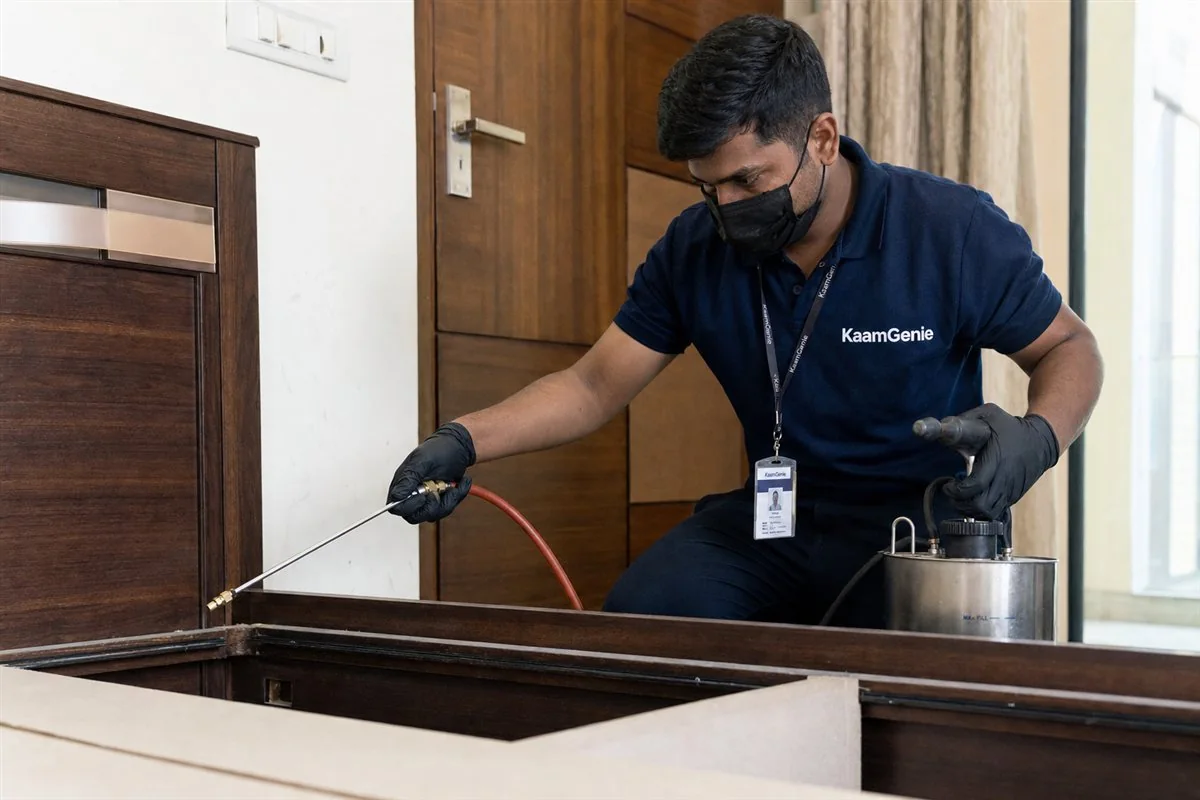
PGs, hostels and hotels — a different game
Bed bugs in a PG, hostel or hotel are a category of their own, and Delhi has plenty — the student belts around Mukherjee Nagar, GTB Nagar and Satya Niketan, the working-women’s PGs across Laxmi Nagar and Munirka, budget hotels in Paharganj and Karol Bagh. The problem in shared housing is simple: bugs don’t respect walls. They travel along skirting and through wall cavities from room to room, and they hitchhike in every new resident’s suitcase. Treat one room and leave the neighbours, and you’ve treated nothing — they just walk back.
So for shared buildings the protocol changes. You treat affected rooms plus the adjacent ones, often floor by floor, and you put it on a schedule rather than a one-off, because new luggage means new risk every week. This is exactly where heat treatment can be worth it for a badly hit hotel room — it turns the room around chemical-free and fast for the next guest — while a chemical protocol with residual protection is usually the better fit for the building as a whole because it keeps working between visits. For managers, the practical record-keeping that matters is a clear schedule, before/after photos and a GST invoice for each treatment, so you can show residents or auditors the work was done. If you run a property, talk to us about a room-count quote and a sensible visit schedule rather than paying per panic.
Stop the bites — we cover Delhi
Bed bugs are not a sign of a dirty home — the cleanest barsati in Defence Colony gets them the same as a crowded PG, because they arrive in luggage and second-hand furniture, not in dust. What beats them is the right method done thoroughly, honest expectations about the egg cycle and the follow-up visit, and proper prep from you. For most Delhi homes that means our chemical protocol from ₹1,299/room with a built-in follow-up; for severe or chemical-free cases, ask us about heat treatment and we’ll tell you straight whether you need it. We serve homes, PGs, hostels and hotels across Delhi — from Rohini, Pitampura and Dwarka in the north and west, to Saket, Lajpat Nagar, Greater Kailash and Malviya Nagar in the south, to Laxmi Nagar, Mayur Vihar and Preet Vihar in the east. Coming soon: Gurgaon, Noida, Faridabad and Ghaziabad. Call 95603 66362 and let’s get you sleeping properly again.
Frequently asked questions
Is heat treatment or chemical treatment better for bed bugs in Delhi?
For most Delhi homes a thorough chemical protocol with a follow-up visit is the practical choice — it’s cheaper, leaves residual protection, and the follow-up handles the eggs. Heat treatment is better for severe or repeat infestations, or when you can’t use any chemical (newborn, serious asthma). The honest truth is that thoroughness matters more than the method: a meticulous chemical job beats a rushed heat job that misses a cold pocket.
Does bed bug heat treatment kill the eggs?
Yes — that’s its main advantage. Sustained heat of about 50–60°C, held long enough and reaching every crack, kills bed bugs and their eggs in a single session. But it only works if the heat actually penetrates the cold spots like the centre of a mattress or the back of a wardrobe, which is why probes are used to confirm. A chemical protocol handles eggs differently — with a follow-up visit once they hatch.
How much does bed bug treatment cost in Delhi in 2026?
KaamGenie’s bed bug treatment starts at ₹1,299 per room, with GST 18% extra, and that price includes the mandatory follow-up visit, not as an add-on. Pricing is per affected room, so a single bedroom costs less than treating a whole infested PG floor. Heat treatment, where it’s warranted, costs more because of the specialised equipment — ask us for a tailored quote.
Why do bed bugs keep coming back after treatment?
Almost always because of the eggs and a missing follow-up. Many sprays kill adults and nymphs but not eggs, so 7–10 days later a fresh batch hatches. Without a second visit around day 14–21 to kill that new generation, the colony rebuilds. Other common causes are poor prep, clutter left in the room, a missed hiding spot like a switchboard, or reinfestation from the next room in shared housing.
Why are bed bugs so hard to get rid of?
Three reasons. A single female lays 200–500 eggs, and eggs resist many sprays. The bugs hide flat in mattress seams, frame joints, skirting and even switchboards, so it’s easy to miss a harbourage. And they survive months without feeding, so you can’t starve them out. Any treatment that ignores the eggs or misses a hiding spot will fail, which is why a single cheap spray almost never works.
Does KaamGenie do heat treatment or chemical treatment?
Our bed bug service is primarily a thorough chemical protocol — a targeted residual treatment of every harbourage, plus a mandatory follow-up visit around day 14–21 to catch hatching eggs — from ₹1,299 per room. We offer heat treatment for select severe or chemical-free cases where it genuinely makes sense, and we’ll tell you honestly which one your situation needs rather than pushing the more expensive option.
How should I prepare my room before bed bug treatment?
Strip and hot-wash all bedding, then tumble-dry on high heat — the dryer’s heat kills bugs and eggs in fabric. Declutter the room and clear the floor, pull the bed away from the wall and dismantle the frame if you can, vacuum the seams and skirting then bin the bag outside immediately, and don’t move your things to another room. Prep is roughly half the result; skipping it is the top reason treatments fail.
Is bed bug chemical treatment safe for kids and pets?
When done correctly, yes. Licensed services use CIB&RC-approved insecticides at the right dose, applied into cracks and harbourages rather than sprayed around open living space. Tell the technician about children, pregnancy, asthma, pets and fish tanks in advance, vacate the treated rooms for the time advised, and ventilate afterwards. If you want zero chemical exposure, heat treatment is the alternative to ask about.
How many visits does bed bug treatment need?
A proper chemical protocol needs two: the initial treatment, then a follow-up around day 14–21 to kill the nymphs that hatch from surviving eggs. Heat treatment is often a single session because it kills eggs at the same time, though severe infestations may still need a repeat. Be very wary of anyone promising 100% elimination in one visit — with the egg cycle involved, that’s rarely honest.
Can I get rid of bed bugs permanently myself?
DIY can reduce them but rarely clears a real infestation, because home sprays don’t reliably kill eggs and you’ll usually miss hidden harbourages. The things that genuinely help are hot-washing and tumble-drying bedding, vacuuming seams, decluttering, and sealing cracks. For anything beyond a handful of bugs, a professional protocol with a follow-up is what actually ends it. See our guide on getting rid of bed bugs permanently for the full method.
Why do PGs, hostels and hotels in Delhi get bed bugs so often?
Because bugs travel between rooms through wall cavities and skirting, and they hitchhike in every new resident’s luggage and second-hand furniture. In student and working-PG belts like Mukherjee Nagar, Laxmi Nagar and Munirka, and budget hotels in Paharganj, constant turnover means constant new risk. Treating one room and ignoring the neighbours doesn’t work — shared buildings need adjacent rooms treated, often floor by floor, on a schedule.
Does bed bug treatment leave a chemical smell or residue?
A proper chemical protocol leaves a low residue by design — that residual is what keeps killing bugs for weeks — and any odour is usually mild and fades with ventilation. Vacate the treated rooms for the time the technician advises and air them out afterwards. If you want no residue at all, heat treatment is the chemical-free option, though it leaves no lasting protection once the room cools.
Ready to actually end the bed bug problem?
A trained technician inspects the harbourages, runs a targeted protocol and comes back for the follow-up — from ₹1,299/room. Heat treatment available for severe cases. We cover all of Delhi.
Sources & references
- Central Insecticides Board & Registration Committee (CIB&RC) — the Indian regulator that approves the insecticides and concentrations used in licensed bed bug treatment.
- US EPA — Bed bugs (find & control) — authoritative reference on bed bug hiding spots, heat and chemical control, and why follow-up matters.
- WHO — Vector ecology and management — global guidance on vector and household pest control principles, including integrated approaches.
- Indian Council of Medical Research (ICMR) — publishes research on household pest biology and integrated pest management in India.
Last verified: 30 June 2026. If you find any of these links broken, please let us know.