

Quick answer — getting rid of bed bugs permanently in Delhi (2026)
- Confirm it’s bed bugs first: bites come in clusters or a line on exposed skin, you’ll find small rust-coloured blood spots on the sheet, and tiny pale eggs and dark specks tucked into mattress seams, the headboard and sofa joins.
- DIY sprays fail because of the eggs: shop sprays kill some adults on contact but miss the eggs hidden deep in seams and cracks, so a new generation hatches within two weeks and you’re back to square one.
- It takes a 2-treatment cycle: a proper job is an initial treatment plus a follow-up after about 14 days — the second visit kills the bugs that hatched after the first and breaks the egg cycle. One visit is rarely enough.
- Prep matters as much as the spray: wash and hot-dry all linen, declutter, and vacuum seams and cracks before the technician arrives, or the treatment underperforms.
- PGs, hostels and second-hand furniture are the big risk in Delhi: student areas like Mukherjee Nagar, Laxmi Nagar and Kingsway Camp see them spread room to room — inspect any used mattress or sofa before it comes home.
- Real cost (2026): bed bug treatment starts from ₹1,299 per room; GST 18% extra. We cover all of Delhi.
First, make sure it’s actually bed bugs
Before you spend a rupee, be certain what you’re fighting. Half the panicked calls I take turn out to be mosquito bites, an allergy, or fleas off a pet — and the treatment for each is completely different. Bed bugs leave a fairly distinctive signature once you know what to look for, so spend ten minutes confirming it before you do anything else.
Start with the bites. Bed bug bites tend to appear in a cluster or a neat line of three or four — people call it “breakfast, lunch and dinner” because the bug feeds, shifts a little, feeds again. They show up on skin that’s exposed while you sleep: arms, shoulders, neck, ankles, the back. They’re itchy red welts, often worse in the morning. A single random bite on your forearm at 5pm is far more likely a mosquito; a line of itchy bumps you woke up with points to bed bugs.
Then look for the physical evidence, which is what really settles it. Strip the bed and check the mattress seams, the piping along the edge, the tag, and the join where the mattress meets the box or frame. You’re hunting four things: tiny rust or rust-brown blood spots on the sheet (squashed bugs or their droppings); small dark specks like ground pepper (faecal marks) clustered in the seams; pale, translucent eggs about the size of a pinhead glued into the seams and cracks; and the bugs themselves — flat, oval, apple-seed-sized and reddish-brown, or smaller and paler when young. Don’t stop at the mattress. Check the headboard, the bed frame joints, the sofa where someone naps, behind the headboard on the wall, skirting near the bed, and the seams of any upholstered chair. Bed bugs hide where they can stay close to a sleeping person but out of sight.
| Clue | Bed bugs | Mosquitoes | Fleas |
|---|---|---|---|
| Pattern | Cluster or line of 3–4 | Single, scattered | Small clusters, often in groups |
| Where on body | Exposed skin while sleeping (arms, neck, back) | Any exposed skin, anytime | Mostly ankles and lower legs |
| When you notice | On waking, in the morning | Evening / night, often as it happens | Any time, often after sitting on floor |
| Physical signs | Blood spots, dark specks, eggs in seams | None on furniture | Pet usually affected; flea dirt on pet |
| Where they live | Mattress seams, headboard, sofa, cracks | Standing water nearby | On pets, carpets, soft furnishing |
If the bites line up and you find blood spots or eggs in the seams, you have bed bugs. That’s not a disaster — it’s a solvable problem — but it does mean you need a real plan, not a shop spray. Here’s why.
Why DIY sprays fail — and they keep coming back
This is the part I wish more people understood before they waste a fortnight and a few hundred rupees. The shop spray you buy, or the bottle the local jhadu-pocha man brings, kills some adult bed bugs on contact — the ones it actually touches. The problem is everything it doesn’t touch. Bed bugs spend most of their lives hidden deep in seams, screw holes, cracks in the headboard and the gap behind skirting. A surface spray simply doesn’t reach them there.
The real killer, though, is the eggs. A female bed bug lays eggs continuously, glued tight into cracks and seams, and those eggs are remarkably tough — most contact sprays do little to them. So you spray, you kill the adults you can see, you feel victorious for a week… and then the eggs hatch. Within roughly 10 to 14 days a fresh generation is feeding on you, and because they were eggs when you sprayed, they survived untouched. This is exactly why people tell me “I sprayed and they came back worse.” They didn’t come back — they hatched.
There’s a second trap: scattering. Aggressive DIY spraying often drives bed bugs out of the bed and deeper into the room — into the sofa, the wardrobe, the next room — spreading a contained problem around the flat. And the genuinely dangerous DIY move is the one I have to warn people off every monsoon: do not douse your mattress and bed frame in kerosene or petrol to “burn them out.” It doesn’t work, the eggs survive, and people have set bedrooms on fire. Bed bugs need a method that reaches the hiding spots and accounts for the eggs — which is a two-part job, not a one-can job.
Not sure if it’s bed bugs or something else?
Our technician inspects the mattress seams, headboard and sofa, confirms what you’re dealing with, and gives you a clear plan. Bed bug treatment from ₹1,299 per room (GST 18% extra).
The professional 2-treatment cycle that actually works
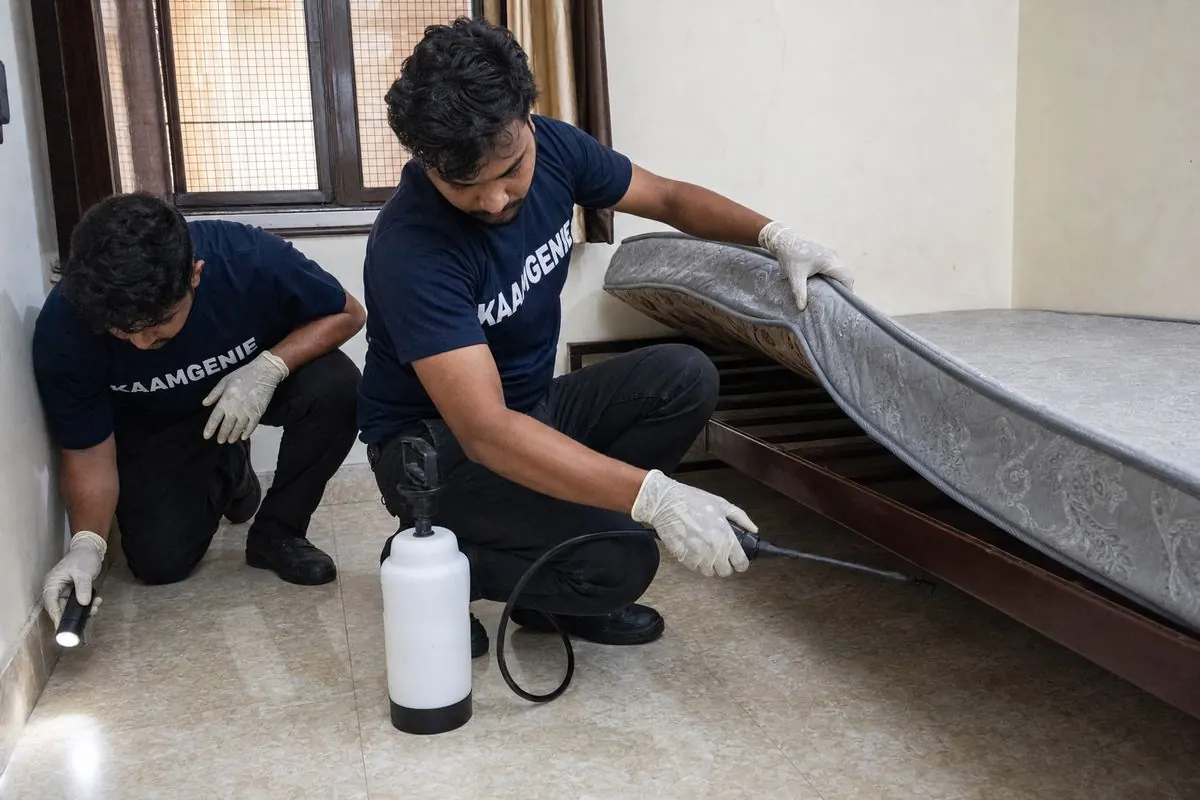
Here is the single most important idea on this page: getting rid of bed bugs permanently takes two treatments, about 14 days apart. This isn’t an upsell — it’s biology. The first treatment knocks out the adults and nymphs that are present. But it can never get every egg, because eggs are hidden and resistant. So you wait roughly two weeks — long enough for the surviving eggs to hatch but not long enough for those new bugs to mature and lay their own eggs — and you treat again. That second visit catches the freshly hatched generation before they can breed, and that’s what breaks the cycle for good. Skip the follow-up and you’re gambling that the first round somehow got every egg. It almost never does.
A proper bed bug treatment, on each visit, looks like this:
- A full inspection. The technician finds every harbourage — mattress, box, frame, headboard, sofa, skirting, even loose wallpaper and the back of the bedside table. You can’t treat what you haven’t found.
- Targeted treatment of the harbourages. Insecticide is worked into the seams, cracks, joints and crevices where the bugs actually live — not just sprayed over surfaces. The products used in licensed work are approved by the Central Insecticides Board & Registration Committee (CIB&RC) and applied at the correct dose.
- Crack-and-crevice work on the room. Skirting, furniture joints, wall cracks near the bed — the routes they use to hide and travel.
- The follow-up after ~14 days. The same harbourages are re-checked and re-treated to kill the new hatch. This is the visit that makes it permanent.
You’ll also hear about heat treatment versus chemical treatment. Honest take: heat (raising a room or contents to a temperature that kills bugs and eggs in one go) is excellent and chemical-free, and it works on eggs — but in Delhi it’s specialist, pricier, and not what most homes need or are quoted. For the vast majority of Delhi bedrooms, PG rooms and flats, the chemical two-cycle is the practical, affordable, effective route, and it’s what we do. Heat earns its place for severe infestations or where someone can’t have chemicals near them — ask and we’ll tell you honestly which your case needs.
How to prep before the technician arrives
This is where you genuinely affect the outcome, and where DIY effort actually helps. A treatment on an unprepped room underperforms, plain and simple — clutter gives bugs places to hide from the chemical, and unwashed linen re-seeds the bed. Do this before the visit:
| Step | What to do | Why it matters |
|---|---|---|
| Strip & hot-wash linen | Wash all sheets, pillow covers, curtains; tumble-dry on the hottest setting for 30+ min, or dry in strong sun | Heat kills bugs and eggs hiding in fabric |
| Bag treated items | Seal washed, dried linen and clothes in plastic bags until treatment is done | Stops re-infestation from a clean source |
| Declutter the room | Clear floor clutter, papers, boxes, and items stored under the bed | Removes hiding spots so chemical reaches the bugs |
| Vacuum seams & cracks | Vacuum mattress seams, headboard, frame joints, skirting; empty the bag/canister into a sealed bag outside immediately | Physically removes bugs and eggs before spraying |
| Pull furniture from walls | Move the bed and sofa a little off the wall | Gives the technician access to hidden harbourages |
| Plan to vacate | Arrange to be out of the treated room for the time the technician advises | Safety for kids, elderly, pregnant women and pets |
One thing people get wrong: don’t throw the mattress out in a panic the day before treatment. A treated mattress is usually fine, and a brand-new mattress on an untreated frame just gets re-infested. We’ll tell you honestly whether yours is salvageable (almost always yes) or genuinely past it (rare — usually only a very old, heavily infested mattress with the foam breaking down).
Where bed bugs hide — and the PG & second-hand furniture trap
If you live in or send a child to a Delhi PG or hostel, this section matters most. Bed bugs are a shared-living and second-hand-furniture problem more than a hygiene problem — they don’t care how clean your room is, they care how close the next sleeping body is. In dense student areas — Mukherjee Nagar, Laxmi Nagar, Kingsway Camp, Old Rajinder Nagar — rooms share walls, furniture gets handed down between tenants, and one infested room quietly seeds the floor. The bug travels in a bag, a mattress, a backpack, a sofa, and sets up next door.
Two rules keep them out. First, inspect any second-hand furniture before it crosses your door — a used mattress, a hand-me-down sofa, a wooden bed from OLX or the kabaadi. Check every seam and joint for blood spots and eggs in good light before you buy or accept it. Second, if you’re moving into a PG or hostel room, inspect the mattress seams and headboard on day one, before you unpack, and raise it with the owner immediately if you see signs — because once your bags touch an infested bed, the problem becomes yours. The chart below shows where the bugs actually concentrate, from what we find on inspections.
Where bed bugs hide in a Delhi home (2026)
Rough share of harbourages we find during inspections, by location.
DIY vs professional — an honest comparison
I’m not going to pretend there’s nothing you can do yourself. Washing and hot-drying linen, vacuuming seams, and decluttering genuinely help — do them. But on the core job of killing every bug and egg in the hiding spots, here’s the honest scorecard.
| Factor | DIY (shop spray) | Professional 2-cycle |
|---|---|---|
| Kills adults you can see | Some | Yes |
| Reaches hidden harbourages | Rarely | Yes — seams, cracks, joints |
| Deals with the eggs | No — they hatch later | Yes — follow-up breaks the cycle |
| Risk of scattering them | High | Low |
| Typical outcome | Back within 2 weeks | Cleared after the follow-up |
| Cost | ₹200–₹500 wasted, usually twice | From ₹1,299/room, done right |
The maths is simple. People rarely spray once — they spray, the bugs return, they spray again, they buy a stronger bottle, and a month later they call us anyway, now more infested and more stressed. Bed bug treatment in Delhi starts from ₹1,299 per room (GST 18% extra) and includes the follow-up that makes it stick. Done once, properly, it’s cheaper than the slow DIY bleed.
Want them gone for good, not just for a fortnight?
The 2-treatment cycle — initial plus a follow-up after 14 days — is what actually breaks the egg cycle. Ask us for a room-by-room quote.
How to stop them coming back
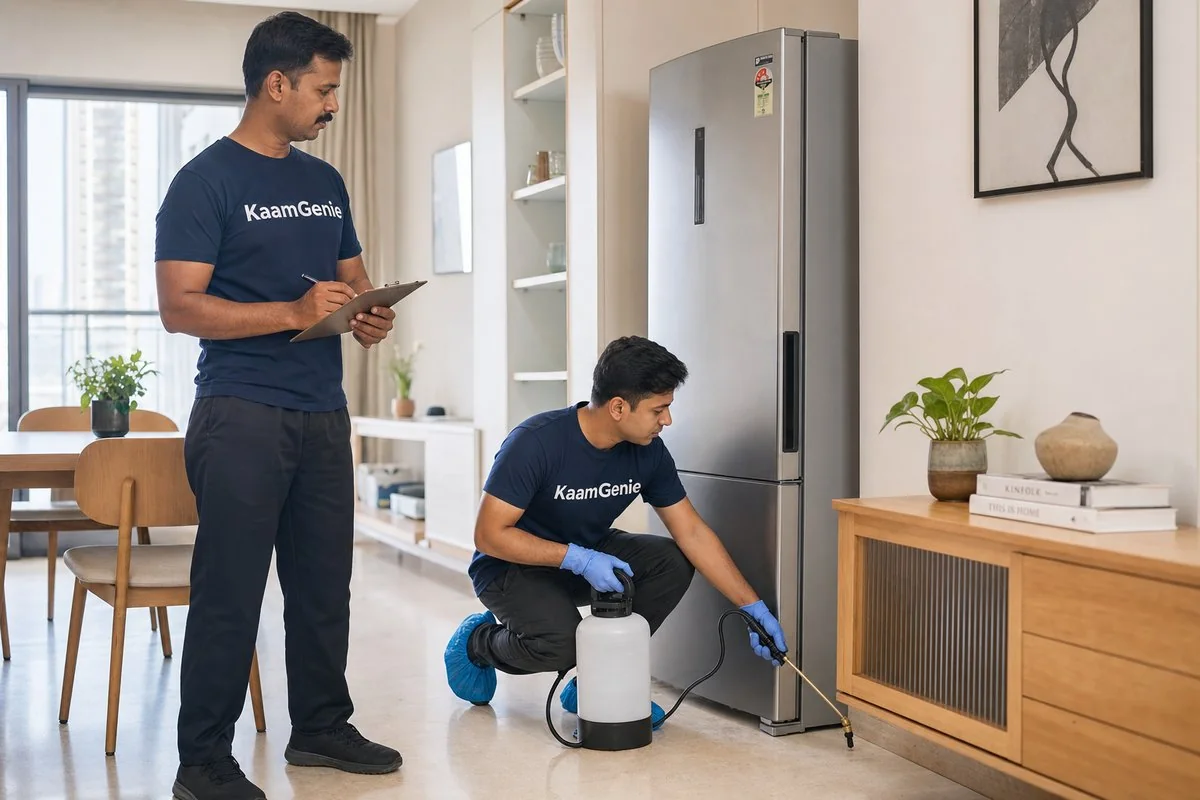
Once you’re clear after the follow-up, a little discipline keeps them gone. None of this is hard; all of it matters.
- Keep checking the seams for a few weeks. A quick look at the mattress and headboard seams every week or two for a month lets you catch any survivor early, when it’s one bug and not fifty.
- Encase the mattress and box. A zip-up bed-bug-proof encasement traps anything missed inside and stops new bugs colonising the seams — cheap insurance, especially in a PG.
- Be ruthless about second-hand furniture. This is the number-one way they re-enter a home. Inspect, or don’t bring it in.
- Watch your luggage when you travel. Bed bugs hitchhike from hotels and trains. Keep bags off the bed, and on return, unpack and hot-dry travel clothes rather than dumping the bag on the mattress.
- Reduce clutter near the bed. Fewer hiding spots means any new arrival has nowhere to settle and is easier to spot.
- If you’re in shared living, act on the whole floor. One treated room beside an infested one will get re-seeded. In a PG, push the owner to treat affected rooms together.
Sleep easy again — we cover Delhi
Bed bugs feel like a private nightmare, but they’re a routine, solvable job when you do it right: confirm the signs, prep the room, treat the harbourages, and — the non-negotiable part — come back after 14 days to kill the hatch. That two-cycle discipline is the whole difference between “gone” and “gone for a fortnight.” If you’d rather a trained technician inspect, treat and follow up so you can actually sleep, that’s exactly what we do. We serve homes, PGs and hostels across Delhi — from Mukherjee Nagar, Kingsway Camp and Old Rajinder Nagar in the north, to Laxmi Nagar and Mayur Vihar in the east, to Saket, Malviya Nagar and Lajpat Nagar in the south, plus Central and West Delhi. Coming soon: Gurgaon, Noida, Faridabad and Ghaziabad. Bed bug treatment from ₹1,299 per room. Call 95603 66362 and let’s get your nights back.
Frequently asked questions
How do I get rid of bed bugs permanently in Delhi in 2026?
Confirm it’s bed bugs (cluster bites, blood spots on the sheet, eggs in mattress seams), then book a professional treatment that runs as a 2-cycle: an initial treatment of all the harbourages plus a follow-up after about 14 days to kill the newly hatched bugs and break the egg cycle. Prep by hot-washing linen, decluttering and vacuuming seams. Bed bug treatment starts from ₹1,299 per room (GST 18% extra). DIY sprays don’t make it permanent because they miss the eggs.
How do I know if I have bed bugs and not mosquito or flea bites?
Bed bug bites usually come in a cluster or a neat line of three or four on skin exposed while sleeping — arms, neck, shoulders, back — and you notice them on waking. The clincher is physical evidence: rust-coloured blood spots and dark pepper-like specks on the sheet, and pale pinhead eggs tucked into mattress seams, the headboard and sofa joints. Mosquito bites are single and scattered; flea bites cluster around the ankles.
Why do bed bugs keep coming back after I spray them?
Because the eggs survive. Shop sprays kill some adults on contact but don’t reach the eggs glued deep into seams and cracks, and most contact sprays do little to eggs anyway. Those eggs hatch within about 10 to 14 days, so a fresh generation appears and it feels like they came back “worse.” That’s why getting rid of them needs a follow-up treatment timed to catch the hatch.
Why does bed bug treatment need two visits?
It’s biology, not an upsell. The first treatment kills the adults and nymphs but can’t reach every hidden egg. You wait about 14 days — long enough for surviving eggs to hatch but not long enough for the new bugs to mature and lay their own — then treat again to kill that fresh generation. The second visit is what breaks the cycle and makes the result permanent.
How much does bed bug treatment cost in Delhi in 2026?
Bed bug treatment in Delhi starts from ₹1,299 per room, with GST 18% extra. That includes the proper 2-cycle — the initial treatment and the follow-up after about 14 days. The exact price depends on the number of rooms and how heavy the infestation is. Be wary of a ₹200–₹500 one-can “spray” with no follow-up; it almost always means a repeat call within a fortnight.
Is heat treatment or chemical treatment better for bed bugs?
Both work. Heat treatment raises the temperature high enough to kill bugs and eggs in one go and uses no chemicals, but in Delhi it’s specialist and more expensive. For most Delhi homes, PG rooms and flats, the chemical 2-cycle treatment is the practical and affordable route and clears the problem well. Heat earns its place for severe infestations or where someone can’t have chemicals near them.
How should I prepare my room before bed bug treatment?
Strip and hot-wash all linen, curtains and affected clothes, then tumble-dry on the hottest setting or dry in strong sun, and seal them in bags. Declutter the room and clear items from under the bed so the chemical can reach the bugs. Vacuum the mattress seams, headboard, frame joints and skirting, then empty the vacuum into a sealed bag outside. Pull the bed and sofa slightly off the wall, and plan to vacate the treated room for the time advised.
Do I need to throw out my mattress if I have bed bugs?
Usually not. A treated mattress is almost always fine, and a brand-new mattress on an untreated frame just gets re-infested, so don’t throw it out in a panic. Only a very old, heavily infested mattress with the foam breaking down genuinely needs replacing — and that’s rare. A bed-bug-proof encasement after treatment traps anything missed and protects the new mattress.
Why are bed bugs common in Delhi PGs and hostels?
Because bed bugs are a shared-living and second-hand-furniture problem, not a hygiene one. In dense student areas like Mukherjee Nagar, Laxmi Nagar, Kingsway Camp and Old Rajinder Nagar, rooms share walls, furniture is handed down between tenants, and bugs travel in bags, mattresses and sofas from one room to the next. They don’t care how clean your room is — only how close the next sleeping person is.
Can bed bugs spread from second-hand furniture?
Yes — it’s one of the most common ways they enter a Delhi home. A used mattress, a hand-me-down sofa or a wooden bed from a reseller can carry bugs and eggs in its seams and joints. Always inspect any second-hand furniture in good light before it crosses your door, checking every seam and join for blood spots and eggs. If in doubt, don’t bring it in.
How can I stop bed bugs from coming back after treatment?
Keep checking the mattress and headboard seams every week or two for a month to catch any survivor early. Use a zip-up bed-bug-proof encasement on the mattress and box. Be strict about inspecting second-hand furniture, watch your luggage when you travel and hot-dry travel clothes on return, and reduce clutter near the bed. If you’re in a PG or hostel, push to treat affected rooms together so a neighbour doesn’t re-seed yours.
Is bed bug treatment safe for children and pets?
When done properly, yes. Tell the technician beforehand about children, pregnant women, asthmatics and pets, vacate the treated room for the time advised, and ventilate afterwards. Licensed pest-control services use CIB&RC-approved products at the correct dose, applied into harbourages rather than sprayed all over. A team that won’t walk you through the safety steps is one to avoid.
Get your nights back — book a proper bed bug treatment
A trained technician inspects, treats every harbourage, and returns after 14 days to break the egg cycle. From ₹1,299 per room. We cover all of Delhi.
Sources & references
- Central Insecticides Board & Registration Committee (CIB&RC) — the Indian regulator that approves the insecticides and doses used in licensed bed bug control.
- Indian Council of Medical Research (ICMR) — publishes research on insect vectors, pest biology and integrated pest management in India.
- National Centre for Disease Control (NCDC) — tracks urban pest and public-health patterns across Indian cities including Delhi.
- WHO — Vector-borne diseases — global reference on insect pests of public-health importance and integrated control.
Last verified: 13 June 2026. If you find any of these links broken, please let us know.