
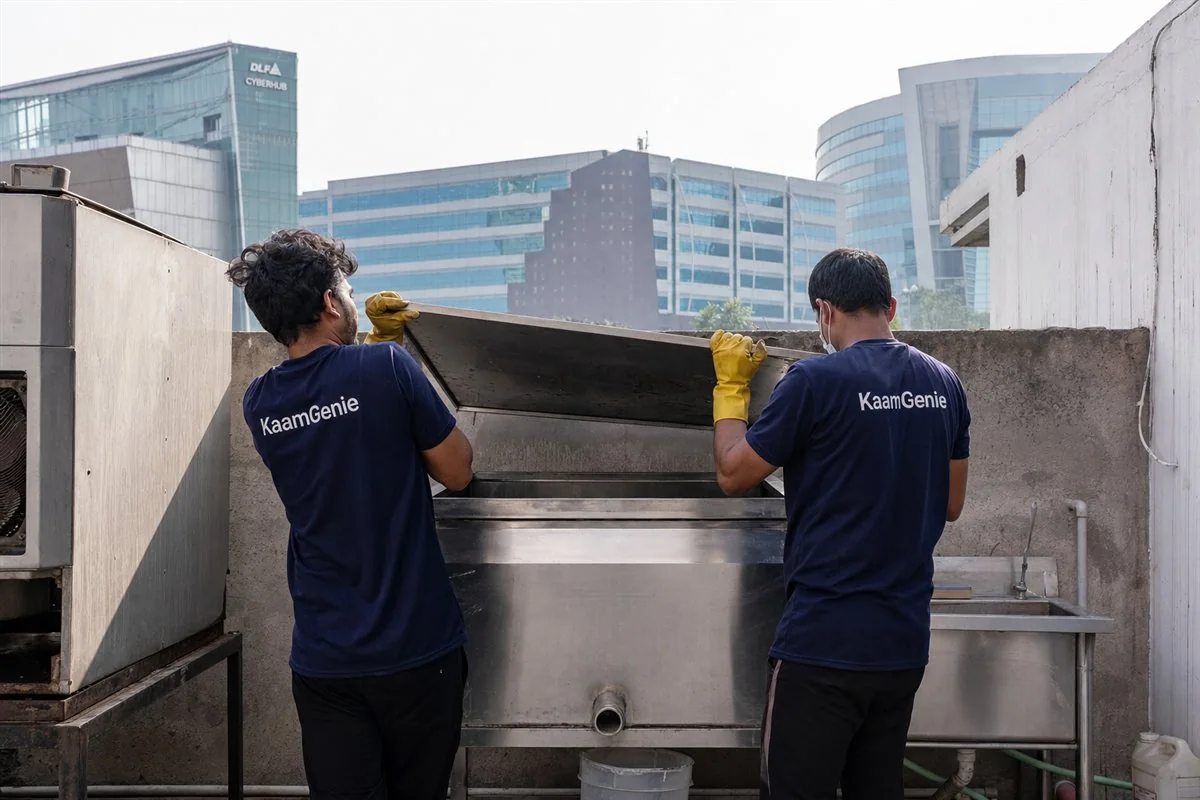
The short answer for food businesses
- FSSAI doesn’t print a fixed date, but it requires potable water and clean storage — a dirty tank fails that
- Practical schedule: clean every 3 months (quarterly); monthly for high-volume kitchens, hotels and banquets
- You need a record: a dated cleaning certificate with photos, food-grade chemical and capacity — for your FSSAI file
- Right chemical only: food-grade sodium hypochlorite at 50–100 PPM, never hardware-shop bleach
- Gurgaon factor: hard borewell water + tanker top-ups build scale and sediment fast in commercial tanks
The cheapest “cleaning” that leaves no certificate is worse than useless to a food business — you can’t show an inspector a rinse.
Gurgaon (Gurugram) is one of the densest food-business markets in the country. The Cyber Hub belt alone packs hundreds of restaurants, bars and QSR counters into a few blocks; Sector 29 and the Golf Course Road hotels run round the clock; and behind almost every glass tower in Cyber City and Udyog Vihar there is a cluster of cloud kitchens cooking for the delivery apps. Every one of those operations holds an FSSAI registration or licence — and every one of them stores water in a tank before it ever reaches a tap, a wash sink, or a pot.
That stored water is the part owners forget. You can buy the best RO system in the city, but if the tank feeding it is full of sludge, biofilm and hard-water scale, you are filtering contaminated water and calling it clean. FSSAI’s hygiene rules care about that tank, and so does any inspector who asks where your kitchen’s water comes from. This guide covers exactly what a food-business tank clean involves in Gurgaon, the certificate you should walk away with, and how often to do it. For the underlying method, our water tank cleaning services page and the water tank cleaning in Gurgaon hub cover the full process.
What FSSAI actually expects of your water storage
There is a common myth that FSSAI mandates tank cleaning “every six months” or “every three months” by name. It doesn’t print a single date. What it does is set out hygiene and sanitary requirements for food businesses, and two of them land squarely on your tank:
- Water used in or around food must be potable — the water that washes vegetables, rinses utensils, makes ice, and goes into cooking has to meet drinking-water quality.
- Storage must be clean and protected from contamination — tanks must be covered, maintained, and kept free of the build-up that breeds bacteria.
Put those together and the obligation is plain: keep the tank clean, and be able to prove it. A tank that hasn’t been opened in two years — with half an inch of sediment on the floor and biofilm on the walls — is not delivering potable water no matter what the municipal supply was like when it arrived. The dated cleaning certificate is how you turn “we keep it clean” into something an inspector can accept.
| Food business | Typical setup | Recommended frequency | Documentation |
|---|---|---|---|
| Standalone restaurant / cafe | Overhead tank + shared UGR | Every 3 months | Certificate + photos per clean |
| Cloud / delivery kitchen | Shared building tank | Every 3 months | Certificate naming your unit |
| QSR / food court counter | Mall or complex reservoir | Quarterly (mall AMC) | Per-tank record on file |
| Hotel / banquet hall | Large UGR + multiple rooftop tanks | Monthly–quarterly AMC | Rolling certificates per tank |
| Bakery / sweet shop / dairy | Overhead + sump | Every 3 months | Certificate + GST invoice |
These are practical schedules built around how hard a kitchen works its water, not a legal minimum. The general guideline for stored potable water is at least twice a year; a food business uses far more, on harder water, so quarterly is the sensible floor and monthly suits the busiest sites.
Get your kitchen tank certified
Full eight-step clean, food-grade disinfection, and a dated certificate plus GST invoice for your FSSAI file. ₹699 onwards for a single tank; commercial custom.
The certificate is the point — what a good one contains
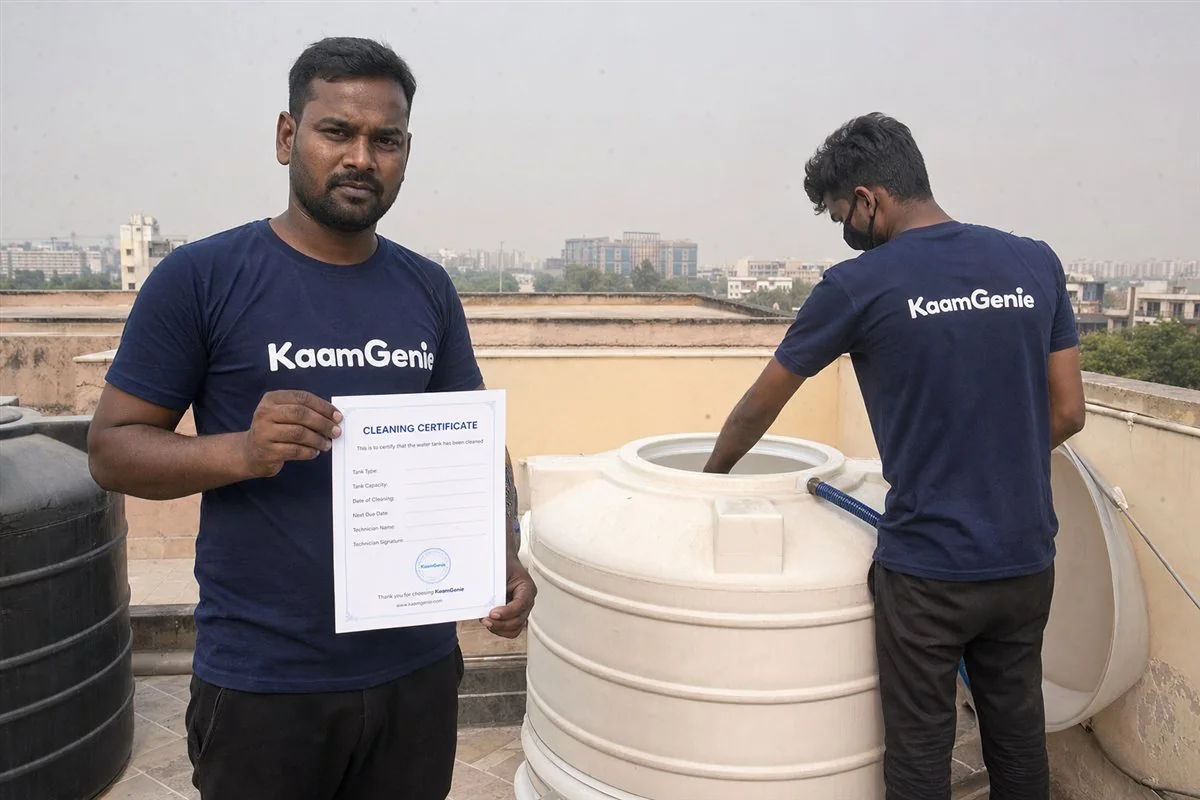
For a home, the certificate is a nice-to-have. For a food business, it is the entire reason the paperwork exists. When an FSSAI inspector or a hygiene auditor asks how you keep your stored water potable, you don’t want to be describing a verbal arrangement with a man who came with a bucket. You want to hand over a document. A usable cleaning certificate names:
- The business name and full address — so it ties to your licence
- The date and time of cleaning
- Each tank cleaned, with its type (overhead, sump, UGR) and capacity
- The food-grade disinfectant used and its concentration
- The crew who did the work
- Before and after photographs
We hand this over after every commercial job in Gurgaon, alongside a proper GST invoice so the expense is clean in your books. Keep them in a single folder — four quarterly certificates on file look immeasurably better at audit time than one you arranged in a panic the week before. A cleaner who finishes in twenty minutes and leaves nothing behind has given you a rinse, and a rinse is something you cannot show anyone.
Why the right chemical matters more in a kitchen
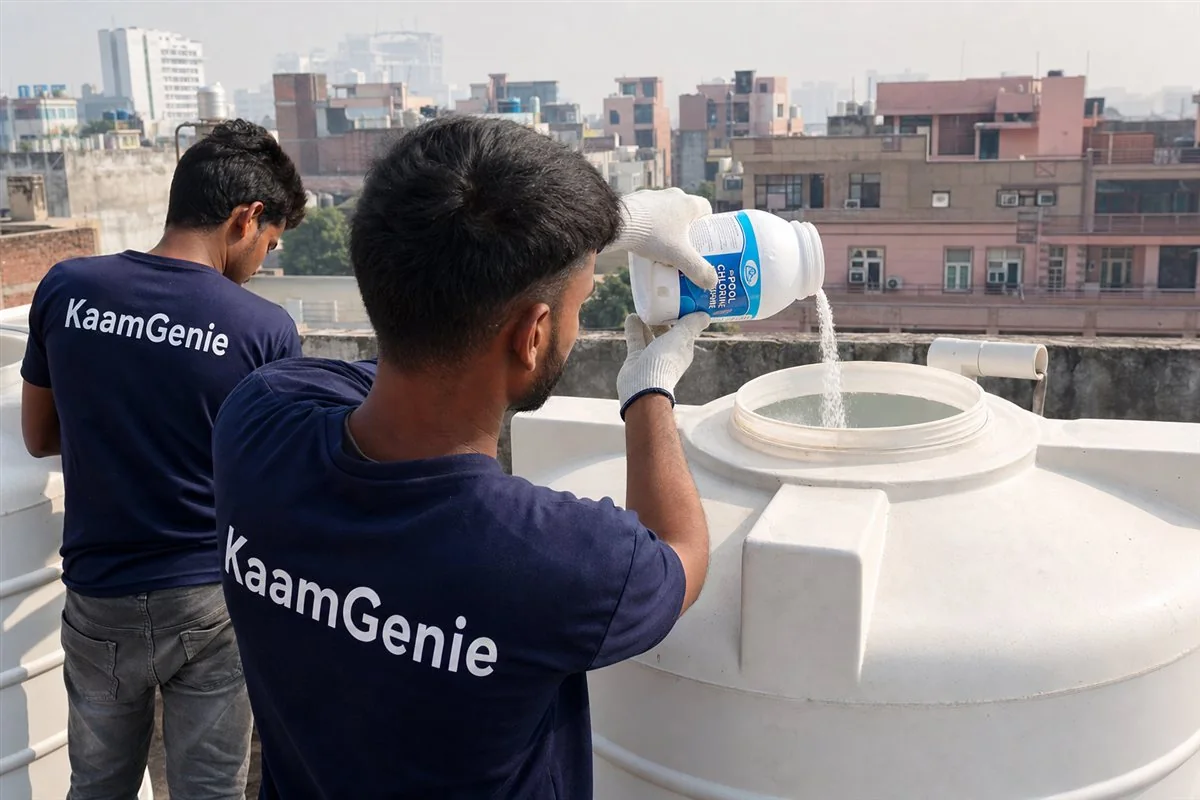
Disinfection is the step that separates a cleaning from a wash, and it is the one cheap operators get wrong most often — either skipping it or using the wrong chemical. For a food business there is no margin for that. We disinfect with food-grade sodium hypochlorite at a controlled 50–100 PPM contact concentration, the same class of chemical used in municipal water treatment and accepted for potable-water systems. It is left to dwell for the proper contact time, then rinsed.
What we never do for a kitchen is reach for industrial bleach or hardware-shop chlorine. Those products carry fragrances, stabilisers and trace contaminants that are fine for a swimming pool and entirely wrong for water that touches food. The food-grade product costs more; for a tank that supplies a working kitchen it is not optional. If you ever read a quote that doesn’t name the disinfectant, that is your sign to ask — the answer tells you whether you are dealing with a professional or a corner-cutter.
The Gurgaon water problem behind every commercial tank
Gurgaon throws two specific problems at a food-business tank, and both make regular cleaning more important here than in many other cities.
Hard borewell groundwater. Large parts of Gurgaon run on hard groundwater, and hardness means scale — calcium and mineral crust on the tank walls, around the inlet and outlet, and on the float valve. Scale isn’t just cosmetic; its rough, porous surface gives bacteria and biofilm somewhere to anchor that smooth plastic doesn’t. Light scale is part of a standard clean; heavy crusted scale needs food-grade descaling, which we flag and quote before we start. Our society and commercial cleaning guide covers how that scales across a whole building.
Heavy tanker reliance. When the municipal and borewell supply falls short — which it routinely does across the commercial belts — kitchens top up from water tankers. Tanker water carries sand and silt that settles thick at the bottom of the tank, and a busy kitchen cycles through far more of it than a household. A commercial tank that hasn’t been opened in a year can hold a surprisingly deep sediment layer. That is exactly the contamination an inspector is worried about, and exactly what a real clean removes.
Recommended cleaning frequency by food-business type — cleans per year
Higher water throughput and bigger reservoirs push the schedule up
Illustrative schedules. The right frequency depends on water source, throughput and tank size — we recommend a plan after a quick survey.
Scheduling around service hours in the Cyber Hub belt
The biggest worry food-business owners raise is downtime, and it is a fair one — a kitchen that can’t run is a kitchen that isn’t earning. In practice this is a scheduling problem, not a blocker. A single restaurant overhead tank is a 75–90 minute job; the shared building underground reservoir most Cyber City and Cyber Hub restaurants draw from is scoped separately and usually done with the building’s facility team.
We plan the work into your off-peak window — early morning before service, or the lull between lunch and dinner — and keep a temporary water supply available where the layout allows, so non-critical tasks continue. For a tank that feeds the whole kitchen, a short, planned pause is almost always smoother than improvising around live cooking. The point is that none of this is a surprise: we agree the timing with you first. Single-counter QSR units inside a mall food court are typically covered by the complex’s own AMC, and we can slot your unit’s record into that or clean it separately. For recurring schedules, our Gurgaon AMC guide explains how the plans lock a lower per-visit rate.
Book FSSAI-ready tank cleaning in Gurgaon
Whether you run a single cafe in Sector 23, a cluster of cloud kitchens in Udyog Vihar, or a full hotel on Golf Course Road, the logic is the same: clean the tank properly, on a sensible schedule, and keep the dated certificate on file. That is what turns “our water is clean” into something you can prove the day an inspector walks in. Browse areas and book on our water tank cleaning in Gurgaon hub, or call us and we’ll scope your kitchen’s tanks in a couple of minutes.
Need a quarterly plan for your kitchen?
Tell us your food-business type, tank setup and area — we’ll build a schedule that keeps you inspection-ready with rolling certificates. Residential ₹699 onwards; commercial custom.
Frequently asked questions
Does FSSAI legally require water tank cleaning for a food business?
Yes, indirectly but firmly. FSSAI’s hygiene and sanitary requirements for food businesses require that water used in or around food is potable and that water storage is kept clean and protected from contamination. A neglected, sludge-filled tank fails that test. So while no rule names a fixed date, keeping your tanks documented and clean is part of staying licence-compliant, and a dated cleaning record is how you prove it.
How often must a Gurgaon restaurant clean its water tank to stay FSSAI-ready?
For a working kitchen we recommend every three months — quarterly — and many busy Cyber Hub and Sohna Road kitchens do it monthly. The general guideline for stored potable water is at least twice a year, but a food business uses far more water, on hard borewell supply and tanker top-ups, so a quarterly schedule keeps the tank consistently safe and gives you four dated certificates a year for inspections.
What does an FSSAI-ready water tank cleaning certificate include?
A usable certificate names the business and address, the date and time of cleaning, each tank cleaned with its type and capacity, the food-grade disinfectant used and its concentration, the crew, and before/after photos. We hand this over after every commercial job in Gurgaon, plus a GST invoice, so it goes straight into your FSSAI compliance file.
What disinfectant is FSSAI-acceptable for a food-business water tank?
Food-grade sodium hypochlorite at a controlled 50–100 PPM contact concentration — the same class of chemical used in municipal water treatment and accepted for potable water systems. We never use industrial bleach or hardware-shop chemicals for a food business, because those carry fragrances, stabilisers and residues that have no place in water that touches food.
We run a cloud kitchen in Udyog Vihar — do we still need tank cleaning records?
Absolutely. A cloud kitchen holds an FSSAI registration or licence just like a dine-in restaurant, and its water still washes produce, utensils and hands. Many cloud kitchens share a building tank with other units, which makes a clear dated record even more important to show your kitchen’s water source is clean. We clean and certify cloud-kitchen tanks across Udyog Vihar and the wider Gurgaon belt.
Will an FSSAI inspector actually ask for tank cleaning proof?
It is a standard line of questioning during a hygiene audit or a renewal inspection, especially after any water-related complaint. Inspectors look at the water source and storage, and a dated cleaning certificate with photos is the fastest way to satisfy that point. Having four quarterly records on file looks far better than scrambling for one the week before an audit.
How long does commercial tank cleaning take for a Cyber Hub restaurant?
A single restaurant overhead tank is usually 75–90 minutes for the full eight-step clean. Most Cyber Hub and Cyber City restaurants also draw from a shared building underground reservoir, which adds time and is scoped separately. We schedule the work around your service hours — typically early morning or between lunch and dinner — so the kitchen is barely disrupted.
Do hotels and banquet halls in Gurgaon need a different cleaning schedule?
Yes. Hotels, banquet halls and large food courts move enormous volumes of water through big underground reservoirs and multiple rooftop tanks, so they typically run a monthly or quarterly AMC with rolling certificates rather than one-off cleans. The schedule is sized to occupancy and event load, and every visit is documented per tank for the property’s FSSAI and audit files.
Can you clean our restaurant tank without shutting the kitchen?
In most cases, yes. We work in your off-peak window and keep a temporary water supply available where the layout allows, so the kitchen can keep running for non-critical tasks. For a tank that feeds the whole kitchen, a short planned pause during cleaning is usually easier than improvising — we agree the timing with you in advance so there are no surprises.
Does hard borewell water in Gurgaon affect a food-business tank clean?
It does. Gurgaon’s groundwater is hard, so commercial tanks build calcium and mineral scale fast, and scale gives bacteria and biofilm somewhere to cling. Light scale is part of the standard clean; heavy crusted scale needs food-grade descaling, which we flag and quote before starting. For a kitchen, clearing that scale matters because it is part of keeping the stored water genuinely potable.
Sources & references
- Bureau of Indian Standards (BIS) — IS 10500:2012 is the canonical Indian Standard for drinking water specification, defining acceptable limits for physical, chemical, and biological parameters.
- WHO Guidelines for Drinking-water Quality, 4th edition — the global reference for water quality standards, including guidance on storage and disinfection.
- Food Safety and Standards Authority of India (FSSAI) — defines water quality requirements for food businesses, including hygiene standards for stored water and acceptable disinfection chemicals.
- WHO Fact Sheet on Drinking Water — overview of safe drinking water requirements and contamination risks.
- CPHEEO — Manual on Water Supply and Treatment — the Government of India’s engineering manual covering tank design, cleaning protocols, and disinfection practices.
Last verified: 29 June 2026. If you find any of these links broken, please let us know.