
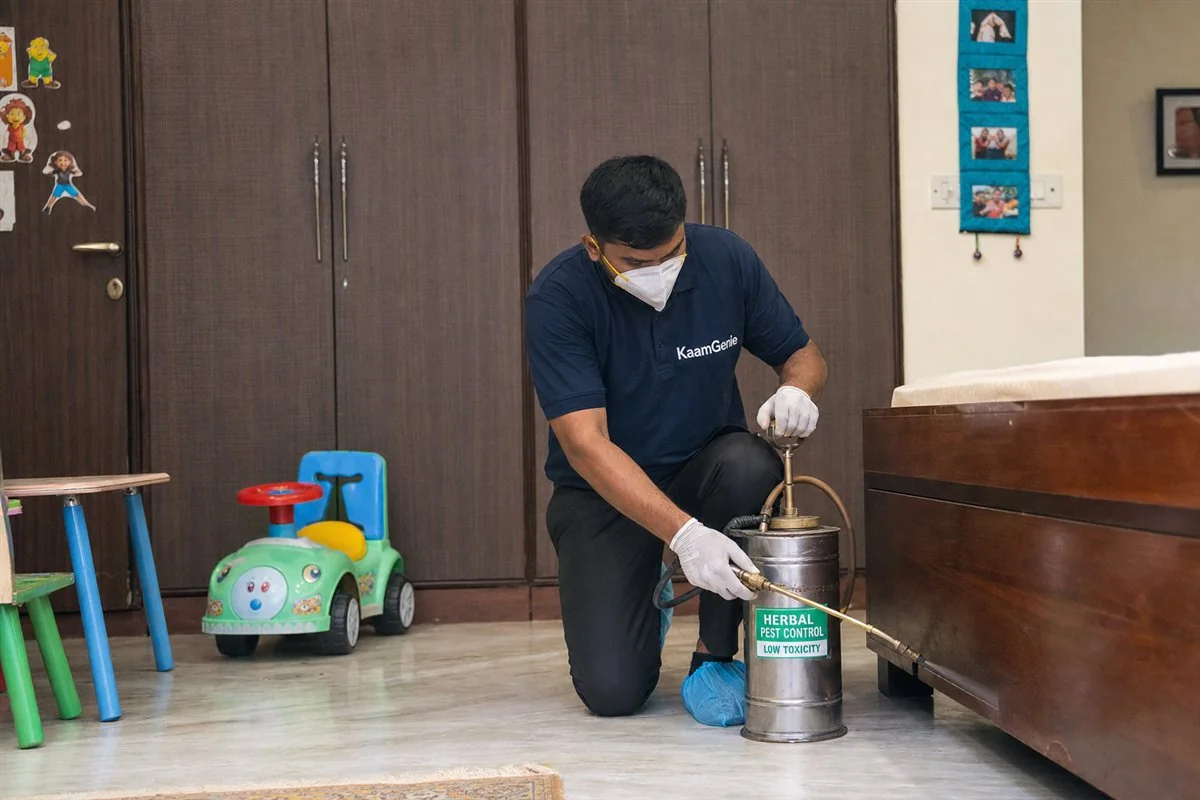
Quick answer — herbal & organic pest control in Delhi (2026)
- What it really means: plant-based or botanical actives (neem, pyrethrum, essential oils), targeted gel baits, and an Integrated Pest Management (IPM) approach that leans on sealing, hygiene and monitoring instead of blanket spraying. ‘Reduced-chemical’ is the honest label — rarely truly ‘zero-chemical’.
- Best for: homes with babies, toddlers, pregnant women, asthmatics, the elderly, or pets — where you want the lowest possible exposure.
- Works well for: cockroaches and ants (gel baits are low-tox and excellent), general maintenance, and mild mosquito or fly issues.
- Where you still need stronger treatment: active termite infestations, heavy bed-bug outbreaks, and serious rodent problems — herbal-only often underperforms here.
- Real cost (2026): usually a small premium — roughly 20–40% over standard. Green home treatment from about ₹1,299 (vs ₹999 standard); green-leaning AMC from about ₹3,499/year. GST 18% extra.
- No honest service claims ‘100% chemical-free and fully effective’ — that’s greenwashing. We cover all of Delhi.
What ‘herbal’, ‘organic’ and ‘green’ pest control actually mean
Let’s start by clearing the fog, because these three words are thrown around loosely and there is no legal definition policing them in India. When a Delhi service says “herbal”, “organic”, “green” or “eco-friendly” pest control, what they should mean — and what a good one does mean — is some combination of these things:
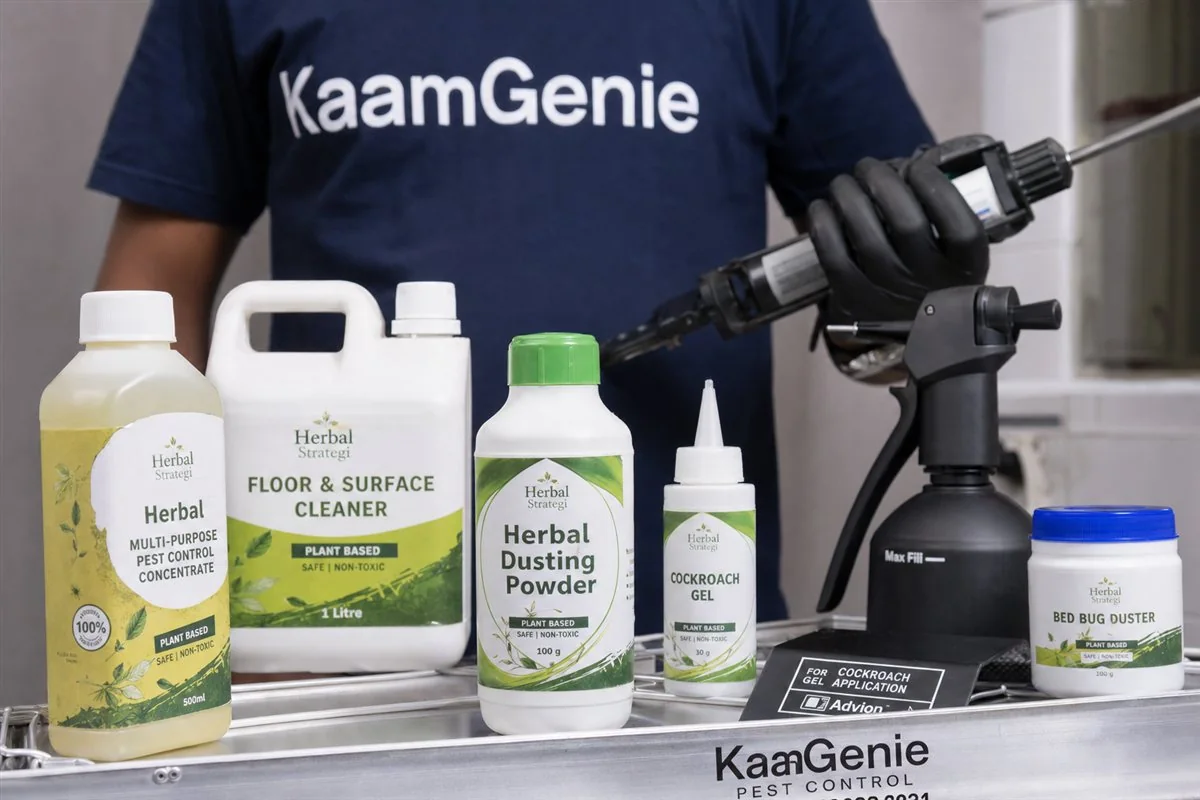
- Botanical / plant-based actives. Ingredients derived from plants rather than purely synthetic chemistry — neem (azadirachtin), pyrethrum (from chrysanthemum flowers), and essential oils such as eucalyptus, lemongrass, citronella, peppermint and clove. These are real insecticides and repellents; they’re just plant-derived and generally break down faster.
- Targeted gel baits instead of blanket spraying. For cockroaches and ants, a tiny dab of bait gel in a cupboard hinge exposes your family to almost nothing — the insect eats it and carries it back to the nest. This is the single biggest “low-tox” win, and ironically it works better than spraying the whole kitchen.
- Integrated Pest Management (IPM). This is the serious, professional version of “green”. Instead of reaching for chemicals first, IPM fixes the causes: sealing entry gaps, fixing leaks, removing food and clutter, fitting mesh, and monitoring — then using the smallest, most targeted treatment only where needed. The Indian Council of Medical Research and global health bodies have promoted IPM for years precisely because it cuts chemical load.
- Reduced-chemical, not always zero-chemical. Here’s the honest bit. Many “herbal” treatments still include a low dose of a conventional, regulated active — just far less of it, and placed precisely. That is still a genuinely good outcome for your family. A service that promises “absolutely no chemicals at all” and total effectiveness is usually overselling one of the two.
One myth worth killing right now: “natural” does not automatically mean “harmless”. Pyrethrum is plant-based but can still irritate asthmatics and is toxic to cats and fish if misused; concentrated essential oils can trigger reactions too. “Herbal” lowers risk — it does not remove the need for sensible precautions. A good Delhi technician will still ask you to ventilate, keep pets out for a couple of hours, and cover the fish tank. If yours doesn’t, that’s a red flag, not a green one.
The honest trade-off: what you gain and what you give up
I’m not going to pretend herbal is a free lunch, because it isn’t. It is a genuine, sensible choice for the right home — but you should walk in knowing the trade-off so you’re not disappointed in three weeks.
What you gain: much lower chemical exposure for the people who matter most — the crawling baby, the asthmatic, the dog that licks the floor. Lower odour, so you’re not evacuating the flat for half a day. Faster re-entry to treated rooms. And, with proper IPM, a longer-term fix because you’ve dealt with why the pests came, not just the ones you could see.
What you give up: a bit of brute-force speed and longevity. Botanical actives like neem and essential oils break down faster in Delhi’s heat and sunlight, so the residual “kill-on-contact” window is shorter than a synthetic. That can mean more frequent visits, or slightly slower knockdown of a heavy infestation. For routine prevention and light problems this barely matters. For a full-blown outbreak that has been ignored for months, herbal-only can feel like bailing a boat with a teaspoon. The smart approach — and what we actually do — is honest about which situation you’re in.
| Factor | Herbal / low-toxicity | Conventional |
|---|---|---|
| Exposure for kids & pets | Much lower | Higher (needs vacating, ventilation) |
| Odour | Mild / herbal | Often strong chemical smell |
| Speed of knockdown | Slower on heavy infestations | Faster |
| Residual life | Shorter (breaks down faster) | Longer |
| Visits needed | Sometimes more frequent | Usually fewer |
| Cost | Small premium (20–40% more) | Baseline |
| Best for | Families, prevention, light–moderate issues | Severe infestations, termites, heavy bed bugs |
Who herbal pest control is genuinely the right choice for
This is where green pest control earns its keep, and where I happily recommend it. If your home includes any of the following, the case for a low-toxicity approach is strong:
- Babies and toddlers who crawl on floors and put hands (and everything else) in their mouths. Their exposure per kilo of body weight is far higher than an adult’s, so cutting the chemical load matters most here.
- Pregnant women, where the sensible instinct is to minimise any avoidable exposure.
- Asthmatics and people with respiratory sensitivity — Delhi already gives their lungs enough to deal with; a strong residual spray indoors can set off a flare.
- The elderly, who are often more sensitive to odours and chemicals.
- Pets — especially cats, fish and birds, which are markedly more sensitive than dogs to certain insecticides.
I won’t go deep on the safety mechanics here because we’ve written a full, careful guide on exactly that — if safety is your main worry, read is pest control safe for babies and pets in Delhi alongside this one. The short version: whether you choose herbal or conventional, the safety of any treatment depends as much on how it’s applied — dosage, placement, ventilation, re-entry time — as on the label on the bottle. Herbal gives you a lower starting point; good technique does the rest.
Want the lowest-exposure option for a home with a baby or pet?
Tell us about your family when you book and we’ll plan a low-toxicity, gel-bait-led treatment — herbal home treatment from ₹1,299 (GST 18% extra).
Which pests herbal handles well — and where you need more
This is the section I wish every “100% herbal” salesperson would read out loud. Low-toxicity methods are excellent for some pests and frankly weak for others. Pretending otherwise is how families end up paying twice. Here’s the straight pest-by-pest picture from what we see across Delhi homes.
| Pest | Low-tox verdict | The honest detail |
|---|---|---|
| Cockroaches | Excellent | Gel baits are inherently low-exposure and highly effective. Herbal’s strongest case. |
| Ants | Excellent | Bait-based control works very well with minimal spraying. |
| Mosquitoes | Good (light–moderate) | Source reduction + botanical larvicides help; heavy/dengue-season may need more. |
| Houseflies | Good | Hygiene, mesh and traps do most of the work — naturally low-chemical. |
| Termites | Limited | An active infestation usually needs a proper regulated termiticide barrier. Herbal-only rarely stops them. |
| Bed bugs | Limited (heavy cases) | Heat treatment is a great low-chemical option, but botanical sprays alone seldom clear a real outbreak. |
| Rats & mice | Limited | Sealing and trapping are low-tox and essential, but a serious rodent problem needs a structured programme. |
So if your issue is cockroaches in the kitchen or ants on the counter — which, for most Delhi flats, it is — herbal/gel-bait-led work is honestly the best approach, not a compromise. For a long-running cockroach problem you want gone for good, our deep-dive on getting rid of cockroaches permanently walks through the same bait-led method. But if a technician swears a few sprays of neem oil will end an established termite colony eating your door frames, walk away. That’s not green — it’s just ineffective, and it’ll cost you a far bigger repair bill later.
What a genuine low-toxicity treatment actually involves
A real green treatment is not “the same spray but they tell you it’s herbal”. Done properly, it’s a slightly different job, and the order matters:
- An inspection and an honest conversation first. The technician should ask who lives in the home — ages, asthma, pregnancy, pets including fish — and look at the actual problem before deciding the method. If they quote before looking, the “herbal” label is marketing.
- Non-chemical fixes done up front (IPM). Sealing cracks and pipe gaps, advising on clutter and food storage, fitting or recommending door sweeps and window mesh, fixing the damp spot under the sink. This removes the reason pests keep coming and means less product is needed at all.
- Targeted baits and botanical actives where treatment is needed. Gel baits in hinges and voids for roaches and ants; neem/pyrethrum or essential-oil based formulations on surfaces where appropriate; botanical larvicides for water spots. Precise placement, not blanket fogging.
- A small, low-dose conventional product only if the situation demands it — with your consent. A good service tells you honestly: “the herbal route will hold this, but for the termite line we need a proper barrier — here’s why.” That transparency is the whole point.
- Monitoring and a return plan. Because botanicals fade faster, a follow-up or an AMC is often part of the deal. You get before/after photos and a clear GST invoice for your records — not vague verbal promises.
Notice what’s not on that list: a dramatic chemical fog, a 24-hour evacuation, or a guarantee that you’ll never see an insect again. Anyone offering all three at once is selling you something that doesn’t exist.
Not sure if herbal is enough for your problem?
Send us a photo on WhatsApp. We’ll tell you honestly whether a green treatment will fix it or whether you need something stronger — no upsell.
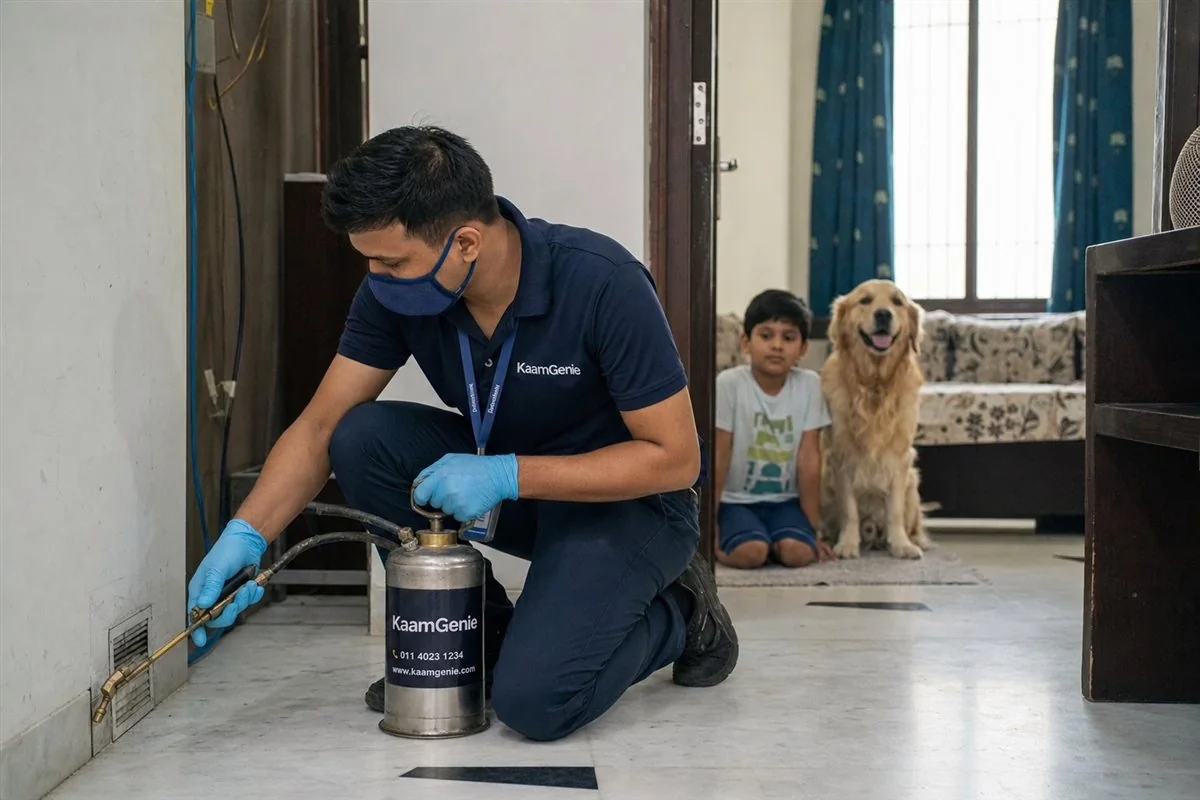
Real cost of herbal pest control in Delhi (2026)
Here’s the question everyone actually wants answered: does going herbal cost more? Usually yes, but less than people fear — it’s a small premium, not double. Botanical products and good gel baits cost more per litre than bulk synthetics, and IPM takes more of the technician’s time (inspecting, sealing, advising), so you’re paying for care and better ingredients. Expect roughly 20–40% over the standard price. Here’s the honest 2026 range, with GST 18% extra on all of it.
| Service | Standard price | Herbal / green-leaning |
|---|---|---|
| General / home treatment (1–2 BHK) | From ₹999 | From ₹1,299 |
| Cockroach gel-bait treatment | From ₹599 | From ₹799 |
| Mosquito control (one-time) | From ₹699 | From ₹999 |
| Annual pest control AMC | From ₹2,999/year | From ₹3,499/year |
| Termite treatment (regulated, needed for active colonies) | From ₹2,499 | Conventional barrier advised |
My honest recommendation for a young Delhi family: don’t obsess over “is every drop herbal”. Get a gel-bait-led home treatment with IPM from around ₹1,299, or a green-leaning AMC from about ₹3,499 a year so someone keeps the home covered without you having to think about it. That combination gives a baby-and-pet home the low exposure it wants for the pests that actually turn up — roaches, ants, the odd mosquito — at a premium most families find fair.
The green premium — standard vs herbal home treatment in Delhi (2026)
Typical starting prices for a 1–2 BHK general home treatment, GST extra. The gap is a modest premium, not a doubling.
How to spot real green pest control vs greenwashing
Because nobody regulates the word “herbal” in this business, the label alone tells you very little. What separates an honest low-toxicity service from a sticker is behaviour. Here’s what I’d look for, and what should make you put the phone down.
Good signs: they ask about your family and pets before quoting; they name what they actually use (neem, pyrethrum, specific gel baits, IPM) rather than just “herbal solution”; they’re willing to say a pest needs a stronger product and explain why; they still advise ventilation and pet precautions; and they give you before/after photos and a GST invoice. Crucially, they use CIB&RC-registered products — even botanical and bio-pesticides used professionally in India should be registered with the Central Insecticides Board & Registration Committee. Ask. A real service answers without flinching.
Greenwashing red flags: “100% chemical-free and 100% effective on everything” (pick one — you can’t have both); “completely harmless, no precautions needed” (untrue even for botanicals); a price identical to or cheaper than standard with no explanation (good botanicals and IPM cost more, not less); and a refusal to name the actual products. If the whole pitch is the word “herbal” in a bright green font and nothing underneath it, you’re buying a colour, not a method.
The genuinely green approach is also the genuinely honest one: lower exposure where it’s possible, a clear-eyed admission of where you still need conventional treatment, and respect for your family enough to tell you the difference. That’s the standard we hold ourselves to across Delhi — from Saket, Greater Kailash and Vasant Vihar in the south, to Dwarka and Janakpuri in the west, to Mayur Vihar and Preet Vihar in the east. If you want the low-toxicity route done properly — and an honest answer about whether it’s right for your problem — call 95603 66362 and just ask. No upsell, no scare tactics.
Frequently asked questions
What does herbal or organic pest control actually mean in Delhi?
It means a low-toxicity approach: plant-based actives such as neem, pyrethrum and essential oils, targeted gel baits instead of blanket spraying, and Integrated Pest Management (IPM) — sealing entry points, fixing damp and clutter, and treating precisely only where needed. The honest label is ‘reduced-chemical’: many herbal treatments still use a small, low dose of a regulated product, just far less of it and placed carefully.
Is herbal pest control completely chemical-free?
Usually not, and be wary of anyone who promises it is. Most genuine ‘herbal’ treatments still include a small amount of a regulated active alongside botanical ingredients — the win is dramatically lower exposure, not zero chemistry. Also remember ‘natural’ doesn’t mean harmless: pyrethrum and concentrated essential oils can still irritate asthmatics and harm cats or fish if misused, so sensible precautions still apply.
Is herbal pest control safe for babies and pets?
It’s designed to be the lowest-exposure option, which is exactly why families with babies, toddlers, pregnant women, asthmatics or pets choose it. But safety depends as much on technique — dosage, placement, ventilation and re-entry time — as on the ingredients. Tell the technician about children, pregnancy, asthma, fish tanks and pets, ventilate after, and keep pets out for the advised time. See our full guide on whether pest control is safe for babies and pets in Delhi.
Which pests does herbal pest control work well on?
It works excellently on cockroaches and ants, because gel baits are both low-exposure and highly effective. It works well for houseflies and for light-to-moderate mosquito issues through source reduction and botanical larvicides. It is weaker on active termite colonies, heavy bed-bug outbreaks and serious rodent problems, which usually need stronger or more structured treatment.
Where is herbal pest control NOT enough?
Active termite infestations, heavy bed-bug outbreaks, and serious rat or mouse problems. For termites you generally need a proper regulated termiticide barrier; herbal sprays rarely stop an established colony. For heavy bed bugs, heat treatment is a great low-chemical option but botanical sprays alone seldom clear a real outbreak. An honest service will tell you when you need to step up.
How much more does herbal pest control cost in Delhi in 2026?
Usually a small premium of roughly 20–40% over standard, not double. A herbal home treatment for a 1–2 BHK starts around ₹1,299 (vs ₹999 standard), a gel-bait-led cockroach treatment from about ₹799 (vs ₹599), and a green-leaning annual AMC from about ₹3,499 a year (vs ₹2,999). GST 18% is extra. The premium reflects better ingredients and the extra time IPM takes.
Why is herbal pest control sometimes more expensive than conventional?
Because good botanical products and quality gel baits cost more per litre than bulk synthetics, and because the IPM method takes more of the technician’s time — inspecting, sealing gaps, advising on hygiene and following up. You’re paying for care and ingredients, not just a quick spray. If a ‘herbal’ quote is cheaper than standard with no explanation, be suspicious.
Does herbal pest control last as long as conventional?
Often not quite. Botanical actives like neem and essential oils break down faster in Delhi’s heat and sunlight, so the residual window is shorter than a synthetic. For routine prevention and light problems this barely matters, but a heavy infestation may need more frequent visits. That’s why a green-leaning AMC, with scheduled return visits, is often the better-value choice for families.
Is ‘natural’ pest control automatically harmless?
No. This is the most common misconception. Pyrethrum is plant-derived but can irritate asthmatics and is toxic to cats and fish if misused, and concentrated essential oils can cause reactions too. Herbal lowers the risk compared with strong synthetics, but it doesn’t remove the need to ventilate, keep pets away briefly, and cover aquariums. A technician who says ‘no precautions needed at all’ is overselling.
How do I tell real green pest control from greenwashing?
Good signs: they ask about your family and pets before quoting, name the actual products and methods (neem, pyrethrum, gel baits, IPM), admit when a pest needs something stronger, still advise precautions, and give before/after photos and a GST invoice using CIB&RC-registered products. Red flags: claims of ‘100% chemical-free and 100% effective on everything’, ‘completely harmless, no precautions’, a price suspiciously equal to or below standard, and refusing to name what they use.
Should babies and pets stay out during a herbal treatment?
Yes, briefly, as a sensible precaution even with low-toxicity products. Keep children and pets out of treated rooms for the short time the technician advises (often an hour or two), ventilate afterwards, and wipe down food-prep surfaces before use. Gel baits placed inside cupboard voids and hinges are very low-exposure, but it’s still good practice to keep curious toddlers and pets away from application points.
Can I get an organic pest control AMC for my Delhi home?
Yes. A green-leaning annual maintenance contract from around ₹3,499 a year (GST extra) gives a family home scheduled, low-toxicity visits across the year — ideal because botanicals fade faster and benefit from regular top-ups. It typically covers cockroaches, ants, general pests and seasonal mosquito control. Active termite or heavy bed-bug issues are usually handled as separate, stronger treatments when needed.
Low-toxicity pest control, done honestly
Tell us who’s at home — baby, pet, asthma — and we’ll plan the lowest-exposure treatment that actually works, and say so plainly if a pest needs more. We cover all of Delhi.
Sources & references
- Central Insecticides Board & Registration Committee (CIB&RC) — the Indian regulator that registers pest-control products, including botanical and bio-pesticides used professionally.
- Indian Council of Medical Research (ICMR) — publishes guidance on Integrated Pest Management (IPM) and reducing chemical load in vector and pest control.
- WHO — Vector-borne diseases — global reference on integrated, source-reduction-led control that minimises reliance on chemical spraying.
- National Centre for Disease Control (NCDC) — tracks urban pest and vector patterns across Indian cities including Delhi.
Last verified: 30 June 2026. If you find any of these links broken, please let us know.