
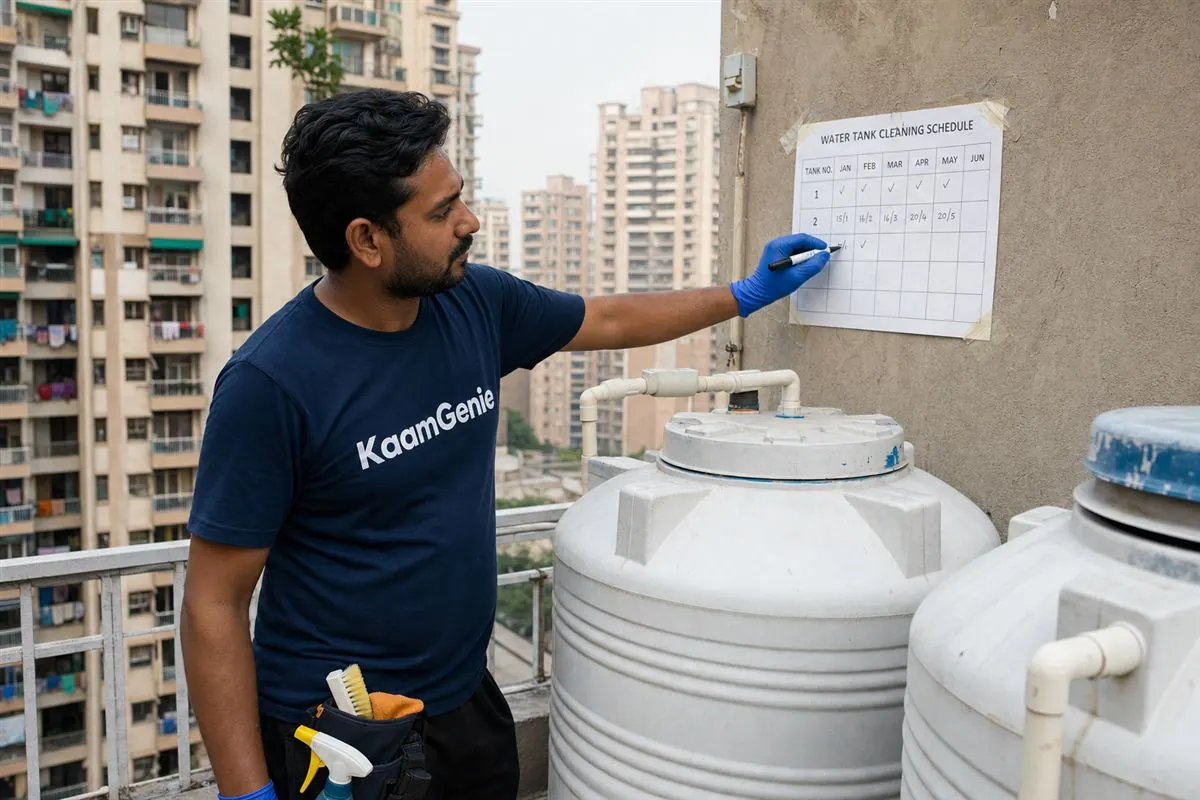
The short answer
- The baseline is every ~6 months. BIS IS 10500 and CPHEEO guidance support cleaning stored drinking-water tanks at least about twice a year.
- But six months is a floor, not a target. It assumes good, soft incoming water.
- Hard borewell sectors & Greater Noida West → quarterly. Calcium and iron scale return fast on groundwater.
- Treated Ganga municipal supply → biannual is fine — if it’s genuinely not blended with borewell.
- High-rise UGR + tower societies → quarterly, staged tower-by-tower so no block loses water.
- Restaurants & commercial kitchens → monthly to quarterly for FSSAI compliance.
- New-possession towers → clean immediately, then quarterly.
Start at six months, then shorten it for every risk factor you have. For most Noida buildings, that lands on quarterly.
Where the “every six months” figure comes from
If you search how often a tank should be cleaned, you’ll see “every six months” repeated everywhere. That number isn’t made up — it’s the practical baseline drawn from Indian standards. BIS IS 10500 is the canonical specification for drinking-water quality, and the CPHEEO Manual on Water Supply and Treatment (the Government of India’s engineering reference) covers storage and disinfection practice. Neither puts a single hard number into law for a domestic tank, but together they establish a clear principle: stored drinking-water tanks should be cleaned and disinfected on a regular cycle, and roughly every six months is the accepted floor for reasonably good incoming water.
The key word there is floor. Six months is the point below which you are clearly under-maintaining — it is not the schedule that keeps every tank genuinely clean. The right frequency depends on two things the standard can’t know about your building: what your water is like, and how your storage is set up. In Noida, both of those usually push the schedule shorter, not longer.
Why Noida’s water pushes the schedule shorter
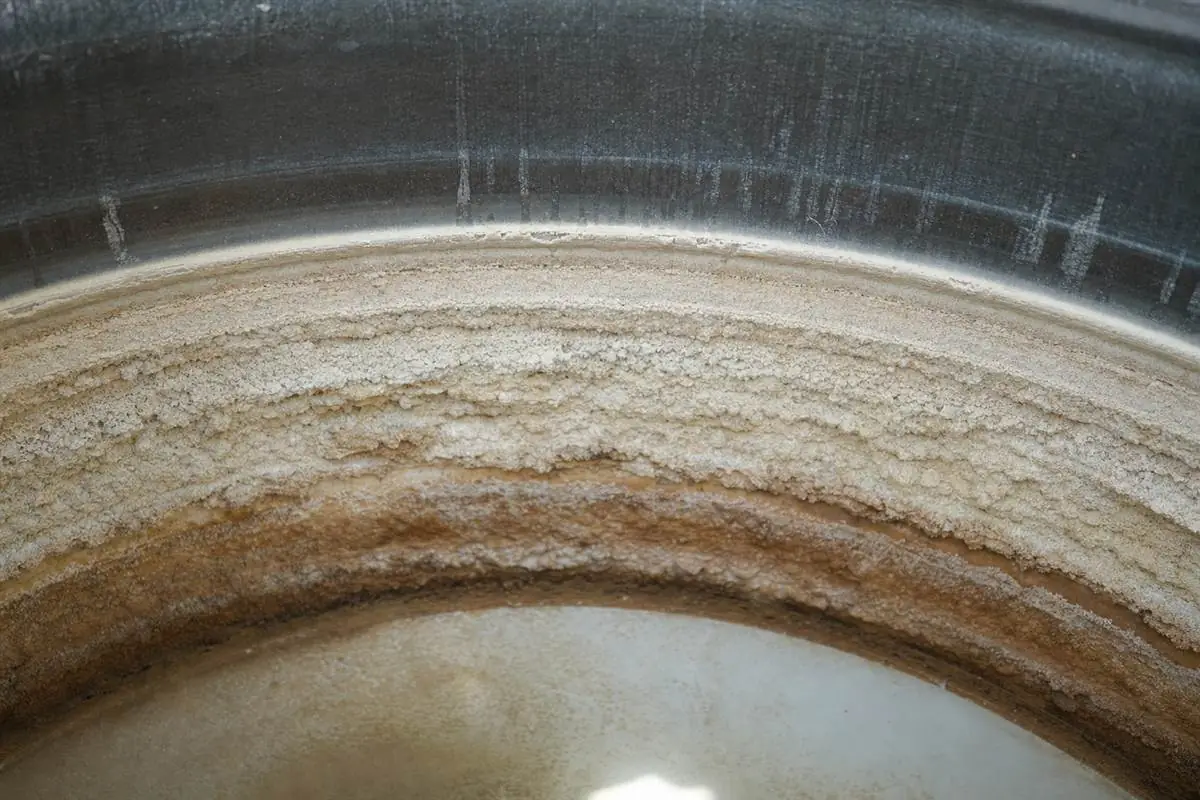
Large parts of Noida and especially Greater Noida West (Noida Extension) run on borewell and groundwater that is genuinely hard — high in calcium and iron. Even where the Noida Authority Jal Vibhag supplies treated Ganga water, many sectors blend in or fall back on borewell during shortfalls and the summer peak. That mineral load doesn’t stay dissolved. It drops out as chalky calcium scale and rust-coloured iron sediment on the walls and floor of your tank, and it does so far faster than it would on soft, treated municipal water.
The practical consequence is simple: a tank on hard water that’s cleaned every six months is already re-scaling and collecting sediment well before the next visit is due. The water looks fine for a while, then the bottom layer builds back up and the “clean” you paid for is half gone. We’re not going to re-explain the chemistry of how that scale forms here — our companion piece on Noida hard water tank cleaning covers why it happens in detail. The point for this article is what it does to your schedule: hard water means a shorter cycle, full stop.
| Your situation | Recommended frequency | Why |
|---|---|---|
| Home on treated Ganga municipal supply | Every 6 months (biannual) | Soft, treated water; BIS/CPHEEO baseline is enough |
| Home on hard borewell / Greater Noida West | Every 3 months (quarterly) | Calcium & iron scale returns fast on groundwater |
| High-rise society (UGR + tower tanks) | Quarterly, staged tower-by-tower | Shared source feeds hundreds of flats; mostly borewell-blended |
| Restaurant / commercial kitchen | Monthly to quarterly | FSSAI hygiene standard; high water throughput |
| New-possession flat or tower | Immediately, then quarterly | Construction debris in tanks at handover |
| Exposed rooftop Sintex tank, summer | Shorten by one cycle | Warm stored water speeds bio-film growth |
Not sure which cycle is yours?
Tell us your sector and water source and we’ll recommend an honest schedule — no upsell. Residential cleaning ₹699 onwards; society/UGR custom-quoted.
The Noida cadence, scenario by scenario
The table above is the quick version. Here’s the reasoning behind each row, because the right answer genuinely depends on your situation.
Homes on treated Ganga municipal supply — every 6 months
If your flat or house genuinely runs on the Noida Authority Jal Vibhag treated Ganga supply and that water isn’t blended with borewell, you’re in the best case. The water is relatively soft and already disinfected, so it scales tanks slowly. A biannual clean — in line with the BIS/CPHEEO baseline — keeps it genuinely clean. The honest caveat: many sectors switch to or top up with borewell during summer shortfalls, so confirm what actually comes out of your tap before you settle on a six-month cycle.
Homes on hard borewell water / Greater Noida West — quarterly
This is the most common situation across newer Noida and the Noida Extension belt, and it’s the one where the six-month default fails. On hard groundwater, open your tank at the four-to-five-month mark and you’ll usually already find a sediment layer forming and scale on the walls. Quarterly is what it takes to stay ahead of it. If you’re in a borewell-fed pocket like Sector 150 or across the wider Greater Noida West belt, treat quarterly as your default and review after the first year.
High-rise societies (UGR + tower tanks) — quarterly, staged
A high-rise stores water in two stages — a shared underground reservoir (UGR) that receives the incoming supply, and each tower’s rooftop overhead tanks that gravity-feed the flats. Both have to be on the schedule, because cleaning only the rooftop tanks leaves the source dirty. Since most societies run partly on hard borewell water and that single UGR feeds hundreds of homes, quarterly is the right cadence. The work is staged compartment-by-compartment and tower-by-tower so no block ever loses water — which is exactly what makes a four-times-a-year schedule practical. Our dedicated guide to society and high-rise water tank cleaning in Noida walks through the staging and the AOA/RWA contract in full.
Restaurants & commercial kitchens — monthly to quarterly
Food businesses are a different category. They’re held to an FSSAI hygiene standard for stored water, and a busy kitchen cycles far more water through its tank than a flat does. A high-throughput restaurant or cloud kitchen often cleans monthly; a lighter-use café or office pantry may be fine at quarterly. The deciding factors are your water usage and what an FSSAI auditor expects to see — and the simple fact that one contaminated tank can shut a food business down. Keep the certificate from every clean as your compliance record.
New-possession flats and towers — immediately, then quarterly
If you’ve just taken possession in a newly handed-over tower — very common in Greater Noida West and along the Expressway corridor — don’t assume the tank is clean because the building is new. New towers routinely carry construction debris: cement slurry, sand, grit and pipe-flushing residue left in the UGR and rooftop tanks from the build itself. The builder’s housekeeping rarely does a real food-grade clean. Commission a full clean at move-in, document it as your baseline, then start a quarterly schedule from there.
Exposed rooftop Sintex tanks in summer — shorten by a cycle
A plastic overhead tank sitting in direct Noida sun runs warm, and warm stored water encourages bio-film and bacterial growth faster than cool water. If your rooftop tank has no shade or insulation and the water genuinely heats up through May and June, lean toward the shorter end of your range and get the clean done before the peak rather than after. The exact seasonal timing matters enough that it’s a topic in its own right — see our piece on the best time of year to clean a water tank in Noida for the calendar logic.
How fast scale returns — relative sediment build-up by month
Why hard-water tanks can’t wait a full six months between cleans
Illustrative, not measured: on hard Noida borewell water the same sediment and scale that takes a soft-water tank six months to accumulate shows up in roughly three — which is why the quarterly cycle exists. Actual build-up depends on your water hardness, tank material and usage.
A simple decision framework
You don’t need a water-quality lab to set your schedule. Start at the baseline and shorten it for each risk factor that applies to you:
- Start at every 6 months — the BIS/CPHEEO floor for any drinking-water tank.
- Hard borewell water or Greater Noida West? Move to quarterly.
- Shared high-rise UGR feeding many flats? Quarterly, both stages, staged.
- Food business? Monthly to quarterly, driven by FSSAI and usage.
- Exposed rooftop tank that heats up in summer? Shorten by one cycle.
- Newly handed-over tower? Clean now, then quarterly.
If none of those apply, biannual is genuinely fine and quarterly would be over-servicing — we’ll tell you so. If one or more apply, which is the case for most Noida buildings, quarterly is the realistic schedule. And the final tie-breaker is free: open the lid at the halfway point. If there’s already a sediment layer or scale returning, your tank has just told you it needs the shorter cycle. The early warning signs that a tank needs cleaning are worth knowing so you can read it correctly.
Putting the schedule on autopilot
The hardest part of any cleaning cadence isn’t the cleaning — it’s remembering to do it. The tank is out of sight on the roof or underground, the water looks fine for months, and the next clean quietly slips from “quarterly” to “whenever someone notices.” That’s how a tank that should be done four times a year ends up cleaned once.
The fix is to take the decision off your plate with a fixed-schedule contract. An annual maintenance plan (AMC) for Noida books the cleans in advance — quarterly dates on the calendar, advance reminders, a certificate after each visit — so the cadence actually happens instead of being something you keep meaning to arrange. For societies it’s the same principle scaled up: four dates a year on the committee calendar with a per-tank certificate each time.
Lock in a quarterly schedule
We’ll set the right cadence for your water source and put it on a fixed calendar with a certificate after every clean. Residential ₹699 onwards; society/UGR custom-quoted.
Set your schedule and book across Noida
Whether you’re a single flat on borewell water, a committee fixing a long-neglected reservoir, or a new owner who just got possession, the principle is the same: start at the six-month baseline, shorten it for your water and your building, and then actually stick to it. We clean to the full professional standard on every visit and set an honest cadence — six months where that’s genuinely enough, quarterly where the water demands it. Start at our water tank cleaning in Noida hub for sector coverage and booking, or see specific belts like Sector 137 and Greater Noida West.
To book, call +91 95603 66362 or use the booking form on this site — we’ll confirm shortly.
Frequently asked questions
How often should I clean my water tank in Noida?
For most Noida homes the honest answer is every 3 to 6 months. The BIS IS 10500 and CPHEEO baseline for stored drinking-water tanks is roughly twice a year, and that is a sensible floor if your supply is treated municipal water. But large parts of Noida and Greater Noida West run on hard borewell groundwater that scales tanks faster, so a quarterly clean is the realistic target there. Set six months as your minimum and move to quarterly if your water is hard, your tank sits in summer sun, or you see sediment returning early.
What does the BIS / CPHEEO standard actually say about cleaning frequency?
Indian guidance does not put a single hard number in law for domestic tanks, but the practical baseline drawn from BIS IS 10500 (drinking-water specification) and the CPHEEO Manual on Water Supply and Treatment is that stored drinking-water tanks should be cleaned and disinfected at least about every six months. That figure assumes reasonably good incoming water. It is a minimum, not a target — it is the point below which you are clearly under-maintaining, not the schedule that keeps a hard-water tank genuinely clean.
I live in a hard-borewell sector like Greater Noida West — how often should I clean?
Quarterly. Hard borewell groundwater is high in calcium and iron, and those minerals drop out as scale and rust-coloured sediment on tank walls and floors far faster than they would on soft treated water. On a six-month cycle a hard-water tank is already re-scaling and accumulating sediment well before the next clean. A three-month cycle keeps it genuinely clean rather than clean-on-paper. If you are in Greater Noida West, Sector 150, or any newer borewell-fed pocket, treat quarterly as the default.
My society gets treated Ganga water from the Noida Authority — can I clean less often?
If your supply is genuinely treated surface water (the Noida Authority Jal Vibhag Ganga supply) and not blended with borewell, then biannual — every six months — is a reasonable schedule, in line with the BIS/CPHEEO baseline. The catch is that many Noida sectors switch to or blend in borewell water during shortfalls and summer peaks, so the water is not always as soft as it is on paper. If you ever see scale or sediment returning before six months, move to quarterly regardless of what the supply is labelled.
How often should a high-rise society with a UGR and tower tanks be cleaned?
Quarterly, staged tower-by-tower. A high-rise stores water in two stages — a shared underground reservoir (UGR) and each tower’s rooftop overhead tanks — and both have to be on the schedule. Because most Noida societies run partly on hard borewell water and the UGR is the single source feeding hundreds of flats, a three-month cycle is the right cadence. The work is staged compartment-by-compartment and tower-by-tower so no block loses water, which makes a quarterly schedule practical rather than disruptive.
How often should a restaurant or commercial kitchen clean its tank in Noida?
More often than a home — monthly to quarterly depending on usage and an FSSAI auditor’s expectations. Food businesses are held to a hygiene standard for stored water, and a busy kitchen cycles far more water through its tank than a flat does. A high-throughput restaurant or cloud kitchen often cleans monthly; a lighter-use café or office pantry may be fine quarterly. The deciding factor is your FSSAI compliance and the fact that one bad tank can shut a food business down.
We just got possession of a new flat or tower — when should the first clean be?
Immediately, before you treat the water as drinkable. New towers in Greater Noida West and along the Expressway routinely carry construction debris — cement slurry, sand, grit and pipe-flushing residue — left in the UGR and rooftop tanks from the build. The builder’s housekeeping rarely does a real food-grade clean. Commission a full clean at handover or move-in, document it as your baseline, then start a quarterly schedule from there.
My overhead Sintex tank is on an exposed rooftop — does summer heat change the schedule?
Yes. An overhead plastic tank sitting in direct Noida summer sun runs warm, and warm stored water encourages bio-film and bacterial growth faster than cool water does. If your rooftop tank has no shade or insulation and the water genuinely heats up through May and June, lean toward the shorter end of your range — clean before the peak summer months rather than after. The seasonal timing of that clean is worth getting right, which is a topic on its own.
Is quarterly cleaning overkill — am I just being upsold?
It is a fair question, and the honest answer is: it depends on your water. On soft treated municipal supply, six months is genuinely enough and quarterly would be over-servicing. On the hard borewell water that feeds much of Noida and Greater Noida West, quarterly is not an upsell — it is what it takes to keep the tank actually clean, because the scale comes back that fast. The simplest test is to look inside at six months: if there is already a sediment layer or scale returning, your tank is telling you it needs the shorter cycle.
What is the simplest way to decide my own cleaning frequency?
Start at the six-month BIS/CPHEEO baseline, then shorten it for each risk factor you have: hard borewell water, a high-rise shared UGR, an exposed rooftop tank in summer heat, a food business, a newly handed-over tower, or any visible sediment returning early. If none of those apply, biannual is fine. If one or more apply — which is the case for most Noida buildings — quarterly is the realistic schedule. When in doubt, open the lid at the halfway point and let the tank’s actual condition decide.
Sources & references
- Bureau of Indian Standards (BIS) — IS 10500:2012 is the canonical Indian Standard for drinking water specification, defining acceptable limits for physical, chemical, and biological parameters.
- WHO Guidelines for Drinking-water Quality, 4th edition — the global reference for water quality standards, including guidance on storage and disinfection.
- Food Safety and Standards Authority of India (FSSAI) — defines water quality requirements for food businesses, including hygiene standards for stored water and acceptable disinfection chemicals.
- WHO Fact Sheet on Drinking Water — overview of safe drinking water requirements and contamination risks.
- CPHEEO — Manual on Water Supply and Treatment — the Government of India’s engineering manual covering tank design, cleaning protocols, and disinfection practices.
Last verified: 27 June 2026. If you find any of these links broken, please let us know.