
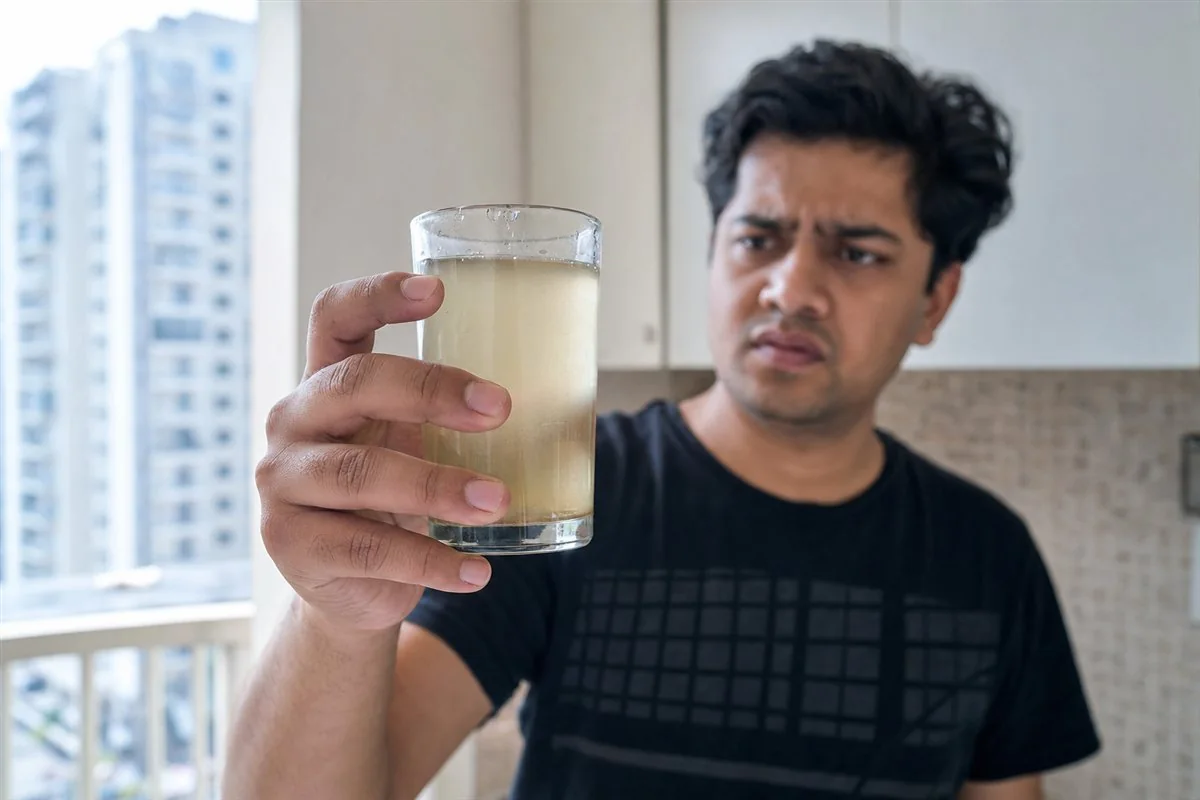
The 7 signs at a glance
- Musty or earthy smell from the tap — or the chlorine smell has vanished entirely
- Off, metallic or stale taste in drinking and cooking water
- White chalky scale on taps and utensils, with falling water pressure
- Yellow, brown or cloudy water, especially first thing in the morning
- Visible sediment or particles when you fill a bucket or clean an aerator
- Skin irritation, dryness or rough hair after bathing
- Unexplained stomach upsets across the household
Plus two timing flags: it’s been 6+ months (or you don’t know) since the last clean, and the post-monsoon window. One sign is worth acting on; two or more together means clean now.
| Sign | What it usually means in Noida | What to do |
|---|---|---|
| Musty smell / no chlorine smell | Bio-film & algae in a warm rooftop tank; disinfectant used up | Clean & disinfect the tank |
| Off / metallic taste | Iron, scale or organic matter from stored borewell water | Drain, clean, then re-check taste |
| White chalky scale + low pressure | Hard groundwater calcium scaling walls, pipes & outlet | Clean tank; review frequency |
| Yellow / brown / cloudy water | Iron sediment or rust settling in the tank | Compare tank-fed vs direct tap, then clean |
| Visible sediment / particles | Sand, silt & scale collected on the tank floor | De-sludge & full clean |
| Skin irritation / rough hair | Hard-water film plus possible bacterial/fungal growth | Clean tank; consider water test |
| Unexplained stomach upsets | Bacterial contamination passing through to taps | Clean, disinfect & test the water |
Spotted one of these? Don’t wait it out
Same-day and next-day cleaning across Noida. Inspect, de-sludge, scrub, jet-wash, food-grade disinfect, before/after photos. ₹699 onwards.
Most people in Noida discover their tank needed cleaning after something goes wrong — a stomach bug that won’t shift, a bathroom tap running yellow, a guest asking why the water smells. The tank is out of sight on the roof or in the basement, so it’s easy to forget it exists. But the water you drink, cook with and bathe in sits in that tank for hours or days before it reaches you, and the tank’s condition quietly becomes your water’s condition. The good news: the warning signs are easy to read once you know them. Here they are, one by one.
Sign 1 — A musty smell (or the chlorine smell has vanished)
The first sign is usually the nose, not the eyes. If your water has picked up a musty, earthy or faintly swampy smell, that’s almost never the incoming supply — it’s bio-film and algae growing inside the tank itself. Noida’s rooftop tanks sit in direct sun for most of the day, and warm stored water is exactly what algae and bacteria want. Within a few months of neglect, a thin slimy layer forms on the walls and under the lid, and that’s what you’re smelling.
There’s a flip side worth knowing. The treated Ganga supply that the Noida Authority Jal Vibhag distributes carries a faint chlorine smell — that’s the disinfectant doing its job. If that smell disappears completely, it often means the chlorine has been used up reacting with the dirt and organic matter in your tank instead of protecting your water. Either way — a new musty smell or a lost chlorine smell — the tank is talking to you. What to do: get it cleaned and disinfected. A sniff test costs nothing and is the single most reliable early warning you have.
Sign 2 — The water tastes “off”
Taste and smell are linked, but taste catches things the nose can miss. A metallic or slightly bitter taste often points to iron and dissolved minerals from borewell groundwater settling in the tank. A flat, stale or “old” taste usually means the water has been sitting too long over a layer of sediment and bio-film. Families notice it most in the morning’s first glass, or in tea and dal where the water flavour comes through.
A common mistake here is to blame the RO purifier and change its filter. An RO unit is designed to polish reasonably clean water, not to rescue water that’s contaminated at the source. If the taste is coming from a dirty tank, no filter swap fixes it for long. What to do: clean the tank first, then judge the taste again. If it persists after a proper clean, get the water tested.
Sign 3 — White chalky scale and falling water pressure
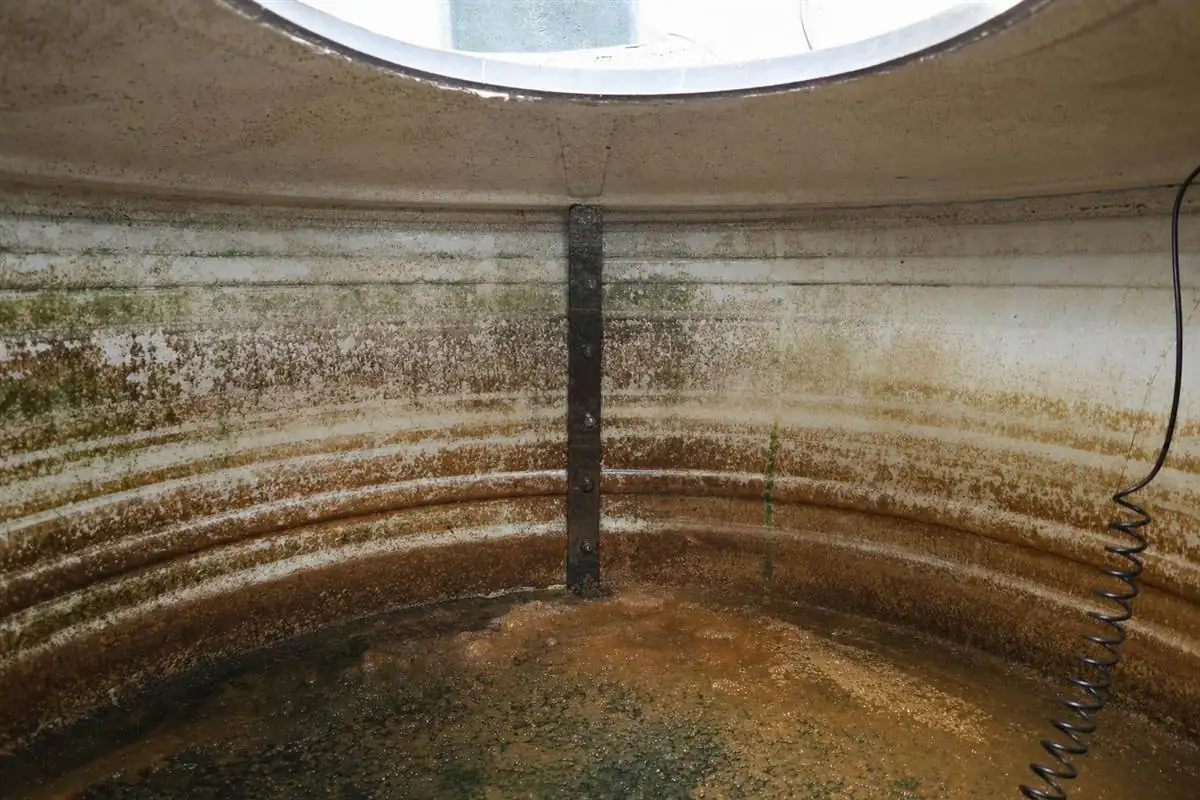
This is the most Noida-specific sign of the lot. If your taps, tiles, kettle and steel utensils keep getting a stubborn white chalky crust — the kind that doesn’t wipe off easily — that’s calcium and magnesium scale from hard groundwater. Large parts of Noida and Greater Noida West run on borewell supply that is genuinely hard, and as that water sits in your tank, the minerals drop out and harden onto the walls, floor and outlet pipe.
You’ll often notice the second symptom before the first: water pressure slowly dropping at the taps and shower. That’s the same scale narrowing your pipes and clogging tap aerators. Scale on the tank floor also creates a rough surface that traps sediment and shelters bacteria, so a scaled-up tank tends to get dirty faster. A proper clean removes the loosened scale and resets the tank — but on hard water it will come back, which is exactly why Noida tanks need cleaning more often than soft-water areas. We go deep into the chemistry and the right cleaning interval in our guide to hard-water tank cleaning in Noida.
Sign 4 — Yellow, brown or cloudy water
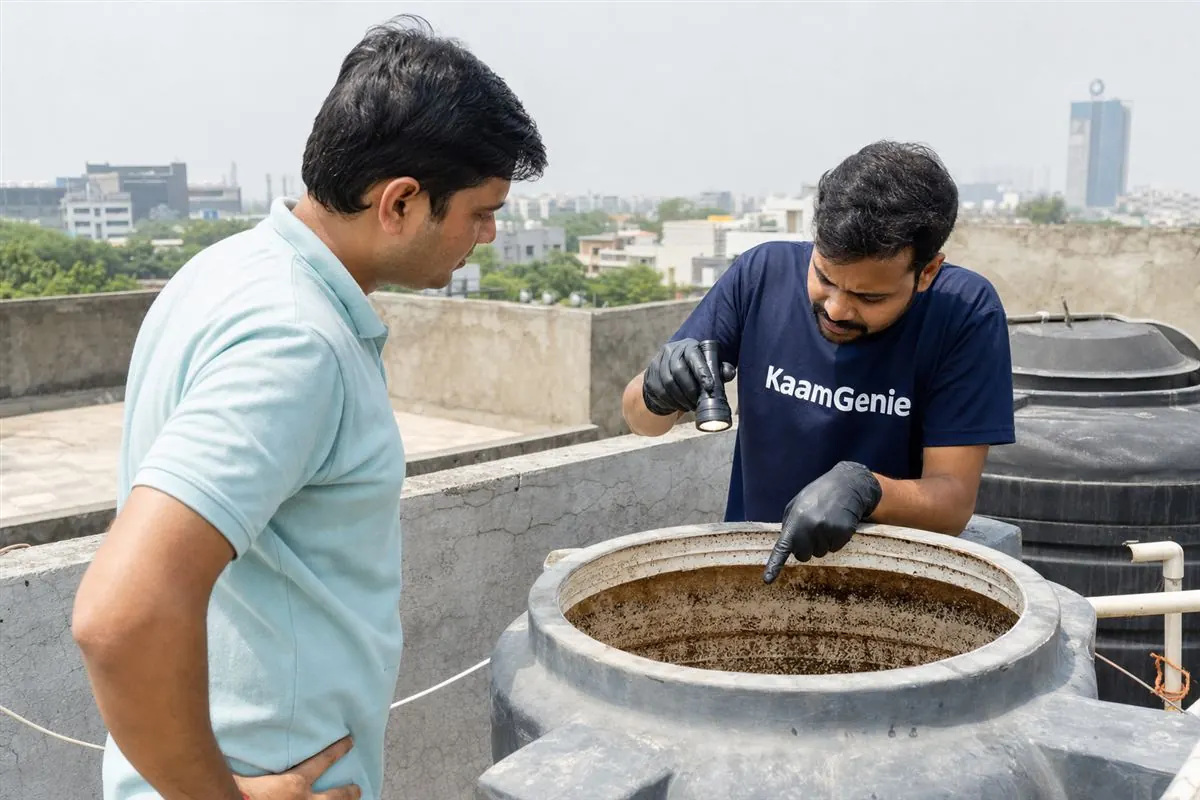
Visible discolouration is the sign people act on fastest — and rightly so. Yellow or brown water usually means iron and rust-coloured sediment: either dissolved iron from borewell groundwater that has settled and concentrated in your tank, or rust shedding from old pipes and metal fittings. It’s often worst first thing in the morning, when the water has been sitting still overnight and the sediment has had time to mix in.
Here’s a quick test before you assume the worst. Fill one glass from a tap fed by the tank, and a second glass from any point on the direct supply (some homes have one before the tank). If only the tank-fed water is discoloured, the tank is your culprit. One thing not to panic about: water that comes out milky or cloudy and then clears from the bottom up within a minute is just trapped air — harmless. But persistent yellow, brown, or particle-laden water means draining and cleaning the tank, ideally soon, because that sediment is also what bacteria feed on.
Sign 5 — Visible sediment or particles
Sometimes the evidence is literally sitting at the bottom of a bucket. If you fill a bucket and see a fine layer of sand, silt or dark grit settle at the base, or you find gritty deposits when you unscrew a tap aerator or clean the geyser inlet, your tank floor has built up a sediment layer. In a tank that hasn’t been cleaned in a couple of years, that layer can be a centimetre or more of sludge — sand, dust, iron particles, dead insects, and hardened scale.
This matters because no amount of rinsing from the top removes a settled sediment bed; it has to be scooped and vacuumed out. It’s also the layer that protects bacteria from any disinfectant in the water. If you’re seeing particles, the tank is well past due. What to do: book a full clean that includes de-sludging, not a quick rinse. For how often this should be happening in the first place, our piece on how often to clean a water tank in Noida lays out a realistic schedule for hard-water homes.
Sign 6 — Skin irritation, dryness or rough hair
This one rarely gets connected to the tank, but it should. Two separate problems in a neglected Noida tank show up on your skin. First, hard-water scale: the high mineral load leaves a film that makes skin feel dry and tight after a bath, makes hair feel rough and straw-like, and stops soap and shampoo rinsing off cleanly (that “never quite clean” feeling). Second, bacterial or fungal growth in a dirty tank can trigger genuine itching, rashes or scalp irritation.
The tell is when more than one person in the house notices it at the same time, and nothing in anyone’s soap, shampoo or routine has changed. If the family’s skin and hair all get worse together, look up — at the tank — before you reach for new products. What to do: clean the tank and, if irritation continues, get the water tested for hardness and bacteria.
Sign 7 — Unexplained stomach upsets in the household
The most serious sign, and the most overlooked. When a tank is contaminated, bacteria can pass straight through to your taps. People assume their RO purifier is a safety net, but an RO is built to polish reasonably clean water, not to fix a contaminated source — and plenty of water (for brushing teeth, washing vegetables, making ice, cooking) never goes through the RO at all.
The pattern to watch for: several family members getting recurring loose motions, mild nausea, or stomach cramps with no clear food cause — sometimes including guests or domestic staff whose only common factor is your water. When that happens, don’t keep blaming the last meal. What to do: get the tank cleaned and disinfected with food-grade chemicals straight away, and have the water tested. This is the sign where waiting genuinely isn’t worth it — which is why we run same-day water tank cleaning in Noida for exactly these situations.
Which sign sends Noida families looking for a cleaner
Roughly how often each warning sign is the one that finally triggers a booking
Illustrative pattern from Noida residential jobs, not a formal survey. The takeaway: most people wait for visible or smelly water, but the cheapest, safest time to clean is on the calendar — before any sign appears.
Two more flags: 6+ months unknown, and post-monsoon
Beyond the seven sensory signs, two timing flags matter just as much in Noida.
It’s been six months or more — or you simply don’t know. BIS IS 10500 and CPHEEO guidance support cleaning stored drinking-water tanks at least twice a year as a floor, and on hard groundwater the realistic standard is closer to quarterly. If you’ve crossed six months, or you’ve recently moved into a rented flat or a newly handed-over tower and have no idea when the tank was last touched, treat that uncertainty as a sign in itself. New towers across Greater Noida West and the Expressway corridor often still carry construction debris — cement slurry, sand and pipe-flushing grit — in the tank from the build, so a fresh-occupancy clean is well worth it.
The post-monsoon window. The weeks after the rains are one of the highest-risk periods of the year. Heavy rain raises the water table and stirs up borewell supplies, pushing more silt and iron into your tank; the warmth and humidity speed up algae and bacterial growth; and a loose or cracked lid lets rainwater, dust and insects in directly. If your water’s smell, taste or colour shifts during or just after the monsoon, that’s the season showing up in your tank. A post-monsoon clean is one of the most worthwhile of the year.
If you’re outside Noida or want the broader, city-agnostic checklist, we keep a general version in our 7 signs your tank needs cleaning urgently guide — but for Noida homes, the hard-water and rooftop-heat context above is what really drives the timing.
Not sure which sign you’re seeing?
Send us a photo of your water or your tank on WhatsApp — we’ll tell you honestly whether it needs cleaning. Residential ₹699 onwards; society/UGR custom-quoted.
Don’t wait for the sign — book a clean across Noida
Every sign on this list is your tank telling you it’s already overdue. The cheapest, safest moment to clean is before any of them appear — on a calendar schedule — but if you’ve spotted even one, act now rather than waiting for the next. We cover homes, societies and commercial buildings right across the city, from the high-rise belts of Sector 137 and Sector 75 to the newer towers of Sector 150 — start at our water tank cleaning in Noida hub for sector coverage and booking. Every job is the full process: inspect, drain, de-sludge, scrub, jet-wash, vacuum, food-grade disinfect, refill, with before/after photos.
To book, call +91 95603 66362 or use the booking form on this site — we’ll confirm shortly.
Frequently asked questions
What are the warning signs that my Noida water tank needs cleaning?
The seven you can spot without any equipment are: a musty or earthy smell from the tap (or chlorine smell completely gone), an off or metallic taste, white chalky scale on taps and utensils with dropping pressure, yellow, brown or cloudy water, visible sediment or particles when you fill a bucket, new skin irritation or rough hair after bathing, and unexplained stomach upsets across the household. Add to those two timing flags: it has been six months or more since the last clean, or you simply don’t know when it was last done. Any single sign is worth acting on; two or more together means clean now.
Why has my Noida tap water started to smell musty or earthy?
A musty, earthy or stale smell almost always means bio-film and organic growth inside the tank, not a problem with the incoming supply. Noida rooftop tanks bake in the sun, and warm stored water is the perfect environment for algae and bacteria to grow on the walls and under the lid. A related clue is when the normal faint chlorine smell of the treated Ganga supply disappears entirely — that means the disinfectant has been used up reacting with the dirt in your tank instead of protecting the water. Both point to the same fix: the tank needs cleaning and disinfecting.
Why does my water leave white chalky scale and my pressure has dropped?
White chalky deposits on taps, tiles, kettles and utensils are calcium and magnesium scale from Noida’s hard borewell groundwater. As that water sits in the tank, the minerals settle and harden onto the walls, floor and outlet, and the same scale narrows pipes and aerators, which is why pressure slowly drops. Scale on the tank floor also traps sediment and shelters bacteria. A proper clean removes the loosened scale and resets the tank, though on hard groundwater it will build again — which is why Noida tanks need cleaning more often than soft-water areas.
Is yellow or brown water always caused by a dirty tank?
Not always, but the tank is the most common cause in Noida. Yellow or brown water usually comes from iron and rust-coloured sediment — either dissolved iron in borewell groundwater that settles in the tank, or rust from old pipes and fittings. To check, fill a glass straight from a tap fed by the tank and a second from any direct supply point: if only the tank-fed water is discoloured, the tank is the source. Cloudy or milky water that clears from the bottom up is usually trapped air and harmless, but persistent yellow, brown or particle-laden water means the tank needs draining and cleaning.
Can a dirty water tank cause skin irritation or hair problems?
Yes. Two things in a neglected Noida tank affect skin and hair. First, hard-water scale — the high calcium and magnesium load leaves a film that makes skin feel dry and tight and hair rough or straw-like, and it stops soap rinsing off cleanly. Second, bacterial and fungal growth in a dirty tank can trigger itching, rashes or scalp irritation. If several people in the home notice dry, itchy skin or worsening hair after bathing and nothing in your routine changed, the stored water is a prime suspect — start with a tank clean.
Could repeated stomach upsets in my household be from the water tank?
They can be, and it is one of the most overlooked causes. When a tank is contaminated, bacteria can pass through to taps and even to RO purifiers, which are designed to polish reasonably clean water, not to fix a contaminated source. The tell-tale pattern is several family members getting recurring loose motions, mild nausea or stomach cramps with no obvious food cause, sometimes including guests or staff who only drank the water. If that is happening, get the tank cleaned and disinfected with food-grade chemicals and have the water checked — do not just blame the last meal.
It has been more than six months — or I don’t know — since my tank was last cleaned. What should I do?
Treat that as a sign in itself. BIS and CPHEEO guidance support cleaning stored drinking-water tanks at least twice a year as a floor, and on Noida’s hard groundwater sediment and scale build faster than that, so many homes do better on a quarterly schedule. If it has been six months or more, or you genuinely don’t know when the tank was last cleaned — common in rented flats and recently handed-over towers — book a clean now rather than waiting for the smell or the yellow water to appear. Once it is done, put the next date on the calendar.
Does the Noida monsoon make tanks dirtier?
Yes, the weeks after the monsoon are one of the highest-risk windows. Heavy rain raises the water table and stirs up borewell supplies, so more silt and iron reach the tank; humidity and warmth accelerate algae and bacterial growth; and a loose or cracked tank lid lets rainwater, dust and insects in directly. If your tank smell, taste or colour changes during or just after the rains, that is the monsoon load showing up. A post-monsoon clean is one of the most worthwhile cleans of the year for a Noida home or society.
How fast can you clean my tank once I notice these signs?
For most Noida homes we can usually do it the same day or next day. A standard residential overhead tank takes about 75–90 minutes for the full process — inspect, drain, de-sludge, scrub, jet-wash, vacuum, disinfect with food-grade chemical, refill — and you get before/after photos. If you’ve already noticed a strong smell, yellow water or stomach upsets, don’t wait for a convenient slot; ask for the soonest available. Residential cleaning starts at ₹699 onwards; society and underground-reservoir work is custom-quoted.
Sources & references
- Bureau of Indian Standards (BIS) — IS 10500:2012 is the canonical Indian Standard for drinking water specification, defining acceptable limits for physical, chemical, and biological parameters.
- WHO Guidelines for Drinking-water Quality, 4th edition — the global reference for water quality standards, including guidance on storage and disinfection.
- Food Safety and Standards Authority of India (FSSAI) — defines water quality requirements for food businesses, including hygiene standards for stored water and acceptable disinfection chemicals.
- WHO Fact Sheet on Drinking Water — overview of safe drinking water requirements and contamination risks.
- CPHEEO — Manual on Water Supply and Treatment — the Government of India’s engineering manual covering tank design, cleaning protocols, and disinfection practices.
Last verified: 27 June 2026. If you find any of these links broken, please let us know.