
The short version (TL;DR)
- Noida runs on a two-stage tank system — shared underground reservoir (UGR) plus rooftop tower tanks — not the single rooftop tank most of Delhi has.
- Hard borewell groundwater scales tank walls fast, so the realistic cleaning interval here is quarterly, not twice a year.
- Society vs flat: the AOA/RWA cleans the reservoir and tower tanks; your private flat/loft tank is yours.
- Cost: residential from ₹699 onwards; society UGR / tower-tank systems are quoted custom.
- New flat in Noida Extension? Get a first-clean before move-in — towers leave construction debris in the tanks.
- To book, jump to water tank cleaning in Noida or your sector below.
| # | Section | In one line | Where it links |
|---|---|---|---|
| 1 | Why Noida tanks are different | UGR + tower tanks, hard water, new-build debris | This page |
| 2 | How the cleaning works | The 8-step process in brief | Process |
| 3 | Society vs flat cleaning | Who is responsible for which tank | Society guide |
| 4 | How often in Noida | Hard water → quarterly | Hard water |
| 5 | What it costs | Residential & society pricing | Cost in Noida |
| 6 | New-flat first-clean | Construction debris before move-in | New flat |
| 7 | Book in your sector | 137, 75, 150, Noida Extension | Noida hub |
Book water tank cleaning in Noida
Trained crew for flats, sumps and society reservoirs across Noida & Greater Noida West. Fixed price before we start. ₹699 onwards for residential.
1. Why Noida tanks are different
If you grew up in a Delhi house, “the water tank” meant one plastic tank on the roof. Noida works differently, and that difference is the single most important thing to understand before you book a cleaning.
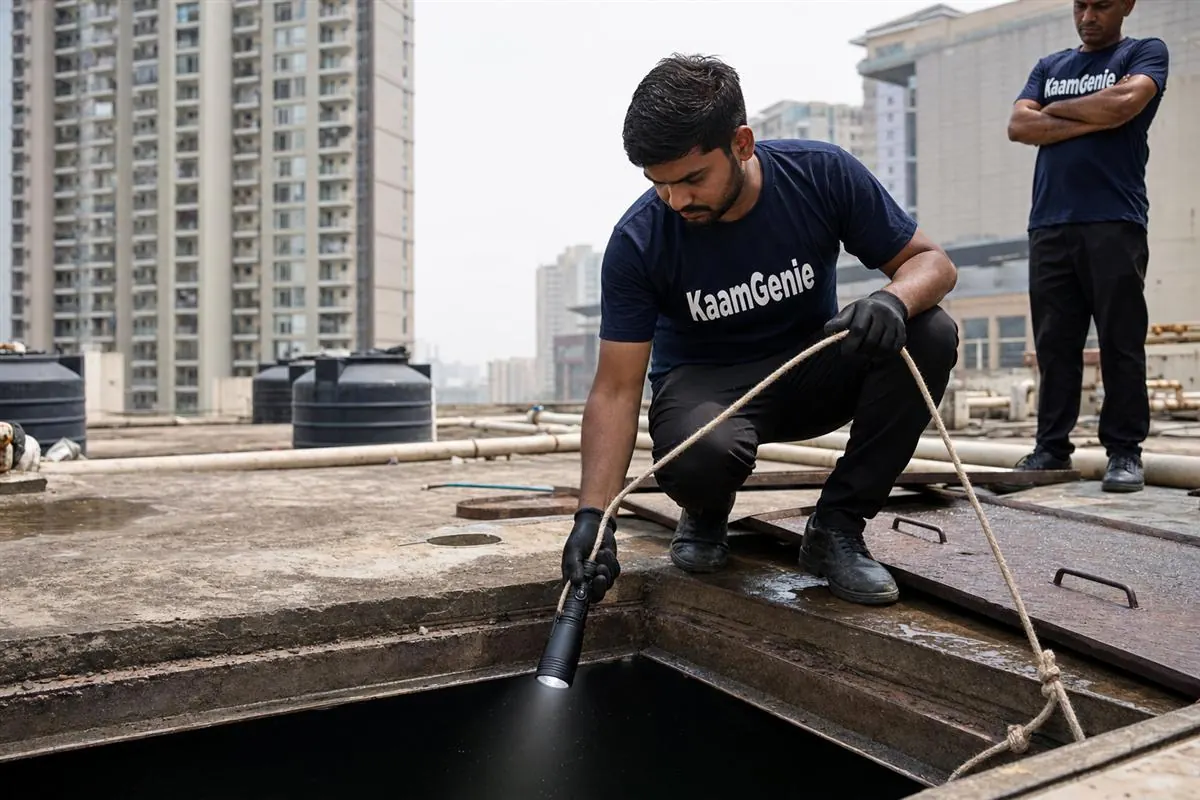
High-rise UGR + tower tanks. Most of Noida lives in high-rise societies. Municipal or borewell water first fills a large underground reservoir (UGR) at the base of each tower or cluster. Booster pumps then push that water up to tower tanks on the terrace, which gravity-feed the flats below. So a single “society” can have one big reservoir plus a dozen rooftop tanks. A real cleaning has to account for every stage — the reservoir where sludge settles, and the tower tanks closest to your tap.
Hard borewell groundwater. Large parts of Noida and especially Greater Noida West (Noida Extension) run partly or fully on borewell groundwater, which is hard — high in dissolved calcium and magnesium. As that water sits, minerals settle out as a chalky white scale on the tank walls and floor. Scale isn’t just ugly; its rough surface shelters biofilm and bacteria, which is exactly why hard-water tanks need cleaning more often than soft-water ones. We go deeper on this in our Noida hard-water tank cleaning guide.
New-tower construction debris. Noida and the Extension are still building out. A brand-new tower hands over tanks that quietly filled with construction residue during the build — cement slurry, sand, PVC pipe shavings, paint flecks. None of it is visible until you open the lid. That’s why a new-flat first-clean is its own thing, heavier than a routine maintenance clean.
Put together — multi-tank systems, hard water, fresh construction — Noida simply asks more of a tank-cleaning crew than a single Delhi rooftop tank does. The rest of this guide walks through each piece.
2. The cleaning process, in brief
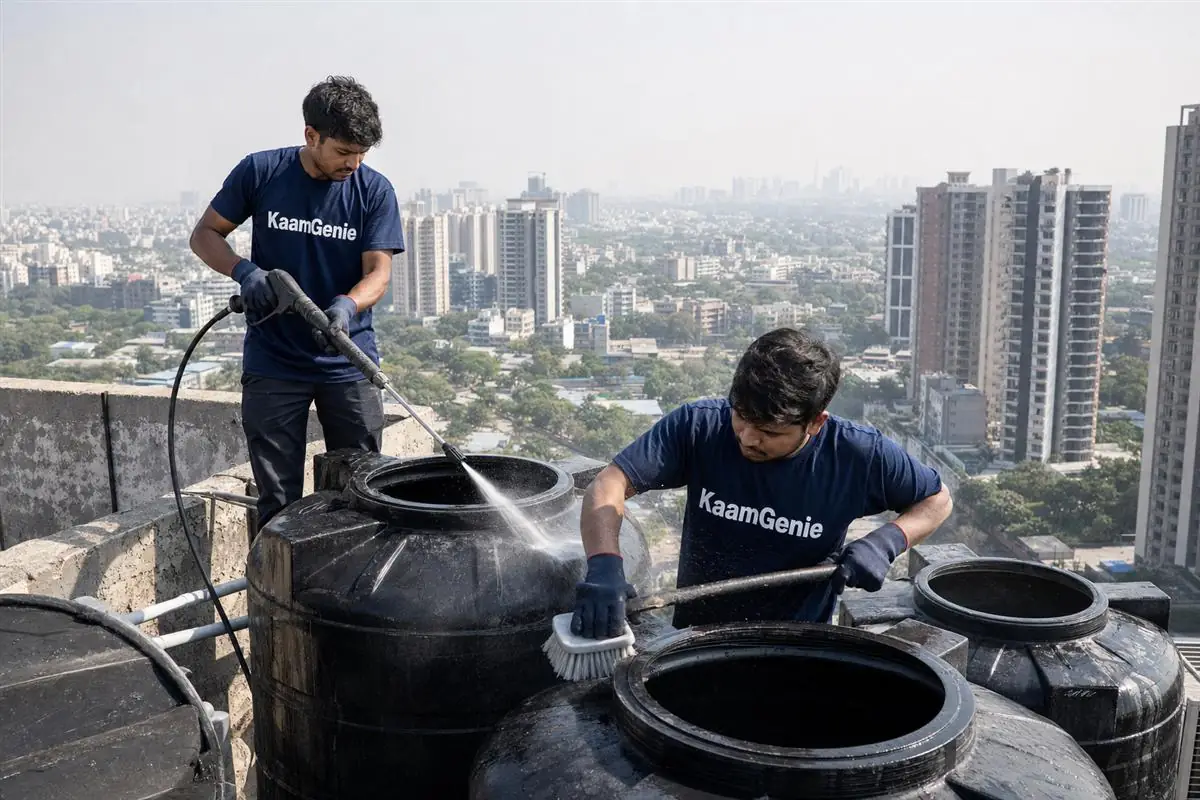
The mechanics of cleaning a tank are the same everywhere — what changes in Noida is scale and access, not method. In short, a proper clean is an eight-step job: inspect → drain → remove sludge → manual scrub → high-pressure jet wash → wet vacuum → food-grade disinfection → refill and certify. The steps most corner-cutters skip are sludge removal, the jet wash, and the disinfection contact time — skip those and you’ve paid for a rinse, not a cleaning.
For a typical residential tank it’s about 75–90 minutes; a society underground reservoir runs several hours and needs confined-space-trained crew and proper pumps. We’ve documented every step, with photos and timings, in our full walkthrough — rather than repeat it here, read how the water tank cleaning process actually works. The same process applies to your Noida tank; only the volume and number of tanks change.
3. Society vs individual-flat cleaning — the Noida split
This is the question we get asked most in Noida societies, and the source of most confusion: who is actually responsible for cleaning which tank?
The shared infrastructure — the underground reservoir and the rooftop tower tanks — is common property. The AOA or RWA arranges and pays for cleaning those, normally on an annual or quarterly contract. If your society does this well, the reservoir and tower tanks are handled and you don’t lift a finger.
But many Noida flats — builder floors, older sectors, and a lot of 2–3 BHK layouts — also have a private loft or kitchen tank inside the flat, the last stop before your tap. That one is yours. The society contract doesn’t touch it. So even in a well-run society, if your water looks fine in the common areas but cloudy at your kitchen sink, the culprit is almost always your own flat tank that nobody has cleaned in years.
The honest rule of thumb: the society handles everything up to your terrace; you handle anything inside your four walls. For the full breakdown of contracts, scheduling and who pays, see our companion guide to society water tank cleaning in Noida. If you just need your own flat tank done, you can book that directly through our Noida service.
4. How often — and why Noida means quarterly
The standard advice across India is to clean your tank twice a year. That holds for soft, treated municipal water. Noida is the exception, because of the hard groundwater we covered above.
Hard water lays down scale faster, and scale gives bacteria and biofilm somewhere to hide that a smooth wall doesn’t. So in most of Noida and Greater Noida West, the realistic interval is every 3 months — quarterly. Underground reservoirs and ground-floor sumps need it the most, because water sits still in them between pump cycles and sediment settles. Restaurants and tiffin kitchens running on the same supply should go further, every 1–2 months, to stay FSSAI-clean.
The general logic of frequency — how usage, tank type and water source change the interval — is laid out in our how often to clean a water tank guide. For the Noida-specific version (why hard water shortens that interval and how to spot scale early), read Noida hard-water tank cleaning.
Rough cleaning frequency — soft municipal water vs Noida hard groundwater
Cleanings per year for the same tank, by water source and use (illustrative)
Indicative only — the right interval depends on your exact water source, tank type and usage. Hard groundwater is the reason Noida tends toward the higher end.
5. What it costs in Noida
Pricing splits cleanly along the society/flat line.
- Residential flat tank (overhead, Sintex, loft): ₹699 onwards, fixed price quoted before we start.
- Underground sump: more than an overhead tank — extra drainage, confined-space access and time push the price up.
- Society UGR + tower-tank system: quoted custom, based on number of tanks, total litres, and access. Billed as an AOA/RWA contract, not a per-flat rate.
What we won’t do is give you a vague “starting from” and then inflate it on site. Whether it’s one loft tank or a full society system, you get a fixed figure first. For the full breakdown — tank-by-tank rates, what changes the price, and how society contracts are costed — see our dedicated guide to water tank cleaning cost in Noida.
6. New flat? Get the first-clean before you move in
If you’ve just taken handover of a flat in Noida Extension or a freshly completed tower along the Expressway, treat the tank cleaning as part of moving in — before the first bucket of water touches your family.
During construction, tanks sit open or loosely covered for months and quietly collect debris: cement slurry that hardens into a film, sand, PVC pipe shavings, paint and putty flecks, brick dust. Builders rarely clean tanks properly at handover; a quick rinse is the most you can expect. The result is that the very first water you store sits on a bed of construction residue.
A new-flat first-clean is a slightly heavier job than routine maintenance — more sludge to scoop, more scrubbing to lift hardened slurry — followed by a full food-grade disinfection so the tank is genuinely potable-ready. We’ve written the whole checklist, including what to ask your builder, in water tank cleaning for a new flat in Noida.
7. Methods & safe chemicals, in brief
Two quick things people worry about: how the tank actually gets clean, and whether the chemicals are safe to drink afterwards.
Methods. A real clean combines manual scrubbing with food-grade brushes, a 100–150 PSI high-pressure jet wash to reach corners and behind fittings, and a wet vacuum to lift the loosened dirt out before refill. Pressure washing matters more for the RCC (concrete) reservoirs common in Noida societies, where biofilm clings into the porous surface. The full comparison of techniques is in our water tank cleaning methods guide.
Chemicals. Disinfection uses food-grade sodium hypochlorite at 50–100 PPM — the same class of chemical used in municipal treatment, acceptable for potable water under FSSAI guidance — with a contact time, then a rinse. We never use hardware-shop bleach or industrial chemicals that leave residue in drinking water. Which chemical, at what concentration, and why food-grade matters is covered in our water tank cleaning chemicals guide.
Book water tank cleaning in your Noida sector
Same trained crew, same fixed residential pricing from ₹699, and custom society quotes — right across Noida and Greater Noida West. Start at the hub for water tank cleaning in Noida, or jump straight to your sector:
- Water tank cleaning in Sector 137 — Expressway high-rise societies and their UGR + tower-tank systems.
- Tank cleaning in Sector 75 — dense society belt with large shared reservoirs.
- Sector 150 tank cleaning — newer towers along the Expressway corridor, often needing first-cleans.
- Noida Extension (Greater Noida West) — hard-water belt with the heaviest scale and the most new handovers.
To book, call +91 95603 66362 or use the booking form on this site — tell us your sector and whether it’s a flat tank, a sump, or a society system, and we’ll confirm shortly.
Not sure which tank is yours to clean?
Tell us your society and sector — we’ll sort out flat tank vs society reservoir and quote the right job. Residential ₹699 onwards; society custom.
Bringing it together — your next step in Noida
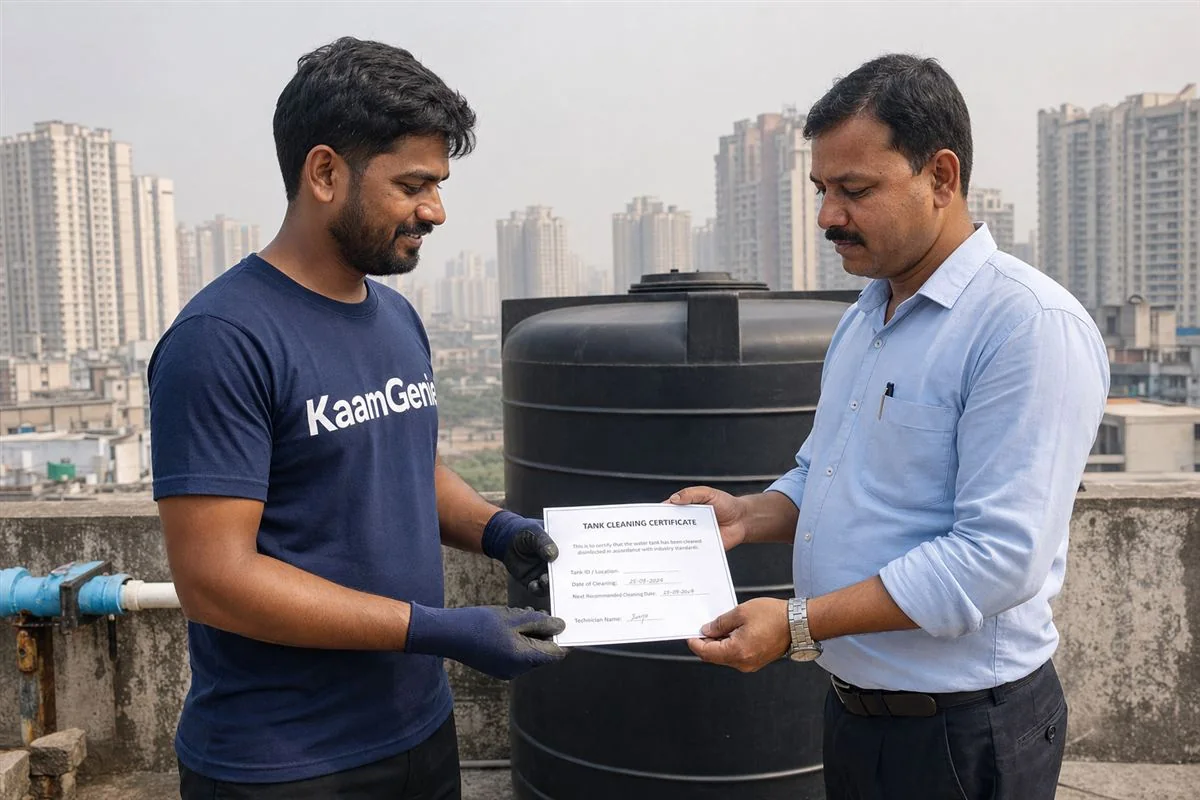
Noida’s water reaches your tap through more stages than most people realise — reservoir, tower tank, and often a flat tank too — and the hard groundwater works against all of them. That’s the whole case for treating tank cleaning as a quarterly habit here, not an afterthought. Whether you need one loft tank done, a sump cleared, or a full society system on a contract, start at our hub for water tank cleaning in Noida and pick your sector. We’ll quote a fixed price, do the real eight-step job, and hand over photos and a record — for your fridge or your society’s files.
Frequently asked questions
Why is water tank cleaning different in Noida compared to Delhi?
Two reasons. First, most of Noida lives in high-rise societies with an underground reservoir (UGR) that feeds rooftop tower tanks on each block — so a “tank cleaning” often means a multi-tank system, not one rooftop tank. Second, large parts of Noida and Greater Noida West run on hard borewell groundwater, which leaves calcium scale on tank walls far faster than Delhi’s DJB supply. Together these mean Noida tanks need quarterly cleaning and a crew set up for confined-space reservoir work.
How often should I get my water tank cleaned in Noida?
Every 3 months for most of Noida. The general rule for soft municipal water is twice a year, but Noida’s hard groundwater builds calcium scale and biofilm faster, so quarterly is the realistic interval. Ground-floor sumps and underground reservoirs that sit still between pump cycles need it most. Restaurants and tiffin kitchens should do it every 1-2 months.
What does water tank cleaning cost in Noida?
A standard residential overhead or Sintex tank starts at ₹699 onwards. Underground sumps cost more because of the extra drainage, confined-space access and time. Society underground reservoirs and tower-tank systems are quoted custom, based on number of tanks, total litres and access — typically billed as an AOA/RWA contract rather than a per-flat rate. We give a fixed figure before starting, never a vague “starting from”.
Who cleans the tank in a Noida high-rise — the society or the flat owner?
It depends on the system. The shared underground reservoir and the rooftop tower tanks are common property, so the AOA/RWA arranges and pays for those — usually on an annual contract. If your flat has its own dedicated overhead or loft tank (common in builder floors and older sectors), that one is yours to maintain. Many residents don’t realise their flat has a private tank in addition to the society system.
My society already cleans the underground reservoir — do I still need my flat tank cleaned?
Yes, if your flat has its own tank. The water that reaches your taps passes through the society UGR, the rooftop tower tank, and then often a small loft or kitchen tank inside your flat. Cleaning only the reservoir leaves the last stage — the one closest to your drinking water — untouched. If your water looks fine at the society level but cloudy at your tap, the problem is usually your own flat tank.
Why does my Noida tank get a white chalky layer so quickly?
That white chalky deposit is calcium and magnesium scale from hard groundwater. Noida and Greater Noida West sit on borewell-heavy supply, and as that water sits in the tank, dissolved minerals settle onto the walls and floor. Scale isn’t just cosmetic — it shelters bacteria and biofilm in its rough surface, which is why hard-water tanks need more frequent, more thorough cleaning than soft-water ones.
We just moved into a new flat in Noida Extension — does the tank need cleaning before we use it?
Almost always, yes. New towers leave construction debris in the tanks — cement slurry, sand, PVC shavings, paint flecks and dust that settle during the build. A first-clean before move-in flushes all of that out and disinfects the tank, so your family isn’t drinking and bathing in construction residue. We treat a new-flat first-clean as a slightly heavier job than a routine maintenance clean.
Do you clean the underground reservoir and rooftop tanks in high-rise societies?
Yes. We handle the full society system — the underground reservoir (UGR), the booster/intermediate tanks, and the rooftop tower tanks on each block — with confined-space-trained crew and the right pumps for large-volume drainage. These jobs are scheduled with the AOA/RWA, often after-hours or in phases so water supply to flats isn’t cut for long. Documentation is provided for society records.
What chemicals do you use, and are they safe for drinking water?
Food-grade sodium hypochlorite at 50-100 PPM for disinfection, and a mild food-grade detergent for scrubbing — both acceptable for potable water systems under FSSAI guidance. We never use hardware-shop bleach or industrial chemicals, which leave residue in drinking water. After disinfection we rinse and vacuum, so there’s no chemical aftertaste once the tank is refilled.
Which Noida sectors and areas do you cover?
We cover Noida and Greater Noida West (Noida Extension) end to end — high-demand sectors like 137, 75, 150 and 128 along the Expressway and FNG corridor, the older sectors 18 and 62, and the society belts of Noida Extension. The same trained crew, fixed residential pricing from ₹699, and custom society quotes apply across all of them. Pick your sector page to see local coverage and book.
Sources & references
- Bureau of Indian Standards (BIS) — IS 10500:2012 is the canonical Indian Standard for drinking water specification, defining acceptable limits for physical, chemical, and biological parameters.
- WHO Guidelines for Drinking-water Quality, 4th edition — the global reference for water quality standards, including guidance on storage and disinfection.
- Food Safety and Standards Authority of India (FSSAI) — defines water quality requirements for food businesses, including hygiene standards for stored water and acceptable disinfection chemicals.
- WHO Fact Sheet on Drinking Water — overview of safe drinking water requirements and contamination risks.
- CPHEEO — Manual on Water Supply and Treatment — the Government of India’s engineering manual covering tank design, cleaning protocols, and disinfection practices.
Last verified: 26 June 2026. If you find any of these links broken, please let us know.