
Quick answer — industrial water tank cleaning Delhi NCR (2026)
- Who it’s for: factories in Okhla / Mayapuri / Bawana / IMT Manesar / Faridabad sector industrial, office towers in Gurgaon and Noida, mall complexes, IT parks, hotel chains, hospitals.
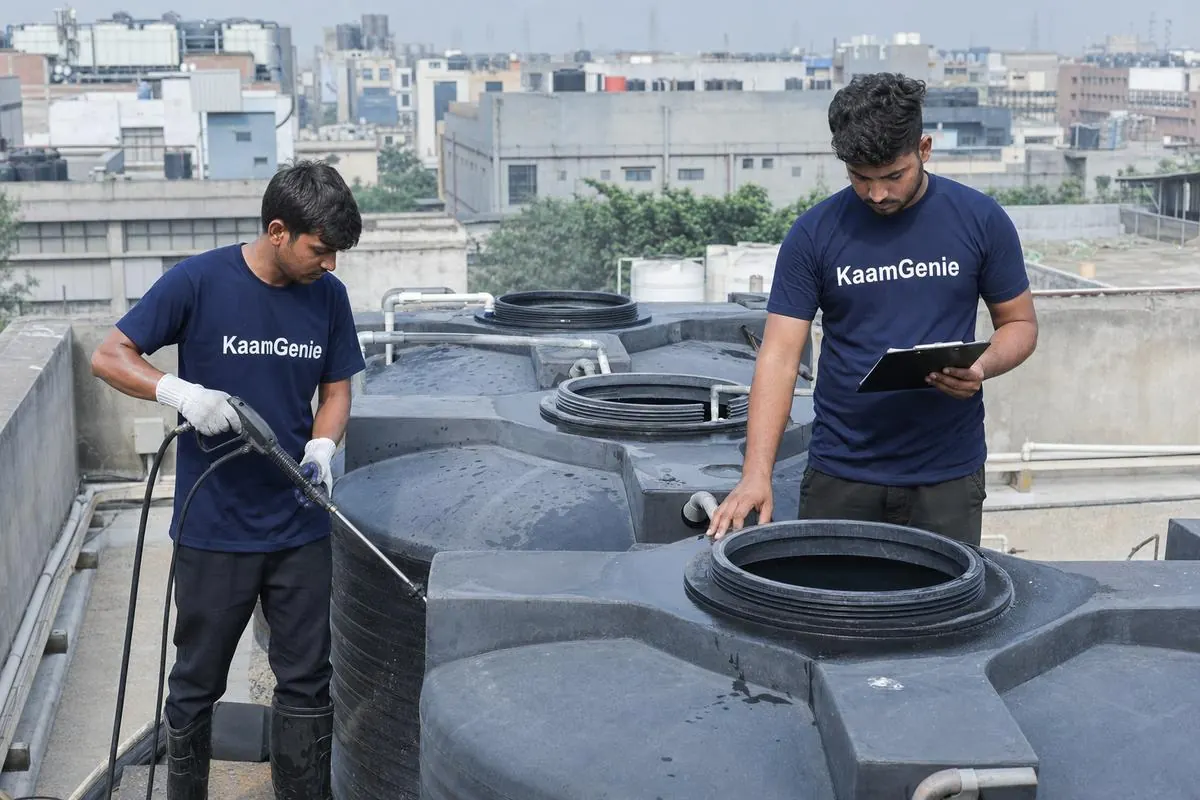
- Why it’s different: 10x residential water flow, confined-space entry, ISO 45001 safety protocol, FSSAI documentation for food courts, fire-hydrant tank coverage.
- Pricing band: small commercial (5,000L) from ₹4,999. Medium (10,000L) ₹7,999. Large (25,000L) ₹14,999. Mall complex multi-tank ₹25,000-60,000. Factory cluster custom quote.
- After-hours scheduling: overnight (10 PM-6 AM) and weekend slots so operations don’t pause.
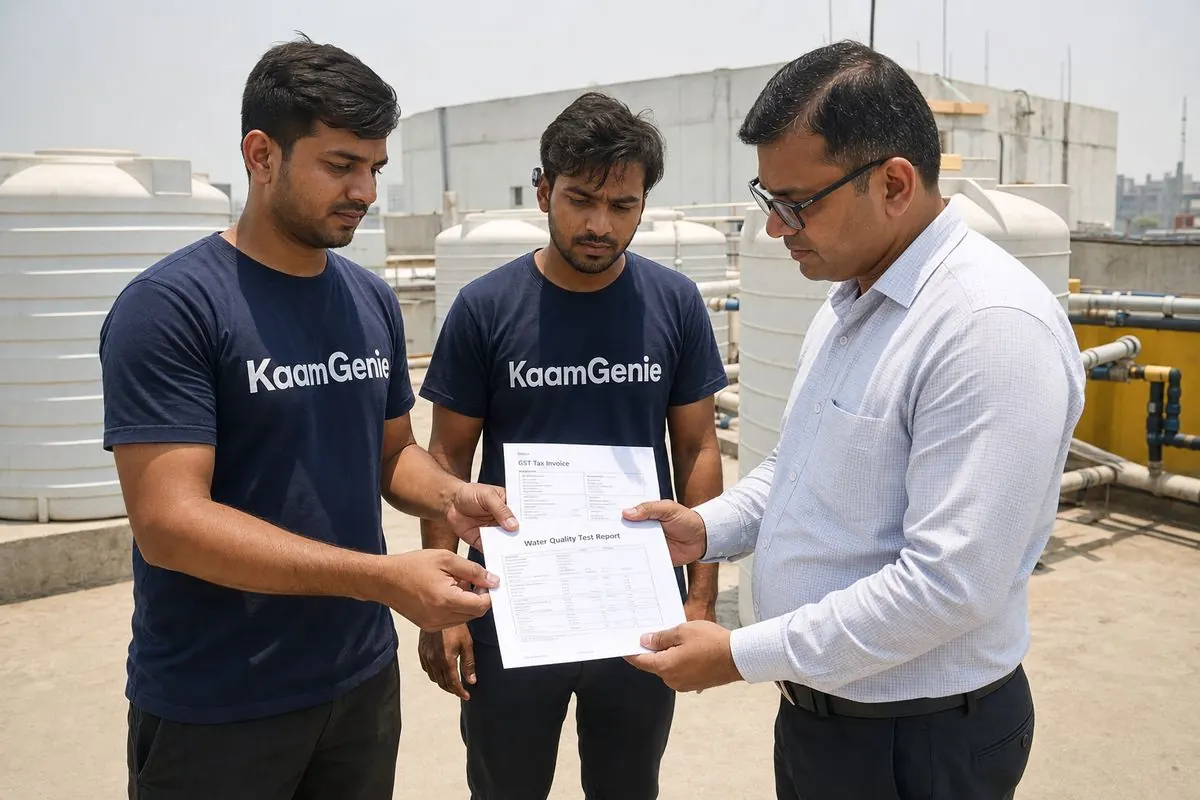
- Documentation: GST invoice, ISO 45001-aligned safety checklist, photo proof, water-test report, vendor master form support.
- Contracts: quarterly AMC or annual AMC. 4-12 visits/year depending on tank type and footfall.
Why industrial water tanks are not just “big residential tanks”
The phrase that costs procurement managers the most money in Delhi NCR is “same job, bigger tank.” A residential operator who quotes ₹1,500 for a kothi sump will sometimes quote ₹6,000 for a 25,000-litre factory reservoir, on the assumption that it’s just a scaled-up version of the same work. It isn’t. Five things change when you cross from residential into industrial, and each one changes the equipment, the crew composition, and the paperwork — which is why our industrial water tank cleaning is scoped differently from a standard home job.
1. Water turnover is roughly 10x. A 4 BHK home with 6 residents draws 1,500-2,000 litres a day. A 200-person Okhla factory floor with a canteen, washrooms, and a small dye unit can pull 18,000-25,000 litres in a single shift. Higher turnover means scale build-up looks different — thinner sediment layer, but heavier mineral crust on the inlet/outlet walls and a more concentrated biofilm around the float valve and overflow pipe. Standard residential brush-and-rinse misses these zones.
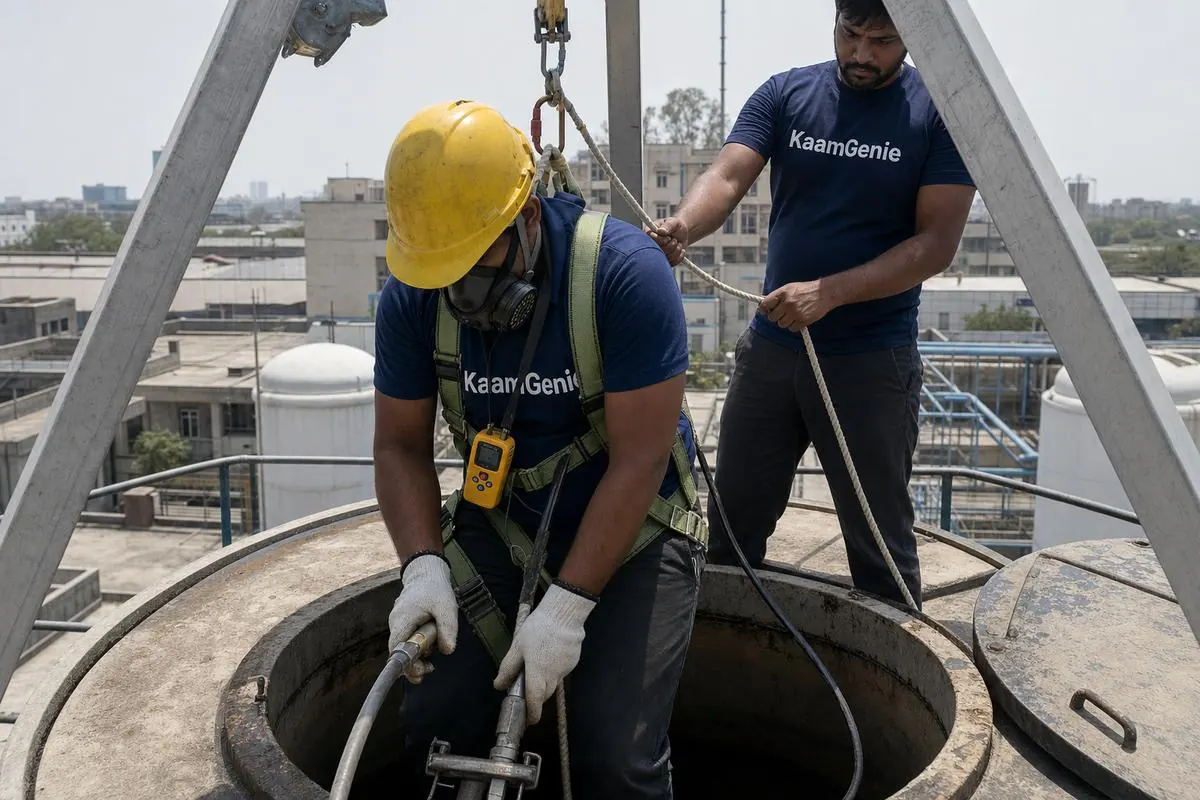
2. Confined-space entry is now a regulated activity. A small residential sump is still a confined space on paper, but a 25,000-litre concrete factory reservoir is one in legal practice — oxygen levels can drop below 19.5%, hydrogen sulphide can pool from sludge breakdown, and a single crew member without a standby will not get out if anything goes wrong. ISO 45001-aligned protocol means harness, lifeline, oxygen monitor, blower for forced ventilation, and a minimum of one supervisor plus two crew. Any operator quoting industrial work with a single labourer and a bucket is illegal under Indian factory safety norms and uninsurable.
3. Documentation is no longer optional. A Defence Colony homeowner pays the ₹699 and signs the WhatsApp invoice. A Gurgaon office tower’s procurement team needs the GST invoice, the safety checklist signed by the crew supervisor, the water-test report from a certified lab, a vendor master form, MSDS sheets for every chemical used, and police-verification proof for the crew that entered the premises. If any one of these is missing, the invoice stalls in accounts payable for 60-90 days.
4. The cost of the wrong vendor is operational, not financial. A small factory in Mayapuri that has its reservoir cleaned during shift hours by a residential operator loses 4-6 hours of canteen and washroom water supply. That’s 200 workers without water, which under Section 42 of the Factories Act 1948 means they can refuse to work. The ₹3,000 you saved on the quote becomes a ₹1.5-lakh production loss. After-hours scheduling is not a premium service in industrial — it’s the only way the job should happen.
5. Multi-tank coordination becomes the actual job. A Gurgaon Cyber City office tower has overhead tanks on the roof, a sump in the basement, a fire-hydrant tank (often separate and rarely cleaned), and sometimes a separate water-treatment-plant clean-water tank. A mall complex adds food-court tanks under separate FSSAI compliance scrutiny. The real skill in industrial work is sequencing all of these in a single overnight window so the building wakes up to clean water everywhere.
Factory water tank cleaning — the Delhi NCR industrial belt context
Delhi NCR has roughly six belts where most of our industrial cleaning work happens. Each has a slightly different tank profile, water source, and access pattern. If you’re a procurement or admin manager in any of these, here’s what the job actually looks like.
Okhla Phase I, II, III industrial area. Mostly garment, leather, light engineering, food processing, and printing units. Tanks are typically 10,000-30,000 litre concrete reservoirs at ground level or on first-floor platforms, fed by a mix of DJB supply and borewell. Borewell water in Okhla runs hard — TDS often above 1,200 ppm — so scale build-up is heavy and chemical descaling is part of the job, not an add-on. Most Okhla units we serve are on a quarterly AMC because the canteen flow makes biofilm aggressive. After-hours window is usually 9 PM to 5 AM, before the morning shift.
Mayapuri Phase I and II. Heavier engineering, auto parts, scrap-handling units. Tanks here are often older, with rusted fittings, and many sit next to dusty open yards which means dust ingress through the lid. The job often includes lid-gasket replacement and inlet-pipe straining, not just cleaning. Tank capacities range 5,000-50,000 litres.
Bawana Industrial Area + Narela. Mid-size factories, food processing, plastics, electronics assembly. Bawana’s water table is poor, so almost every unit relies on DJB tanker supply, which means the receiving sump is the critical asset — if it’s not clean, the entire factory drinks contaminated water for weeks. We do a lot of receiving-sump-first work here, often paired with an overhead tank twice a year.
IMT Manesar (Gurgaon). Auto component manufacturers, two-wheeler ancillaries, FMCG packaging. Tanks are newer (post-2010 builds) so the metalwork is cleaner, but the volumes are larger — 50,000-100,000 litre reservoirs are common. Manesar has stricter ISO 9001 / ISO 14001 audit pressure because most units export, so the water-test report after cleaning is the document that matters most. Annual AMC with quarterly visits is the norm.
Faridabad sectors 22, 24, 25, 27 industrial. Auto, steel, rubber. Tanks here often haven’t been cleaned for 18-36 months when we first arrive — the AMC habit is weaker than Gurgaon. First-clean jobs in Faridabad routinely take 8-10 hours because the sediment layer is 100-200 mm deep.
Noida Phase 2 + Phase 3 industrial. Mix of older electronics, newer IT-adjacent units, some food processing. Tanks are typically 15,000-40,000 litres. Water source is mostly UP Jal Nigam municipal + borewell mix. Quarterly AMC works well here because the typical Noida industrial unit runs single shift, so the after-hours window (post 8 PM) is long.
What changes our approach across these six belts: water source (DJB vs UP Jal Nigam vs borewell vs tanker), shift pattern (single vs double vs continuous), accessibility (rooftop vs ground reservoir vs basement sump), and audit pressure (export-oriented units want more paperwork). We site-survey before quoting because none of this is visible from a phone call.
Office tower & IT park water tank cleaning — Gurgaon, Noida, Delhi
Office towers and IT parks are a different beast from factories. The water doesn’t feed production, it feeds people — washrooms, pantries, drinking-water dispensers, sometimes a cafeteria. The volume is lower per square foot than a factory, but the consequence of failure is higher: a contaminated office water supply means an immediate email storm from tenants and a 24-hour resolution window before someone tweets a photo of yellow water.
Gurgaon Cyber City, Cyber Hub, Golf Course Road. Multi-tenant office buildings with 4-15 floors. Tank architecture is almost always: rooftop overhead tanks (often plastic, 5,000-15,000 litres each, sometimes 4-8 tanks in parallel), basement sump (concrete, 30,000-60,000 litres), pressure pump room with a small intermediate tank, and a separate fire-hydrant reservoir that rarely sees a cleaner. We almost always find the fire-hydrant tank has not been touched in 5+ years — the building maintenance team forgets about it because it’s not in the daily plumbing loop.
DLF Cyber City + Phase 2 / 3 / 5. Mostly built 2008-2018, modern tank fittings, well-maintained access. The job here is fast because the access is easy, but the after-hours window is short — building security wants you out by 5:30 AM before the first cafeteria staff arrive. Two-night scheduling for larger buildings.
Noida Sector 16, 18, 62, 125 (Knowledge Park). Tech parks with multiple buildings on a shared campus. The procurement model is usually one master contract with the campus facility manager covering all buildings. We schedule the work in rotation — one building per weekend — rather than trying to do the whole campus in one shot. Quarterly AMC at campus level.
Connaught Place, Nehru Place, Bhikaji Cama, Saket commercial. Older buildings, 1970s-1990s construction. Tanks are typically smaller (3,000-8,000 litres per overhead) and there are usually more of them, scattered across rooftops in unintuitive layouts. The job here is slower per tank but each individual tank is smaller. Access via service lifts only, so equipment-portage is part of the time budget.
What office tower clients ask for that factories don’t: real-time WhatsApp updates to the facility manager during the job, photo-proof of every tank treated (often there are 12+), water sample collection for third-party lab testing the next day, and a one-page summary the facility manager can forward to the tenant WhatsApp group. We build this into the standard scope — it’s not an add-on.
Industrial site survey — no obligation
We’ll visit your factory, office tower, or mall, map all tanks (including the fire-hydrant one), and send a fixed-scope quote within 24 hours. After-hours and weekend slots available.
Mall complex water tank cleaning — footfall, food court compliance, fire-hydrant tanks
Malls are the most complex single category we handle. A typical Delhi NCR mall has four distinct tank systems running in parallel, and each one has different cleaning frequency, different audit pressure, and different consequence of failure. If your mall’s last cleaning vendor quoted one number for the whole property, they probably skipped at least one system.
System 1: General-use tanks (washrooms, mall HVAC make-up, common-area cleaning). Usually 30,000-80,000 litre basement sumps feeding 10,000-20,000 litre overhead tanks per floor cluster. Quarterly cleaning, standard protocol. Footfall of 15,000-40,000 visitors/day means biofilm builds fast even with continuous turnover.
System 2: Food court & restaurant tank lines. Either a separate tank or a separately-treated downstream from the general system. FSSAI compliance kicks in here — the food court operators each need to show that the building’s water supply is documented, and during food-safety audits the mall management is expected to produce cleaning records. Quarterly minimum, often monthly for malls with hot, high-volume food courts. We issue a separate FSSAI-aligned certificate for this line.
System 3: Drinking-water dispensers + cafe lines. Some malls run a separate clean-water line for branded cafes, juice bars, and customer-facing drinking-water dispensers. This needs a finer-filter polish after the main clean, and a water-test report at the dispenser tap, not just at the tank.
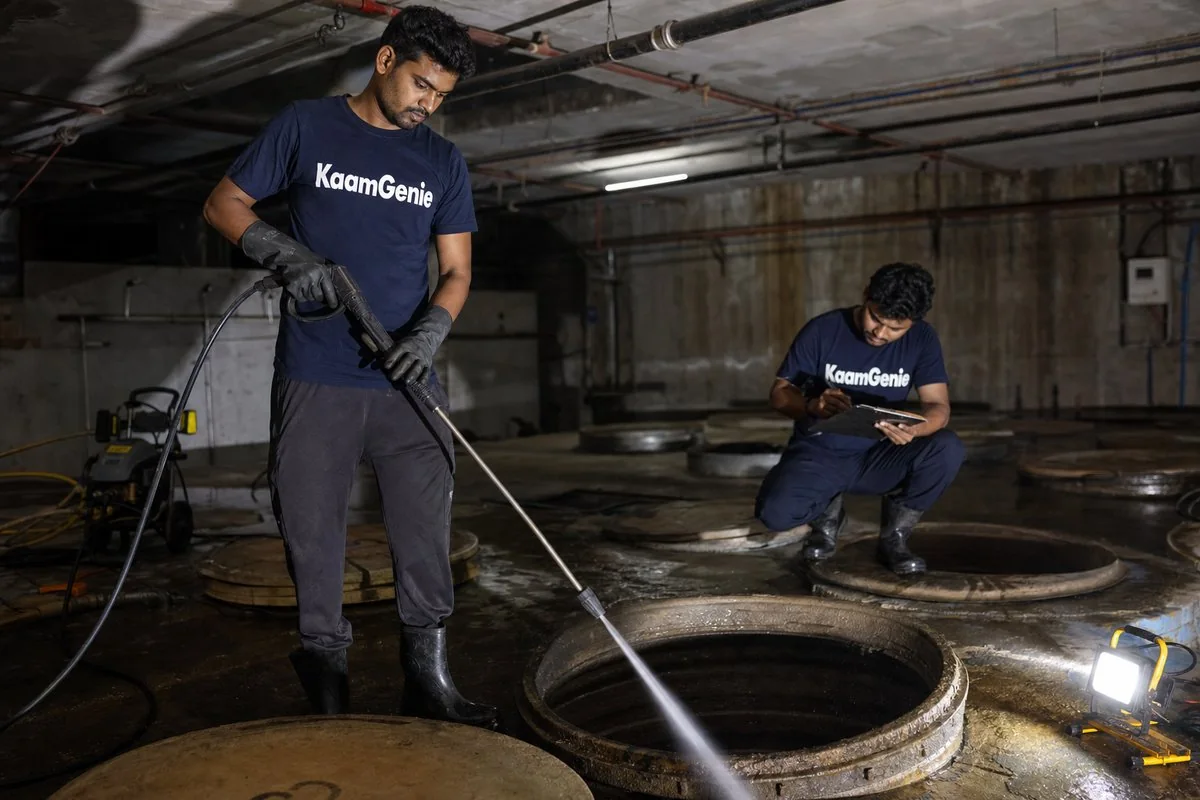
System 4: Fire-hydrant reservoir. This is the tank that has not been cleaned in 8 years in roughly 60% of malls we’ve surveyed. It’s usually a 100,000-300,000 litre underground concrete tank, sized per NBC fire-safety norms. The water sits stagnant until a fire actually happens, by which point the sludge inside could clog the hydrant pumps. Annual cleaning at minimum, ideally biannual. Most mall maintenance teams don’t have this on the schedule until we point it out.
What changes for mall work specifically: scheduling is brutal because the mall is occupied 10 AM to 11 PM, so the entire job has to fit in the 1 AM to 7 AM window. Crew sizes are larger (6-10 people on site simultaneously across multiple tank zones) and we deploy 2-3 vehicles for equipment. Food-court line work has to happen on the same night as the general system, otherwise the restaurants run dry the next morning. We bring in a separate two-person crew for the fire-hydrant tank because the pump-down and pump-up alone takes 6-8 hours.
Examples of Delhi NCR malls in the scope we typically handle: DLF Promenade, Ambience, Select Citywalk, Pacific, V3S, Cross River, Logix City Centre, Worlds of Wonder, GIP Noida. Each has its own quirks (Select has the largest fire reservoir we’ve seen, DLF Promenade has 14 separate overhead tank clusters on the roof). The right way to scope these is a daytime walkthrough with the mall maintenance head plus an overnight test-run on one tank before committing to a full-property contract.
Industrial-scale pricing — what 2026 quotes actually look like
Honest pricing band for industrial water tank cleaning across Delhi NCR. GST 18% extra on all quotes. After-hours premium is baked in — we don’t add it as a separate line because industrial jobs are always after-hours.
| Tank type / size | Indicative price | Scope | Crew | Time on site |
|---|---|---|---|---|
| Small commercial (5,000L) | ₹4,999 | Single tank, full protocol + report | 1 supervisor + 2 crew | 3-4 hours |
| Medium commercial (10,000L) | ₹7,999 | Single tank or 2 small tanks | 1 supervisor + 2 crew | 4-5 hours |
| Large industrial (25,000L) | ₹14,999 | Single reservoir, descaling included | 1 supervisor + 3 crew | 6-8 hours (overnight) |
| Factory cluster (50,000-100,000L total) | ₹25,000-45,000 | Overhead + sump + receiving tank | 1 supervisor + 4-6 crew | 1-2 nights |
| Office tower (5-15 floors) | ₹18,000-40,000 | Rooftop tanks + basement sump + fire tank | 2 supervisors + 6 crew | 1 overnight window |
| Mall complex (multi-tank) | ₹25,000-60,000 | All 4 tank systems + FSSAI cert | 2 supervisors + 8-10 crew | 1 overnight + half day |
| IT park campus (per building) | ₹15,000-30,000 | Per-building scope, rotation schedule | 1 supervisor + 4 crew | Per-night per building |
| Fire-hydrant reservoir only (100,000L+) | ₹20,000-35,000 | Pump-down, clean, refill, pressure test | 1 supervisor + 4 crew | 1-2 nights |
| Quarterly AMC (mid-size factory) | ₹28,000-45,000/yr | 4 visits + water tests + reports | Standard crew per visit | Per-visit |
| Annual AMC (large factory cluster) | Custom quote | 4-6 visits + documentation pack | Standard crew per visit | Per-visit |
If you’re evaluating quotes and one operator is at ₹3,000-4,000 for a 10,000-litre tank, ask three questions: are you ISO 45001-aligned, can you provide a water-test report from a NABL-accredited lab, and is your crew police-verified with documentation we can keep on file. The honest answer to all three is usually no, which is why their number is half ours. The price difference is the difference between a quick scrub and a documented industrial-grade service that survives a procurement audit.
After-hours scheduling + procurement documentation — how we actually run the job
Here’s the operational reality of an industrial cleaning job, end to end, so you know what your facility manager is signing up for. We walk every new client through this on the first call.
T-7 days: site survey. Our supervisor visits the site (daytime), maps every tank, photographs access points and equipment, identifies which tanks are coupled (so we sequence drain-downs correctly), confirms the after-hours window, and notes any security clearance needed. Output: a one-page fixed-scope quote with line items per tank.
T-3 days: paperwork. We share the GST invoice format, the work-order acceptance copy, ISO 45001 safety method statement, MSDS sheets for every chemical we’ll use, crew police-verification copies, and a vendor master form. Your procurement team uploads to your vendor management system. We have done this for enough Delhi NCR factories and offices that we know the exact format Tata, Maruti ancillary, Wipro, and most large facility-management firms expect.
T-1 day: pre-job confirmation. WhatsApp confirmation with the facility manager: crew names, arrival time (usually 9-10 PM), expected completion (usually 5-6 AM), water-shutdown notice (we draft the resident/tenant communication if you want).
Job night. Crew arrives, supervisor signs the gate-pass register, equipment moves in via service lift or rear access. Pre-work safety briefing on site — we run the standard 8-point toolbox talk and the gate-keeper signs it. Then sequential tank work: drain, descale, scrub, jet-wash, food-grade chlorination, contact time, refill, sample. Each tank generates a photo set (before, during, after) and a per-tank checklist.
T+1 morning: handover. WhatsApp summary to facility manager with photo set, signed checklist, MRN reference, and the next-day timeline for the water-test lab report. Operations resume at the normal opening time.
T+2 to T+4 days: lab report. Water samples go to a NABL-accredited lab. Report comes back with bacterial count, residual chlorine, TDS, hardness. We email the PDF report plus our dated cleaning documentation to facility manager + procurement.
The reason this matters: a quote that doesn’t spell out this full chain is, in practice, a quote for half the work. The cleaning itself is maybe 60% of the value. The documentation, scheduling discipline, and post-job verification is the other 40%, and it’s what separates a vendor that survives a procurement audit from one that gets dropped at the next contract review.
Confined-space safety protocol — ISO 45001 framing, not optional
Every industrial tank job that involves entry into the tank itself is a confined-space activity under Indian factory safety norms and ISO 45001:2018 occupational health & safety management. Here’s the actual protocol our crew follows, and what to look for if you’re auditing your existing vendor.
Pre-entry checks. Oxygen level must read 19.5-23.5% before any crew enters. We carry a calibrated MSA Altair 4X multi-gas monitor and log the reading on the pre-entry checklist. Hydrogen sulphide must read below 10 ppm. If either reading is off, we run the blower for 20-40 minutes and re-test. No crew enters until both readings clear.
Crew composition: 1 supervisor + 2 crew minimum. One crew member inside the tank doing the work, one crew member at the entry point as the standby (lifeline holder, ready to extract), one supervisor managing the overall job and equipment. For 25,000-litre+ tanks we add a second inside-crew so there’s rotation every 30-40 minutes to manage heat and oxygen consumption.
Equipment per entry. Full-body harness with D-ring lifeline, retractable lifeline attached to a tripod or overhead anchor point above the entry, hard hat with chin strap, non-slip rubber boots, nitrile chemical-resistant gloves, FFP2 dust mask (upgraded to a half-face respirator if descaling chemicals are in use), portable LED work light (non-incandescent, no spark risk).
Continuous monitoring during work. The multi-gas monitor stays on the inside crew member. If oxygen drops below 19.5% or H₂S rises above 10 ppm during work, the alarm triggers and the crew evacuates immediately. The blower runs continuously throughout, not just before entry.
Communication. Standby crew member maintains line-of-sight or two-way verbal contact at all times. For deep sumps with poor sight-line, we use radio comms.
Documentation. Pre-entry checklist signed by supervisor + standby + entrant. Permit-to-work issued by site facility manager and counter-signed by our supervisor. Post-job sign-out confirms all crew accounted for, no equipment left inside, tank lid secured.
If your current vendor sends one person in with no standby, no monitor, and no harness, you’re carrying the liability for any incident on your premises. The cost of getting this wrong is much larger than the cost of a properly-resourced vendor.
Annual maintenance contract (AMC) vs one-time — the procurement math
For residential customers the AMC question is mostly about convenience. For industrial customers it’s about three different things: capex vs opex treatment, audit readiness, and vendor lock-in pricing.
One-time per-visit booking. Each visit is quoted separately, raised as a one-off purchase order, and goes through full procurement approval each time. For a mid-size factory needing 4 visits a year, that’s 4 separate POs, 4 separate vendor onboardings (if your system requires re-verification per PO), 4 separate audit trails. Per-visit price is at list rate. Cash-flow impact is lumpy.
Quarterly AMC (4 visits/year). Single annual contract, single PO, predictable visit dates. Per-visit cost typically drops 15-25% because we’re committing crew and equipment slots in advance. Water-test reports are scheduled and filed as a continuous compliance trail — audit-ready without extra work. Vendor master entry happens once.
Annual AMC with documentation pack. For ISO 9001 / ISO 14001 / ISO 45001 certified facilities, we add a documentation pack: monthly visual inspections (no entry, just a 30-minute walkthrough), quarterly full cleaning, half-yearly water-quality lab report, annual compliance summary signed by our QHSE lead. This is the package most exporters in Manesar and Noida sign up for.
The actual math, mid-size Okhla factory, single 25,000L tank.
One-time: 4 visits at ₹14,999 = ₹59,996 + GST. Plus 4 procurement cycles of admin overhead.
Quarterly AMC: 4 visits at ₹11,250 average = ₹45,000 + GST. Single annual PO. ~25% direct saving. Audit trail is automatic.
The break-even is somewhere around 2 cleanings a year. Anything more than that, AMC almost always wins on total cost of ownership. The exception is a single-clean job for a procurement spot-buy — building a new facility, taking over a leased premises, or recovering from a contamination incident — where one-time makes sense.
How to spot a real industrial-grade quote vs a residential operator pretending
This is the question every Delhi NCR procurement manager should ask before signing any industrial water-tank cleaning contract. The market has many residential operators quoting industrial jobs, and the only way to know the difference is to test the quote against a real-vendor checklist.
- Do they ask for a site survey before quoting? A real industrial vendor never quotes blind. If they give you a final number over phone or email without walking the site, the number is either inflated or they’re planning to skip scope. We’ve had clients save 20-30% just by switching from a phone-quote operator to one who surveys first.
- Is ISO 45001-aligned safety protocol in the quote? A residential operator won’t write “ISO 45001” into a quote because they don’t know what it means. Real industrial vendors include the safety method statement, gas-monitor model used, and crew certification level. If the quote is silent on safety, the actual job will be too.
- Do they include a water-test lab report from a NABL-accredited lab? Post-cleaning water testing is the only objective proof that the work was done correctly. NABL accreditation is the Indian standard for lab credibility. If the quote says “water testing included” without naming the lab or accreditation, it’s probably an in-house dipstick test, which is worthless for audit purposes.
- Is the crew police-verified and is the documentation transferable? Industrial sites need crew identity records on file. A real vendor will share police-verification copies and Aadhaar-onboarding records as part of the contract documents. A residential operator typically has none.
- Do they have references in your industry, in your belt? Ask for three references in the same belt (Okhla, Manesar, Cyber City etc.) and the same scale of operation. A vendor who has done 50 factories in Okhla knows what they’re walking into; one who has only done residential will improvise on your site, badly.
- Is the contract format vendor-master-ready? Large facilities run on vendor master systems (SAP, Oracle, Tally). The vendor’s GST, PAN, MSME registration (if applicable), bank details, and insurance documents need to slot directly into your system. If onboarding takes more than 48 hours because the vendor’s paperwork is incomplete, expect every subsequent invoice to stall for the same reasons.
- Are they insured for the work they’re doing on your premises? Workmen’s compensation insurance and third-party liability insurance covering confined-space work. Real industrial vendors carry both and share copies with the contract. Without it, an injury on your site is your problem under the Factories Act and your liability under tenancy/lease terms.
If a vendor passes all seven of these, you’re looking at an industrial-grade operator. If they fail more than two, they’re a residential operator pricing into a job that will fail your next audit. The price difference between the two tiers is real, but the cost of getting it wrong is much larger than the saving.
Areas we serve for industrial water tank cleaning across Delhi NCR
Industrial-grade water tank cleaning across the full NCR industrial and commercial belt: Okhla Phase I/II/III, Mayapuri Phase I/II, Bawana, Narela, Naraina, Patparganj industrial, Wazirpur, Mohan Cooperative, Jasola commercial, Nehru Place, Connaught Place, Bhikaji Cama Place, Saket commercial; Gurgaon Cyber City, Cyber Hub, Golf Course Road, DLF Phase 1-5, IMT Manesar, Udyog Vihar, Sector 18 / Sector 32 commercial, Sohna Road; Noida Sector 16 / 18 / 62 / 125 / 132, Noida Phase 2 / 3 industrial, Greater Noida West; Faridabad sectors 22/24/25/27 industrial, Faridabad NIT; Ghaziabad Sahibabad industrial, Loni industrial. For factory clusters or campuses outside this belt, contact us directly with a brief site description and we’ll confirm coverage.
Frequently asked questions
How much does industrial water tank cleaning cost in Delhi NCR (2026)?
Indicative bands: small commercial 5,000L tank from ₹4,999, medium 10,000L ₹7,999, large 25,000L ₹14,999, factory cluster ₹25,000-45,000, office tower ₹18,000-40,000, mall complex ₹25,000-60,000, fire-hydrant reservoir ₹20,000-35,000. GST 18% extra. After-hours premium is baked in. Anything quoted below half this band usually skips ISO 45001 safety and NABL water testing — ask before signing.
Can the cleaning happen after-hours so operations don’t stop?
Yes — this is the default for industrial work, not an add-on. Typical windows: factories 9 PM to 5 AM (before morning shift), office towers 10 PM to 5:30 AM, malls 1 AM to 7 AM. Weekend slots also available. We coordinate with your security and facility manager so equipment moves in via service lifts and the property opens normally the next morning.
Do you give a proper GST invoice and procurement documentation?
Yes. Standard documentation pack: GST invoice, work-order acceptance copy, ISO 45001 safety method statement, MSDS for every chemical used, crew police-verification copies, vendor master form, NABL-accredited water-test lab report, photo-proof set per tank, signed pre-entry safety checklist. Format matches what large facilities like Tata, Maruti ancillaries, Wipro, and major facility-management firms expect.
What confined-space safety protocol do you follow?
ISO 45001:2018-aligned protocol. Pre-entry oxygen check (must read 19.5-23.5%) and H₂S check (below 10 ppm) using calibrated multi-gas monitor. Full-body harness with retractable lifeline. 1 supervisor + 2 crew minimum (one inside, one as standby at entry). Continuous gas monitoring during work. Forced ventilation via blower throughout. Permit-to-work counter-signed by site facility manager. Workmen’s compensation + third-party liability insurance in force.
AMC vs one-time — which is better for a factory or office tower?
For anything more than 2 cleanings a year, quarterly AMC almost always wins on total cost of ownership. Per-visit cost typically drops 15-25%, single annual PO instead of 4 separate ones, audit trail is continuous and automatic, vendor master entry happens once. One-time makes sense only for spot situations — new facility commissioning, taking over leased premises, recovering from a contamination incident.
How is cleaning a factory tank different from cleaning an office or a mall?
Factory: high water turnover (10x residential), heavy mineral scale on inlet/outlet walls, often paired with receiving sumps for tanker-fed sites in Bawana/Narela, descaling included. Office tower: lower volume per sqft but multi-tank architecture (rooftop + sump + fire-hydrant + intermediate), strict 5-7 hour overnight window. Mall: four parallel tank systems (general, food court, drinking-water, fire-hydrant), FSSAI compliance for food-court line, 6-10 person crew, 2-3 vehicles, 1 AM to 7 AM window.
What equipment do you use for industrial-scale jobs?
High-capacity submersible drainage pumps, industrial wet/dry vacuum (15-30L), high-pressure jet wash (150-200 bar), descaling chemical sprayer for mineral build-up, calibrated multi-gas monitor (MSA Altair 4X or equivalent), powered blower for forced ventilation, full-body harnesses with retractable lifelines and tripod anchor points, food-grade chlorination dosing kit. For 25,000L+ tanks we deploy 2-3 vehicles of equipment.
Are your chemicals and process ISO and FSSAI compliant?
Yes. Disinfection uses food-grade sodium hypochlorite at WHO-recommended contact time. Safety method statement is ISO 45001:2018 aligned. For food-court / restaurant / hotel / hospital clients, we issue separate FSSAI-aligned documented proof of cleaning suitable for production during food-safety audits. MSDS sheets for every chemical used are part of the standard documentation pack.
What scope is included in a standard industrial cleaning visit?
Pre-job site walk and tank inventory, water shutdown coordination with facility manager, drainage of existing water, manual sludge removal, descaling of inlet/outlet walls (chemical or mechanical based on scale type), brush + jet-wash interior scrubbing, food-grade chlorination with full contact time, refill, post-job sample collection. For fire-hydrant tanks: additional pressure test after refill. For office towers: per-tank photo set and one-page facility-manager summary.
How many crew members come per visit and how long does the job take?
Small commercial (5,000L): 1 supervisor + 2 crew, 3-4 hours. Medium (10,000L): 1 supervisor + 2 crew, 4-5 hours. Large industrial (25,000L): 1 supervisor + 3 crew, 6-8 hours. Factory cluster: 1 supervisor + 4-6 crew, 1-2 nights. Office tower: 2 supervisors + 6 crew, 1 overnight. Mall complex: 2 supervisors + 8-10 crew, 1 overnight + half day. Job sequencing is planned during the pre-survey so the total downtime window is minimised.
Will operations have to shut down during the cleaning?
Generally no — that’s the whole point of after-hours scheduling. Production lines don’t stop. Canteens and washrooms have a planned water-shutdown window (we coordinate the resident/tenant communication for you) typically 4-6 hours overnight when the building is least occupied. Water is back on by the morning shift / mall opening / office start time. Fire-hydrant tank work is the one exception — that needs a separate planned window because of pressure-test sign-off, but it doesn’t affect general operations either.
How do we book a site survey or request a quote?
Call 95603 66362 or WhatsApp wa.me/919560366362 with your facility type (factory / office tower / mall / IT park), approximate tank capacity, location, and preferred site-survey window. Our supervisor will visit within 48 hours during your working hours, walk every tank including the often-forgotten fire-hydrant reservoir, and send a fixed-scope quote within 24 hours of the survey. No obligation, no survey charge.
Sources & references
- Bureau of Indian Standards (BIS) — IS 10500:2012 — the Indian drinking-water quality standard. Defines the parameters (bacterial count, residual chlorine, TDS, hardness) measured in post-cleaning water tests from NABL-accredited labs.
- WHO Drinking Water Guidelines — global reference for drinking-water safety, contact times for chlorine disinfection, and acceptable residual chlorine ranges that our food-grade chlorination protocol meets.
- ISO 45001:2018 — Occupational Health & Safety Management — the international standard for safety management systems. Our confined-space entry protocol (oxygen monitor, harness, standby crew, permit-to-work) aligns with the ISO 45001 framework that export-oriented Delhi NCR factories increasingly require from vendors.
- CPHEEO Manual on Water Supply & Treatment (Ministry of Housing & Urban Affairs) — the Indian engineering reference on storage and distribution of potable water, including cleaning frequency recommendations for large municipal-fed reservoirs.
Last verified: 7 June 2026. If you find any of these links broken, please let us know.