
Quick answer for restaurant owners
- Cleaning frequency: every 3 months for standard restaurants; every 1-2 months for cloud kitchens and high-volume operations.
- Documentation required: third-party cleaning record with 9 specific fields, retained for 2+ years.
- Chemicals allowed: food-grade sodium hypochlorite 5-6%, calcium hypochlorite, or potable-water-approved chlorine tablets — with MSDS.
- Water quality target: BIS IS 10500:2012 — no E. coli, residual free chlorine 0.2 mg/L, TDS preferably under 500 mg/L.
- Penalty exposure: ₹2L-10L plus licence cancellation for repeat violations. One outbreak ends the business reputation regardless.
- Typical cost: ₹1,500-2,500 per cleaning visit including the FSSAI-ready certificate. Annual contracts save 20-25%.
What FSSAI actually says about restaurant water tanks
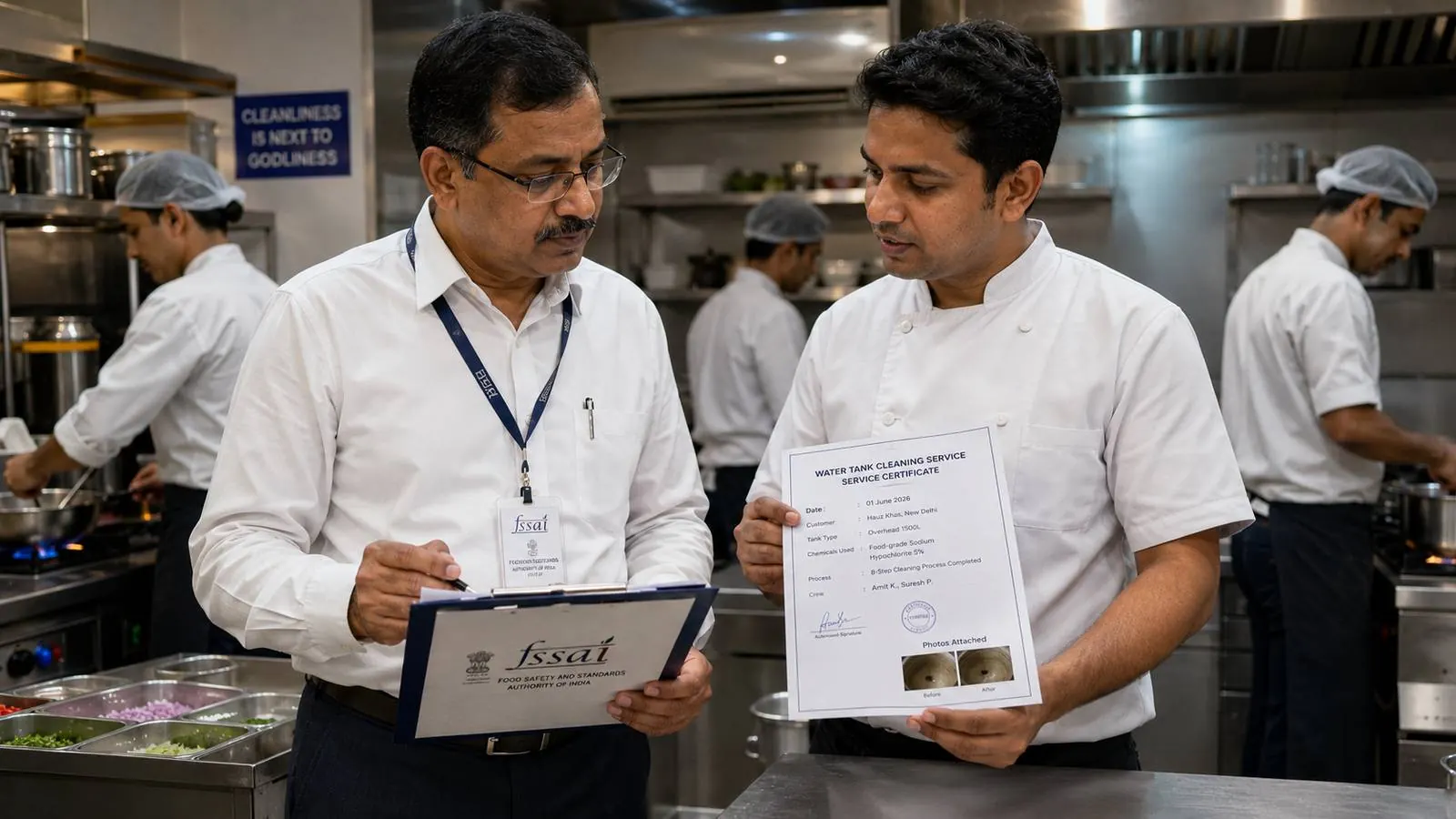
Most restaurant owners we’ve worked with first encounter FSSAI’s water tank requirements during a renewal inspection, when an inspector asks for "the last six months of cleaning logs" and the owner realises there’s a folder of receipts but not a single proper cleaning record. That moment is avoidable with about an hour of upfront understanding.
The relevant rules come from the Food Safety and Standards Act 2006 and its accompanying regulations — specifically the Schedule 4 hygiene and sanitary practices that every FBO (Food Business Operator) must comply with. The act doesn’t mention "water tank cleaning frequency" by exact words, but it does require:
- Water used in food preparation must meet BIS IS 10500:2012 drinking water quality standards
- Water storage must prevent contamination from external sources, vermin, or stagnation
- Storage tanks must be cleaned and disinfected "at appropriate frequency"
- Records of all cleaning and sanitation activities must be maintained
- Material safety data and chemical concentration records must be available
"Appropriate frequency" is what trips most restaurants up. The regulation doesn’t say "every 3 months". But every FSSAI guidance document and most state food-safety departments interpret it as quarterly minimum for standard restaurants and more frequent for higher-volume or higher-risk operations. Below is the practical frequency table we use with our restaurant clients.
How often you should actually be cleaning
FSSAI doesn’t prescribe one number for every restaurant. The frequency that holds up in an inspection depends on your scale, your menu, and your water source.
| Restaurant type | Recommended frequency | Why |
|---|---|---|
| Small café / coffee shop | Every 4 months | Lower water turnover, simpler menu, lower contamination risk |
| Standard dine-in restaurant | Every 3 months | Standard FSSAI guidance for FBOs |
| Cloud kitchen / dark kitchen | Every 1-2 months | High volume, multiple brands, frequent equipment cycles |
| Large multi-cuisine restaurant (50+ covers) | Every 2 months | Higher water turnover, larger tank capacity |
| Restaurants serving raw meat / seafood | Every 2 months | Higher contamination risk profile |
| Hotel kitchen / banquet | Every 1-2 months | Volume + variety + 24/7 operation |
| Bakery / sweet shop | Every 3-4 months | Moderate water use; document storage water hygiene too |
| Food court / mall outlets | Every 3 months | Shared building tanks need RWA + outlet records together |
The frequency on the right column is what we recommend — not what FSSAI mandates word-for-word. But if an inspector asks "when was the tank last cleaned?" and your answer is older than the frequency in this table, expect follow-up questions.
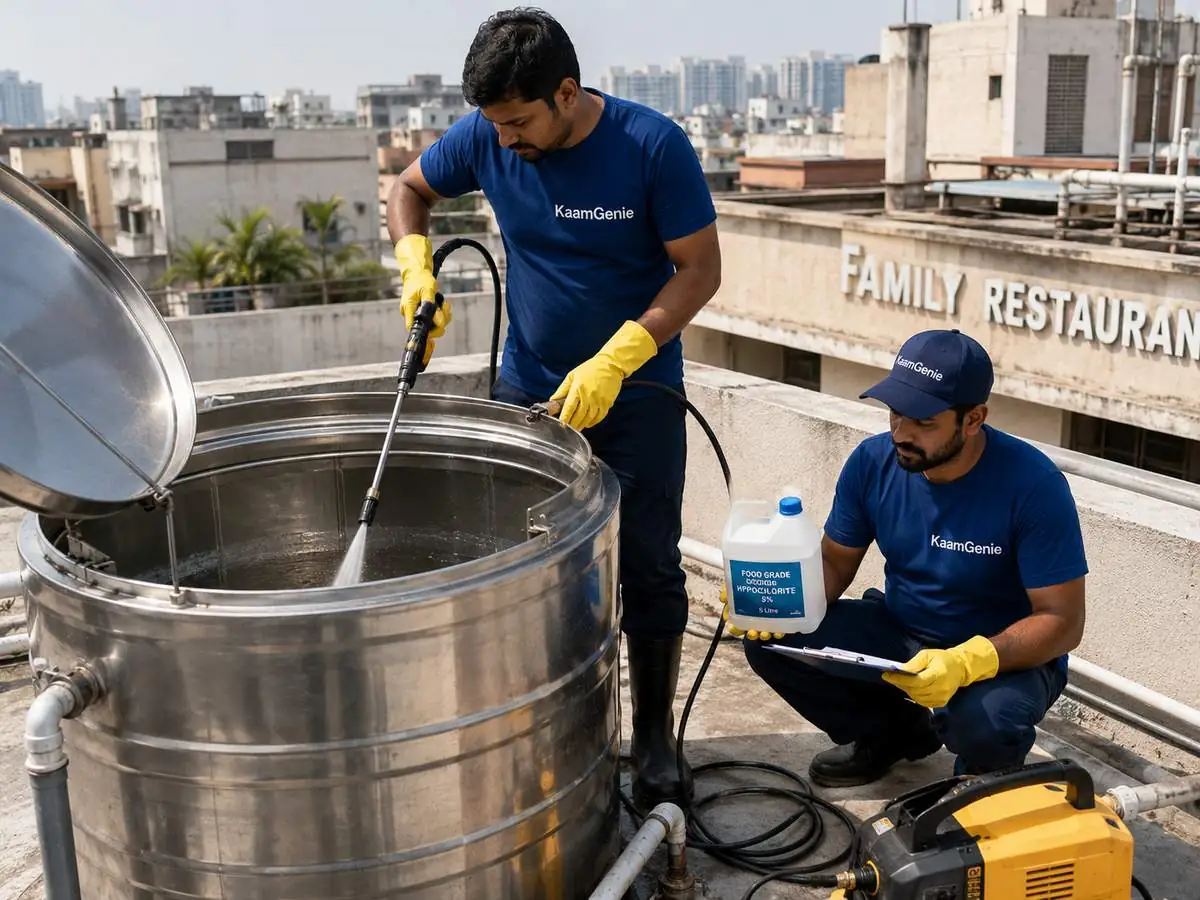
Restaurant booking — FSSAI-ready cleaning
Quarterly contracts available. Every visit includes FSSAI-acceptable certificate, chemical MSDS, and before/after photo log.
The 9-field cleaning record (what inspectors look for)
When an FSSAI inspector asks for "the water tank cleaning record", they are not asking for a receipt or a payment confirmation. They are asking for a dated cleaning record that proves a qualified cleaning was performed with documented chemicals and contact-time discipline. A receipt from a casual cleaner with just a date and an amount does not meet this requirement.
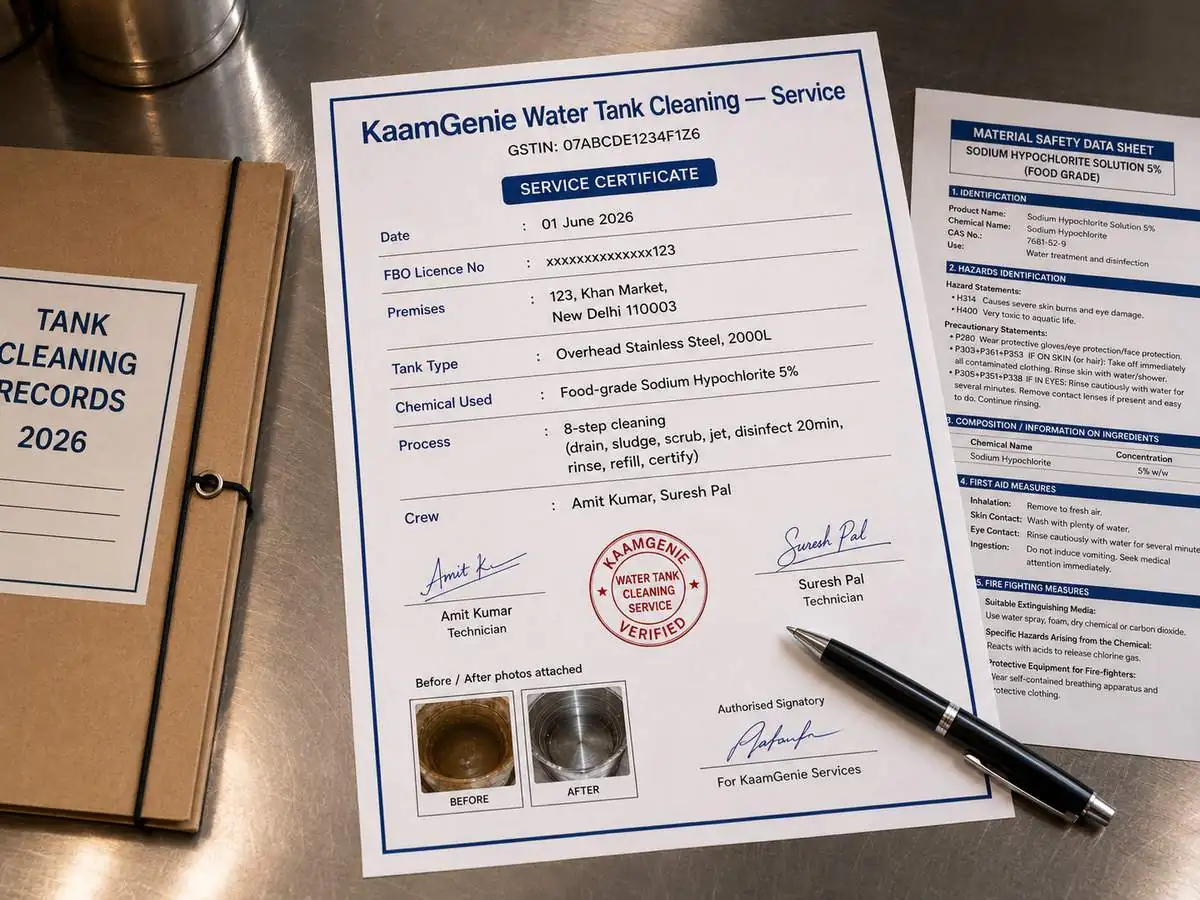
Here’s exactly what the certificate must contain:
| Field | What it must say | Why inspectors care |
|---|---|---|
| 1. Date of service | Specific date (not month/year alone) | Confirms cleaning frequency compliance |
| 2. FBO licence number | Your restaurant’s FSSAI licence # | Ties the cleaning to your specific outlet |
| 3. Premises address | Full address of the restaurant | Verifies on-site cleaning |
| 4. Tank type and capacity | Overhead/sump, litres | Matches inspector's physical inspection |
| 5. Chemical used + concentration | e.g. "Food-grade sodium hypochlorite, 5%" | Confirms food-safe disinfection |
| 6. Cleaning process steps | Brief list of 6-8 steps performed | Confirms SOP-compliant cleaning |
| 7. Crew names + signatures | Named individuals, signed | Accountability trail |
| 8. Before/after photos | Attached or referenced | Visual evidence of work done |
| 9. Service company stamp + GSTIN | Registered company stamp + GSTIN on header | Confirms third-party verifiability |
A certificate missing any one of these can be questioned. A certificate missing three or more will not pass inspection. We’ve had restaurants call us after a failed inspection — in every case, the cleaning had actually happened, but the documentation was inadequate.
How prepared is the average Delhi restaurant? (and where the gap is)
Based on the restaurants we’ve onboarded over the last 18 months, here’s our honest assessment of where most kitchens score on FSSAI water-tank readiness before working with us:
FSSAI water-tank inspection readiness — Delhi restaurants (our observation)
Percentage of restaurants meeting each requirement on first inspection (n ~120)
The cleaning happens — the documentation doesn’t. Most failed inspections trace back to the bottom three rows, not to genuinely unclean tanks.
The pattern in the chart is the entire story: cleaning happens, documentation doesn’t. Almost every restaurant has been cleaning regularly. Almost none of them have the paper trail to prove it in a way that satisfies FSSAI. The fix is changing service provider, not changing cleaning habit.
The chemicals you can and cannot use
For drinking water tank disinfection in a food business, FSSAI defers to BIS and WHO standards on acceptable disinfectants. The three categories are:
- Food-grade sodium hypochlorite (5-6% concentration) — the standard professional disinfectant. Available in 20-25 litre cans, with MSDS, from food-safety supply distributors.
- Calcium hypochlorite — less common but accepted. Higher concentration, used for larger industrial reservoirs.
- Potable-water-approved chlorine tablets — sometimes used for small tanks or emergency use. Must be the drinking-water grade, not pool-grade.
What you cannot use:
- Household bleach — contains fragrances, stabilisers and surfactants not approved for drinking water contact
- Pool chlorine — different stabilisation, not certified for potable use
- Industrial cleaners or sanitisers — not certified for human water contact
- Anything without an MSDS available — you can’t document what an inspector asks about
For every chemical used, the cleaning company should be able to provide the Material Safety Data Sheet (MSDS) on request, and ideally keep one on file at your premises. We provide MSDS digitally with every certificate.
What an FSSAI inspector actually does (the 20-minute version)
It helps to understand the inspector’s view of the visit. Here’s how a typical water-tank-related portion of a Delhi FSSAI inspection runs:
- Asks for cleaning logs / certificates for the past 12 months — usually expects to see 3-4 visits depending on your operation type
- Reviews most recent certificate in detail — checks for the 9 required fields above, especially the chemical name and concentration
- Asks about chemical sourcing — "where do you get the disinfectant?" If you can’t name a supplier or show an MSDS, it’s a flag
- Physically inspects the tank — lid condition, surroundings, signage, any visible algae or contamination
- May take a water sample — sent to a state-approved lab for TDS, microbial load, residual chlorine
- Asks about water source — DJB / borewell / tanker, with documentation if tanker
- Cross-references with the FBO licence — verifies the cleaning records match the licensed premises
The whole water-tank portion typically takes 15-25 minutes. The single fastest way to fail is to hand over a folder of receipts with no proper cleaning records. The fastest way to pass is to hand over a thin folder with quarterly third-party certificates, each with all 9 fields complete.
Annual restaurant contract — pay less, document everything
4 visits per year, all FSSAI-ready certificates, all chemical MSDS on file. From ₹4,800/year for standard cafes.
What you should keep on file (the 3-folder system)
Whether digital or physical, restaurants that pass inspections cleanly keep three things organised and accessible within 60 seconds when asked:
- Folder 1 — Cleaning certificates. 12+ months of dated cleaning records, in reverse chronological order. Most recent on top.
- Folder 2 — Chemical documentation. MSDS for every disinfectant used. Supplier invoice if you store chemicals in-house. Brand/concentration record per visit.
- Folder 3 — Water quality reports. Any lab tests, periodic supplier (tanker/DJB) water analyses, photos of any contamination events and how they were resolved.
For digital systems, label the files with date + tank ID + outlet name. We provide all three categories to our restaurant clients in a shared Google Drive folder so renewal time is a 5-minute check, not a panicked week.
Common ways restaurants fail FSSAI on water tank specifically
- "We clean it monthly" but can’t produce monthly certificates — verbal claim, no paper. Fails.
- Receipt from a casual cleaner — not a cleaning record, just a payment record. Fails.
- Certificate with no FBO number — doesn’t tie cleaning to this specific outlet. Questioned.
- Chemical name missing or vague — "chlorine" without concentration is insufficient. Questioned.
- Old certificate (over 90 days) for a high-frequency operation — suggests overdue cleaning. Flagged.
- Tank lid broken or missing at physical inspection — documentation is fine but tank condition fails.
- Tanker water with no supplier documentation — cleaning certificate alone doesn’t cover this; you need supplier paperwork too.
Putting it together — the restaurant compliance routine
The whole thing reduces to a simple quarterly rhythm:
- Every 3 months (or your tier’s frequency): schedule a professional cleaning. Confirm date, time, expected duration with the service.
- On the day: have a manager available to sign the cleaning record. Keep both digital and printed copies.
- Within 24 hours: file the certificate in Folder 1 with photos in Folder 3. Update the calendar with the next due date.
- Annually: review the full year of certificates before the FBO renewal. Address any gaps proactively, not under pressure.
For most Delhi restaurants this whole compliance overhead is about 30 minutes per quarter once the rhythm is set, plus the 2-hour cleaning visit. It is far less expensive in time and money than an inspection failure, a re-inspection, or worst case a closure order.
If you want to outsource the entire compliance side to our commercial tank cleaning services — quarterly scheduling, FSSAI-ready certificates, MSDS on file, digital and printed records, calendar reminders — call +91 95603 66362 or use the booking form. We’ll set up the annual contract structure that fits your specific outlet type.
Frequently asked questions
How often does FSSAI require water tank cleaning for restaurants?
FSSAI’s Schedule 4 hygiene requirements specify that water tanks used in food businesses must be cleaned and sanitised at intervals that prevent contamination — in practice, every 3 months is the safe interval for most Delhi restaurants. Higher-risk operations (cloud kitchens, large dine-in restaurants, anything dealing with raw meat) typically clean every 1-2 months.
What documentation does FSSAI need for water tank cleaning?
A signed cleaning record from a third-party cleaner showing: date, your restaurant’s FBO licence number, tank type and capacity, chemicals used with concentration, cleaning process steps, crew names and signatures, and before/after photos. The document must be retained for at least 2 years and produced on demand during inspection.
Can I clean my restaurant water tank myself for FSSAI compliance?
Self-cleaning may be questioned during inspection because there’s no independent verification. FSSAI strongly prefers third-party cleaning records from a registered cleaning company. If you do clean in-house, you’ll need detailed SOPs, chemical purchase records, staff training certificates, and signed-off logs — which is more paperwork than just booking a service.
What chemicals are FSSAI-acceptable for restaurant water tank disinfection?
Food-grade sodium hypochlorite at 5-6% concentration is the standard. Calcium hypochlorite is also accepted. Chlorine tablets approved for potable water are acceptable. Any chemical used must have a Material Safety Data Sheet (MSDS) available and be applied at concentrations and contact times documented in the cleaning SOP.
What happens during an FSSAI inspection of water tanks?
The inspector typically asks for the cleaning logs and most recent cleaning record, physically inspects the tank exterior and lid condition, may take a water sample for lab testing (TDS, microbial load, residual chlorine), and asks about the source of water (DJB / borewell / tanker supply). They also check whether the tank is BIS-IS-10500 compliant in placement and access.
What’s the penalty for failing FSSAI water tank requirements?
Penalties under the FSS Act range from ₹2 lakh for misbranding/misleading information to ₹10 lakh for unsafe food and possible licence cancellation. Repeat violations can lead to closure orders. Beyond the penalty, a single waterborne illness outbreak traced to your premises can permanently damage the business reputation.
Do cloud kitchens and food trucks need to follow FSSAI water tank rules?
Yes. Any FBO (Food Business Operator) under FSSAI licence must comply, regardless of format. Cloud kitchens often have higher cleaning frequency requirements (every 1-2 months) due to volume. Food trucks need documentation for both their on-board water storage and any base-kitchen tanks they use.
What’s the FSSAI water quality standard restaurants must meet?
Water used in food preparation must meet BIS IS 10500:2012 drinking water quality parameters — including limits on total dissolved solids (TDS up to 500 mg/L preferred), pH between 6.5-8.5, no E. coli or coliform bacteria, and residual free chlorine of 0.2 mg/L at point of use for chlorinated supplies. Lab tests verify compliance.
How much does FSSAI-compliant water tank cleaning cost in Delhi?
Restaurant tank cleaning in Delhi typically costs ₹1,500-2,500 per visit including the FSSAI-acceptable cleaning documentation. Annual contracts (4-6 visits per year) usually reduce per-visit cost by 20-25%. The cleaning documentation is what justifies the higher price vs residential cleaning.
Can I share one water tank cleaning record across multiple restaurant outlets?
No. Each FBO location must have its own cleaning record tied to that specific premises. If you run a chain, each outlet maintains its own cleaning logs. The record must reference the FBO licence number for that specific location.
What if my restaurant uses tanker water instead of DJB or borewell?
Tanker-supplied water requires additional documentation — you need to keep records of the tanker supplier’s water source, periodic test reports from the supplier, and the storage tank cleaning logs. Some inspectors require additional water testing at point of use if tanker is the primary source. Plan for stricter scrutiny in this case.
How long should I retain water tank cleaning certificates for FSSAI?
Minimum 2 years per general FSSAI record-keeping requirements. We recommend 3 years to align with the FSSAI licence renewal cycle. Digital copies are acceptable if signed and timestamped; we provide both paper and digital versions with every cleaning so you can store either or both.
Sources & references
- Food Safety and Standards Authority of India (FSSAI) — primary source for food business operator licensing requirements and Schedule 4 hygiene and sanitary practices.
- Bureau of Indian Standards (BIS) — IS 10500:2012 drinking water quality specification referenced throughout FSSAI compliance guidance.
- FoSCoS — FSSAI Food Safety Compliance System — the portal where FBO licences are issued and renewals processed; inspection records are linked here.
- Delhi Jal Board (DJB) — water supply authority for Delhi; publishes municipal water quality reports referenced in BIS compliance.
- WHO Drinking Water Fact Sheet — global framework on safe drinking water that informs Indian standards.
Last verified: 1 June 2026. If you find any of these links broken, please let us know.