
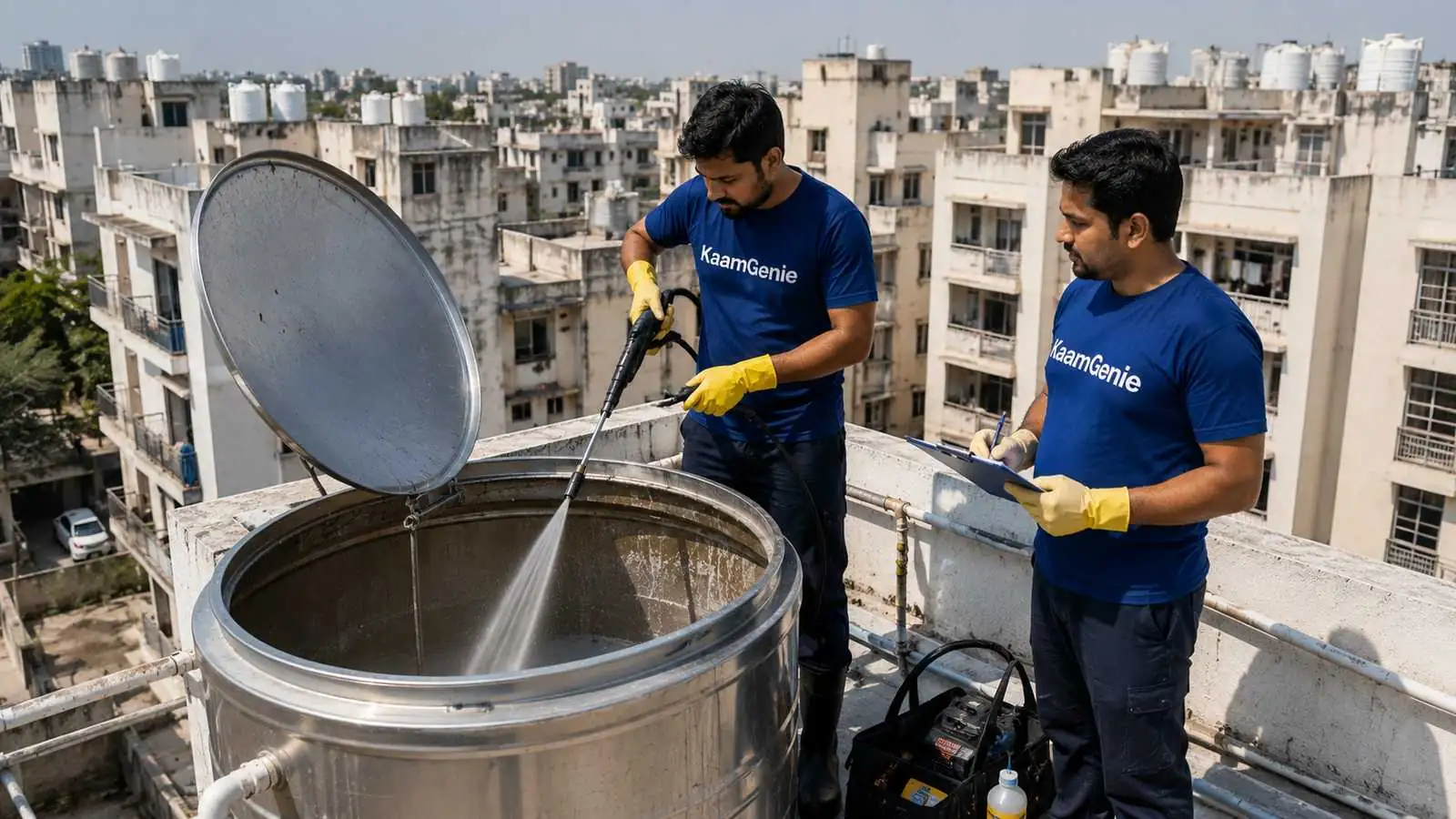
Quick answer for RWA committees
- Pricing range: ₹4,800/year for a 4-flat building — ₹40,000+/year for large gated societies with multiple reservoirs.
- Savings vs ad-hoc: 20-25% per visit, plus consistent water quality across the year.
- Recommended frequency: quarterly for DJB-fed buildings, bi-monthly for borewell-fed.
- Must include: food-grade chemicals, signed certificate per visit, before/after photos, service guarantee for rework.
- Sign-off: usually executive committee + maintenance secretary; share 3 quotes for audit trail.
- Term: 12 months with annual review is the flexibility sweet spot.
Why ad-hoc cleaning is the worst economics for societies
A typical Delhi RWA cleaning rhythm looks like this: residents complain about a brown tinge in the water during the May heatwave. The maintenance committee scrambles, calls the first provider that picks up, pays whatever they quote, and the issue clears. Three months later, somebody else complains. Different provider. Different price. No paperwork. Repeat.
The cost of this approach isn’t just the per-visit price — it’s the unpredictability. Different crews don’t know your building, different chemicals get used, and there’s no continuity record. When a new resident asks "when was the tank last cleaned?", the answer is a vague "few months back."
An annual contract changes three things in particular:
- The same crew comes each time. They learn your building — where the tank lid sticks, which valve to use for drainage, who in security to coordinate with. Cleaning quality improves visit on visit.
- Visits are scheduled, not reactive. Quarterly cleanings prevent the water-quality drift that triggers complaints in the first place. You don’t see brown water in May because the April cleaning addressed the buildup.
- The paper trail is continuous. Four signed cleaning records per year, dated, in one folder. Useful for the AGM, useful when buyers do due diligence, useful if anyone ever questions water quality.
Annual contract pricing tiers (Delhi NCR, 2026)
RWA contract pricing depends on three variables: total water tank capacity (the biggest factor), number of visits per year, and any optional add-ons like water testing or sump cleaning. Below is the pricing structure we offer — representative of fair-market rates in Delhi for established service providers.
| Society size | Total tank capacity | Visits / year | Annual price |
|---|---|---|---|
| Small building (4-6 flats) | Up to 2,000L | 4 visits | ₹4,800 |
| Medium building (8-12 flats) | 2,000-5,000L | 4 visits | ₹8,400 |
| Large building (15-25 flats) | 5,000-10,000L | 4 visits | ₹14,000 |
| Small society (1 tower, 30-50 flats) | 10,000-20,000L (overhead + sump) | 4-6 visits | ₹18,000-24,000 |
| Medium society (2-4 towers, 60-150 flats) | 20,000-50,000L | 6 visits | ₹28,000-40,000 |
| Large gated community (200+ flats) | 50,000L+ (multiple reservoirs) | 6-12 visits | Custom quote |
For societies on borewell water, add roughly 15-20% — borewell water leaves more mineral residue, which means longer cleaning time and higher chemical usage per visit. For societies with restaurants or food businesses in the basement, add the FSSAI-grade certificate fee per outlet (covered in our FSSAI requirements guide).
The actual savings — ad-hoc vs annual, in real numbers
Let’s use a 12-flat DDA building in CR Park as a worked example. The shared overhead tank holds about 4,000L. Here’s the math both ways:
Ad-hoc cleaning vs Annual contract — total spend for a 12-flat building over 12 months
4,000L shared tank, CR Park (representative case)
Annual contract costs more in absolute rupees because you get 2× the visits. But per-visit price drops 29%, per-flat annual spend is ₹700 (less than ₹60/month), and the tank stays consistently clean.
The takeaway: an annual contract isn’t how you save money. It’s how you buy reliable water quality at a 29% lower per-visit cost than the alternative, with documentation that survives any audit.
For a 12-flat building, ₹8,400 per year is ₹700 per flat per year, or about ₹58 per month. There is no other building maintenance line item that delivers as much resident impact per rupee.
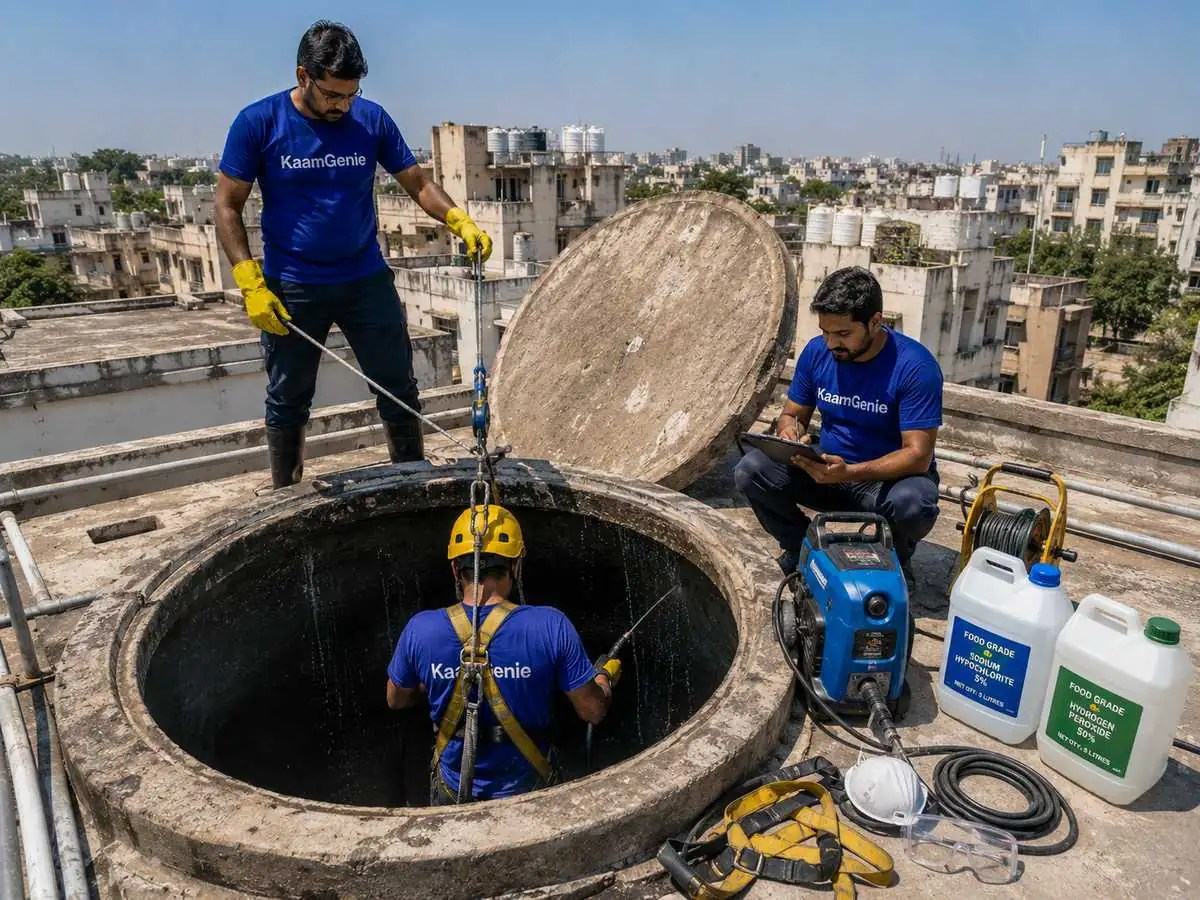
Get a fixed annual quote for your society
Send us your flat count + tank capacity. We’ll send back a fixed annual price with the schedule, inclusions, and references from comparable societies.
What a good RWA contract must include (the 10-point list)
If you’re evaluating annual contracts from 2-3 providers, here’s the standard inclusion list every quote should cover. A missing item isn’t automatically a deal-breaker but it’s a question worth raising.
| # | Item | Why it matters |
|---|---|---|
| 1 | Number of scheduled visits per year | Avoids ambiguity later — should be 4-6 typically |
| 2 | Specific tank inventory covered | Overhead + sump + any auxiliary tanks listed by capacity |
| 3 | Cleaning process steps | 6-8 steps named (drain, sludge, scrub, jet, disinfect, refill, certify) |
| 4 | Chemicals + concentration | e.g. "Food-grade sodium hypochlorite, 5%" + MSDS on request |
| 5 | Cleaning record after every visit | Signed, with all 9 fields (date, address, chemicals, crew, photos) |
| 6 | Before/after photo deliverable | Sent to RWA WhatsApp / email within 24 hours |
| 7 | Service guarantee for rework | Free re-cleaning within 7-14 days if RWA flags an issue |
| 8 | Fixed annual price + GST | No surprise add-ons during the year |
| 9 | Single point of contact at provider | One named coordinator, not a call centre |
| 10 | Cancellation / change-of-mind clause | Pro-rata refund if RWA chooses to exit mid-term |
Optional but valuable add-ons:
- Quarterly water testing — TDS, pH, microbial. Adds ₹2,000-4,000 to annual cost but gives the RWA documented evidence of water quality.
- Emergency visit clause — one or two unscheduled visits if water issues are reported, at no extra charge.
- Tank repair/patch service — for small cracks or fitting issues found during cleaning, at agreed labour rate.
- Annual presentation at AGM — provider attends one RWA meeting to present the year’s cleaning summary and answer resident questions.
The 5 documents to collect from any provider before signing
Before the RWA committee finalises a contract with any provider, the maintenance secretary should ask for and review these five documents. It takes 30 minutes and dramatically reduces the chance of a bad contract:
- GSTIN certificate — verify the number on gst.gov.in. Confirms tax registration and legal name match the company you’re contracting.
- CIN / company registration certificate — for Pvt Ltd companies, verifiable on MCA21. Confirms the entity exists and is active.
- Sample cleaning record — ask for an anonymised copy from another client. Check that all 9 fields are present (date, address, chemicals, crew, photos, signature, etc.).
- Crew police verification documentation — provider should be able to confirm the crew sent to your premises has been verified. Doesn’t need to share individual documents, just confirm the practice.
- Three or four RWA referrals — existing clients from comparable buildings or societies. A 5-minute call to each is the single most useful pre-contract step.
If a provider hesitates on any of these or refuses outright, that’s your answer about the seriousness of their operation. Established providers are happy to share — we’ll send you all five within a day of being asked.
What the contract should NOT include
Equally important — here’s what we’d push back on if we saw it in an RWA contract from anyone, including us:
- "Best-effort" cleaning frequency. Contracts should specify exact visit count and roughly the months when visits will happen. "We’ll come when needed" is ambiguous and unenforceable.
- Open-ended add-on charges. Anything that’s "billed separately" should be listed and rate-capped. Avoid contracts where a chemical, equipment, or labour add-on can be invoked at the provider’s discretion.
- Long auto-renewal without review. 12-month with explicit RWA approval to renew is healthy. 36-month auto-rolling contracts trap the RWA if service drops.
- Liability caps that exclude water contamination. The whole point of professional cleaning is to prevent contamination — if the contract excludes liability for it, that’s the wrong contract.
- Lump-sum advance payment for the whole year. Quarterly billing aligned with the cleaning schedule is fairer to the RWA. Avoid one-time advance contracts unless there’s a meaningful additional discount.
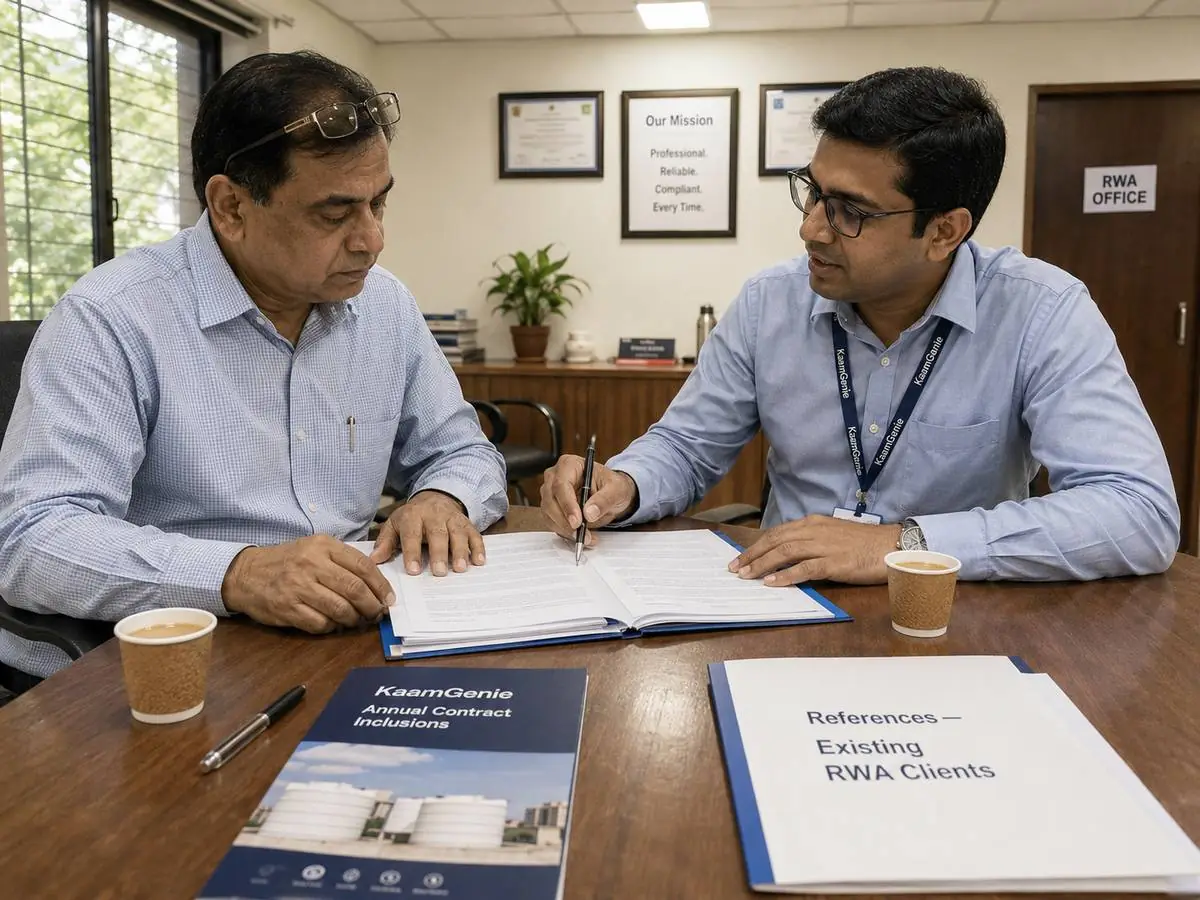
RWA reference list — we’ll share ours
We can connect you with 3-4 existing RWA clients in your zone for honest references. No pressure, no sales pitch — just verify before you sign.
How RWA committees should run the decision (the 4-meeting process)
For RWAs that want to do this properly, here’s the four-meeting structure that produces a defensible, well-priced contract:
- Meeting 1 — Define requirements (30 min). Total tank capacity, current cleaning pain points, budget bracket, must-have inclusions. Maintenance secretary drafts a one-page brief.
- Meeting 2 — Review quotes (45 min). Maintenance secretary brings 3 quotes from established providers + 5 documents from each. Committee compares and shortlists 1-2.
- Meeting 3 — Site visit + reference check (1 hour). Shortlisted provider does a site walk of all tanks, gives a final fixed quote. Maintenance secretary calls 2 RWA referrals.
- Meeting 4 — Sign (30 min). Final terms reviewed at committee meeting, recorded in minutes, signed by authorised signatory. Contract starts the month following.
The whole process takes about 4 weeks elapsed time, with maybe 3 hours of total committee work spread across that period. Compared to fielding water complaints all year, it’s a small investment.
Common RWA committee questions (answered honestly)
- "Can we just keep using the local guy?" — If he’s registered, provides a dated cleaning record, uses food-grade chemicals, and gives you a contract with the 10 items above, yes. If any of those are missing, you’re paying for a rinse with a familiar face.
- "Won’t residents complain about higher annual spend?" — Not when you frame it correctly. ₹8,400 per year for a 12-flat building is ₹58 per flat per month — less than the cost of one bottle of branded mineral water per resident per month. Frame it that way.
- "What if we don’t want a full year commitment?" — Start with a 6-month trial contract at slightly worse pricing. Most providers will do this. If they refuse, they don’t want your repeat business.
- "Should we get insurance coverage on the contract?" — The provider’s liability should be specified in the contract. For larger societies, professional liability insurance on the provider’s side is standard. Ask for the policy number; you don’t need the document.
- "What about water tanker cleaning?" — If your society uses water tankers as a backup, the tanker’s on-board tank needs cleaning too. Some contracts include this; others bill separately. Clarify upfront.
The compounding benefit nobody talks about
The reason annual contracts matter isn’t just price. It’s that water quality compounds across cleanings. A tank cleaned every 3 months stays substantially cleaner than a tank cleaned every 6 months — not just at the time of cleaning, but in the months between. Bio-film doesn’t have time to re-establish. Mineral scale doesn’t accumulate to the level where it requires aggressive removal. The whole baseline shifts.
RWAs that have run annual contracts for 2-3 consecutive years notice this: cleaning visits get easier and faster because there’s less buildup each time. Residents stop complaining because the water genuinely is consistently better. The committee stops getting pinged about "brown water in C-block again". The annual line item becomes invisible because the problem it solves has stopped being a problem.
To get a fixed annual quote for your specific RWA from our society water tank cleaning services — just send us flat count, building location, and total tank capacity at +91 95603 66362 or via the form. We’ll send back a detailed quote with all 10 inclusions, three references, and the 5 verification documents within one working day. No pressure, no follow-up calls.
Frequently asked questions
How much does an annual water tank cleaning contract cost for a Delhi RWA?
Annual contracts in Delhi typically range from ₹4,800 for a small 4-flat building with one shared tank to ₹40,000+ for large gated societies with multiple reservoirs. The pricing depends on total tank capacity, number of visits per year, and whether quarterly water testing is included.
How much does an RWA save with an annual contract vs ad-hoc booking?
Typically 20-25% per visit. A 6-flat building paying ₹1,500 per ad-hoc visit pays around ₹1,200 per visit under an annual contract. The contract is more total cost because it includes 4 visits a year instead of 2, but the tank stays consistently cleaner and the per-flat cost is lower.
What should be included in an RWA water tank cleaning contract?
A complete RWA contract includes: fixed number of scheduled visits per year, food-grade chemical disinfection at every visit, a signed cleaning record after each visit, before/after photos, optional water testing (recommended quarterly), service guarantee for rework, fixed annual price with GST, and a designated single point of contact at the service provider.
How often should an RWA clean its shared water tanks?
Quarterly (every 3 months) for societies on DJB water with normal usage. Bi-monthly (every 2 months) for societies on borewell water (higher mineral load) or with high resident density. Some larger gated societies opt for monthly visits during peak summer when tank turnover is faster.
Who in the RWA usually approves the cleaning contract?
Usually the RWA executive committee, with the maintenance secretary or treasurer driving the comparison and shortlisting. For larger societies, the contract may require approval from the general body. Best practice is to share three comparable quotes in the same email to keep the decision auditable.
Can RWA water tank cleaning be paid out of the monthly maintenance?
Yes — most RWAs in Delhi pay for tank cleaning from the regular maintenance corpus rather than a special assessment. An annual contract with a fixed price simplifies budgeting because the line item is the same every quarter, with no surprise spikes from ad-hoc bookings.
Should the contract include water testing?
For larger societies (50+ flats) or any society on borewell water, yes. Quarterly TDS, pH, residual chlorine, and microbial testing adds about ₹500-1,000 per test but gives the RWA documented evidence that the cleaning is actually achieving water quality standards. For small DJB-supplied buildings, annual testing is usually sufficient.
What if a resident is unhappy with the cleaning quality?
A good contract includes a service guarantee — usually free re-cleaning within 7-14 days if the RWA flags an issue. The before/after photos plus the signed certificate are the documentation that protects both sides. Without a contract, ad-hoc cleanings rarely offer this recourse.
How long should the contract term be — 6 months, 1 year, or longer?
12 months is standard and recommended. Six-month contracts don’t typically get the full discount. Multi-year contracts (24-36 months) sometimes get an additional 5-10% discount but lock the RWA in if service quality drops. Annual with auto-renewal subject to RWA review is the most flexible approach.
What’s the difference between AMC and annual contract for water tank cleaning?
They’re essentially the same — Annual Maintenance Contract (AMC) is the common term in Indian service industries. For water tanks specifically, an AMC bundles 4-6 scheduled visits per year at a discounted per-visit rate with fixed terms. The phrase ‘annual contract’ is interchangeable.
What documents should an RWA collect from the service provider before signing?
Five things: GSTIN certificate, CIN or company registration certificate, a sample cleaning record, evidence of police verification for crew, and three or four referrals from existing RWA clients. Reviewing these takes 30 minutes and dramatically reduces the chance of a bad contract.
Are RWA contracts negotiable on price?
Yes, especially for larger societies. Most service providers have published tier pricing but will negotiate 5-15% off for medium-to-large RWAs that commit to a 12-month term, pay quarterly in advance, or refer one or two other societies. Multi-tower complexes often get tiered discounts based on total tank count.
Sources & references
- MCA21 (Ministry of Corporate Affairs) — verify any service provider’s company registration by CIN before signing a contract.
- GST Portal — Taxpayer Search — verify GSTIN to confirm the entity issuing the contract is the same as the entity registered for GST.
- Bureau of Indian Standards (BIS) — IS 10500:2012 drinking water quality specification that informs RWA water testing targets.
- Delhi Jal Board (DJB) — municipal water supply authority; useful when discussing water source documentation in contracts.
- National Consumer Helpline — where to file complaints if a service provider breaches contract terms.
Last verified: 1 June 2026. If you find any of these links broken, please let us know.