
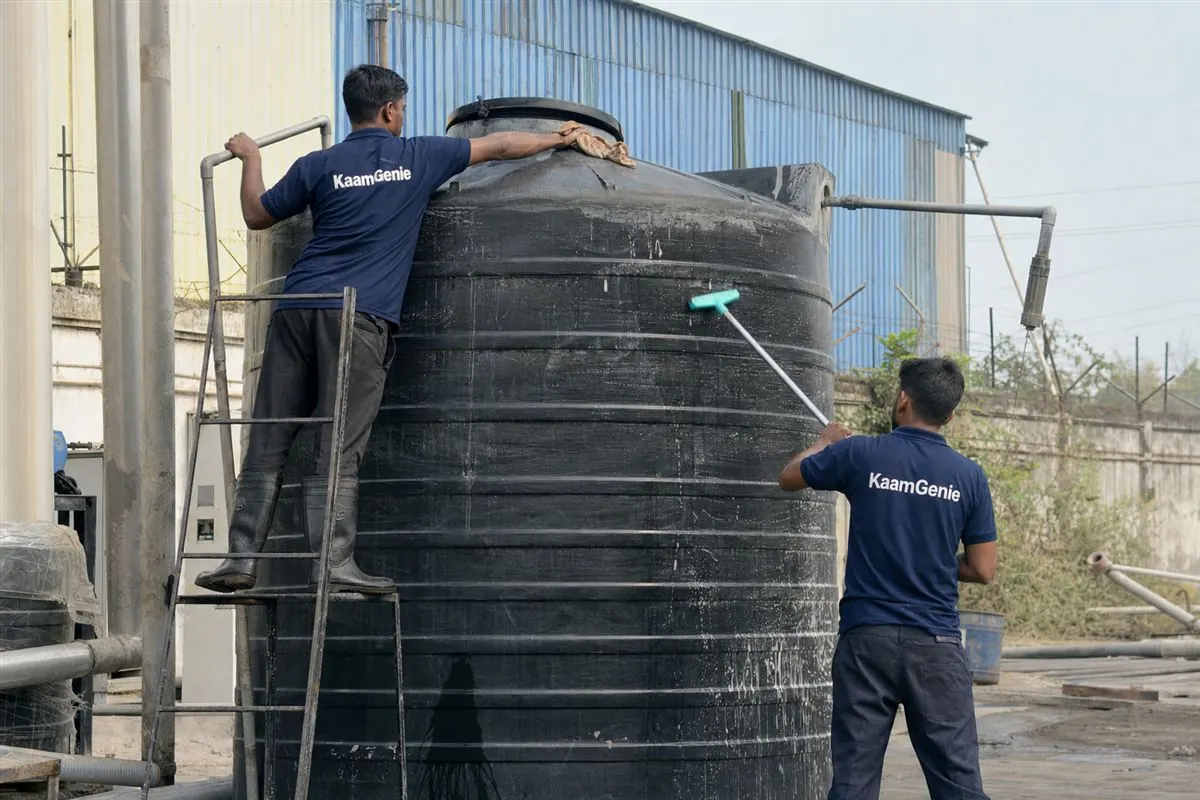
Quick answer — industrial water tank cleaning in Noida
- Who it’s for: factories and manufacturing units in Noida’s Phase 1 / Phase 2 / Phase 3 industrial sectors and Sector 16 industrial, plus warehouses and units in Greater Noida West / Noida Extension.
- Tanks we handle: large process tanks, storage tanks, potable/canteen tanks, and big underground reservoirs (UGRs) feeding rooftop towers.
- Why it’s different: roughly 10x residential water turnover, heavy borewell/tanker mineral scale, confined-space entry, worker-canteen FSSAI hygiene, and documentation for procurement.
- Scheduling: scheduled shutdown cleaning — planned around your off-day, maintenance shutdown, or post-shift night window so production doesn’t stop.
- Pricing: custom by tank count, capacity and sediment depth. Residential is ₹699 onwards; industrial/UGR/cluster jobs are quoted after a site survey.
- Contracts: quarterly or annual AMC with a continuous documentation trail, or one-time for commissioning and spot jobs.
Why industrial tanks in Noida are a different job
The most expensive assumption a Noida factory admin can make is “it’s the same job, just a bigger tank.” A residential operator who cleans a flat’s 1,000-litre overhead tank for a few hundred rupees will sometimes quote a flat per-litre rate for a 25,000-litre factory reservoir, on the assumption that it’s scaled-up but identical work. It isn’t. Three things change the moment you cross from a home tank into an industrial one, and each changes the equipment, the crew, and the paperwork — which is why our water tank cleaning services are scoped differently for industrial sites.
1. Water turnover is roughly ten times higher. A 4 BHK flat with six residents draws maybe 1,500-2,000 litres a day. A 200-worker unit in Noida Phase 2 — process use, washrooms, and a canteen serving two meal sittings — can pull 18,000-25,000 litres in a single shift. Higher turnover doesn’t mean cleaner tanks; it means heavier mineral crust around the inlet and outlet, a more aggressive biofilm near the float valve, and a sediment layer that rebuilds fast. A standard residential brush-and-rinse simply misses these zones.
2. The water source is hard. Most Noida industrial units run on a mix of hard borewell groundwater and tanker supply, sometimes blended with piped Ganga Jal where the sector is connected. Borewell water in the Noida belt carries high dissolved minerals, so what builds on the tank wall isn’t soft sludge — it’s a hard calcium-and-iron scale that a brush alone won’t shift. Descaling is part of the job, not an upsell. The hard-water problem in Noida tanks is the single biggest reason factory tanks look worse than their cleaning schedule suggests.
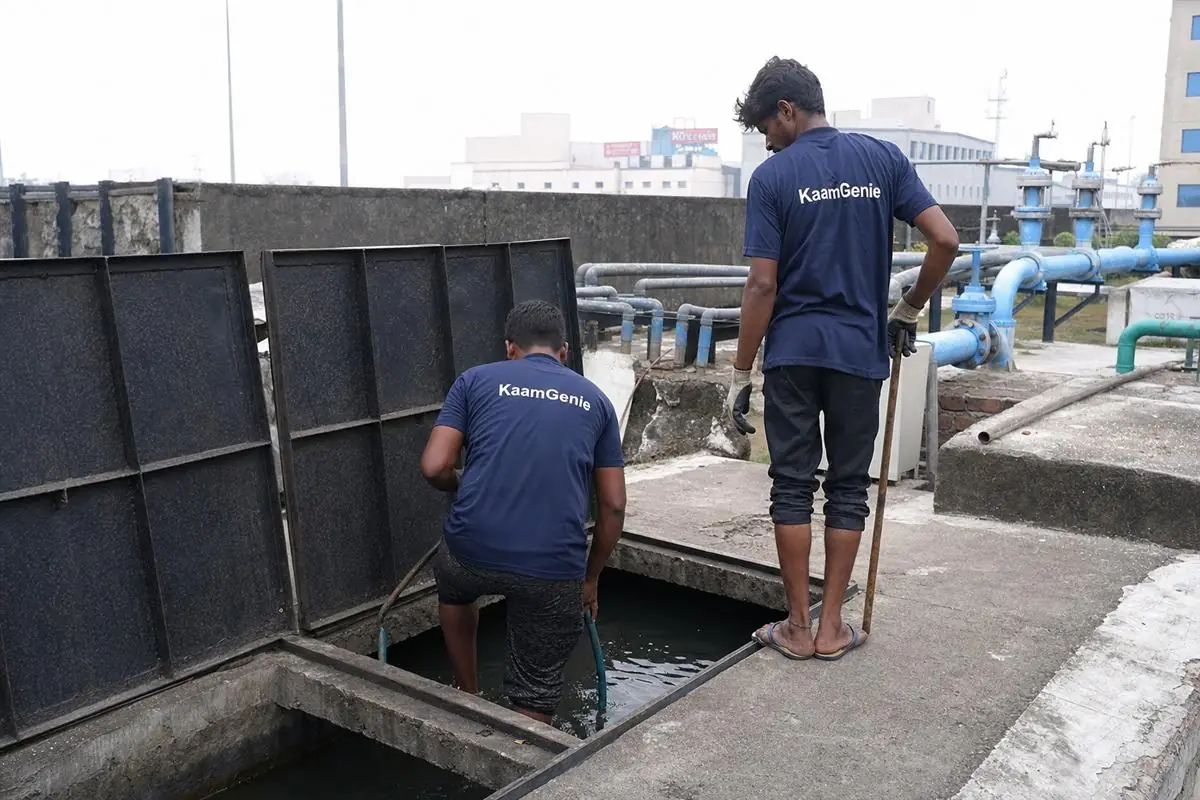
3. Scale means confined-space entry. A large underground reservoir — the big UGR that feeds the rooftop tower tanks — is a confined space in legal practice, not just on paper. Oxygen can drop, sludge breakdown can release gas, and a single worker without a standby will not get out if something goes wrong. Proper industrial cleaning means a harness, a lifeline, a blower for forced ventilation, an oxygen check, and a minimum of one supervisor plus two workers. Any operator quoting a 25,000-litre reservoir with one labourer and a bucket is uninsurable and unsafe.
| Tank type | Typical size | Main challenge | Cleaning approach |
|---|---|---|---|
| Process / utility tank | 5,000–20,000L | Heavy mineral scale, high turnover | Descale + brush + jet-wash |
| Storage tank (overhead/ground) | 10,000–30,000L | Stagnation, settled sediment | Drain, sludge-out, disinfect |
| Worker-canteen / potable | 2,000–10,000L | FSSAI hygiene, drinking-water safety | Food-grade chlorination + record |
| Labour-housing tank | 3,000–15,000L | Neglect, high occupancy | Full potable-grade protocol |
| Underground reservoir (UGR) | 25,000–100,000L+ | Confined space, deep sediment | Gas check, entry, descale, vacuum |
| Fire / standby reservoir | 50,000L+ | Stagnant for years, clogged pumps | Pump-down, clean, refill, test |
Book an industrial site survey — no obligation
We’ll visit your Noida unit, map every tank including the underground reservoir, and send a fixed-scope quote. Scheduled shutdown and weekend slots available. Residential cleaning ₹699 onwards; industrial custom-quoted.
The Noida industrial belt — sector by sector
Noida is an Authority-planned city, and its industrial pockets sit in defined bands rather than scattered through the residential sectors. That makes the tank profile fairly predictable once you know the belt. Here’s what we actually walk into across the main industrial areas.
Sector 16 industrial and the older pockets. Some of Noida’s earliest industrial and commercial units sit around Sector 16 and its neighbours. Buildings here are older, fittings are often rusted, and the storage tanks frequently haven’t been opened in two or three years. First-clean jobs here routinely run long because the sediment layer is 100-200 mm deep and the inlet walls carry a hard scale crust.
Phase 1, Phase 2 and Phase 3 industrial sectors. This is the manufacturing heart of Noida — electronics assembly, garments, light engineering, food processing, packaging. Tanks are typically 10,000-40,000-litre concrete or steel reservoirs at ground level, fed by a borewell-and-tanker mix. Most units run a single shift, so the after-8 PM window is long enough to clean process and storage tanks without touching the working day. Heavy canteen flow makes these tanks the most biofilm-prone in the belt, which is why quarterly cleaning suits them.
Sector 62 and the IT / corporate belt. Sector 62 blends manufacturing-adjacent units with IT and corporate offices. Here the water feeds people, not production — pantries, washrooms, cafeterias, drinking-water dispensers — so the consequence of a dirty tank is an immediate complaint from staff rather than a stalled line. The tank architecture is usually multi-tank: rooftop overheads, a basement sump, and an intermediate pressure tank that the building team often forgets.
Greater Noida West / Noida Extension. The newer factory, warehouse and logistics townships in Noida Extension are heavily tanker-fed because the piped network is still catching up. That makes the receiving sump the critical asset — if the sump that collects tanker water is dirty, every tank downstream inherits it. We do a lot of receiving-sump-first work in this belt, usually paired with the overhead and storage tanks on the same visit.
What changes our approach across these pockets: the water source (borewell vs tanker vs Ganga Jal blend), the shift pattern (single vs double), and the access (ground reservoir vs basement sump vs rooftop cluster). None of this is visible from a phone call, which is why we survey before we quote.
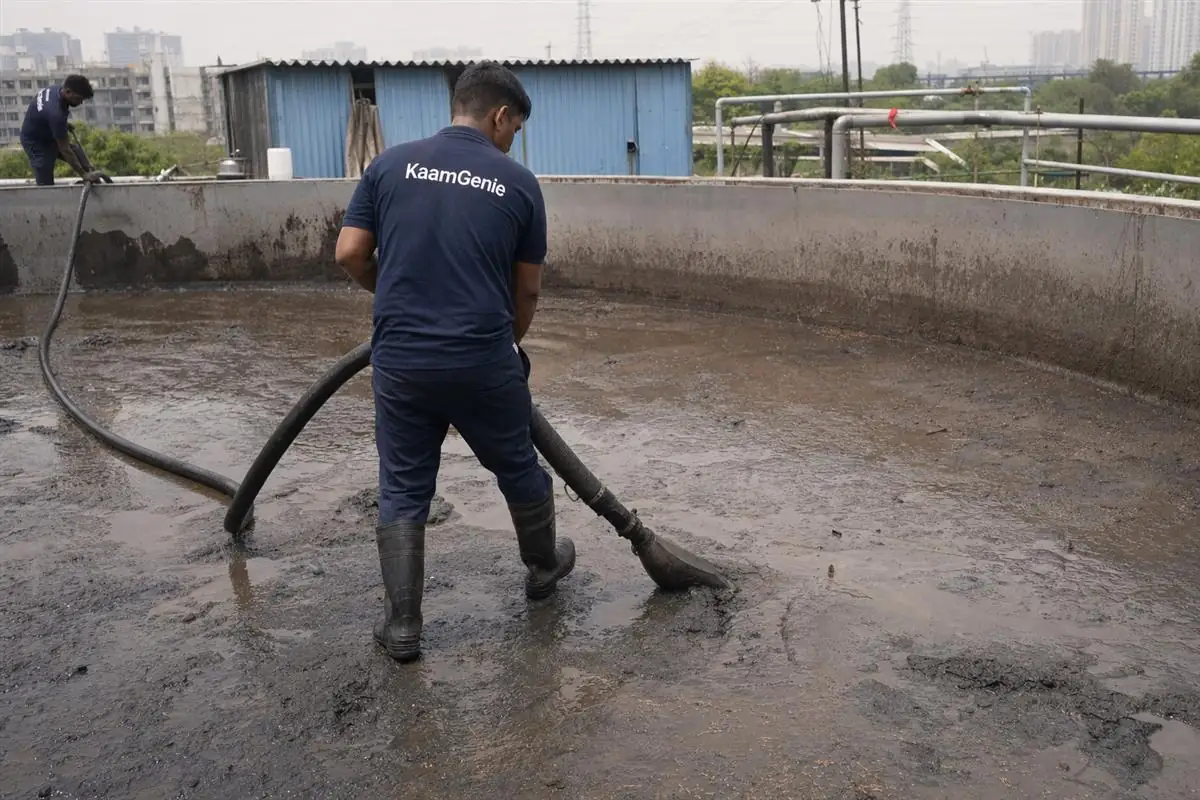
Scheduled shutdown cleaning — how the job runs without stopping production
The single biggest worry an industrial client has isn’t the price — it’s downtime. If a residential operator cleans your reservoir during a working shift, you lose canteen and washroom water for several hours, which under the Factories Act means workers can down tools. The few thousand rupees you saved on the quote becomes a production loss many times larger. That’s why every industrial job we run is built around a scheduled shutdown window, not squeezed into the working day.
Here’s how a typical Noida factory job sequences end to end:
- Site survey (before quoting): our supervisor visits in working hours, maps every tank, photographs access points, identifies which tanks are coupled so we drain them in the right order, and confirms the shutdown window. Output is a fixed-scope quote, line-item per tank.
- Shutdown coordination: we lock the window around your weekly off-day, a planned maintenance shutdown, or the post-shift night gap. For single-shift Phase 2/3 units that’s usually after 8 PM; for continuous units it’s a Sunday.
- Drain and isolate: inlet valves closed, process and storage tanks drained, usable water preserved where possible for non-potable use.
- Sludge-out and descale: the heavy bottom sediment is scooped and vacuumed; hard mineral scale on the walls and around the inlet/outlet is chemically or mechanically descaled.
- Scrub, jet-wash, disinfect: manual scrubbing, high-pressure jet-wash into corners and behind fittings, then food-grade sodium hypochlorite disinfection with the correct contact time.
- Refill and handover: tanks refill, water is back before the morning shift, and the facility manager gets the per-tank photo set and cleaning records.
The point of all this is simple: the line never stops, and the canteen has water by breakfast. If you also run a restaurant or staff cafeteria under FSSAI scope, the canteen tank gets the same potable protocol we apply to FSSAI water tank cleaning in Noida, with a dated record you can produce during a food-safety audit.
Worker-canteen & potable tanks — FSSAI-grade hygiene
It’s easy to treat the canteen and labour-housing tanks as an afterthought because they’re smaller than the process reservoirs. They’re actually the highest-risk tanks on the site, because their water goes straight into drinking and cooking for a few hundred workers. A contaminated process tank is an operational problem; a contaminated canteen tank is a health one, and it’s the one a food-safety inspector will check first.
For these tanks we use the full potable-grade protocol: complete drain, hand sludge removal, scrubbing with food-grade brushes (never metal), and disinfection with food-grade sodium hypochlorite at the WHO-recommended contact time — never industrial bleach, which leaves residue you don’t want in drinking water. For any unit running a canteen under FSSAI scope, we issue a dated cleaning record suitable for production during an audit. Labour-housing tanks get the same treatment, because high occupancy and weak maintenance habits make them some of the dirtiest tanks we open in the whole belt.
Where time goes on a 25,000L industrial UGR — full scheduled clean
Heavy sediment removal and descaling dominate, not the disinfection
Indicative for a 25,000L underground reservoir with a deep first-clean sediment layer — roughly 6–7.5 hours on site. Cleaner, AMC-maintained tanks are far quicker because the sludge and descaling stages shrink.
Heavy sediment & descaling — what Noida borewell water leaves behind
On a residential tank, the bottom layer is mostly soft silt that scoops out in minutes. On a Noida industrial tank fed by hard borewell water, it’s a different material. The high mineral content precipitates out as the water sits, building a dense calcium-and-iron scale on the walls and a compacted sediment bed on the floor. In a unit that hasn’t been cleaned in two or three years, that bed can be 100-200 mm deep and set hard enough that it has to be broken up before it can be vacuumed.
This is why descaling is a named step in our industrial scope, not an extra. We remove the loose sediment first by hand and wet-vacuum, then treat the hard scale on the walls and around the inlet/outlet — chemically or mechanically depending on what the scale is — before the final scrub and jet-wash. Skip the descaling and you get a tank that looks clean on a quick glance but re-fouls within weeks, because the rough scaled surface is exactly where biofilm re-anchors. A genuine industrial clean leaves the wall surface smooth, not just rinsed.
AMC & documentation — the procurement side of the job
For a homeowner, an annual maintenance contract is about convenience. For an industrial client it’s about three different things: predictable cost, audit readiness, and clean procurement paperwork. A factory that needs four cleanings a year can either raise four separate purchase orders with four separate approval cycles, or sign one quarterly AMC with a single PO, predictable visit dates, and a per-visit cost that drops because we commit crew and equipment slots in advance.
The bigger win is documentation. Every visit on an AMC generates a per-tank before/after photo set, a dated cleaning record listing capacity, chemicals and crew, a pre-entry safety checklist for the confined-space tanks, and an FSSAI-aligned record for the canteen line. Filed in sequence, that becomes a continuous compliance trail your auditors and procurement team can pull at any time — which is exactly what the ISO-certified, export-oriented units in the Noida belt need at their annual review. One-time cleaning still makes sense for spot situations: commissioning a new unit, taking over leased premises, or recovering after a contamination complaint. For everything else, the math favours an AMC. We cover the contract structures in detail in our guide to water tank cleaning AMCs in Noida, and the wider commercial scope in commercial water tank cleaning across Noida.
Set up a factory AMC — one PO, full documentation
Quarterly or annual cleaning with a continuous audit trail, FSSAI-aligned canteen records, and scheduled shutdown windows. We’ll survey first and quote a fixed scope per tank.
Book industrial tank cleaning across Noida
Whether you run a manufacturing unit in Phase 2, an IT block in Sector 62, or a warehouse in Noida Extension, the approach is the same: we survey first, plan the work around a scheduled shutdown, clean every tank to potable-grade standard, and hand you the documentation your procurement and audit files need. You can see the full residential and commercial service, pricing bands and coverage on our water tank cleaning in Noida hub, then call us for a factory site survey. No survey charge, no obligation.
Frequently asked questions
How much does industrial water tank cleaning cost in Noida?
Industrial pricing is always custom because it depends on tank count, capacity, sediment depth and access. As a rough guide for Noida: a single 10,000L process or storage tank typically starts around ₹6,000-9,000, a 25,000L underground reservoir ₹12,000-18,000, and a factory cluster with overhead, storage and a large UGR runs ₹25,000-50,000 per visit. GST is extra. Residential cleaning is ₹699 onwards, but a factory tank is a different job — confined-space safety, heavy sediment, descaling and documentation are all built in. We site-survey before quoting because none of this is visible over the phone.
Can you clean our factory tanks during a scheduled shutdown so production doesn’t stop?
Yes — scheduled shutdown cleaning is how most Noida industrial jobs run. We plan the work around your weekly off-day, a planned maintenance shutdown, or the night gap between shifts so process water and the canteen line are never cut during production. For single-shift units in Noida Phase 2 and Phase 3 the after-8 PM window is long enough for most tanks; double-shift units we sequence over a Sunday. We coordinate the water-shutdown notice with your facility or admin manager in advance.
Do you handle worker-canteen and labour-housing tanks to FSSAI hygiene standards?
Yes. Canteen and labour-housing tanks supply drinking and cooking water, so they get the potable-grade protocol: food-grade sodium hypochlorite disinfection at the correct contact time, never industrial bleach. For units that run a canteen under FSSAI scope, we issue a dated cleaning record suitable for production during a food-safety audit. This is the same standard we apply to restaurant and institutional tanks across Noida.
What confined-space safety protocol do you follow for large UGRs?
A large underground reservoir is a confined space in legal practice. Before anyone enters we check oxygen (must read 19.5-23.5%) and run a blower for forced ventilation. Minimum crew is one supervisor plus two workers — one inside, one as standby at the entry holding the lifeline. Full-body harness, non-slip boots, gloves and a work light are standard, and the standby keeps verbal contact throughout. Any operator who sends a single labourer into a 25,000L reservoir with a bucket is cutting a corner that puts a life and your liability at risk.
How is an industrial tank in Noida different from a society or home tank?
Three things change. First, volume — a factory canteen plus washrooms plus process use can move ten times what a flat uses, so sediment and scale build heavier and faster. Second, water source — Noida industrial units lean on hard borewell groundwater and tanker supply, which leaves a thick mineral crust that needs descaling, not just a brush. Third, scale — big underground reservoirs and storage tanks mean confined-space entry, larger crews, longer hours and proper documentation. It is not a home job with a bigger tank; it is a different job.
Do you provide GST invoices and documentation for our procurement and audit files?
Yes. The standard documentation set for an industrial job: GST invoice, a per-tank before/after photo set, a dated cleaning record listing tank capacity, chemicals used and crew, a pre-entry safety checklist, and an FSSAI-aligned record for canteen/potable tanks. For units on an AMC the records build into a continuous compliance trail your auditors and procurement team can pull at any time, which is exactly what ISO-certified exporters in the Noida belt ask for.
Is an AMC better than one-time cleaning for a Noida factory?
For anything more than two cleanings a year, a quarterly AMC almost always wins. Per-visit cost drops because we commit crew and equipment slots in advance, you raise one purchase order instead of four, and the audit trail is continuous and automatic. One-time cleaning makes sense for a spot situation — commissioning a new unit, taking over leased premises, or recovering after a contamination complaint. Heavy-turnover canteen and process tanks usually justify quarterly visits; pure storage tanks can run twice a year.
How long does it take to clean a large industrial reservoir?
A single 10,000L tank with moderate sediment is 4-5 hours. A 25,000L underground reservoir runs 6-8 hours, longer if the sediment layer is 100-200 mm deep — common in Noida units that haven’t been cleaned in two or three years. A full factory cluster (overhead tanks, a storage tank and a large UGR) is usually a one or two-night job. We plan the drain, descale, scrub, jet-wash, disinfection and refill sequence during the site survey so the total water-off window is as short as possible.
Which Noida industrial areas do you cover?
We cover the full Noida and Greater Noida industrial belt — the older industrial pockets in Sector 16, the Phase 1, Phase 2 and Phase 3 industrial sectors, the IT and corporate units in Sector 62, the Sector 80-91 belt, and the new factory and warehouse townships in Greater Noida West / Noida Extension. For a unit outside these pockets, send us your location and tank details and we’ll confirm coverage and arrange a survey.
Sources & references
- Bureau of Indian Standards (BIS) — IS 10500:2012 is the canonical Indian Standard for drinking water specification, defining acceptable limits for physical, chemical, and biological parameters.
- WHO Guidelines for Drinking-water Quality, 4th edition — the global reference for water quality standards, including guidance on storage and disinfection.
- Food Safety and Standards Authority of India (FSSAI) — defines water quality requirements for food businesses, including hygiene standards for stored water and acceptable disinfection chemicals.
- WHO Fact Sheet on Drinking Water — overview of safe drinking water requirements and contamination risks.
- CPHEEO — Manual on Water Supply and Treatment — the Government of India’s engineering manual covering tank design, cleaning protocols, and disinfection practices.
Last verified: 30 June 2026. If you find any of these links broken, please let us know.