
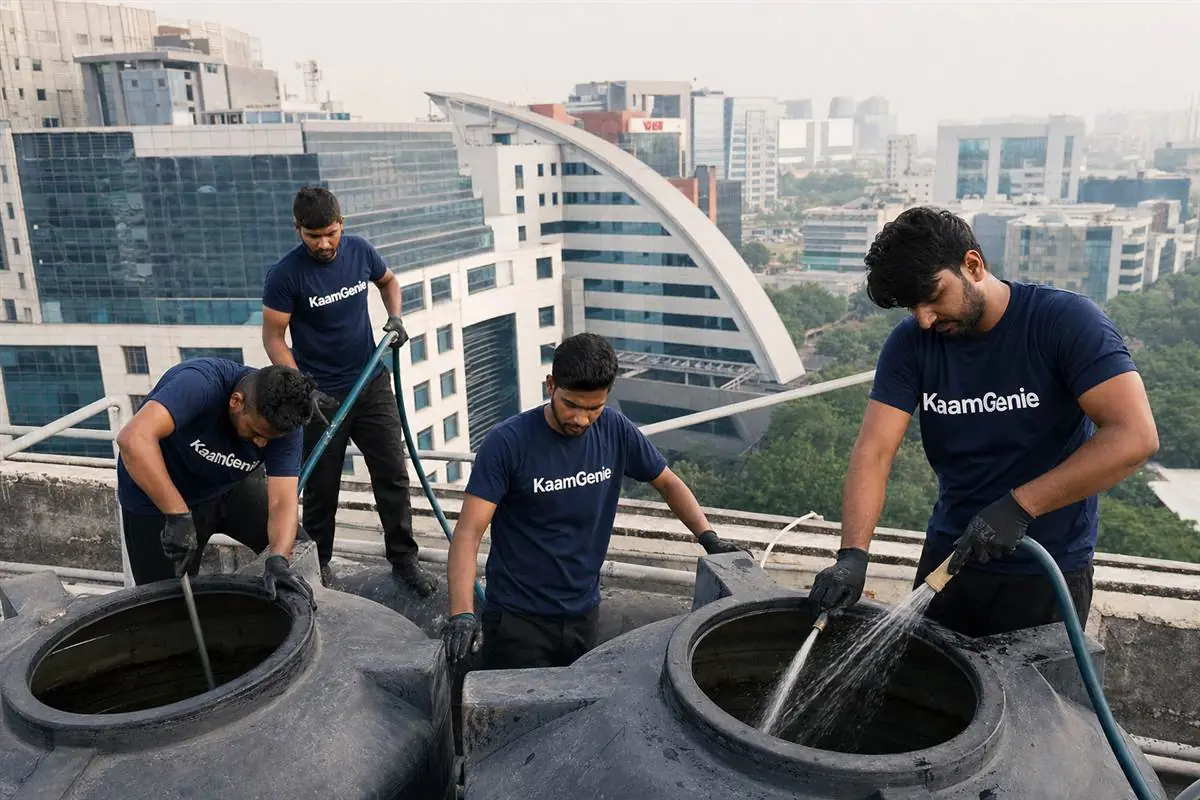
The short version for facility managers
- Duty of care, not just housekeeping. Staff, students, patients and visitors all drink from your tanks — a neglected reservoir is a liability, not a line item to defer.
- Zero downtime is the whole game. Large underground reservoirs and rooftop tanks are cleaned in sequence, after-hours or in a low-occupancy window, so washrooms and pantries keep running.
- Building type drives the plan. Offices, schools, clinics, malls and PG/hostels each have their own frequency, scheduling and safety needs.
- Compliance is documented per tank. Each tank gets its own certificate, before/after photos and a TDS reading for audits and inspections.
- Quarterly on Noida’s hard water — borewell and groundwater scale tank walls fast; higher-risk sites go more often.
- An AMC makes it predictable — fixed schedule, locked per-tank pricing, a rolling file of certificates.
Run a restaurant, cafe or cloud kitchen? That’s a different rulebook — see our FSSAI water tank cleaning in Noida guide for F&B compliance.
What “commercial” actually means here (and what it doesn’t)
When people say “commercial water tank cleaning,” they often lump everything non-residential together. It’s worth being precise. This guide is about non-food commercial premises — the buildings where water supports people and operations but the building itself isn’t a food business. That means corporate offices and IT parks, schools and coaching centres, hospitals and clinics, malls and retail, and PG/hostels and co-living. Each of these has a facility manager, an owner or a committee who carries a legal and moral duty of care for the water their occupants use.
What this guide is not about: restaurants, cafes, cloud kitchens, hotel kitchens and any FSSAI-licensed food business. Those premises live under FSSAI hygiene rules, with their own inspection documentation and food-grade compliance requirements, and we cover them separately in our FSSAI water tank cleaning in Noida guide. If you serve food, read that one. If you want the resident-society version — AOA/RWA contracts, tower-by-tower staging — that’s our society and high-rise water tank cleaning guide. This page stays in its lane: offices, schools, clinics, retail and shared accommodation.
The cleaning method itself doesn’t change — it’s the same proven inspection, drain, de-sludge, scrub, jet-wash, vacuum, disinfect and certify sequence we use everywhere. What changes for commercial work is everything around the method: the size and number of tanks, the scheduling discipline, the documentation, and the compliance trail. You can book a one-off through our water tank cleaning in Noida service, but most commercial sites end up on a contract.
Building by building — what each type actually needs
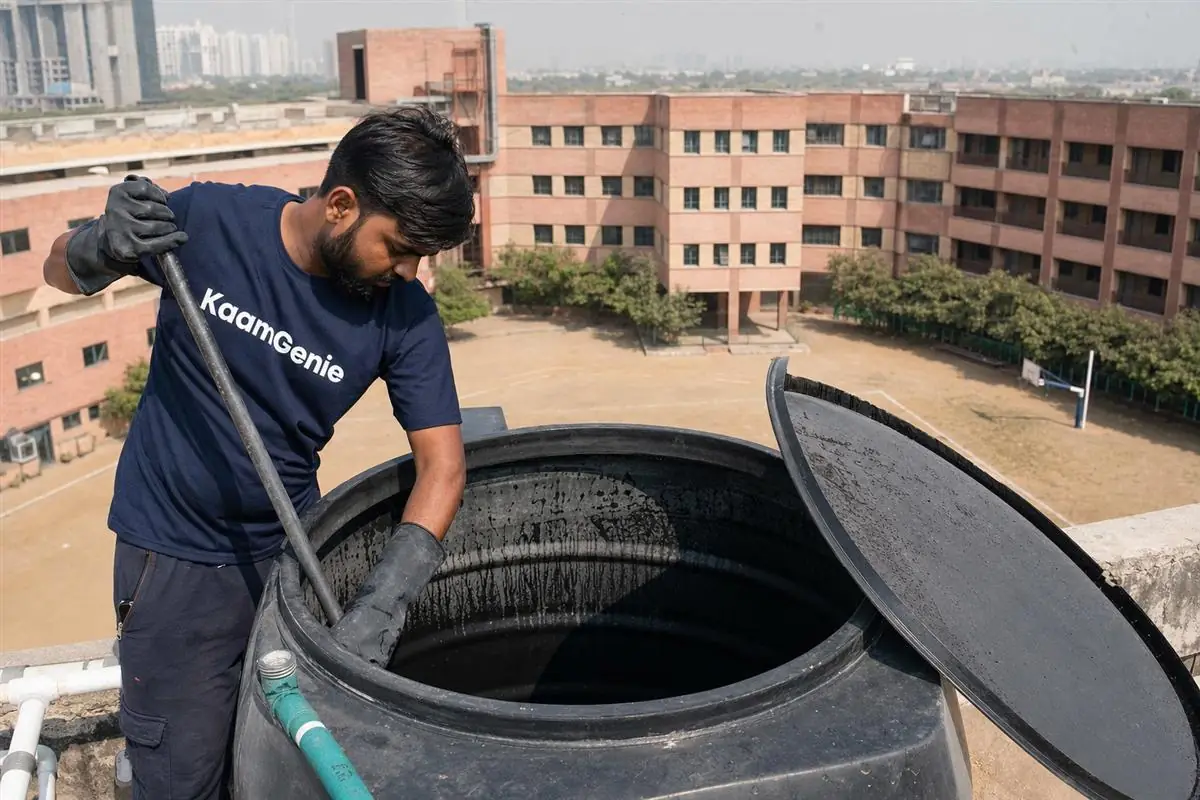
The reason commercial cleaning can’t be a single fixed package is that a 12-floor IT office, a school campus and a single-floor clinic have almost nothing in common except the word “commercial.” Here’s how the needs actually differ.
Corporate offices & IT parks
The big office and tech clusters — Sector 62, Sector 125, Sector 132 and Sector 135 along the Expressway — almost all run a large underground reservoir (UGR) feeding rooftop tower tanks, often with separate domestic and flushing compartments. The defining constraint here is zero downtime during business hours. Hundreds or thousands of people use the washrooms, pantry and cafeteria through the day, so we do the heavy work after-hours, on weekends, or during a planned low-occupancy window. Because the UGR is usually compartmentalised, one side feeds the building while the other is drained and cleaned, then we swap — the building never runs dry. For a campus with multiple towers we stage tower-by-tower. These sites are natural Sector 62 commercial AMC candidates because the scheduling has to be planned, not improvised.
Schools & coaching centres
Schools have one non-negotiable: child safety. Children must never be anywhere near open tanks, wet floors or chemical contact times. The clean answer is the holiday window — we schedule school and coaching cleans into vacations, weekends, or after the last class of the day, and for a multi-block campus we stage it across the break. Everything is food-grade and FSSAI-acceptable, the work area is cordoned, and the system is handed back refilled and ready before students return. Schools also tend to value the documentation: a per-tank certificate is exactly what a parent committee or an inspecting authority wants to see.
Hospitals & clinics
This is the highest-stakes category, because of infection control. Water in a hospital or clinic touches hand-washing, instrument-prep areas, wards, pantries and patient use — a contaminated tank isn’t an inconvenience, it’s a clinical risk. So clinical sites run a higher frequency than offices (quarterly to monthly depending on the area served), strict food-grade disinfection, documented TDS readings, and certificates retained for NABH and health-department audits. We schedule clinical cleans tightly around patient-care hours and keep critical areas supplied throughout. The documentation discipline here is the deliverable as much as the cleaning itself.
Malls & retail
Malls and large retail combine high public footfall with long operating hours and, often, food courts elsewhere in the building (those F&B units fall under the FSSAI rules linked above). For the building’s shared washroom and common-area supply, the constraint is footfall and hours — we work the overnight or pre-opening window, stage the reservoir compartments, and keep the public washrooms supplied. Retail facility teams usually want the same procurement-ready paperwork as offices: per-tank certificates and a predictable schedule.
PG/hostels & co-living
PG, hostel and co-living buildings are occupied around the clock, so “after-hours” doesn’t exist the way it does in an office. Instead we stage the clean — UGR compartment-by-compartment, rooftop tanks in turn — and do the work in the lowest-usage window, typically mid-morning on a weekday when most residents are out at work or college. Short, announced refill windows and a notice at the entrance mean residents keep water throughout, and the operator gets a per-tank certificate for their records and their tenants’ peace of mind.
| Premises | Main constraint | Typical frequency | Best window |
|---|---|---|---|
| Corporate office / IT park | Zero downtime for staff & cafeteria | Quarterly | After-hours / weekend |
| School / coaching | Child safety — no students near work | Quarterly + holiday clean | Vacation / weekend |
| Hospital / clinic | Infection control & documentation | Quarterly to monthly | Around patient-care hours |
| Mall / retail | Public footfall & long hours | Quarterly | Overnight / pre-opening |
| PG / hostel / co-living | 24×7 occupancy | Quarterly | Low-usage weekday window |
Get a commercial site survey & per-tank quote
We’ll survey your tank inventory, agree a zero-downtime staging plan, and quote per tank with per-tank certificates. Residential single-tank cleaning ₹699 onwards; commercial custom-quoted.
Compliance & duty of care — why the paperwork matters
For a home, the consequence of a dirty tank is one family’s upset stomach. For a commercial building, it’s a documented failure of duty of care that can surface in an audit, an inspection, an insurance claim or, worst case, a public-health incident affecting hundreds of people. That’s why the deliverable for commercial work isn’t just a clean tank — it’s a clean tank plus the evidence that it was done properly.
The standards underneath this are clear. BIS IS 10500 sets the Indian Standard for drinking-water quality; CPHEEO’s manual covers tank design, cleaning protocols and disinfection; and WHO’s guidelines frame storage and disinfection globally. None of these is satisfied by a quick rinse with no record. A genuine commercial clean gives you:
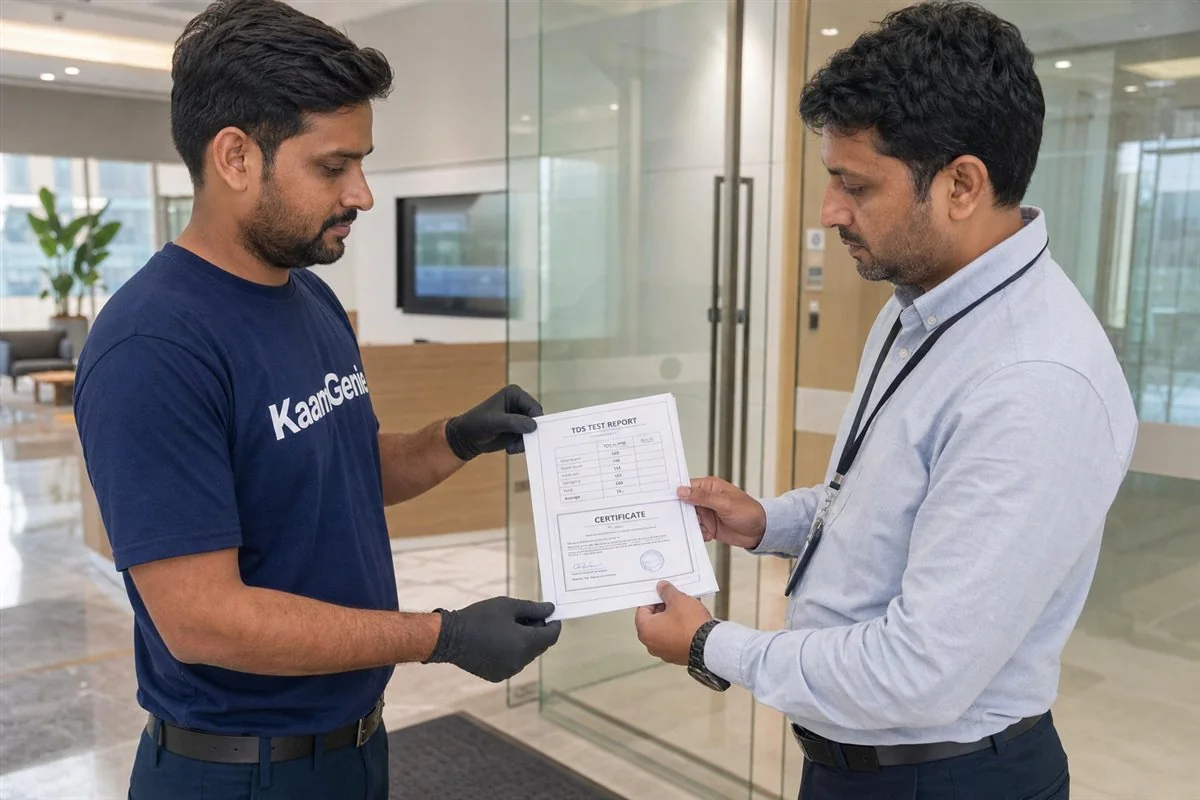
- A per-tank certificate — tank ID, capacity, date, crew, chemicals used, and before/after photos for every tank in the inventory, so an auditor can see the whole system was covered.
- A post-clean TDS report on request, so you have a measured water-quality reading after the service, not just a verbal assurance.
- Food-grade disinfection — FSSAI-acceptable sodium hypochlorite specified by spec, never hardware-shop bleach, because the water reaches drinking points and hand-wash basins.
- A scope you can show — the full 8-step process per tank, in writing, so “rinse-and-run” can’t hide behind a single line-item invoice.
This documentation is exactly what protects the facility team during an ISO, NABH, fire-safety or health inspection, and it’s what an AMC keeps on a rolling quarterly file so you’re never scrambling for last quarter’s record.
Scheduling around operations — the real skill
The hardest part of a commercial clean isn’t the scrubbing — it’s doing it without interrupting the business. A Noida office can’t close its washrooms at 11am; a hospital can’t shut its hand-wash supply; a hostel can’t leave residents dry. The way around this is the same physics that makes society cleaning work: the building stores water in two stages, and those stages can be isolated.
Almost every commercial building runs a UGR feeding rooftop tower tanks. The UGR is usually split into compartments, so one half keeps the building supplied while the other is drained, de-sludged, scrubbed, jet-washed, vacuumed and disinfected — then we swap. The rooftop tanks are cleaned in sequence, each out of service only for its own clean-plus-refill window. Stack that staging onto an after-hours, weekend or low-occupancy schedule and the building genuinely never loses supply during operating hours. The honest version of “zero downtime” is: a short, announced refill window on one tank at a time, planned around when your people aren’t using it.
This is the difference between a planned commercial contract and a chaotic one-off where a cleaner “turns the water off for the day” and the facility manager fields complaints from every floor. We run this scheduling across the Expressway and FNG corridor — including the office belts at Sector 62, retail and institutional pockets around Sector 18, and the newer commercial clusters near Sector 128.
Recommended cleaning frequency by commercial premises type
Higher footfall and higher clinical risk push the schedule tighter than the twice-a-year floor
Illustrative guidance, not a fixed rule. Actual frequency depends on tank size, occupancy, water source and the risk profile of the area served — set per site in the AMC. Noida’s hard borewell supply pushes most premises toward the quarterly end and above.
How commercial pricing works
Commercial work is quoted per tank, never as a flat per-building fee, because two “offices” can have wildly different tank inventories. Each item — every UGR compartment and every rooftop tank — is priced on two things: capacity (a 50,000-litre reservoir takes far longer to drain, de-sludge and disinfect than a 5,000-litre rooftop tank) and access difficulty (a below-ground UGR needs confined-space gear and a standby person; a rooftop tank up a service ladder needs harness work). Add up the inventory and you have the site’s per-clean cost.
Residential single-tank cleaning starts at ₹699 onwards, but a commercial building with multiple large tanks, after-hours scheduling and per-tank certification is always custom-quoted after a quick survey. The reason to put it on an AMC is that the contract locks the per-tank price for the year and spreads the cost into predictable quarterly amounts — far easier to budget than a surprise annual bill. For the full breakdown of what drives a number, our water tank cleaning cost in Noida guide walks through capacity, access and tank type.
Why an AMC is the right default for commercial sites
One-off commercial cleans have a failure mode we see constantly: the clean happens once, everyone’s happy, and then nobody books the next one. Three quarters later the tanks are scaling again, there’s no current certificate for the audit, and the “who’s responsible for booking it” question goes unanswered until something goes wrong. This is the commercial version of the society handover gap.
An annual maintenance contract closes that gap. It fixes a quarterly (or higher-frequency) calendar so the clean is never forgotten, locks per-tank pricing for the year, and keeps a rolling file of certificates and TDS reports ready for any audit. For a facility manager juggling fire drills, ISO renewals and a dozen vendors, turning tank hygiene into a scheduled, documented, budgeted line item is the single biggest upgrade available. Our water tank cleaning AMC in Noida guide lays out how the plans are structured and when each tier makes sense.
Set up a commercial AMC for your building
Fixed quarterly schedule, locked per-tank pricing, a rolling file of certificates and TDS reports for audits. Free tank-inventory survey for your facility team. Commercial custom-quoted; residential ₹699 onwards.
Book commercial tank cleaning across Noida
Whether you manage a Sector 132 IT tower, a school campus, a clinic, a mall or a co-living block, we clean non-food commercial tanks across Noida and Greater Noida West — UGR plus every rooftop tank, staged so your building never loses supply during operating hours, with a per-tank certificate and TDS report for each one. Start at our water tank cleaning in Noida hub for sector coverage and booking, or call us to arrange a free tank-inventory survey for your facility team. If you serve food, head to the FSSAI guide instead.
To book, call +91 95603 66362 or use the booking form on this site — we’ll confirm shortly.
Frequently asked questions
What counts as commercial water tank cleaning, and how is it different from a home or society clean?
Commercial cleaning covers non-residential premises where the building owner or facility manager carries a duty of care to staff, students, patients or visitors — corporate offices, IT parks, schools and coaching centres, hospitals and clinics, malls and retail, and PG/hostels and co-living. The cleaning method is the same proven 8-step process, but the wrapper is different: larger rooftop and underground tanks, zero-downtime scheduling around operating hours, per-tank certificates and TDS reports for audits, and often an AMC rather than a one-off booking. A home clean is a single tank; a commercial site is an inventory with compliance attached.
How do you clean an office or IT-park tank without shutting down the building?
By scheduling around your operations and working the tanks in sequence. Most Sector 62, 125, 132 and 135 office buildings have a large underground reservoir feeding rooftop tower tanks, often split into compartments — so one side keeps the building supplied while the other is cleaned, then we swap. We do the heaviest work after-hours, on weekends or during a planned low-occupancy window. With a staging plan agreed in advance, no floor loses water during business hours and the washrooms, pantry and cafeteria keep running.
How often should a commercial building in Noida clean its water tanks?
Quarterly is the realistic default for most Noida commercial premises, because much of the supply is hard borewell and groundwater that scales tank walls fast. BIS and CPHEEO guidance supports cleaning stored drinking-water tanks at least twice a year as a floor, but high-footfall and higher-risk sites — hospitals, clinics, schools, food-serving offices — should treat quarterly as the minimum and some clinical settings go monthly. The right frequency depends on tank size, occupancy, water source and risk profile; we set it per site in the AMC.
We run a school — when can you clean without disrupting classes?
We schedule school and coaching-centre cleans into holiday windows, weekends or after the last class, so children are never around open tanks, wet floors or chemical contact times. Child safety is the whole point: we use only FSSAI-acceptable food-grade disinfectant, seal and cordon the work area, and hand back a documented, refilled, ready-to-use system before students return. For a campus with multiple blocks we stage it block-by-block across the break.
What documentation do you provide for an audit or inspection?
Every tank gets its own certificate listing tank ID, capacity, date, crew, the chemicals used and before/after photos, plus a post-clean TDS reading on request. For a multi-tank site you receive the full set so a facility manager, auditor or inspector can see the entire inventory was covered — not just the easy-to-reach tanks. This paper trail is what protects the building during an ISO, NABH, fire or health inspection, and what an AMC keeps on a rolling quarterly file.
Do hospitals and clinics need more frequent tank cleaning?
Yes. Infection control raises the stakes — water touches hand-washing, instrument areas, wards, pantries and patient use, so a contaminated tank is a clinical risk, not just an inconvenience. Hospitals and clinics typically run a higher frequency than offices (quarterly to monthly depending on the area served), with strict food-grade disinfection, documented TDS and microbiological context, and certificates retained for NABH and health-department audits. We schedule clinical cleans tightly around patient-care hours and keep critical areas supplied throughout.
I run a restaurant or cloud kitchen — is this the right guide for me?
No — food and beverage premises have their own rules. If you run a restaurant, cafe, cloud kitchen, hotel kitchen or any FSSAI-licensed food business, read our dedicated FSSAI water tank cleaning in Noida guide instead, which covers FSSAI hygiene requirements, inspection documentation and food-grade compliance specific to F&B. This page is for non-food commercial premises — offices, schools, clinics, malls and PG/hostels.
How is commercial water tank cleaning priced?
Commercial work is quoted per tank, not as a flat fee. Each underground reservoir compartment and each rooftop tank is priced on capacity and access difficulty, then totalled for the site. Residential single-tank cleaning starts at ₹699 onwards, but a commercial building with multiple large tanks, after-hours scheduling and per-tank certification is always custom-quoted after a quick survey. An AMC spreads that into predictable quarterly costs. Our Noida cost guide breaks down what drives a quote.
Can you clean a PG, hostel or co-living tank with residents on-site?
Yes. PG, hostel and co-living buildings are occupied around the clock, so we stage the clean — underground reservoir compartment-by-compartment and rooftop tanks in turn — and do the work during the lowest-usage window (typically mid-morning on a weekday when most residents are out). With short, announced refill windows and a notice at the entrance, residents keep water throughout and the operator gets a per-tank certificate for their records.
Do you offer an AMC for commercial buildings?
Yes, and for most commercial sites it is the sensible route. An annual maintenance contract fixes a quarterly (or higher-frequency) calendar, locks per-tank pricing for the year, keeps a rolling file of certificates and TDS reports for audits, and removes the handover-gap risk where nobody books the next clean. It turns tank hygiene from a forgotten one-off into a predictable, budgetable line item. See our Noida AMC guide for how the plans are structured.
Sources & references
- Bureau of Indian Standards (BIS) — IS 10500:2012 is the canonical Indian Standard for drinking water specification, defining acceptable limits for physical, chemical, and biological parameters.
- WHO Guidelines for Drinking-water Quality, 4th edition — the global reference for water quality standards, including guidance on storage and disinfection.
- Food Safety and Standards Authority of India (FSSAI) — defines water quality requirements for food businesses, including hygiene standards for stored water and acceptable disinfection chemicals.
- WHO Fact Sheet on Drinking Water — overview of safe drinking water requirements and contamination risks.
- CPHEEO — Manual on Water Supply and Treatment — the Government of India’s engineering manual covering tank design, cleaning protocols, and disinfection practices.
Last verified: 27 June 2026. If you find any of these links broken, please let us know.