
The short version
- The sump is the silt trap. It’s the first storage point and the lowest in the system, so gravity drops the heaviest sediment there — sand, iron silt, grit and scale all settle on the sump floor.
- Two stages in every Noida tower. Supply fills the underground reservoir (UGR) first, pumps lift it to the rooftop overhead tanks, then it gravity-feeds to flats. A dirty sump pumps contamination into every tank above it.
- Cleaning means desludging, not rinsing. Dewater, manually scoop the settled sludge, scrub, high-pressure jet wash the concrete, wet-vacuum, then disinfect.
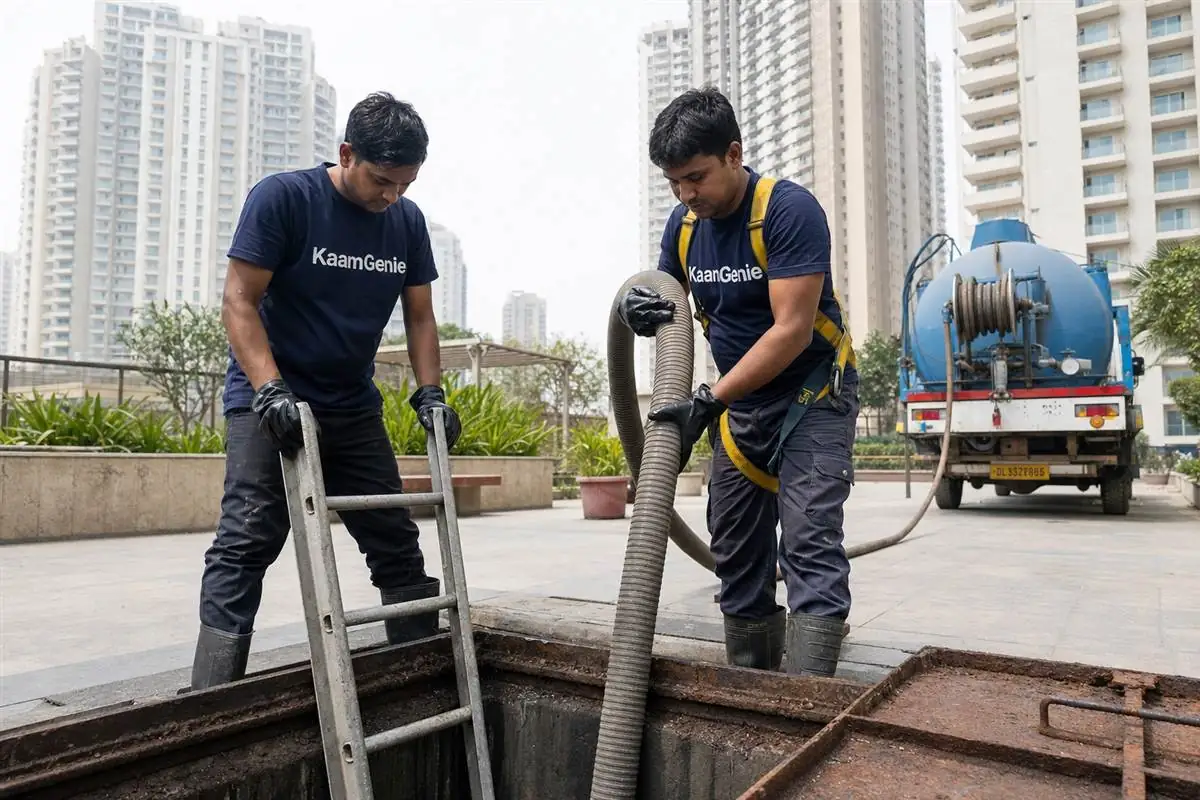
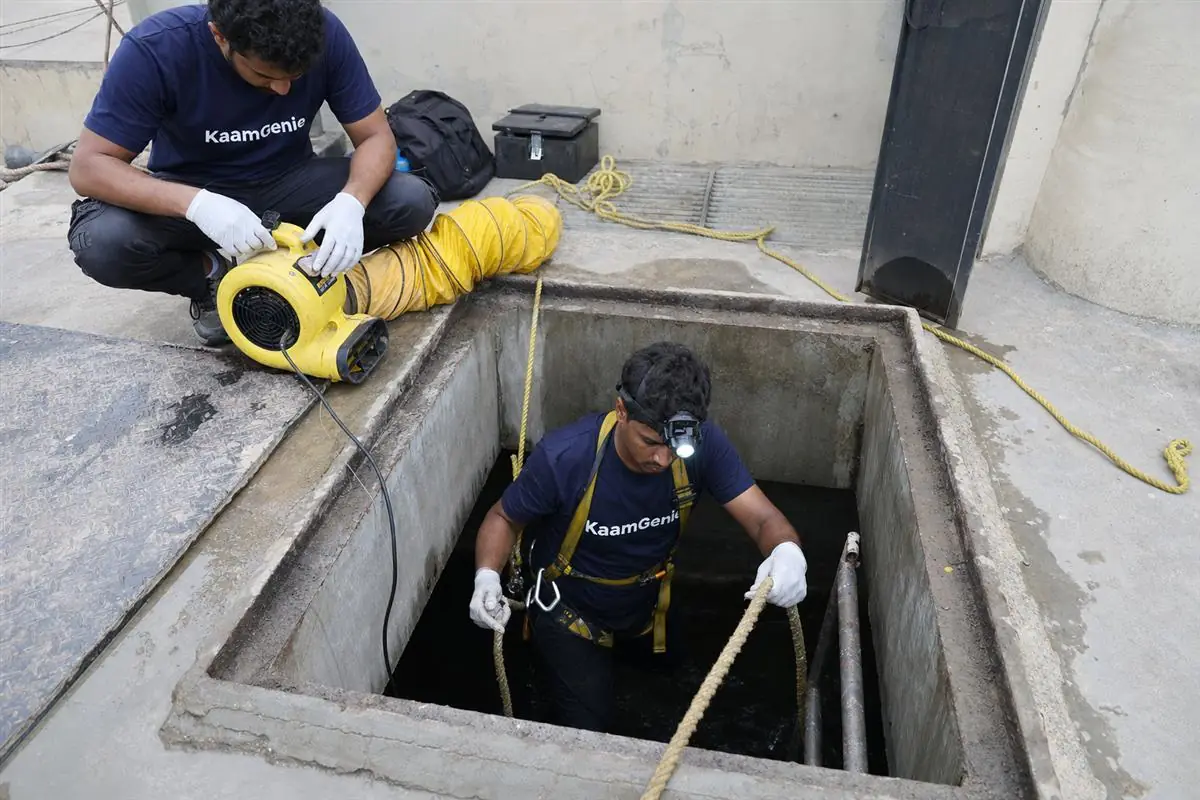
- It’s confined-space work. Gas testing, forced ventilation, harness and a standby person — never climb into a deep sump yourself.
- RCC concrete is porous. Hard Noida groundwater drives calcium and iron scale into the wall pores, so a concrete reservoir needs jet washing, not a wipe.
- Cost is custom, not ₹699. Sump and UGR work is quoted by capacity and access; the ₹699-onwards rate is for small residential overhead tanks.
If a cleaner only does your rooftop tank and skips the sump, they cleaned the second tank in the chain and left the first one dirty.
Why the underground reservoir collects the worst sediment
There’s a simple reason the underground sump is always the dirtiest tank in a Noida high-rise, and it’s pure physics. Whatever water comes into the complex — Ganga-treated supply from the Noida Authority Jal Vibhag, or hard borewell groundwater during shortfalls — lands in the underground reservoir first. The sump is the bottom of the entire storage chain, the lowest point water reaches before anything is pumped upward. And sediment obeys gravity: every grain of sand, every flake of rust from old mains, every speck of iron silt suspended in the supply settles out and sinks to the lowest available floor. That floor is the sump.
By the time water is pumped up to a tower’s rooftop tank, the heaviest particles have already dropped out in the sump below. So the overhead tank gets the relatively cleaner draw off the top of the reservoir, while the sump quietly accumulates the silt for the whole building. In a sump that hasn’t been desludged for a couple of years, that settled layer can be several inches of dense iron-stained mud across the floor. This is the inversion most residents get wrong: people fuss over the rooftop tank they can see and ignore the reservoir they can’t. The one buried in the basement is the one doing the dirty work. For the broader logic of why the two tank types need different handling, our overhead vs underground tank cleaning guide lays out the basics.
The two-stage flow: how the sump feeds your tap
To understand why the sump matters so much, you have to see where it sits in the system. Almost every tower in Noida and Greater Noida West stores water in two stages:
- Stage one — the underground reservoir (UGR). Incoming supply fills this large below-ground tank, usually split into compartments (commonly a domestic/drinking side and a flushing or fire-line side). This is the source. Everything downstream draws from it.
- The pump room. Pumps lift water from the sump up the riser to each tower.
- Stage two — the rooftop overhead tanks. Each tower has its own rooftop tanks. Water sits here before gravity-feeding down to the flats.
So the water in your 12th-floor kitchen tap passed through the sump first and the overhead tank second. That order is everything. If iron sediment, bio-film or scale is sitting in the sump, the pumps don’t care — they lift that contaminated water straight up into every overhead tank, and from there into every flat. Cleaning only the rooftop tank while leaving the sump untouched is like wiping the second glass in a row and leaving the first one filthy: the next pour just dirties everything again. A genuine clean has to start at the source. The flip side — that one neglected reservoir is the drinking water of hundreds of homes — is the heart of our society and high-rise water tank cleaning guide, which covers the whole AOA/RWA contract picture in detail.
| Factor | Underground sump / UGR | Rooftop overhead tank |
|---|---|---|
| Position in system | First storage, lowest point — the silt trap | Second storage, fed from the sump |
| Sediment load | Heaviest — sand, iron silt, grit settle here | Lighter — coarse sediment already dropped out below |
| Typical material | RCC concrete, porous walls hold scale | Often plastic / Sintex, smooth, releases scale easily |
| Access | Deep, enclosed, narrow opening — confined space | Open rooftop, ventilated, easy entry |
| Safety needs | Gas test, forced ventilation, harness, standby person | Standard care, gloves, no confined-space risk |
| Pricing | Custom by capacity & access | ₹699 onwards for a standard residential tank |
Book an underground sump / UGR clean
Dewatered, manually desludged, jet-washed and disinfected with full confined-space safety — never a rinse from the top. Residential overhead tanks ₹699 onwards; sump/UGR custom-quoted by capacity.
How a sump is actually desludged, dewatered and vacuumed
A sump clean is not a rooftop tank clean done lower down. Because the contamination is heavy settled sludge rather than a thin wall film, the work centres on physically getting that layer out. Here’s the real sequence:
- Isolate and dewater. The compartment is isolated so the building keeps drawing from the other half, then a submersible pump empties it down to the last few inches the pump can’t lift.
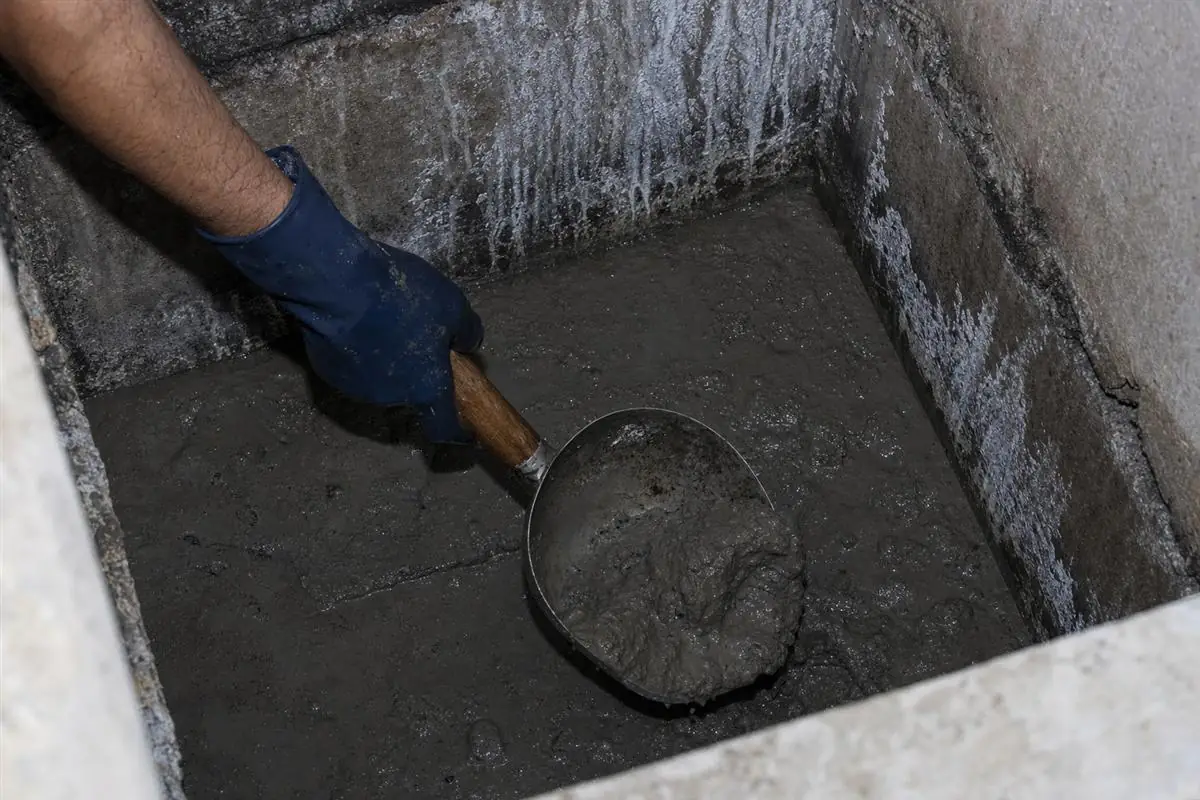
- Manual desludging. With confined-space safety in place, a crew member enters and hand-scoops the settled sludge — sand, iron silt, grit, scale flakes — into buckets that are carried out and disposed of off-site. This is the step cheap operators skip, and it’s the whole point of the job.
- Scrub the walls and floor. Food-grade brushes and detergent work the surfaces, including the corners and the area around the inlet, outlet and pump foot-valve.
- High-pressure jet wash. A 100–150 PSI jet drives scale and bio-film out of the porous concrete — on RCC walls a brush alone can’t reach into the surface texture.
- Wet-vacuum the residue. An industrial wet vacuum removes the dirty rinse water and loosened debris so it doesn’t redistribute when the sump refills.
- Disinfect. Food-grade sodium hypochlorite is applied to every surface and given proper contact time before a final rinse and vacuum.
The honest tell is simple: if nobody dewatered the sump and physically went in to scoop the sludge, the cleaning was a rinse from the top and the silt layer is still down there. The same disciplined eight-step scope we use on every job is broken down in our water tank cleaning process walkthrough — the sump just adds dewatering and confined-space safety on top.
Confined-space safety: why you must never DIY a deep sump
This is the part that turns a sump from a cleaning job into a hazardous one. An underground reservoir is, by definition, a confined space: a deep enclosed chamber with one narrow opening and almost no natural air movement. That combination is genuinely dangerous, and people in India die every year climbing into sumps and septic tanks to clean them. The risks are invisible:
- Oxygen depletion. Stagnant water and decaying organic sludge consume oxygen, so the air at the bottom can be too thin to breathe even though it looks completely normal.
- Toxic and flammable gases. Rotting sludge releases hydrogen sulphide (the rotten-egg smell that deadens your nose at exactly the levels that can kill), plus methane and carbon dioxide that pool at the bottom — right where a person has to stand.
- No escape. Through one narrow opening, an unconscious person cannot climb out and a panicking helper often can’t pull them either.
A professional crew controls all of this before anyone enters: a gas meter tests the atmosphere, a blower force-ventilates the chamber to flush bad air and bring in fresh, testing continues throughout, and a harnessed worker goes in only while a standby person stays outside at the opening, never entering, ready to haul them out. That’s the difference between a trained crew and a resident with a bucket and a ladder. Please don’t treat a deep sump as a DIY job — it is the one tank where cutting corners can cost a life, not just a clean.
Where the time goes — cleaning a ~10,000L society UGR compartment
Dewatering and manual desludging dominate — the parts a rinse skips
Illustrative for a ~10,000L UGR compartment with moderate sludge: roughly 3 hours of real work. Bigger reservoirs and heavier silt loads scale the dewatering and desludging steps further. A sump “done” in 30 minutes was never desludged.
RCC concrete porosity and hard-water scaling on reservoir walls
Most Noida sumps are cast in RCC concrete, and the material itself changes how the clean has to be done. Concrete is porous — its surface is full of fine pores rather than the smooth skin of a plastic tank. That matters enormously on Noida’s water. A lot of supply here, especially borewell groundwater in the newer sectors and during shortfalls, is genuinely hard: high in dissolved calcium and iron. As that water sits in the reservoir, the minerals drop out and deposit as scale — and on a porous concrete wall they grip into the pores instead of sitting loosely on top.
The practical consequence is that you can’t just wipe a concrete reservoir clean. Scale lodged in the wall texture needs high-pressure jet washing to drive it out, which is exactly why the jet-wash step is non-negotiable on a UGR. The same porosity means that if the waterproof lining is damaged or worn, the wall can hold bio-film and stay a source of contamination even after a surface clean — so the crew inspects the walls and lining on every visit and flags anything beyond cleaning. A smooth Sintex or plastic tank behaves very differently, releasing scale far more readily, which is one of the comparisons we draw in our Sintex vs concrete tank cleaning guide for Noida.
Not sure when your sump was last desludged?
We’ll survey the reservoir, quote by capacity and access, and clean it properly with confined-space safety and a certificate. Society/UGR custom-quoted; residential ₹699 onwards.
How often, and why the cost is custom (not flat ₹699)
Because the sump is the silt trap, it fouls faster than the tank above it — so it needs cleaning more often, not less. For most Noida and Greater Noida West buildings a quarterly schedule is the realistic standard. BIS IS 10500 and CPHEEO guidance support cleaning stored drinking-water tanks at least twice a year as a floor, but that minimum assumes benign water. On Noida’s hard borewell groundwater, with calcium and iron dropping out into a concrete reservoir, a six-monthly clean means the sump is already re-silting and re-scaling well before the next visit. Quarterly desludging keeps the source genuinely clean. Newly handed-over towers are a special case: they need an immediate sump clean to flush out construction debris — cement slurry, sand and pipe-flushing residue left in the UGR from the build.
And this is why sump work isn’t priced from a flat menu. The headline ₹699 onwards rate is for a standard residential overhead tank — small, accessible, quick. An underground reservoir is custom-quoted on two things:
- Capacity. A 20,000 or 50,000-litre sump takes far longer to dewater, desludge and disinfect than a 1,000-litre rooftop tank.
- Access. Confined-space entry needs gas testing, a ventilation blower, a harness and a standby person — real costs a small open tank simply doesn’t carry.
So we survey the reservoir, then quote by capacity and access. For societies, every UGR compartment and every tower tank is priced and totalled — the full per-tank contract picture sits in our water tank cleaning cost guide for Noida, which breaks down exactly what drives a quote. We do this work right across the FNG and Noida–Greater Noida Expressway corridor, including fast-occupying high-rise belts like Sector 150, the Noida Extension towers at Greater Noida West, and established pockets around Sector 137.
Book an underground sump clean across Noida
Whether it’s a single home sump, a freshly handed-over tower that still carries construction silt, or a society UGR that hasn’t been desludged in years, the work is the same in principle: dewater it, get the sludge physically out, jet-wash the concrete, disinfect, and do it all with proper confined-space safety. Never a rinse from the top. Start at our water tank cleaning in Noida hub for sector coverage and booking, or call us to arrange a survey for your reservoir.
To book, call +91 95603 66362 or use the booking form on this site — we’ll confirm shortly.
Frequently asked questions
Why does the underground sump collect more sludge than the overhead tank?
Because it is the first place water lands and gravity does the rest. In a Noida high-rise the borewell or Authority supply fills the underground reservoir (UGR) at the bottom of the complex before anything is pumped up. Every grain of sand, iron particle and bit of grit in that incoming water settles to the lowest point in the system, which is the sump floor. The overhead tank only ever receives water that has already been pumped from the sump, so the heaviest sediment has largely dropped out by then. The sump is the silt trap for the whole building, which is exactly why it is the dirtiest and most important tank to clean.
Why is cleaning a deep sump confined-space work, and why should I never DIY it?
An underground reservoir is a confined space: a deep, enclosed pit with one narrow opening and almost no natural ventilation. Stagnant water and decaying sludge can deplete oxygen and release gases such as hydrogen sulphide and methane that collect at the bottom, exactly where a person has to stand. People have died climbing into sumps to clean them. A professional crew gas-tests the air, force-ventilates the chamber, uses a harness with a standby person at the opening who never enters, and limits time inside. None of that exists when a resident or an untrained helper climbs in with a bucket, which is why a deep sump is the one tank you must never DIY.
How does the two-stage UGR-to-overhead-tank flow work in a Noida high-rise?
Almost every Noida tower stores water in two stages. The incoming supply, whether Ganga-treated Authority water or borewell groundwater, first fills the underground reservoir (UGR) at ground or basement level, usually split into compartments. Pumps in the pump room then lift that water up the riser to overhead tanks on each tower roof, and from the rooftop tanks it gravity-feeds down to the flats. So your tap water passes through the sump first and the overhead tank second. A real clean has to cover both stages, because if the source sump is dirty it simply pumps that contamination up into every overhead tank above it.
How often should an underground sump in Noida be cleaned?
For most Noida and Greater Noida West buildings a quarterly schedule is the realistic standard, because the sump is the silt trap and the local groundwater is hard, high in calcium and iron, so sediment and scale build up fast. BIS and CPHEEO guidance supports cleaning stored drinking-water tanks at least twice a year as a floor, but the sump fouls quicker than the overhead tank, so on hard borewell supply quarterly desludging of the UGR keeps it genuinely clean rather than clean on paper. New towers that have just been handed over should have the sump cleaned immediately to remove construction debris.
How is an underground sump actually desludged and dewatered?
After isolating the compartment, the crew dewaters it with a submersible pump down to the last few inches that the pump cannot lift. A trained crew member then enters with confined-space safety in place and manually scoops out the settled sludge, the sand, iron silt, grit and scale flakes, into buckets that are carried out and disposed of off-site, never flushed back into the building drains. The walls and floor are scrubbed with food-grade brushes and detergent, jet-washed at high pressure to clear scale from the concrete pores, then a wet vacuum removes the residual dirty water before disinfection. Skipping the manual desludge and just pumping the water out leaves the worst contamination sitting on the floor.
Does an RCC concrete sump need different cleaning from a plastic tank?
Yes. Most Noida sumps are cast in RCC concrete, which is porous, so hard-water calcium and iron scale grips into the surface pores instead of sitting loosely on a smooth plastic wall. That is why a concrete reservoir needs proper high-pressure jet washing to clear scale out of the texture, not just a wipe-down. The same porosity means a damaged or unlined concrete wall can harbour bio-film, so the crew inspects the walls and waterproofing on every visit. A smooth Sintex or plastic tank releases scale far more easily, which is one of the differences we cover in the overhead-vs-underground and Sintex-vs-concrete guides.
Why isn’t sump cleaning a flat ₹699 like a residential tank?
The ₹699-onwards price is for a standard residential overhead tank that is small, accessible and quick. An underground reservoir is custom-quoted because the cost is driven by capacity and access. A 20,000 or 50,000-litre sump takes far longer to dewater, desludge and disinfect than a 1,000-litre rooftop tank, and confined-space entry needs gas testing, forced ventilation, a harness and a standby person. Those are real costs that a small overhead tank does not carry. So sump and UGR work is quoted by capacity and access after a quick survey, not from a flat menu price.
Can the sump be cleaned without cutting off the building’s water?
Usually yes. Most Noida UGRs are split into two or more compartments, so the crew isolates one compartment and lets the building keep drawing from the other, cleans the isolated half, then swaps. Where the sump is a single chamber, the overhead tanks are topped up first so the building runs off stored rooftop water during the short window the sump is offline. With scheduling during low-usage hours and advance notice to residents, a sump clean is done without anyone losing supply for more than a brief refill window.
What gases can collect in an underground reservoir and how do you make it safe?
Decomposing organic sludge and stagnant water in an enclosed sump can deplete oxygen and generate hydrogen sulphide, which smells of rotten eggs at low levels but deadens the sense of smell at dangerous ones, along with methane and carbon dioxide that displace breathable air at the bottom. Before any entry the crew tests the atmosphere with a gas meter, force-ventilates the chamber with a blower to flush out bad air and bring in fresh, keeps testing throughout, and stations a standby person at the opening who stays outside and can pull the worker out by harness. Entry only happens once the readings are safe.
How long does cleaning an underground sump take?
A residential underground sump up to about 5,000 litres typically takes 2 to 2.5 hours end to end. A society UGR of 10,000 litres or more runs 2.5 to 4 hours per compartment depending on how much sludge has built up and how difficult the access is. The dewatering, manual desludging and the disinfection contact time are the slow parts, and they scale with capacity. A sump that is finished in 30 minutes was rinsed from the top, not desludged.
Sources & references
- Bureau of Indian Standards (BIS) — IS 10500:2012 is the canonical Indian Standard for drinking water specification, defining acceptable limits for physical, chemical, and biological parameters.
- WHO Guidelines for Drinking-water Quality, 4th edition — the global reference for water quality standards, including guidance on storage and disinfection.
- Food Safety and Standards Authority of India (FSSAI) — defines water quality requirements for food businesses, including hygiene standards for stored water and acceptable disinfection chemicals.
- WHO Fact Sheet on Drinking Water — overview of safe drinking water requirements and contamination risks.
- CPHEEO — Manual on Water Supply and Treatment — the Government of India’s engineering manual covering tank design, cleaning protocols, and disinfection practices.
Last verified: 27 June 2026. If you find any of these links broken, please let us know.