
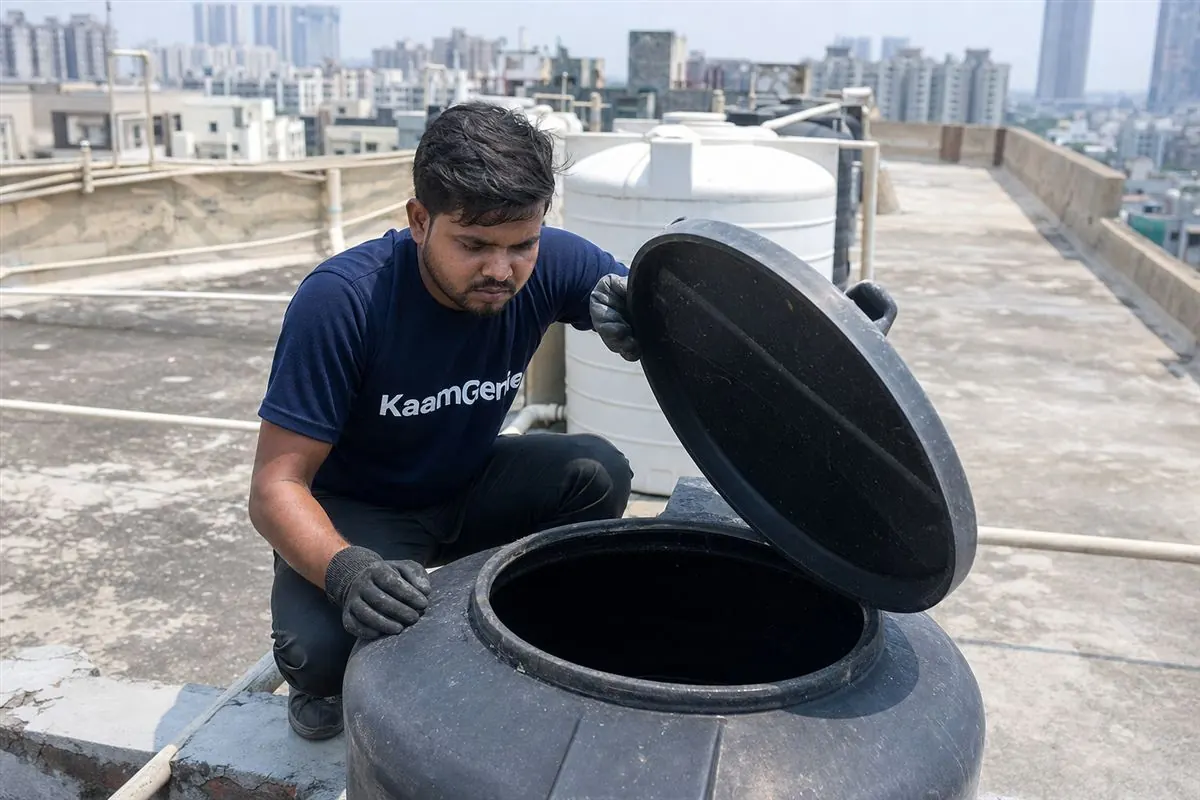
The short version
- Two sources. Noida runs mainly on treated Ganga/canal water from the Noida Authority’s plants, backed up by hard borewell groundwater.
- The supply is usually clean at the plant. It’s disinfected to meet BIS IS 10500 drinking-water limits before it enters the sector mains.
- Your tank is the weak link. Clean water still passes through your sump and overhead tank — where sediment settles, biofilm grows and hard-water scale forms.
- Borewell sectors scale faster. High calcium and iron in groundwater leave chalky white and rust-brown deposits on tank walls within months.
- So the tank, not the source, is usually the problem at your tap — and it’s the part you actually control.
- Clean quarterly on Noida water and do both the sump and the overhead tank, not just the easy one.
If your supply line runs clear but your stored water doesn’t, the fix isn’t a complaint to the Authority — it’s a tank clean.
Where Noida’s water actually comes from
Ask most residents where their water comes from and the honest answer is “the tap.” But Noida’s supply has a real and fairly specific story, and understanding it explains a lot about why your water behaves the way it does. The city draws on two very different sources, and most homes get a blend of them.
- Treated surface water (Ganga & canal). This is the primary, intended source. Raw water from the Upper Ganga Canal and allied channels is brought to the Noida Authority’s water treatment plants, where it is filtered, clarified and disinfected before being pumped into the sector pipe network. When people say Noida gets “Ganga water,” this is what they mean — treated canal water that has been engineered up to drinking-water standard.
- Borewell groundwater (the backup that does a lot of work). Surface supply doesn’t always cover demand — summers, peak hours, and fast-growing outer sectors stretch it. To fill the gap, the Authority and many societies run borewells that pull water straight from the ground. This groundwater is the second source, and in plenty of sectors it is doing far more than “backup” duty.
Which mix you get depends on your sector, the season and how much canal water is flowing on a given day. A flat near a well-served trunk main might run almost entirely on treated canal water; a newer high-rise in Greater Noida West (Noida Extension) might lean heavily on borewell supply for much of the year. That blend matters, because the two sources dirty your tank in completely different ways.
The journey: from the plant to your tap
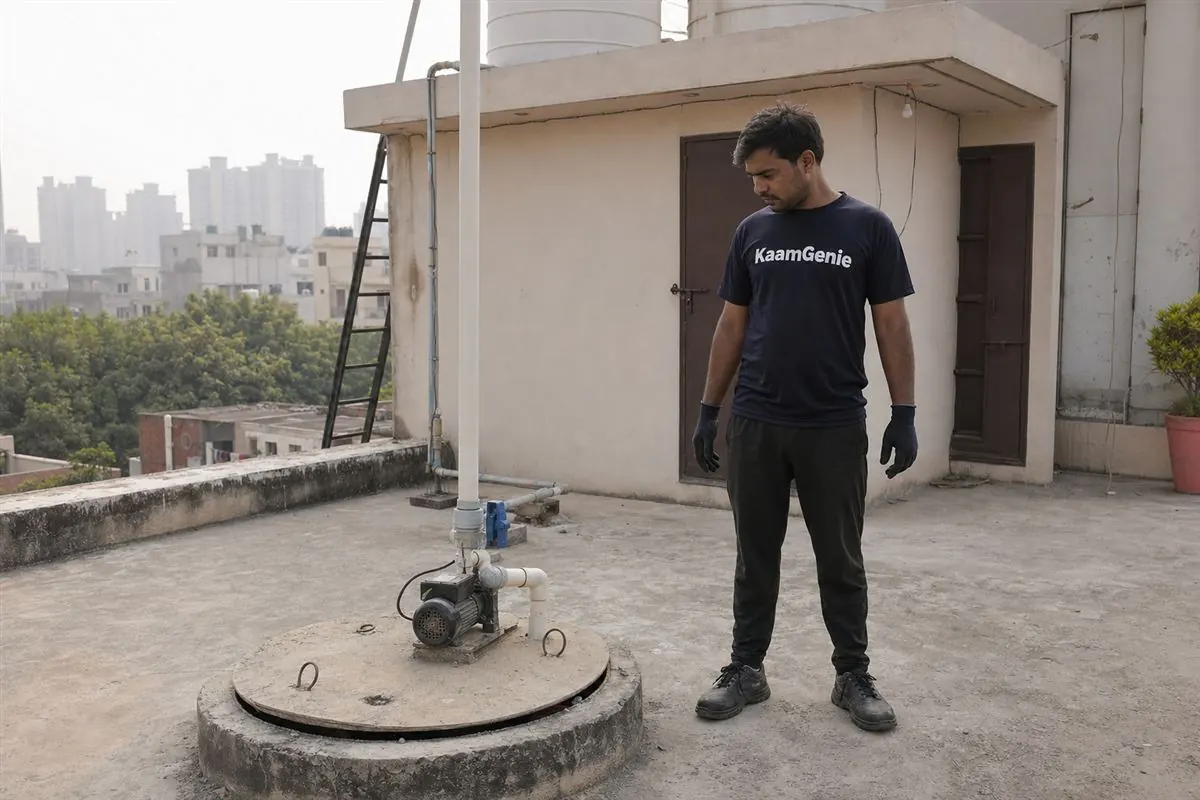
Here’s the part most people skip over. Water doesn’t travel from the treatment plant straight to your kitchen. It moves through a chain, and every link is a chance for clean water to pick up something it shouldn’t:
- Sector main. Treated canal water, topped up by borewells, flows through the buried sector pipe network to your plot or society gate.
- Underground sump (UGR). In most Noida buildings the supply lands first in a ground-level underground reservoir. This is where the heaviest grit, sand and sediment settle out — and it feeds everything above it.
- Pump. A pump lifts water from the sump up the riser to the roof.
- Overhead tank. Water sits in the rooftop tank, sometimes for hours, before it’s used. This is the last stop before your tap.
- Your tap. Gravity feeds the stored water down to the kitchen and bathroom.
So between the Noida Authority’s disinfected supply and your morning glass of water sit two storage tanks. The supply can be perfectly clean and your tap water can still be cloudy, scaly or off-tasting — because the problem lives in the storage, not the source. Our step-by-step water tank cleaning process guide walks through exactly how a real clean tackles both of those tanks.
Why even clean treated water turns unsafe in a dirty tank
This is the central idea of the whole article, so it’s worth being precise. Water that leaves the plant meeting BIS IS 10500 limits can become unsafe purely from how it’s stored. Three things happen inside a neglected tank:
- Sediment settles. Even treated water carries a tiny load of fine particles, and borewell water carries far more. Over weeks, that drops to the floor of the sump and overhead tank as a layer of silt. Stir it up — a heavy refill, a pump surge — and it goes straight up the pipe to your tap.
- Biofilm grows. A tank is a dark, still, warm-ish reservoir — ideal for a thin, slimy bacterial film to grow on the walls. Biofilm shrugs off the small amount of residual disinfectant in stored water, and it’s the source of that musty, earthy smell and taste people blame on “the supply.”
- Scale builds up (the Noida special). On hard borewell water, dissolved calcium and iron drop out of solution and bond to the tank walls and floor as chalky white scale and rust-brown staining. That scale then sheds back into the water and harbours more biofilm.
None of this is the Noida Authority’s fault, and none of it shows up if you only test the supply line. It shows up at your tap, because it happens in your tank. That’s genuinely good news: it means the one variable you fully control — how clean your storage is — is also the one that most affects your water. For the deeper detail on this contamination chain, see our water tank cleaning guide for Noida.
Not sure if it’s your supply or your tank?
We’ll inspect your sump and overhead tank, show you what’s inside, and clean both with a food-grade disinfectant. Single-tank cleaning ₹699 onwards across Noida.
Why borewell-heavy sectors scale faster
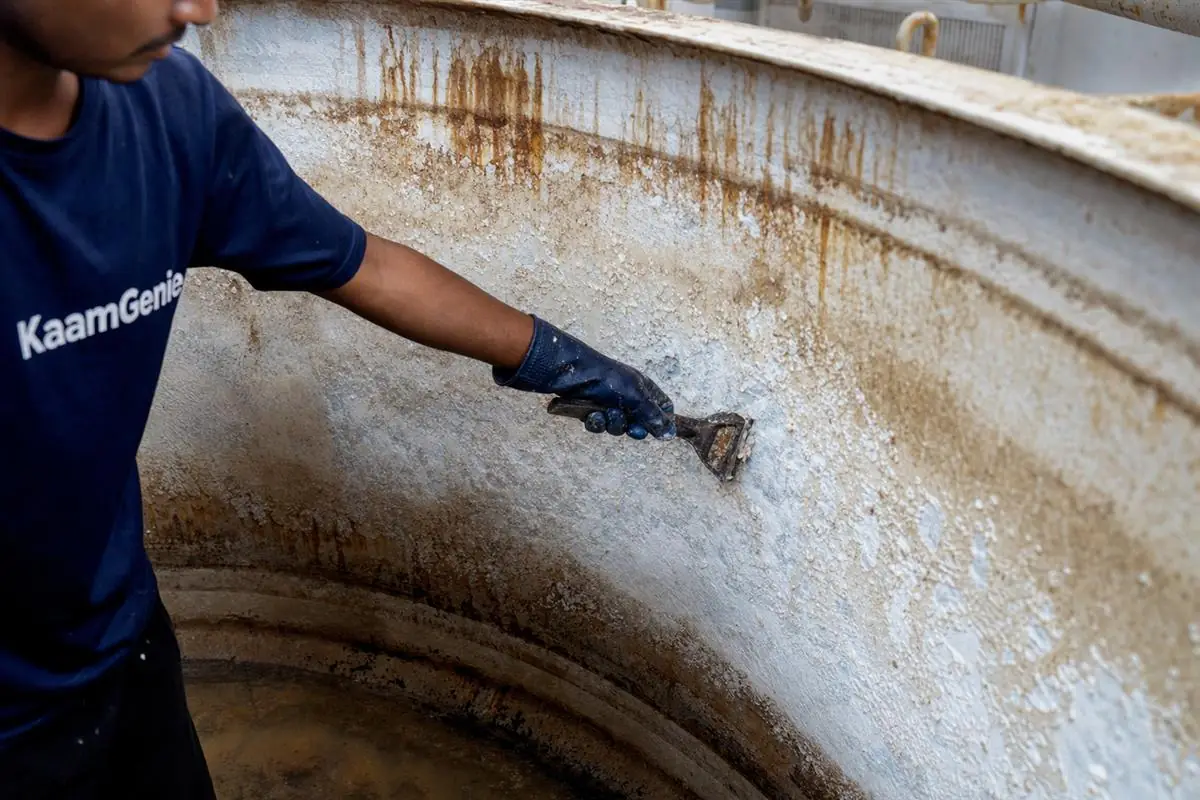
Treated canal water is comparatively gentle on a tank. Borewell groundwater is not. It is naturally hard — loaded with dissolved calcium, magnesium and iron pulled from the rock and soil it sits in. The moment that water rests in your tank, those minerals start coming out of solution:
- Calcium and magnesium deposit as the chalky, off-white scale that crusts on walls, floor and the float valve. It’s the same stuff that furs up a kettle — only here it’s coating your drinking-water tank.
- Iron oxidises into the rust-brown staining and the occasional yellow-brown first flush after the tank has sat overnight. It’s also what stains your washbasin and clothes.
So a flat on mostly treated canal supply might keep a tank reasonably clean for several months, while a high-rise on heavy borewell draw in the Noida Extension belt or an outer sector can re-scale within weeks of a clean. This is exactly why our dedicated hard water tank cleaning in Noida guide treats borewell sectors as a different problem requiring active de-scaling, not just a rinse. If you’re in a society on shared borewell supply, our society & high-rise tank cleaning guide explains how the same scale problem multiplies across an underground reservoir feeding hundreds of flats.
What a real clean actually removes on Noida supply
A “tank cleaning” that just opens the lid, splashes some water around and drains it does almost nothing for Noida water. Because the supply leaves three distinct deposits — sediment, biofilm and hard-water scale — a real clean has to tackle all three. Here’s what each stage is actually doing:
| What’s in the tank | Where it comes from | How a real clean removes it |
|---|---|---|
| Settled sediment & silt | Fine particles in supply; heavy in borewell water | Full drain, manual de-sludging and vacuum extraction from the floor |
| Biofilm (slimy walls) | Bacteria growing in still, stored water | Mechanical scrub of every wall, then food-grade disinfection |
| Calcium scale (white crust) | Hard borewell groundwater (calcium, magnesium) | Active de-scaling and scrubbing of walls, floor and fittings |
| Iron staining (rust-brown) | Dissolved iron in groundwater oxidising in the tank | Targeted scrubbing and jet-wash of stained surfaces |
| Stale, dirty water | Water sitting too long on top of all of the above | Complete drain, vacuum-dry, then refill with clean supply |
| Lingering bacteria | Survivors after scrubbing | FSSAI-acceptable disinfectant left to act, then safe rinse |
The de-scaling row is the one budget operators skip, and it’s the one that matters most on Noida’s hard water. A rinse leaves the calcium and iron exactly where they were; only mechanical de-scaling actually lifts them. If your tank is an underground sump rather than a rooftop tank, the work is heavier still — see our underground sump tank cleaning service, since the sump is where the worst sediment collects.
How often to clean on Noida water
Realistic cleaning frequency by supply type in Noida
How fast a tank re-dirties depends on how much borewell water it stores
Illustrative guidance, not a fixed rule. BIS IS 10500 and CPHEEO guidance treat twice a year as a floor for stored drinking water; Noida’s hard groundwater pushes the practical interval shorter, especially in borewell-heavy and newly occupied sectors.
The headline: quarterly is the sensible default for most of Noida, and borewell-heavy sectors deserve to be at the tighter end of that. The official floor — twice a year — assumes fairly benign water and a tank that isn’t fighting constant scale. On Noida supply, a tank that’s genuinely clean at month six is usually re-scaling and re-silting well before then. Our how often to clean a water tank piece works through the full frequency logic if you want to set a schedule.
Signs your tank — not the supply — is the problem
Before you raise a complaint about the supply, it’s worth checking whether the issue is actually in your storage. These are the tells we see most often in Noida homes:
- Clear from the line, cloudy from the tank. If water drawn directly from the supply inlet is clean but water from the stored tank isn’t, the tank is the culprit.
- A yellow-brown first flush after the tank has sat overnight — classic iron and sediment that settled and got stirred up.
- White chalky scale or slimy walls when you lift the tank lid — calcium and biofilm you can see and feel.
- Sediment in the bottom of a glass left to stand, or grit in the kitchen tap filter.
- An earthy, musty or metallic taste and smell that the same supply doesn’t have at a neighbour’s clean tank.
- Neighbours on the same line have clean water and you don’t. Same supply, different result — the difference is your tank.
Any one of these points at storage rather than source. The fix isn’t a letter to the Authority; it’s draining, de-scaling and disinfecting your sump and overhead tank. We cover this across the city — from the high-rise belts of Sector 137 to the established homes of Sector 62 — and the same applies right across the river with water tank cleaning in Delhi, where Yamuna-treated supply meets the same storage problem.
Book a tank clean across Noida
Whether you’re on mostly treated Ganga/canal water, a borewell-heavy outer sector, or the mixed supply most of Noida actually gets, the principle is the same: your supply is usually fine, and your tank is what needs attention. We clean both the underground sump and the overhead tank, actively de-scale hard-water deposits, and finish with a food-grade disinfection so the water reaching your tap is as clean as the water that left the plant. Start at our water tank cleaning in Noida hub for sector coverage and booking.
To book, call +91 95603 66362 or use the booking form on this site — we’ll confirm shortly.
Clean supply deserves a clean tank
Book a full sump + overhead clean with active hard-water de-scaling and food-grade disinfection. Single-tank from ₹699 onwards; societies custom-quoted.
Frequently asked questions
Where does Noida’s tap water actually come from?
Noida runs on two main sources. The primary one is treated surface water — Ganga and canal water that the Noida Authority cleans at its water treatment plants and pumps into the sector pipe network. The backup, used during shortfalls and heavily in newer and outer sectors, is borewell groundwater drawn from below the ground. Most homes get a blend of the two depending on their sector, the season and how much canal water is flowing that day.
Is Noida tap water clean and safe to drink?
At the point the Noida Authority delivers it, the treated Ganga/canal supply is disinfected and meant to meet BIS IS 10500 drinking-water limits. The catch is that water does not go straight from the plant to your tap — it sits in your building’s underground sump and overhead tank first. If those tanks are dirty, the water picks up sediment, biofilm and scale on the way to you. So Noida’s supply is usually clean at the source but can become unsafe in storage, which is why the tank is the part you actually control.
Why is Noida’s borewell water so hard?
Borewell water in Noida and Greater Noida West is drawn from groundwater that is naturally high in dissolved minerals — mainly calcium, magnesium and iron. That mineral load is what makes it hard. As the water sits in a tank it drops those minerals out as chalky white calcium scale and rust-coloured iron staining on the walls and floor. Sectors that lean more on borewell supply get scale and sediment build-up noticeably faster than sectors on mostly treated canal water.
If the supply is treated, why does my tap water still look or taste dirty?
Because the problem is almost always downstream of the supply — in your own storage. Treated water enters a clean pipe, lands in your underground sump, gets pumped to the overhead tank, then flows to your tap. If the sump or overhead tank has settled sediment, a slimy biofilm layer or hard-water scale, the water leaving them is no longer as clean as the water that arrived. A cloudy glass, an earthy or metallic taste, or yellow-brown tinge after a gap usually points at the tank, not the Noida Authority’s plant.
How does water get from the Noida supply to my tap?
It travels in stages. Treated Ganga/canal water (topped up by borewells) flows through the sector mains into your plot. In most buildings it first fills an underground reservoir or sump at ground level. A pump then lifts it up to the overhead tank on the roof. From the overhead tank gravity feeds it down to your taps. So between the clean supply and your kitchen there are two storage tanks — the sump and the overhead — and both can dirty the water if they are not cleaned.
Does a tank clean remove hard-water calcium and iron scale?
Yes — that’s a core part of a real clean on Noida supply. A proper service drains the tank, removes settled sludge and iron sediment, then mechanically scrubs and de-scales the walls and floor to lift calcium and rust deposits that a simple rinse leaves behind. After that the tank is vacuumed dry and disinfected with a food-grade solution. On hard borewell water this de-scaling step is the difference between a tank that looks rinsed and one that is actually clean.
How often should I clean my tank on Noida water?
Every three to four months is the realistic standard for most Noida homes, and quarterly is sensible in borewell-heavy sectors and in Greater Noida West. BIS and CPHEEO guidance treats twice a year as a floor for stored drinking water, but that assumes fairly benign supply. Noida’s hard groundwater leaves scale and sediment faster, so a tank that is genuinely clean at six months is often re-scaling well before the next visit. If your supply is mostly borewell, treat quarterly as the default.
How can I tell if my tank — not the supply — is the problem?
A few signs point at the tank rather than the Noida Authority. Water that is clear straight from the supply line but cloudy or smelly from the stored tank; a yellow-brown first flush after the tank has sat overnight; white chalky scale or slimy walls when you open the lid; sediment in the bottom of a glass; or recurring stomach upsets in the household with no other cause. If neighbours on the same supply line have clean water and you don’t, the difference is your storage.
Do I need to clean both the underground sump and the overhead tank?
Yes, both. The underground sump is where the incoming supply lands first, so it is where the heaviest sediment, grit and sludge settle — and it feeds everything above it. The overhead tank is the last stop before your tap. Cleaning only the overhead tank while leaving a dirty sump means the pump keeps pushing sediment back up. A real service does the sump and the overhead together so the whole storage path from supply to tap is clean.
Does a water purifier mean I can skip tank cleaning?
No. A point-of-use RO or UV purifier only treats the small amount of water you drink and cook with — it does nothing for the water you bathe in, brush teeth with or use in the kitchen tap before the purifier. It also runs on the same stored water, so a dirty tank shortens the life of your purifier’s filters and membrane by feeding them sediment and scale. Cleaning the tank protects your whole household’s water and your purifier; it is not a replacement for it.
Sources & references
- Bureau of Indian Standards (BIS) — IS 10500:2012 is the canonical Indian Standard for drinking water specification, defining acceptable limits for physical, chemical and biological parameters, including hardness, iron and total dissolved solids relevant to Noida groundwater.
- WHO Guidelines for Drinking-water Quality, 4th edition — the global reference for water quality, including guidance on safe storage, disinfection and the risks of contamination in stored water.
- CPHEEO — Manual on Water Supply and Treatment — the Government of India’s engineering manual covering surface-water treatment, storage-tank design, cleaning protocols and disinfection practices.
- Ministry of Jal Shakti, Department of Drinking Water & Sanitation — national policy context on drinking-water supply, groundwater use and the Ganga/canal surface-water programmes that feed urban supply in the NCR.
- WHO Fact Sheet on Drinking Water — overview of safe drinking-water requirements and how contamination can occur between source and consumption.
Last verified: 26 June 2026. If you find any of these links broken, please let us know.