
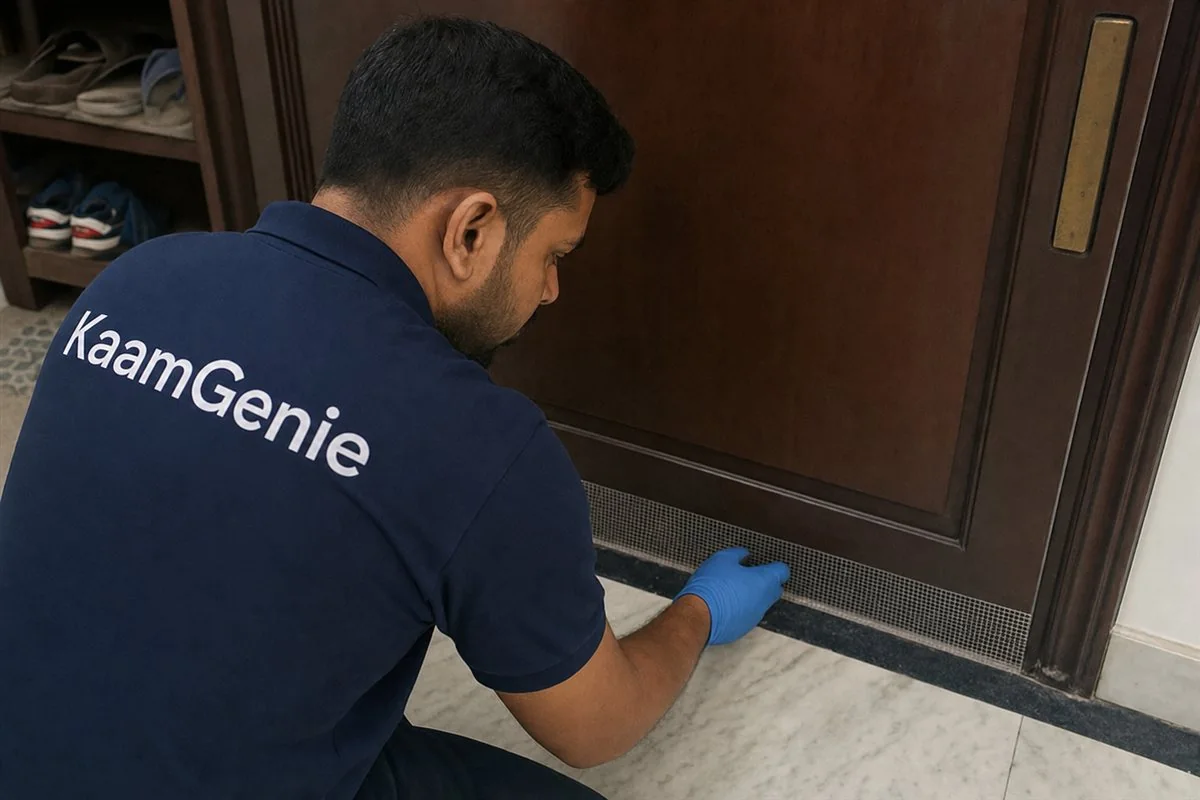
Quick answer — rodent proofing in Delhi (2026)
- Proofing beats baiting: a house mouse squeezes through a gap the width of a pencil (about 6–7mm) and a rat through one the size of a ₹10 coin. Seal the entries and the re-infestation stops — bait alone never does.
- The usual entry points: the gap under the main door, holes where water and gas pipes or AC drains pass through walls, open exhaust and ventilator grilles, broken sewer covers, and the runway behind kitchen cabinets.
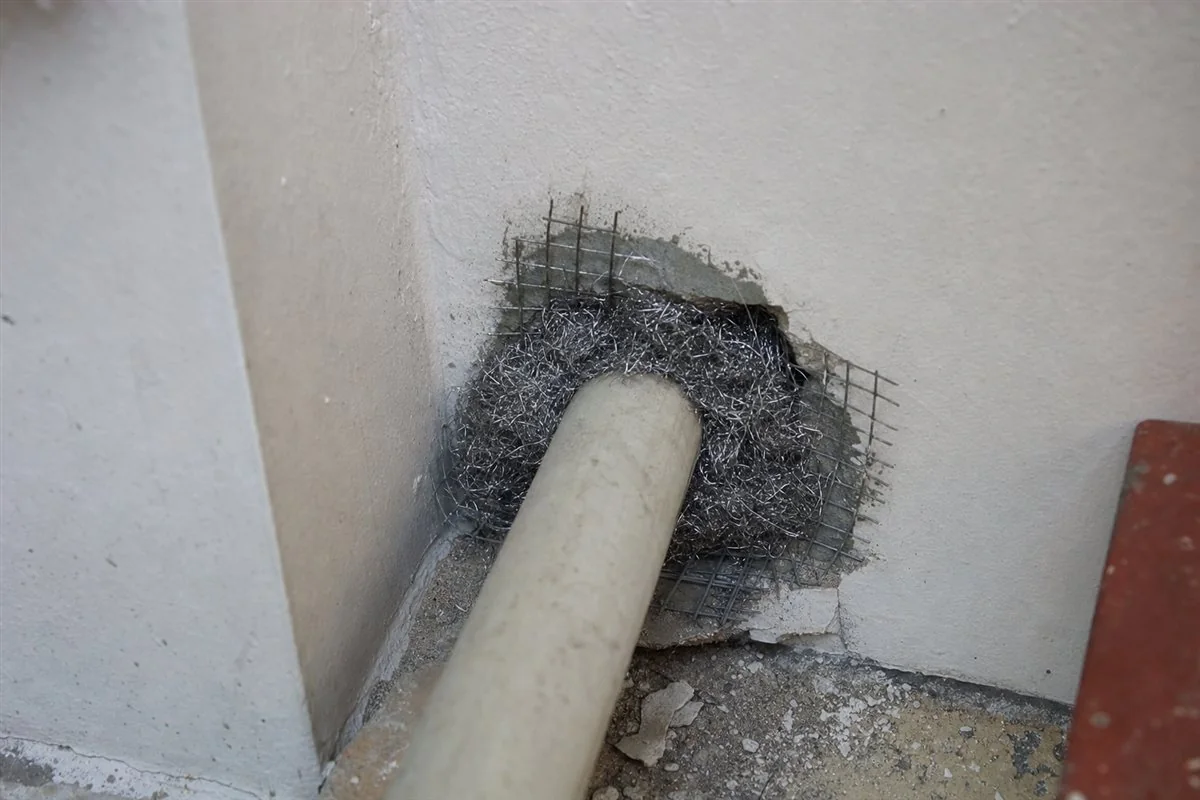
- Seal with the right materials: steel wool packed into pipe gaps, fine metal mesh over vents, a brush or aluminium door sweep on the gap below doors, and cement or metal collars — rats gnaw through foam, plastic and rubber.
- Trapping over baiting indoors: snap traps let you remove the carcass; bait often means a rat dies inside a wall and stinks for days. Glue boards are inhumane and a last resort, not a first move.
- Real cost (2026): rodent treatment & proofing starts from ₹999; larger homes, kitchens and warehouses are quoted on entry-point count. GST 18% extra.
- No honest service promises a forever rat-free building — proofing plus monitoring is the real answer. We cover all of Delhi.
Why baiting alone never ends the rat problem
Let me start with the thing most pest companies won’t tell you, because it’s the whole point of this page. Poison does not stop rats coming into your home — it only kills the ones already inside. The moment that batch is gone, the building is still full of open doorways, and the next rat from the lane, the sewer or the neighbour’s shop walks straight in. You bait again. They die again. New ones arrive. That cycle is not bad luck and it is not a stronger poison you need — it’s a sealing job you haven’t done.
Rats and mice are commensal animals, which is a polite way of saying they have evolved over thousands of years to live off humans. In a dense city like Delhi — old Lajpat Nagar shops with shared walls, Karol Bagh godowns, a Dwarka society with a common garbage area, a Chandni Chowk kitchen backing onto a drain — there is a near-infinite supply of rats outside your wall. As long as the wall has a hole, baiting is bailing water out of a boat without plugging the leak. Proofing plugs the leak. That is the single most important sentence in this guide.
There’s a second reason to lead with proofing rather than poison: a rat that eats bait often dies somewhere you can’t reach — inside a cavity wall, above a false ceiling, behind a heavy almirah. Then you live with the smell for a week or more, and in summer that is genuinely unbearable. Seal the building properly and you need far less bait in the first place, and the trapping you do use happens where you can collect the carcass. Proofing is not the expensive add-on; it’s the part that makes everything else cheaper and cleaner.
Find every entry point — the gaps rats actually use
Before you seal anything you have to think like a rat, and a rat’s body is astonishing. A young house mouse gets through a gap about 6–7mm — the width of a standard pencil. A brown rat flattens its rib cage and pushes through a hole the size of a ₹10 coin, roughly 20mm. If your finger fits in a gap, a rat fits too. So when I do a survey I’m on my knees with a torch looking at the boring, low-down parts of the house nobody decorates. Here is where they get in, in the order I find them most often in Delhi homes:
- The gap under the main door and balcony door. The single most common entry point, full stop. Old wooden doors warp and leave a 15–25mm gap at the bottom — an open invitation at night when the street goes quiet.
- Pipe and AC penetrations. Wherever a water pipe, gas line, drain or AC copper pipe passes through an external wall, the mason left a ragged gap around it. Under the kitchen sink and behind the washing machine are the classic spots.
- Exhaust fans, ventilators and chimney outlets. The kitchen exhaust and bathroom ventilator are highways straight to the outside. If the mesh is missing or torn, it’s a door.
- Floor drains and sewer connections. Rats genuinely swim up sewer lines and push through a broken or unweighted floor trap, especially in ground-floor flats and basements.
- Broken vents in the false ceiling and ducting. In offices, restaurants and malls the suspended ceiling is a motorway. One gap at the building edge and they run the whole floor.
- The runway behind kitchen cabinets and behind the fridge. The warm, dark gap behind a modular kitchen is where they nest once they’re in — and the cable and water-pipe cut-outs in the back panel are how they move between units.
- Gaps under shutters and around shopfronts. For Delhi shops and warehouses, the roller-shutter gap and the gap beside the frame are the main weak points.
Walk your own home with a torch this weekend and you’ll be surprised — the droppings and the dark greasy “rub marks” (rats follow the same wall route every night and leave an oily smear) usually point you straight to the active runs.
| Entry point | Why it’s a problem | The right seal |
|---|---|---|
| Gap under door | 15–25mm gap, used nightly | Brush or aluminium door sweep / metal threshold |
| Pipe & AC wall penetrations | Ragged mason gap around the pipe | Steel wool packed in, sealed with cement or metal collar |
| Exhaust & ventilator grilles | Open or torn mesh = open door | Fine galvanised metal mesh (not plastic) |
| Floor drains / sewer traps | Rats swim up the line | Weighted metal grate or one-way drain flap |
| Cabinet & fridge cut-outs | Hidden runway behind units | Seal cable/pipe holes; mesh the back-panel gaps |
| Shutter & shopfront gaps | Main entry for shops/godowns | Brush strip on shutter base; seal frame edges |
Seal it right: the materials that actually stop a rat
This is where DIY usually fails, because people reach for the wrong stuff. A rat’s front teeth never stop growing and it gnaws constantly to wear them down — it can chew through foam filler, silicone, plastic, rubber, wood and even soft mortar in a single night. So if you squirt PU foam into a pipe gap and feel pleased, the rat will treat it as a snack and be back through by morning. You have to use materials it can’t bite.
- Steel wool (or copper wool / wire mesh) for pipe gaps. Pack it tight into the hole around the pipe, then seal over it with cement or a metal collar. Rats hate chewing metal fibres — it hurts their mouths — so they give up.
- Fine galvanised metal mesh for vents and grilles. Hardware cloth with a small aperture, screwed firmly over exhausts, ventilators and weep holes. Plastic mosquito mesh does nothing here — it has to be metal.
- A proper door sweep on the bottom gap. A brush-strip or aluminium sweep screwed to the door base closes the biggest entry of all. For shutters, a brush strip along the base does the same job.
- Cement, mortar or metal sheet for larger holes. Broken brickwork, gaps around the meter box, holes at the wall base — fill solid, ideally with a bit of wire mesh embedded so it can’t be gnawed out.
- Weighted metal grates on floor drains. So a rat can’t push the cover up from below.
I’m honest with customers that good proofing is fiddly, unglamorous work — it’s an hour on your knees with steel wool and a caulking gun per problem area, not a five-minute spray. But it’s also the only part of rodent control that stays done. A sealed pipe gap is sealed next year too. A bait tray is empty next week.
Rats keep coming back no matter how much bait you put down?
Our technician maps every entry point and seals it — steel wool, mesh and door sweeps — so they can’t get back in. Rodent work from ₹999 (GST 18% extra).
Baiting vs trapping vs glue boards — the honest comparison
Once the building is sealed, you still have to deal with whatever is already inside. There are three common tools, and they are very much not equal. Here’s my honest take after seeing all three used and misused in thousands of Delhi homes and kitchens.
Trapping is my first choice indoors. A well-placed snap trap on an active run kills quickly and — crucially — leaves you a carcass you can find and remove. No smell, no guessing. It’s also the safest option around children and pets when placed in tamper-resistant boxes, and the only sensible option inside a food kitchen where you cannot have poison near produce.
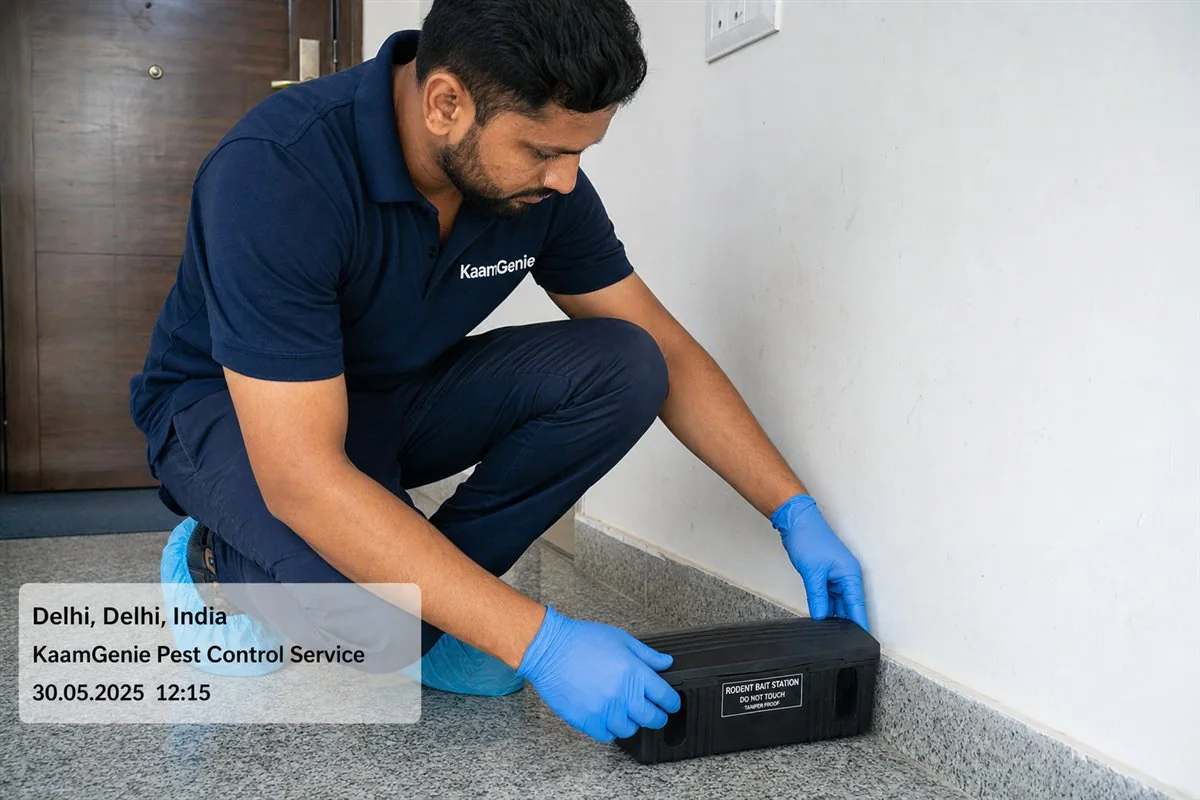
Baiting (rodenticide) has its place for outdoor and perimeter pressure — locked, tamper-proof bait stations along the boundary of a society or a warehouse, knocking down the population trying to get in. But indoors it carries the dead-in-the-wall smell risk, plus secondary-poisoning risk to cats, dogs and birds of prey, so it must be used in locked stations and never as loose pellets thrown behind the fridge. The rodenticides a licensed service uses are approved by the Central Insecticides Board & Registration Committee (CIB&RC); a back-lane “rat-kill powder” sold loose is exactly what you should not have around a home with kids.
Glue boards I’ll be blunt about: they are inhumane and a genuine last resort. A rat stuck to a glue board dies slowly of stress, exhaustion or dehydration over hours, often screaming, sometimes chewing off a limb to escape. They also catch lizards, small birds and a curious kitten just as easily. Many pest professionals worldwide are moving away from them, and we treat them as something to use only in a tightly defined situation where nothing else can be placed — never as a default. If a service’s whole answer to your rat problem is to scatter glue boards, that tells you they haven’t thought about proofing at all.
| Method | Best for | The catch |
|---|---|---|
| Snap trapping | Indoors, kitchens, around kids/pets | Needs correct placement on active runs; remove carcass promptly |
| Baiting (in locked stations) | Outdoor / perimeter pressure | Dead-in-wall smell & secondary-poisoning risk indoors |
| Glue boards | Last resort only, where nothing else fits | Inhumane, slow death; catches non-target animals — avoid |
| Proofing (sealing) | Every building — the permanent layer | None: it’s the part that actually stops re-infestation |
Why proofing beats endless re-baiting — the numbers
Let me put the argument in plain money, because that’s what changes minds. Imagine two identical Delhi flats with the same rat problem. Flat A keeps buying bait every time the rats come back — four or five call-outs a year, forever, because nothing about the building changed. Flat B pays once to seal the entry points and does light monitoring after. Within a year Flat B has spent less and stopped seeing rats; Flat A is still on the treadmill. The chart below is the difference I watch play out constantly.
Re-baiting vs proofing — Delhi homes still rat-free at 6 months (2026)
Rough share of homes reporting no fresh rat activity half a year later, from what we see on the ground.
It’s the same logic everywhere rodents matter. A home kitchen in Greater Kailash wants the cabinet cut-outs and the sink-pipe gap sealed so droppings stop appearing in the drawer. A restaurant in Connaught Place needs proofing to pass an FSSAI inspection — auditors look for sealed entry points and want to see audit-ready records, not a pile of glue boards. A warehouse or godown in Naraina or Okhla loses real stock to gnaw damage and contamination, so a sealed perimeter plus monitored outdoor bait stations protects the inventory far better than reactive poisoning. And a housing society in Dwarka or Rohini has to think at the building level — shared service ducts and the common garbage area feed every flat, so proofing the common services protects everyone at once. In every one of these, sealing is the layer that lasts.
Got a kitchen, shop or warehouse to protect?
Food businesses and godowns need proofing, not just bait stations. We map the perimeter and seal it, with audit-ready records. Custom quote by entry-point count.
Real rodent proofing & control cost in Delhi (2026)
Prices depend on how many entry points need sealing and the size of the building, but here’s an honest 2026 range so you can spot both the lowball and the overcharge. A ₹200 packet of rat-kill powder is not pest control — it’s the thing that keeps the cycle going. Real proofing costs a bit more because someone is actually sealing your building, but it’s the spend that ends the problem instead of renting it.
| Service | What you get | Starting price (2026) |
|---|---|---|
| One-time rodent treatment | Survey + trapping/baiting + basic gap sealing, 1–2 BHK | From ₹999 |
| Full home proofing | All entry points sealed: pipes, vents, door sweeps, drains | From ₹2,499 (by entry-point count) |
| Kitchen / restaurant proofing | Cabinet cut-outs, sink gaps, exhausts + audit-ready records | Custom quote |
| Warehouse / godown | Perimeter seal + monitored bait stations + reporting | Custom quote |
| Rodent AMC (yearly) | Scheduled monitoring & re-checks across the year | From ₹2,999/year |
My honest recommendation for a Delhi home with a recurring rat problem: pay once for proper proofing from around ₹2,499 rather than ₹999 of treatment four times a year. For a food business or godown, take an AMC from ₹2,999/year so someone comes back on a schedule, checks the seals, and you have the audit-ready records an FSSAI inspector or a quality auditor will ask for. Paying per panic is always the most expensive way to deal with rats.
Stop renting the rat problem — we cover Delhi
Rats aren’t a curse; they’re a sign of an open building. Find the gaps with a torch, seal them with steel wool, mesh and a door sweep, trap what’s already inside rather than poisoning blindly, and keep glue boards out of it. Do that and you stop paying for the same problem every season. If you’d rather a trained technician map every entry point and seal it properly — with the right materials and audit-ready records for a kitchen or godown — that’s exactly what we do. We serve homes, shops, kitchens and societies across Delhi — from Dwarka, Janakpuri and Rohini in the west and north, to Saket, Lajpat Nagar and Greater Kailash in the south, to Mayur Vihar, Preet Vihar and Laxmi Nagar in the east, plus the Karol Bagh, Naraina and Okhla commercial belts. Coming soon: Gurgaon, Noida, Faridabad and Ghaziabad. Call 95603 66362 and let’s seal them out for good. For more on getting rid of an active infestation see our guide to getting rid of rats and mice in Delhi, and for full pricing read the rat & rodent control cost guide.
Frequently asked questions
What is rodent proofing and why does it work better than poison?
Rodent proofing means physically sealing every gap a rat or mouse uses to enter — the under-door gap, pipe and AC penetrations, vents, drains and cabinet cut-outs — with materials they can’t gnaw, like steel wool, metal mesh and door sweeps. It works better than poison because poison only kills the rats already inside; the moment they’re gone, new ones walk in through the same open gaps. Proofing closes the door so re-infestation stops.
How small a gap can a rat or mouse get through?
Smaller than people expect. A young house mouse squeezes through a gap about 6–7mm — the width of a pencil. A brown rat flattens its body and pushes through a hole about 20mm, the size of a ₹10 coin. A rough rule: if your finger fits in a gap, a rat can get through it, so even small holes around pipes need sealing.
What are the most common rodent entry points in a Delhi home?
The gap under the main and balcony doors is the most common, followed by the ragged gaps where water, gas and AC pipes pass through external walls (especially under the kitchen sink), open or torn exhaust and ventilator mesh, floor drains and sewer traps, and the cable and pipe cut-outs behind modular kitchen cabinets and the fridge. Shops and godowns also leak at the roller-shutter base.
What materials should I use to seal rat entry points?
Use materials a rat can’t gnaw. Steel wool or wire mesh packed into pipe gaps and sealed over with cement; fine galvanised metal mesh screwed over vents and exhausts; a brush or aluminium door sweep on the under-door gap; cement or metal sheet for larger holes; and weighted metal grates on floor drains. Avoid foam, silicone, plastic and rubber — rats chew straight through all of them in a night.
Is baiting or trapping better for rats indoors?
Trapping is better indoors. A snap trap on an active run kills quickly and leaves a carcass you can find and remove, so there’s no smell — and it’s safer around children, pets and food than poison. Baiting is more suited to outdoor or perimeter pressure in locked, tamper-proof stations, because a baited rat often dies inside a wall and stinks for days, and loose poison risks pets and other wildlife.
Are glue boards a good way to catch rats?
No — glue boards are inhumane and should only ever be a last resort. A trapped rat dies slowly over hours from stress and dehydration, and the boards also catch lizards, small birds and curious pets. Many pest professionals are moving away from them. A service whose main answer is scattering glue boards hasn’t done the real work, which is proofing and proper trapping.
Why do rats keep coming back after pest control?
Because the treatment killed the rats but never sealed the building. Rats are commensal animals with an endless supply outside your wall in a dense city like Delhi, so as long as the entry gaps stay open, new ones simply replace the ones that died. Re-baiting without proofing is bailing a boat without plugging the leak — proofing is what finally ends the cycle.
How much does rodent proofing cost in Delhi in 2026?
A one-time rodent treatment (survey, trapping/baiting and basic gap sealing) for a 1–2 BHK starts from ₹999. Full home proofing — sealing all entry points with steel wool, mesh and door sweeps — starts from about ₹2,499 depending on how many entry points there are. Kitchens, restaurants and warehouses are quoted on the perimeter and entry-point count. A rodent AMC starts from ₹2,999/year. GST 18% is extra.
Can rats really come up through the drains and toilet?
Yes. Rats are strong swimmers and can travel up sewer and drain lines, then push through a broken, light or unweighted floor trap — this is most common in ground-floor flats and basements. The fix is a weighted metal grate or a one-way drain flap so the cover can’t be pushed up from below.
How do I rodent-proof a kitchen or food business in Delhi?
Seal the gaps behind and under modular cabinets, the cut-outs where pipes and cables enter the back panels, the gap around the sink waste pipe, and the kitchen exhaust with metal mesh. Fit door sweeps and keep the dry-store sealed. For an FSSAI inspection, use trapping rather than open poison near food and keep audit-ready records of every visit and seal — inspectors look for proofed entry points, not glue boards.
Will rodent proofing make my home permanently rat-free?
Proofing dramatically cuts re-infestation, but no honest service should promise a forever rat-free building. New gaps open as a building ages, deliveries and neighbours bring fresh pressure, and seals need occasional checking. The realistic answer is good proofing plus light monitoring — an AMC for a kitchen or godown — rather than a one-time guarantee. Be wary of anyone promising 100% permanent results.
How do I know I have rats and where they’re getting in?
Look for droppings (small, dark, rice-grain shaped), gnaw marks on skirting, food packets, wires and wood, and dark greasy “rub marks” along walls where they run the same route nightly. Those rub marks and droppings usually trace straight back to the active entry point — follow them with a torch at floor level, checking under doors and around pipes, and you’ll find where to seal.
Seal the rats out for good
Let a trained technician map every entry point and seal it with the right materials — steel wool, mesh and door sweeps — plus trapping and audit-ready records where needed. We cover all of Delhi.
Sources & references
- WHO — Rodents and public health — global reference on rodent-borne disease and the primacy of exclusion (proofing) in control.
- Central Insecticides Board & Registration Committee (CIB&RC) — the Indian regulator that approves the rodenticides used in licensed rodent control.
- Food Safety and Standards Authority of India (FSSAI) — sets the pest-control and rodent-proofing expectations for food businesses and restaurant audits.
- National Centre for Disease Control (NCDC) — tracks rodent-associated disease patterns across Indian cities including Delhi.
Last verified: 30 June 2026. If you find any of these links broken, please let us know.