

Quick answer — warehouse & factory pest control in Delhi (2026)
- It’s a program, not a one-time spray: a real industrial setup runs on a fixed bait-station grid, insect light traps (ILT), monthly inspections and documented logs — not a man with a sprayer once a year.
- Rodents are the headline risk: they gnaw stock and chew wiring, and chewed cabling is a genuine fire hazard in a packed Delhi godown. External tamper-proof bait stations plus internal snap-trap and glue-board points are the standard.
- Stored-product insects ruin grain & FMCG stock: weevils, beetles and moths breed inside food and packaging. Pheromone monitoring and stock rotation catch them early.
- Proofing beats spraying: sealing loading-bay gaps, fitting door brushes, screening vents and bird-proofing the rafters stops pests getting in at all.
- Audit-ready records (2026): for ISO 22000, WHO-GMP, FSSAI and export audits you need a service map, dated inspection logs, trend data, GST invoice and approved-chemical list — before/after photos, not vague claims.
- Cost is by area & risk: a small Delhi unit AMC starts around ₹15,000–₹25,000/year; large food warehouses run higher. Custom quote, GST 18% extra. Night-shift scheduling available so we don’t stop your line.
Why warehouse pest control is a different game from home pest control
When a homeowner in Lajpat Nagar calls about cockroaches, the job is simple: treat the kitchen, treat the bathrooms, done. A warehouse in Okhla or a food factory in Bawana is a completely different problem, and treating it like an oversized house is exactly how facility managers fail audits. The scale changes everything. You’ve got thousands of square feet, racking up to the ceiling, pallets coming and going through loading bays all day, and stock worth lakhs sitting in the dark where pests do their quiet damage. A one-time fog does nothing here. What works is a program — a fixed system of monitoring devices, scheduled inspections and written records that runs month after month.
The other big difference is the stakes. In a home, a rat is a nuisance. In a Delhi godown, a rat colony can gnaw through a season’s worth of grain bags, contaminate FMCG stock that then gets rejected at dispatch, and — the one that keeps facility managers awake — chew through electrical wiring. Rodents grind their teeth on cable insulation constantly, and a chewed live wire in a building packed with cardboard and shrink-wrap is a real fire risk. Insurers and fire inspectors know this. So does any serious food buyer. Pest control in a warehouse isn’t a cleanliness nicety; it’s loss prevention, fire safety and compliance rolled into one line on your operating budget.
And then there’s the audit. If you store or process food, FMCG, pharma inputs or anything for export, you live under standards — ISO 22000, FSSC 22000, WHO-GMP, BRC, FSSAI licensing, and the specific checklists your export buyers impose. Every one of them asks the same thing about pests: show me your program and show me your records. That’s the part this guide keeps coming back to, because in Delhi’s industrial belts — Okhla, Mayapuri, Naraina, Kirti Nagar, Wazirpur, Bawana and Narela — the units that lose contracts rarely lose them to a visible infestation. They lose them to a thin or missing pest file.
The four pest threats every Delhi godown faces
Across the industrial estates we serve, the same four problems show up again and again. Knowing which one you’re fighting decides the whole program.
- Rodents (rats and mice) — the number-one threat. They enter through loading-bay gaps and damaged shutters, nest behind racking and in false ceilings, gnaw stock and packaging, and chew wiring. Droppings and gnaw marks are an instant audit red flag. This is where most of the program’s effort goes.
- Stored-product insects (SPI). Grain weevils, flour beetles, saw-toothed grain beetles and moths breed inside the product — in atta, pulses, rice, spices, pet food, biscuits. By the time you see moths flying, the infestation is already deep in the stock. These need monitoring, not just spraying, because the larvae live where spray can’t reach.
- Flying insects. House flies and fruit flies near loading bays and pantries, plus the moths above. Insect light traps (ILT) are the standard tool — they catch and monitor flyers without spraying chemicals over open stock.
- Birds — mostly pigeons. They roost on rafters, ledges and the steel trusses over loading bays, and their droppings contaminate stock and surfaces below. Droppings near food storage are a serious audit failure. The fix is physical proofing — netting and spikes — not chemicals.
Crawling insects like cockroaches matter too, especially around pantries, canteens and drains, but in a warehouse they’re usually a smaller piece than rodents, SPI and birds. The table below maps each threat to the zone where it bites hardest, which is how a proper survey is planned.
| Zone | Main pest risk | Control approach |
|---|---|---|
| Storage / racking area | Rodents nesting; stored-product insects in stock | Internal trap & bait points along walls; pheromone & SPI monitoring; stock rotation (FIFO) |
| Loading bay / dispatch | Rodent entry; flies; pigeons in the roof | Door brushes & gap sealing; ILT; bird netting & spikes on trusses |
| Pantry / canteen / wet areas | Cockroaches; flies; rodents at food waste | Gel bait & crack-and-crevice; ILT; drain & waste hygiene |
| Perimeter & external walls | Rodents approaching from outside | Tamper-proof external bait-station grid at fixed intervals |
| Roof, rafters & ledges | Pigeons roosting; droppings | Netting under trusses, spikes on ledges, no-chemical proofing |
What a real industrial program actually looks like
Here’s the part that separates a genuine commercial setup from someone who quotes you a low number and shows up with a knapsack sprayer. A proper warehouse program is built around monitoring devices fixed in place and inspected on a schedule, not around spraying. The spraying is the small part. The system is the job.
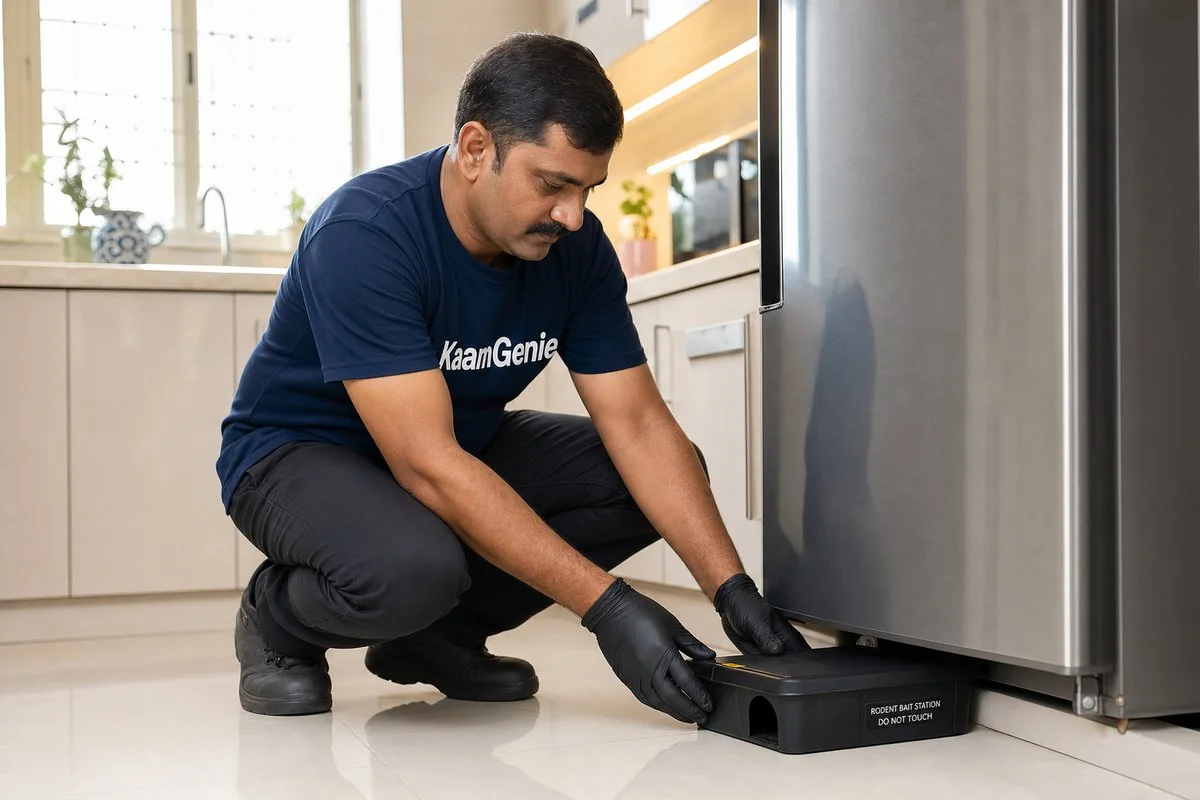
- The external bait-station grid. Tamper-proof, weighted, lockable bait stations are placed around the building perimeter at regular intervals — the standard is roughly one every 15–20 metres along external walls, tighter near doors and known runways. Each is numbered and mapped. They intercept rodents before they ever reach your stock.
- Internal monitoring points. Inside, you don’t use poison bait over open food — you use snap traps and glue boards along the walls, behind racking and near entry points, again numbered and mapped. These tell you where activity is, which feeds the trend data auditors love.
- Insect light traps (ILT). Placed away from doors (so they don’t draw flies in from outside) and never directly over open product, ILTs catch and count flying insects. The catch is logged each visit — a rising fly count is an early warning.
- Stored-product insect monitoring. Pheromone traps for moths and beetles, plus visual checks of incoming and stored stock, catch SPI before they spread. Pair this with strict stock rotation — first in, first out — so nothing sits long enough to become a breeding pile.
- Bird proofing. Where pigeons roost, netting under the trusses and spikes on ledges — a one-time physical job that then just needs checking.
- Scheduled inspections with documented logs. A technician walks the full site monthly (food units often go fortnightly), checks every device, records findings on a service map, notes any corrective actions, and leaves a dated report. This is the spine of the whole thing.
The honest point: in a good program you might barely see anyone spraying anything for months at a stretch. That’s not the service slacking — that’s the system working. Prevention and monitoring do the heavy lifting; targeted treatment only kicks in when a device flags activity. If a vendor’s idea of warehouse pest control is fogging the whole shed every quarter, they’re selling you the cheap version, and it won’t survive an audit.
Got an audit coming up and a thin pest file?
We set up the bait-station grid, ILT placement and the documented inspection log auditors actually ask for. Industrial AMC by facility size — custom quote, GST 18% extra.
Proofing the building — the entry points everyone ignores
The cheapest, most effective thing you can do in a Delhi warehouse is stop pests getting in at all. I tell every facility manager the same thing: walk your building like a rat would. Rodents need a gap the width of a pencil to squeeze through, and a typical godown is full of them. The usual offenders:
- Loading-bay shutters and dock levellers. The gap under a worn shutter, or the space around a dock leveller, is a highway. Brush strips and rubber seals close it. This single fix prevents more rodent problems than any amount of bait.
- Pallet movement and incoming goods. Pests ride in on pallets and packaging — especially SPI in food sacks. Inspect incoming stock, keep pallets off the wall (a 45–50 cm inspection gap all around the perimeter), and never stack tight to the wall where you can’t see or treat.
- Doors left open. The most common one. Personnel doors and bay doors propped open all day let flies and birds in. Self-closers, air curtains and simple discipline matter.
- Vents, cable entries and drains. Wall vents need fine mesh; gaps around pipe and cable penetrations need sealing; drains need one-way valves or covers so rats don’t come up through them.
- Damaged walls and roof junctions. Cracks, broken brickwork and gaps where the roof meets the wall — rodents and birds both exploit these.
Proofing is a one-time investment that keeps paying. A few thousand rupees of brush strips and mesh saves you far more in damaged stock, chewed wiring and audit headaches over a year. Any serious survey starts here, with a building inspection, before anyone talks about chemicals.
What goes wrong most — the issues we see across Delhi’s industrial belts
From the units we walk in Okhla, Naraina, Mayapuri, Wazirpur, Kirti Nagar, Bawana and Narela, here’s the rough breakdown of which problems actually cause damage and audit failures. Rodents lead by a distance.
Top pest issues that cause damage or audit failures in Delhi warehouses (2026)
Rough share of serious findings we see on industrial site surveys across Delhi’s estates.
Notice that the top three are all best handled by proofing and monitoring, not spraying. That’s the whole argument for running a program rather than booking the occasional treatment: you’re managing the conditions that let pests thrive, not chasing them after the damage is done.
Audit-ready records — the documents that pass ISO 22000, FSSAI and export checks
This is the section to bookmark. When an auditor or an export buyer’s inspector arrives, the visible site matters — but the folder matters just as much. A clean program produces a standard set of documents, and you should be able to put your hand on every one of them. Here’s what a complete pest file looks like in 2026.
| Document | What it shows | Why auditors ask for it |
|---|---|---|
| Service / device location map | Numbered layout of every bait station, trap and ILT | Proves coverage is planned, not random |
| Dated inspection / service logs | Each visit: date, technician, findings, devices checked | Proves the program actually runs on schedule |
| Trend / catch analysis | Activity over time per device and per pest | Shows the program is monitored and improving |
| Corrective action records | Issues found and what was done about them | Demonstrates a closed-loop response |
| Approved chemical & MSDS list | Products used, with CIB&RC approval & safety sheets | Confirms only legal, safe products are in use |
| Technician training / licence proof | Operator competence & pest-control licence | Required for food-safety standards |
| Before/after photos & GST invoice | Visual proof of work + a proper tax invoice | Backs up the record with evidence and traceability |
One thing we never issue and you should never rely on: a so-called “pest-free certificate” as a substitute for records. No honest program promises a building is pest-free forever — pests are a condition you manage, not a box you tick once. What passes audits is the documented program: the map, the dated logs, the trend data, the before/after photos and the GST invoice. If a vendor leads with a fancy certificate and can’t show you a real inspection log, walk away — that paper won’t hold up when an auditor probes it.
Rodents chewing through stock and wiring?
A proofing-first program seals the entry points and runs a monitored bait grid — with night-shift visits so we never stop your line.

What it costs — industrial pest control pricing by facility size (2026)
Warehouse and factory pest control is always a custom quote, because it depends on your square footage, what you store (a dry-goods godown is very different from a food-processing line), how many devices the site needs, and how often you’re inspected. But facility managers want a ballpark before they call, so here’s an honest 2026 range to plan against. These are annual AMC figures — GST 18% extra — and they assume a monitored program with documented logs, not a one-time spray.
| Facility size | Typical setup | Indicative annual AMC (2026) |
|---|---|---|
| Up to ~5,000 sq ft | Small godown / unit; monthly visits; basic bait grid + ILT | From ₹15,000–₹25,000/year |
| ~5,000–20,000 sq ft | Mid warehouse; monthly visits; full grid, ILTs, SPI monitoring | From ₹30,000–₹60,000/year |
| ~20,000–50,000 sq ft | Large warehouse / 3PL; fortnightly option; bird proofing | From ₹70,000–₹1,50,000/year |
| Food / FMCG processing | Fortnightly+; full documentation for ISO 22000 / FSSAI / export | Custom quote (higher; audit-grade) |
| One-time proofing (add-on) | Door brushes, mesh, bird netting & spikes | Quoted by scope of work |
A word on the lowball quote, because it’s the most expensive mistake in this whole guide. If someone offers to “cover” a 20,000 sq ft food warehouse for ₹8,000 a year, they are not running a real program — they’re visiting occasionally, spraying, and leaving you a thin file that collapses the moment an auditor pushes on it. Against the cost of rejected stock, a failed audit or a lost export contract, the difference between a cheap quote and a proper one is rounding error. Buy the program, not the price.
Scheduling around your operation — night shifts and zero downtime
The objection I hear most from factory managers in Delhi isn’t cost — it’s “I can’t stop my line for pest control.” You don’t have to. A well-run industrial program is built around your schedule, not ours. Most monitoring — checking bait stations, reading ILT catches, inspecting devices — happens quietly alongside normal operations without touching your stock or your people. For anything that does need clear access or that you’d rather keep away from production hours, we schedule night-shift or off-hours visits so the work happens while the line is idle.
This matters even more for food and FMCG units, where you can’t have open product near treatment. The plan is sequenced so dispatch, intake and processing windows are protected, and any targeted treatment is timed and zoned to avoid stock. A serious vendor will ask about your shift pattern and dispatch schedule in the very first survey — if they don’t, they haven’t done many warehouses. The whole point of a documented program is that it runs in the background and only surfaces when there’s something to act on.
Protect your stock and pass your next audit — we cover Delhi’s industrial belts
Warehouse and factory pest control comes down to three honest things: stop pests getting in (proofing), watch for them constantly (a monitored device grid), and write it all down (audit-ready logs). Do those, and the rats never reach your wiring, the weevils never reach your grain, and the auditor never reaches for a non-conformance. We set up and run exactly this kind of program for godowns, factories, 3PL warehouses and food units across Delhi’s industrial estates — Okhla, Mayapuri, Naraina, Kirti Nagar, Wazirpur, Bawana and Narela — with night-shift scheduling and the documentation your standards demand. Coming soon: Gurgaon, Noida, Faridabad and Ghaziabad. Call 95603 66362 for a facility survey and a quote built around your floor plan and your audit calendar.
Frequently asked questions
How is warehouse pest control different from home pest control in Delhi?
It’s a documented program, not a one-time treatment. A warehouse runs on a fixed grid of monitoring devices — external bait stations, internal traps, insect light traps and stored-product monitors — checked on a monthly schedule with written inspection logs. The stakes are higher too: rodents damage stock and chew wiring (a fire risk), and you have to pass ISO 22000, FSSAI and export audits that demand records, not just a clean-looking floor.
Why are rodents the biggest risk in a Delhi godown?
Rats and mice enter through loading-bay gaps and damaged shutters, nest behind racking, and gnaw both stock and electrical wiring. Chewed cable insulation in a building full of cardboard and shrink-wrap is a genuine fire hazard, and rodent droppings or gnaw marks are an instant audit red flag. They are usually the single largest source of damage and non-conformances in industrial pest surveys.
What are stored-product insects and why do they matter?
Stored-product insects (SPI) — grain weevils, flour beetles, saw-toothed grain beetles and moths — breed inside the product itself, in atta, pulses, rice, spices, pet food and packaged goods. Because the larvae live inside the stock, spraying doesn’t reach them. They are controlled with pheromone monitoring, inspection of incoming and stored goods, and strict first-in-first-out stock rotation.
Do warehouses need bird and pigeon proofing?
Often, yes. Pigeons roost on rafters, ledges and the trusses over loading bays, and their droppings contaminate stock and surfaces below — a serious audit failure near food storage. The fix is physical proofing: netting under the trusses and spikes on ledges. It’s a one-time job that then just needs periodic checking, with no chemicals over your stock.
What is a bait-station grid and an ILT?
A bait-station grid is a set of numbered, tamper-proof, lockable rodent bait stations placed around the building perimeter at regular intervals (roughly every 15–20 metres, tighter near doors), so rodents are intercepted before they reach stock. An ILT is an insect light trap — a UV-light unit that attracts and catches flying insects so they can be counted and monitored, placed away from doors and never directly over open product.
How much does industrial pest control cost in Delhi in 2026?
It’s a custom quote based on square footage, what you store and inspection frequency. As a 2026 guide: a small unit up to ~5,000 sq ft runs from about ₹15,000–₹25,000 a year; a mid warehouse from roughly ₹30,000–₹60,000; a large warehouse or 3PL from about ₹70,000 upward; and food or FMCG processing units are higher because of audit-grade documentation. GST 18% is extra. One-time proofing is quoted separately by scope.
What pest control records do I need for an ISO 22000 or FSSAI audit?
A complete pest file includes a numbered service/device location map, dated inspection and service logs for every visit, trend or catch analysis over time, corrective-action records, the approved-chemical list with CIB&RC approval and safety sheets, proof of technician training or licence, plus before/after photos and a proper GST invoice. Auditors care as much about this documented program as they do about the visible site.
Is a pest-free certificate enough to pass an audit?
No. A certificate on its own is not what passes audits, and no honest program promises a building is pest-free forever — pests are a condition you manage continuously. What auditors want is the documented program: the device map, dated inspection logs, trend data, corrective actions, before/after photos and the GST invoice. If a vendor offers a fancy certificate but can’t show a real inspection log, that’s a warning sign.
Can pest control be done without stopping my production line?
Yes. Most monitoring — checking bait stations, reading ILT catches, inspecting devices — happens quietly alongside normal operations. For anything needing clear access or that you’d rather keep away from production, we schedule night-shift or off-hours visits so the work happens while the line is idle. For food and FMCG units the plan is sequenced and zoned so open product is never near treatment.
How do pests get into a warehouse, and how do you stop them?
Rodents need only a pencil-width gap. The common entry points are worn loading-bay shutters and dock levellers, doors propped open, gaps around pipe and cable penetrations, unscreened vents, drains, and damaged walls or roof junctions. Pests also ride in on incoming pallets and food sacks. Proofing — brush strips, seals, mesh, inspecting incoming stock and keeping pallets off the wall — stops most problems before they start.
How often should a warehouse be inspected?
General warehouses are typically inspected monthly, with a technician walking the full site, checking every device, logging findings and noting corrective actions. Food, FMCG, pharma and export-focused facilities usually move to fortnightly or more frequent visits because their standards demand tighter monitoring and documentation. The right frequency is set during the facility survey based on your stock and audit requirements.
Which Delhi industrial areas do you cover for warehouse pest control?
We run warehouse and factory programs across Delhi’s main industrial estates — Okhla, Mayapuri, Naraina, Kirti Nagar, Wazirpur, Bawana and Narela — for godowns, factories, 3PL warehouses and food units, with night-shift scheduling and audit-ready documentation. Gurgaon, Noida, Faridabad and Ghaziabad are coming soon. Call 95603 66362 for a facility survey.
Set up an audit-ready pest program for your facility
We survey your floor plan, build the bait-station and ILT grid, proof the entry points and keep the documented logs your auditors ask for — with night-shift visits across Delhi’s industrial belts.
Sources & references
- Central Insecticides Board & Registration Committee (CIB&RC) — the Indian regulator that approves the rodenticides and insecticides used in licensed industrial pest control.
- Food Safety and Standards Authority of India (FSSAI) — sets the food-business hygiene and pest-management requirements that warehouses and food units must meet.
- ISO 22000 — Food safety management systems — the international standard whose prerequisite programs require documented pest control records.
- National Centre for Disease Control (NCDC) — tracks urban rodent and vector patterns relevant to commercial and storage premises in Indian cities.
Last verified: 13 June 2026. If you find any of these links broken, please let us know.