
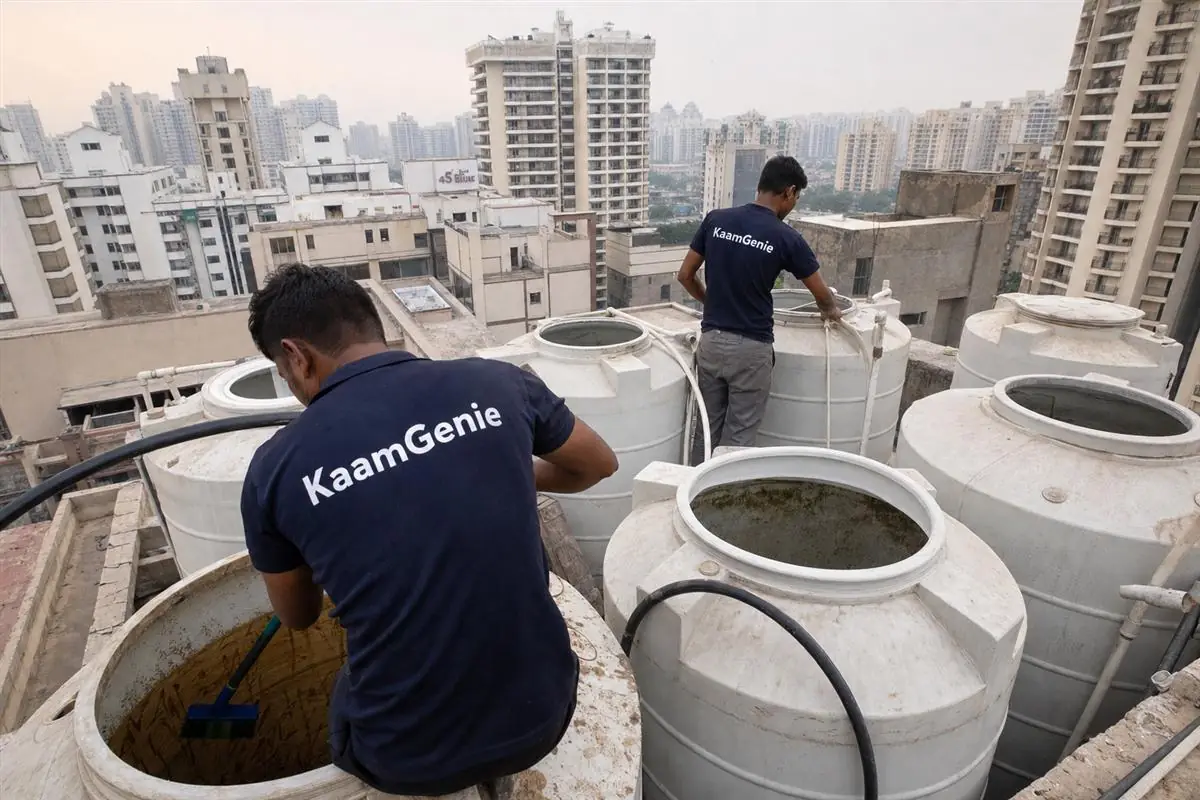
The short version for the managing committee
- Put it on a contract, not on memory. An annual contract delivering quarterly cleanings beats the “call someone when residents complain” habit.
- Tender on a written scope. Issue the same tank inventory to 3–4 bidders so quotes are actually comparable — itemised per tank, never a lump sum.
- An annual contract saves roughly 15–25% against booking four one-off cleans, plus price certainty for the whole term.
- Documentation is the deliverable. A per-tank certificate with photos, every cycle, is what protects the committee at the AGM and in audit.
- Pay per delivered cycle, not a year upfront — it keeps the contractor accountable and lets you exit if quality drops.
- Minute the decision. The committee owns the contract; record the award so it survives committee changes.
This guide is the contract-and-committee side. For how the cleaning itself is staged tower-by-tower across the UGR and rooftop tanks, see our companion society & high-rise tank cleaning guide.
Why your RWA needs a contract, not a “we’ll call someone” arrangement
Almost every avoidable water-quality complaint we see in a Gurgaon condominium traces back to the same root cause — not a bad crew, but a bad arrangement. There was no contract, so there was no schedule; with no schedule, the tanks got cleaned whenever someone on the committee remembered or whenever a resident escalated about brown water in a WhatsApp group. By then the underground reservoir had already been pumping silt and scale up into every tower for months.
The mechanics of how a society’s water actually flows — one shared underground reservoir feeding rooftop tanks on each tower — we cover in detail in the society & high-rise cleaning guide, and we won’t repeat it here. This piece is about the part the managing committee actually controls: turning an ad-hoc habit into a written, scheduled, documented contract. A proper RWA contract does three jobs an informal arrangement can never do. It guarantees the frequency (four cleanings a year, dated in advance, not when someone complains). It fixes the price for the full term so the maintenance budget is predictable. And it creates a record — a per-tank certificate every cycle — that protects the committee when residents ask, at the AGM, or in an audit, where the maintenance money went.
What a good annual RWA contract actually covers
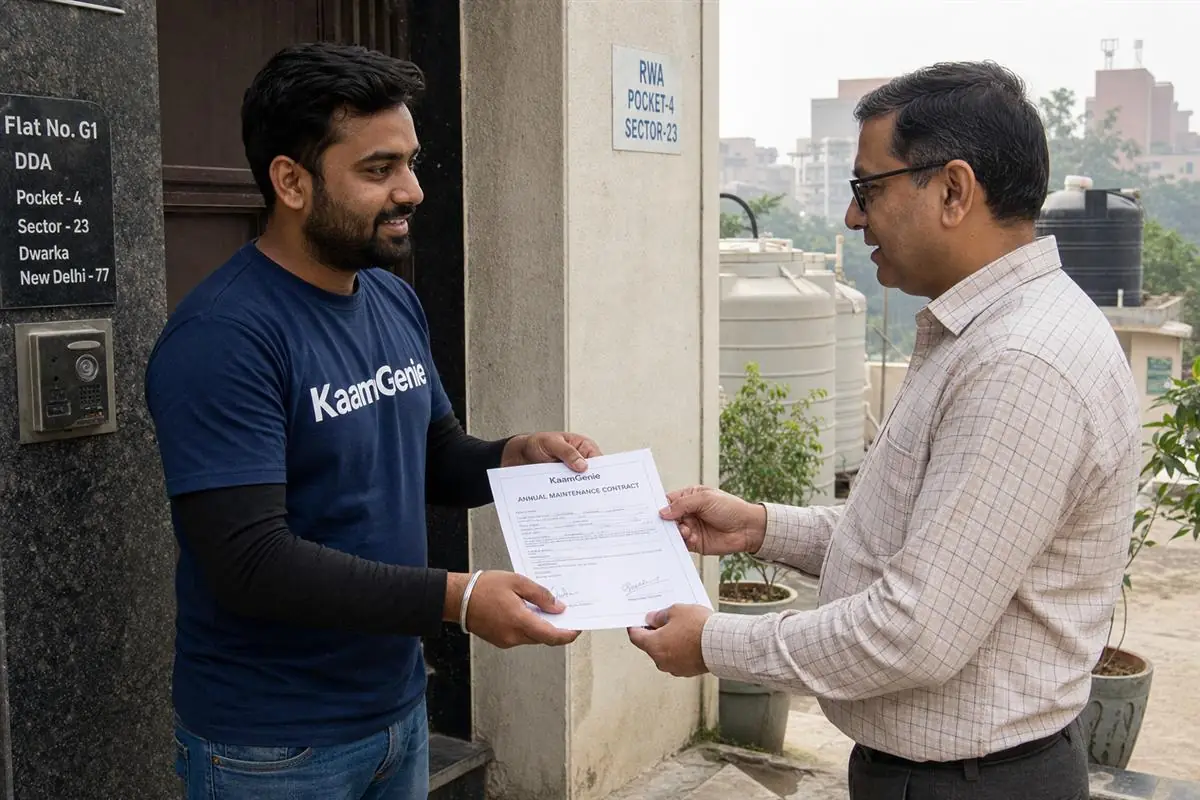
A society tank-cleaning contract is not a one-line work order. For a multi-tower condominium across DLF colonies, Golf Course Road or the Sohna Road and Dwarka Expressway towers, the contract is what stops the cheap, predictable failure mode — a contractor quietly cleaning only the easy rooftop tanks and skipping the underground reservoir nobody on the committee climbs down to check. Every clause below exists to close one of those gaps.
| Contract clause | What it should say | Why the committee needs it |
|---|---|---|
| Tank inventory schedule | Every UGR compartment and every tower overhead tank listed by ID and capacity | Proves the whole system is contracted, not just convenient tanks |
| Term & frequency | 12-month term delivering four quarterly cleanings, dates calendared in advance | Guarantees frequency instead of complaint-driven cleaning |
| Fixed price for the term | Per-tank rates locked for all four cycles, no mid-year revision | Predictable maintenance budget; AMC discount baked in |
| Documentation deliverable | Per-tank certificate with before/after photos, every cycle | The audit trail for residents, AGM and statutory auditor |
| Disinfectant specification | FSSAI-acceptable sodium hypochlorite named by spec, not “bleach” | Holds the contractor to a real potable-water standard |
| Safety & indemnity | Confined-space gear, standby person and insurance for reservoir entry | Legal and moral duty for below-ground work on common property |
| Payment milestones | Payment per cycle on certified completion, via society account on GST invoice | Keeps the contractor accountable; no full-year advance at risk |
| Default & exit clause | Termination on written notice for missed certificates or skipped tanks | Lets the society switch if quality drops mid-year |
Notice what is deliberately not in this contract: the technical 8-step cleaning method, the staging plan, and the per-tank pricing mechanics. Those are operational details — the society cleaning guide covers the method, and the Gurgaon cost guide breaks down what drives the per-tank rate. The contract’s job is to lock the commercial and accountability terms around that work.
Get a society contract drafted around your tanks
Free tank-inventory survey, a per-tank quote, and a written annual contract your committee can put to the AGM. Residential single-tank cleaning ₹699 onwards; society/UGR contracts custom-quoted.
How to tender it: getting quotes you can actually compare
The single most common tendering mistake we see Gurgaon committees make is collecting three quotes that can’t be compared — one is “₹X for the society,” another is “₹Y per tank but which tanks?”, and a third bundles things differently again. You end up choosing on a number that doesn’t mean the same thing across bidders. Fix that before you ask for a single price:
- Build the inventory first. Walk the property with your facility management team and list every tank — each UGR compartment, each tower’s rooftop tanks — with capacities and access notes. This document becomes the spine of the tender and of the eventual contract.
- Issue one written scope to every bidder. Hand all 3–4 contractors the same inventory and the same scope sheet (per-tank 8-step clean, named disinfectant, per-tank certificate). Now their quotes are answering the same question.
- Demand itemised, per-tank pricing. Reject any lump sum. A lump sum is where the underground reservoir quietly disappears from the job. Per-tank lines force the whole inventory into the open.
- Score on capability before price. Ask each bidder for a sample certificate, proof of confined-space safety gear, and references from other Gurgaon condominiums — in DLF Phase 4, around Golf Course Road, or the newer towers in Sector 82. The cheapest per-tank rate is usually the one planning to skip the reservoir or the disinfection step.
- Then compare price. With identical scope and verified capability, the per-tank totals are finally a fair comparison — and you’ll often find the honest mid-priced bid is cheaper over a year than the “cheap” one that re-bills for everything it left out.
If your committee wants the full NCR context for what a professional crew should be delivering, our pillar water tank cleaning services page sets out the standard, and the hub for booking and area coverage is water tank cleaning in Gurgaon.
The AMC discount: why an annual contract is cheaper than four one-offs
Most committees instinctively understand that a contract should cost less than buying the service four separate times — but it helps to see why, and roughly how much. When you commit the whole year’s work to one contractor, they get guaranteed repeat volume, plan a single mobilisation across all towers, and skip the cost of re-quoting and re-negotiating every quarter. That efficiency comes back to the society as a discount, typically in the 15–25% range against the same four cleanings booked one-off.
Annual contract vs four one-off cleanings — illustrative society cost
Same four quarterly cleanings; the annual contract bundles them at a discount
Illustrative only — actual figures depend on tank count, capacity and tower count. The point: an annual contract bundles the four quarterly cleanings at a discount, while a no-contract society often pays more over a year once you add emergency call-outs and the residents’ complaints that follow a missed cycle.
There’s a hidden cost on the other side too. A society with no contract frequently ends up paying more across a year, not less — because the missed cycles turn into emergency call-outs at premium rates after a complaint, plus the occasional reactive flush of a badly silted reservoir that a quarterly schedule would have prevented. The annual structure that formalises the discount and the rhythm is worth reading about in our dedicated Gurgaon water tank cleaning AMC guide before you sign anything.
Documentation and certificates your auditor will ask for
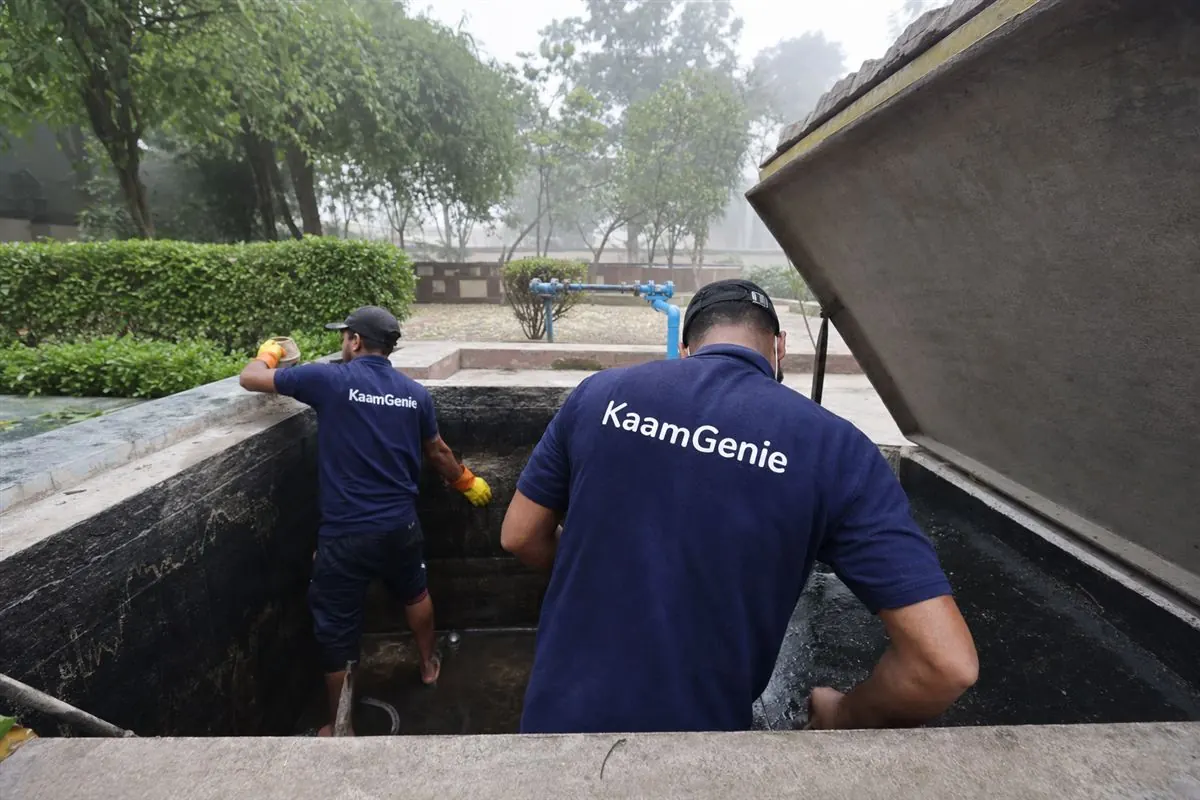
For an RWA or AOA, the certificate is not paperwork for its own sake — it is the deliverable that justifies a recurring line in the maintenance budget. When a resident asks at the AGM “what did we spend the tank-cleaning money on?”, or when the society’s statutory auditor reviews the accounts, a stack of per-tank certificates with dated before/after photos answers the question instantly. Without them, the committee is asking residents to take it on trust — which is exactly the position that gets committee members blamed when a complaint arises.
Keep, for every cycle:
- A per-tank certificate for each UGR compartment and each tower tank — tank ID, capacity, date, crew names, disinfectant used, before/after photos.
- The invoice for that cycle, matched to the certificates and paid through the society account against a GST bill.
- The resident notice that was posted in the lift lobbies for that cycle, showing the society communicated the schedule.
- The master inventory the contract is built on, so an auditor can confirm every tank in the building was actually covered.
Filed quarter by quarter, this is a clean, defensible record. It protects the individual committee members personally, it shortens the audit, and it ends the recurring AGM argument about whether the maintenance charges are being spent on real work. For large gated DLF-style condominiums with club and amenity tanks on top of the residential towers, the documentation set is bigger still — our DLF condominium water tank cleaning guide covers that multi-tower, multi-tank case.
Who decides — the managing committee, step by step
One reason society tanks fall through the cracks is genuine confusion over who owns the decision. The short answer: the managing committee of the RWA or AOA. The practical breakdown, in a typical Gurgaon condominium:
- The maintenance / facilities secretary drives the tendering — builds the inventory, issues the scope, collects the comparable quotes.
- The treasurer confirms the budget line and the payment-per-cycle terms.
- The committee approves the award by resolution at a meeting, and the decision is minuted so it survives the next committee election.
- The facility management (FM) team executes the day-to-day coordination — access, scheduling, resident notices — but does not own the contract once the AOA/RWA has taken over common-area maintenance from the builder.
That last point is where the most damage happens. During the builder-managed phase the FM agency arranges cleaning; at handover, responsibility is supposed to pass to the residents’ committee — and in the messy transition, nobody clearly owns it and the tanks sit uncleaned for months. The newer towers along the Southern Peripheral Road, Golf Course Extension and Dwarka Expressway are where we see this handover gap most often. The fix is for the committee to take ownership explicitly, the moment it forms: commission a baseline clean, then put the annual contract in place. The deeper mechanics of that handover-stage clean are in the society & high-rise guide.
Putting it to your next committee meeting?
We’ll give you a free tank-inventory survey, a per-tank quote, and a draft annual contract with the documentation standard written in — everything you need to take it to the committee and the AGM. Society/UGR custom-quoted; residential ₹699 onwards.
Set up your society’s contract across Gurgaon
Whether your committee is writing its first contract after handover, replacing a contractor that kept skipping the reservoir, or simply moving an informal arrangement onto a proper annual footing, we work with AOAs and RWAs right across the Millennium City — DLF colonies, Golf Course Road and Extension, Sohna Road, SPR and the Dwarka Expressway towers. We’ll survey your tank inventory, quote per tank, stage the work so no block loses water, and hand the committee a per-tank certificate for every tank, every cycle. Start at our water tank cleaning in Gurgaon hub for area coverage and booking, or call us to arrange a free tank-inventory survey for your committee.
To book, call +91 95603 66362 or use the booking form on this site — we’ll confirm shortly.
Frequently asked questions
What should an annual RWA water tank cleaning contract in Gurgaon cover?
A complete tank inventory (every UGR compartment and every tower overhead tank by ID and capacity), a defined per-tank scope, a fixed quarterly cleaning calendar, a locked per-tank price for the full term, per-tank certificates with before/after photos, confined-space safety provisions for reservoir entry, a named coordination point with the facility management team, payment milestones, an escalation and quality-default clause, and a clean exit clause. The contract should name the disinfectant by specification, not just say “cleaning”, so the committee can hold the contractor to a real standard rather than a rinse.
How does a Gurgaon RWA tender or get quotes for tank cleaning?
Start by building the tank inventory with your facility management team, then issue the same written scope to three or four contractors so the quotes are actually comparable. Insist every quote is itemised per tank, not a single lump sum, because a lump sum hides whether the underground reservoir is even included. Ask each bidder for proof of confined-space safety gear, a sample certificate, and references from other Gurgaon societies. Compare on scope and documentation first and price second — the cheapest per-tank rate is usually the one skipping the reservoir or the disinfection step.
Who in a Gurgaon society decides on the water tank cleaning contract?
The managing committee of the RWA or AOA. In practice the maintenance or facilities secretary drives the tendering, the treasurer signs off the budget, and the committee approves the award by resolution at a meeting. While the building is still builder-managed the facility management agency arranges it, but once the AOA or RWA takes over common-area maintenance the committee owns the contract. The decision should be minuted so it survives committee changes and stands up at the AGM.
How much can an RWA save with an annual contract versus one-off cleanings?
Booking the same four cleanings a year as a single annual maintenance contract typically saves roughly 15–25% against calling for one-off cleans each quarter. The saving comes from guaranteed repeat volume, a single mobilisation plan for the whole society, and no renegotiation every quarter. The committee also gets price certainty for the full term, which makes the maintenance budget predictable. The exact discount depends on tank count, total capacity and how many towers are bundled into one schedule.
What documentation should a society keep for audits?
Keep the signed annual contract, the tank inventory it is based on, and a per-tank cleaning certificate for every cleaning cycle with the tank ID, capacity, date, crew names, disinfectant used and before/after photos. Keep the invoices matched to each cycle and the resident notices that were posted. Together these prove to the statutory auditor and to residents at the AGM that the maintenance charges were spent on a real, documented service across the whole tank inventory and not just the easy-to-reach rooftop tanks.
Should the RWA contract be quarterly or annual?
Both, structured together. The cleaning frequency should be quarterly because Gurgaon’s hard borewell groundwater and tanker top-up scale and silt the tanks fast. The commercial arrangement should be a one-year annual contract that locks those four quarterly cleanings, the price and the documentation standard in place. So the answer is an annual contract delivering quarterly cleanings — you get the frequency the water demands and the price stability and accountability a contract gives.
What payment terms are normal for a society tank cleaning contract?
The cleanest arrangement for an RWA is payment per cycle, released after each quarter’s cleaning is completed and the per-tank certificates are handed over — not a large advance for the whole year. This keeps the contractor accountable for every cycle and protects the committee if quality slips. A modest mobilisation advance is reasonable for a large multi-tower society, but the bulk should be tied to delivered, documented cleanings. All payments should run through the society account against a GST invoice, never in cash.
Can the society switch contractors mid-year if quality drops?
Yes, if the contract is written properly. A good annual contract includes a quality-default and termination clause that lets the committee exit on written notice if certificates aren’t delivered, the reservoir is skipped, or the disinfectant standard isn’t met. Because payment is tied to each delivered cycle rather than a full-year advance, the society isn’t financially trapped. This is exactly why the committee should never pay the whole year upfront and should keep the tank inventory and scope as a separate document it can hand to a replacement contractor.
What questions should the managing committee ask before signing?
Ask: does the quote list every tank including each UGR compartment, or just the rooftop tanks? Is the price fixed for the full term? Do we get a separate certificate with photos for every tank, every cycle? What disinfectant do you use, named by specification? Do you carry confined-space safety gear for reservoir entry, and who is your standby person? How do you stage the work so no tower loses water? What are the payment milestones, and what is the exit clause if quality drops? If a bidder is vague on any of these, that is the tell.
Sources & references
- Bureau of Indian Standards (BIS) — IS 10500:2012 is the canonical Indian Standard for drinking water specification, defining acceptable limits for physical, chemical, and biological parameters.
- WHO Guidelines for Drinking-water Quality, 4th edition — the global reference for water quality standards, including guidance on storage and disinfection.
- Food Safety and Standards Authority of India (FSSAI) — defines water quality requirements for food businesses, including hygiene standards for stored water and acceptable disinfection chemicals.
- WHO Fact Sheet on Drinking Water — overview of safe drinking water requirements and contamination risks.
- CPHEEO — Manual on Water Supply and Treatment — the Government of India’s engineering manual covering tank design, cleaning protocols, and disinfection practices.
Last verified: 29 June 2026. If you find any of these links broken, please let us know.