
The short version
- Concrete fouls faster. RCC’s rough, porous wall grips Gurgaon’s hard-water scale and biofilm far more than smooth Sintex plastic.
- The underground reservoir is the dirtiest tank. It’s usually concrete, tanker-fed and first in line, so it collects the most sludge.
- Method changes by material. Sintex needs softer brushes and gentler jet pressure; concrete needs harder scrubbing, higher pressure into the pores, and a crack check.
- Frequency changes too. Concrete sump roughly every 3 months; rooftop Sintex every 4–6 months in Gurgaon water.
Same 8-step backbone for both — but a crew that treats a Sintex tank and a concrete reservoir identically is doing one of them wrong.
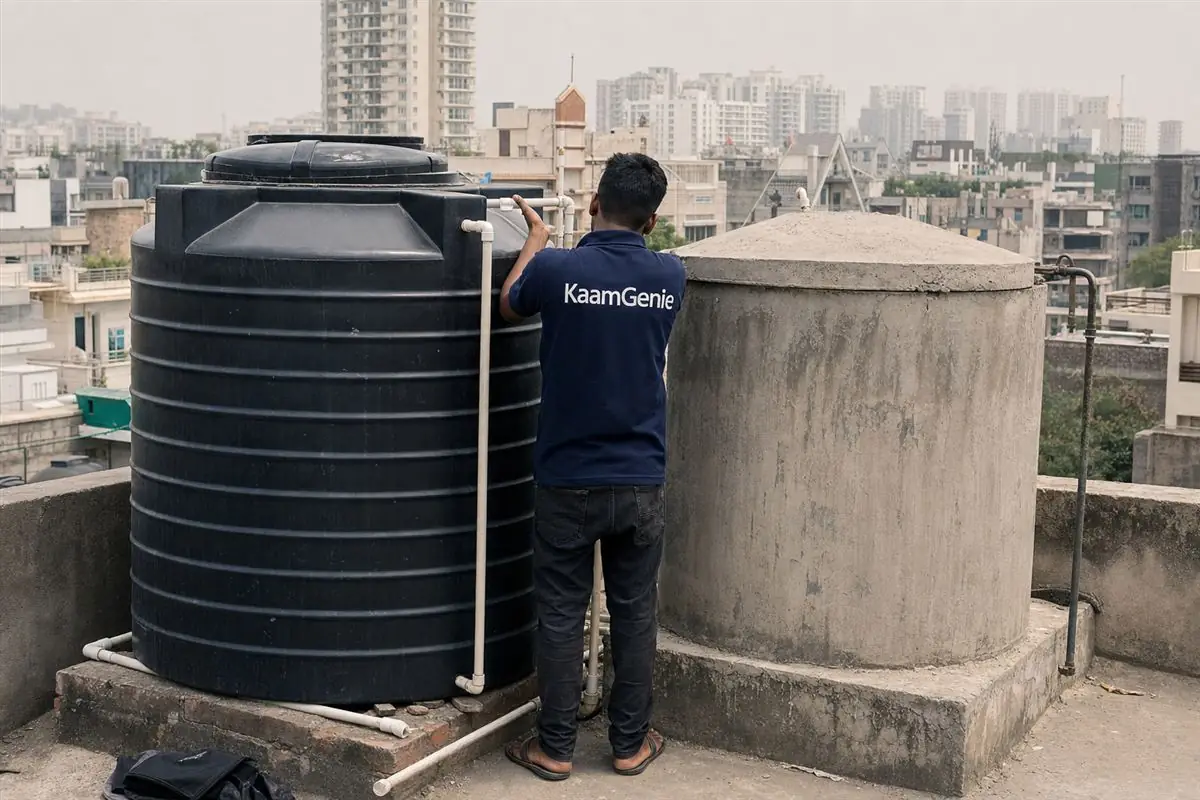
Walk onto almost any Gurgaon rooftop — a builder floor in Sushant Lok, a society tower off Sohna Road, an independent house in Sector 56 — and you’ll see the same setup. A plastic overhead tank (almost everyone calls it a “Sintex” after the brand, whether it’s PVC, HDPE or LLDPE) sits on the terrace. Down at ground level or in the basement, a much larger concrete reservoir holds the bulk supply that the tanker fills. Water is pumped up from the concrete tank to the plastic one, and the plastic one feeds your taps.
Because the two materials behave so differently in Gurgaon’s mineral-heavy groundwater, the cleaning is not the same job done twice. Let’s break down what actually changes.
| Factor | Sintex / plastic (PVC, HDPE) | Concrete / RCC |
|---|---|---|
| Surface | Smooth, sealed, chemically inert | Porous, rough, slightly alkaline |
| Scale grip | Sheds scale fairly easily | Holds a hard scale crust |
| Biofilm | Less; comes off with brush | More; keys into the pores |
| Typical location | Rooftop overhead tank | Underground reservoir / sump |
| Main failure | UV brittleness, cracks, warping | Seepage, hairline cracks, plaster loss |
| Brush | Soft/medium food-grade nylon | Stiff food-grade nylon |
| Jet pressure | Lower (protect old plastic) | Higher (reach into pores) |
| Cleaning frequency (Gurgaon) | Every 4–6 months | Every 3 months (UGR) |
Two tanks, one visit
We clean your rooftop Sintex and your concrete reservoir on the same trip — right method for each, photos and certificate for both. ₹699 onwards.
Why concrete fouls faster than Sintex in Gurgaon water
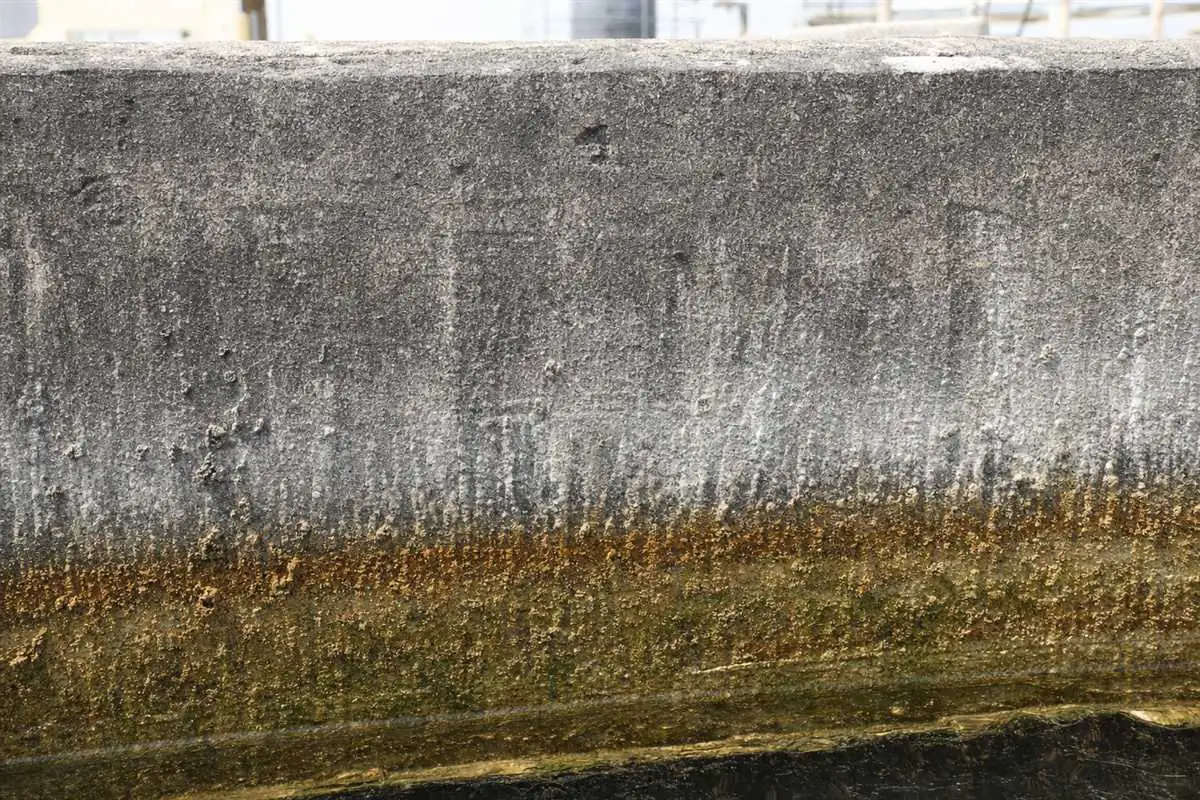
The single biggest difference comes down to surface texture. A Sintex/HDPE tank is moulded plastic: the inner wall is smooth, sealed and chemically inert. Scale and biofilm sit on top of it and, with a brush and a jet, come away relatively cleanly. Concrete is the opposite. Even a well-plastered RCC tank has a microscopically rough, porous surface, and it is mildly alkaline. Gurgaon’s groundwater is hard — rich in dissolved calcium and magnesium — and those minerals love a rough alkaline surface to crystallise onto.
The result is that a concrete tank in Gurgaon builds a genuine scale crust: a hard, chalky, grey-white layer that bonds into the pores. On top of that, the same pores shelter biofilm — the slimy bacterial layer that protects organisms from a quick rinse. Where a plastic tank gives you a thin film you can feel come off under the brush, concrete gives you a crust you have to work at. That is the core reason the two materials are not interchangeable on a cleaning job, and why our crews carry stiffer brushes and run higher jet pressure when they open a concrete reservoir. If you want the deeper story on the water chemistry itself, we cover it in our guide to cleaning tanks in Gurgaon’s hard water.
The underground reservoir is almost always the dirtiest tank
There’s a second reason concrete tanks foul faster in Gurgaon, and it has nothing to do with the material itself: it’s about position in the supply chain. In the typical Gurgaon building, water arrives by tanker or borewell into a large underground reservoir (the UGR or sump), which is concrete. From there it’s pumped up to the rooftop Sintex tank, which feeds the flats.
That sequence matters. Whatever sediment the tanker brings — and tanker water in Gurgaon carries plenty of fine silt — settles first in the underground reservoir. The sump acts as a giant settling basin. By the time water reaches the rooftop plastic tank, a lot of the heavy material has already dropped out below. So even setting aside the texture difference, the concrete UGR collects more sludge simply because everything passes through it first and it’s the lowest point in the system.
This is why, on a society or large independent home, the underground concrete reservoir is the tank we spend the most time on. It’s bigger, darker, harder to access, and dirtier. If your building relies heavily on tankers — which much of new-tower Gurgaon does — that sump needs attention on a tighter schedule than the tank on your roof. We go into the access and confined-space side of this in our overview of what tank cleaning costs in Gurgaon.
How the cleaning method actually changes
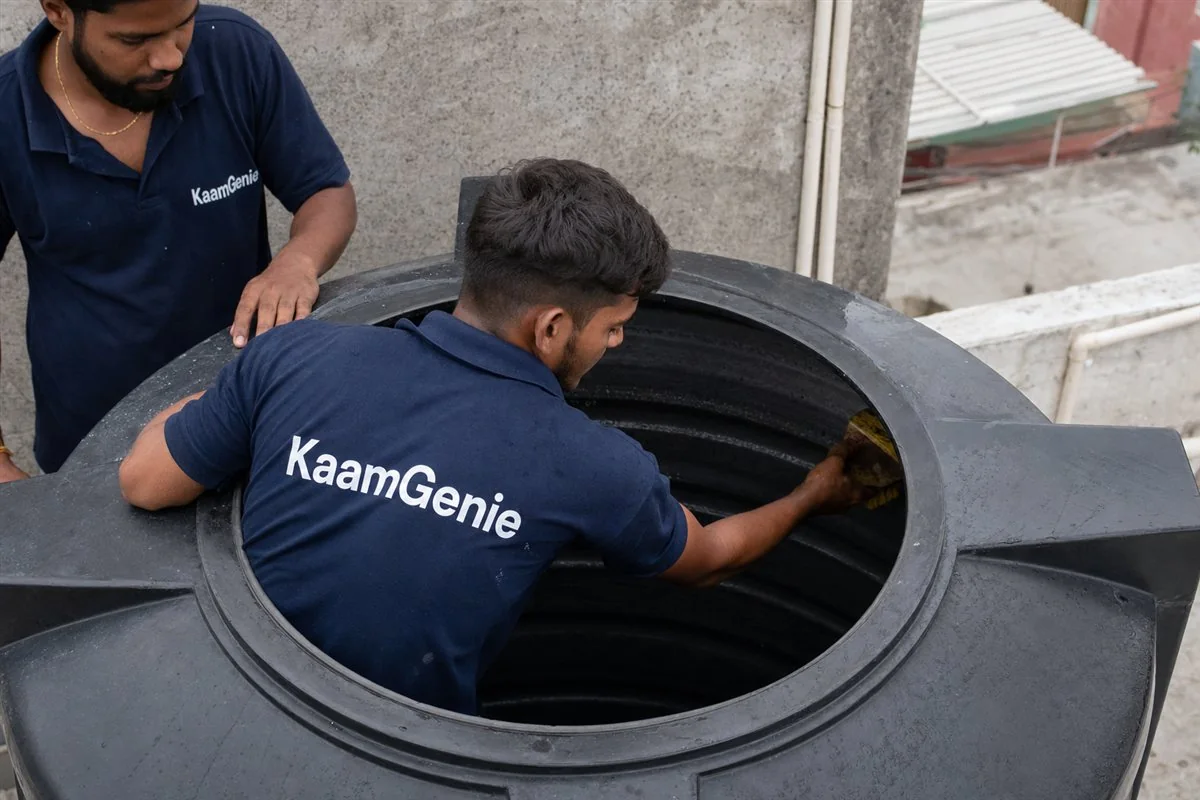
The eight-step backbone is identical for both materials — inspect, drain, de-sludge, scrub, jet wash, vacuum, disinfect, refill. What changes is the technique inside those steps:
- Brushes. Plastic gets soft-to-medium food-grade nylon — stiff bristles and anything metal scratch the wall and create new homes for bacteria. Concrete gets a stiffer brush because the scale and biofilm are bonded harder.
- Jet pressure. We run lower pressure on plastic, especially old rooftop tanks that have spent years baking in Gurgaon sun and gone brittle. Concrete takes higher pressure, which is exactly what’s needed to drive water into the pores and lift the crust.
- Scrub time. A 1,000L Sintex tank scrubs out faster than the equivalent area of concrete because the deposits release more easily. Concrete simply takes longer per square foot.
- Corners and joints. Concrete reservoirs have wall-to-floor joints, construction cold joints and pipe penetrations where biofilm and seepage hide. We give those a lot more attention than the moulded one-piece interior of a Sintex tank.
- Inspection. On plastic we’re looking for cracks, UV crazing and a warped or broken lid. On concrete we’re looking for hairline cracks, damp patches, crumbling plaster and any exposed reinforcement.
Disinfection is the one step that doesn’t change: both materials get the same food-grade sodium hypochlorite at the same concentration, with the same contact time. Bacteria don’t care what the wall is made of. For a full step-by-step that applies to both tank types, see our complete Gurgaon water tank cleaning guide.
Cracking and ageing: different problems, different fixes
Both materials fail eventually, but in opposite ways — and that affects what we can and can’t do on a cleaning visit.
Sintex/plastic tanks fail from above: years of direct Gurgaon sun degrade the polymer (UV embrittlement), so an old tank cracks, the lid warps and stops sealing, and sometimes the wall develops a slow weep. A cracked plastic tank is usually a replace job, not a repair — and an unsealed lid is the number-one reason a rooftop tank gets dirty again within weeks, because dust, insects and bird droppings get straight in. When we find a brittle or split Sintex tank, we flag it honestly rather than cleaning a tank that’s about to leak.
Concrete tanks fail from within: hairline cracks open up, the plaster lining starts shedding into the water, and in older Gurgaon sumps you get seepage where groundwater pushes in (or stored water pushes out). The good news is concrete is repairable — minor cracks can be sealed with food-grade waterproof coating, and a tank with crumbling plaster can be relined. Often these problems are invisible until the walls are scrubbed bare during a cleaning, which is why we always photograph and report them. A concrete reservoir that’s structurally sound and just scaled has years of life left; one that keeps seeping after sealing is a different conversation.
How long a tank stays visibly clean in Gurgaon — by material
Approximate interval before scale, sediment and biofilm return enough to warrant the next clean
Indicative for Gurgaon hard borewell / tanker water. Heavy tanker reliance, a large rental population, or an unsealed lid shortens every interval. These are guideline ranges, not lab figures.
So how often should each be cleaned?
Putting the texture and the position-in-the-system effects together, here’s the practical schedule we recommend for Gurgaon:
- White / pale HDPE Sintex rooftop tank: every 5–6 months. Smooth wall, opaque, fed by already-settled water.
- Black or dark plastic rooftop tank: every 4–5 months. Runs warmer in Gurgaon summer, so biofilm grows a little faster.
- Old, rough concrete overhead tank: every 4 months. Less common now, but the porous surface fouls faster than plastic.
- Concrete underground reservoir (tanker-fed): every 3 months. Dirtiest tank in the building; first to receive sediment.
These are starting points, not rules. A villa in a quiet sector with a sealed white tank and steady piped supply can stretch the rooftop interval; a packed builder floor or a tanker-dependent tower will need everything done sooner. The honest answer is that we check the actual condition on the first visit and tell you what your specific tanks need — not a one-size schedule. The principle that holds everywhere in Gurgaon: clean the concrete sump more often than the rooftop plastic, because that’s where the dirt lands first.
The bottom line for your Gurgaon home
If you take one thing from this: don’t let a cleaner treat your Sintex tank and your concrete reservoir as the same job. The plastic tank needs a gentle hand and a tight lid; the concrete reservoir needs muscle, pressure, a crack inspection and a tighter schedule. A crew that scrubs both the same way is either being too rough on your plastic or too soft on your concrete — and in Gurgaon’s hard water, too soft on concrete means the scale and biofilm are still there when they leave.
KaamGenie cleans both tank types on a single visit, with the right brushes, the right pressure, food-grade disinfection and a photographed before/after for each tank. To see coverage, pricing and to book, head to water tank cleaning in Gurgaon, or read more about our wider NCR water tank cleaning services. We also work right across DLF Phase 5 and the rest of Gurugram.
Not sure which schedule yours is on?
Book one cleaning and we’ll tell you honestly how each tank is doing — plastic and concrete — with photos. Residential from ₹699 onwards.
Frequently asked questions
Which gets dirtier faster in Gurgaon — a Sintex tank or a concrete tank?
In Gurgaon’s hard borewell water, a concrete (RCC) tank almost always fouls faster than a smooth Sintex one. Concrete has a porous, slightly rough surface that grips calcium scale and biofilm, and most concrete tanks here are underground reservoirs that are dark, large and tanker-fed — ideal conditions for sludge. A sealed plastic Sintex rooftop tank has a slick wall that sheds deposits more easily.
Do concrete underground reservoirs really need cleaning more often than rooftop Sintex tanks?
Usually yes. In most Gurgaon buildings the underground concrete reservoir (UGR) is the first stop for tanker and borewell water, so it collects the most sediment and is the dirtiest tank in the system. We typically recommend cleaning a concrete UGR every 3 months and a rooftop Sintex tank every 4–6 months, because the sump feeds the rooftop tank and not the other way around.
Why does Gurgaon’s hard water cause more scale in concrete tanks?
Gurgaon’s groundwater is hard, with high calcium and magnesium. As water sits and evaporates slightly at the surface, those minerals deposit as white-grey scale. Concrete’s rough, alkaline, porous surface gives the scale far more to key into than the smooth, chemically inert wall of an HDPE Sintex tank, so concrete builds a thicker, harder crust that needs scrubbing plus jet wash to remove.
Can a high-pressure jet damage an old Sintex tank?
It can if the pressure is wrong for the tank’s age. UV-aged plastic from years on a Gurgaon rooftop gets brittle, and an over-aggressive jet on a thin or cracked Sintex wall can worsen a crack. Our crew drops the pressure for old plastic and leans more on manual scrubbing. Concrete tolerates higher pressure, which is one reason the method differs by material.
My concrete tank wall is sweating or has hairline cracks — should I clean or repair first?
Clean and inspect first, then repair. Hairline cracks and damp patches in an RCC tank are common in older Gurgaon sumps and often only become visible once the walls are scrubbed bare. We flag the cracks with photos during cleaning; minor ones can be sealed with food-grade waterproof coating, while structural seepage needs a waterproofing specialist before the tank is reliable again.
How often should I clean a Sintex tank vs a concrete tank in Gurgaon?
As a rule of thumb in Gurgaon: a sealed white Sintex/HDPE rooftop tank every 5–6 months, a black plastic rooftop tank every 4–5 months (heat drives more biofilm), an old rough concrete overhead tank every 4 months, and a tanker-fed concrete underground reservoir every 3 months. Heavy tanker dependence or a large rental population shortens all of these intervals.
Is a black Sintex tank worse than a white one for algae?
Black or dark tanks block light, which actually suppresses algae, but they absorb Gurgaon’s summer heat and run warmer inside — and warm water grows bacteria and biofilm faster. Translucent or pale tanks let light through and can grow green algae if they’re not opaque. The practical fix is the same: an opaque tank with a tight lid, cleaned on schedule.
Does the cleaning method actually change between Sintex and concrete tanks?
Yes. The 8-step backbone is the same — drain, de-sludge, scrub, jet, vacuum, disinfect, refill — but the emphasis shifts. Plastic Sintex tanks need softer brushes, gentler jet pressure and care around the moulded seams; concrete tanks need stronger scrubbing, higher jet pressure to reach into the pores, more attention to corners and joints, and a crack inspection. Disinfection with food-grade chlorine is identical for both.
Should I replace my old concrete underground tank or keep cleaning it?
If the concrete is structurally sound and just scaled, regular cleaning keeps it perfectly usable for years. Replacement or relining is worth considering when there is persistent seepage, exposed rusting reinforcement, crumbling plaster that keeps shedding into the water, or cracks that re-open after sealing. We give an honest assessment with photos so you can decide — we don’t push a rebuild you don’t need.
Sources & references
- Bureau of Indian Standards (BIS) — IS 10500:2012 is the canonical Indian Standard for drinking water specification, defining acceptable limits for physical, chemical, and biological parameters including hardness.
- WHO Guidelines for Drinking-water Quality, 4th edition — the global reference for water quality standards, including guidance on storage and disinfection.
- Food Safety and Standards Authority of India (FSSAI) — defines water quality requirements for food businesses, including hygiene standards for stored water and acceptable disinfection chemicals.
- WHO Fact Sheet on Drinking Water — overview of safe drinking water requirements and contamination risks.
- CPHEEO — Manual on Water Supply and Treatment — the Government of India’s engineering manual covering tank design, cleaning protocols, and disinfection practices.
Last verified: 29 June 2026. If you find any of these links broken, please let us know.