
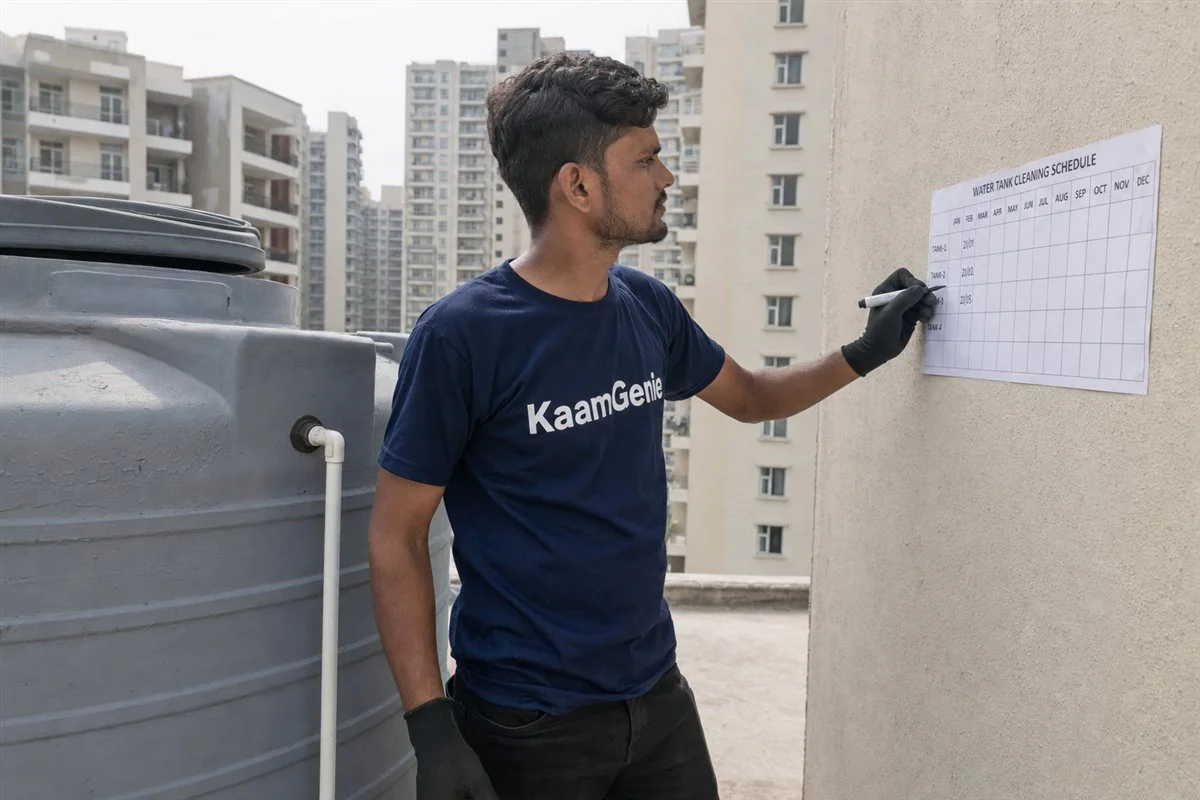
The short answer
- Baseline: every 6 months. That’s the BIS/CPHEEO-aligned rule of thumb for a lightly used home on clean, treated water.
- Hard borewell water: every 3–4 months. Scale and sediment build faster, so the same dirtiness arrives sooner.
- Tanker-fed home or society: every 3 months. Tanker quality is unpredictable; silt loads swing.
- Condominium UGR + rooftop tower tanks: quarterly, staged. Two-stage storage and shared use.
- New tower / new flat: clean on move-in, then quarterly for year one. Construction debris first, routine after.
- Commercial & FSSAI food premises: monthly to quarterly. Heavy turnover plus a compliance record to keep.
For most Gurgaon addresses, six months is the floor — not the target.
Ask the internet how often to clean a water tank and you’ll get one number back: six months. It’s a fine starting point. The problem is that the six-month rule assumes you’re storing reasonably clean, treated water and using it gently — and that describes almost nobody in Gurugram. The Millennium City runs on hard borewell groundwater, a heavy dependence on private water tankers, and large condominium storage systems that hold water in two stages before it reaches your tap. Each of those pushes the right interval shorter.
This guide does two things. First, it gives you the honest baseline and where it comes from. Then it gives you a cadence table by scenario — because a standalone kothi on canal water and a DLF condominium on tanker-filled reservoirs are not the same problem. We won’t re-explain why hard water fouls tanks faster here; that chemistry has its own home in our guide to hard water tank cleaning in Gurgaon. This page is purely about the schedule.
Where the 6-month baseline actually comes from
There is no single Indian law that says “clean your home tank every X months.” What exists is a quality standard and engineering guidance, and the six-month figure is the practical interval that keeps you inside them.
The Bureau of Indian Standards’ IS 10500 defines what your stored drinking water must contain — the acceptable limits for turbidity, total dissolved solids, microbial load and the rest. It tells you the outcome, not the cleaning frequency. The CPHEEO Manual on Water Supply and Treatment and the WHO drinking-water guidance both stress that stored water needs regular, periodic cleaning and disinfection to stay within those limits. Put together, six months is the interval that reliably keeps an ordinary, lightly used tank fed with clean water inside the standard.
So treat six months as sensible practice rather than a statute — and notice the assumption baked into it: clean source water, light use. The moment your water is hard borewell or tanker-supplied, or your tank is shared by dozens of flats, that assumption breaks and the interval needs to come down. That’s the whole reason a Gurgaon-specific table matters.
| Your situation | Typical in Gurgaon | Recommended cadence | Why this interval |
|---|---|---|---|
| Home on treated / municipal supply | Standalone kothi or builder floor, mostly canal-treated water | Every 6 months | Clean source, light use — the baseline holds |
| Home on hard borewell water | Borewell-fed homes, white scale on taps & geysers | Every 3–4 months | Scale + sediment build faster on hard water |
| Tanker-dependent home or society | Reliant on private tankers, especially in summer | Every 3 months | Tanker quality varies; silt loads swing |
| Condominium UGR + rooftop tower tanks | DLF / AOA condos: big sump pumping up to tower tanks | Quarterly, staged | Two-stage storage + heavy shared use |
| New flat / new tower (first year) | Just-handed-over Dwarka Expressway & SPR towers | Clean on move-in, then quarterly Y1 | Construction debris first; settle to routine |
| Commercial / FSSAI food premises | Cyber City offices, malls, restaurants, hotels | Monthly to quarterly | High turnover + a hygiene record to maintain |
Not sure which row is yours?
Tell us your supply and tank setup and we’ll suggest a schedule — no obligation. Standard residential cleaning ₹699 onwards; society & commercial quoted on site.
Hard borewell & tanker homes: quarterly, not biannual
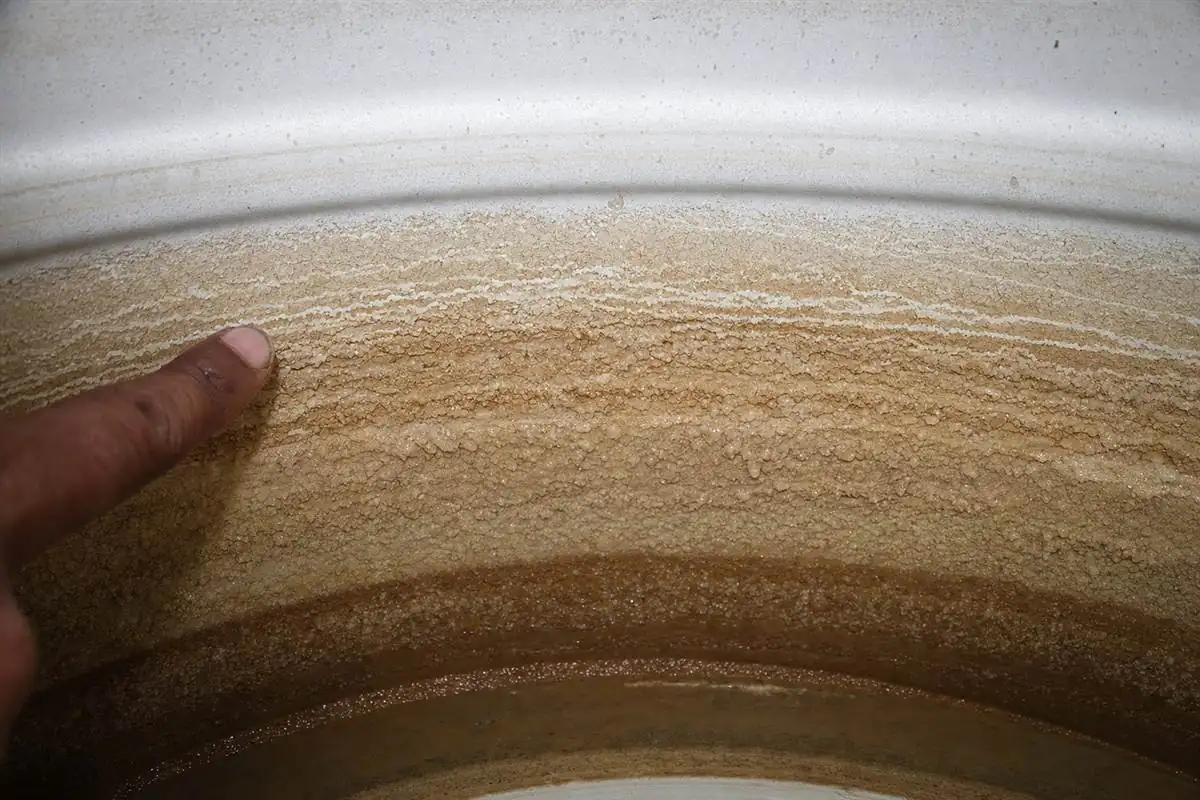
Most Gurgaon homes that aren’t on a full municipal connection fall into one of two buckets: hard borewell groundwater, or a heavy reliance on private water tankers — and plenty of homes are on both depending on the season. Both shorten the cleaning interval, for different reasons.
Hard borewell water carries a lot of dissolved calcium and magnesium. As the water sits, that hardness deposits as scale on the walls and as a gritty layer on the floor, and the scale is precisely where biofilm takes hold. A borewell-fed tank simply gets to the same level of fouling in three to four months that a municipal-fed tank reaches in six. If you see white crust on your taps, geysers and kettle, your tank floor looks the same. (The detailed chemistry is in our hard water tank cleaning guide.)
Tanker-fed homes and societies face a different issue: you don’t control what arrives. Tanker water quality varies by source, by how clean the tanker barrel is, and from one delivery to the next. That unpredictability means sediment loads swing, and silt can settle on your tank floor surprisingly fast after a few murky loads. Quarterly is the realistic minimum — our Gurgaon AMC plans are built around exactly this rhythm. This holds whether you’re in an independent home off Sohna Road or a builder floor in Sector 82 on the new-tower belt.
Condominiums: two stages of storage, one rolling schedule
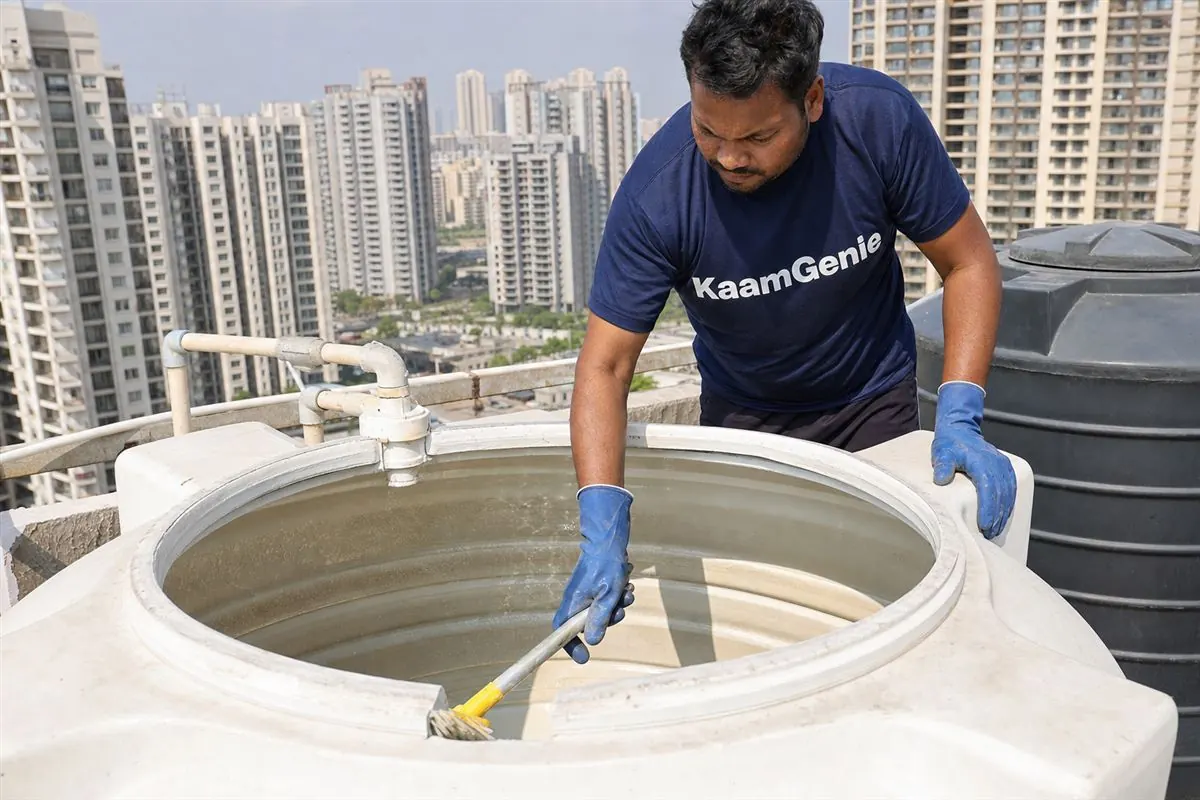
A typical Gurgaon condominium — the DLF colonies, the AOA-run luxury towers along Golf Course Road and Golf Course Extension — stores water in two stages. A large underground reservoir (UGR) in the basement fills from tankers or borewell, and pumps lift that water up to rooftop tower tanks serving each block. Both stages collect sediment, and both feed your tap, so both need cleaning.
The smart way to run this isn’t one giant annual shutdown — it’s a rolling quarterly schedule. Most AOAs clean the UGR and one set of tower tanks on a given weekend, then the remaining blocks the following weekend, so no resident ever loses supply. Because the storage is split and the usage is heavy and shared, a condo should never stretch past three to four months on either stage. Our society and condominium cleaning guide walks through how a staged schedule is planned across a multi-tower complex like those in DLF Phase 5. If you manage the maintenance for a society, you can also see the full water tank cleaning services we run for AOAs and RWAs across NCR.
New towers & commercial premises: the two special cases
Two situations break the normal pattern, and both deserve their own line.
New flats and new towers. If you’ve just taken possession on the Dwarka Expressway or the Southern Peripheral Road (SPR) new-tower belt, your tanks have never held drinking water — they’ve held construction. Cement dust, sand, plaster flecks, and sometimes leftover packaging sit in those tanks from the build. The first cleaning should happen on move-in, before anyone drinks from the supply, not at the six-month mark. Then keep to a quarterly schedule through the first year while the building’s plumbing settles and tanker supply stabilises, and reassess against your source water after that.
Commercial and food premises. Offices in Cyber City and Udyog Vihar, malls, hotels, restaurants and cloud kitchens all combine heavy daily turnover with a compliance obligation. FSSAI expects food businesses to keep stored water hygienic and to hold records proving it. In practice that means restaurants and hotels clean monthly to two-monthly, while large offices and malls run quarterly with documentation kept for audits. The heavier the footfall and the stricter the audit, the tighter the interval.
Recommended cleanings per year — by Gurgaon scenario
Source water and usage decide the cadence; six months (2/yr) is the floor for most homes
Indicative cadence, not a fixed rule — your exact interval depends on source water quality, tank size and usage. When in doubt, clean sooner and let the next inspection tell you whether you can stretch.
A 30-second decision framework
If you’d rather not memorise a table, answer these in order and stop at the first “yes”:
- Do you run a food business, restaurant or hotel? → Monthly to two-monthly, with records.
- Is it a condominium or society tank (UGR + towers)? → Quarterly, staged across blocks.
- Did you take possession of a new flat in the last year? → Clean now, then quarterly for the rest of year one.
- Is your supply hard borewell water or private tankers? → Every 3–4 months.
- None of the above — clean municipal water, light use? → Every 6 months, the baseline.
Then adjust for what you actually observe. If, partway to your next scheduled clean, you notice white scale on taps, a faint earthy smell, cloudy water, or grit in a glass left overnight, don’t wait for the calendar — clean now and shorten the interval. Those are the early warnings we list in detail in our guide to the signs your Gurgaon tank needs cleaning. The tank tells you the truth before the calendar does.
The cheapest way to keep the schedule
Here’s the uncomfortable truth after years of doing this: the hard part of a cleaning schedule isn’t the cleaning. It’s remembering to book it. Households set out meaning to clean every six months and look up a year later having done it once. That’s how the sediment layer most people are shocked by actually forms — not from one missed clean, but from a schedule that quietly slipped.
The fix is to take the remembering out of your hands. An annual maintenance contract fixes the cadence for you — typically two to four visits a year matched to your scenario above — locks the per-visit price so there’s no haggling each time, and keeps a dated record of every clean, which societies and food businesses need anyway. Per visit, it usually works out cheaper than booking one-offs. We break the plans down in our Gurgaon AMC guide.
Put your tank on a schedule that fits Gurgaon water
Quarterly for borewell and tanker homes, staged for societies, monthly for food premises — we’ll set the cadence and remember it for you. ₹699 onwards.
Book your next clean in Gurgaon
Whatever row of the table you fall into, the principle is the same: match the interval to your water, then keep to it. If you’re overdue — and on hard Gurgaon water it’s easy to be — the fix is one booking away. See areas, pricing and how we work on our water tank cleaning in Gurgaon hub, or call +91 95603 66362 and tell us your supply and tank setup — we’ll suggest the right schedule and confirm shortly.
Frequently asked questions
How often should I clean my water tank in Gurgaon?
Six months is the safe baseline for an ordinary home on treated municipal water. But most of Gurgaon does not run on clean municipal water — if your supply is hard borewell groundwater or private tankers, move to every three to four months. Condominiums with an underground reservoir feeding rooftop tower tanks, and any commercial or food premises, should clean more often still. The honest answer is: six months is the floor, not the target, for most Gurgaon addresses.
Do BIS or CPHEEO legally mandate a 6-month cleaning schedule?
No single law puts a number on it for a private home. BIS IS 10500 sets the quality your stored drinking water must meet, and the CPHEEO manual and WHO guidance both stress regular periodic cleaning and disinfection of storage. The widely used six-month rule of thumb comes from that guidance plus standard practice — it is the interval that reliably keeps stored water within those quality limits for a typical, lightly used tank. It is sensible practice, not a statute, and it assumes reasonably clean source water.
Why does hard borewell water mean I should clean more often?
Gurgaon’s groundwater is hard — high in dissolved calcium and magnesium. That hardness drops out as scale on tank walls and as fine sediment on the floor, and it does so far faster than soft treated water. The scale layer is exactly where biofilm and bacteria settle, so a borewell-fed tank reaches the same dirtiness in three to four months that a municipal-fed tank reaches in six. We cover the chemistry of why hard water fouls tanks faster in our hard water tank cleaning guide for Gurgaon.
We’re fully tanker-fed — how often should our tank be cleaned?
Every three months. Tanker water quality is unpredictable — it varies by source, by the cleanliness of the tanker itself, and from one delivery to the next. You have no control over what arrives, so sediment loads in your tank swing widely and silt builds up quickly on the floor. Quarterly cleaning is the realistic minimum for any home or society that depends on tankers.
How often should a condominium clean its underground reservoir and tower tanks?
Quarterly, staged. A typical Gurgaon condominium stores water twice — a large underground reservoir (UGR) that fills from tankers or borewell, which then pumps up to rooftop tower tanks on each block. Both stages need cleaning, but they don’t have to happen the same day. Most AOAs run a rolling quarterly schedule: clean the UGR and a set of tower tanks one weekend, the rest the next, so no block ever loses supply. Shared usage and the two-stage storage mean condos should never stretch past three to four months.
We just got possession of a new flat or tower — when’s the first cleaning?
Before you drink a drop. New tanks on the Dwarka Expressway and SPR new-tower belt are full of construction residue — cement dust, sand, plaster flecks, sometimes packaging and tools left behind. Clean and disinfect on move-in, not six months later. For the whole first year, keep to a quarterly schedule while the building settles and tanker supply stabilises, then reassess against your source water.
How often for a restaurant, office, or commercial building in Gurgaon?
Monthly to quarterly, depending on use. FSSAI expects food businesses to keep stored water hygienic and to hold records of it, so restaurants, cloud kitchens and hotels typically clean monthly to two-monthly. Cyber City / Udyog Vihar offices and malls with heavy daily footfall usually run quarterly with documentation for audits. The high turnover and the compliance requirement both push commercial premises to a tighter schedule than homes.
Can I just clean once a year to save money?
On hard Gurgaon borewell or tanker water, once a year is too long — by month nine or ten you usually have a measurable sediment layer and biofilm on the walls, which is when families start noticing taste, smell, or skin niggles. Annual cleaning can be defensible only for a lightly used home on genuinely clean treated water. For most Gurgaon addresses, stretching to twelve months saves a few hundred rupees and costs you water you wouldn’t want to drink. An annual contract that bundles two to four visits usually works out cheaper per visit anyway.
How do I know if I’m waiting too long between cleanings?
Your tank tells you before the calendar does. White scale crusting on taps and geysers, a faint earthy or chlorine-off smell, water that looks cloudy or leaves grit in a glass left overnight, or unexplained stomach and skin complaints in the household — any of these means you’ve gone too long. Treat them as a prompt to clean now and then shorten your interval. We list the full set of warning signs in our guide to signs your Gurgaon tank needs cleaning.
Does an AMC make sense for keeping to the schedule?
For most Gurgaon households and every society, yes. The hardest part of a cleaning schedule isn’t the cleaning — it’s remembering to book it. An annual maintenance contract fixes the cadence for you (commonly two to four visits a year), locks the per-visit price, and keeps a dated record of every clean, which societies and food businesses need anyway. We break down how AMCs are priced in our Gurgaon water tank cleaning AMC guide.
Sources & references
- Bureau of Indian Standards (BIS) — IS 10500:2012 is the canonical Indian Standard for drinking water specification, defining acceptable limits for physical, chemical, and biological parameters.
- WHO Guidelines for Drinking-water Quality, 4th edition — the global reference for water quality standards, including guidance on storage and disinfection.
- Food Safety and Standards Authority of India (FSSAI) — defines water quality requirements for food businesses, including hygiene standards for stored water and acceptable disinfection chemicals.
- WHO Fact Sheet on Drinking Water — overview of safe drinking water requirements and contamination risks.
- CPHEEO — Manual on Water Supply and Treatment — the Government of India’s engineering manual covering tank design, cleaning protocols, and disinfection practices.
Last verified: 29 June 2026. If you find any of these links broken, please let us know.