
Quick answer — termite treatment for existing homes in Delhi (2026)
- This is post-construction treatment (2026): a chemical barrier put in by drilling and injecting — not the soil treatment done while a house is being built.
- How it works: 12-inch grid of holes along the wall-floor junction, CIB&RC termiticide injected under pressure, wooden frames treated, holes sealed.
- Real cost (2026): 1–2 BHK from ₹2,499; 3–4 BHK roughly ₹4,500–₹7,500; a small kothi ₹8,000–₹18,000+. Works out to about ₹5–₹9 per sq ft. GST 18% extra.
- Warranty (be realistic): 1–5 years with an annual top-up for occupied homes. The ‘10-year’ figure is for pre-construction soil treatment, not this.
- Why DIY spray fails: it kills the termites you can see; the colony lives in the soil under your foundation and walks straight back in.
- You usually don’t move out — the chemicals are approved for occupied buildings; just ventilate and keep pets off wet surfaces till they dry.
Already have termites? That’s a different job — here’s why
First thing I tell people who call about deemak: the price you find online is often for the wrong service. There are two completely different jobs, and they cost different money. Pre-construction treatment is done when a plot is just foundation and soil — the soil under and around the building is soaked with termiticide before the floor goes down, so termites never get a path in. Post-construction treatment is what you need when the house is already built and lived in, and the termites have already found a way through a hairline crack in the floor or around a pipe. You can’t flood the soil under a finished house, so the job changes shape entirely.
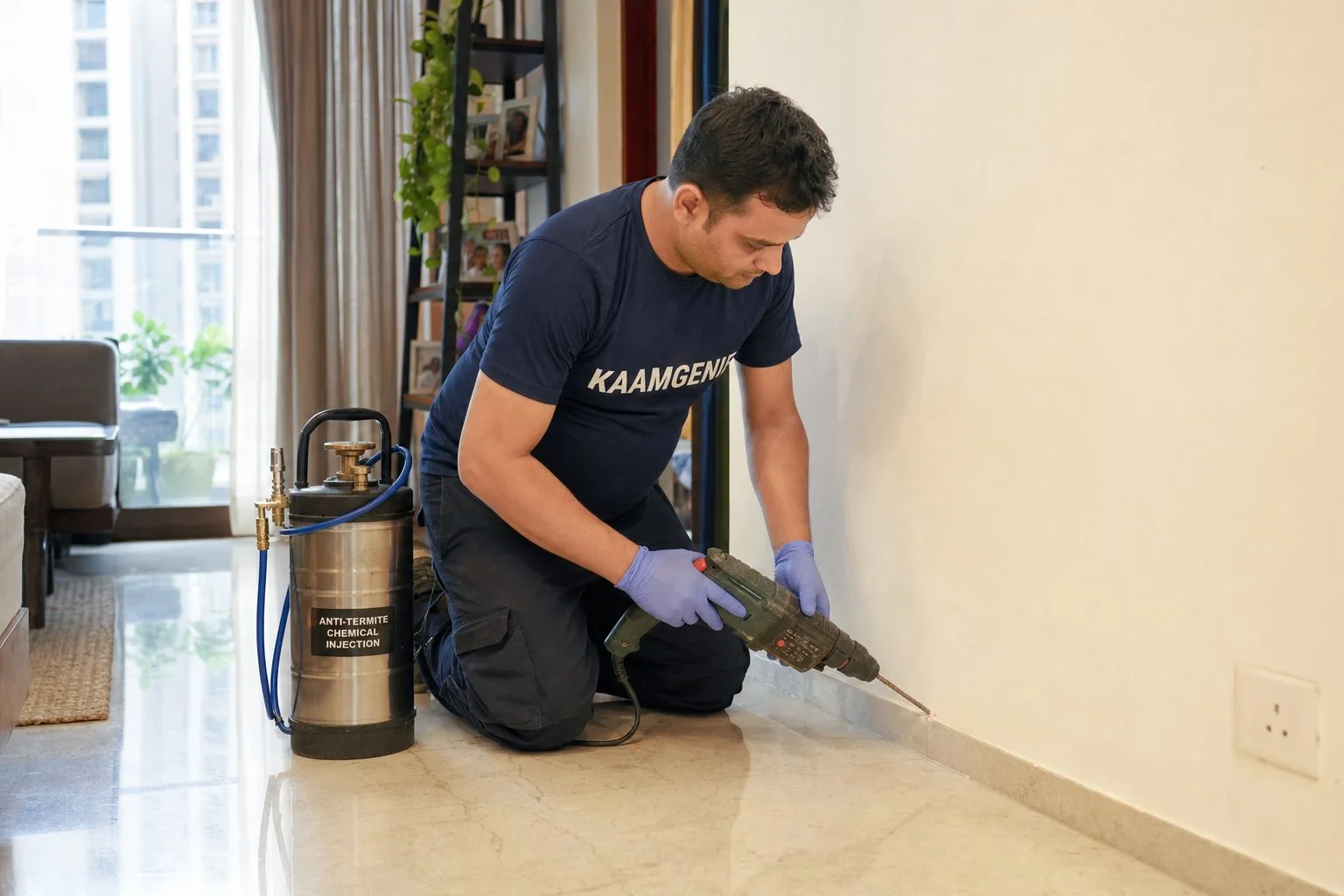
For an existing home, a real crew builds the same chemical barrier — but from inside the finished house. They drill a line of small holes along the joint where the wall meets the floor, push termiticide into the soil underneath through those holes under pressure, treat any wood the termites are feeding on, and seal everything back up. No demolition. You don’t lose your flooring and you don’t move out. It is a more careful, slower job than soil treatment, which is partly why a brand-new builder floor in Dwarka can sometimes cost less to protect than an old kothi in Defence Colony with thirty years of cracks and wooden almirahs.
This matters because the cheap quotes you see — ₹500, ₹800 — are almost never this. They’re a man with a sprayer wetting the one wall you pointed at. That’s not post-construction treatment. That’s a temporary cover-up, and I’ll come back to why it always fails.
How to know it’s really termites (and a quick checklist)
Termites are quiet. By the time most Delhi families notice, the colony has been working for months. These are the signs I’d look for, in roughly the order people spot them:
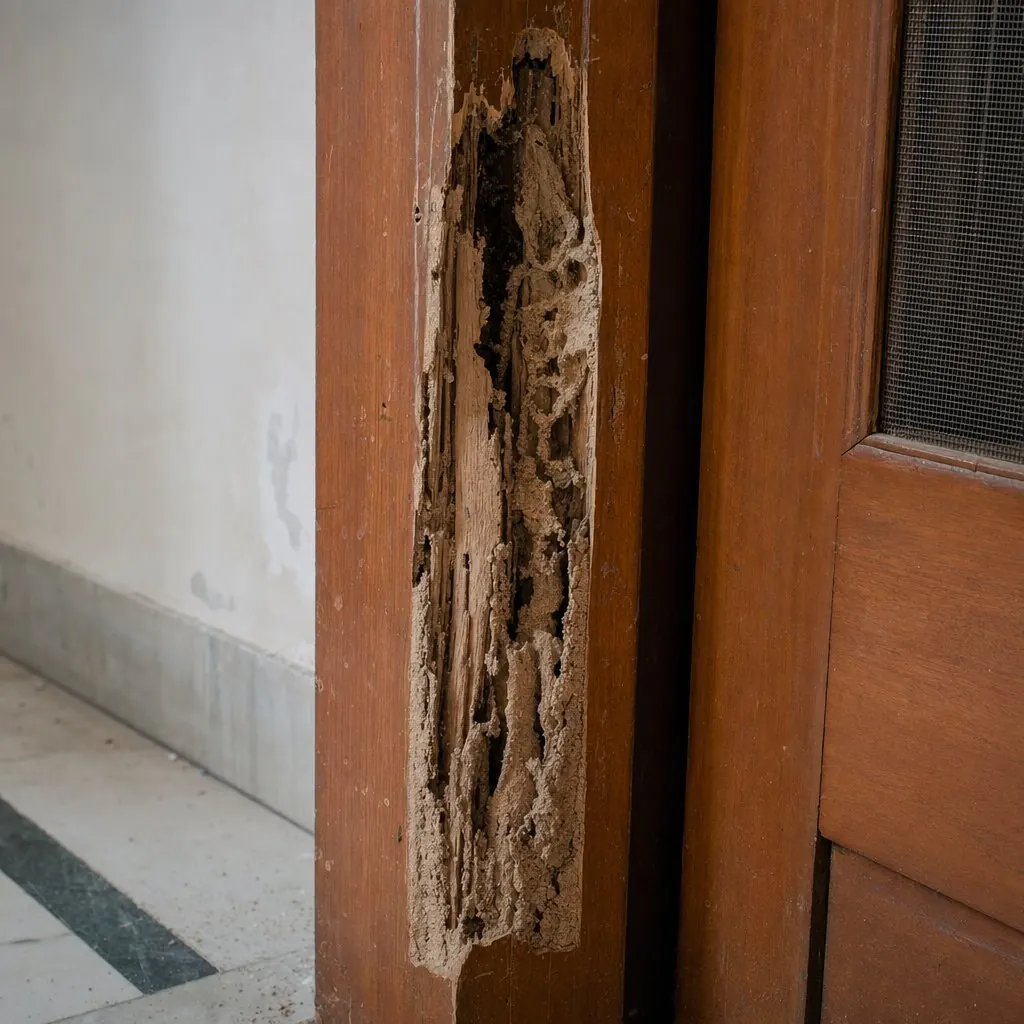
- Mud tubes climbing the walls. Thin pencil-width lines of dried mud running up from the skirting, behind the fridge, along a beam. Subterranean termites build these tunnels to travel from the soil to the wood without drying out. This is the clearest sign.
- Hollow or sagging wood. Tap a door frame, a window panel, a wooden almirah back. If it sounds papery and hollow instead of solid, they’ve eaten it from the inside. Sometimes a finger goes straight through.
- Doors and windows suddenly tight. Wood that swells from termite moisture jams in its frame. If a door that opened fine all year is suddenly sticking, check it.
- Bubbling, rippled or blistered paint. Termites working just under the surface make the paint or POP look like it has tiny ripples or trapped air. People mistake it for a damp problem.
- Discarded wings near windows in spring. Around the first warm, humid evenings — roughly March to May in Delhi — winged termites swarm, fly to light, then shed their wings in little piles on the sill or floor. A heap of identical pale wings is a swarm, and a swarm means an established colony nearby.
- Fine, gritty dirt or frass. Small piles of what looks like sawdust or soil under wooden fixtures.
Found one of these? Don’t panic and don’t spray it yourself yet — spraying the visible spot just scatters them deeper. Note where you saw it and get the whole house looked at.
| Look at… | Termite | Flying ant |
|---|---|---|
| Waist | Straight, no pinch | Clear pinched waist |
| Wings | Four wings, all equal length | Front wings longer than back |
| Antennae | Straight, beaded | Bent / elbowed |
| Where you find them | Mud tubes, near wood | Open trails, kitchen counters |
The post-construction process, step by step
Here is what an honest crew actually does in an occupied Delhi home — and what a ₹500 spray man skips:
- Inspection and marking. Walk the whole house, tap the wood, find the active tubes, work out where the colony is getting in. The technician marks the drill line.
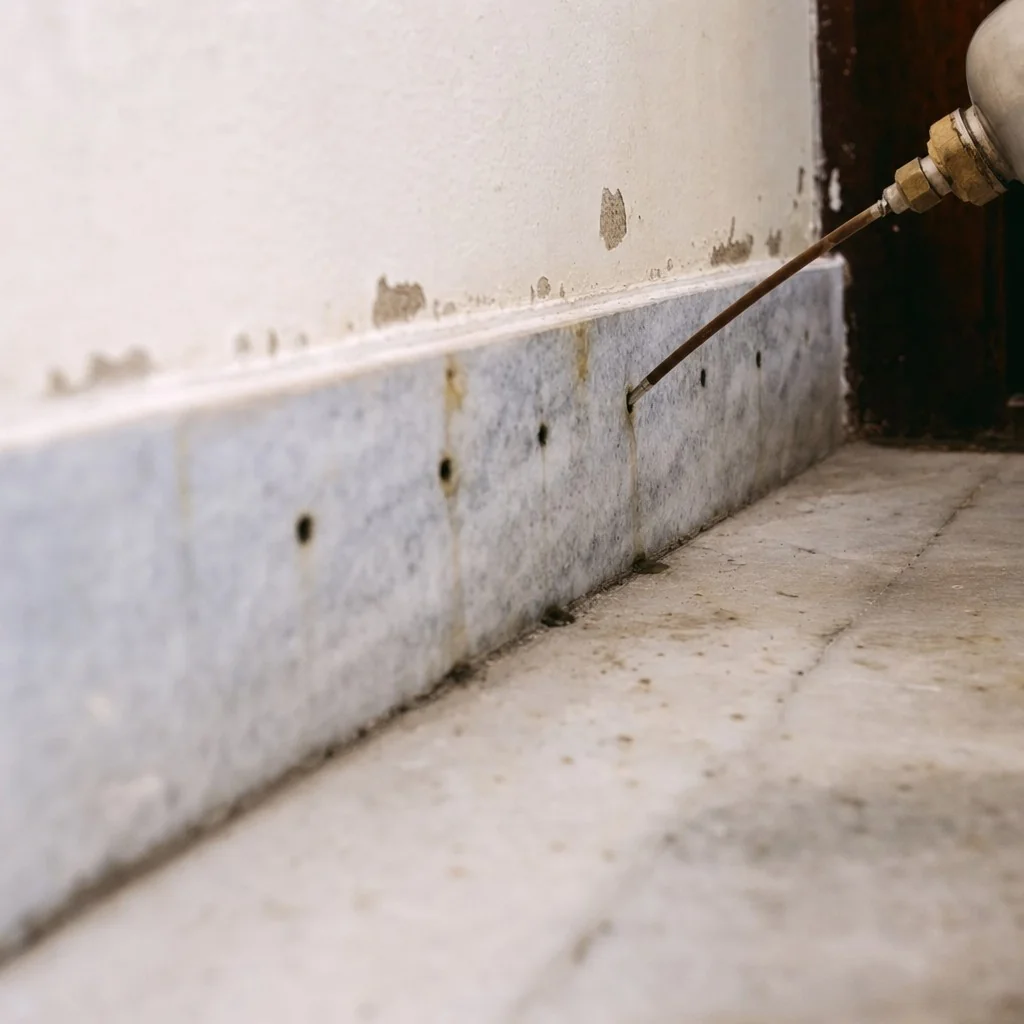
- Grid drilling along the wall-floor junction. A line of small holes — roughly every 12 inches — is drilled into the joint where walls meet the floor, plus around door frames, pipe entries and any spot where the slab meets soil. This is the part people are nervous about; the holes are small and get sealed at the end.
- Pressure injection of termiticide. A CIB&RC-approved chemical — usually imidacloprid or chlorpyrifos at the registered concentration — is injected through those holes under pressure so it spreads through the soil and forms a continuous treated zone. Termites crossing it die and carry it back, which is what knocks the colony down rather than just the foragers.
- Treating the wood. Infested door frames, window frames, wooden almirahs and skirting get treated directly — drilled and injected or surface-applied where appropriate — so the bit you can see is dealt with too.
- Sealing. Every drill hole is filled (usually with white cement / putty) so your floor and skirting look normal again.
The difference is the barrier. A surface spray wets one wall; the next morning it looks ‘done’ and three months later the deemak is back through the floor two feet away. The drill-fill-inject job puts a treated layer between the soil and your home, which is the only thing that actually stops subterranean termites for years rather than weeks.
Seen mud tubes or hollow wood? Get it inspected before it spreads.
A KaamGenie technician checks the whole house, marks the active spots, and gives a written price. Treatment starts at ₹2,499 for a 1–2 BHK (GST extra).
Real termite treatment cost for existing homes in Delhi (2026)
Let’s talk numbers. Post-construction termite treatment in Delhi is priced two ways — a flat rate by home size, or per square foot of built-up / affected area. As a rough rule in 2026 it works out to about ₹5 to ₹9 per sq ft of the area being treated, and GST at 18% is extra on every quote. Bigger homes get the lower per-foot rate; small flats sit at a minimum charge. Here is the honest range I’d quote:
| Home type | Typical price range | Notes |
|---|---|---|
| 1–2 BHK flat | ₹2,499 – ₹3,500 | Minimum-charge band; one floor, few wooden fixtures |
| 3–4 BHK flat | ₹4,500 – ₹7,500 | More running junction to drill, more wood |
| Builder floor (independent) | ₹5,000 – ₹9,000 | Ground floor costs more — direct soil contact |
| Small kothi / bungalow | ₹8,000 – ₹18,000 | Old construction, many cracks, wooden almirahs, stairs |
| Large bungalow | ₹18,000+ | Priced per sq ft of built-up area; survey first |
A few real-world notes from doing this around Delhi: a fresh builder floor in Dwarka or Rohini with tiled floors and almost no wood often lands near the bottom of its band. An old kothi in Karol Bagh, Daryaganj or a Defence Colony bungalow with wooden frames, parquet, and decades of micro-cracks lands near the top — there’s simply more junction to drill and more wood to treat. Don’t trust a fixed price quoted over the phone for a big house; a real company surveys first.
What actually changes the price
If two quotes for ‘the same’ flat differ, it’s usually one of these:
- Built-up area. The biggest lever. More square footage means more drilling and more chemical. Per-foot pricing keeps it fair.
- How far it’s spread. One door frame is a small job. Termites in three rooms, the kitchen platform and the staircase means more wood treatment and more entry points to seal off.
- Chemical chosen. Imidacloprid-based termiticides cost more than older chlorpyrifos; some homes (kids, pets) prefer the low-odour option, and you pay a little more for it.
- Number of wooden fixtures. Lots of wooden almirahs, panelling, window frames and skirting all need individual treatment — that’s labour and material.
- Ground floor vs upper floor. Ground-floor and basement rooms sit on the soil where the colony lives, so they need the full soil barrier. A third-floor flat with no direct soil contact is often cheaper.
Treat now vs wait 12 months (2026)
A small early job is cheap. Let it spread through more rooms and wood for a year and the price climbs — rough Delhi figures for the same 3 BHK.
The warranty — what’s real and what’s a sales line
This is where most people get misled, so I’ll be blunt. For an existing home, an honest post-construction warranty is usually 1 to 5 years, and the longer ones almost always need an annual top-up or renewal — a yearly inspection and a refresh of the barrier — to stay valid. That’s normal and fair: a chemical barrier in soil weakens over time.
When a salesman promises a flat ‘10-year warranty’ for your already-built house, be careful. The well-known 10-year term comes from pre-construction soil treatment, where the whole plot was treated before the slab was poured — a far more complete barrier than anything you can put into a finished home. Quoting that figure for post-construction work is either a misunderstanding or a sales trick. Ask exactly what the warranty covers, whether re-treatment is free if termites return, and whether you must pay for annual top-ups to keep it alive. Get it in writing. Nobody can honestly promise ‘100%’ or ‘permanent’ — termites are persistent, and any company that says otherwise is overselling.
Want a fixed quote for your exact home?
Send us your built-up area and the rooms where you’ve seen damage — we’ll give you a per-sq-ft price with no surprise add-ons.
Why DIY and local ‘deemak wale’ sprays keep failing
Every week someone tells me they already ‘did’ the termites — bought a bottle from the hardware shop, or paid a local fellow ₹500 to spray. And every week the termites are back. Here’s why it never holds:
Subterranean termites — the ones eating Delhi homes — don’t live in your wall. They live in the soil under and around your foundation, sometimes a colony of lakhs of insects, and they send foragers up through cracks to feed. When you spray the visible wall, you kill the few hundred you can see. The colony underneath is untouched. There’s no barrier between the soil and your home, so within a few months they simply find another crack and come back — often a couple of feet from where you sprayed. Worse, a bad spray can make them avoid that area and quietly spread to a new room, so you think it’s gone while it’s actually getting wider.
The whole point of proper treatment is the soil barrier — the drill-fill-inject step that a sprayer can’t replicate. That’s the difference between ‘they came back in three months’ and ‘clear for years.’
Surface spray vs full soil barrier — homes still termite-free at 1 year (2026)
Rough outcome we see across Delhi: the spray buys you a few months; the barrier holds.
Is it safe with the family at home?
For an occupied house, yes — with normal sense. The termiticides a licensed crew uses are CIB&RC-approved for treatment of buildings in use, and they go into the soil and the wood, not sprayed into the air you breathe. You almost never need to move out for post-construction work. Practical points I tell every family:
- Open windows and keep rooms ventilated during and for a couple of hours after the work.
- Keep small kids and pets out of the treated room until the surfaces and sealed holes are dry — usually a few hours.
- Tell the technician if anyone in the house is pregnant, asthmatic, or you have fish/birds, and ask for the low-odour imidacloprid option.
- Cover or move open food and utensils in the kitchen before they treat the platform.
A good crew will tell you all of this without being asked. If a ‘pest control’ man can’t name the chemical he’s using or won’t talk about safety, that’s your answer.
Where we treat termites across Delhi
We do post-construction termite treatment across Delhi — the old construction belts where deemak is worst included: Daryaganj, Karol Bagh, Lajpat Nagar, Greater Kailash, Defence Colony kothis and Civil Lines, as well as the newer flats and builder floors in Dwarka, Rohini, Saket, Janakpuri and across South, West, East and North Delhi. If you’ve seen mud tubes or hollow wood, call 95603 66362 for an inspection — treatment starts at ₹2,499 for a 1–2 BHK (GST extra). Coming soon: Gurgaon, Noida, Faridabad and Ghaziabad.
Frequently asked questions
How much does termite treatment cost for an existing home in Delhi in 2026?
For an occupied home it starts around ₹2,499 for a 1–2 BHK, roughly ₹4,500–₹7,500 for a 3–4 BHK, and ₹8,000–₹18,000+ for a kothi or bungalow. As a rule it works out to about ₹5–₹9 per sq ft of built-up area, and GST at 18% is extra.
What is the difference between pre-construction and post-construction termite treatment?
Pre-construction treatment soaks the soil with termiticide before the building’s floor is laid, so termites never get in. Post-construction treatment is for a finished, lived-in home — the same chemical barrier is built by drilling holes along the wall-floor junction and injecting termiticide under pressure, with no demolition.
Do I need to move out of my house during termite treatment?
Almost never. The chemicals are CIB&RC-approved for occupied buildings and go into the soil and wood, not into the air. Just ventilate the rooms and keep kids and pets off the treated area until it dries, usually a few hours.
Is the ‘10-year termite warranty’ real for an existing home?
Be careful with that one. The 10-year figure normally refers to pre-construction soil treatment. For an existing home, an honest warranty is usually 1–5 years and the longer ones need an annual top-up to stay valid. Always get the exact terms in writing.
Why does the local ‘deemak wale’ spray keep failing?
Because subterranean termites live in the soil under your foundation, not in the wall. A surface spray kills only the few you can see; the colony is untouched and walks back through another crack within months. Only a proper soil barrier (drill-fill-inject) stops them for years.
How long does post-construction termite treatment take?
A typical flat takes a few hours to half a day depending on size and how many rooms and wooden fixtures are affected. A large bungalow may need a full day. The crew drills, injects, treats the wood and seals the holes in one visit.
Will the drilling damage my flooring?
The holes are small — drilled into the joint where the wall meets the floor — and every one is filled with putty or white cement at the end, so your floor and skirting look normal again. There is no major flooring damage.
Which chemical is used for termite treatment in Delhi?
Licensed crews use CIB&RC-approved termiticides — commonly imidacloprid or chlorpyrifos at the registered concentration. Imidacloprid is lower-odour and a little costlier, which families with kids or pets often prefer.
How do I know if it is termites and not flying ants?
Termites have a straight body with no pinched waist, four equal-length wings and straight antennae, and you find them near mud tubes and wood. Flying ants have a pinched waist, longer front wings and bent antennae, and travel in open trails. In spring you may also find piles of shed termite wings on the windowsill.
What raises the price of termite treatment?
Built-up area is the biggest factor, then how far the infestation has spread, the chemical you choose, the number of wooden fixtures, and whether it’s a ground floor with direct soil contact (more expensive) or an upper floor.
Should I treat now or wait?
Treat at the first signs. Termites spread quietly through more rooms and wood, so a small early job that might cost ₹4,500 can become a ₹12,000+ job after a year of spread — plus the cost of replacing eaten door frames and furniture.
Can termite treatment ever be permanent or 100% guaranteed?
No, and anyone who promises that is overselling. Termites are persistent and a soil barrier weakens over time. A good treatment keeps a home clear for years and is renewed with annual top-ups — that’s the honest, realistic outcome.
Found mud tubes or hollow wood? Let’s deal with it properly.
Book a termite inspection across Delhi — we drill, inject the soil barrier, treat the wood and seal up. Starts at ₹2,499 for a 1–2 BHK (GST extra).
Sources & references
- Central Insecticides Board & Registration Committee (CIB&RC) — approves the termiticides (imidacloprid, chlorpyrifos and others) and concentrations used in licensed treatment.
- Bureau of Indian Standards (BIS) — IS 6313 (Part 3) covers anti-termite treatment of existing buildings — the protocol this guide follows.
- CSIR — Central Building Research Institute (CBRI) — national building-research body whose guidance informs termite control in occupied structures.
Last verified: 9 June 2026. If you find any of these links broken, please let us know.