
Quick answer — pre-construction anti-termite in Delhi
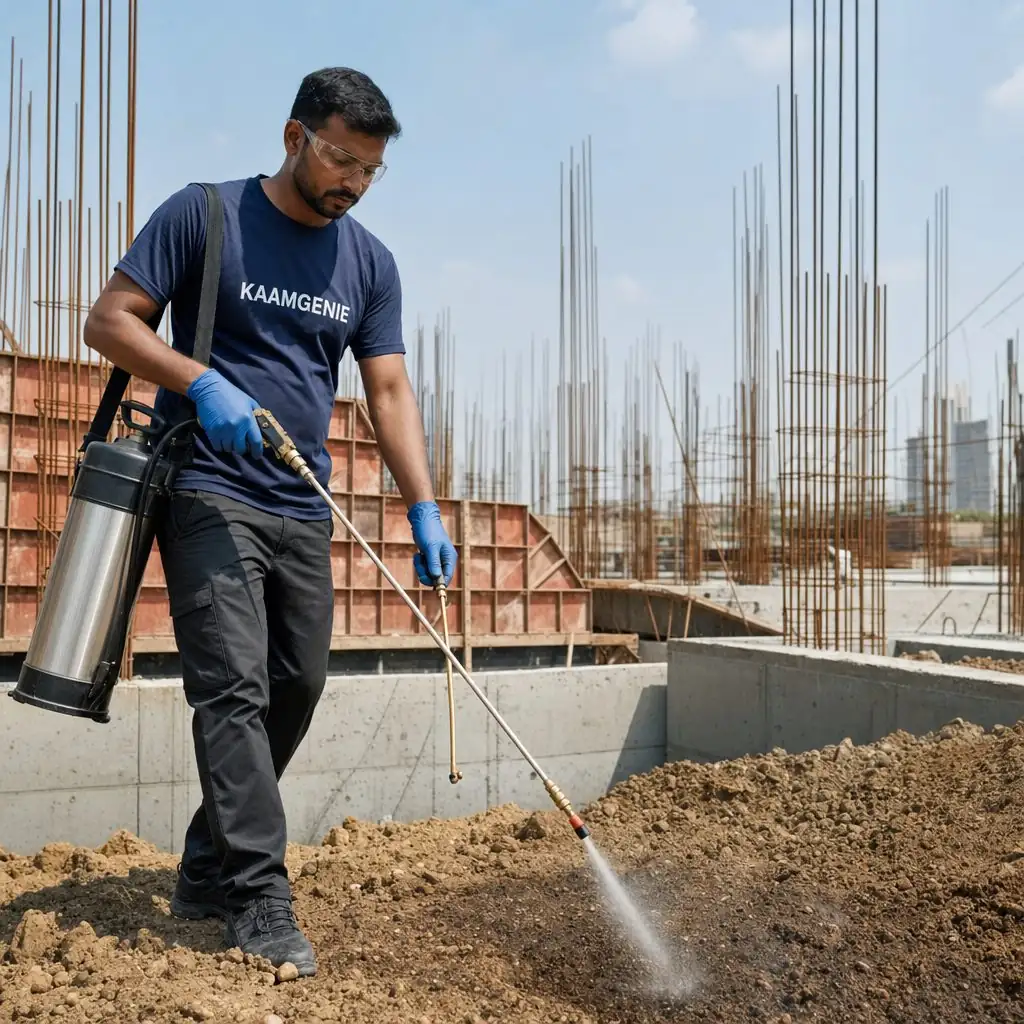
- When to do it: Twice during construction — once after foundation excavation (before concrete is poured), once at plinth level (before flooring is laid). Both treatments form a chemical barrier the termites can’t cross.
- What we apply: CIB&RC-approved soil emulsion — chlorpyrifos 1% (the IS 6313 standard) or imidacloprid 0.075% (modern alternative) — at 5 litres per square metre of soil surface.
- Real cost in Delhi (2026): Up to 1,500 sqft plot ₹5,999. 1,500-2,500 sqft ₹8,999. 2,500+ sqft ₹12,999+. Society project from ₹25,000.
- 10-year structural re-treatment cover — the longest commitment in residential pest control. If termite activity shows up in treated zones within 10 years, we re-treat free.
- Time on site: Half a day for individual home (2 visits over the construction timeline), 2-3 days spread across construction for a society tower.
- Document for the builder: Treatment certificate + chemical name + plot dimensions + cover terms. Goes into your building completion file.
Why pre-construction anti-termite is the cheapest treatment you’ll ever do
The math on this one is brutal and worth doing before you start construction. We’ve seen too many Delhi homeowners skip pre-construction termite to save ₹6,000, then spend ₹2-3 lakh on repair work five years later when the wooden door frames, the underlay below the wooden flooring, and the structural wood in the false ceiling all show termite damage at once.
Honest comparison from the homes we’ve treated in the last 8 years:
Pre-construction treatment cost (2026): ₹5,999 for a 1,200 sqft Dwarka plot. ₹8,999 for a 2,000 sqft Vasant Kunj kothi. ₹12,999 for a 3,000 sqft Defence Colony or GK-1 plot. One-time during construction. 10-year structural re-treatment cover.
Post-construction termite repair (if you skip): ₹25,000-40,000 for a single round of injection treatment if termites are caught early at year 4-5. ₹80,000-1,50,000 if the termite damage has spread to the wooden door frames, kitchen modular, and built-in cupboards by year 6-8. ₹2,00,000-5,00,000 if structural wood (false ceilings, wooden trusses, underlay under flooring) needs replacement by year 8-10.
The cheapest version of this problem — pre-construction treatment — saves you somewhere between 4x and 80x its cost over the life of the home. It is the single highest-ROI pest decision a Delhi homeowner can make.
The reason most homeowners skip it is because the builder doesn’t bring it up, and the homeowner is overwhelmed by 30 other construction decisions. Both sides have the same incentive to skip: the builder saves a line item, the homeowner saves a small cost. Both lose when the kothi is 5 years old and the door frames start hollowing out.
The 2-step protocol — foundation pit and plinth level
Pre-construction anti-termite isn’t one treatment. It’s a 2-step protocol spread across the early construction timeline. Both steps are mandatory under IS 6313 (the Indian Standard for anti-termite measures in buildings). Missing either step voids the cover and weakens the chemical barrier.
Step 1 — Foundation pit treatment. Done after excavation is complete and before the concrete bed for the foundation is poured. Our crew sprays the chemical emulsion on the bottom of the excavated foundation pit (the “floor” of the excavation), on the sides of the trench up to the natural ground level, and on the backfill soil as it’s replaced around the foundation. This creates a chemical envelope around the entire foundation. Coverage rate: 5 litres of emulsion per square metre of treated surface. Time on site for an individual home: 3-4 hours.
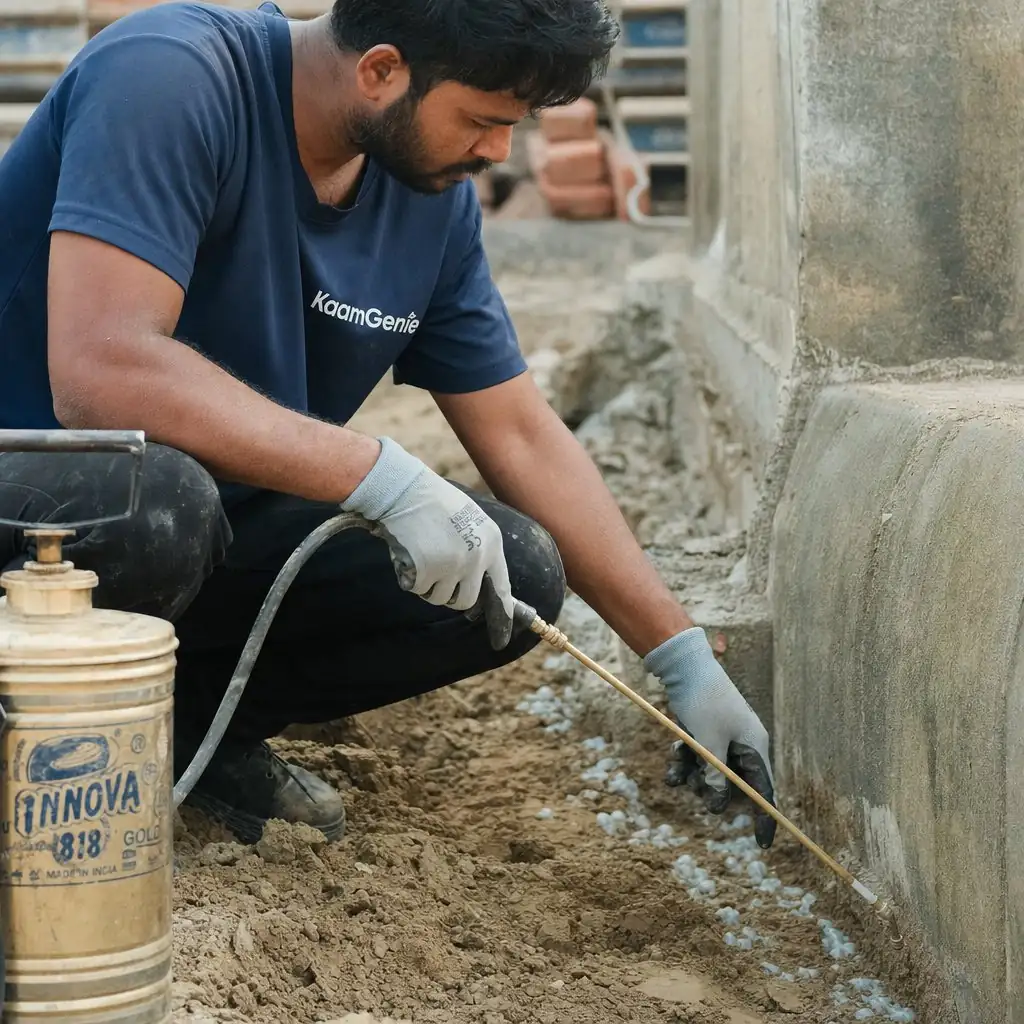
Step 2 — Plinth level treatment. Done after the plinth beam is cast and the soil-filling between the plinth and the ground floor slab is in place, but before the ground floor flooring (tile, marble, wooden) is laid. Our crew sprays the chemical emulsion on the entire ground floor area where the flooring will sit, with extra concentration along the wall-floor junctions where termites typically enter. Coverage rate: 5 litres of emulsion per square metre. Time on site: 2-3 hours.
Some builders ask if just Step 2 is enough — the answer is no. Step 1 protects the foundation from soil-side termite entry. Step 2 protects the ground floor from above-soil entry through wall-floor junctions. A single-step treatment leaves one of these gaps open and significantly reduces the effective life of the chemical barrier.
For societies and high-rises, the same 2-step protocol applies, but Step 1 is broken into sub-treatments for each tower’s foundation pit and is coordinated with the structural engineer’s pour schedule. We’ll come back to society pricing in the bulk-pricing section below.
Real cost for individual homes and society projects in Delhi
Honest 2026 pricing from our pre-construction sheet. GST 18% extra. Both steps included in the price. Includes treatment certificate + 10-year cover.
| Plot / project size | Total pre-construction cost | Both steps included? | Cover period |
|---|---|---|---|
| Up to 1,500 sqft plot (small Dwarka builder floor, Najafgarh, Burari) | ₹5,999 | Yes | 10 years |
| 1,500-2,500 sqft (typical Vasant Kunj, Dwarka kothi) | ₹8,999 | Yes | 10 years |
| 2,500-4,000 sqft (Defence Colony, GK-1, GK-2, Hauz Khas, larger kothi) | ₹12,999 | Yes | 10 years |
| 4,000-6,000 sqft (large bungalow, farmhouse-style) | ₹17,999 | Yes | 10 years |
| Single society tower (up to 50 flats) | From ₹25,000 | Yes — staged with construction | 10 years |
| Medium society project (3-5 towers, 200-300 flats) | From ₹1,20,000 | Yes — staged with construction | 10 years |
| Large society project (5+ towers, 500+ flats) | Custom quote (site visit) | Yes — coordinated with builder | 10 years |
Two things to know about the numbers above. First — the pricing is per the IS 6313 chemical coverage standard. Anyone quoting significantly less is either skipping a step or under-dosing the chemical. Second — the 10-year cover is structural, meaning it covers the original treated zones for the full decade. If the termite activity shows up in any treated zone, we re-treat free.
Starting construction in Delhi? Lock in pre-construction termite now.
2-step protocol. CIB&RC chemicals. 10-year structural cover. From ₹5,999 for individual homes.
Chemicals used and why CIB&RC matters for foundations
Two CIB&RC-approved chemicals are used for pre-construction anti-termite work in Delhi. Both are listed in IS 6313 as acceptable. The choice depends on soil type, water table depth, and what’s on the home’s neighbouring plots.
Chlorpyrifos 1% emulsion in water (the IS 6313 reference standard). This is the chemical most pre-construction treatments in Delhi use because it’s been the standard for 40 years and has well-documented 10-year residual life in Indian soil conditions. The 1% concentration is critical — lower concentrations don’t create a barrier termites can’t cross. Most older Delhi homes built between 1985 and 2010 were treated with chlorpyrifos. Soil contamination risk is well-understood and managed.
Imidacloprid 0.075% emulsion in water (modern alternative). Increasingly used in the last 5-7 years, particularly in Vasant Kunj and Dwarka where homeowners have asked for lower-toxicity options. Works through a different chemical pathway — targets the insect nervous system rather than acting as a contact poison — and has lower mammalian toxicity. Slightly higher cost (about 15-20% more). Residual life of 7-10 years documented in Indian soil studies. We use this when the homeowner specifically requests it or when the construction site is adjacent to an organic garden, a water body, or a school.
Why CIB&RC matters: the registration number guarantees the formulation has been tested for foundation use and has documented residual life in Indian soil. Cheaper non-CIB&RC alternatives sometimes circulate in the unorganised market — they may work for 1-2 years and then break down, leaving you with a worthless “cover” certificate. Always insist on the CIB&RC number on the treatment certificate.
10-year structural cover — what’s covered, what’s voided
The 10-year cover on pre-construction anti-termite is the longest commitment in residential pest control. It’s also the one most easily voided by structural changes the homeowner makes years later without realising. Honest breakdown of what’s included and what voids it.
What the cover includes:
- Free re-treatment of any treated zone where termite activity is observed within 10 years of the original treatment, with original chemicals at the original IS 6313 coverage rate.
- Inspection visit on request within 7-14 days of customer report.
- Photo documentation of re-treatment work in case future homeowners or property buyers ask for the cover history.
- Transferable cover — if you sell the home within 10 years, the cover transfers to the new owner.
What voids the cover:
- Major structural alteration after treatment. Knocking down walls, adding rooms, extending the home into untreated soil — all void the cover for the altered zone. Talk to us first if you’re planning a major renovation 3-5 years in.
- Underground waterlogging or sewage seepage. Chemical barriers break down faster when soaked in sewage. If you have a recurring drainage problem under your home, fix it before the chemical barrier degrades.
- Untreated wood imported into the home. Pre-construction protects the home structure from soil-side termite entry. It does not stop termite-infested wooden furniture you import. We’ll re-treat the affected zone but it’s a paid call.
- Skipped follow-up inspections. Most pre-construction packages include free year 5 inspection. Skip it three years running and the cover starts looking weak when you eventually file a claim.
None of this is hidden — it’s all in the standard cover document we hand over after Step 2. Read it once, file it, and tell whoever inherits the home (kids, buyer, tenant) what they should not do.
Society / project pre-construction — bulk pricing and bulk protocol
Society and high-rise pre-construction work follows the same IS 6313 standard but at a different scale. The honest delta is logistical, not chemical — the chemical itself is identical, but the crew coordination, the staged-pour scheduling, and the documentation volume are much heavier.
How a single-tower society treatment runs:
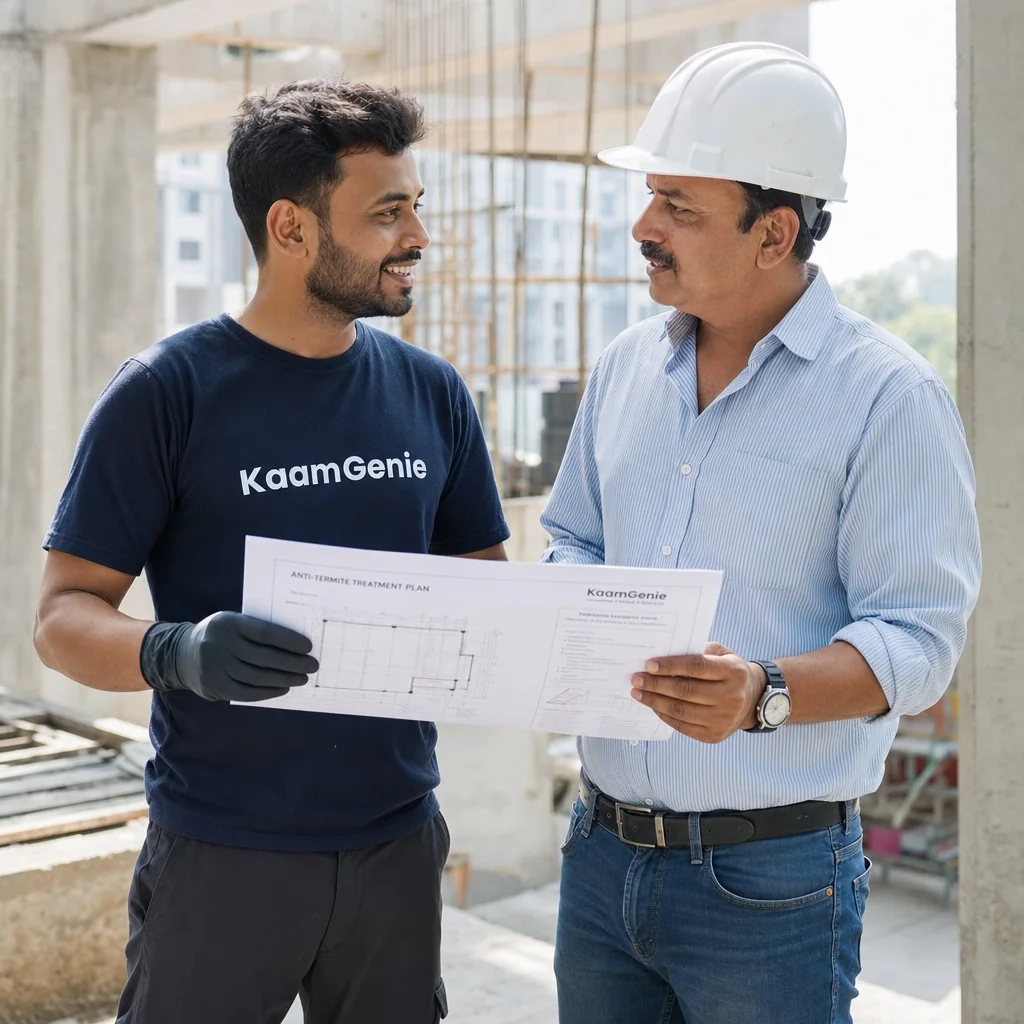
- Site visit + scope. We meet the structural engineer, walk the foundation drawing, identify which sections of the foundation pit are being treated when, and align with the concrete pour schedule.
- Step 1 treatment, staged. Foundation pit treatment usually happens over 2-3 visits across the construction timeline, synchronised with the staged foundation pour. Each visit is documented with photos and CIB&RC chemical batch numbers.
- Step 2 treatment, full ground floor. Plinth-level treatment of the full ground-floor slab area, including all the wall-floor junctions and the stilt parking floor. Larger surface area means longer treatment time — usually a full day.
- Documentation package. A multi-page document showing each treatment date, each chemical batch used (with CIB&RC numbers), photo evidence, structural engineer sign-off, and the 10-year cover terms. This goes into the building completion file and is eventually handed to the RWA / management committee.
Single-tower society pre-construction starts at ₹25,000 for towers up to 50 flats. Multi-tower projects scale roughly linearly. Custom quotes for projects above 5 towers because each project has unique foundation logistics. Site visit is included free of charge for any project quote.
What to put in the builder’s contract
If you’re building through a contractor or builder (most Delhi homeowners do, very few self-manage), the pre-construction termite work has to be in the builder’s contract. Otherwise the builder will quietly skip it. Honest clauses to include:
- Pre-construction anti-termite treatment in accordance with IS 6313 is mandatory. Both Step 1 (foundation pit) and Step 2 (plinth level) to be completed.
- Chemical to be CIB&RC-approved. Specifically chlorpyrifos 1% or imidacloprid 0.075%. Coverage rate of 5 litres per square metre.
- Pest control vendor to be selected by the homeowner (not the builder). Builder is responsible for coordinating site access. Homeowner pays the pest control vendor directly — builder doesn’t take a margin.
- Treatment certificate to be handed to the homeowner within 7 days of each treatment. Photo evidence to be attached.
- 10-year cover document to be included in the building handover file.
- Construction schedule to allow for treatment timing. Step 1 happens between excavation and foundation concrete pour. Step 2 happens between plinth completion and flooring. Builder is responsible for not blocking these windows.
- Penalty for skipping treatment — the cost of subsequent termite damage repair is borne by the builder if it can be shown the original treatment was skipped or under-dosed.
Many Delhi builders will resist clause 3 (homeowner picks the vendor) because they prefer to take a 20-30% margin. Don’t budge. It’s your home and your 10-year cover. The cost difference is the difference between a real treatment and a paper one.
Building a society project? Talk to us about bulk pricing.
Site visit + scope discussion + written quote. From ₹25,000 for a single tower. 10-year cover. Photo documentation included.
Common mistakes builders make
If you’re going to oversee the construction or visit the site weekly, these are the four mistakes to watch for. All four void the IS 6313 standard and weaken or kill the 10-year cover.
Mistake 1 — Skipping Step 2 entirely. The most common cost-cutting move. The builder lets Step 1 happen (because excavation timing makes it visible) but skips Step 2 because flooring goes in fast and no one notices. Plinth-level treatment is then quietly omitted. Without Step 2 the chemical barrier has gaps along the wall-floor junctions, which is exactly where termites enter from above-soil. Show up on plinth completion day. Demand the treatment.
Mistake 2 — Wrong chemical or under-dose. Cheap unorganised-market chemicals get substituted for CIB&RC-approved ones. Or the IS 6313 5-litre-per-sqm coverage rate gets dropped to 3 litres to save chemical cost. Both produce a treatment certificate that looks legitimate but has no actual residual life. Insist on CIB&RC numbers on the certificate and on the chemical container being shown to you before treatment starts.
Mistake 3 — Treating the foundation pit AFTER concrete is poured. This is structurally impossible to do correctly but happens occasionally when the schedule slips. The treatment has to happen on the open excavation, not after the foundation. If you arrive on Step 1 day and the concrete is already poured, the work has to be rescheduled for a different layer — or the cover is void.
Mistake 4 — No documentation handed over. Treatment happens, no certificate is given to the homeowner, no cover document is created. Five years later when termites show up, there’s no record. Insist on the certificate within 7 days of each treatment and on the cover document at building handover.
Areas we serve for pre-construction anti-termite in Delhi
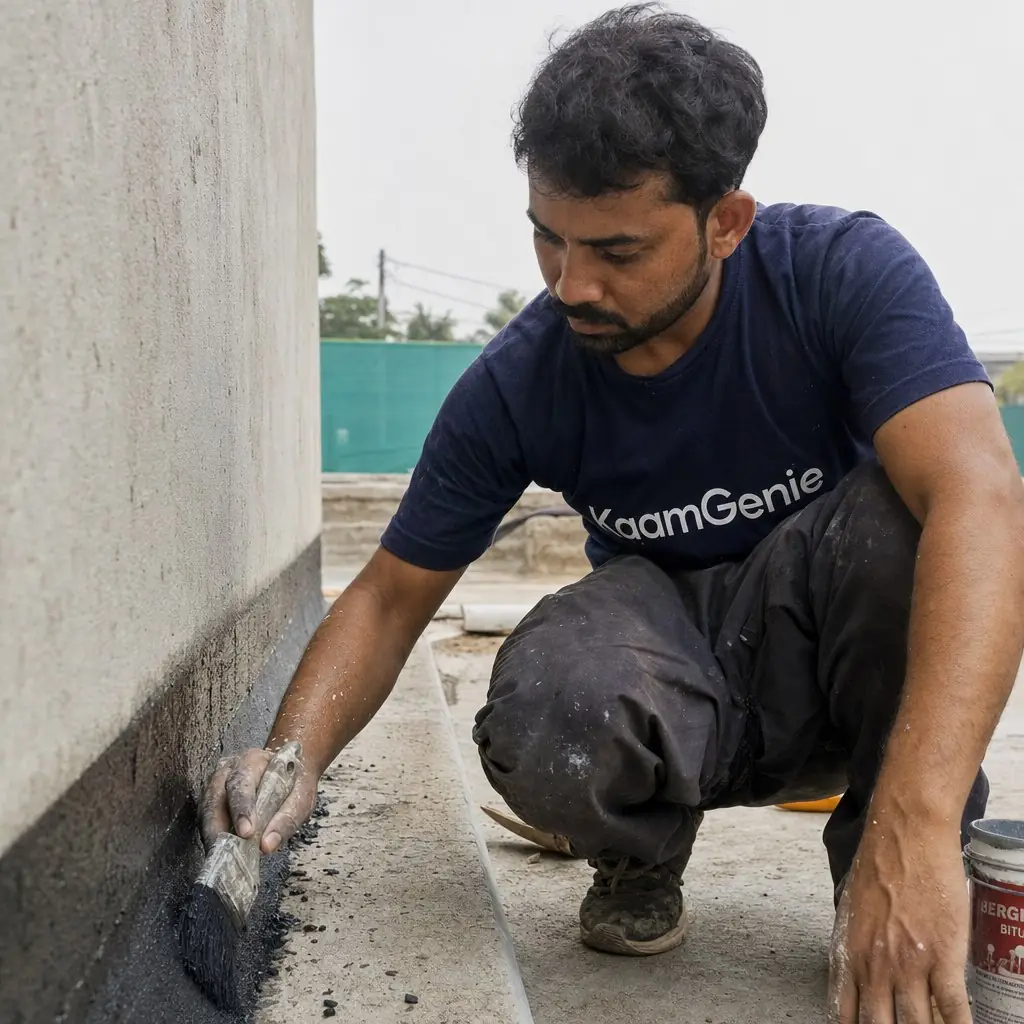
Pre-construction treatment booked for individual homes and society projects across all of Delhi NCR: South Delhi (Vasant Kunj, Defence Colony, GK-1, GK-2, Hauz Khas, Sainik Farms, Chattarpur farmhouses, Khanpur new construction), West Delhi (Dwarka all sectors, Janakpuri new builder floors, Uttam Nagar, Najafgarh), East Delhi (Mayur Vihar Extension, Patparganj new construction, Pandav Nagar), Central Delhi (Karol Bagh re-build, Pandara Road), North Delhi (Civil Lines new builds, Model Town, Burari), North-West Delhi (Rohini new sectors, Pitampura, Shalimar Bagh). Society projects across NCR — Gurgaon Sector 56-110, Noida Sector 137-150, Greater Noida, Faridabad new sectors, Ghaziabad NH-24 corridor.
Frequently asked questions
How much does pre-construction anti-termite cost in Delhi?
Up to 1,500 sqft plot ₹5,999. 1,500-2,500 sqft ₹8,999 (typical Vasant Kunj or Dwarka kothi). 2,500-4,000 sqft ₹12,999 (Defence Colony, GK-1). 4,000-6,000 sqft ₹17,999. Society single tower from ₹25,000. Both steps included in the price. GST 18% extra.
When in the construction timeline do we do it?
Two steps. Step 1 (foundation pit treatment) happens after excavation is complete and before the foundation concrete is poured. Step 2 (plinth-level treatment) happens after the plinth beam is cast and before the ground floor flooring is laid. Missing either step weakens the barrier and voids the cover.
Is the 10-year cover real or marketing talk?
Real. It’s a structural re-treatment cover — if termite activity shows up in treated zones within 10 years, we re-treat the affected zone free with original chemicals at the original IS 6313 coverage rate. Documentation is signed at handover. Cover is transferable to a new homeowner if you sell within 10 years.
What chemicals are used for pre-construction termite?
Two CIB&RC-approved options. Chlorpyrifos 1% emulsion in water — the IS 6313 reference standard, used in most Delhi homes for 40 years, well-documented 10-year residual life. Imidacloprid 0.075% — modern lower-toxicity alternative, about 15-20% more expensive, used when the homeowner specifically requests or near a water body, school, or organic garden.
Do builders cover this or is it homeowner’s job?
Builders rarely include pre-construction termite in the base contract. The homeowner has to either negotiate it into the builder’s scope or hire the pest control vendor directly during construction. We recommend the homeowner hires us directly — the builder coordinates site access but doesn’t take a margin, and the 10-year cover is in the homeowner’s name.
Can we skip pre-construction and do post-construction instead?
Technically yes, but it’s 4x-80x more expensive over the home’s life. Pre-construction at ₹5,999-12,999 vs post-construction termite damage repair at ₹25,000-5,00,000 depending on when the damage shows up. Skip only if the construction is already past the plinth stage and Step 2 is no longer possible.
Does pre-construction work for builder floors / apartments?
Yes for the ground floor and lower stilt. Upper floors are protected indirectly by the chemical envelope below. For builder floors specifically, all units share the foundation barrier — meaning each unit owner benefits from the original pre-construction treatment. The treatment is paid for once by the builder and amortised across units.
What documentation do we get?
Treatment certificate for each step (Step 1 + Step 2) within 7 days of completion, with chemical name + CIB&RC registration number + plot dimensions + technician signature. 10-year structural cover document at building handover. Photo evidence of treatment. All of this goes into your building completion file.
Can we hire you directly instead of going through the builder?
Yes — in fact we recommend it. Homeowner contracts directly with KaamGenie. Builder coordinates site access (foundation excavation timing, plinth completion timing) but doesn’t take a margin. Treatment certificate and 10-year cover are issued in the homeowner’s name. This is the standard pattern for individual Delhi kothis.
What if the construction is already 6 months in — too late?
Depends on the stage. If Step 1 is missed (foundation pit already concreted) but flooring is not yet laid, we can still do Step 2 for partial coverage at reduced rates — cover becomes 5-7 years instead of 10. If both windows are gone, we move you to post-construction termite treatment — possible but significantly more expensive and the cover terms change.
Pre-construction termite done right in Delhi
2-step protocol. 10-year structural cover. CIB&RC chemicals. From ₹5,999 for individual homes.
Sources & references
- Central Insecticides Board & Registration Committee (CIB&RC) — the Indian regulator that approves chlorpyrifos and imidacloprid for pre-construction anti-termite use, with registration numbers quoted on every treatment certificate.
- Bureau of Indian Standards (BIS) — publishes IS 6313, the Indian Standard for anti-termite measures in buildings. The 2-step protocol, the 5 litre per square metre coverage rate, and the chemical concentrations referenced throughout this guide come from IS 6313.
- New Building Materials & Construction World — trade publication that has published multiple field studies on pre-construction termite treatment outcomes in Indian metros over the past two decades.
Last verified: 7 June 2026. If you find any of these links broken, please let us know.