
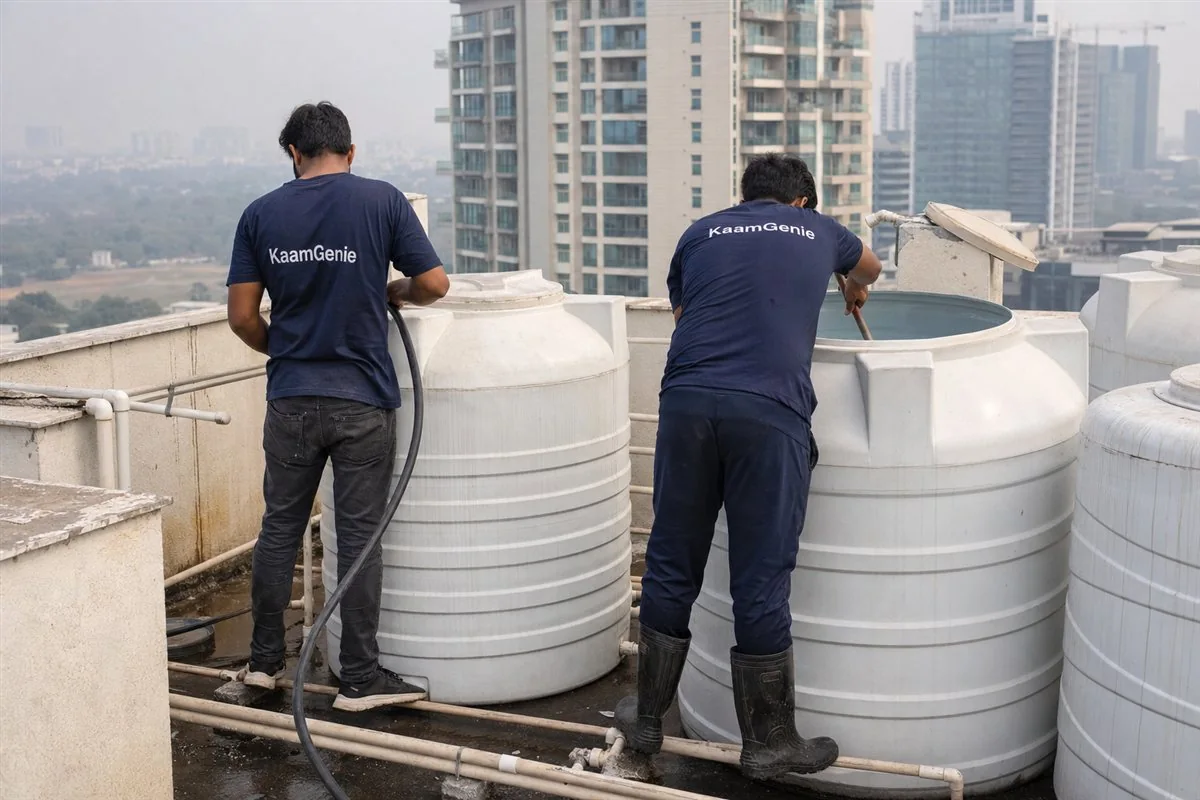
The short version for Golf Course Road residents & AOAs
- A premium address doesn’t mean clean tanks — the same hard borewell and tanker water sits in storage, just at larger scale.
- Condominiums here use a large basement reservoir (UGR) feeding rooftop tower tanks — the whole chain must be cleaned, not just the top.
- Hard borewell water scales walls and fittings fast, and scale is where bio-film grips.
- The common tank farm is an AOA / facility-management responsibility — usually an annual or twice-yearly contract with per-tank certificates.
- Single tank from ₹699 onwards; condominium / UGR / multi-tower work is quoted custom after a quick survey.
If your tower’s water leaves a grey film in the geyser or a faint smell at the tap, the tank farm isn’t on a real schedule — however premium the lobby looks.
| Factor | Why it matters on Golf Course Road / DLF Phase 5 | What it means for cleaning |
|---|---|---|
| Tall condominium towers | High-rise blocks store large volumes high above the flats | Big rooftop tower tanks; access & safety planning |
| Large basement reservoirs (UGR) | One sump feeds many tower tanks across the block | Clean the whole chain, not just the top tank |
| Hard borewell + tanker supply | High calcium/magnesium; little surface-water dilution | Faster scale; clean every 4–6 months |
| AOA-managed common areas | Tank farm is shared, audited and on a contract | Per-tank certificates + consolidated report |
| Premium resale & rental market | Discerning buyers and corporate tenants ask about water | Documented schedule as a trust signal |
Book a clean for your Golf Course Road tower
Single flat or whole condominium — basement reservoir and rooftop tower tanks, staged with certificates. Single tank ₹699 onwards; society custom.
Premium address, ordinary water: the Golf Course Road reality
Golf Course Road is the spine of premium Gurgaon. Running from the Sikanderpur end down past DLF Phase 5, it’s lined with marquee condominium towers, manicured podiums, valet parking and maintenance charges that would make most of Delhi wince. It is, by any measure, one of the most expensive places to live in the country.
And yet the water that arrives in those towers is the same water the rest of Gurgaon drinks: hard borewell groundwater, topped up by water tankers, with very little soft municipal surface water in the mix. That water is stored, often for a day or two, in large basement reservoirs and rooftop tower tanks before it ever reaches a tap. Storage is exactly where the trouble starts — sediment settles, hard-water scale builds, and bio-film forms on the walls. A premium address does nothing to change that chemistry. If anything, the bigger the building, the more water is sitting in storage, and the more there is to keep clean. This is the gap our water tank cleaning in Gurgaon team is called in to close, tower after tower along this corridor.
The basement-to-rooftop chain: clean the whole thing or nothing
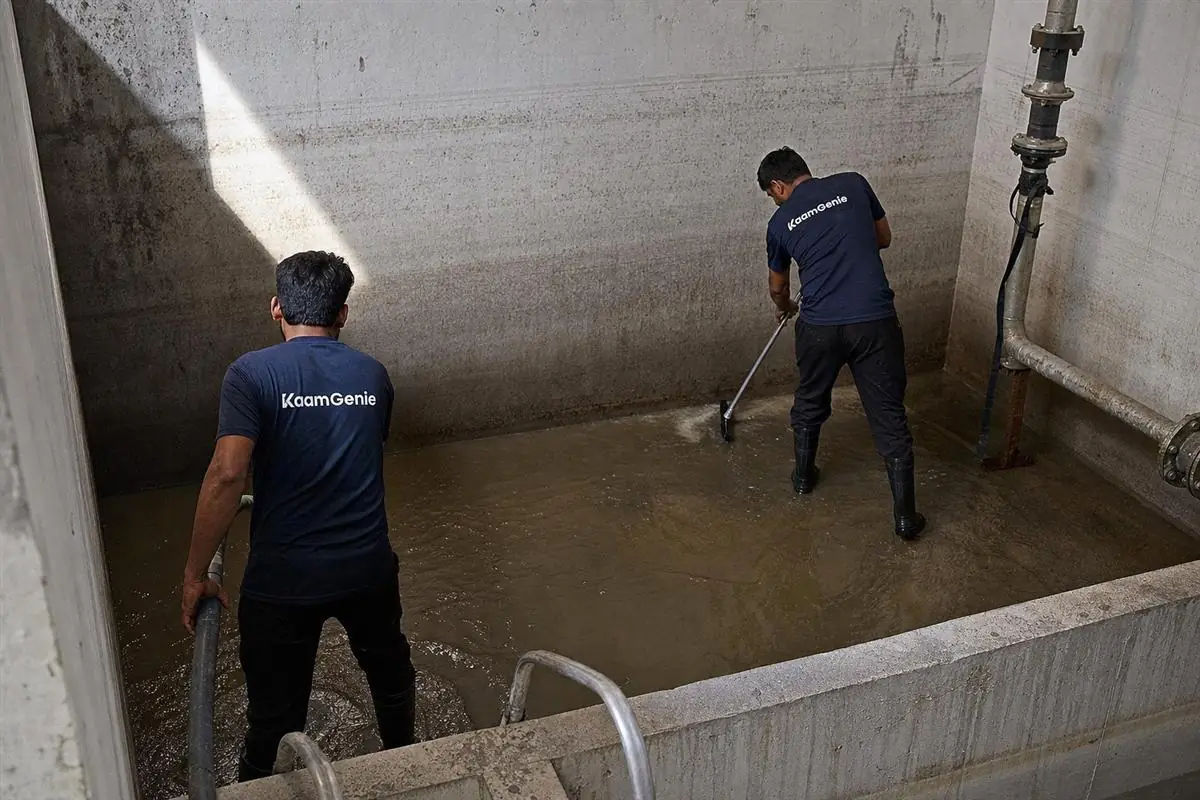
Almost every condominium on Golf Course Road uses the same water arrangement, and it’s worth understanding because it changes what a real cleaning looks like. Tanker or borewell water first fills a large underground reservoir (UGR) — a big concrete sump in the basement. Pumps then lift that water all the way up to rooftop tower tanks sitting high above the flats, and from there gravity feeds it down to each unit.
It is a chain, and the single most common mistake we see — even in expensive buildings — is cleaning only the rooftop tank because it’s the one people think of. That doesn’t work. The basement UGR is the first point of storage, which makes it the dirtiest link: it collects the heaviest grit and sediment, and every pump cycle lifts whatever is sitting down there straight up into the rooftop tanks. If the sump stays dirty, the freshly cleaned tower tank is re-contaminated within days. A proper job cleans the full chain — basement reservoir, any intermediate tanks, and the rooftop tower tanks — in the right order. For the way we sequence shared, multi-tank buildings, our guide to society water tank cleaning in Gurgaon walks through the staging in detail, and our piece on the big DLF condominium tank farms covers the access and documentation side for large complexes specifically.
Hard borewell water: the premium-corridor multiplier
Golf Course Road doesn’t escape Gurgaon’s water hardness just because the postcodes are expensive. The corridor leans heavily on borewell groundwater and tankers, and both are hard — loaded with dissolved calcium and magnesium, with almost no soft surface water to dilute them.
Hard water leaves a white-grey scale on every surface it touches: tank walls, float valves, inlet fittings, the inside of distribution pipes. In a soft-water area that buildup is slow; here it is fast, and it causes two problems. First, scale narrows fittings and jams ball valves over time. Second — and this is the part that matters most — scale is a rough, porous surface, and that roughness is exactly where bio-film clings and grows. A scaled tank gets dirty again far quicker than a smooth one, which means a premium tower on hard water genuinely needs a more frequent, more thorough schedule than an annual token clean. We go into the chemistry and the right cleaning approach in our piece on hard water tank cleaning in Gurgaon. The practical takeaway for Golf Course Road: treat twice a year as a floor, not a ceiling.
What we actually find in a Golf Course Road tank
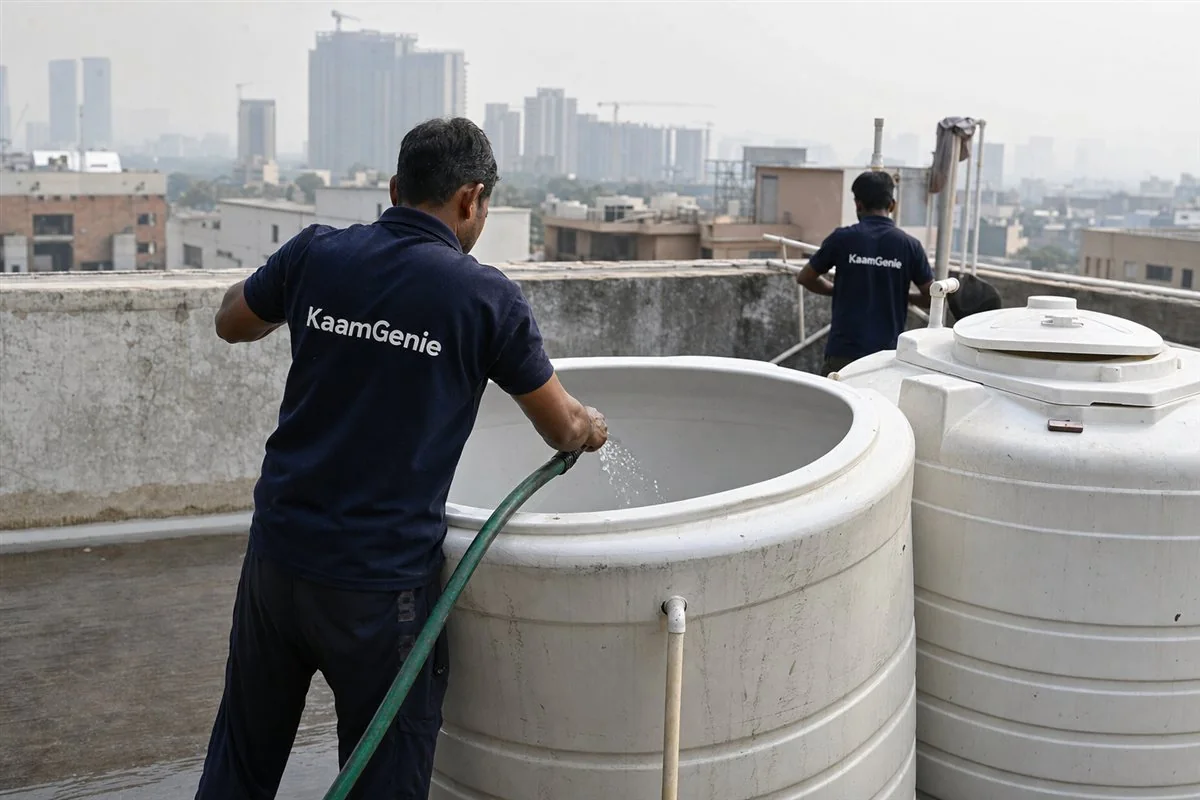
Residents are often genuinely surprised by the before-photos, because the water looked clear coming out of the tap and the building looks immaculate. What comes out of a neglected premium tank is the same as anywhere else, just more of it: hard-water scale flaking off the walls, a layer of fine grey-brown sediment on the floor of the UGR, bio-film in the corners and around fittings, and the occasional surprise around a poorly sealed lid. The chart below is a rough breakdown of what we typically remove from a condominium tank that hasn’t been on a real schedule — by relative volume, not weight.
Neglected condominium tank — what comes out, by relative volume
Hard-water scale and fine sediment dominate; the rest is the long tail
Indicative composition from cleans we’ve done across Golf Course Road and DLF Phase 5 condominiums — not a measured study. Exact mix varies by building, supply source and how long the tank has gone uncleaned.
AOA contracts: who owns the tank farm
In a managed condominium, the basement reservoirs and rooftop tower tanks are common property, and that means they’re the responsibility of the AOA (Apartment Owners Association) or the facility-management agency it appoints. Individual flats on Golf Course Road rarely have their own tank — the supply is shared — so for most residents the cleaning is something that should be happening quietly in the background as part of maintenance. The question worth asking your AOA or FM team is simple: when was the UGR last cleaned, and is there a certificate?
For an AOA managing several towers, the sensible setup is a single contract covering the whole tank farm, with each tank on a schedule and each clean documented separately. We survey the site, give a per-tank schedule and one consolidated quote, then stage the work tank by tank and tower by tower so no block loses supply for long. Every tank gets its own certificate and before/after photos, and the society gets a consolidated report for its records, for resident queries and for any audit. Many condominiums fold this into an annual arrangement — our water tank cleaning AMC in Gurgaon page covers exactly how that works, and what a good contract should include.
The premium-buyer trust angle
There’s one more reason this matters on Golf Course Road specifically, and it’s a commercial one. The buyers and corporate tenants who pay these prices are discerning, and water quality is increasingly something they ask about. A documented cleaning schedule with per-tank certificates is a quiet but real trust signal — it says the building is run properly, all the way down to the basement sump. Grey residue in a geyser, a faint smell at the tap, or scale on the bathroom fittings does the opposite: it chips away at the premium an address is supposed to command. Clean, certified tanks aren’t a luxury add-on here. They’re part of what justifies the postcode.
Where we work on this corridor
We clean tanks right across the Golf Course Road belt and the neighbourhoods that hang off it. Whether you’re in a tower on Golf Course Road itself, in DLF Phase 5, in the Sushant Lok II pockets, or just across into DLF Phase 4 and Golf Course Extension Road, we cover you with the same trained crew and the same fixed, written pricing. For the full picture of what we do across the city — residential, society, UGR, commercial — start at the hub for water tank cleaning in Gurgaon, or see the wider NCR water tank cleaning services page.
Get a survey for your condominium’s tank farm
Basement UGR + rooftop tower tanks, staged tower by tower, per-tank certificates. One consolidated quote for the AOA. Book a free survey across Golf Course Road & DLF Phase 5.
Premium address, premium water — keep it that way
A flat on Golf Course Road is one of the best addresses in Gurgaon, and the water system is the one part of it that touches your household every single day. Getting it right is straightforward: clean the whole chain — basement reservoir and rooftop tower tanks — properly, then keep it on a sensible schedule against the hard-water reality of the corridor, with a certificate for every tank. Whether you’re an owner asking your AOA the right questions or an FM team running several towers, start at the hub for water tank cleaning in Gurgaon and we’ll take it from there — survey, fixed quote, certificates, done.
To book, call +91 95603 66362 or use the booking form on this site — we’ll confirm shortly.
Frequently asked questions
Why does a premium Golf Course Road condominium still need professional tank cleaning?
A glossy lobby and a high maintenance charge tell you nothing about what is inside the tanks. Golf Course Road towers store the same hard borewell and tanker water as the rest of Gurgaon, in basement reservoirs and rooftop tower tanks that collect sediment, scale and bio-film exactly like any other tank. The only difference is scale — there is more storage, feeding more flats. Premium does not mean self-cleaning; it means there is more water sitting in storage that needs a proper schedule.
How does the basement UGR-to-tower-tank system work in a Golf Course Road high-rise?
Almost every condominium on this corridor uses the same arrangement: tanker or borewell water fills a large underground reservoir (UGR) in the basement, pumps lift it to rooftop tower tanks high on the building, and gravity then feeds the flats. It is a chain. The basement UGR is the first point of storage and collects the heaviest grit, so cleaning only the rooftop tank while the basement sump stays dirty just pumps contamination straight back up. A real clean does the whole chain in the right order.
Who is responsible for tank cleaning in a DLF Phase 5 or Golf Course Road condominium — the resident, RWA, or AOA?
In a managed condominium the common basement reservoirs and rooftop tower tanks are the responsibility of the AOA (Apartment Owners Association) or the facility-management agency it appoints, usually on an annual or twice-yearly contract. Individual flats rarely have their own tank in these towers, so for residents the cleaning is built into maintenance. We work directly with AOAs and FM teams on the common tank farm, and with individual owners in low-rise or builder-floor pockets who do have a private tank.
How does Gurgaon’s hard borewell water affect tanks on Golf Course Road?
Golf Course Road runs largely on borewell groundwater and water tankers, both of which are hard — high in dissolved calcium and magnesium. That hardness deposits as a white-grey scale on tank walls, float valves and inlet fittings, and it builds faster than in soft-water areas. Scale matters for two reasons: it jams fittings, and its rough surface is exactly where bio-film grips. So a scaled premium tank gets dirty again quicker than a smooth one, which is why these towers need a genuinely regular schedule, not an occasional rinse.
How often should a luxury condominium on Golf Course Road clean its tanks?
Twice a year is the sensible baseline for both the basement underground reservoir and the rooftop tower tanks. On hard borewell or tanker-fed supply, or in high-occupancy towers with heavy turnover, every four months is better — especially for the UGR, which is the first point of storage and collects the most sediment. We give each tank its own certificate so the AOA has a clear audit trail and can show residents the schedule is actually being kept.
Will cleaning a multi-tower condominium interrupt our water supply?
We stage the work to keep disruption minimal. In a multi-tower society we clean tank by tank and tower by tower, so only one tank’s supply is down at a time and for the shortest possible window — usually a few hours per tank. We coordinate timing with the FM team, schedule around peak usage where we can, and let residents know in advance. The whole tank farm is never taken offline at once.
Does tank cleaning matter when reselling or renting a premium Golf Course Road flat?
More than most sellers realise. Discerning buyers and corporate tenants on this corridor do ask about water quality, and a documented cleaning schedule with per-tank certificates is a quiet trust signal that the building is properly maintained. Grey residue in geysers or a faint smell from the tap, on the other hand, undermines a premium asking price. A clean, certified tank farm is part of what justifies the address.
What documentation do you provide for AOA records and audits?
Every tank we clean gets its own certificate listing date, tank type and capacity, chemicals used and crew, plus before-and-after photos. For a multi-tower condominium we also provide a single consolidated report covering the whole tank farm, so the AOA has one clean document for its records, for resident queries and for any audit. We use food-grade sodium hypochlorite at the correct concentration for potable water, which the certificate notes.
What does tank cleaning cost for a Golf Course Road flat versus a whole condominium?
A single overhead tank — for example in a low-rise or builder-floor unit with its own tank — starts at ₹699 onwards. Whole-condominium work, with large basement reservoirs, multiple rooftop tower tanks and an AOA contract, is quoted custom after a quick survey, because the price depends on tank count, capacity and access. We give a fixed written quote before starting, so there are no surprises on the invoice.
Sources & references
- Bureau of Indian Standards (BIS) — IS 10500:2012 is the canonical Indian Standard for drinking water specification, defining acceptable limits for physical, chemical, and biological parameters.
- WHO Guidelines for Drinking-water Quality, 4th edition — the global reference for water quality standards, including guidance on storage and disinfection.
- Food Safety and Standards Authority of India (FSSAI) — defines water quality requirements for food businesses, including hygiene standards for stored water and acceptable disinfection chemicals.
- WHO Fact Sheet on Drinking Water — overview of safe drinking water requirements and contamination risks.
- CPHEEO — Manual on Water Supply and Treatment — the Government of India’s engineering manual covering tank design, cleaning protocols, and disinfection practices.
Last verified: 29 June 2026. If you find any of these links broken, please let us know.