
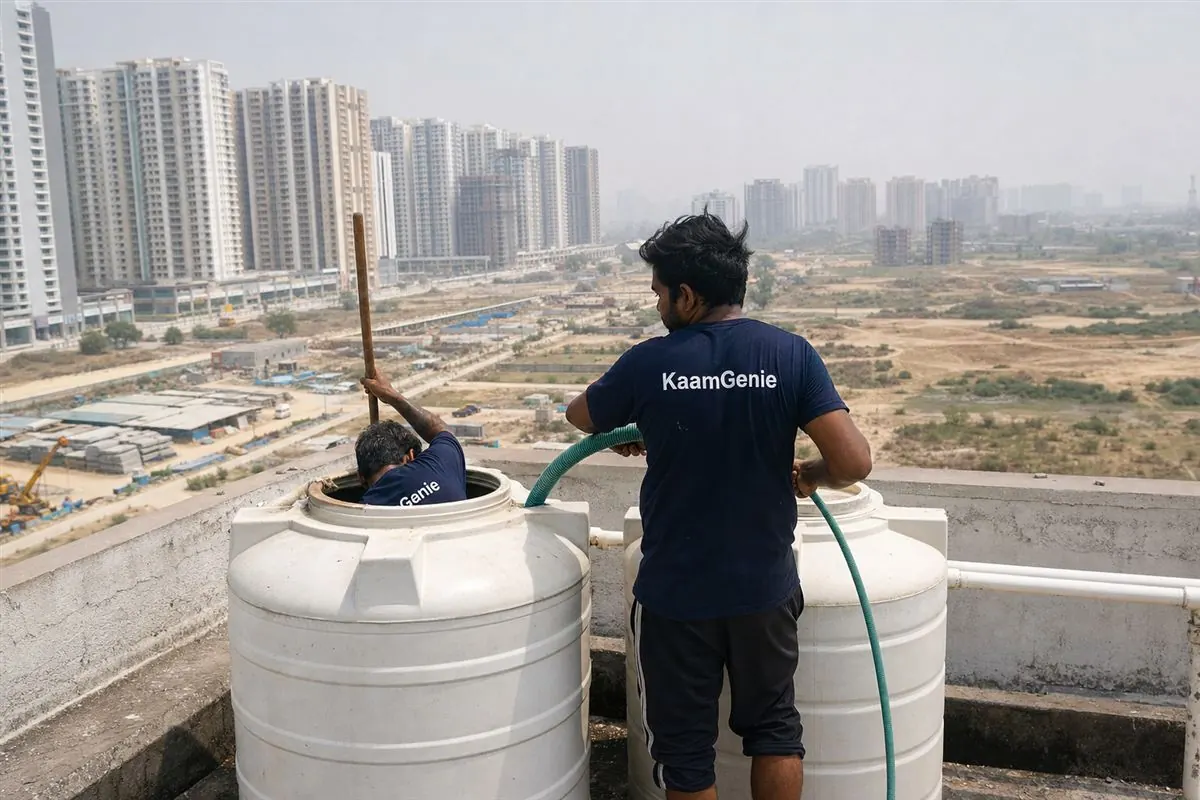
The short version for New Gurgaon residents & AOAs
- New Gurgaon is Sectors 76 to 95 — mostly fresh-possession high-rises whose tanks have rarely had a proper clean.
- Newly handed-over towers carry construction debris — cement slurry, sand, pipe shavings — in their tanks. The first clean is the most important one you’ll ever book.
- The belt runs on hard borewell water and tankers, so scale builds fast on tank walls and fittings.
- Each tower uses a large underground reservoir (UGR) feeding rooftop tower tanks — clean the whole chain, not just the top tank.
- Single flat from ₹699 onwards; society / UGR / multi-tower work is quoted custom after a quick survey.
If your brand-new flat’s water smells faintly of cement or leaves a grey film in the kettle, the tank was put into use without a first clean. That’s fixable in one visit.
| Factor | Why it matters in New Gurgaon | What it means for cleaning |
|---|---|---|
| Fresh-possession towers | Sectors 76–95 are mostly 1–4 years old; tanks sat open through construction | Heavy first clean for builder debris |
| Hard borewell + tanker supply | High calcium/magnesium; little surface-water dilution | Faster scale; clean every 4–6 months |
| UGR-to-tower tank chains | One large sump feeds many rooftop tanks across the tower | Clean the whole chain, not just the top |
| Large society blocks | Hundreds of flats per tower; high water turnover | Tower-by-tower staging to keep supply on |
| AOA-managed common areas | Tank farm is shared, audited, and on a contract | Per-tank certificates + consolidated report |
Book the first clean for your New Gurgaon tower
New flat in Sector 82, 86 or anywhere across 76–95 — the first clean removes builder debris before you drink the water. Single flat ₹699 onwards; society custom.
What we mean by “New Gurgaon”
When people say New Gurgaon, they usually mean the band of sectors numbered roughly 76 to 95 — the planned high-rise zone that sits along the Dwarka Expressway fringe and runs into the Southern Peripheral Road (SPR) belt. Think Sector 82, Sector 84, Sector 86, Sector 89, Sector 92, and the clusters around them. Unlike the older DLF colonies and Golf Course Road condominiums, this is almost entirely new construction: integrated townships, builder-developed group housing, and tower after tower handed over within the last few years.
That single fact — newness — changes everything about how the water tanks here behave. The buildings are modern and well-planned, but a tank that was cast or installed during construction and then put straight into service is, in plumbing terms, an unknown quantity. In our day-to-day across the belt, the first question we end up answering for almost every fresh-possession family is the same one nobody asked at handover: has anyone actually cleaned the tanks? That gap is exactly what our water tank cleaning in Gurgaon team is called in to close, tower after tower.
Why the first clean is the most important one you’ll ever book
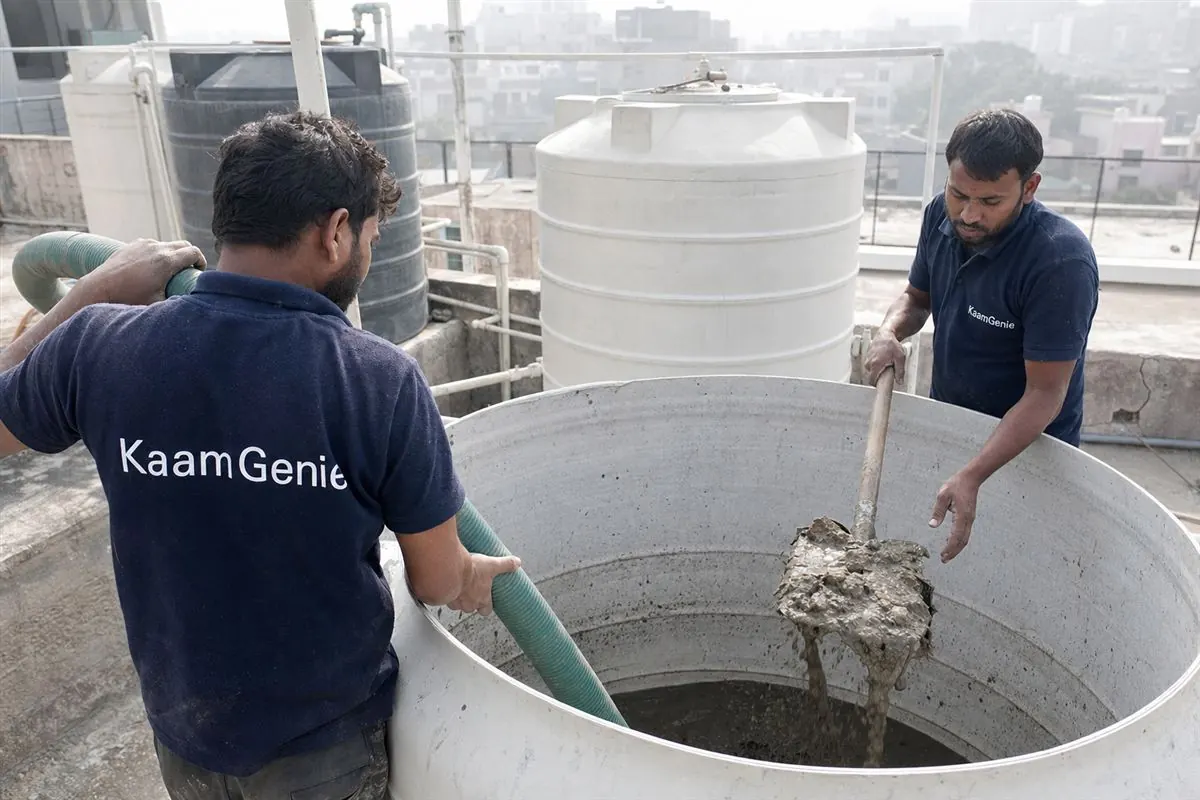
Picture what a tank goes through on a New Gurgaon site. The underground reservoir and the rooftop tanks are built or installed early in the project, and then they sit — often for a year or more — while the structure goes up around them. Through that whole stretch they collect cement and grout slurry, fine stone dust, sand, scraps of plastic packaging, and the shavings and burr left behind when PVC supply lines are cut and joined. When the plumbing is finally commissioned, the very first water pushed through those new pipes flushes even more grit straight down into the tanks.
So the first time a fresh-possession family turns on a tap, they are drawing water that has been resting on a bed of builder debris. That’s why the first clean belongs in a different category from routine maintenance. It is heavier work — more hand-scooping, longer scrubbing to lift cement film off the walls, often a second jet-wash pass — and it is the one clean that sets the baseline for everything after. If you have just taken possession, our dedicated guide to the first water tank cleaning in a new Gurgaon flat walks through exactly what to check before you start drinking the water.
What the construction phase leaves in your tank
People are genuinely surprised by the before-photos, because the water out of the tap looked clear. The thing is, the heavy stuff settles. The clear water sits on top while a grey, gritty layer builds at the bottom of the tank, out of sight until someone opens the lid and shines a torch in. On a New Gurgaon first clean, here’s what we typically find, in rough order of how much there is:
- Cement and grout slurry — the single biggest component, a fine grey sludge that sets into a film on the walls and floor.
- Sand and stone dust — gritty sediment that blows in or washes off the structure during finishing.
- Hard-water scale — already forming, because the tank started filling with borewell water from day one.
- PVC shavings and pipe burr — little plastic curls from cut supply lines, flushed in at commissioning.
- Plastic and packaging bits — whatever blew in while the lids were still off the tank.
None of this is a sign of a bad builder — it is simply what happens to any tank that sees a construction site. What matters is that it gets removed properly, by draining the tank fully, scooping the settled layer by hand, scrubbing, jet-washing and then disinfecting. A cleaner who sprays water in from the top and calls it done has left the worst of it exactly where it sat.
The UGR-to-tower chain: clean the whole thing or nothing
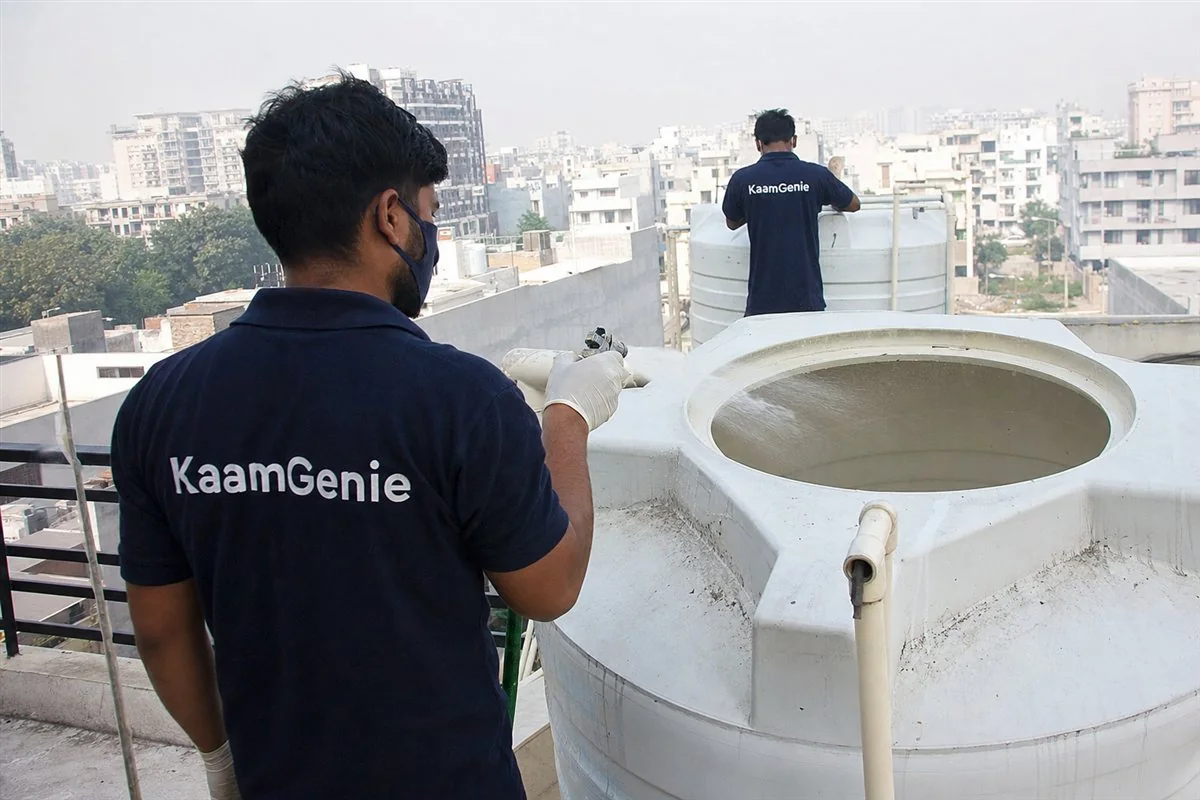
Almost every high-rise in New Gurgaon uses the same arrangement. Tanker or borewell water comes into a big underground reservoir (UGR) — the sump — which is then pumped up to one or more rooftop tower tanks, and from there distributed to the flats. It is a chain, and the most common mistake we see is cleaning only the rooftop tank because it is the visible one.
That approach doesn’t hold. If the UGR below is still sitting on sediment and scale, every pump cycle lifts that contamination straight up into the freshly cleaned rooftop tank, and within days you are back where you started. The UGR is usually the dirtiest link in the chain — it is the first point of storage, the largest volume, and where the heaviest grit settles. A real job cleans the full chain — underground reservoir, any intermediate tanks, and the rooftop tower tanks — in the right order. For shared society tank farms specifically, our society water tank cleaning in Gurgaon guide explains how we sequence multi-tank buildings so no block loses supply for long.
What a first clean actually pulls out
The chart below is a rough breakdown of what we typically remove from a fresh-possession tower’s tanks — by relative volume, not weight. Builder debris dominates; the ordinary sediment you’d expect in an older tank is the small part here.
First clean of a New Gurgaon tower — what comes out of the tank, by relative volume
Builder debris dominates; ordinary sediment is the small part
Indicative composition from first cleans we’ve done across New Gurgaon towers — not a measured study. The exact mix varies by site, finishing quality and how long the tank sat before commissioning.
Hard borewell water: the New Gurgaon multiplier
New Gurgaon doesn’t sit on a generous municipal pipeline the way the older inner sectors do. The 76–95 belt leans heavily on borewell groundwater and on water tankers, and both are hard — loaded with dissolved calcium and magnesium, with very little soft surface water to dilute them.
Hard water leaves a white-grey scale on everything it touches: tank walls, float valves, inlet fittings, the inside of pipes. In a soft-water area that buildup is slow. Here it is fast, and it does two things you don’t want. First, scale narrows fittings and jams ball valves over time. Second — and this is the real problem — scale is a rough surface that bio-film grips onto, so a scaled tank gets dirty again much quicker than a smooth one. We cover the chemistry and the right cleaning approach in detail in our piece on hard water tank cleaning in Gurgaon. The practical takeaway for a New Gurgaon tower: the twice-a-year schedule a brochure suggests is a floor, not a ceiling, and on heavy borewell supply every four months is closer to right.
Get a survey for your society’s tank farm
UGR + rooftop tower tanks, staged tower by tower, per-tank certificates. One consolidated quote for the AOA. Book a free survey anywhere across New Gurgaon.
Whose job is it after handover: builder vs AOA
There is a handover moment in every New Gurgaon society that quietly changes who is responsible for the tanks. While the project is still under the builder’s facility-management team, they own the cleaning of the common tank farm — in theory. Once the AOA (Apartment Owners Association) is formed and takes over the common areas, the underground reservoir and the tower tanks become a society responsibility, and that is usually when a proper, written contract gets put in place.
For an AOA managing several towers — very common across the 82–92 pockets — the sensible setup is a single contract covering the whole tank farm, with each tank on a schedule and each clean documented separately. We survey the site, give a per-tank schedule and one consolidated quote, then stage the work tower by tower so no block loses supply for long. Every tank gets its own certificate and before/after photos, and you get a consolidated report for the society records and any future audit. Many societies fold this into an annual arrangement — our water tank cleaning AMC in Gurgaon page covers how that works. For a wider tour of the new-tower belt and the Dwarka Expressway corridor specifically, see our companion guide on water tank cleaning on Dwarka Expressway.
Where we work across New Gurgaon
We clean tanks across the whole 76–95 corridor and the connecting sectors, with the same trained crew and the same fixed pricing. If you’re on the SPR side in Sector 82, deeper into the new belt in Sector 86, or anywhere across the wider New Gurgaon township pockets, we cover you. For the full picture of services across the city — residential, society, UGR, commercial — start at the hub for water tank cleaning in Gurgaon, and the wider NCR water tank cleaning services page.
New tower, clean water — start it right
A high-rise in New Gurgaon is a serious investment, and the water system is the one part of it that touches your family every single day. The good news is that getting it right is simple: book a proper first clean of the whole tank chain, then keep it on a sensible schedule against the hard-water reality of the belt. Whether you’re a single owner who just took possession or an AOA running half a dozen towers, start at the hub for water tank cleaning in Gurgaon and we’ll take it from there — survey, fixed quote, certificates, done.
To book, call +91 95603 66362 or use the booking form on this site — we’ll confirm shortly.
Frequently asked questions
Which sectors count as New Gurgaon, and why is tank cleaning different there?
New Gurgaon broadly covers Sectors 76 to 95 along the Dwarka Expressway fringe and the Southern Peripheral Road belt — areas like Sector 82, Sector 84, Sector 86, Sector 89 and Sector 92. Almost all of this is brand-new high-rise stock handed over in the last few years. That newness is exactly why cleaning is different: the tanks have rarely had a proper first clean, they carry construction debris, and they run on hard borewell and tanker water that scales fast.
We just got possession in Sector 82 — should we clean the tank before moving in?
Yes. A first clean before you start drinking, cooking and bathing is the single most useful thing on a fresh-possession checklist. Through construction the underground reservoir and rooftop tanks sit open for months collecting cement slurry, sand and pipe debris, and the plumbing is flushed into them when it is first commissioned. One proper clean clears all of that and gives you a known-clean baseline from day one.
What construction debris actually ends up in a brand-new tower’s tanks?
More than people expect. The main culprits are cement and grout slurry, fine stone dust and sand, PVC pipe shavings and burr from cutting supply lines, and bits of plastic packaging that blow in while the tank lids are still off. On top of that, fresh concrete leaches a fine alkaline powder for months. All of it settles at the bottom of the tank as a grey, gritty layer that a top rinse cannot reach.
Why is the first clean heavier and sometimes pricier than a routine clean?
Because we are removing builder debris, not just a year of ordinary sediment. A first clean usually needs more hand-scooping of slurry, longer scrubbing to lift cement film off the walls, and often a second jet-wash pass before disinfection. That extra time and effort is why a first clean is sometimes a little above the standard residential rate. After it is done, a normal twice-a-year schedule keeps the tank in good shape.
How does New Gurgaon’s hard borewell and tanker water affect our tanks?
New Gurgaon leans heavily on borewell groundwater and water tankers, and both are hard — high in dissolved calcium and magnesium. That hardness deposits as white-grey scale on tank walls, float valves and inlet fittings, and it builds far faster than in soft-water areas. Scale also gives bio-film a rough surface to grip, so a scaled tank gets dirty again quicker. Hard-water towers genuinely need more frequent, more thorough cleaning than a builder brochure suggests.
Do you clean the underground reservoir as well as the rooftop tower tanks?
Both, and that matters. A typical New Gurgaon tower runs tanker or borewell water into a large underground reservoir (UGR), pumps it up to rooftop tower tanks, then distributes to flats. We clean the full chain because cleaning only the rooftop tank while the UGR below stays dirty just re-contaminates the clean water on the next pump cycle. The UGR is usually the dirtiest link, so it gets the most attention.
How often should a New Gurgaon high-rise be cleaned after the first clean?
Twice a year is the sensible baseline for both the underground reservoir and the rooftop tower tanks. On hard borewell or tanker-fed supply, or in high-occupancy towers with heavy water turnover, every four months is better. We give each tank its own certificate and before/after photos so the AOA or owner has a clear record of when each tank was last done.
Who is responsible for the tank cleaning — the builder, the AOA, or me?
It depends on the stage. While the project is still under the builder’s facility-management team, they are responsible for the common tank farm. Once the AOA (Apartment Owners Association) takes over the common areas, the underground reservoir and tower tanks become a society responsibility, usually on an annual or twice-yearly contract. An individual flat tank, if you have one, is yours. We handle both single-flat first cleans and full society contracts.
What does it cost for a single flat versus a whole tower in New Gurgaon?
A single flat’s overhead tank starts at ₹699 onwards, with the first clean sometimes slightly higher because of the extra debris removal. Whole-tower and society work — large underground reservoirs, multiple rooftop tanks, AOA contracts — is quoted custom after a quick survey, because it depends on tank count, capacity and access. We give a fixed written quote before starting, so there are no surprises on the invoice.
Sources & references
- Bureau of Indian Standards (BIS) — IS 10500:2012 is the canonical Indian Standard for drinking water specification, defining acceptable limits for physical, chemical, and biological parameters.
- WHO Guidelines for Drinking-water Quality, 4th edition — the global reference for water quality standards, including guidance on storage and disinfection.
- Food Safety and Standards Authority of India (FSSAI) — defines water quality requirements for food businesses, including hygiene standards for stored water and acceptable disinfection chemicals.
- WHO Fact Sheet on Drinking Water — overview of safe drinking water requirements and contamination risks.
- CPHEEO — Manual on Water Supply and Treatment — the Government of India’s engineering manual covering tank design, cleaning protocols, and disinfection practices.
Last verified: 29 June 2026. If you find any of these links broken, please let us know.